Retro Television Review: Miami Vice 4.12 “The Cows of October”


Welcome to Retro Television Reviews, a feature where we review some of our favorite and least favorite shows of the past!  On Mondays, I will be reviewing Miami Vice, which ran on NBC from 1984 to 1989.  The entire show can be purchased on Prime!

This week …. I don’t even know how to describe it.

Episode 4.12 “The Cows Of October”

(Dir by Vince Gillum, originally aired on February 5th, 1988)

A cannister of bull seamen has been stolen from a Miami lab and the feds (represented by Harry Shearer) want it back before it falls into the hands of the Cubans.  Switek assists.  Izzy shows up to broker the deal.  Gerrit Graham plays a shady person who we are told is from Texas.  (His accent is more Arizona.)  Philip Michael Thomas wears a cowboy hat.  Don Johnson is largely absent until the final scene.  One gets the feeling that Johnson hated every minute of this episode while Thomas just seemed to be having fun.

This episode was, without a doubt, the stupidest episode of Miami Vice ever filmed.  And listen, I will admit that I haven’t seen every episode.  I’ve still got a season and a half to go.  There seems to be a general online consensus that the final two seasons of Miami Vice were not good at all.  I’m sure I have many dumb episodes ahead of me.  But I cannot — as much as I try — imagine any episode that could be as a dumb as the Vice Squad abandoning the war on drugs so that they could keep the Cubans from getting their hands on a cannister of bull semen.

Miami Vice has always been as its best when its been surrealistic, cynical, and gritty.  I would argue that Miami Vice really does not need to do comedic episodes.  For the first three seasons, nearly every episode ended with an innocent person either dead or forever embittered.  At its best, Miami Vice was not a happy show.  It was a show where Crockett and Tubbs drove around in the dark, loaded their guns, and Phil Collins sang in the background.  When Collins sang, “I can feel it coming in the air tonight,” he was not talking about bull semen.  At least, I hope he wasn’t.  (Oh, Lord….)

I really don’t know what to make of season 4.  Trudy’s going to space.  Crockett’s married.  The Vice Squad is searching for bull semen.  Yet somehow, through it all, Castillo continues to just stare at the floor and speak through gritted teeth.  Like seriously, shouldn’t Castillo be concerned about all this weird stuff going on?

I didn’t care much for this episode.  Searching for bull semen is a Pacific Blue thing.  Miami Vice needs to handle real cases and leave all that other stuff for the bike cops.

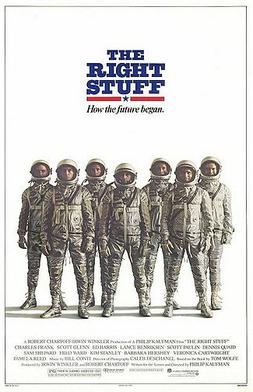
Lisa Marie Reviews An Oscar Nominee: The Right Stuff (dir by Philip Kaufman)


There’s a brilliant scene that occurs towards the end of 1983’s The Right Stuff.

It takes place in 1963.  The original Mercury astronauts, who have become a symbol of American ingenuity and optimism, are being cheered at a rally in Houston.  Vice President Lyndon Johnson (Donald Moffat) stands on a stage and brags about having brought the astronauts to his supporters.  One-by-one, the astronauts and their wives wave to the cheering crowd.  They’re all there: John Glenn (Ed Harris), Gus Grissom (Fred Ward), Alan Shephard (Scott Glenn), Wally Schirra (Lance Henrisken), Deke Slayton (Scott Paulin), Scott Carpenter (Charles Frank), and the always-smiling Gordon Cooper (Dennis Quaid).  The astronauts all look good and they know how to play to the crowd.  They were chosen to be and sold as heroes and all of them have delivered.

While the astronauts are celebrated, Chuck Yeager (Sam Shepard) is at Edwards Air Force Base.  Yeager is the pilot who broke the sound barrier and proved that the mythical “demon in the sky,” which was whispered about by pilots as a warning about taking unnecessary risks, was not waiting to destroy every pilot who tried to go too fast or too high.  Yeager is considered by many, including Gordon Cooper, to be the best pilot in America.  But, because Yeager didn’t have the right image and he had an independent streak, he was not ever considered to become a part of America’s young space program.  Yeager, who usually holds his emotions in check, gets in a jet and flies it straight up into the sky, taking the jet to the edge of space.  For a few briefs seconds, the blue sky becomes transparent and we can see the stars and the darkness behind the Earth’s atmosphere.  At that very moment, Yeager is at the barrier between reality and imagination, the past and the future, the planet and the universe.  And watching the film, the viewer is tempted to think that Yeager might actually make it into space finally.  It doesn’t happen, of course.  Yeager pushes the jet too far.  He manages to eject before his plane crashes.  He walks away from the cash with the stubborn strut of a western hero.  His expression remains stoic but we know he’s proven something to himself.  At that moment, the Mercury Astronauts might be the face of America but Yeager is the soul.  Both the astronauts and Yeager play an important role in taking America into space.  While the astronauts have learned how to take care of each other, even the face of government bureaucracy and a media that, initially, was eager to mock them and the idea of a man ever escaping the Earth’s atmosphere,  Chuck Yeager reminds us that America’s greatest strength has always been its independence.

Philip Kaufman’s film about the early days of the space program is full of moments like that.  The Right Stuff is a big film.  It’s a long film.  It’s a chaotic film, one that frequently switches tone from being a modern western to a media satire to reverent recreation of history.  Moments of high drama are mixed with often broad humor.  Much like Tom Wolfe’s book, on which Kaufman’s film is based, the sprawling story is often critical of the government and the press but it celebrates the people who set speed records and who first went into space.  The film opens with Yeager, proving that a man can break the sound barrier.  It goes on to the early days of NASA, ending with the final member of the Mercury Seven going into space.  In between, the film offers a portrait of America on the verge of the space age.  We watch as John Glenn goes from being a clean-cut and eager to please to standing up to both the press and LBJ.  Even later, Glenn sees fireflies in space while an aborigines in Australia performs a ceremony for his safety.  We watch as Gus Grissom barely survives a serious accident and is only rescued from drowning after this capsule has been secured.  The astronauts go from being ridiculed to celebrated and eventually respected, even by Chuck Yeager.

It’s a big film with a huge cast.  Along with Sam Shepherd and the actors who play the Mercury Seven, Barbara Hershey, Pamela Reed, Jeff Goldblum, Harry Shearer, Royal Dano, Kim Stanley, Scott Wilson, and William Russ show up in roles both small and large.  It can sometimes be a bit of an overwhelming film but it’s one that leaves you feeling proud of the pioneering pilots and the brave astronauts and it leaves you thinking about the wonder of the universe that surrounds our Earth.  It’s a strong tribute to the American spirit, the so-called right stuff of the title.

The Right Stuff was nominated for Best Picture but, in the end, it lost to a far more lowkey film, 1983’s Terms of Endearment.  Sam Shepard was nominated for Best Supporting Actor but lost to Jack Nicholson.  Nicolson played an astronaut.

Horror Film Review: Godzilla (dir by Roland Emmerich)


There’s a giant lizard rampaging through New York, the result of a mutation that happened as a result of being exposed to radiation.  The military tries to stop the lizard but it turns out that stopping a giant lizard is not that easy.  Scientists try to understand the lizard and how it came to be a destructive giant.  The media breathlessly reports from the scene as two wisecracking cameramen do their best to record every second of the mayhem.  The reporters call this lizard …. GODZILLA!

But is it Godzilla?

No, it’s not.  Oh, it may be called Godzilla.  And the movie itself may be called Godzilla.  But the creature at the center of the 1998 American film Godzilla is definitely not Godzilla.

Godzilla was released with a great deal of fanfare in 1998, with commercials and toys and a lot of hype.  Diddy, back when he was still calling himself Puff Daddy, recorded a song for the soundtrack and upset thousands of Led Zeppelin fans like my Dad who found themselves having to deal with kids who thought Kashmir was called Follow Me.  (Diddy singing, “Follow me?”  AGCK!  How cringey is that!?)  But, like many of the film of Roland Emmerich, it’s been almost totally forgotten in the years since.

And why not?  It’s a forgettable film.  It’s the epitome of an assembly-line action blockbuster, the type of thing that Roland Emmerich is known for.  There’s comic relief, in the form of Hank Azaria.  There’s a nerdy scientist hero in the form of Matthew Broderick.  Broderick’s scientist has an ex-wife and yes, Godzilla’s invasion of New York gives them a chance to get back together.  There’s a mysterious Frenchman who is played, somewhat inevitably, by Jean Reno.  The Mayor of New York is a fat guy named Ebert (Michael Lerner) and he has an assistant named Gene (Lorry Goldman) and they get a lot of screentime because Emmerich wanted to make fun of two films critics who didn’t care much for his work.  In fact, the Mayor and his assistant get so much screentime that it distracts from the rest of the film.  Emmerich was directing a multi-million dollar reboot of a beloved franchise and he was more concerned with a petty feud.

He certainly wasn’t concerned with Godzilla.  Personally, I like the giant lizard and one of the only effective moments in the film is when the lizard discovers that its children have been killed by the military.  But that lizard is not Godzilla and the fact that Emmerich made a Godzilla film without Godzilla indicates that he didn’t really care about the monster or its fans.  This film has no love for its source material and that’s a shame.  The Godzilla films are fun!  And the fact that the majority of the ones made up until the release of this film looked kind of cheap and featured a Godzilla who was obviously a man in a rubber suit only added to the fun.  There’s not much fun to be found in this version of Godzilla.  The movie looks great without ever making much of an impression.

And you know what?  Having gotten this review out of the way, I’m ready to get back to reviewing the true Godzilla films.  They may not have cost as much as Emmerich’s film but they’ve got heart.

Previous Godzilla Reviews:

  1. Godzilla, King of the Monsters (1958)
  2. Godzilla Raids Again (1958)
  3. King Kong vs Godzilla (1962)
  4. Mothra vs. Godzilla (1964)
  5. Ghidorah: The Three-Headed Monster (1964)
  6. Invasion of the Astro-Monster (1965)
  7. Godzilla vs. The Sea Monster (1966)
  8. Son of Godzilla (1967)
  9. Destroy All Monsters (1968)
  10. All Monsters Attack (1969)
  11. Godzilla vs Hedorah (1971)
  12. Godzilla vs Gigan (1972)
  13. Godzilla vs Megalon (1973)
  14. Godzilla vs Mechagodzilla (1974)
  15. The Terror of Mechagodzilla (1975)
  16. Cozilla (1977)
  17. Godzilla 1985 (1985)
  18. Godzilla vs. Biollante (1989)
  19. Godzilla vs King Ghidorah (1992)
  20. Godzilla vs. Mothra (1992)
  21. Godzilla vs Mechagodzilla 2 (1994)
  22. Godzilla vs SpaceGodzilla (1994)
  23. Godzilla vs. Destoroyah (1995)
  24. Godzilla, Mothra, and King Ghidorah: Giant Monsters All-Out Attack (2001)
  25. Godzilla (2014)
  26. Godzilla: Planet of the Monsters (2017)
  27. Godzilla, King of the Monsters (2019)
  28. Godzilla vs Kong (2021)
  29. Godzilla Minus One (2023)

Film Review: Prime Time (1977, directed by Bradley R. Swirnoff)


Prime TimeThe great character actor Warren Oates appeared in a lot of fairly obscure movies but none are as obscure as Prime Time.

With a running time of barely 70 minutes, Prime Time is a comedic sketch film that was meant to capitalize on the then-recent success of The Groove Tube, Tunnelvision, The Kentucky Friend Movie, and the first season of Saturday Night Live.  According to the Unknown Movies Page, Prime Time was financed independently and was picked up for distribution by Warner Bros.  After the Warner execs saw the finished film, they decided it was unreleasable so the film’s production team sold the film to Cannon Pictures, who were famous for being willing to release anything.  The movie played in a few cities under the terrible title American Raspberry and then went straight to VHS obscurity.

Sketch comedies are usually hit-and-miss and Prime Time is definitely more miss than hit.  The majority of the film is made up of commercial parodies but, since most of the commercials being parodied are no longer on the air, the humor has aged terribly.  There is also a wrap-around story.  The President (George Furth) and a general (Dick O’Neill) try to figure out where the commercial parodies are coming from and stop them before the broadcast leads to a riot.   There are a few funny bits (including Harry Shearer as a stranded trucker looking for a ride and Kinky Friedman singing a song about “Ol’ Ben Lucas who has a lot of mucus”) but, for the most part, the film is epitomized by a skit where people literally get shit dumped on their head.  The film’s opens with an incredibly racist commercial for Trans Puerto Rican Airlines and it’s all downhill from there.

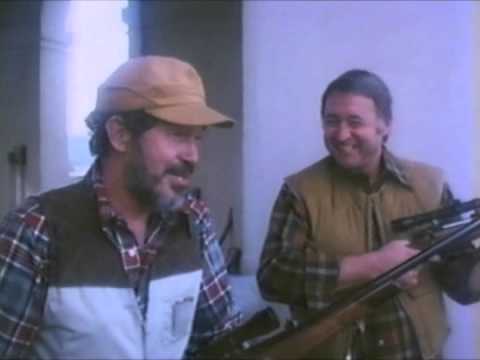
As for Warren Oates, he appears in an early skit.  He and Robert Ridgely (best known for playing Col. James in Boogie Nights) play hunters who take part in the Charles Whitman Celebrity Invitational, climbing to the top of the Tower on the University of Texas campus and shooting at the people below.  It’s even less funny now than it probably was in 1977.

How did Warren Oates end up in a movie like Prime Time?  Even great actors have bills to pay.  As for Prime Time, it is the one Warren Oates film that even the most dedicated Warren Oates fan won’t regret missing.

Warren Oates and Robert Ridgely in Prime Time

Warren Oates and Robert Ridgely in Prime Time

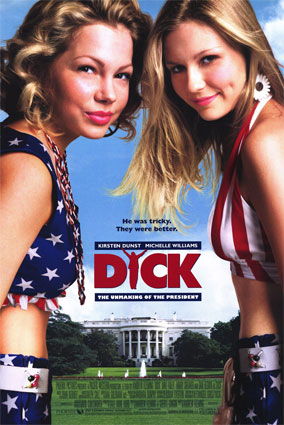
Shattered Politics #64: Dick (dir by Andrew Fleming)


Theatricalposterdick

I wouldn’t necessarily say that I love Dick but I still think it’s a pretty good film.  (Ha ha, see what I did there?)  Of course, to really appreciate this 1999 comedy, it helps to know a little something about political history.  For instance, it helps to know that the Dick of the title is President Richard Nixon (played here by a hilariously paranoid Dan Hedaya).  In 1973, as the result of his attempt to cover up White House involvement of a burglary at the Watergate Hotel, Nixon became the first President to resign from office.

A lot of the credit for Nixon’s downfall was given to two reporters for the Washington Post, Bob Woodward and Carl Bernstein (played, in this film, by Will Ferrell and Bruce McCulloch).  While Woodward and Bernstein investigated the Watergate break-in, they were reportedly fed information by a highly placed informant who was referred to as being Deep Throat.  For years, the identity of Deep Throat was a closely held secret.  Countless books were written that speculated as to who Deep Throat may have been.  (In the film All The President’s Men, he was played by Hal Holbrook.)  Finally, in 2005, it was revealed that Deep Throat was a FBI agent named Mark W. Felt, who was upset because he was passed over for a promotion.

And, quite frankly, that’s kind of a disappointing solution.  When you think about someone who brought down the government, you hope that he or she will turn out to be something more than just a disgruntled employee whose previous work consisted on running counter intelligence operations against domestic political activists.

In fact, it’s hard not to wish that, perhaps, Deep Throat could have been two 15 year-old girls who just happened to stumble across one of the biggest political scandals in American history.

Well, fortunately, this is the theory proposed in Dick.  Betsy (Kirsten Dunst) and Arlene (Michelle Williams) are two friends who, one night in 1972, sneak out of Arlene’s apartment so that they can mail a fan letter to singer Bobby Sherman.  While doing so, they happen to stumble across the Watergate burglars and get a good look at White House aide G. Gordon Liddy (Harry Shearer).

The next day, while on a field trip to the White House, the two girls are spotted by Liddy.  Liddy arranges for them to be pulled to the side and questioned by chief-of-staff H.R. Haldeman (Dave Foley), who determines that the girls barely know who Nixon is and that they don’t understand what they witnessed.  However, before Haldeman can send the girls on their way, Nixon himself enters the office and complains about how poorly planned the break-in was.

This leads to an unlikely relationship between Nixon and Betsy and Arlene.  Hoping to win their loyalty (and their silence), Nixon arranges for them to be his official dog walkers.  Betsy and Arlene, meanwhile, still don’t have the slightest idea of what’s going on.  They accidentally bring pot cookies to the White House (which Nixon particularly enjoys) and Arlene even develops a mad crush on Nixon.

But, of course, Nixon eventually shows his true colors and Betsy and Arlene take down the government….

In many ways Dick is a one-joke film, in which Betsy and Arlene regularly find themselves blissfully unaware while history literally unfolds around them.  But it’s actually a pretty clever joke and it’s also a very plausible one.  People are often unaware that anything important is happening when it’s actually happening.  Often times, it’s only in retrospect that historical moments are seen to be truly historical.  And, ultimately, Watergate itself is such a bizarre scandal that it’s the perfect moment in history to be reinterpreted as a comedy.

Dick is ridiculous enough to be funny but plausible enough to be memorable.