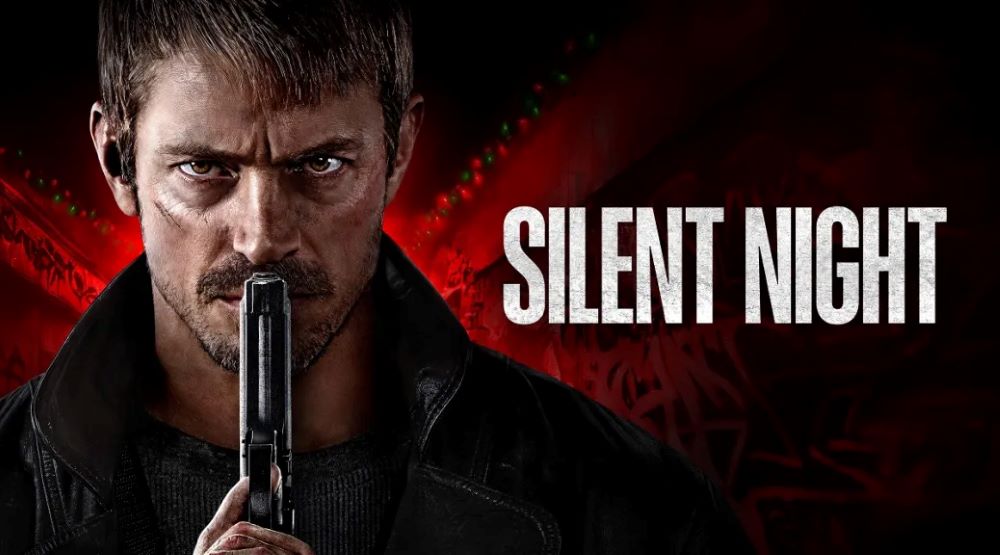
“I can’t speak, but I’ll make them listen.” — Brian Godlock
Silent Night (2023) finds John Woo making his first American action film in two decades, since the disappointing Paycheck in 2003. While it’s definitely a step up from that sci-fi thriller misfire, Silent Night still doesn’t quite reach the heights of Woo’s Hong Kong classics or even his best Western productions like Face/Off. This latest outing is a lean, mostly dialogue-free revenge thriller that has Woo’s fingerprints all over it—a mix of balletic violence and emotional anguish—but it also shows the limitations of trying to recapture that old Woo magic in a very different cinematic landscape.
The story is simple: Joel Kinnaman plays Brian Godlock, an electrician whose son is killed in a gang shootout on Christmas Eve, and he himself is shot in the throat, losing his voice. The film then follows Brian’s quiet but brutal quest for revenge a year later. The choice to tell this nearly wordless story is a bold gamble, and for much of the film, the absence of dialogue adds power to the emotions and the tension. Kinnaman’s physical performance carries most of the weight—his grief, anger, and determination are all conveyed through body language and expression. This is one of the biggest strengths of Silent Night: Woo’s ability to communicate story and feeling visually, which harkens back to the silent films of early cinema, blending with his signature poetic violence.
That said, the silence also highlights the script’s thinness. The supporting characters, including Brian’s wife (Catalina Sandino Moreno) and a sympathetic detective (Kid Cudi), feel underdeveloped, serving more as plot functions than full people. This narrow focus on Brian’s pain and revenge means the film sometimes feels emotionally shallow beyond the core trauma. Compared to Woo’s earlier work, where secondary characters and relationships added layers of complexity and intensity, Silent Night is more singular and direct, for better and worse.
When it comes to action, Woo shows he still has the chops. The gunfights and hand-to-hand scenes are meticulously choreographed, emphasizing realism with a solid dose of stylized flair. It’s a return to the grounded grit Woo displayed in some of his earlier Hong Kong films, leaving behind some of the higher-octane operatic excess of his best-known Hollywood hits. The violence feels impactful and earned, avoiding cheap spectacle for a more tactile, bone-crunching effect.
Still, Silent Night doesn’t quite have the scope and scale of Face/Off or The Killer. It lacks the grandeur and intricate storytelling that made those films iconic. Instead, it’s a tighter, moodier experience that prioritizes emotional atmosphere over plot complexity. This stripped-down approach is refreshing to a degree, but it can also become monotonous—especially since the lack of dialogue and limited character development demand more patience from the viewer.
Comparing it directly to Paycheck, Silent Night is a clear improvement. Paycheck was widely regarded as a forgettable action film that failed to capitalize on Woo’s talents, stuck with a muddled sci-fi plot and lacking the emotional firepower Woo excels at. Silent Night ditches the high-concept sci-fi for a more grounded, personal revenge story, allowing Woo to bring more of his hallmarks to bear—the intense physical performances, a palpable sense of loss, and carefully crafted action sequences.
However, it’s important to temper enthusiasm with the fact that Silent Night is not a full return to Woo’s prime Hong Kong cinema or his best Hollywood days. It’s missing some of the poetry, charm, and iconic bravado of movies like Hard Boiled or Face/Off, where Woo’s characters felt larger than life and the action was operatic and unforgettable. Here, the film often feels restrained, even muted, perhaps reflecting a director adapting to new cinematic expectations but also struggling to fully bring himself back to the forefront in the American industry.
Silent Night is a worthwhile viewing for fans of John Woo and action cinema looking for something different—one part homage to classic revenge tales, one part experiment in silent storytelling. It’s emotionally raw, visually precise, and markedly better than Paycheck, but it also lacks the fire and inventiveness that made Woo a legend. It’s a step forward and a reminder that even the greatest filmmakers can evolve and sometimes falter. If Woo is finding his voice again, it’s decidedly quieter but still unmistakably his own.
 Through the Shattered Lens