The TSL Grindhouse: Mitchell (dir by Andrew V. McLaglen)


I come here to defend Mitchell.

First released in 1975, Mitchell does not have a great reputation.  It’s often described as being one of the worst of the 70s cop films and Joe Don Baker’s performance in the lead role is often held up to ridicule.  A lot of that is due to the fact that Mitchell was featured on an episode of Mystery Science Theatre 3000.  Last year, for my birthday, my friend Pat McCurry actually hosted a showing of the MST 3K version of Mitchell.  I laughed all the way through it.  It was a funny show and most of the jokes uttered by Joel and the Bots landed.  That said, I wish they hadn’t been so hard on Joe Don Baker.  Baker was an outstanding character actor, one whose good ol’ boy persona sometimes kept people from realizing just how fiercely talented he actually was.

Here’s the thing with Mitchell.  Just because a film is snarkable, that doesn’t mean that it’s a bad film.  Just because there are moments in a film that inspire you to talk back to the screen, that doesn’t make it a bad film.  Some of the most enjoyable films that I’ve ever watched were enjoyable specifically because they were made to inspire the audience to talk back to the characters.  Whatever flaws you may want to find in Mitchell, it’s an entertaining film.  The plot may be impossible to follow but who cares?  When you’ve got Joe Don Baker, John Saxon, and Martin Balsam all in the same film, does the plot really matter?

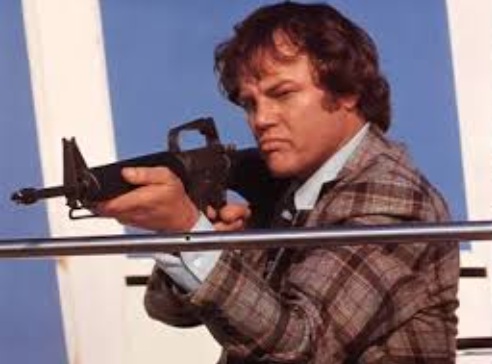
This is a film that you watch for the personalities involved.  Balsam plays a wannabe drug lord who always seems to be somewhat annoyed.  Someone once describes Bernie Sanders as always coming across as if he was about send his meal back to the kitchen because it was too cold and that’s a perfect description of Balsam’s performance in Mitchell.  John Saxon plays a sleazy rich guy who murders a burglar and then tries to cover up his crime.  Saxon is calm, cool, collected, and completely confident that his wealth will get him out of anything.  And then you’ve got Joe Don Baker as Mitchell, wearing an ugly plaid suit, drinking beer the way that I drink Diet Coke, and continually pretending to be dumber than he actually is.  There’s an interesting subtext to these three characters and how they interact.  Saxon and Balsam play criminals who are both rich and who both think they can get away with anything because they’ve got money.  Mitchell is a complete and total slob, a guy with a cheap apartment, a cheap suit, and absolutely no refinement at all.  Mitchell uses his good old boy persona to get the bad guys to continually underestimate him.  He ultimately turns out to be smarter and actually more ruthless than any of them.
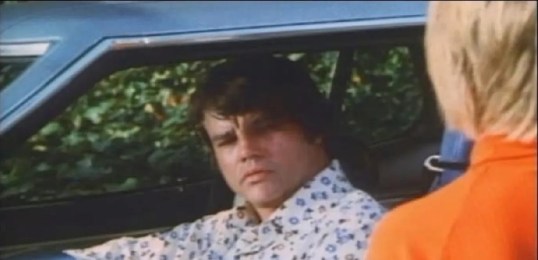
Joe Don Baker throws himself into the role of Mitchell and there’ actually a lot of intentional humor to be found in his performance.  Baker doesn’t play Mitchell as being a supercop.  Instead, he plays Mitchell as being a blue collar guy who gets absolutely no respect.  Even when he’s on a stakeout, a random kid starts arguing with him.  (Mitchell loses the argument.)  Mitchell’s a jerk who busts his hooker girlfriend (Linda Evans) for having weed on her but he’s also the only one who could stop Balsam from doing whatever it is that Balsam thinks he’s trying to do.  (Again, don’t spend too much time trying to understand the plot.)  Mitchell’s super power is that he’s a slob who doesn’t give up.  To paraphrase Road House‘s Dalton, he plays dumb until it’s time not to be dumb.

As I said, it’s an entertaining film.  Where else are you going to see a not particularly high-speed chase between two station wagons?  Where else are you going to see John Saxon in a dune buggy or Joe Don Baker in a helicopter or Martin Balsam as the captain of a yacht?  Where else are you going to see a film that features its hero saying, “Yep, that’s grass,” before arresting his lover?  Mitchell is fun and entertaining and I’ll always defend both the movie and its star.
Horror Film Review: X: The Man With X-Ray Eyes (dir by Roger Corman)


X: The Man With The X-Ray Eyes (1963, dir by Roger Corman, DP: Floyd Crosby)

Eyes.  They’re one of the most important parts of our body but they’re also frightening easy to damage. Unlike the heart or the liver or the brain, they don’t have a protective covering of skin and bone.  They sit exposed and  are easily injured.  They can be ripped out of one’s head, which is a scary thought.  As well, they tend to grow weaker over time.  I love my multi-colored eyes and I think they’re one of my best features but I still spend a lot of time wishing that they weren’t quite as vulnerable as they are.  I often say that I’m blind without my contacts or my glasses.  That’s not quite true, of course.  I can see enough to get by if I forget to put in my contacts but I still have to do a lot of squinting, enough so that most people can take one look at me and say, “You forgot to put in your contacts, didn’t you?”  In my case, my eyesight has definitely gotten even worse over the past few years.  I’ve been told that’s normal but it still freaks me out.  I worry about waking up one day and not being able to see anything at all.

Director Lucio Fulci, a diabetic who was slowly going blind during the final years of his life, was infamous for including scenes of eyes being either pierced or gouged out in his films.  The New York Ripper even featured one scene where an eye was slit in half with a razor blade.  (This occurred in a close-up, no less!)  In Joe D’Amato’s Beyond the Darkness, there’s a scene where a mad taxidermist replaces the eyes of his dead fiancée with glass and for me, that’s one of most disturbing elements of the film.  Horror directors understand the vulnerability of the eyes and the sadness when life is extinguished from those eyes.  Eyes are said to be the windows to soul and when those eyes are lifeless, it’s a reminder that a living soul is a fleeting thing.

Perhaps that’s why 1963’s X: The Man With The X-Ray Eyes is such an effective work of art.  Directed by Roger Corman, the film tells the story of Dr. James Xavier (Ray Milland), a doctor who has developed eye drops that, when taken, allow one to have x-ray vision.  Dr. Xavier claims that the eye drops will allow doctors to more easily diagnose their patients and certainly, he has a point there.  His friend, Dr. Sam Brant (Harold J. Stone), points out that the eyes are directly connected to the brain and that using experimental eye drops on them could potentially drive a person mad.  Dr. Xavier proves Dr. Brant’s point by losing his tempter and accidentally pushing him out of a window.

Ah, x-ray vision.  It all starts out fun.  Dr. Xavier is performing miracle surgeries and seeing what everyone looks like naked.  (The swinging jazz party scene is a classic example of how 60s B-movies teased audiences while never quite showing everything.) But once he’s forced to go on the run from the police, Xavier finds himself making a living as a carnival psychic while still trying to refine his eyedrops.  Xavier’s sleazy manager (Don Rickles) tries to turn Xavier into a faith healer but, with Xavier’s x-ray vision growing more erratic and more intense, Xavier ends up running off to Vegas with a former colleague, Dr. Diane Fairfax (Diana Van der Vils).

And again, it’s all fun and games as Xavier uses his powers to cheat at cards.  But then the megalomania kicks in and, after Xavier basically announces that he’s cheating, he finds himself being chased through the desert by a police helicopter and freaking out as more and more of the universe is revealed to him.  Much like a Lovecraftian protagonist who has been driven mad by the sight of the Great Old Ones, Xavier finds himself overwhelmed by the center of the universe.  At a tent revival, a preacher shouts, “If thine eye offends thee, pluck it out!”

The film’s final image is a shocking one and it stays with you.  (There were rumors that the film originally ended with Xavier shouting, “I can still see!” but Corman himself said that never happened.)  Even without that final image, this would be one of Corman’s best films, a surprisingly intelligent and rather sad story about a man who, in trying to see what is usually hidden, was driven mad by what he discovered.  Ray Milland was well-cast as Dr. Xavier and watching him go from being a somewhat stiff but good-hearted scientist to a raving madman at a revival is quite an experience, a testament to the vulnerability that all humans share.  In the name of science, Xavier goes from being a respected researcher to being chased through the desert by a helicopter.  The man who wanted to be able to see everything finds himself wishing to be forever blinded.  Sometimes, the film suggests, it’s best not to be able to see everything around us.  Sometime, the mysteries of the universe should remain mysteries and the rest of us should respect our own vulnerabilities.

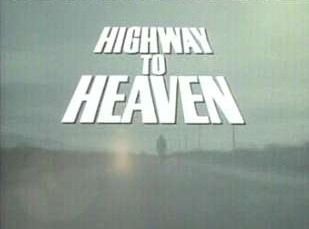
Late Night Retro Television Review: Highway to Heaven 2.14 “Close Encounters of the Heavenly Kind”


Welcome to Late Night Retro Television Reviews, a feature where we review some of our favorite and least favorite shows of the past!  On Thursdays, I will be reviewing Highway to Heaven, which aired on NBC from 1984 to 1989.  The entire show is currently streaming on Freevee and several other services!

There’s really not much to say about this episode.

Episode 2.14 “Close Encounters of the Heavenly Kind”

(Dir by Victor French, originally aired on January 15th, 1986)

Adam (Jerry Supiran) is a kid who lives with his grandfather, Harvey (Harold J. Stone).  Unless Harvey can find a real job, Adam is going to be put in foster care.  Harvey is a self-taught electrician but, since he never graduated high school, no one is willing to take a chance on him.

One night, a meteorite crashes into the Earth.  When Adam rides his bike out to the impact area, he sees Jonathan and Mark stepping out of the crater.  Though Jonathan and Mark just happened to be driving by and decided to investigate the meteorite on their own, Adam assumes that they’re aliens.  Jonathan lets him assume that as he and Mark go on to help Harvey find a job and also help Adam to find the courage to stand up to his bullies.

Especially when compared to last week’s episode, this was all pretty bland.  Jerry Spurian was one of those child actors who overemoted with every line while Harold J. Stone comes across as just being cranky and disagreeable.  This felt like a throw-away episode and there’s really not much else to be said about it.

(How’s that for a short review?  Sorry, there’s not much to say about this one.)

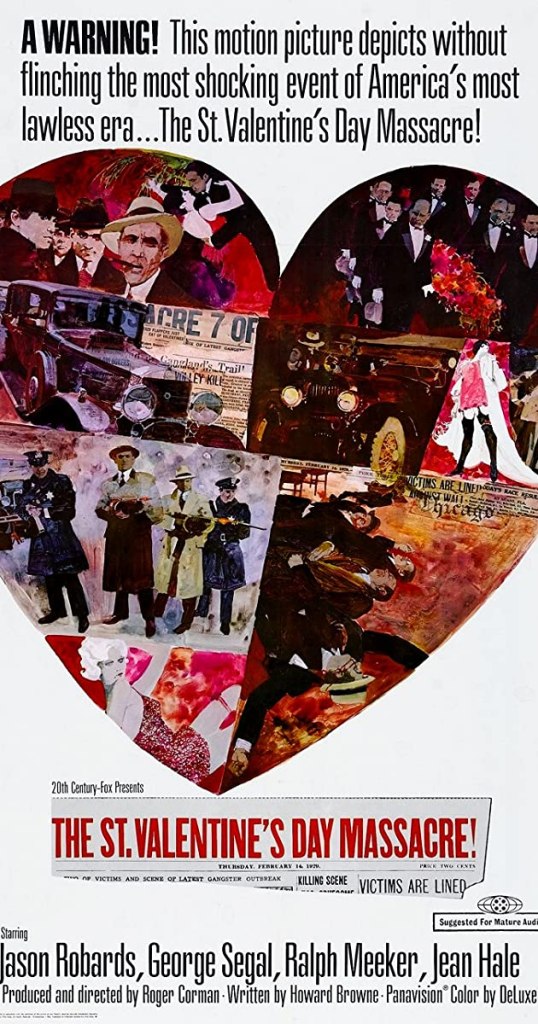
An Offer You Can’t Refuse #18: The St. Valentine’s Day Massacre (dir by Roger Corman)


On February 14th, 1929, seven men were murdered in a garage in Chicago, Illinois.  Five of the seven men were known to be associates of gangster George “Bugs” Moran.  The other two men were considered to be innocent bystanders, a mechanic and a dry cleaner who just happened to enjoy hanging out with gangsters.  Though no one was ever convicted of the crime, it was well-known that the murders were carried out on the orders of Al Capone.

In many ways, the St. Valentine’s Day Massacre was a turning point in America’s relationship with organized crime.  Before the massacre, Capone had become a bit of a folk hero.  He knew how to talk to the press and he was viewed as merely breaking a law (in this case, prohibition) that most people opposed in the first place.  However, after the murders, public opinion soured on Capone.

Some of it was the brutality of the crime.  It’s been said that over five hundred bullets were fired in that garage, all to kill seven defenseless men who were lined up against a wall.  Grisly pictures of the victims were released to the press.  Perhaps if the seven men had been carrying weapons and had been involved in a shootout with their murderers, the public’s reaction would have been different.  But this was a cold-blooded execution.

Personally, I think the fact that the killers disguised themselves as cops also played a role in the public’s outrage.  It was a very calculated move on the part of the killers and it highlighted just how much planning went into the St. Valentine’s Day Massacre.  As well, it undoubtedly made people paranoid.  If a bunch of killer could dress up like cops, who knew who else they could dress up as?

Finally, I think that Capone’s biggest mistake was carrying out the crime on Valentine’s Day.  You don’t murder people on a holiday.  Anyone should know that.  If Capone had waited until February 20th, he probably could have gotten away with it.

The 1967 film, The St. Valentine’s Day Massacre, details the rivalry between Capone and Moran, starting with them fighting for control over the Chicago rackets and ending with the title event.  Moran is played by Ralph Meeker while Jason Robards plays Capone.

Now I know what you’re probably thinking.  Perennial WASP Jason Robards as Al Capone?  That may sound like odd casting and, let’s just be honest here, it is.  However, it actually kind of works.  Robards may not be convincingly Italian but he is convincingly ruthless.  Add to that, one of the major subplots of the St. Valentine’s Day Massacre is that, even as the head of the Chicago Outfit, Capone still feels like an outsider in the world of organized crime because, while he is Italian, he isn’t Sicilian.  Capone feels as if Lucky Luciano and all of the major New York crime bosses look down on him and one reason why he’s so ruthless about taking over Chicago is that wants to show Luciano that he can be just as effective a crime lord as any Sicilian.  Capone feeling out of place in the Mafia is reflected by Robards initially seeming to be out of place in a gangster film.  By the end of the movie, of course, Capone has proven himself and so has Jason Robards.

Robards isn’t the only familiar face to be found in The St. Valentine’s Day Massacre.  Though this film was released by 20th Century Fox, it was directed by Roger Corman and Corman fills the production with members of his stock company.  Dick Miller, Jonathan Haze, and Jack Nicholson all have small roles as gunmen.  Bruce Dern plays the unlucky mechanic who enjoys hanging out with gangsters.  Buck Taylor, Leo Gordon, and Joe Turkel all have small roles.  John Agar plays Dion O’Bannon and is gunned down in his flower store.  Though not members of the Corman stock company, George Segal and David Canary plays brothers who work for Moran.  There’s a lot of characters wandering through this film but Corman makes sure that everyone gets a chance to make an impression.

It’s a good gangster film.  Though he was working with a larger budget than usual, Corman still brought his exploitation film aesthetic to the material and the end result is a violent, melodramatic gangster film that looks really impressive.  The film’s recreation of 1920s Chicago is a visual delight and looking at the well-dressed and stylish gangsters walking and driving down the vibrant city streets, you can understand why organized crime would have such a draw for some people.

The St. Valentine’s Day Massacre is a classic gangster film and a classic Corman film.  It’s an offer you can’t refuse.

Previous Offers You Can’t (or Can) Refuse:

  1. The Public Enemy
  2. Scarface
  3. The Purple Gang
  4. The Gang That Could’t Shoot Straight
  5. The Happening
  6. King of the Roaring Twenties: The Story of Arnold Rothstein 
  7. The Roaring Twenties
  8. Force of Evil
  9. Rob the Mob
  10. Gambling House
  11. Race Street
  12. Racket Girls
  13. Hoffa
  14. Contraband
  15. Bugsy Malone
  16. Love Me or Leave Me
  17. Murder, Inc.


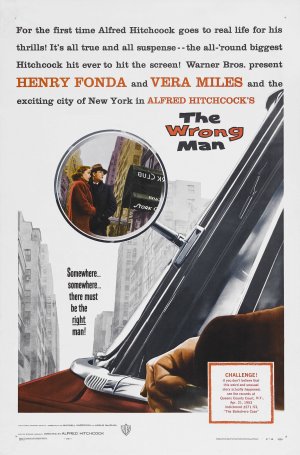
Lisa Marie Does The Wrong Man (dir by Alfred Hitchcock)


Since today is Alfred Hitchcock’s birthday, I figured why not take a few minutes to recommend one of his films that you may not have seen.  First released in 1956 but still painfully relevant today, The Wrong Man is one of Hitchcock’s best but it’s also one of his most underrated.

The Wrong Man deals with a common Hitchcock theme — i.e., an innocent man has been accused of a crime and, despite all of his efforts, cannot seem to convince anyone of his innocence.  The difference between The Wrong Man and something like Saboteur or Frenzy is that The Wrong Man is based on a true story.

Manny Ballestro (Henry Fonda) is a struggling musician.  He makes $85 a week, playing in a small jazz club.  But even though he may not be rich, he’s happy.  He loves his job.  He loves making music.  Even more importantly, he loves his wife, Rose (Vera Miles).  But Rose needs to have her wisdom teeth removed and it’s going to cost $300.  (As a sign of how much things have changed, I would have been relieved if it had only cost me $300 to get my wisdom teeth taken out.)  Desperate for money, Manny tries to borrow money on his wife’s life insurance plan.  What Manny doesn’t know is that the insurance office has been held up twice by a man who bears a vague resemblance to him.  A clerk calls the police and Manny soon finds himself being taken down to the police station.

Two detectives say that they need Manny’s help but they don’t tell him why.  But Manny knows he’s innocent of any crime and he believes that the police are on his side and he agrees to help.  When they tell him to walk into a liquor store, he does so.  When they take him to a deli, he goes in there as well.  When they demand to know why he was trying to borrow money on his wife’s life insurance, he tells them.  When they ask him about his financial difficulties, he tells them about that as well.  Why shouldn’t he?  He’s innocent and the police are just doing their job, right?  And when the cops finally ask him to copy down a few words that were used in the note that the robber slipped the clerk at the insurance company, Manny does so.  And when they then ask him to take part in a line-up, he does that as well…

And when Manny is arrested and charged with a crime … well, that’s when he finally understands that the system is not on his side.  His wife manages to hire a reputable attorney, Frank O’Connor (Anthony Quayle), to defend him but it quickly becomes obvious that the world has already decided that Manny is guilty.  When Manny and his wife try to track down some people who could provide Manny with an alibi, they discover that two of them are dead and one of them cannot be found.  For once, in a Hitchcock film, it’s not a case of conspiracy.  Instead, it’s just bad luck.

And, through it all, Rose continues to blame herself.  In fact, she is so wracked with guilt that she has a nervous breakdown.

It all leads to an amazingly disheartening courtroom scene.  As quickly becomes obvious, the judge has little interest in what’s happening in his court.  Even worse, the jury is unconcerned with the evidence.  Most of them are just annoyed at the inconvenience and punishing Manny seems like the perfect way to release their own frustrations…

It’s a bleak picture of the American justice system.  Watching The Wrong Man today, it’s tempting to say that the film is just a reflection of society in the 1950s and that things have changed today.  But really, have they?  True, the police may now be required to read someone their rights when they’re arrested.  A suspect can now ask for a lawyer.  We’ve got laws against entrapment and all the rest.  But that doesn’t matter.  We still live in a society where people are still widely presumed to be guilty, even after they’ve been found innocent in a court of law.  We still live in a society where the wrong man can have his life ruined because of one mistake.

The Wrong Man doesn’t get as much attention as some of Hitchcock’s other films.  In many ways, it’s an atypical example of his work.  Hitchcock was notorious for his dark sense of humor and his habit of waving away most plot points as just being mere “macguffins.”  With the exception of two scenes, both of which are meant to depict Manny’s mental state, The Wrong Man is filmed in a documentary style, one that occasionally seems more like Sidney Lumet than Alfred Hitchcock.  There’s next to no humor, nor are there any big or flamboyant twists.  In short, The Wrong Man finds the director of Psycho, Vertigo, and Rear Window at his most sincere.  It takes some getting used to.

But, once you do get used to it, The Wrong Man emerges as a powerful and bleak portrait of two innocent people at the mercy of a soulless system.  It’s a must see so be sure to see it!

The-Wrong-Man-poster

Horror On TV: The Twilight Zone 3.2 “The Arrival”


When Flight 107 out of Buffalo, New York makes a perfect (if unannounced) landing, airport officials are shocked to discover that the airplane has no passengers, no luggage, and no pilots!  It’s up to Grant Sheckley (Harold J. Stone) to solve the mystery but Sheckley has a secret of his own.

This episode of The Twilight Zone was written by Rod Serling and directed by Boris Sagal.  It was originally broadcast on September 22nd, 1961.