Yes, Die Hard is a Christmas movie.
And, in an alternative universe, it was a Frank Sinatra movie.
Released into theaters in 1988, Die Hard was based on a novel called Nothing Lasts Forever. Nothing Lasts Forever told roughly the same story as Die Hard, with one of the big exceptions being that the cop fighting the terrorists was not the youngish and quippy John McClane but instead was a weary, aging and retired detective named Joe Leland. Leland previously appeared in another novel called The Detective. In 1968, The Detective was turned into a film and the role of Leland was played by Frank Sinatra. As a part of his contract, Sinatra had the right to play Leland in any sequels to The Detective. When Die Hard was in pre-production, Sinatra could have demanded that the film be a Joe Leland film and that he be allowed to star in it. Fortunately, Sinatra did not do that and Joe Leland was instead transformed into John McClane. And, after the role was was turned down by Arnold Schwarzenegger, Sylvester Stallone, Clint Eastwood, Nick Nolte, Mel Gibson, Don Johnson, Harrison Ford, Burt Reynolds, Paul Newman, James Caan, Al Pacino, and Richard Dean Anderson, popular television actor Bruce Willis finally received the role.
Seriously, just consider that. Bruce Willis was not only not the first choice for John McClane but even Richard Dean Anderson was offered the role before the filmmakers finally went with Willis. It’s hard to imagine anyone else starring in Die Hard because, to most of us, Bruce Willis is John McClane. Growing up and watching Die Hard on television every Christmas, it was very easy to assume that Willis probably spent all of his spare time fighting terrorists and coming up with snarky quips. Definitely, it’s difficult to imagine Stallone and Schwarzenegger in the role. What made McClane such a compelling hero was that he wasn’t superhuman. He was just a blue collar guy who hurt his feet, got tired, and had his moments of frustration just like everyone else. He was the relatable action hero. It didn’t matter how many stories that one heard about Bruce Willis having an ego or occasionally being difficult to work with. Bruce Willis was John McClane and, after everything that McClane had been though, he had every right to occasionally be difficult.
You’ll notice that I haven’t really discussed the plot of Die Hard because …. well, everyone knows that plot. I mean, this is one of those films that has such a permanent place in pop cultural history that even people who somehow haven’t seen the film still know what it’s about. John McClane is an NYPD cop who flies to Los Angeles to see his estranged wife, Holly, for Christmas. Holly (Bonnie Bedelia) works for the Nakatomi Corporation. During the company’s Christmas party, terrorists led by Hans Gruber (Alan Rickman) take over the skyscraper. The terrorists claim to be politically-motivated but, actually, they just want to break into the building’s vault and make off with a lot of money. McClane makes his way through the unfinished skyscraper, killing the terrorists one-by-one. He only has two allies. Al Powell (Reginald VelJohnson) is an LAPD sergeant who is outside the building and who communicates with McClane via radio. Argyle (De’Veroux White) is the friendly limo driver who spends almost the entire siege oblivious in the parking garage. (The first time I ever watched Die Hard, I was so worried something bad would happen to Argyle.)
McClane has a lot of enemies and not all of them are terrorists. The Deputy Chief of the LAPD (Paul Gleason) thinks that McClane is making the situation worse. Two FBI agent, both named Johnson (and played by Robert Davi and Grand L. Bush), seem to view the entire siege as being a game with the older Johnson talking about how much it reminds him of Vietnam. A reporter (William Atherton) makes the situation worse with his on-the-spot reports. Meanwhile, there’s Harry Ellis (Hart Bochner). A coke-addled executive, Ellis actually thinks that he’s helping McClane by trying to negotiate with Gruber. I know that some people can’t stand Ellis but I always feel sorry for him. In his way, he was trying to help and you could tell that he was so proud of himself for not telling Gruber that McClane was in Los Angeles to see Holly.
Needless to say, there’s a lot of action in Die Hard. A lot of people die. One thing that I appreciate the movie is that the bad guys get as upset over their friends and family being killed as McClane gets over Holly being threatening. No one in the film is one-dimensional and even the bad guys have their own distinct personalities. Theo (Clarence Gilyard) gets so excited about the idea of opening the vault that you can’t help but relate. Karl (Alexander Godonuv) appears to be nearly indestructible. Hans Gruber may be totally evil but he has a quick wit and there’s something intriguing about how confident he is. Alan Rickman, famously, was not happy that his first role led to him being typecast as an international villain and one can’t blame him. Still, almost every action movie villain who has followed has owed something to Alan Rickman. Just as it’s difficult to imagine anyone other than Bruce Willis as John McClane, it’s impossible to imagine anyone other than Alan Rickman as Hans Gruber.
(That said, I’m sure there’s another alternate universe out there, right next to the Sinatra universe, where Blade Runner was not as troubled a production as it was and, as a result, Die Hard was made with Ridley Scott directing, Harrison Ford starring as McClane, and Rutger Hauer playing Hans.)
For all of the action, there’s also a lot of moments that make me laugh out loud and I’m not just talking about McClane’s one liners. The two FBI agents don’t get much screentime but Davi and Bush make the most of what they have. Paul Gleason is wonderfully deadpan as the clueless Chief Robinson. Even Rickman gets his share of laughs. “I read about them in Time Magazine” indeed.
Die Hard is a Christmas tradition with my family and a lot of other families as well. Does Die Hard count as a Christmas movie? I would say yes. The terrorists may not respect the holiday but John McClane does. No one ruins McClane’s Christmas!

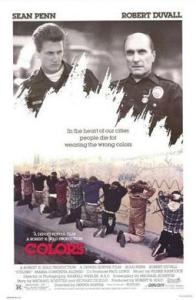 Los Angeles in the 80s. Beneath the California glamour that the rest of America thinks about when they think about L.A., a war is brewing. Bloods vs Crips vs the 21st Street Gang. For those living in the poorest sections of the city, gangs provide everything that mainstream society refuses to provide: money, a chance to belong, a chance to advance. The only drawback is that you’ll probably die before you turn thirty. Two cops — veteran Hodges (Robert Duvall) and rookie McGavin (Sean Penn) — spend their days patrolling a potential war zone. Hodges tries to maintain the peace, encouraging the gangs to stay in their own territory and treat each other with respect. McGavin is aggressive and cocky, the type of cop who seems to be destined to end up on the evening news. With only a year to go before his retirement, Hodges tries to teach McGavin how to be a better cop while the gangs continue to target and kill each other. The cycle continues.
 Through the Shattered Lens