Guilty Horror Pleasure #87: The ‘Burbs (dir by Joe Dante)


1989’s The ‘Burbs takes place in …. well, it’s right there in the title.

Welcome to the suburbs!  It’s place with big houses, green lawns, and neighbors who often don’t have much to do other than watch each other and gossip.  Ray Peterson (Tom Hanks) lives with his wife, Carol (Carrie Fisher), and is friends with Art Weingartner (Rick Ducommun) and Mark Rumsfield (Bruce Dern).  Ricky Butler (Corey Feldman) is the local teenager.  It’s a nice neighborhood …. at least, until the Klopeks move in.

The Klopeks are viewed with suspicion from the minute they show up.  They’re from a different country, they always seem to be burying something in their backyard, and Dr. Werner Klopek (Henry Gibson) is oddly stand-offish.  When Walter Seznick (Gale Gordon) disappears and the the Klopeks are seen around Walter’s house and with Walter’s dog, Ray and his friends start to suspect that their new neighbors might be ritualistic murderers!

Oh, how I love The ‘Burbs.  The film’s portrait of the suburbs as being a hotbed of paranoia may be a familiar one but it doesn’t matter when you’ve got actors like Tom Hanks and Bruce Dern throwing themselves into their roles.  As always, Hanks is the glue that holds the film and its disparate parts together, giving a likable performance as a man who goes from being the voice of reason to being convinced that his neighbors are cannibals.  Bruce Dern gleefully sends up his own image as a paranoid Vietnam vet but there’s also a sweetness to Dern’s performance that really makes it stand out.  Dern’s character might be a little crazy but he does truly care about his neighbors.

Just as he did with Piranha and The Howling, Dante balances humor with suspense.  He does such a good job of telling the story and getting good performances from his cast, that even the film’s big twist works far better than one might expect.  It’s an 80s film so, of course, a few things explode towards the end of it.  The film’s character-based humor is replaced with some broader jokes but no matter.  The Burbs is an entertaining trip to the heart of suburban paranoia.

As the saying goes, just because you’re paranoid, that doesn’t mean that they aren’t out to get you.

Previous Guilty Pleasures

  1. Half-Baked
  2. Save The Last Dance
  3. Every Rose Has Its Thorns
  4. The Jeremy Kyle Show
  5. Invasion USA
  6. The Golden Child
  7. Final Destination 2
  8. Paparazzi
  9. The Principal
  10. The Substitute
  11. Terror In The Family
  12. Pandorum
  13. Lambada
  14. Fear
  15. Cocktail
  16. Keep Off The Grass
  17. Girls, Girls, Girls
  18. Class
  19. Tart
  20. King Kong vs. Godzilla
  21. Hawk the Slayer
  22. Battle Beyond the Stars
  23. Meridian
  24. Walk of Shame
  25. From Justin To Kelly
  26. Project Greenlight
  27. Sex Decoy: Love Stings
  28. Swimfan
  29. On the Line
  30. Wolfen
  31. Hail Caesar!
  32. It’s So Cold In The D
  33. In the Mix
  34. Healed By Grace
  35. Valley of the Dolls
  36. The Legend of Billie Jean
  37. Death Wish
  38. Shipping Wars
  39. Ghost Whisperer
  40. Parking Wars
  41. The Dead Are After Me
  42. Harper’s Island
  43. The Resurrection of Gavin Stone
  44. Paranormal State
  45. Utopia
  46. Bar Rescue
  47. The Powers of Matthew Star
  48. Spiker
  49. Heavenly Bodies
  50. Maid in Manhattan
  51. Rage and Honor
  52. Saved By The Bell 3. 21 “No Hope With Dope”
  53. Happy Gilmore
  54. Solarbabies
  55. The Dawn of Correction
  56. Once You Understand
  57. The Voyeurs 
  58. Robot Jox
  59. Teen Wolf
  60. The Running Man
  61. Double Dragon
  62. Backtrack
  63. Julie and Jack
  64. Karate Warrior
  65. Invaders From Mars
  66. Cloverfield
  67. Aerobicide 
  68. Blood Harvest
  69. Shocking Dark
  70. Face The Truth
  71. Submerged
  72. The Canyons
  73. Days of Thunder
  74. Van Helsing
  75. The Night Comes for Us
  76. Code of Silence
  77. Captain Ron
  78. Armageddon
  79. Kate’s Secret
  80. Point Break
  81. The Replacements
  82. The Shadow
  83. Meteor
  84. Last Action Hero
  85. Attack of the Killer Tomatoes
  86. The Horror At 37,000 Feet

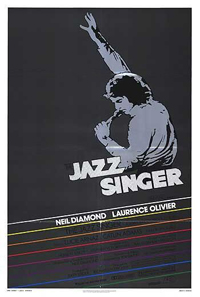
Film Review: The Jazz Singer (dir by Richard Fleischer)


In the 1980 remake of The Jazz Singer, it only takes the film seven minutes to find an excuse to put Neil Diamond in blackface.

Of course, the film was a remake of the 1927 version of The Jazz Singer, which featured several scenes of Al Jolson performing in blackface.  In fact, Al Jolson in blackface was such a key part of the film that it was even the image that was used to advertise the film when it was first released.  Back in the 20s, Jolson said that wearing blackface was a way of honoring the black artists who created jazz.  (As shocking as the image of Al Jolson wearing blackface is to modern sensibilities, Jolson was considered a strong advocate for civil rights and one of the few white singers to regularly appear on stage with black musicians.)  Regardless of Jolson’s motives, less-progressively minded performers used blackface as a way to reinforce racial stereotypes and, to modern audiences, blackface is an abhorrent reminder of how black people were marginalized by a racist culture.  You would think that, if there was any element of the original film that a remake would change, it would be the lead character performing in blackface.

But nope.  Seven minutes into the remake, songwriter Jess Robin (Neil Diamond) puts on a fake afro and dons blackface so that he can perform on stage at a black club with the group that is performing his songs.  The group’s name is the Four Brothers and, unfortunately, one of the Brothers was arrested the day of the performance.  Jess performs with the group and the crowd loves it until they see his white hands.  Ernie Hudson — yes, Ernie Hudson — stands up and yells, “That’s a white boy!”  A riot breaks out.  The police show up.  Jess and the three remaining Brothers are arrested and taken to jail.  Jess is eventually bailed out by his father, Cantor Rabinovitch (Laurence Olivier).  The Cantor is shocked to discover that his son, Yussel Rabinovitch, has been performing under the name Jess Robin.  He’s also stunned to learn that Yussel doesn’t want to be a cantor like his father.  Instead, he wants to write and perform modern music.  The Cantor tells Yussel that his voice is God’s instrument, not his own.  Yussel returns home to his wife, Rivka (Caitlin Adams), and tries to put aside his dreams.

But when a recording artist named Keith Lennox (Paul Nicholas) wants to record one Yussel’s songs, Yussel flies out to Los Angeles.  As Jess Robin, he is shocked to discover that Lennox wants to turn a ballad that he wrote into a hard rock number,  Jess sings the song to show Lennox how it should sound.  The arrogant Lennox is not impressed but his agent, Molly (Lucie Arnaz) is.  Soon, Jess has a chance to become a star but what about the family he left behind in New York?  “I have no son!” the Cantor wails when he learns about Jess’s new life in California.

I’ve often seen the 1980 version of The Jazz Singer referred to as being one of the worst films of all time.  I watched it a few days ago and I wouldn’t go that far.  It’s not really terrible as much as its just kind of bland.  For someone who has had as long and successful a career as Neil Diamond, he gives a surprisingly charisma-free performance in the lead role.  The most memorable thing about Diamond’s performance is that he refuses to maintain eye contact with any of the other performers, which makes Jess seem like kind of a sullen brat.  It also doesn’t help that Diamond appears to be in his 40s in this film, playing a role that was clearly written for a much younger artist.  Still, when it comes to bad acting, no one can beat a very miscast Laurence Olivier, delivering his lines with an overdone Yiddish accent and dramatically tearing at his clothes to indicate that Yussel is dead to him.  Olivier was neither Jewish nor a New Yorker and that becomes very clear the more one watches this film.  It takes a truly great actor to give a performance this bad.  Diamond, at least, could point to the fact that he was a nonactor given a starring role in a major studio production.  Olivier, on the other hand, really had no one to blame but himself.

Still, I have to admit that ending the film with a sparkly Neil Diamond performing America while Laurence Olivier nods in the audience was perhaps the best possible way to bring this film to a close.  It’s a moment of beautiful kitschThe Jazz Singer needed more of that.

Scenes That I Love: Convoy (RIP, Kris Kristofferson)


Rest in peace, Kris Kristofferson.

Today’s scene of the day comes from 1979’s Convoy and it features Kristofferson as the greatest trucker of all time, Rubber Duck.  In this scene, Rubber Duck rescues a fellow trucker from jail and lets the authorities know what they can do with their law.

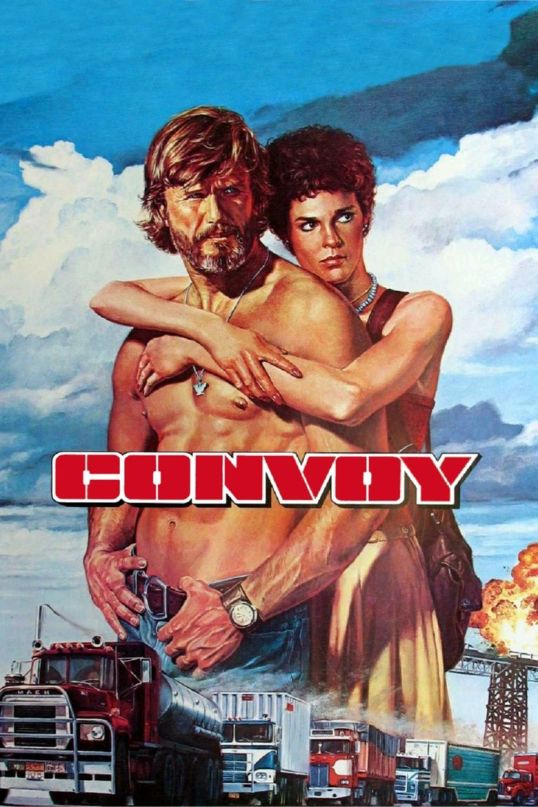
Film Review: Convoy (dir by Sam Peckinpah)


Well, it looks like we’ve got ourselves a Convoy!

The 1978 film Convoy opens with the image of a truck passing by some hills that have been covered with snow.  At a certain point, it actually looks like the truck is descending into a sea of white powder.  It’s an appropriate image because, to film lovers and cinematic historians, Convoy will always be associated with cocaine.

Convoy was meant to be a relatively small-scale B-movie, one that was meant to capitalize on the popularity of a novelty song, as well as the recent success of other car chase films.  Instead, it became a notoriously troubled production that went famously overbudget and overschedule as director Sam Peckinpah turned Convoy into a personal statement about modern cowboys and independence.  When the film was finally released, it was the biggest box office hit of Peckinpah’s storied career.  However, because so much money had been spent making the film, it still failed to make a profit and the film is regularly described as being one of the many flops of the late 70s that eventually led to the power in the film industry shifting away from the directors and over to the studio executives.  Many in Hollywood grumbled that it was Peckinpah’s well-known cocaine use that led to him having such trouble with what should have been a simple B-movie.  That’s probably a bit unfair to Peckinpah as it’s been written that just about everyone in Hollywood was using cocaine in 1978.

Add to that …. Convoy‘s not that bad.

Convoy tells the story of Rubber Duck (Kris Kristofferson), a legendary trucker who has never joined the Teamsters.  He’s an independent.  Rubber Duck’s nemesis is Sheriff Dirty Lyle (Ernest Borgnine), who is also an independent.  He’s never joined the policeman’s union.  As Rubber Duck puts it, “There’s not many like us anymore.”

Anyway, for reasons that are only vaguely defined, Rubber Duck leads a convoy of trucks across the southwest while being pursued by the police.  It has something to do with protesting the law enforcement tactics of Dirty Lyle, despite the fact that Rubber Duck appears to kind of like Lyle.  Soon hundreds of other independent truckers are joining Rubber Duck’s convoy, all to protest law enforcement.  Among those in the convoy are Pig Pen (Burt Young), Widow Woman (Madge Sinclair), and Spider Mike (Franklyn Ajaye), who just wants to get home to his pregnant wife.  Traveling with Rubber Duck is Melissa (Ali MacGraw), who is supposed to be some sort of photojournalist.  Rubber Duck and Melissa fall in love but there’s only so much you can do with a love story when it centers around two of the least expressive stars of the 70s.  During the chase, Rubber Duck picks up some non-truckers supporters, including some religious fanatics in a microbus.  He and the truckers also drive through and destroy a lot of buildings, which kind of makes it look like the cops might have had a point.

What sets Convoy apart from other chase films of the 70s is just how seriously it takes itself.  There’s an undercurrent of melancholy that runs through the entire film.  Rubber Duck seems to know that America is changing and as people become more comfortable with the idea of sacrificing their freedoms, his days as an independent trucker are numbered.  Dirty Lyle also seems to be stuck in a permanent existential crisis, taking no joy in being a crook but still forced to do so by being a part of an inherently corrupt government system.  There’s a scene where a truckstop waitress offers herself up as a gift to Rubber Duck on his birthday and Peckinpah films it as if he’s making an Italian neorealist drama about Rome after the war.  When Spider Mike says that he has to get home to his wife, he says it with the pain of a man who knows that the system only cares about control and not happiness.  These aren’t just truckers.  These are men and women who are on the front lines battling a creeping culture of oppression.

Surprisingly enough, the film’s serious tone actually works to its advantage.  You may not fully understand why Rubber Duck is leading that convoy but you hope that it succeeds because you get the feeling that the world might end if it doesn’t.  When the film ends with Ernest Borgnine laughing like a maniac, it comes across less like a moment of amusement and more like an acknowledgment that the universe is a tragic farce.  Life is a riddle wrapped inside an engima and only Rubber Duck and Dirty Lyle seem to understand that fact.

Add to that, this is a film about independents refusing to allow themselves to be limited by the regulatory state.  In its way, it’s one of the most sincerely Libertarian films ever made and, with all of us currently living under “lockdowns” and hoping that our governors don’t join those who have already surrendered their better instincts to their inner tyrant (sorry, Michigan, Kentucky, and New Jersey), Convoy remains an important film.  Go, Rubber Duck, go!