Francis Ford Coppola was still a UCLA film student when he made YOU’RE A BIG BOY NOW, the 1966 coming of age comedy he used as his MFA thesis. The young Coppola was 27, and had gained experience working for Roger Corman ; indeed, Corman gave him his first break when he hired Coppola to write and direct the horror quickie DEMENTIA 13. But YOU’RE A BIG BOY NOW was his first major studio release, and put him on the map as a talent to keep an eye on.
Bernard Chanticleer is a 19 year old nerd with a way-overprotective mother and disinterested, authoritarian father. He works for Dad at a New York City library, and is constantly goofing up on the job. Dad thinks it’s time for Bernard to spread his wings and move on his own, much to Mom’s displeasure. She finds him a room at a house owned by Miss Thing, who’s tenants include conservative…
My look back at the previous year continues with 10 of my favorite non-fiction books of 2016! Now, it should be noted that, because this is an entertainment-related website, I’m only listing my favorite entertainment-related books. There was a lot of good nonfiction published last year but the majority of it had nothing to do with either the movies or television so who cares?
Anyway, all of these are wonderful and well-worth the money!
The Godfather Notebook by Francis Ford Coppola
TV: The Book by Matt Zoller Seitz and Alan Sepinwall
The Only Pirate at the Party by Lindsey Stirling
Natalie Wood: Reflections on a Legendary Life by Manoah Bowman
The Purple Diaries: Mary Astor and the Most Sensational Hollywood Scandal of the 1930s by Joseph Egan
In Search of Lost Films by Phil Hall
Down from the Attic: Rare Thrillers of the Silent Era through the 1950s by John T. Soister and Henry Nicolella
Shirley Jackson: A Rather Haunted Life by Ruth Franklin
The Curse of Beauty: The Scandalous & Tragic Life of Audrey Munson, America’s First Supermodel by James Bone
A Thousand Cuts: The Bizarre Underground World of Collectors and Dealers Who Saved the Movies by Dennis Bartok and Jeff Joseph
Finally, I have to give an honorable mention to two books that were published in 2015 but which I didn’t read until 2016. These two books were definitely my favorite non-fiction reads in 2016 and there’s no way that I couldn’t mention them. Troy Howarth’s So Deadly, So Perverse and So Deadly, So Perverse Volume 2 contain everything you could possibly want to know about the giallo genre!
Tomorrow, my look back at 2016 continues with my favorite novels of the year!
(I originally shared this film back in 2011 — can you believe we’ve been doing this for that long? — but the YouTube vid was taken down. So, I’m resharing it today!)
For today’s excursion into the world of public domain horror, I offer up the film debut of Francis Ford Coppola. Before Coppola directed the Godfathers and Apocalypse Now, he directed a low-budget, black-and-white thriller that was called Dementia 13. (Though, in a sign of things to come, producer Roger Corman and Coppola ended up disagreeing on the film’s final cut and Corman reportedly brought in director Jack Hill to film and, in some cases, re-film additional scenes.)
Regardless of whether the credit should go to Coppola, Corman, or Hill, Dementia 13 is a brutally effective little film that is full of moody photography and which clearly served as an influence on the slasher films that would follow it in the future. Speaking of influence,Dementia 13 itself is obviously influenced by the Italian giallo films that, in 1963, were just now starting to make their way into the drive-ins and grindhouses of America.
In the cast, keep an eye out for Patrick Magee, who later appeared as Mr. Alexander in A Clockwork Orange as well as giving a memorable performance in Lucio Fulci’s The Black Cat. Luana Anders, who plays the duplicitous wife in this film, showed up in just about every other exploitation film made in the 60s and yes, the scene where she’s swimming freaks me out to no end.
(One final note: I just love the title Dementia 13. Seriously, is that a great one or what?)
(As some of you may have noticed, I shared this movie last year as well. However, since the video that I embedded in the previous post was subsequently taken down, I figured I might as well post it again this year. Plus, it’s Boris Karloff, Jack Nicholson, and Dick Miller! Why not post it twice?)
Have you ever woken up and thought to yourself, “I’d love to see a movie where a youngish Jack Nicholson played a French soldier who, while searching for a mysterious woman, comes across a castle that’s inhabited by both Dick Miller and Boris Karloff?”
Of course you have! Who hasn’t?
Well, fortunately, it’s YouTube to the rescue. In Roger Corman’s 1963 film The Terror, Jack Nicholson is the least believable 19th century French soldier ever. However, it’s still interesting to watch him before he became a cinematic icon. (Judging from his performance here and in Cry Baby Killer, Jack was not a natural-born actor.) Boris Karloff is, as usual, great and familiar Corman actor Dick Miller gets a much larger role than usual. Pay attention to the actress playing the mysterious woman. That’s Sandra Knight who, at the time of filming, was married to Jack Nicholson.
Reportedly, The Terror was one of those films that Corman made because he still had the sets from his much more acclaimed film version of The Raven. The script was never finished, the story was made up as filming moved alone, and no less than five directors shot different parts of this 81 minute movie. Among the directors: Roger Corman, Jack Hill, Monte Hellman, Francis Ford Coppola, and even Jack Nicholson himself! Perhaps not surprisingly, the final film is a total mess but it does have some historical value.
(In typical Corman fashion, scenes from The Terror were later used in the 1968 film, Targets.)
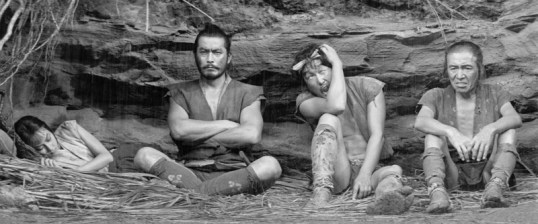
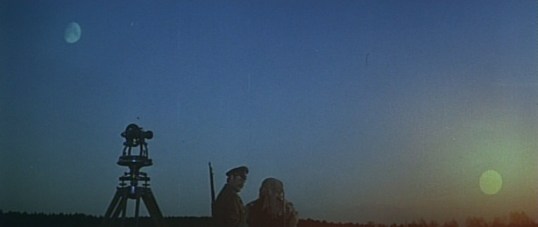
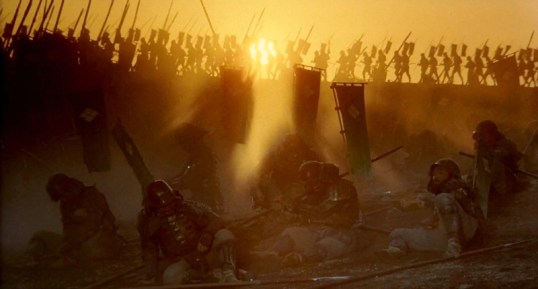
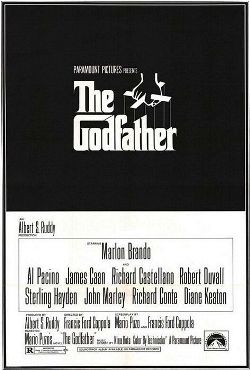
4 Shots From 4 Films is just what it says it is, 4 shots from 4 of our favorite films. As opposed to the reviews and recaps that we usually post, 4 Shots From 4 Films is all about letting the visuals do the talking.
With the latest entry to the Star Wars franchise set to be released in just a few days I thought it was appropriate to share four particular scenes from one filmmaker who has been a huge influence on George Lucas’ vision for Star Wars. This filmmaker also became a huge influence on other master filmmakers such as John Ford, Steven Spielberg, Martin Scorsese, Francis Ford Coppola and Sidney Lumet just to name a few.
Many consider this filmmaker to be one of the greatest filmmakers who ever lived and in this humble individual’s opinion he was the greatest filmmaker who stood above all and whose storytelling and visual techniques would become part of the modern filmmaker’s toll bag.
(I originally shared this film back in 2011 — can you believe we’ve been doing this for that long? — but the YouTube vid was taken down. So, I’m resharing it today!)
For today’s excursion into the world of public domain horror, I offer up the film debut of Francis Ford Coppola. Before Coppola directed the Godfathers and Apocalypse Now, he directed a low-budget, black-and-white thriller that was called Dementia 13. (Though, in a sign of things to come, producer Roger Corman and Coppola ended up disagreeing on the film’s final cut and Corman reportedly brought in director Jack Hill to film and, in some cases, re-film additional scenes.)
Regardless of whether the credit should go to Coppola, Corman, or Hill, Dementia 13 is a brutally effective little film that is full of moody photography and which clearly served as an influence on the slasher films that would follow it in the future. Speaking of influence, Dementia 13 itself is obviously influenced by the Italian giallo films that, in 1963, were just now starting to make their way into the drive-ins and grindhouses of America.
In the cast, keep an eye out for Patrick Magee, who later appeared as Mr. Alexander in A Clockwork Orange as well as giving a memorable performance in Lucio Fulci’s The Black Cat. Luana Anders, who plays the duplicitous wife in this film, showed up in just about every other exploitation film made in the 60s and yes, the scene where she’s swimming freaks me out to no end.
(One final note: I just love the title Dementia 13. Seriously, is that a great one or what?)
Have you ever woken up and thought to yourself, “I’d love to see a movie where a youngish Jack Nicholson played a French soldier who, while searching for a mysterious woman, comes across a castle that’s inhabited by both Dick Miller and Boris Karloff?”
Of course you have! Who hasn’t?
Well, fortunately, it’s YouTube to the rescue. In Roger Corman’s 1963 film The Terror, Jack Nicholson is the least believable 19th century French soldier ever. However, it’s still interesting to watch him before he became a cinematic icon. (Judging from his performance here and in Cry Baby Killer, Jack was not a natural-born actor.) Boris Karloff is, as usual, great and familiar Corman actor Dick Miller gets a much larger role than usual. Pay attention to the actress playing the mysterious woman. That’s Sandra Knight who, at the time of filming, was married to Jack Nicholson.
Reportedly, The Terror was one of those films that Corman made because he still had the sets from his much more acclaimed film version of The Raven. The script was never finished, the story was made up as filming moved alone, and no less than five directors shot different parts of this 81 minute movie. Among the directors: Roger Corman, Jack Hill, Monte Hellman, Francis Ford Coppola, and even Jack Nicholson himself! Perhaps not surprisingly, the final film is a total mess but it does have some historical value.
(In typical Corman fashion, scenes from The Terror were later used in the 1968 film, Targets.)
First released in 1990, The Godfather Part III was nominated for best picture (it lost to Goodfellas Dances With Wolves) but it’s got a terrible reputation. Over the past two weeks, whenever I’ve mentioned that I was planning on reviewing The Godfather and The Godfather Part IIfor this series of reviews, everyone who I talked to mentioned that they loved the first two Godfather films and that they hated the third one. Quite a few, in fact, suggested that I shouldn’t even bother reviewing the third one. In their eyes, The Godfather Part III was like that one cousin who you know exists but, because he got caught cashing your grandma’s social security check, you never send a Christmas card.
But you know what?
It was never even an option for me to skip reviewing The Godfather, Part III. First off, I’m a completist. It’s long been my goal to review every single best picture nominee and, regardless of how much some people may dislike it, that’s exactly what The Godfather Part III is.
Plus, I love the Godfather movies. I’m a fourth Italian (and, much like the Corleones, my Italian side comes from Southern Italy) and I was raised Catholic. Let’s face it — The Godfather movies were made for me. Even Part III.
So, with all that in mind, I recently sat down and rewatched The Godfather Part III. And I’m not saying that it was an easy film to watch. It’s a flawed film and those flaws are made even more obvious when you compare it to the previous two Godfathers. It’s hard to follow up on perfection. And I have to admit that, even though I had seen Part III before, I was still expecting it to be better than it actually was. I had forgotten just how many slow spots there were. I had forgotten how confusing the plot could get. I had forgotten….
Okay, I’m really starting to sound negative here and I don’t want to sound negative. Because I like The Godfather, Part III. I think it’s a good but uneven film. Some of my favorite films are good but uneven…
But this is a Godfather film that we’re talking about here!
The Godfather Part III opens in 1979, 20+ years since the end of the second film. Tom Hagen has died off-screen (booo!) and Michael (Al Pacino) is nearly 60 and looking forward to retirement. He’s handed the Corleone criminal empire over to the flamboyant Joey Zasa (Joe Mantegna). Michael has finally become a legitimate businessman but he’s lost everyone that he loved. Kay (Diane Keaton) has divorced him. His son, Anthony (Franco D’Ambrosio), knows that Michael was responsible for killing Uncle Fredo and wants nothing to do with the family business. Instead, Anthony wants to be an opera singer. Meanwhile, his daughter Mary (Sofia Coppola) is headstrong and rebellious. (Or, at least, she’s supposed to be. That’s what the audience is told, anyway. None of that really comes across on the screen.)
Now, the first two Godfather films featured their share of melodrama but neither one of them comes close to matching all of the schemes, betrayals, and plots that play out over the course of Godfather, Part III. Let’s see if I can keep all of this straight:
As the film opens, Michael is receiving an award from the Vatican. Kay, who is now married to a judge, shows up with Mary and Anthony. Michael is obviously happy to see her. Kay glares at him and says, “That ceremony was disgusting!” (Damn, I thought, Kay’s suddenly being kind of a bitch. Fortunately, later on in the movie, Kay’s dialogue was both better written and delivered.)
Then, Vincent (Andy Garcia) shows up! Vincent is one of those handsome, sexy gangsters whose every action is followed by an exclamation point! Vincent is Sonny’s illegitimate son! He wears a cool leather jacket! He openly flirts with his cousin Mary! He has sex with Bridget Fonda! He kills Joey Zasa’s thugs! He convinces Michael to mentor him!
And, as soon as Vincent enters the film, suddenly every scene starts to end with an exclamation point!
And then, Michael goes to Sicily! He gets swindled by the corrupt Archbishop Gilday (Donal Donnelly)! He gets targeted by a corrupt Italian politician! He confesses his sins to Cardinal Lamberto (Raf Vallone)! Lamberto later becomes Pope!
Meanwhile, Don Altobello (Eli Wallach) is conspiring to kill Michael! Because that’s what elderly Mafia dons do! And then Kay, Anthony, and Mary all come to Sicily! Anthony is going to be making his opera debut! And soon Vincent is sleeping with Mary, even though they’re first cousins!
And even more people want Michael dead and I’m not really sure why! Everyone goes to the opera! We sit through the entire opera! Meanwhile, enemies of the Corleones are killed! And some Corleones are killed! And it all ends tragically!
Okay, I’m starting to get snarky here and it’s probably getting a little bit hard to believe that I actually do like The Godfather, Part III. And, as much as I hate to do it, there are a few more flaws that I do need to point out. Sofia Coppola is one of my favorite directors and she has really pretty hair and we both have similar noses but …. well, let’s just say that it’s probably a good thing that Sofia pursued a career as a director and not as an actress. Reportedly, Sofia was a last minute pick for the role, cast after Winona Ryder suddenly dropped out of the production. It’s not so much that her performance is terrible as much as it’s not up to the level of the rest of the cast. Watching this Godfather, you’re acutely aware of how much of what you’re seeing on screen was determined by Sofia’s inexperience as an actress.
And then there’s that opera. Now, I know that I’m supposed to love opera because I’m a girl and I’m a fourth Italian. And I do love big emotions and big drama and all the rest. But oh my God, the opera at the end of the movie went on and on. There’s only so much entertainment you can get out of watching actors watch other actors.
But, at the same time, for every flaw, there’s a part of the film that does work. First off, the film itself is gorgeous to look at, with a lot of wonderfully baroque sets and scenes taking place against the beautiful Italian landscape. Al Pacino brings a very real gravity to the role of Michael and it’s fun to watch him trying to win back Diane Keaton. (In those brief scenes, The Godfather Part III almost becomes a romantic comedy.) Talia Shire is obviously having a lot of fun playing Connie as being a Lady MacBeth-type of character. (In fact, they needed to give Connie a film of her own where she could poison anyone who get on her nerves.) And Andy Garcia does a great job as Vincent. You watch him and you never have any doubt that he could be Sonny’s son.
The Godfather Part III may not live up to the first two Godfather films but what film could?
“I got something for your mother and Sonny and a tie for Freddy and Tom Hagen got the Reynolds Pen…” — Kay Adams (Diane Keaton) in The Godfather (1972)
It probably seems strange that when talking about The Godfather, a film that it is generally acknowledged as being one of the best and most influential of all time, I would start with an innocuous quote about getting Tom Hagen a pen.
(And it better have been a hell of a pen because, judging from the scene where Sollozzo stops him in the street, it looked like Tom was going all out as far as gifts were concerned…)
After all, The Godfather is a film that is full of memorable quotes. “Leave the gun. Take the cannoli.” “I’m going to make him an offer he can’t refuse.” “It’s strictly business.” “I believe in America….” “That’s my family, Kay. That’s not me.”
But I went with the quote about the Reynolds pen because, quite frankly, I find an excuse to repeat it every Christmas. Every holiday season, whenever I hear friends or family talking about presents, I remind them that Tom Hagen is getting the Reynolds pen. Doubt me? Check out these tweets from the past!
But all that love also makes The Godfather a difficult film to review. What do you say about a film that everyone already knows is great?
Do you praise it by saying that Al Pacino, Robert Duvall, James Caan, Diane Keaton, Marlon Brando, John Cazale, Richard Castellano, Abe Vigoda, Alex Rocco, and Talia Shire all gave excellent performances? You can do that but everyone already knows that.
Do you talk about how well director Francis Ford Coppola told this operatic, sprawling story of crime, family, and politics? You can do that but everyone already knows that.
Maybe you can talk about how beautiful Gordon Willis’s dark and shadowy cinematography looks, regardless of whether you’re seeing it in a theater or on TV. Because it certainly does but everyone knows that.
Maybe you can mention the haunting beauty of Nina Rota’s score but again…
Well, you get the idea.
Now, if you somehow have never seen the film before, allow me to try to tell you what happens in The Godfather. I say try because The Godfather is a true epic. Because it’s also an intimate family drama and features such a dominating lead performance from Al Pacino, it’s sometimes to easy to forget just how much is actually going on in The Godfather.
The Godfather tells the story of the Corleone Family. Patriarch Vito Corleone (Marlon Brando) has done very well for himself in America, making himself into a rich and influential man. Of course, Vito is also known as both Don Corleone and the Godfather and he’s made his fortune through less-than-legal means. He may be rich and he may be influential but when his daughter gets married, the FBI shows up outside the reception and takes pictures of all the cars in the parking lot. Vito Corleone knows judges and congressmen but none of them are willing to be seen in public with him. Vito is the establishment that nobody wants to acknowledge and sometimes, this very powerful man wonders if there will ever be a “Governor Corleone” or a “Senator Corleone.”
Vito is the proud father of three children and the adopted father of one more. His oldest son, and probable successor, is Sonny (James Caan). Sonny, however, has a temper and absolutely no impulse control. While his wife is bragging about him to the other women at the wedding, Sonny is upstairs screwing a bridesmaid. When the enemies of the Corleone Family declare war, Sonny declares war back and forgets the first rule of organized crime: “It’s not personal. It’s strictly business.”
After Sonny, there’s Fredo (John Cazale). Poor, pathetic Fredo. In many ways, it’s impossible not to feel sorry for Fredo. He’s the one who ends up getting exiled to Vegas, where he lives under the protection of the crude Moe Greene (Alex Rocco). One of the film’s best moments is when a bejeweled Fredo shows up at a Vegas hotel with an entourage of prostitutes and other hangers-on. In these scenes, Fred is trying so hard but when you take one look at his shifty eyes, it’s obvious that he’s still the same guy who we first saw stumbling around drunk at his sister’s wedding.
(And, of course, it’s impossible to watch Fredo in this film without thinking about both what will happen to the character in the Godfather, Part II and how John Cazale, who brought the character to such vibrant life, would die just 6 years later.)
As a female, daughter Connie (Talia Shire) is — for the first film, at least — excluded from the family business. Instead, she marries Sonny’s friend Carlo Rizzi (Gianni Russo). And, to put it gently, it’s not a match made in heaven.
And finally, there’s Michael (Al Pacino). Michael is the son who, at the start of the film, declares that he wants nothing to do with the family business. He’s the one who wants to break with family tradition by marrying Kay Adams (Diane Keaton), who is most definitely not Italian. He’s the one who was decorated in World War II and who comes to his sister’s wedding still dressed in his uniform. (In the second Godfather film, we learn that Vito thought Michael was foolish to join the army, which makes it all the more clear that, by wearing the uniform to the wedding, Michael is attempting to declare his own identity outside of the family.) To paraphrase the third Godfather film, Michael is the one who says he wants to get out but who keeps getting dragged back in.
And finally, the adopted son is Tom Hagen (Robert Duvall). Tom is the Don’s lawyer and one reason why Tom is one of my favorite characters is because, behind his usual stone-faced facade, Tom is actually very snarky. He just hides it well.
Early on, we get a hint that Tom is more amused than he lets on when he has dinner with the crude Jack Woltz (John Marley), a film producer who doesn’t want to use Johnny Fontane (Al Martino) in a movie When Woltz shouts insults at him, Tom calmly finishes his dinner and thanks him for a lovely evening. And he does it with just the hint of a little smirk and you can practically see him thinking, “Somebody’s going to wake up with a horse tomorrow….”
However, my favorite Tom Hagen moment comes when Kay, who is searching for Michael, drops by the family compound. Tom greets her at the gate. When Kay spots a car that’s riddled with bullet holes, she asks what happened. Tom smiles and says, “Oh, that was an accident. But luckily no one was hurt!” Duvall delivers the line with just the right attitude of “That’s my story and I’m sticking to it!” How can you not kind of love Tom after that?
And, of course, the film is full of other memorable characters, all of whom are scheming and plotting. There’s Clemenza (Richard S. Catellano) and Tessio (Abe Vigoda), the two Corleone lieutenants who may or may not be plotting to betray the Don. There’s fearsome Luca Brasi (Lenny Montana), who spends an eternity practicing what he wants to say at Connie’s wedding and yet still manages to screw it up. And, of course, there’s Sollozzo (Al Lettieri, playing a role originally offered to Franco Nero), the drug dealer who reacts angrily to Vito’s refusal to help him out. Meanwhile, Capt. McCluskey (Sterling Hayden) is busy beating up young punks and Al Neri (Richard Bright) is gunning people down in front of the courthouse. And, of course, there’s poor, innocent, ill-fated Appollonia (Simonetta Stefanelli)…
The Godfather is a great Italian-American epic, one that works as both a gangster film and a family drama. Perhaps the genius of the Godfather trilogy is that the Corleone family serves as an ink blot in a cinematic rorschach test. Audiences can look at them and see whatever they want. If you want them and their crimes to serve as a metaphor for capitalism, you need only listen to Tom and Michael repeatedly state that it’s only business. If you want to see them as heroic businessmen, just consider that their enemies essentially want to regulate the Corleones out of existence. If you want the Corleones to serve as symbols of the patriarchy, you need only watch as the door to Michael’s office is shut in Kay’s face. If you want to see the Corleones as heroes, you need only consider that they — and they alone — seem to operate with any sort of honorable criminal code. (This, of course, would change over the course of the two sequels.)
And, if you’re trying to fit a review of The Godfather into a series about political films, you only have to consider that Vito is regularly spoken of as being a man who carries politicians around in his pocket. We may not see any elected officials in the first Godfather film but their presence is felt. Above all else, it’s Vito’s political influence that sets in motion all of the events that unfold over the course of the film.
The Godfather, of course, won the Oscar for best picture of 1972. And while it’s rare that I openly agree with the Academy, I’m proud to say that this one time is a definite exception.
I recently watched James Toback’s 2013 Seduced and Abandoned on HBO. This documentary failed to seduce me but it certainly left me feeling abandoned.
Seduced and Abandoned follows James Toback and Alec Baldwin as they wander around the Cannes Film Festival, interviewing filmmakers and attempting to raise money for Toback’s latest film. That film, incidentally, is a remake of Last Tango In Paris. Though neither Toback nor Baldwin goes into too much detail about the film (and I’m not exactly convinced that they’re all that serious about it to begin with), we do learn that this remake would be set in Iraq. Alec Baldwin would play a right-wing CIA agent while Neve Campbell would play a leftist journalist. We watch as Baldwin and Toback pitch this film to a countless number of potential producers and ask for twenty million dollars. Without fail, every producer replies that he loves Alec Baldwin but he’s not willing to spend that type of money on him because Baldwin is not a bankable star. As Baldwin and Toback frequently lament, nobody seems to care what the film is about. Instead, they’re only interested in making money.
And this brings us to this documentary’s main problem. It would be easier to agree with them about businessmen sacrificing art for greed if not for the fact that the movie that Toback and Baldwin are talking about making sounds like perhaps the worst fucking film ever pitched. A remake of Last Tango in Paris starring Alec Baldwin, directed by James Toback, and taking place in Iraq? Are you freaking kidding me? I would never pay money to see a movie that sounded that pretentious. I would never ask anyone else to buy me a ticket for this movie. If I saw this movie on HBO, I would cancel my cable subscription. Seriously, no way.
And yes, I do understand Baldwin and Toback’s point. They’re arguing that a politically-themed, Iraq-set remake of Last Tango In Paris could not be made today because the system has been set up to silence the voice of artists. The industry is more concerned with making money than making an artistic statement. I happen to agree 100% but that still doesn’t change the fact that Toback and Baldwin’s film sounds terrible.
Toback and Baldwin interview everyone from Ryan Gosling to Jessica Chastain to Martin Scorsese to Francis Ford Coppola and the one thing that every interview has in common is the sound of Toback’s braying laughter. It’s a very forced and calculating laugh, one that seems almost as fake as Toback’s pseudo-intellectual persona. And that’s the other big problem with Seduced and Abandoned. Toback and Baldwin never really come across as being the rebels that they obviously believe themselves to be. Even when Toback is talking to the financiers that he and Baldwin appear to blame for ruining the movies, it’s obvious that Toback wants us to impressed by the fact that he knows so many fabulously wealthy people. In the end, the film feels self-congratulatory in the most undeserving of ways.
And yet, there are occasional moments where the film, almost despite itself, manages to escape from the suffocating egos of James Toback and Alec Baldwin. The section of the film that deals with the history of Cannes Film Festival is fascinating and Martin Scorsese is such a lively and sincere artist that it’s impossible not to enjoy his interview. (In many ways, Scorsese seems to be the anti-Toback.) For a few seconds, Alec Baldwin stops being insufferable long enough to do a reasonably humorous impersonation of Woody Allen. If you’re a student of Italian cinema, you’ll be happy to see a brief appearance from Mark Damon, a former actor turned producer who appears in several Italian spaghetti westerns in the late 60s. Damon is the first producer to have to sit through Toback’s pitch and its fascinating to watch just how indifferent he is to idea of remaking Last Tango In Paris with Alec Baldwin and James Toback.
Mark Damon aside, Seduced and Abandoned is a documentary that fails to do the former and will probably inspire many viewers to do the latter.




 Through the Shattered Lens