4 Shots From 4 Films: Children of the Corn, Gremlins, A Nightmare on Elm Street, Silent Night Deadly Night


4 Shots From 4 Films is just what it says it is, 4 shots from 4 of our favorite films. As opposed to the reviews and recaps that we usually post, 4 Shots From 4 Films lets the visuals do the talking!

This October, we’re using 4 Shots From 4 Films to look at some of the best years that horror has to offer!

4 Shots From 4 1984 Horror Films

Children of the Corn (1984, dir by Fritz Kiersch)

Gremlins (1984, dir by Joe Dante)

A Nightmare on Elm Street (1984, dir. by Wes Craven)

Silent Night, Deadly Night (1984, dir by Charles E. Sellier, Jr.)


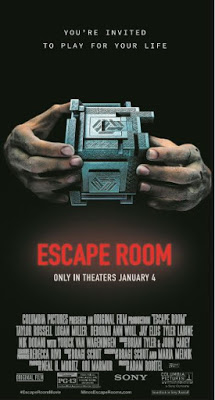
Horror Film Review: Escape Room (dir by Adam Robitel)


Does everyone here remember Escape Room?

Though it may be hard to believe now, Escape Room was actually the first surprise hit of 2019.  When the film was first released on January 4th, nobody expected much from it.  January, of course, is when the year’s worst movies are usually released.  The studios figure that they can get rid of their disasters while everyone’s busy trying to predict the Oscar nominees and usually, the studios are correct.  The ad campaign for Escape Room made it look like just another slasher movie, the mainstream reviewers were, as they tend to be with January horror movies, unimpressed and I don’t think anyone expected the film to make a dent in the box office.

And yet, in the end, Escape Room did pretty well for itself at the box office.  Not only did it open stronger than expected but it remained fairly strong (at least by the standards set by previous January horror films) during its second week of release.  The film managed to hold its own opposite Aquaman, which had pretty much drowned every other competitor.  A sequel was quickly greenlit.

What drew people to Escape Room?  I think it was the title.  For a while, people were genuinely obsessed with the idea of escape rooms.  For those who have a life outside of the internet, an escape room is a game in which a group of people are locked in a room and have to figure out how to get the door unlocked.  This usually involves searching the room, gathering clues, and figuring out a password or something similar.  Personally, I’ve never done the whole escape room thing and, being that I’m rather claustrophobic, I doubt that I ever will.  Add to that, I absolutely suck at solving puzzles so I imagine that I would be trapped in that room for a long time!  However, there are other people who absolutely love escape rooms and I imagine that every single one of them went to see this movie.

Escape Room is about a group of people who all receive a mysterious imitation, inviting them to an escape room and promising $10,000 to whomever wins.  Among those involved, there’s Zoey (Taylor Russell), who is a college student.  She’s studying physics so we automatically know that she’s going to be our hero.  Ben (Logan Miller) is a stockboy and is just bland enough to be a potential romantic interest for Zoey.  Mike (Tyler Labine) drives a truck.  Jason (Jay Ellis) is rich and, therefore, evil.  Danny (Nik Dodani) is the geeky escape room expert.  And Amanda (special guest Deborah Ann Woll) is the Iraq war veteran.  They’re a group of smart people but it apparently didn’t occur to anyone to just stay home for the weekend.  I mean, $10,000 is not that much.

Anyway, it turns out that the escape room isn’t just one room.  Instead, it’s several rooms and each room requires the group to solve a different puzzle.  Each room is also designed to potentially kill.  One heats up like an oven.  Another features a frozen pond, specifically designed to allow a player to fall through the ice.  Another room looks like an operating room from Hell.  My favorite room was the upside down pool hall with the floor/ceiling that started to break up as soon as the group entered.  That was fun.

Of course, it turns out that everyone playing the game has a secret in their past and each room has been designed to force them to confront those secrets.  Eventually, it’s revealed who is behind all of this and it’s not a shock at all.  In fact, Escape Room‘s final scenes are probably the film’s worst because the movie doesn’t really have a conclusion.  Instead, the filmmakers might as have just slapped a big “To Be Continued” across the screen.

Oh well!  Flaws and predictability aside, Escape Room is actually kind of fun.  The characters are all pretty much disposable but the actors all do their best with the material that they’ve been given.  Of course, the film’s main attraction is the chance to see all the various rooms and discovering how they’ve been booby trapped.  Fortunately, each room is fascinating in its own individual way and the puzzles are genuinely challenging.  (I would have totally died if I was in this movie.)

Escape Room is a decent enough way to spend 100 minutes.

Horror on the Lens: Nosferatu (dir by F.W. Murnau)


Today’s Horror on the Lens is a classic film that really needs no introduction!  Released in 1922, the German silent film Nosferatu remains one of the greatest vampire films ever made.  It’s a film that we share every October and I’m happy to do so again this year!

Enjoy!

Scenes That I Love: Jonathan Harker Meets A Vampire Bride in Horror of Dracula


Today’s horror scene that I love comes from the classic 1958 British film, Horror of Dracula.  Horror of Dracula was not only one of my favorite horror films but iit was also a favorite of Gary’s as well and, as I spend today considering how best to honor his memory and his love of cinema, sharing a scene from this film just feels very appropriate.

Horror of Dracula was not only the film that introduced the world to Christopher Lee as Dracula but it was also the film that, for lack of a better term, “rebooted” the whole Dracula legend.  It was the film that showed that Dracula could still be intriguing and frightening in the modern era.  Even more so than the original Dracula starring Bela Lugosi, the Hammer Dracula films — and Lee’s performance as Dracula — have influenced every vampire film that has come out since.

In this scene, Jonathan Harker (John Van Eyssen) leaves his room at Castle Dracula and runs into one of Dracula’s brides (Valerie Gaunt).  Lee’s Dracula doesn’t make an entrance until towards the end of the scene but what an entrance it is!

This scene epitomizes everything that made the Hammer Dracula films so memorable.  You’ve got sex, horror, and Christopher Lee playing Dracula.  What had before merely been the subtext in previous vampire films was revealed by Hammer in all of its glory.

Enjoy!

A Blast From The Past: Responsibility (dir by Herk Harvey)


Director Herk Harvey

The year is 1953 and a rural high school — maybe one that’s a lot like yours — is in chaos!

That’s the idea behind Responsibility, a short film that was apparently designed to make students think about the importance of …. well, responsibility.  Narrated by a rather judgmental principal, Responsibility tells the story of two teenagers.  Lloyd is responsible and mature and boring and probably is destined for a middle management job at the local feed store.  Hank is a new student with a chip on his shoulder and a haircut that screams “trouble.”  Hank is irresponsible but charismatic and, in the real world, there’s absolutely no question who would be the more popular of the two.

However, this is a short film from the 50s so we’re thrown into this weird fantasy world where students actually give serious thought to their options before voting in student elections.  It’s a world where everyone might like Hank better but they just can’t forgive him for blowing off class and losing the big debate tournament.  It’s world where boring old Lloyd could possibly be a more appealing choice than a rebel in a leather jacket.

Lloyd and Hank are friends but that doesn’t stop them from both running for president of the student body.  The initial vote is tied but there is one absentee ballot.  That ballot will determine who will become the new president — unless, of course, the absentee student has a sense of humor and wrote in their own name, like I always used to do.

“Who would you vote for?” the principal asks.

Me?  Why, Gary Johnson, of course!

This is yet another educational short film from Herk Harvey.  Harvey made a career out of doing films like this but, today, he’s best remembered for directing the classic horror film, Carnival of Souls.  We’ll be watching Carnival of Souls later this month.  For now, enjoy Responsibility and ask yourself …. “Who would you vote for?”

4 Shots From 4 Films: The Beyond, The House By The Cemetery, The Howling, Possession


4 Shots From 4 Films is just what it says it is, 4 shots from 4 of our favorite films. As opposed to the reviews and recaps that we usually post, 4 Shots From 4 Films lets the visuals do the talking!

This October, we’re using 4 Shots From 4 Films to look at some of the best years that horror has to offer!

4 Shots From 4 1981 Horror Films

The Beyond (1981, dir by Lucio Fulci)

The House By The Cemetery (1981, dir by Lucio Fulci)

The Howling (1981, dir by Joe Dante)

Possession (1981, dir by Andrzej Zulawski)

Horror on the Lens: Dementia 13 (dir by Francis Ford Coppola)


(I originally shared this film back in 2011 — can you believe we’ve been doing this for that long? — but the YouTube vid was taken down.  So, I’m resharing it today!)

For today’s excursion into the world of public domain horror, I offer up the film debut of Francis Ford Coppola.  Before Coppola directed the Godfathers and Apocalypse Now, he directed a low-budget, black-and-white thriller that was called Dementia 13.  (Though, in a sign of things to come, producer Roger Corman and Coppola ended up disagreeing on the film’s final cut and Corman reportedly brought in director Jack Hill to film and, in some cases, re-film additional scenes.)

Regardless of whether the credit should go to Coppola, Corman, or Hill, Dementia 13 is a brutally effective little film that is full of moody photography and which clearly served as an influence on the slasher films that would follow it in the future.  Speaking of influence,Dementia 13 itself is obviously influenced by the Italian giallo films that, in 1963, were just now starting to make their way into the drive-ins and grindhouses of America.

In the cast, keep an eye out for Patrick Magee, who later appeared as Mr. Alexander in A Clockwork Orange as well as giving a memorable performance in Lucio Fulci’s The Black Cat.  Luana Anders, who plays the duplicitous wife in this film, showed up in just about every other exploitation film made in the 60s and yes, the scene where she’s swimming freaks me out to no end.

(One final note: I just love the title Dementia 13.  Seriously, is that a great one or what?)

The TSL’s Horror Grindhouse: The Yesterday Machine (dir by Russ Marker)


The 1965 film The Yesterday Machine opens with dancing!

Well, okay, actually, it opens with two college students out in the middle of nowhere, listening to an old radio.  Howie Ellison (Jay Ramsey) is working on his car, trying to get the engine to work again.  Margie de Mar (Linda Jenkins) is working on her baton twirling, as one tends to due when stuck out in the middle of nowhere.

As soon as the film started and I got one look at the barren landscape, I knew that it had to have been filmed in my part of the world.  The whole thing just screamed Texas/Oklahoma border.  Then I saw Margie’s boots and then I heard Howie and Margie’s accents and I yelled, “OH MY GOD, THEY FILMED THIS IN TEXAS!”

And, indeed, they did.  The Yesterday Machine is a regional production, through and through.  Nearly everyone in the film has a strong accent and the North Texas landscape is notably flat.  (The film’s harsh black-and-white cinematography actually gives it something of a apocalyptic feel.)  After I watched this film, I did some research and I discovered that this film was shot in Dallas.  Director Russ Marker was a Texas filmmaker and actor.  He apparently directed two films over the course of his short career, this and The Demon From Devil’s Lake.  He also had an uncredited role as a bank guard in Bonnie and Clyde.

(There were actually quite a few low-budget filmmakers working in Texas in the 60s.  The best-known, of course, would probably be Larry Buchanan.  But, at the same time that Russ Marker was shooting this film, Hal Warren was filming Manos: The Hands of Fear.)

Anyway, Howie and Margie are supposed to be heading to a college football game but it turns out that Howie is totally useless when it comes to fixing cars.  So, instead, they leave the car and go looking for help.  After wandering around for a bit, they run into some soldiers who are dressed in Confederate army uniforms.

“Those are some crazy threads, Dad!” Howie says.

Having no respect for Howie’s beatnik ways, the soldiers shoot him and then kidnap Margie.

What’s going on, you may ask.  Well, fear not!  Lt. Partane (Tim Holt) is on the case!  And yes, classic film fans, you read that actor’s name correctly.  Tim Holt, star of both The Magnificent Ambersons and Treasure of the Sierra Madre, lends his gravitas to The Yesterday Machine!  According to the imdb, Holt grew disillusioned with Hollywood in the 50s and gave up the movies, retiring to his ranch in Oklahoma.  He only came out of retirement to play Lt. Partane in this film and Agent Clark in Herschell Gordon Lewis’s moonshiner epic, This Stuff’ll Kill You.  According to imdb, Holt only came out of retirement as a “favor for his friends.”  So, in other words, Tim Holt probably did this movie to be nice.

Helping out Lt. Partane is a reporter named Jim Crandall (James Britton) and Margie’s sister, a singer named Sandy (Ann Pelligrino).  Working together, they investigate why Confederate soldiers are wandering around North Texas and what they discover is that it’s because a fugitive Nazi scientist, Dr. Blake (Charles Young), has built a time machine!  He’s planning on using it to go to the past and help Hitler win World War II!

However, before he does that, he wants to make sure that everyone knows how time travel works.  This leads to a — I kid you not, dear readers — TEN MINUTE LECTURE IN FRONT OF A BLACKBOARD, during which Dr. Blake goes into meticulous detail about how he can travel in time!  It’s interesting because you can tell that the filmmakers actually did go to the trouble of researching all of the theories about how time works and how man might be able to travel into the past and it’s also obvious that they really wanted to show off what they had learned.

But, here’s the thing.  It’s totally unnecessary.  We’ve already seen the Confederate soldiers.  If we’re still watching the film by the time that Dr. Blake shows up then it’s safe to assume that we’ve suspended our disbelief enough to accept that time travel is possible.  There’s no need to convince us.  And, since Young wasn’t exactly the best actor in Texas, having him spend ten minutes madly lecturing the audience wasn’t exactly going to convince anyone that time travel was a plausible reality.  Instead, it just brings the entire film to a halt and kills the small amount of narrative momentum that it had going for it.

Anyway, once Dr. Blake finally shuts up, it’s time to stop his nefarious plans and hopefully make the world safe for college football games.

The Yesterday Machine is a really bad movie but I have to admit that I always kind of enjoy watching these regional oddities.  There’s something touching about everyone’s attempt to turn The Yesterday Machine into a “real” movie and, at its best, the film features the type of enthusiasm that you can only get from a low-budget amateur production.  If nothing else, this movie about time travel is a real time capsule.  Movies like this are about as close to real time machine as we’ll ever get.

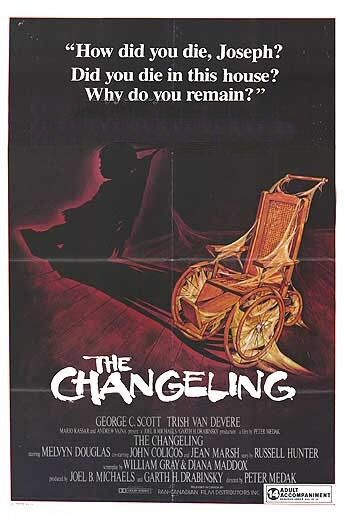
Horror Scenes That I Love: After The Changeling’s seance….


So, last night, at the TSL offices, Jeff, Leonard, Case, and I watched Insidious!  It was an enjoyable experience.  I think we were all surprised to discover just how well Insidious holds up.  When the film reached the seance scene, in which the ghosts were asked questions and a possessed Lin Shaye would write out their answers, I said, “This scene reminds me of the seance scene from The Changeling!

And then I thought to myself, “That should be our next horror scene that I love!”

So, I went to YouTube and I searched for the classic (and really scary) seance scene from Peter Medak’s great 1980 ghost story, The Changeling.  And guess what?  I couldn’t find it!  I found a lot of scenes from The Changeling and I found a lot of people talking about how much they love the seance scene but I couldn’t find the scene itself!

So, here’s the best I could do.  This scene that I love takes place immediately after the seance and features George C. Scott listening and re-listening to a tape of the seance until he can finally hear the voice of the child who, years before, was murdered in his house.

Even if it’s not the seance scene, it’s still pretty good.  I personally consider this to be one of George C. Scott’s best performances.  And the sound of the little boy’s voice on the tape is chilling.

The Changeling is really good, by the way.  You should watch it, if you haven’t already!

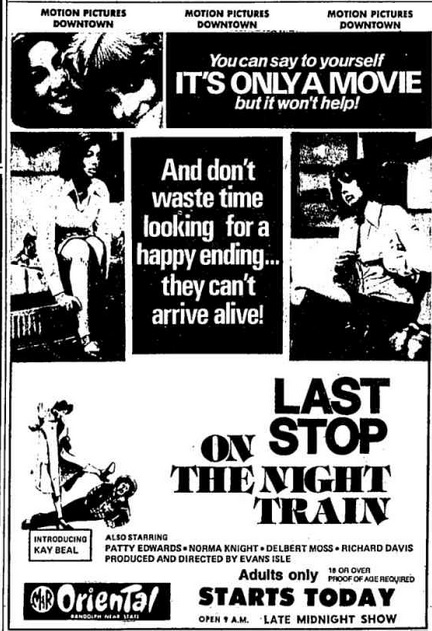
International Horror Film Review: Last Stop on the Night Train (dir by Aldo Lado)


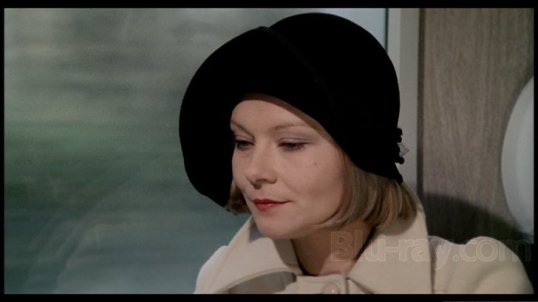
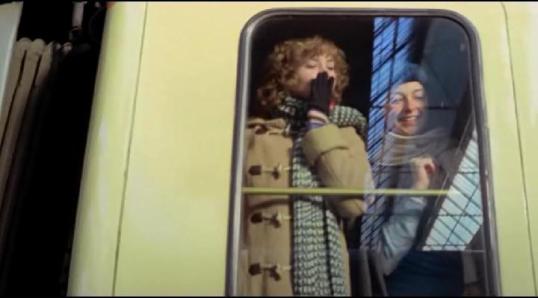
This Italian film from 1975 opens with two German teenagers — Lisa Stradl (Laura D’Angelo) and Margaret Hoffenbach (Irene Miracle) — happily looking forward to the future in general and spending Christmas with Lisa’s parents in specific.  (Of course, the Stradls live in Verona so Lisa and Margaret are going to have to take a train to visit them.)  Their happiness is reflected by the song that plays over the opening credits.  A Flower’s All You Need is perhaps the most obnoxiously happy song to ever show up in an Italian horror film.  Imagine my shock when I discovered that it was apparently co-written by Ennio Morricone.

Like many Italian exploitation films, Last Stop on the Night Train has been released under many different titles.  Here’s just a few: Night Train Murders, Xmas Massacre, Don’t Ride on Late Night Trains, Torture Train, New House on the Left and Second House on the Left.  As those last two titles indicate, this film was directly inspired by the financial success of Wes Craven’s Last House on the Left (which, for what it’s worth, was sold as being a remake of Ingmar Bergman’s The Virgin Spring).  According to an interview with director Aldo Lado, which was included with the film’s Code Red DVD release, the film’s producers approached him and told him that they wanted him to remake Last House On The Left.  Since Lado hadn’t seen Last House on the Left, the producers hastily filmed him on what happened in Craven’s film.  Based on what the producers told him, Lado proceeded to write the script for what would become Last Stop On The Night Train.

As a result, Last Stop on the Night Train follows the general plot of Last House on the Left but with some key differences.  Lado was a protegee of director Bernardo Bertolucci so, not surprisingly, he added a Marxist political subtext to the story, one that makes Last Stop On The Night Train a bit more interesting than the usual exploitation rip-off.  (Wes Craven, it should be said, always said that Last House On The Left was meant to be political, too.  Whether that’s true or not is open to debate.)  Like Craven’s film, Last Stop On The Night Train is about two innocent travelers who are abused and murdered by a group of thugs (played, in this case, by Flavio Bucci and Gianfranco de Grassi).  By an amazing coincidence, the murderers then find themselves staying at the home of one of the girl’s parents (Enrico Maria Salerno and Marina Berti).  When the parents discover the identity of their guests, they get revenge and prove themselves to be just as capable of violence and sadism as the murderers.

The main difference between Craven and Lado’s take on the story is that Lado adds a mysterious character who is identified as being only The Lady on the Train (played by Macha Meril, who also played the unlucky psychic in Argento’s Deep Red).  The Lady on the Train is apparently very privileged.  When we first see her, she is coolly and calmly talking to a group of other wealthy passengers.  The only hint that she’s anything other than an upper class passenger on a train comes when she reveals that she’s carrying a collection of BDSM-themed postcards with her.  Before meeting the Lady on the Train, the two criminals played by Bucci and de Grassi were portrayed as just being obnoxious and larcenous but not necessarily homicidal.  It’s the Lady on the Train who goads the two men into attacking and ultimately murdering Lisa and Margaret, largely for her own amusement.  (Disturbingly, the train’s other upper class passengers are portrayed as being aware of what’s happening but either not caring or being amused by the whole thing.  One passenger — who is later revealed to be an acquaintance of the Stradls — briefly joins in.)  Even at the end of the film, while the parents are savagely attacking the two men, the Lady on the Train watches with the confident certainty that her wealth and position will protect her from any form of retribution.

It’s a disturbing film and definitely not one for everyone.  Even if you appreciate the technical skill with which it was made, this is a film that you won’t necessarily want to rewatch.  (I rewatched it only so I could write this review.  For me, it certainly didn’t help that one of the victims was named Lisa.)  If Wes Craven’s film was ultimately about gore and the idea that violence only leads to more violence, Lado is less concerned with both of those and instead focuses on the idea that, when the privileged and the marginalized both commit the same crime, only the marginalized are punished.  Lado’s film is also far better acted (and, if we’re going to be honest, directed) than Craven’s film, which makes Last Stop On The Night Train the rare rip-off that’s better than its source material.