Given how much I love the 1953 film, Roman Holiday, I’ve probably shared this scene before but that’s okay. It’s an incredibly charming scene and hey, it’s Gregory Peck’s birthday!
Given how much I love the 1953 film, Roman Holiday, I’ve probably shared this scene before but that’s okay. It’s an incredibly charming scene and hey, it’s Gregory Peck’s birthday!
Today is not only Roger Corman’s birthday!
And it’s not just Albert Broccoli’s birthday!
It’s also Bette Davis’s birthday and there’s absolutely no way that we here at the Shattered Lens, as lovers of both classic and modern films, could let the day pass without acknowledging it.
Here’s Bette Davis in a General Election commercial from 1933. This commercial would have been shown in theaters, in between a double feature.

4 Shots From 4 Films is just what it says it is, 4 shots from 4 of our favorite films. As opposed to the reviews and recaps that we usually post, 4 Shots From 4 Films lets the visuals do the talking!
Today, we wish a happy birthday to the one and only Roger Corman! The godfather of indie cinema is 94 years old today. It’s hard to know what’s left to be said about Roger Corman. Corman was the producer who discovered some of the most important filmmakers in the history of American cinema. He’s also the director who had the guts to tackle the important issues that the major Hollywood studios were afraid to acknowledge. When all is said and done, Roger Corman is one of the most important figures in film history. He’s also one of our favorite filmmakers, here at the Shattered Lens.
It’s impossible to do justice to this man’s career with just 4 shots from 4 films but it’s a start.
4 Shots From 4 Films
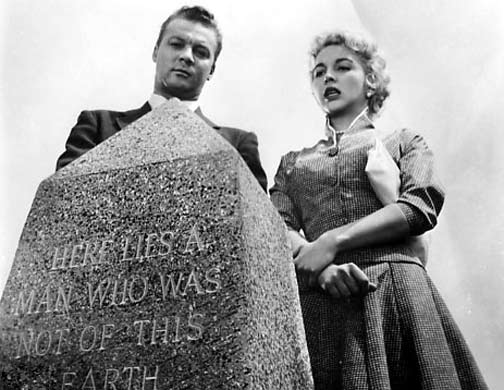
Not Of This Earth (1957, dir by Roger Corman)

The Masque of the Red Death (1964, dir by Roger Corman)

The Wild Angels (1966, dir by Roger Corman)
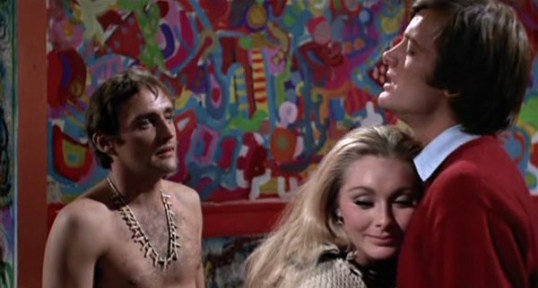
The Trip (1967, dir by Roger Corman)
The 1979 Russian film, Stalker, takes place in a world that might be our own.
In the middle of a wilderness that we assume, just because of the language that’s spoken in the film, to be in Russia, there is an area known as the Zone. The Zone is a place where the normal laws of physics don’t seem to apply. It’s not an easy place to enter and it’s almost impossible to exit but it’s rumored that there’s a very special room located in one of the Zone’s deserted buildings. If you can find the Room, you’re innermost desires will be granted. It’s said, for instance, that a semi-legendary man known as Porcupine found the Room and became wealthy as a result. Of course, Porcupine also hung himself just a few days later.
Legally, no one is allowed to enter the Zone. Soldiers patrol the perimeter and the gate that leads into the Zone is only opened to allow a train to make it’s way through. However, there are outlaws who specialize in leading expeditions through the Zone. They can get people in and, as long as everyone does as instructed, they can hopefully lead people out. One of these outlaws is known as The Stalker (Alexander Kaidanovsky). The Stalker, a former student of Porcupine, lives in a drab village where everything is filmed in Sepia. (By contrast, the Zone is filmed in color.) The Stalker is married to a woman (Alisa Freindlich) who continually begs him to stop leading expeditions into the Zone but who also says that she married the Stalker because his illegal activities bring a little bit of life to an otherwise drab existence. They have a daughter (Natasha Abramova) who is described as being a “child of the zone.” She may have a physical disability, though we’re never quite sure what the exact details of it may be. The final enigmatic shot of the film belongs to her and it’s a shot that makes us wonder about everything that we’ve just previously seen.
The Stalker’s latest clients are the Writer (Anatoly Solonitsyn) and the Professor (Nikolai Grinko). Both the Writer and the Professor have their own reasons for wanting to see the Zone. The Writer is an alcoholic who has lost his inspiration and hopes to find it again. The Professor says that he’s interest in the Zone is a scientific one, though it turns out that his actual intentions are a bit more complex. The Stalker leads them into the Zone but it’s not an easy journey. The Stalker grows annoyed as he comes to realize that the Writer does not share his nearly spiritual reverence for the powers and the mysteries of the Zone. Meanwhile, the Professor obsesses over his backpack, even when the Stalker tells him to leave it behind. There’s something in that backpack that the Professor definitely doesn’t want to lose.
Stalker is a science fiction film but it’s one that has no elaborate special effects. There are hints that the Zone may have been visited by extraterrestrials but the film deliberately leave ambiguous the true origin of the Zone. Director Andrei Tarkovsky instead emphasizes the barren landscape and the discussions between the three men, each one of whom is desperate in his own way. Though the Zone may be filmed in vibrant color while the village is filmed in Sepia tones, both locations are equally desolate.
Watching this film today, it’s impossible not to compare the film’s Zone to the real-life forbidden zone surrounding Chernobyl. However, Stalker was made 7 years before the disaster at Chernobyl. The film’s Zone probably has more in common with the 1908 Tunguska event, which was when something (an asteroid, a comet, or maybe something else depending on how conspiracy-minded one is willing to be) either crashed into or exploded above Siberia. The explosion was the equivalent of 30 megatons of TNT and, needless to say, you can find all sorts of fanciful stories about strange things happening in the area in the years after the explosion. That said, it’s definitely not a coincidence that the modern-day guides who lead unauthorized tours of the Chernobyl area have taken to calling themselves stalkers.
The film itself is a fascinating one, though definitely not one for everyone. As a director, Tarkovsky’s trademark was the long take and the camera often lingers over each scene, inviting the viewer to look for a deeper meaning that may or may not be there. It’s a film that invites the viewer to think and to wonder who is right and who is wrong about the Zone. It’s a film that asks a lot of questions but never claims to have all the answers. The true meaning of it all is left the individual viewer to determine. It really is a film that probably could have only been made by an artist trying to subtly rebel against a totalitarian society. The Writer has lost his inspiration because society has become so drab and corrupt. The intellectual Professor is forced to be deceptive about his true intentions. And the Stalker looks for a deeper meaning that goes beyond what the State has to offer. For that, he’s willing to risk everything.
Tragically, it’s possible that filming Stalker may have contributed to Tarkovsky’s death in 1986. (Interestingly, he died just a few months after the Chernobyl disaster.) Much of Stalker was filmed near a chemical plant and it’s felt that filming in such a toxic condition may have eventually led to the illnesses that not only killed Tarkovsky but several other members of the film’s cast and crew. By the time of his death, Tarkovsky had escaped from Russia and was living in Paris. Today, incidentally, is his birthday. He would have been 88 years old.
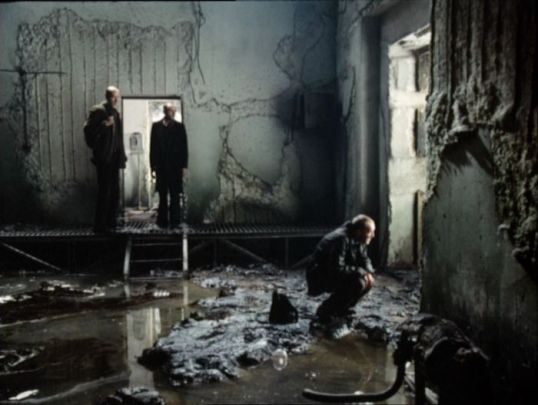

The 1948 Japanese film, Drunken Angel, tells the story of two seemingly different men living in a burned-out neighborhood in postwar Tokyo.
Sanada (Takashi Shimura) is an aging and world-weary doctor. Though he may drink too much and he is occasionally too quick to snap at his patients, he truly cares about the people who live near his clinic. He worries about the spread of tuberculosis, which was a very real concern in postwar Japan and which remains a concern to this day. He continually tells his patients that they need to stop drinking and take better care of themselves, even though he does not seem to be capable of taking his own advice.
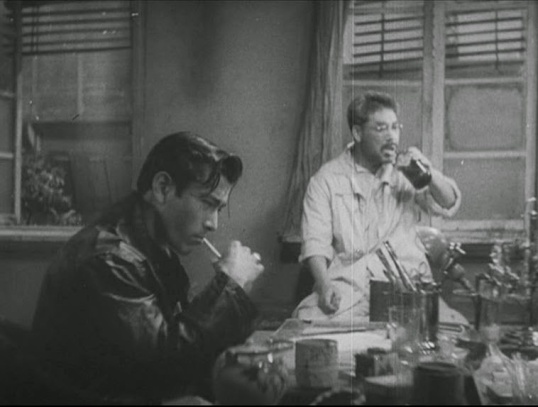
Matsunaga (Toshiro Mifune) is a young Japanese gangster, a member of the yakuza. Matsunaga does everything with a swagger, one that he appears to have largely adapted from Hollywood gangster movies. He not only dresses like an idealized version of an American gangster but he also smokes his cigarettes like one. Everything about Matsunaga gives the impression that he’s desperate to prove that he’s something more than just a small-time hood living in a bombed-out neighborhood that’s centered around a poisonous bog.
One night, Matsunaga shows up at Sanada’s clinic. He’s got a bloody hole in his hand. Mastunaga claims that he walked into a door. When Sanada responds with skepticism, Matsunaga adds that the door had a nail sticking out of it. Sanada may not believe Matsunaga but he’s a doctor so he treats Matsunaga’s wound. Sanada also diagnosis Matsunaga as suffering from tuberculosis and tells him that he has to stop drinking and womanizing. Needless to say, Matsunaga is not pleased with this diagnosis.
Though they start out as antagonists, a weary friendship grows between the doctor and the gangster. Matsunaga even starts to follow the doctor’s advice or, at least, he does until his boss, Okada (Reisaburo Yamamoto), is released from prison. Under Okada’s influence, Matsunaga falls back into his own habits, drinking and going to nightclubs where the musicians perform Americanized music. Okada is also the ex-boyfriend of Sanada’s nurse and, when he threatens to murder Sanada unless the doctor lead him to her, Matsunaga is finally forced to decide which of his two potential mentors will have his loyalty.
Taken on its own, Drunken Angel is an entertaining gangster film that features two memorable lead performances. Takashi Shimura is likable as Sanada while Toshiro Mifune is dangerously charismatic as Matsunaga. Director Akira Kurosawa originally planned for the film to focus solely on Sanada, with Matsunaga only playing a minor role. Mifune, however, so impressed him that he ended up expanding Matsunaga’s role until Mifune was eventually the film’s co-lead. (Following Drunken Angel, Kurosawa would go on to make 15 other films with Mifune.) Kurosawa keeps the action moving at an exciting pace and he frames the story with haunting images of the dilapidated neighborhood that the two men call home.
However, Drunken Angel is even more fascinated with one consider that it was made at a time when Japan, having been defeated in World War II and still traumatized by the nuclear attacks on Nagasaki and Hiroshima, was still occupied by American forces. The film was made at a time when it was still very much an open question as to what role Japan would play in a postwar world. Would Japan become dominated by American culture (which, in this film, is represented by gangsters like Okada) or would it remain true to itself? When Sanada warns Matsunaga that he is surrounded by toxic germs that are making him ill and threatening his future, he could very well have been talking about what Kurosawa perceived as being the threat of Americans transforming Japan into a westernized playground.
In the end, it’s a film that works on many levels, as a gangster film, as a portrait of a friendship, and as a metaphor for a people and a culture trying to find their place in a new and imperfect world. If you haven’t seen it yet, now is the perfect time to do so.
4 Shots From 4 Films is just what it says it is, 4 shots from 4 of our favorite films. As opposed to the reviews and recaps that we usually post, 4 Shots From 4 Films lets the visuals do the talking!
Happy birthday to Lamberto Bava!
4 Shots From 4 Lamberto Bava Films

Macabre (1980, dir by Lamberto Bava)

A Blade In the Dark (1983, dir by Lamberto Bava)
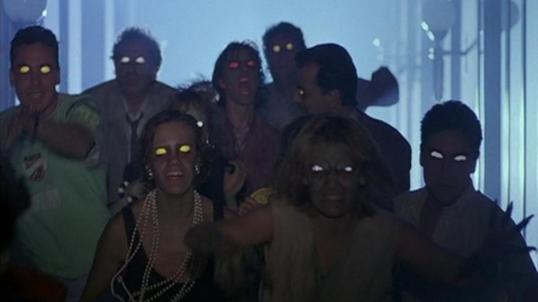
Demons 2 (1986, dir by Lamberto Bava)

Delirium (1987, dir by Lamberto Bava)

96 years ago today, Marlon Brando was born in Omaha, Nebraska.
Unfortunately, Brando is one of those actors who, later in his life, became better known for his eccentricities than for his performances. Though Brando never stopped being a good actor, it’s undeniable that some of his later performances reveal an actor who often did seem to be a bit bored with the films that he was making. It’s sad to think that there’s people out there who might only know Brando because they stumbled across The Island of Dr. Moreau on Starz at like 3 in the morning.
Regardless of the reputation that he developed in his later years, Marlon Brando was one of the best actors of all time. His early performances are still exciting to watch and, even when his work was becoming progressively more eccentric in the 70s and 80s, he still continued to give performances that could grab your attention and leave you surprised by their power.
Of course, my favorite Brando film remains The Godfather so it only makes sense to share a scene from that film on Brando’s birthday. In this beautifully acted scene, Tom Hagen (Robert Duvall) informs Don Vito (Brando) that Sonny has been killed. Of course, first, Tom has to have a drink. This scene might not be as iconic as some of the other scenes in The Godfather but it’s wonderfully performed by both actors and it reminds us that The Godfather is powerful not because it’s a crime film but because it’s a film about family.
On a snowy day in Montreal, a nameless young man (Maxim Gaudette) wanders about a cramped apartment. He loads a rifle. He drives to his mother’s house and leaves a note in her mailbox. He goes to École Polytechnique, the engineering school where he’s a student. Leaving the rifle in his car, he walks around the school. He stares at the students in the cafeteria, observing them with a hatred that they might not notice but which we’ll never forget. He goes back outside. He sits in his car while the snow continues to fall.
As we watch him, we hear him reading the suicide note that he’s written for the authorities. He talks about his belief that the world has been destroyed by feminists. He writes that he’s offended that he is expected to compete with women and that women have an unfair advantage in both the academic and the professional world. He brags about the good grades that he gets, despite the fact that he rarely attends school. He says that he’s never fit in with the world and that woman are to blame. He complains about women competing at the Olympics, showing that he views everything through the filter of his own misogyny. At one point, he apologizes for not being as eloquent as he believes he could be. He explains that he only had 15 minutes to put down his thoughts.
Inside the school, another engineering student, Jean-Francois (Sébastien Huberdeau ) struggles to complete an assignment before his next class begin. He sits in the cafeteria with open books scattered across the table in front of him. Later, we’ll see Jean-Francois running through the hallways of the school, trying to warn the other students that something terrible is happening. He’ll run to a security officer and ask him to call the police, just to be given a somewhat confused look in response. Later still, we’ll see Jean-Francois outside of the school, visiting his family and haunted by guilt.
One of Jean-Francois’s classmates, Valerie (Karine Vanasse), goes to a job interview where the older male interviewer states that he’s shocked that Valerie wants to go into engineering after graduation. Most women, he says, don’t do that. It’s a profession that requires a lot of hard work and it’s not ideal for someone who wants to start a family. Stunned, Valerie lies and says that she doesn’t have any desire to start a family. Throughout the film, we watch as Valerie stop several times at her locker so that she can switch shoes. When she has to deal with stuff like her job interview, she puts on high heels that are obviously very uncomfortable for her. When she just wants to go to class, she has to stop and switch to shoes that she can actually walk in and, at that moment, I knew exactly what she was feeling. Every woman watching will instantly know what she’s going through. Later, she complains to her friend and roommate, Stephanie (Evelyn Brouchu), about how condescending the interview was. Stephanie tells her not to obsess on it.
Outside, the snow continues to fall in the night, creating a bleakly cold landscape and making Montreal look like a barren and bombed-out wasteland.
Later, we’ll see Jean-Francois arriving late for a class. Valerie and Stephanie are already in the class, listening to the lecture. Not long after Jean-Francois claims his seat, the unnamed man steps into the room, carrying his rifle. He orders the males to gather on one side of the room and the women on the other….

These are the moments and images that stick with you, long after the 2009 Canadian film, Polytechnique, concludes it’s brief 77-minute run time. It’s a haunting film, definitely not one to watch if you’re already feeling depressed. What makes it especially disturbing is that it’s based on a true story. On December 8, 1989, an Algerian-Canadian student opened fire at École Polytechnique in Montreal. (The film does not name the killer and I won’t either, because to name him without naming his victims does a disservice to their memory. Those who really want to know his name are free to look it up on Wikipedia.) As seen in the film, the gunman specifically targeted women and even ordered all of the males in the classroom to leave before he opened fire. Also, as seen in the movie, the men did just that, with not a single one trying to stop the gunman or warn others until they were already out of the classroom. The character of Jean-Francois stands in for all of the men who were haunted by their decision to leave. As I watched the film, I had mixed feelings about the men who left that classroom. Yes, the gunman was armed but there were enough men in that classroom that it’s hard to justify the fact that not a single one attempted to intervene.
Before shooting himself in the head, the gunman killed 14 women and wounded 10 women and 4 men. It remains the deadliest mass shooting in Canada’s history. When the police found his body, they also found a suicide note in his pocket, the same note that we hear read at the beginning of this film. In memory of the lives lost, the anniversary of the massacre has been commemorated as the National Day of Remembrance and Action on Violence Against Women.
Poltytechnique, which is dedicated to those who died, was directed by Denis Villeneuve, long before he would come to America and make a name for himself with films like Sicario, Arrival, and Blade Runner 2049. Polytechnique is filmed in harsh black-and-white and Villeneuve skips around in time, often showing us the consequences of the killer’s actions before showing us the actions themselves. It’s an approach that reminds us that the Montreal Massacre and all other acts of violence are events that will forever haunt us. The past will always cast a shadow over both the present and the future.
As I said, it’s not a happy film but perhaps not every film needs to happy. With Polytechnique, Villeneuve mourns for the lives lost on that day in 1989 and he encourages us all to try to create a better world for the future.
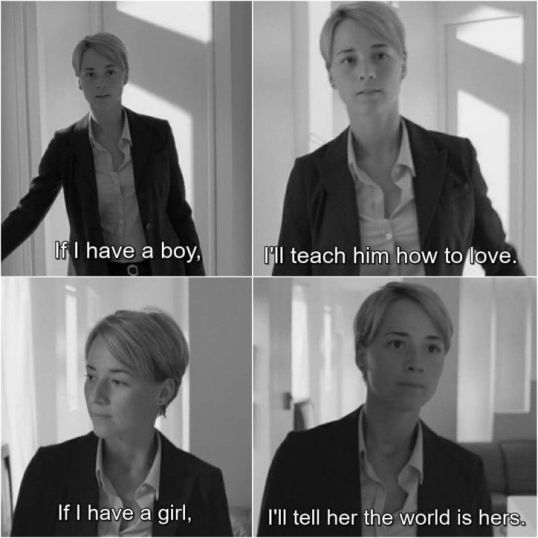
If there’s anything that I’ve discovered over the years, it’s that cinema is truly a universal language.
I’ve lost track of the number of film fans with whom I’ve bonded with over social media. Some of them live near me and some of them live very far away but the one thing that we all have in common is that we all love movies. For instance, I have a friend in India who loves Sofia Coppola almost as much as I do. Meanwhile, I’ve got friends in the UK who are as crazy about horror movies as I am and my friend Carlo in Italy shares my total disdain for Avatar. In short, films bring us together.
This month, I want to celebrate that fact here on the Shatered Lens. Along with my usual reviews, I’ll be taking a look at some films that were produced outside of the United States and far away from the Hollywood studios. Some of these films will be great and some of them probably won’t. Some of these films may be well-known and, again, some of them won’t be. What they all have in common is that they’re out there for discriminating viewers who aren’t scared of having to read a subtitle or two.
I want to start things off by looking at a French film, La fille au bracelet (The Girl With A Bracelet).
This low-key but thought-provoking courtroom drama opens with a family enjoying a day at the beach. We watch them from a distance and they seem almost like the perfect family unit. And yet, that perfection puts us ill at ease. We’ve seen enough movies to know that any family that appears to be perfect is going to be the exact opposite and, even more importantly, director Stéphane Demoustier knows this. Therefore, we’re not surprised when the police suddenly show up. We are perhaps a little bit more surprised when the police lead away not the mother or the father but instead, the teenage daughter, Lise (Melissa Guers).
The film jumps forward two years. Lise has been under house arrest ever since that day at the beach and is required to wear an ankle bracelet, so that the authorities can keep track of her. Lise has been charged with murdering her best friend, Floria. While her father (Rosdchy Zem) insists that Lise is innocent and gets involved in her defense, Lise’s mother, Celine (Chiara Mastroianni), has thrown herself into her work and says that she probably won’t even be able to attend her daughter’s trial.
As for Lise, she refuses to show remorse for a crime that she says she didn’t commit and she refuses to apologize for a lifestyle for which she feels no shame. As the proceedings begin, it becomes apparent that Lise is as much on trial for her perceived coldness and lack of conformity as for anything else. Much of the evidence against Lise seems weak. Lise and Flora had a fight shortly before the murder and Lise’s DNA was found on Flora’s body. Lise claims that she and Flora made up on the same night that Flora was found dead. While her parents listen, Lise’s sexual history is clinically dissected in the courtroom, suggesting that she is as much on trial for not conforming to society’s expectations as she is for any murder that she may have committed. Is Lise on trial because of the evidence or because she’s a member of generation that has been vilified by its elders? Is she on trial because she’s guilty or is she on trial because she’s a young woman who is not reacting the way that society expects women to react?
And yet, even though you want to be on Lise’s side, the film keeps you off-balance. Is it true that Lise is simply mourning her friend in her own way or is it possible that Lise is actually a remorseless murderer? At times, it seems like either one of the two could be true. The film ends on a deliberately ambiguous note, one that may leave some frustrated but which will also leave you thinking.
The Girl With A Bracelet requires some patience. The film plays out at a deliberate and methodical pace. However, your patience will be rewarded with a fascinating mystery that will keep you thinking. The cast is excellent, especially Anais Demoustier as the prosecutor. (Given the film’s theme of generational conflict, it’s interesting that the prosecutor is closer, in age, to Lise’s generation while Lise’s defense attorney is from her parent’s generation.) Melissa Guers makes her film debut in the role of Lise and gives an excellent and intriguing performance as an enigmatic character who always seems like she should be more sympathetic than she actually is.
I was fortunate enough to see The Girl With A Bracelet in Paris. (Two weeks later, and four days after Jeff & I returned home to the U.S., the entire world shut down. It’s strange to think about it now.) It’s a film that’s stuck with me and hopefully it’ll make it’s way over to the States sometime soon.

I know I’ve probably shared this scene in the past but I’m going to share it again because today is Lon Chaney’s birthday! 137 years ago, today, one of the greatest actors of all time was born in Colorado Springs, Colorado. He was the man of a thousand faces and he brought a lot of life to silent cinema.
This scene is from the 1925 version of Phantom of the Opera! That’s Lon as the phantom and Mary Philbin as Christine. In honor of the anniversary of Lon Chaney’s birth, we invited you to enjoy a scene that I love…..
This scene, incidentally, was originally planned to be shot in color. Unfortunately, the lights that were (back then) necessary to film in color were too hot and they caused Chaney’s makeup to melt. So, those plans were scrapped and then scene was shot in black-and-white but, personally, I find the black-and-white to be more effective. I’ve seen a colorized version of this film and it just wasn’t as effective.
 Through the Shattered Lens