Film Review: Left Behind: World At War (dir by Craig R. Baxley)


With the 2005 film, Left Behind: World At War, the Left Behind series enter special guest star territory.  Kirk Cameron and Brad Johnson, while still present in the film, were largely pushed to the background and Louis Gossett, Jr. and Charles Martin Smith popped up as Nicolae Carpathia’s two main adversaries.

Gossett plays President Gerald Fitzhugh.  Smith plays Vice President John Mallory.  (Speaking as someone of Irish descent, it fills me with pride to think that America will someday be led by the presidential ticket of Fitzhugh and Mallory.)  Despite the fact that Carpathia (again played by Gordon Currie) spent the previous film talking about how, under his leadership, there would be no more borders, it appears that there still are borders.  However, Carpathia has a plan to take care of that.  Mallory has discovered the plan but, right after he tells Fitzhugh about it, they’re attacked by Carpathia’s goons.  The presidential limo is blown up and with it, John Mallory.  (Poor Charles Martin Smith.)  Fitzhugh manages to escape, thanks to the help of the Tribulation Force.

It turns out that Carpathia’s latest scheme is to steal the few remaining bibles in the world, lace them with anthrax, and then distribute them back to the believers.  Gossett gets to go full action hero as he tries to stop Carpathia and good for him.  As for the other members of the Tribulation Force, Buck (Kirk Cameron) marries Chloe Steele (Janaya Stephens) and Chloe’s father, Rayford (Brad Johnson), meets his former lover, Hatti Dunham (Chelsea Noble).  Hattie is now Carpathia’s lover and is pregnant with his child.  Some members of the Tribulation Force die over the course of the film.  Buck has a moment of anger at God, which is the best scene in the film because it at least acknowledges that one can believe and still be angry.  The majority of the film, however, is Lou Gossett, Jr. wandering around with a “How did I go from winning an Oscar to appearing in this?” look on his face.

Anyway, credit where credit is due.  World at War is the most action-packed of the Left Behind films and, while it’s still definitely an evangelical film, it’s considerably less preachy than either the first Left Behind film or Tribulation Force.  World at War is pure melodrama, with a lot of plotting and evil cackling and overdone action scenes.  If you don’t want to listen to the dialogue, you can focus on just how small the film’s version of the Oval Office is.  That’s what happens when you try to a globe-spanning epic on a low budget.  Sometimes, you have to settle for a small replica of the Oval Office instead of trying for the real thing.

That’s not to say that World At War is a particularly good film.  Brad Johnson gets even less to do than in the second film and Kirk Cameron is still Kirk Cameron.  Since he lost his job at the end of Tribulation Force, we’re no longer asked to believe that Kirk Cameron’s playing a respected journalist.  Instead, Buck is now just a self-righteous evangelist and, for obvious reasons, it’s easy to believe Kirk Cameron in that role but Kirk Cameron is one of those actors who is far more likable when he’s miscast than when he’s playing himself.  Much as with Tribulation Force, World At War can’t seem to decide just how powerful Carpathia actually is.  He’s got supernatural powers and is apparently actually immortal and yet, he is often easily deceived by the simplest of ruses and is incapable of killing anyone until their usefulness to the film’s narrative has expired.

Louis Gossett, Jr. was smart enough to play a character who dies at the end of World At War, therefore freeing him from having to appear in any more Left Behind movies.  It turned out to be a moot point, however.  This was the last Left Behind film until the recent unsuccessful attempt to reboot the franchise with Nicolas Cage as Rayford Steele.

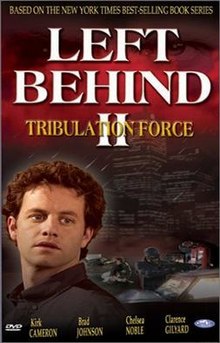
Film Review: Left Behind 2: Tribulation Force (dir by Bill Corcoran)


The 2002 film, Left Behind II: Tribulation Force, begins a week after the Rapture.  I have to admit that it took me by surprise when they mentioned that only a week had passed since the events that kicked off the first Left Behind film because the action in the original film seemed to go on for a lot longer than week.  I guess, if nothing else, that’s a lesson in the importance of keeping your film moving at a steady pace.

Speaking of pacing, Tribulation Force has a bit of quicker pace than the first film.  Now that everyone knows what happened, Rayford Steele (Brad Johnson) and Buck Williams (Kirk Cameron) can jump into action and start working to try to thwart the evil plans of Nicolae Carpathia (Gordon Currie).  Of course, at the start of the film, they’re told that it’s impossible to thwart the evil plans of Carpathia because the Bible has already predicted that he can’t be thwarted.  However, the Bible has also predicated that people will still try so I guess Rayford and Buck really don’t have that much of a choice.

Both Buck and Rayford get minor subplots that are designed to bring some humanity to all of the apocalyptic melodrama.  Rayford is still coming to terms with being left behind and struggling to forgive himself for not going to church with his wife and son.  To give some credit where credit is due, Brad Johnson is this film’s secret weapon.  He doesn’t really get to do much but Johnson brings just enough emotional reality to the role that his scenes have some depth that the rest of the film is missing.

As for Buck, he’s pursuing a tentative relationship with Rayford’s daughter, Chloe (Janaya Stephens).  Unfortunately, he’s also letting his assistant Ivy crash at his apartment and when Chloe stops by and discovers Ivy wearing a towel and an engagement ring, she assumes the worst.  Luckily, Buck’s able to say, “She’s my assistant” and that takes care of that.

Kirk Cameron is pretty much at the center of Tribulation Force, which is a problem because he’s totally miscast as a tough and respect journalist.  Carpathia, who really should have known better seeing as how he’s the son of Satan and everything, decides to turn Buck into the public face of his global news channel.  Unfortunately, there’s nothing about Kirk Cameron that suggests that any character he would play would ever have the gravitas or the charisma necessary to be the public face of any government.  As in the first film, Cameron comes across as being extremely earnest and a little bit dull.  He’s like the intern who accidentally screws up everyone’s lunch order.

Anyway, in Tribulation Force, everyone in the world loves Carpathia, even though he’s the most obviously evil dictator ever.  (The Rapture left behind not just the nonbelievers but also the extremely stupid.)  Carpathia announces the birth of a new world without borders and without religion.  Buck and Rayford plan to televise an interview with the Two Witnesses, who are waiting at the Wailing Wall.  But, to do that, they’re going to have to figure out a way to work around the fact that Carpathia controls all of the news channels….

Despite the fact that Tribulation Force is not as slow as the first film, the bulk of the film is still made up of people having long conversations about Biblical prophecy.  Like a lot of early faith-based films, Tribulation Force gets bogged down in explaining its message as opposed to showing the audience what that message means.  When Buck does finally reach the Wailing Wall, we do get to see some people get set on fire but, other than that, this is a very talky film.  As well, Tribulation Force can’t ever seem to decide just how powerful and all-knowing Carpathia is supposed to be.  At times, he has nearly supernatural powers and yet, at the same time, he’s totally incapable of seeing that Buck and Rayford are both plotting against him.  Is Carpathia a victim of his own hubris or is it just bad plotting on the part of the film?  I’ll leave it up to you decide.

Tribulation Force was followed by one more Left Behind film, World At War.  I’ll review that one in about 15 minutes!  Hope to see you then.


Film Review: Left Behind: The Movie (dir by Vic Sarin)


As I watched the 2000 film Left Behind: The Movie (not to be confused with the remake starring Nicolas Cage), I found myself thinking about names.

For instance, if your name is Rayford Steele, you really probably don’t have any choice but to become a pilot and maybe star in a low-budget action movie.  I mean, let’s just be honest.  People with names like Rayford Steele don’t end up working the night shift at 7-11.  In Left Behind, Rayford Steele is played by Bad Johnson and Johnson has just the right look to play a character named Rayford Steele.  He’s handsome in a somewhat old-fashioned, Gary Cooperish sort of way.

And yes, Rayford is a pilot.  He had a wife who resents the fact that Rayford is always flying off and abandoning his family.  She goes to church and she worries that he’s not a believer.  Rayford, meanwhile, is having an affair with flight attendant Hattie Dunham (Chelsea Noble).  That affair, however, may have to soon come to an end because Hattie has a new job with the UN.  Poor Hattie.  Nothing good ever comes from working at the UN!

Just as anyone named Rayford Steele would have to become a pilot, I imagine that anyone named Buck Williams would have to become a globe-trotting journalist.  We’re told that Buck is one of the most famous and successful journalists in the world.  Someone even mentions that Buck is so brave that he would have reported from Hiroshima while the first atomic bomb was being dropped.  (I assume that would have been a fairly short broadcast.)  Unfortunately, it’s a bit of a struggle to buy Buck Williams as a crusading journalist because he’s played by Kirk Cameron.  Buck is described as being tough and cynical.  There’s absolutely nothing tough about Kirk Cameron.  At his best, he projects an earnest blandness.  At his worst, he reminds you that he’s the guy who, years after starring in this film, would claim that a conspiracy of atheists was responsible for Saving Christmas receiving bad reviews.

Finally, if your name is Nicolae Carpathia, you’re pretty much destined to grow up to be very wealthy and also very evil.  You’re not going to end up living in the suburbs, mowing your own lawn and complaining about property taxes.  No, with a name like Nicolae Carpathia, you’re destined to end up using your position at the UN to take over the world.  When you declare that your goal is to lead the world into “seven years of peace,” everyone knows that you’re planning on doing the exact opposite.

Or, at the very least, everyone should know.  As played by Gordon Currie, Nicolae Carpathia is obviously evil from the minute he first appears.  (Even if you didn’t know his name, you would think he was evil just from the way he smirks.)  However, in the world of Left Behind, almost everyone loves Nicolae Carpathia.  When thousands of people mysteriously vanish, all at the same time, Carpathia is the person to whom humanity turns their tear-brimmed eyes.  The viewers know that it’s the Rapture and Rayford Steele and Buck Williams come to realize that it was the Rapture but Carpathia sees it as an opportunity to lead humanity into a …. dare I say it? …. new world order.

Left Behind is an odd film.  For the most part, it’s a fairly ludicrous film, a low-budget and excessively preachy attempt to create a religious epic on a Wal-Mart budget.  Kirk Cameron is miscast as a journalist and the film’s special effects are so obviously cheap that one can’t help but feel the filmmakers got a bit too ambitious for their own good.  (Just check out the scene at the start of the film when Buck Williams reports while “bombs” explode all around him.)  With a running time of one hour and 40 minutes, the film drags a bit and the characters are often frustratingly dense.  (Even non-evangelicals have, at the very least, heard that there’s a thing called the Rapture.)  And yet, occasionally, there will be moments when the film actually comes close to working.  Brad Johnson, for instance, gives about as good a performance as anyone could as Rayford Steele.  The scene where Carpathia manipulates a subordinate into committing suicide may not be terrible original but it’s still surprisingly effective.

Despite the fact that the film itself barely made a profit, Left Behind would go on to spawn two sequels.  We’ll look at the first, Tribulation Force, in 15 minutes.  Hope to see you then!

Lifetime Film Review: Ruthless Realtor (dir by Devon Downs and Kenny Gage)


So, imagine this scenario.

You’re young, you’re attractive, you’ve got a great career, and you’ve got a partner who is also young and attractive and who has a great career.  You’ve just arranged to buy a new home and it’s a big, beautiful, and surprisingly affordable house.  Of course, you suspect that the house has a history but then again, what house doesn’t?  It’s a little bit annoying that the lights keep randomly going out but that’s what you get for living in California.  So, you move into the house and it seems like everything’s perfect.

Except….

Your realtor simply will not go away!  It’s not enough that she showed you the house and arranged for you to purchase it and that she also apparently lied to the bank on your behalf (even though you certainly didn’t ask her to do that).  She also wants to be your best friend.  She wants to be a part of your family.  You simply cannot get rid of her….

That’s the situation in which Annie (Lily Anne Harrison) and her husband Ralph (Brian Ames) find themselves.  Annie’s a successful lawyer.  Ralph’s a photographer.  Annie’s pregnant with their first child.  The house is lovely.  Everything should be great.  But Meg (Christie Burson) simply won’t stop coming by the house!

Annie thinks it’s strange to come home and find her realtor cooking dinner in the kitchen.  Ralph thinks that it’s nothing to worry about but then, during a photography session, Meg tries to kiss him.  Ralph and Annie tell Meg to stop coming around but Meg keeps showing up.  The increasingly distraught Meg insists that someone was trying to break into the house and that the house itself has a dangerous history that Annie and Ralph need to know about.  Soon, Meg ends up in jail.

Problem solved, right?

Well, no.  Not only does Meg escape from jail but it turns out that there’s even more to Meg’s story than Annie and Ralph originally suspected….

I’ve always felt that one of the best things about Lifetime movies is that they always seem to take place in big houses and Ruthless Realtor proves my point.  The house really is gorgeous, regardless of how many have died inside of it.  When Annie tells her friend Lynette (Alexandra Peters) that she plans on staying in the house regardless of all the craziness going on around and inside of it, you can hardly blame her.  A big house like that?  A few murders are worth the risk!

Along with the big house, the other thing that I liked about Ruthless Realtor is that, as played by Christie Burson, Meg is literally the only likable character in the film.  Even though she’s obviously unstable and tries to break up a marriage, it’s impossible not to sympathize with her.  Annie and Lynette are both extremely self-righteous and full of themselves.  Ralph is painfully goofy.  But Meg actually believes in something and you have to feel sorry for her as she vainly tries to convince Annie that something terrible has happened at the house.  It should be noted that the film seems to fully understand that Meg is a hundred times more likable than any of the other characters and it takes good advantage of that fact with a few twists during the final half of the film.

Ruthless Realtor is an entertaining-enough Lifetime film.  If nothing else, it deserves to be seen for Christie Burson’s performance as Meg and for that beautiful house.


Here’s The Trailer For Come Play!


It’s weird how many Community stars keep popping up in somewhat forgettable horror films.

Alison Brie was in Scream 4.  Joel McHale just did Becky and he was also in Deliver us from Evil.  Donald Glover was in The Lazarus Effect.  Has Chevy Chase done a horror film?  How about Danny Pudi?  According to Wikipedia, he appeared in a movie called Babysplitters.  I can only imagine that’s a movie about splitting babies so that would definitely count….

Anyway, Gillian Jacobs is the latest member of the study group to show up in a horror film.  I will admit that I nearly gave up on the trailer for Come Play when I heard that, “He’s autistic, dude,” line.  Even in the trailer, that felt like a clumsy piece of exposition.  But I stuck with the rest of the trailer and …. well, it’s doesn’t look too bad.  It doesn’t look too good either.  It looks like an adequate Halloween time waster, to be honest.

Anyway, here’s the trailer for Come Play:

Here’s The Trailer for Ammonite!


Down here at the Texas Branch Office of Through the Shattered Lens, our internet and cable were both out on Monday night and for all of Tuesday.  It was Hell but, fortunately, we’re back up and running today.  Unfortunately, as a result of everything being down, I missed the premiere of the trailer for Ammonite.

Ammonite, which stars Kate Winslet and Saoirse Ronan, is expected to be a major Oscar contender.  There’s already speculation that this film could win Winslet her second Oscar and Ronan her first.  Winslet plays paleontologist Mary Anning while Ronan is cast as geologist Charlotte Muchison.  The trailer certainly suggests that the film could very well be a contender.  It’s a period piece starring two acclaimed actresses and dealing with not only universal themes but also subject matter that feels very relevant to what’s happening in the world today.

Well, better late than never, here’s the trailer for Ammonite!

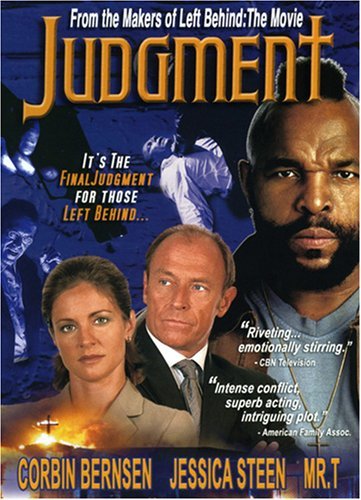
Film Review: Judgment (dir by Andre Van Heerden)


After three previous movies that all dealt with the growing power of Franco Macalousso (Nick Mancuso) and the revolution spearheaded by former journalist Helen Hannah (Leigh Lewis), the Apocalypse saga finally came to a close with the 2001 film, Judgment.

One of the more interesting things about the Apocalypse franchise is that each film was done in the style of a different genre.  Apocalypse was pretty much a straight-forward, faith-based film.  Revelation attempted to be an action film.  Tribulation was a horror film.  Meanwhile, Judgment is a courtroom drama, complete with a witnesses, objections, a corrupt judge, two former lovers turned legal adversaries, and a verdict.  Of course, the verdict itself is never in question.

Helen Hannah has finally been captured by O.N.E.  (That stands for One Nation Earth.)  Instead of just executing her like he does everyone else, Macalousso wants to put her on trial.  He wants to humiliate her while the entire world is watching.  He wants a show trial.  Mitch Kendrick (Corbin Bernsen), who father was a preacher who was executed after a previous show trial, is assigned to serve as Helen’s defense attorney,  Prosecuting the case is Victoria Thorne (Jessica Steen), who is Mitch’s former lover and one of the few people to know that Mitch has a fake mark of the beast on his hand.  Victoria believes that taking part in the trial will finally bring Mitch fully over to the side of Macalousso.

The trial has been carefully scripted out but, to everyone’s shock, Mitch refuses to follow the script.  Instead, he says that Helen cannot be punished because she has only been doing what her God told her to do so, therefore, God should be on trial instead of Helen.  Macalousso decides that he actually likes the idea of putting God on trial so he agrees to let Mitch do his thing.

Meanwhile, a revolutionary named  J.T. (Mr. T) is making plans to bust Helen out of prison but he finds himself frustrated by Helen’s aversion to violence.  J.T. just wants to break into the court and shoot everyone.  “There’s another way,” everyone keeps telling him….

Judgment is the best of the Apocalypse films, which may not be saying much when you consider how bad the other films are.  That said, Leigh Lewis had considerably improved as an actress by the time that she appeared in this film and Corbin Bernsen gives a good performance as a man torn between doing the right thing or doing what he has to do to keep himself safe.  Jessica Steen and Michael Copeman (as the Judge) bring a little bit more nuance than expected to their roles and Nick Mancuso is properly charismatic and smug as Franco Macalousso.  For a faith-based film, Judgment is not particularly preachy and I appreciated the fact that the film’s message was ultimately one of peaceful resistance.  Unfortunately, the film is also about 20 minutes too long.  It clocks in at 102 minutes and there are some parts of this film that seriously dragged.

As I’ve said about the previous Apocalypse films, Judgment actually works better as a political film than a religious tract.  The film presents Franco Macalousso as being the Beast but he could just as easily be seen as the ultimate symbol of collectivism.  When it’s announced that Helen is being prosecuted for the crime of “Hatred of the Human Race” and when witnesses in the court swear an oath to the “unity of all people,” it’s not a subtle moment but it’s a lot of fun for those viewers who tend to value personal freedom over the demands of the collective.

Judgment was the final Apocalypse film, though it doesn’t really bring the overall story to a close.  Tomorrow, we’ll bring our look at the apocalypse to a close with a look at the — God help us — Left Behind series.

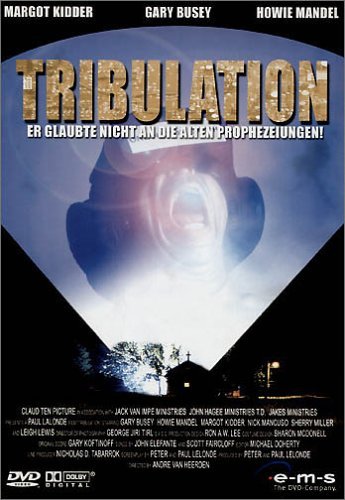
Film Review: Tribulation (dir by Andre Van Heerden)


The Apocalypse saga continues with 2000’s Tribulation!  This is the film that answers the question: How do you get an outspoken atheist and a prominent Jewish entertainer to star in your evangelical Christian propaganda film?  Apparently, you do it by not revealing what type of film that you’re making.

At least, that’s what Margot Kidder said happened.  In an interview with the AV Club, Kidder said that neither she nor Howie Mandel realized that they were appearing in a Christian film until they got on the set, looked at the complete script, and asked why Kidder’s character mysteriously vanished from the film.  According to Kidder, this was a film that she did because she was broke, she couldn’t get a job because she had a reputation for being difficult, and she was offered a lot of money to go up to Toronto for a week and shoot a few scenes.  And so, Kidder, who was not a fan of religion in general, was cast as Eileen Canboro, the outspoken Christian who tries to teach everyone about the rapture.

To quote Kidder: “And I still get stopped by those freaky fundamentalists going “Oh, I’m so glad you did Tribulation.” And I wanna go, “Don’t count me into your group, honeybuns. I’m not one of you.”

As for the film itself, it stars Gary Busey as Tom Canboro, a police detective who is indifferent to religion.  His brother-in-law is Jason Quincy (Howie Mandel), an occultist who, early on in the film, gets possessed by a bunch of Satanists.  The film never really makes it clear why Jason was possessed, beyond I guess to warn against using Ouija boards or reading New Age literature.  After Jason is briefly possessed, the Satanists decide that they have to kill everyone who saw him possessed so that no one learns of their existence.  (But it seems like it would have just been simpler to not possess anyone in the first place.)  All of this leads to Tom eventually slipping into a coma.  Don’t ask how.  It just does.

While Tom’s out of it, the events of the first two movies happen.  Franco Manculousso (Nick Mancuso) magically rids the world of nuclear missiles and declares himself to be the messiah.  Millions of people — including Margot Kidder — mysteriously vanish.  An underground rebellion — labeled “The Haters” by Manculousso — forms against the one world government.  Everyone in the world is given a VR headset that will allow Manculousso to either kill them or steal their soul by giving them the mark of the beast.

(In this film, getting the mark of the beast means that you literally end up with 666 tattooed on your hand.  One thing I always find interesting about films like this is how they take everything in Biblical prophecy so literally.  For instance, 7 is the number of God so therefore it makes sense that the number of the Beast’s number would be 6 because the Beast will always be powerful but ultimately inferior.  He’ll be “one away” from God.  However, films like this always feature people wandering around with 666 prominently displayed on their body and oddly, no one ever says, “Hey, have you ever seen that Omen movie?”)

Anyway, Tom eventually wakes up and finds himself trapped in this brand new world.  It turns out that his sole remaining brother is now prominent follower of Manculousso’s and Jason is now involved in the Hater underground.  A few characters from the previous films pop up, largely so they can be executed by Manculousso.  You know how it goes.

Anyway, if Apocalypse was basically a found footage film and Revelation was an action film, Tribulation is a horror film, complete with demonic possession, exploding heads, and virtual reality snakes.  It’s also a bit slow — it takes forever for Tom to actually enter that coma — but it has a few effective scenes.  Howie Mandel, for instance, really throws himself into being possessed.  As for Gary Busey, Margot Kidder said in that previously cited interview that he was a “pain in the ass” to work with but he actually gives a …. well, I don’t know if it’s really a good performance but it’s definitely interesting.  He’s credible during the first half of the film and then, during the second half of the film, he seems to be genuinely confused.  There’s a few weird moments where he smiles when he definitely shouldn’t be smiling but otherwise, Busey’s okay in this film.

There would be one more film in the Apocalypse saga, Judgment.  I’ll be posting a review of that film in 15 minutes.  Hope to see you there!

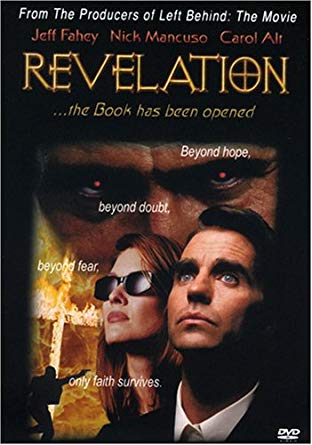
Film Review: Revelation (dir by André van Heerden)


The world which started to end in the 1998 film Apocalypse continues to end in its first sequel, 1999’s Revelation!

Revelation beings three months after the end of Apocalypse.  The people of the world worship the president of the European Union, Franco Macalousso (Nick Mancuso, replacing Sam Bornstein from the first film).   The world is ruled over by O.N.E., which stands for One Nation Earth.  Those who oppose Macalousso’s claim to the messiah are known as “The Haters.”  At the start of the film, a school bus has been bombed and all of the children aboard have been killed.  O.N.E. claims that the Haters bombed the bus but counterterrorist agent Thorold Stone (Jeff Fahey) comes across evidence that it was actually an inside job.  When Macalousso’s second-in-command, Len Parker (David Roddis), attempts to murder Thorold, he’s forced to go on the run.

The Day of Wonders is approaching.  On this day, everyone on Earth is to put on a VR headset.  Macalousso hasn’t made clear what the headset will do but everyone’s planning on doing it because Macalousso has told them to do it and everyone on the planet does what Macalousso says.  Thorold tracks down Willy Spino (Tony Nappa), a wheelchair-bound programmer (in the 90s sense of the term, of course) who is somehow involved with setting up The Day of Wonders.  Willy says that O.N.E. is not the benevolent organization that everyone thinks it is.  You would have thought that Thorald would have figured that out after Parker attempted to kill him but Thorald remains convinced that Maclousso is the messiah and that his wife and daughter previously vanished not because they were Christians but because they were abducted by aliens.

Anyway, long story short, it turns out that Willy’s stepsister is Helen Hannah (Leigh Lewis), the news anchor from the first film.  Helen is now a leader in the Hater underground.  While she tries to convince Thorold that Macalousso is actually the Devil, Willy spends his time flirting with a cynical blind woman named Cindy (Carol Alt).  Both Willy and Cindy find themselves tempted to put on the VR headset, just to see what the Day of Wonders will hold for them….

Revelation is a marked improvement on Apocalypse though, considering how shoddy the production of that first film was, that’s really not saying much.  As opposed to the first film’s stiff performances and reliance on stock footage, Revelation features actual actors, actual sets, and an actual script.  There’s even a few action sequences and some attempts at intentional humor.  That said, if you’re a nonbeliever, Revelation isn’t going to convert you and, about halfway through the film, all of the action stops so that Thorold and Hannah can have a very long discussion about faith and whether or not God should prove his existence by turning over a glass of water.

Like the first film, Revelation actually works better as a political allegory than a religious tract.  Today, it’s kind of easy to laugh at the bulky computers that fill O.N.E.’s headquarters and the scenes where Willy carefully explains what virtual reality and computer viruses are serve as a reminder that, apparently, there was a time when all of this stuff was still viewed as being somehow exotic.  I mean, it’s easy to be snarky about this movie.  But let’s be honest — it’s probably easier today than it was when this film was first released to imagine a world where everyone blindly does whatever the government tells them to do.  And the idea of a group running a false flag operation — like blowing up a school bus and blaming it on unseen enemies — no longer seems quite as outlandish as it perhaps did it 1999.

Revelation was apparently enough of a success that it was followed by yet another sequel.  This one was called Tribulation and I’ll be posting a review of it in about 15 minutes.  Hope to see you then!


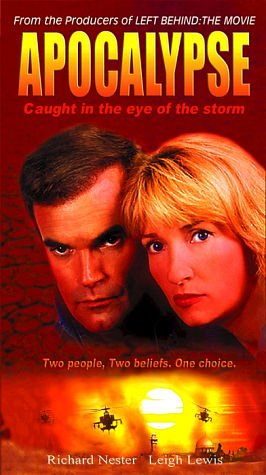
Film Review: Apocalypse (dir by Peter Gerretsen)


In the 1998 Biblical prophecy film, Apocalypse, the world ends not with a bang but with stock footage.  Lots and lots of stock footage.

Admittedly, I’m being a bit snarky about Apocalypse‘s reliance on stock footage but it’s actually kind of understandable.  When you’re trying to convincingly end the world on a budget, it just makes sense to borrow someone else’s footage of a plane exploding than going through the trouble (and expense) of buying a plane and blowing it up yourself.  The two main characters in Apocalypse are both anchorpeople for a 24-hours new channel called WNN.  Because they’re constantly reporting on the end of the world, the stock footage is portrayed as being a part of their report.  That’s kind of clever but it’s also really icky.  For instance, there’s a clip of a woman sobbing in front of an angry crowd.  We’re told that the woman is sobbing because her relatives have mysteriously vanished but, because the footage is in focus and the camera is held steady, we know that we’re actually watching stock footage.  Which means that this woman truly was crying about something but we don’t know what.  It’s hard not to feel that the filmmakers essentially took her pain and used it for their own advantage.  By that same token, when we’re shown people rioting in the streets and getting attacked by police, we’re told that it’s because the world is about to end but we know that there was another real reason why those people were rioting and it’s doubtful that any of those rioting people ever thought to themselves, “Hmmm….I wonder if this footage of me getting chased by the police will ever somehow appear in a propaganda film that has nothing to do with what I’m risking injury to protest about?”

The main characters of Apocalypse are Bronson Pearl (Richard Nester) and Helen Hannah (Leigh Lewis).  Bronson Pearl is the most trusted man in the world.  We know this because there’s a shot of a Time Magazine cover declaring that Bronson is the “Man of the Year.”  (It must have been a slow year.)  When the president of the European Union, Franco Macalusso (Sam Bornstein), announces that 1) he has magically vaporized every nuclear missile on the planet mere moments before Earth went up in a nuclear fireball and 2) he’s the true messiah, Bronson is enthusiastic but Helen has her doubts.  Those doubts are caused by the mysterious disappearance of millions of people across the globe.  One minute, they’re there.  The next minute, they’ve vanished and left behind a pile of neatly folded clothes.  Before Helen’s aunt disappeared, she organized a box of VHS tapes for Helen to watch.  The tapes feature footage of televangelists interpreting prophecy, which of course means that it’s time for more stock footage!

Anyway, you can guess where all of this is leading.  Over the course of six days, the world goes from being on the brink of nuclear war to being ruled over by Franco Macalusso.  Everyone sacrifices their individual freedom so that Maclusso can keep them “safe” and Macalusso even takes over WNN and turns the news channel into his own personal propaganda outlet.  In some ways, this film does feel a bit prophetic.  In the years since this film was first released, news channels have become propaganda outlets and people have started to look to their political leaders as being messianic figures.  In fact, I’d argue that Apocalypse works better as a warning against authoritarianism than it does as a biblical tract.

Which isn’t to say that Apocalypse actually works.  This is a low-budget and stiffly acted film and, as I said before, the use of stock footage of real disasters to stand-in for fictional disasters is undeniably icky.  It’s one of those films that was made for an evangelical audience and which seems to be more concerned with taunting nonbelievers than with actually trying to be dramatically convincing.  Still, if your natural instinct is to distrust authority, you’ll probably find a lot to relate to in Apocalypse‘s not-quite paranoid vision of people being brainwashed into accepting dictatorship.

Or you might just view the film as being a tribute to the power and convenience of stock footage.  I guess it all depends on how you look at it.