October Positivity: Remember The Goal (dir by Dave Christiano)


The 2016 film, Remember the Goal, is all about running track.

Well, actually, I guess it’s not all about running track.  It’s also about the importance of teamwork.  It’s also about the importance of remaining humble, respecting authority, and doing what your coach tells you to do.  In short, it’s a film that makes me happy that I wasn’t on the track team in high school.  I’m not really a fan of authority or doing what other people tell me to do.  For that matter, I’m not really much of a team person.  I’m an individualist who enjoys being around other individualists.  I’m a big believer that people can work together while still allowing everyone to do their own thing and at their own pace.

In short, Coach Courtney Smith-Donnelly (Allee Sutton Hethcoat) would probably not want me on her track team and that’s okay.  Though I will say that, a few years ago, I took up running because I was told that it might help to ease my asthma and it totally has.  I start nearly every morning with a good run.  I enjoy running.  It helps me to clear my head and get my thoughts in order.  Plus, it keeps my legs looking good.

But anyway, back to the film.

Courtney is the new coach at the local Christian school.  Unfortunately, her coaching techniques prove to be controversial.  She wants the members of the track team to pace themselves and to only run at a certain tempo, even if it means losing the race.  Courtney is trying to teach the team how to conserve their energy so that they’ll still have it when they get to State.  All of the parents, though, are upset because they want their daughters to win every race instead of spending all of their time preparing for the state competition.  They’re also not happy when Courtney starts tells them that they need to stop putting so much pressure on their children and instead just have faith in Courtney’s plans.

Meanwhile, the five girls on the team all deal with typical high school problems.  One of them likes a guy but her father has forbidden her from dating and, since this is a Christian film, she decides to honor her father’s wishes.  Another girl has just started smoking weed and, when confronted about it, she replies (quite correctly) that the Bible doesn’t say anything about smoking.  She also points out that most teenagers her age are experimenting with new things.  “An alcoholic starts with just one drink!” her friend replies, “A drug addict starts with just one joint!”  Uhmmm, that’s not really true but it’s enough to get her friend to give up the weed with roots in Hell.

This is another Dave Christiano film that takes a popular genre — in this case, a sports movie — and uses it to push a faith-based message.  The coach continually quotes Corinthians and the end of the film literally compares coaching a cross country team to Jesus raising the dead.  It’s a bit much, even if it’s not quite as preachy as his earlier films.  (No one is condemned to Hell in this film, for example.)  Christiano makes the unfortunate decision to have the final race play out in slow motion.  That’s several minutes of nonstop slow motion.  Unfortunately, slow motion and running are not a great combination, especially when some members of the cast are obviously more experienced runners than others.

Anyway, the main message here (beyond the religious one) seems to be that there’s no “self” in team.  What fun is that, though?  I’ll keep running for myself.

The TSL’s Horror Grindhouse: Beyond The Time Barrier (dir by Edgar G. Ulmer)


This 1960 film tells the story of Bill Allison (Robert Clarke), an air force test pilot who flies his test craft into space and then returns to discover that Earth has totally changed!

The Air Force base where he previously worked is now deserted and desolate.  After he’s captured by a group of silent soldiers, Allison is taken to an underground city known as the Citadel.  He meets the head of the city, an older man known as The Supreme (Vladimer Sokoloff).  The Supreme explains that only he and his second-in-command, The Captain (Red Morgan), can speak and hear.  The rest of humanity communicates through telepathy.  Though the Supreme’s granddaughter, Princess Trirene (Darlene Tompkins), telepathically insists that Allison is not a threat, the Supreme and the Captain still exile him to live with a bunch of angry, bald mutants who are determined to destroy the city.  Allison meets three other exiles and discovers that they too are time travelers.  The scientists explains that Bill has found himself in the far future.  The year is no longer 1960.  No, the year is …. 2024!

OH MY GOD, WE’VE ONLY GOT TWO YEARS LEFT!

Actually, we’ve probably got less than two years left.  This is October and the film appears to be taking place in the summer so we’ve probably only got 18 months to go!

(Cue Jennifer Lawrence: “We’re all gonna die!”  Cue Leonardo Di Caprio: “I’m so scared!”  Okay, tell them both to shut up now.)

Anyway, Allison assumes that society must have collapsed due to a global war but the scientists explain that the first manned spacetrip to the moon actually ushered in an era of peace.  (Wow, how did I miss this?)  In fact, humans had colonized the Moon, Mars, and Venus by 1970.  (Woo hoo!  Yay, humanity!)  However, years of nuclear testing had weakened the Earth’s atmosphere and, in 1971, the planet was bombarded by cosmic rays.  (Uh oh….)  Humanity was forced to move into underground cities.  Some of them developed telepathy and became super advanced.  Others became bald mutants.  Unfortunately, everyone is now sterile and the Supreme probably expects Allison to impregnate Trirene and do his part to repopulate the planet.

On the one hand, Allison and Trirene are falling in love.  Allison is handsome and strong.  Trirene has pretty hair and is the only citizen of the Citadel who gets to wear anything flattering.  They’re a cute couple.  On the other hand, if Allison sticks around the repopulate the planet, he’ll never be able to go back to his present and warn everyone about the upcoming cosmic ray plague.  Plus, it soon becomes clear that the scientists have an agenda of their own.  Allison finds himself torn between the two factions trying to control the Citadel.

Made for next to no money and filmed at Fair Park in Dallas, Beyond The Time Barrier is a surprisingly good film.  It was directed by Edgar G. Ulmer, an Austrian director who started out as an associate of Fritz Lang’s and who followed Lang to the United States.  Ulmer made films for the Poverty Row studios and he was a master of creating atmosphere on a budget.  He was one of the pioneers of film noir and he brought that same style to his horror and sci-fi films.  As envisioned by Ulmer in Beyond The Time Barrier, the future is full of menacing shadows, dangerous con artists, and untrustworthy authority figures.  It’s a fatalistic film, one that ends on a surprisingly downbeat note.  Even if Allison can save humanity, will it really be worth all the trouble?  Much like Detour, Ulmer’s best-known film, Beyond The Time Barrier plays out like a deliberately-paced dream, full of surreal moments and ominous atmosphere.

Beyond The Time Barrier is available on YouTube and Prime.  Watch it now before we have to go underground.

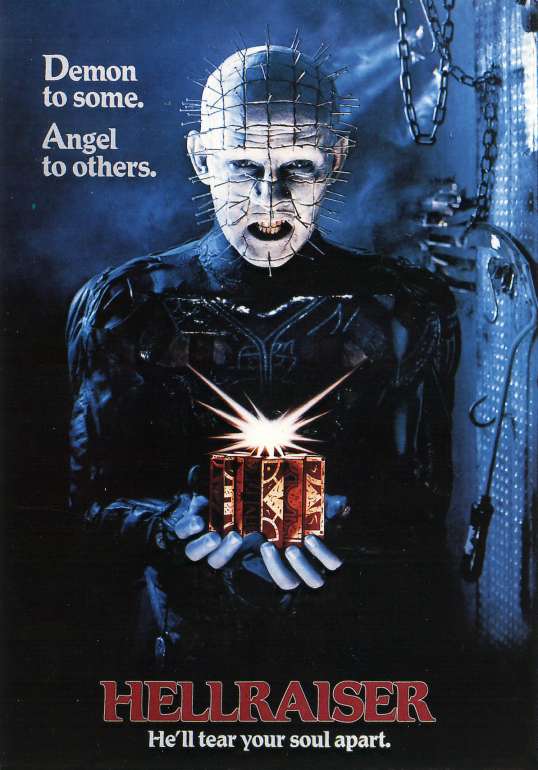
Horror Scenes I Love: The Cenobites Make Their First Appearance In The Original Hellraiser


AGCK!

This is from the original 1987 Hellraiser.  The Cenobites were probably never scarier than they were in their very first appearance.  Perhaps the most interesting thing about them is that, rather than being stereotypically good or evil, they’re actually neutral.  They’re doing their job and, if you don’t want to see them, don’t mess around with the puzzle box.  Doug Bradley was brilliant in the role of the head Cenobite (who, of course, would later be known as Pinhead).

International Horror Review: Don’t Deliver Us From Evil (dir by Joel Seria)


Reportedly, when this 1971 film was released in Europe, it was advertised as being “The French film that was banned in France.”

That wasn’t just hyperbole.  Don’t Deliver Us From Evil was so controversial that it was accused of promoting “blasphemy” and it was barely released in its native country.  It would be thirty years before the film was finally released in the United States and, even then, it would just be a DVD release.  The United States and France may not have agreed on much but apparently, they both agreed that Don’t Deliver Us From Evil was just too dangerous to be released into theaters.

The film is loosely based on a true story, the same 1954 Parker-Hulme murder case that would later inspire Peter Jackson’s Heavenly Creatures.  In Don’t Deliver Us From Evil, Pauline Parker and Juliet Hulme are reimagined as Anne de Boissy (Jeanne Goupil) and Lore Fournier (Catherine Wagener), two 15 year-old girls who meet at boarding school and become fast friends.  Together, they read sordid novels, they spy on the nuns, and they taunt the priest with fictional confessions.  (Anne has erotic fantasies about the priest during Mass.  Are you starting to get why some people considered this film to be blasphemous?)  During the summer, Lore stays at Anne’s estate.  Spending all of their time together, they start to play games that become increasingly dangerous and cruel.  For instance, they playfully taunt a pervy goat herder until the man attempts to rape Lore.  Lore and Anne manage to escape and they get their revenge by burning down the man’s home.  Meanwhile, they also find the time to cruelly taunt their mentally disabled gardener, pledge their souls to Satan, and eventually kill a stranger.  Uh-oh, summer’s over!  Time to go back to school.  Hopefully, Lore and Anne were able to successfully hide the stranger’s body because there certainly are a lot of police around.  It all leads to a shocking and rather disturbing finale.

The question running through the film is whether the girls are evil or if they’re just playing a game.  Many of their actions are undeniably cruel, especially when it comes to taunting the gardener.  But there are other times when Anne and Lore are revealed to be painfully naïve.  Having been raised by nuns and often ignored by their wealthy parents, Anne and Lore’s knowledge of sex and sexuality is largely the result of the “forbidden” books that they read late at night when everyone else is asleep.  For most of the movie, neither seems to care that their “games” have real world consequences but is that due to them being evil or is it due to them being completely sheltered and cut-off from the rest of the world?  When they pledge their souls to Satan, is it because they truly want to be evil or is it just something to do for a laugh?  Anne is undeniably the dominant personality in their friendship.  Anne has a near breakdown when she spends two days apart from Lore but, at the same time, it’s Anne who is constantly instructing Lore to do things that put her safety at risk.  Lore herself seems to be a follower, one who follows Anne even when Anne is putting Lore’s life at risk.

Don’t Deliver Us From Evil has enough sex, violence, and nudity (though Lore and Anne are both 15, the actresses playing them were 19 and 20) that it’s not surprising that the film was controversial.  That said, it’s not a bad film.  Much as Peter Jackson did when he told his version of the Parker-Hulme Murder Case, Don’t Deliver Us From Evil refuses to pass easy judgment on either of the girls.  Instead, it’s left to the viewer to try to figure out if Anne and Lore are evil or if they’re just immature and confused.  Director Joel Seria directs most of his ire not at the girls but at the Church and at Anne’s upper class parents.  Having pushed her off on the Church to raise, Anne’s parents never seem to be particularly interested in what their daughter is doing.  Even during the film’s apocalyptic finale, Anne’s parents (and really, just about every adult in the film) is clueless as to what’s actually happening right in front of them.

Watching the film, I could imagine the controversy that it caused when it was first released.  While some of the once-shocking scenes are tame by today’s standards, there are still a few moments that retain their power to shock.  Ultimately, though, Don’t Deliver Us From Evil is an intelligent exploration of la mauvaise caractère.

10 Shots From 10 Horror Films: 1987 — 1989


4 Or More Shots From 4 Or More Films is just what it says it is, 4 shots from 4 of our favorite films. As opposed to the reviews and recaps that we usually post, 4 Shots From 4 Films lets the visuals do the talking!

This October, I’m going to be doing something a little bit different with my contribution to 4 (or more) Shots From 4 (or more) Films.  I’m going to be taking a little chronological tour of the history of horror cinema, moving from decade to decade.

Today, we take a look at 1987, 1988, and 1989!

10 Shots From Horror History: 1987–1989

Hellraiser (1987, dir by Clive Barker, DP: Robin Vidgeon)

Stage Fright (1987, dir by Michele Soavi, DP: Renato Tafuri)

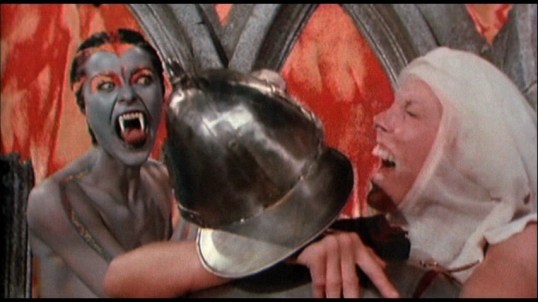
Near Dark (1987, dir by Kathryn Bigelow, DP: Adam Greenberg)

Prince of Darkness (1987, dir by John Carpenter, DP: Gary B. Kibbe)

They Live (1988, dir by John Carpenter, DP: Gary B. Kibbe)

Night of the Demons (1988, dir by Kevin S. Tenney, DP: David Lewis)

The Lair of the White Worm (1988, dir by Ken Russell, DP: Dick Bush)

The Church (1989, dir by Michele Soavi, DP: Renato Tafuri)

Twin Peaks: The Pilot (1989, dir by David Lynch, DP: Ron Garcia)

Friday the 13th Part VIII: Jason Takes Manhattan (1989, dir by Rob Hedden, DP: Bryan England)

Monday Live Tweet Alert: Join Us For Champions and I Can Only Imagine!


As some of our regular readers undoubtedly know, I am involved in hosting a few weekly live tweets on twitter.  I host #FridayNightFlix every Friday, I co-host #ScarySocial on Saturday, and I am one of the five hosts of #MondayActionMovie!  Every week, we get together.  We watch a movie.  We tweet our way through it.

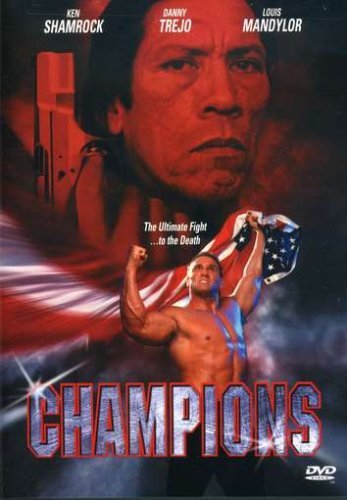
Tonight, for #MondayActionMovie, the film will be 1997’s Champions!  Selected and hosted by @Titus88Titus, Champions is about a retired modern day gladiator trying to avenge the death of his brother. The movie starts at 8 pm et and it is available on YouTube.


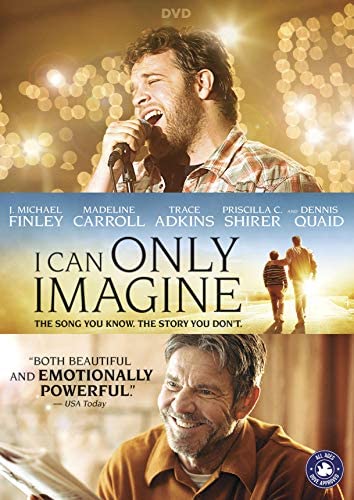
Following #MondayActionMovie, Brad and Sierra will be hosting the #MondayMuggers live tweet.  Tonight’s movie, starting at 10 pm et, will be 2018’s I Can Only Imagine.  The movie tells the story behind the song.  The film is available on Prime!


It should make for a night of intense viewing and I invite all of you to join in.  If you want to join the live tweets, just hop onto twitter, start Champions at 8 pm et, and use the #MondayActionMovie hashtag!  Then, at 10 pm et, switch over to prime, start I Can Only Imagine and use the #MondayMuggers hashtag!  The live tweet community is a friendly group and welcoming of newcomers so don’t be shy.  And reviews of these films will probably end up on this site at some point over the next few weeks. 

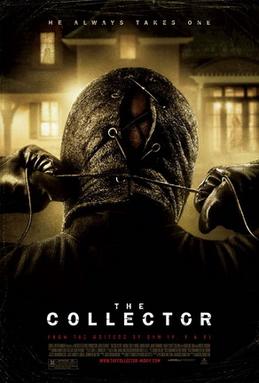
Horror Film Review: The Collector (dir by Marcus Dunstan)


There are a few horror films that I dislike as much as I dislike 2009’s The Collector.

I guess that should be considered fair warning about how this review is going to go.

I’ve only watched this movie two times and, both times, it was as a part of a live tweet group.  The first time that I watched it, I absolutely hated it because I found it to be incredibly mean-spirited and lacking in any sort of wit.  It just felt like a rip-off of the Saw movies, with a bit of Hostel tossed in.  I felt that it was the least imaginative torture show that I had ever watched,

The second time I watched, I know what was coming so my reaction was not quite as viscerally negative as the first time.  I still didn’t like the film but I could at least see that there was some craft involved in the making of the film and there were even a few hints of wit at the start of the film.  I could even respect the fact that the film stayed true to its dark worldview.  The Collector was a truly creepy character, even if his motivations and his techniques made absolutely no sense.

That said, I simply cannot get beyond the death of the cat.

A cat is killed in the film and it’s such a gratuitous and mean-spirited scene that I simply cannot look past it.  There was absolutely no reason to kill the cat, beyond wanting to show off that this film was so hardcore that it was even willing to kill cute pets.  The way the cat died was sadistic.  It was unnecessary and the scene went on forever.  Sorry, The Collector.  You lost me.

What’s interesting, though, is that it’s not just the cat that dies in the film.  At least seven or eight people die over the course of this film.  Of the two main, non-villainous characters who are still alive at the end of the film, one only has a future of physical and mental torture to look forward to while the other is going to be psychologically scarred for the rest of their lives.  And yet, none of the human death and suffering bothered me as much as the death of the cat.  I guess some of that is because the humans were played by recognizable actors and I’ve seen enough behind-the-scenes documentaries to know how all of the gore effects are done.  I didn’t particularly enjoy the many scenes of people being tortured but I knew they weren’t really being tortured and that everyone was getting paid.  Of course, it also helped that none of the human characters were particularly likable or interesting.  The cat, meanwhile, was just an innocent house pet who was killed for absolutely no reason.

And yes, I know they didn’t kill a real cat.  Still, it was way too graphic and drawn-out for me.

So, maybe I just don’t like seeing animals suffer in horror movies.  But it really didn’t bother me when an attacking dog was killed towards the end of the film so maybe I just like cats.

Anyway, I didn’t like The Collector.

Horror on the Lens: The Cabinet of Dr. Caligari (dir by Robert Wiene)


The Cabinet of Dr. Caligari (1920, dir by Robert Wiene, DP: Willy Hameister)

The Cabinet of Dr. Caligari is a film that I’ve shared many times previously on the Shattered Lens.  The first time was in 2011 and then I shared it again in 2014, 2015, 2016, 2017, 2018, 2019, 2020, and 2021!  Well, you know what?  I’m sharing it again because it’s a classic, it’s Halloween, and everyone should see it!  (And let’s face it — it’s entirely possible that some of the people reading this post right now didn’t even know this site existed in any of those previous years.  Why should they be deprived of Caligari just because they only now arrived?)

Released in 1920, the German film The Cabinet of Dr. Caligari is one of those films that we’ve all heard about but far too few of us have actually seen.  Like most silent films, it requires some patience and a willingess to adapt to the narrative convictions of an earlier time.  However, for those of us who love horror cinema, The Cabinet of Dr. Caligari remains required viewing.  Not only did it introduce the concept of the twist ending (M. Night Shyamalan owes his career to this film) but it also helped to introduce German expressionism to the cinematic world.

My initial reaction to The Cabinet of Dr. Caligari was that it simply wasn’t that scary.  It was certainly interesting to watch and I was happy that I was finally experiencing this film that I had previously only read about.  However, the film itself was obviously primitive and it was difficult for my mind (which takes CGI for granted) to adjust to watching a silent film.  I didn’t regret watching the film but I’d be lying (much like a first-year film student) if I said that I truly appreciated it after my first viewing.

But you know what?  Despite my dismissive initial reaction, the film stayed with me.  Whereas most modern films fade from the memory about 30 minutes after the end credits,The Cabinet of Dr. Caligari has stuck with me and the night after I watched it, I even had a nightmare in which Dr. Caligari was trying to break into my apartment.  Yes, Dr. Caligari looked a little bit silly staring through my bedroom window but it still caused me to wake up with my heart about to explode out of my chest.

In short, The Cabinet of Dr. Caligari passes the most important test that a horror film can pass.  It sticks with you even after it’s over.

For the curious with an open mind to watch with, here is Robert Wiene’s The Cabinet of Dr. Caligari!

Enjoy!

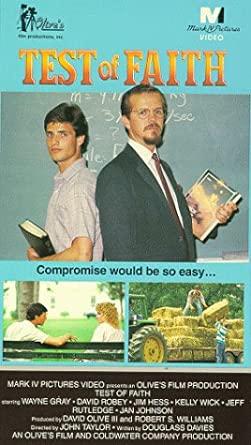
October Positivity: Test of Faith (dir by John Taylor)


The 1987 film, Test of Faith, tells the story of Taylor Mitchell (Wayne Gray) and Prof. Heinlien (David Robey).

Taylor is a religious farm kid who wants to be a scientist.  He’s received a scholarship to a prominent university!  The only catch is that Taylor has to maintain at least a 3.5 GPA or he’ll lose his scholarship.  That shouldn’t be too hard for Taylor.  He’s a smart kid and serious student.  Who could possibly give him a failing grade?

Prof. Heinlien is a Physics professor who is notorious for failing students who disagree with his views on religion, the Big Bang Theory, and evolution.  If a student wants to pass Heinlien’s class, they better be willing to set aside their backwards beliefs and just agree with everything that Heinlien says.  Every student on campus is terrified of Prof Heinlien.  Maybe it’s because Prof. Heinlien has a beard and a goat-tee that makes him look like Satan.

Taylor takes the professor’s class and together….

THEY FIGHT CRIME!

No, actually, they don’t.  Instead, Prof. Heinlien tries to teach about things like the Big Bang Theory and the Theory of Evolution and Taylor keeps interrupting him to argue that there is a scientific basis to the theory of Creationism as well.  Heinlien gets kind of annoyed with him and, if Taylor’s college is anything like my college, I imagine that the other students in the class got pretty annoyed as well.  Most students just want to take the notes, study the right chapters, pass their tests, and move on from the class.  There’s nothing more annoying than when there’s one person in the class who always wants to have a conversation with the teacher.  As I watched Test of Faith, I was reminded of how, in every English class I ever took, there was always one student who had to make a big deal about how “no one would read this book if it wasn’t required!”  Everyone would groan when he started talking but he never seemed to notice.

When it comes to faith-based films, the dilemma of religious students being mocked by atheistic professors has always been a popular subject.  The people behind God’s Not Dead has built an entire franchise out of the idea of Christian students challenging their professors.  Compared to the more recent examples of the genre, Test of Faith is actually rather low key.  Prof. Heinlien, for instance, may disagree with Taylor but, at the same time, he doesn’t bully him.  He doesn’t demand that the students sign a paper declaring that there is no God.  Unlike a typical professor in a film like this, he doesn’t rant and rave about how God didn’t save the life of his wife or mother.  Compared to the way that professors are usually portrayed in films like this, Prof. Heinlien actually comes across as being fairly reasonable.  For that matter, Taylor is not quite as self-righteous as viewers might initially expect.  In fact, Taylor and Heinlien are so reasonable that they’re actually a bit dull.  This is a film that could have used a little melodrama.

I have to admit that films like this, where a student has to stand up to a professor, are always a bit strange to me.  I always assumed that none of my professors knew what they were talking about so I never really worried about whether or not I agreed with them.  I’ve always assumed that most people were the same way.  When did people start respecting their professors enough to debate them?

The TSL’s Horror Grindhouse: Cutting Class (dir by Raspo Pallenberg)


Someone is murdering the students and the teachers at the local high school and it’s up to Paula Carson (Jill Schoelen), the studious daughter of the local DA (Martin Mull), to figure out who is responsible!

Though the principal (Roddy McDowall, who seemed to be cast as a lot of bizarre school employees during the latter half of his career) is a perv and the janitor (Robert Glaudini) fancies himself as being some sort of bizarre ninja with a mop, it soon becomes apparent that there’s really only two viable suspects. One of them is Brian Woods (Donavon Leitch), who has just returned home after spending several months in a mental hospital where he was regularly given electroshock therapy. The other is Dwight Ingalls (Brad Pitt), the alcoholic jock who is under tremendous pressure to win a basketball scholarship and who also happens to be Paula’s boyfriend! Brian and Dwight were friends when they were younger. Now, Dwight spends all of his time bullying Brian and Brian spends all of his time staring at Paula. Who could the murderer be!?

Actually, you won’t be surprised at all when the identity of the murderer is revealed. You’ve probably already guessed who the killer is. A campy slasher film from 1989, Cutting Class doesn’t exactly win any points for originality. If Cutting Class is remembered for anything, it’s for providing Brad Pitt with an early leading role. Pitt, it should be said, is totally convincing as Dwight. On the one hand, he’s such a jerk that it’s difficult to really like him but, on the other hand, he looks like Brad Pitt so you totally can’t blame Paula for putting up with him. For that matter, both Leitch and Schoelen give convincing performances as well. When you’ve got a trio as talented as these three, it’s kind of a shame that Cutting Class wasn’t a better film.

Cutting Class tries to mix horror and comedy but the comedy is too broad (Roddy McDowall leers like a cartoon wolf) while the horror is not quite horrific enough and, as such, the film never really settles on a consistent or an interesting tone. Whenever the film starts to get into a horror grove, Martin Mull shows up like a character in an overplayed Saturday Night Live skit. Whenever the film starts to find itself as a comedy, someone is horribly murdered and you’re totally taken out of the mood. This is also another one of those films where the characters randomly switch from being ludicrously stupid to unnaturally intelligent from scene-to-scene. The killer, for instance, is diabolically clever until the film’s final moments, at which point the murderer suddenly gets very talky and very easily fooled.

Cutting Class is occasionally interesting as a time capsule. It’s from 1989, after all. And it’s interesting to see Brad Pitt playing the type of character one would more likely expect to see on a very special episode of Saved By The Bell. Otherwise, this one is fairly forgettable.