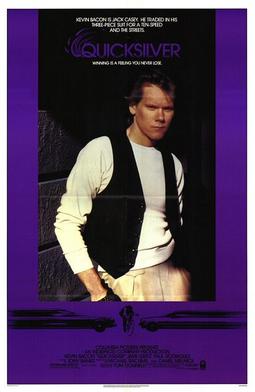
Embracing the Melodrama Part II #77: Quicksilver (dir by Thomas Michael Donnelly)


QuicksilverWho doesn’t love Kevin Bacon?

Seriously, I have yet to meet anyone who doesn’t have a positive reaction to seeing Kevin Bacon on screen.  He may not be a star in the way that Bradley Cooper or Bollywood sensation Shah Rukh Kahn are stars but still, he is one of those actors that everyone just seems to instinctively like.

I think, to a large extent, that is because, despite the fact that he’s been around and acting forever, Kevin Bacon himself still comes across as being a normal, blue-collar sorta guy.  Whenever you see him being interviewed, you get the feeling that Kevin Bacon basically shows up, does his job to the best of his ability, and, as opposed to many other actors, he doesn’t take himself or his movies too seriously.  He’s justifiably proud of the good films that he’s appeared in and he’s never had any problem admitting that he’s been in a lot of bad films as well.

In fact, it was Kevin Bacon’s openness about his bad films that led to me discovering 1986’s Quicksilver.  This is the film that, in a 2008 interview, Kevin Bacon referred to as being “the absolute lowest point of my career.”  (Consider, for a minute, that this is being said by the same Kevin Bacon who had an arrow shoved through his throat in the original Friday the 13th and that will give you some clue of how much disdain Kevin seems to have for Quicksilver.)

Naturally, having read that, I knew that I simply had to see Quicksilver.  I’ll admit right now that I was hoping to discover that it was some sort of loss and unappreciated classic.  I wanted this to be the review where I defended the unacknowledged brilliance of Quicksilver.  I wanted to say, “Don’t be so hard on yourself, Kevin!  Give Quicksilver another chance!”

But no.

Quicksilver doesn’t quite suck but it definitely comes close.

At the same time, it is interesting as a classic example of what happens when a filmmaker tries to assign some sort of deeper meaning to or find inherent nobility in an activity or job that really isn’t that interesting.  Often times, this will happen with sports movies.  A director or producer will make the mistake of thinking that just because he’s obsessed with beach volleyball that means that there’s a huge audience out there just waiting for someone to make the ultimate beach volleyball film.  Or, you’ll get a film like 1999’s Just The Ticket, where Andy Garcia is described as being the “world’s greatest ticket scalper” and the audience is supposed to be impressed.

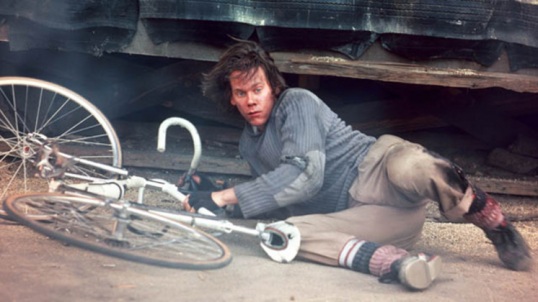
In the case of Quicksilver, it’s all about being a bicycle messenger.  I’m assuming that, one day, director Thomas Michael Donnelly was stuck in traffic and he happened to see a bike messenger rushing down the street, whizzing past all of the stalled commuters.  And Donnelly probably thought, “I wish I was that guy right now!”  Every day after that, whenever Donnelly was stuck in traffic, he thought back to that bike messenger and slowly he grew obsessed.  All of his friends and his family got sick of listening to him talk about how much he envied the freedom of that bike messenger.  Finally, a little light bulb turned on over Donnelly’s head and he said, “I’ve got to make a movie out of this!”

And then the bulb burned out but nobody noticed.
Quicksilver-photo_625px_8col

Kevin Bacon plays Jack Casey.  When we first meet Jack, he’s a successful stock broker and he’s got a really bad, porn-appropriate mustache.  One day, he’s sitting in the back of a cab and he goads his driver into getting into a race with a bike messenger.  The messenger beats the cab.  Jack is amazed!

And then, perhaps the very same day (the film is so poorly edited that it’s hard to tell), Jack not only loses all of his money but all of his parents’ money as well.  Since poor men couldn’t afford facial hair in the 1980s, he shaves off his mustache.  Desperately needing work, Jack applies to be a  — you guessed it! — bicycle messenger.

The rest of the film is basically Jack delivering messages and talking about how he’s free now to live the life that he’s always wanted to live.  And the thing is, you like Jack because he’s being played by Kevin Bacon.  I mean, Kevin Bacon is so inherently likable that audiences even liked him when he was trying to kill Professor X and Magneto in X-Men: First Class.  But, at the same time, you listen to Jack go on and on about how much better his life is now and you just want to say, “Who are you kidding?”

Needless to say, Jack has a group of quirky coworkers.  Of course, by quirky, I mean that they are all quirky in a very predictable Hollywood sort of way.  For instance, there’s the crusty old veteran and the goofy fat guy and the hard-working Mexican guy who wants to start his own business in America and the cocky black guy who is mostly notable for being played by Laurence Fisburne.  One thing they all have in common is that they all love and damn near worship Jack, who has quite the common touch despite having formerly been a super rich stock broker with a bad mustache.

Anyway, Terri (Jami Gertz) also wants to become a bicycle messenger but she’s being used to deliver drugs by Gypsy (Rudy Ramos).  She and Jack fall in love and, along with helping out his quirky coworkers and finding a way to make back his fortune, Jack also has to deal with Gypsy.  It’s all very dramatic (though the drug dealer subplot feels as if it was awkwardly inserted into the film at the last moment) but mostly, the plot is just an excuse for scenes like the one below:

Quicksilver is … well, it’s not particularly good.  It has a few good bike weaving in and out of traffic scenes but it’s definitely no Premium Rush.  But it is kinda fun, in a “Oh my God, look at the 1980s” sorta way.  And, for what it’s worth, it’s a film that proves that Kevin Bacon can be likable in almost anything.
Embracing the Melodrama Part II #76: Children of a Lesser God (dir by Randa Haines)


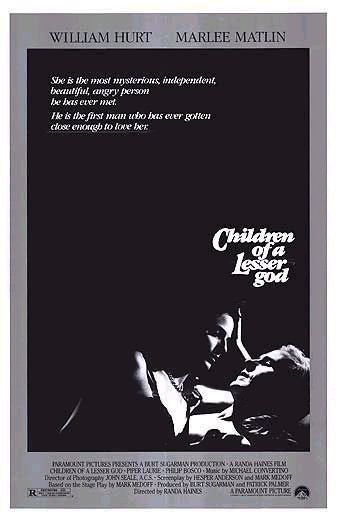
Children_of_a_Lesser_God_film_posterSo, we all know that The Hurt Locker was the first best picture winner to have been directed by a woman.  And we also all know that, when Kathryn Bigelow won her Oscar for that film, she was the first woman to win the Academy Award for Best Director.

But do you know the title of the first film to be both be directed by a woman and to be nominated for best picture?  Well, you probably do now because I’m assuming that you’ve read the title of this post and you’ve seen the picture of the film’s poster above.  But, let’s just pretend that you don’t so I can triumphantly say, “The 1986 film Children of a Lesser God was the first nominee for best picture to be directed by a woman!”

And the name of that director was Randa Haines.  Never heard of her?  You’re probably not alone in that.  After making her feature debut with Children of a Lesser God, Haines only directed three more theatrical films.  Instead, she’s spent most of her career in television and, if not for the nudity and the language, Children of a Lesser God could probably pass for a well-made Lifetime movie.  That’s not necessarily a criticism because I happen to like well-made Lifetime movies.  But still, it’s not surprising that Children of a Lesser God was the only 1986 best picture nominee not to receive a nomination for best director.

(For the record, Platoon won best picture and Oliver Stone won best director.  Nominated in Haines’s place was David Lynch for Blue Velvet.)

As for the film itself, it’s a well-acted and well-made film.  It’s not exactly great in the way that we ideally expect a best picture nominee to be.  It’s directed a bit too much like a television movie and the film ends on a happy note that doesn’t exactly feel earned.  (If any film would have benefitted from a bittersweet conclusion, it would have been Children of a Lesser God.)  Still, at the same time, you can tell why the film was nominated.  It deals with a social issue (in this case, the way that the deaf are marginalized by mainstream society) and it’s a romance between … well, I was going to say mature adults but actually, William Hurt was 15 years older than Marlee Matlin when they played lovers in this film, which adds a perhaps unintentional layer of ambiguity to their relationship.  Children of a Lesser God was also the first film to feature a deaf performer in a lead role and, when Marlee Matlin won the Oscar for Best Actress, she became both the youngest and, to date, the only deaf actress to win.

Ultimately, Children of a Lesser God is more interesting from a historical point of view than a cinematic one.  But the value of history should never be underestimated!  It’s a worthy-enough film and Matlin’s angry performance holds up well.  (As for William Hurt, how you respond to his performance will depend largely on how much tolerance you have for his voice.  Whenever Matlin communicates through sign language, Hurt repeats aloud whatever it is that she’s said.  As a result, the film is basically 2 hours straight of William Hurt talking and, on occasion, it’s a bit too theatrical and distracting.  If the film were made today, the filmmakers would probably just use subtitles.)  Finally, and perhaps most importantly, even if it didn’t lead to bigger things for Randa Haines, Children of a Lesser God did open the door for others to follow.

Embracing the Melodrama Part II #75: Witness (dir by Peter Weir)


Witness_movieLast night, I was lucky enough to watch Witness, a best picture nominee from 1985.

Taking place in Pennsylvania, Witness tells the story of what happens when an Amish widow named Rachel (Kelly McGillis) and her 8 year-old son Samuel (Lukas Haas) decide to take a trip to visit Rachel’s sister.  Traveling on an Amtrak train, Samuel is amazed by his first view of the world outside of the close-knit and insular Amish society.  However, Samuel’s excitement soon turns to horror when they arrive in Philadelphia and he witnesses a man being brutally murdered.

Detective John Book (Harrison Ford, who received his first and, to date, only Oscar nomination for this film) is assigned to the case and arranges for Rachel and Samuel to stay with his sister.  John soon discovers that the murder was committed by two crooked cops, McFee (Danny Glover, who is pure evil in this film) and Ferguson (Angus MacInnes).  John goes to his superior officer, Chief Schaefer (Josef Sommer) with his evidence.  Soon after, McFee attempts to kill and seriously wounds John.  John realizes that Schaefer must be corrupt as well.

Book manages to drive Rachel and Samuel back to their farm in Lancaster County but, after dropping them off, he passes out from blood loss.  Knowing that sending John to the hospital would reveal Rachel and Samuel’s location to Schaefer, Rachel’s father (Jan Rubes) reluctantly allows John to stay at the farm.

And so, while McFee, Ferguson, and Schaefer search for him, John temporarily pretends to be Amish.  He works in the fields.  He helps to build a barn.  He becomes something of a surrogate father to Samuel and he begins a forbidden flirtation with Rachel.

He also goes to town, where he watches as an idiotic local bullies the Amish, knowing that their religion forbids them from fighting back.  John responds by punching a bully, upsetting both the Amish and the a local store owner who yells that this will be terrible for the tourism.  In many ways, the scene is played for laughs and applause but there’s a very serious subtext here, as it would appear that the area’s main appeal to tourists is that you can humiliate the Amish without having to worry about any sort of retaliation.

While we, as viewers, definitely get some satisfaction from seeing John punch that jackass, it also allows Schaefer to discover where he and Rachel are hiding.  One morning, McFee, Ferguson, and Schaefer pull up outside the farm.  They get out of their car and, as the sun rises and with beautiful green fields on either side of them, the three men hold up their shotguns and start to walk down the road….

Witness may technically be a cop film but it’s actually so much more.  It’s a character study of a deeply cynical man who finds himself changed by simple and innocent surroundings.  It’s a love story, with Ford and McGillis illuminating the screen with their chemistry.  It’s a celebration of community, with the harshness of Philadelphia being contrasted with life among the Amish.  It’s a film full of beautiful images and it also features an excellent performance from Harrison Ford.

It’s a good film.  I’m glad that I witnessed Witness.

Embracing the Melodrama Part II #74: Perfect (dir by James Bridges)


PerfectOkay,before reviewing the 1985 film Perfect, I have three things to say.

Number one, I nearly captioned the picture above “John Travolta, Jamie Lee Curtis, and Little Xenu.”  And then I laughed and laughed.  But, in the end, I resisted temptation because I’m an adult now.

Number two, Perfect came out in June in 1985, a few months before I was born.  As a result, I have no idea what the 1985 reviews looked like.  However, it still seems to me that you’re taking a big risk when you give a movie a title like Perfect, especially when the movie itself is far from perfect.  How many reviews opened with, “Perfect fails to live up to its name…”

And finally, as a result of seeing both this film and Staying Alive, I have to say, “What the Hell, John Travolta?”  Seriously, what the Hell was going on?  John Travolta gave a great performance in the 1970s, with Saturday Night Fever.  And then in the 1990s, he was good in Pulp Fiction, Get Shorty, Face/Off, Primary Colors, and a few others.  (For our purposes here, we shall pretend that Battlefield Earth never happened.)  Even though most of Travolta’s recent films have been forgettable, his performances have generally been adequate.

So, seriously, John — what was going on in the 80s?  Because judging from both Perfect and Staying Alive, John Travolta apparently totally forgot how to act during that decade.  When I reviewed Staying Alive, I said that Travolta’s performance managed to create a whole new definition of bad.  But he’s actually even worse in Perfect.  It helped, of course, that in Staying Alive, Travolta’s character was supposed to be stupid.  In Perfect, on the other hand, he’s actually supposed to be a brilliant reporter.

Or, at the very least, he’s supposed to be brilliant by the standards of Rolling Stone.  Travolta plays Adam Lawrence, an award-winning reporter for Rolling Stone.  The magazine, by the way, plays itself and so does its publisher, Jann Wenner (though his character is technically named Mark Roth).  What’s interesting is that the film itself doesn’t necessarily paint a flattering picture of Rolling Stone or Jann Wenner, though admittedly a lot of that is due to the fact that Wenner himself gives a performance that is even worse than Travolta’s.  It’s impossible to watch Perfect without thinking about the fact that Adam is writing for the same magazine that would eventually put Dzokhar Tsarnaev on the cover and publish the UVA rape story.

Anyway, if I seem to avoiding talking about the exact plot of Perfect, that’s because there’s not really much of a plot to describe.  Adam, a hard-hitting investigative journalist, is doing research on a story about how people are hooking up at gyms.  Wenner agrees.  “We haven’t done L.A. in a while!” he says.  Adams joins the a gym called the Sports Connection, which he is soon calling “The Sports Erection” because he’s a super clever reporter.  He falls in love with an aerobics instructor, who is played by Jamie Lee Curtis.  She doesn’t trust reporters but is eventually won over by Travolta’s … well, who knows?  Mostly she’s won over because the plot needs some conflict.  She gets on Adam’s computer and she types, “Want to fuck?”  Adam says sure but then tries too hard to dig into the dark secret from her past.  “You’re a sphincter muscle!” she shouts as him.  Adam writes a compassionate and balanced article about the Sports Connection.  Wenner edits the article and turn it into a sordid hit piece.  (And again, you wonder why Wenner agreed to play himself.)  Feelings are hurt, issues are resolved, and eventually everyone takes an aerobics class.

Honestly, the entire movie is mostly just a collection of scenes of Jamie Lee Curtis and John Travolta working out.  And, in all fairness, Curtis does about as well as anyone could in this terrible film.  Travolta, on the other had … well, just check out the scene below and maybe you’ll understand why I had a hard time concentrating on Travolta’s acting.

Perfect fails to live up to its name.

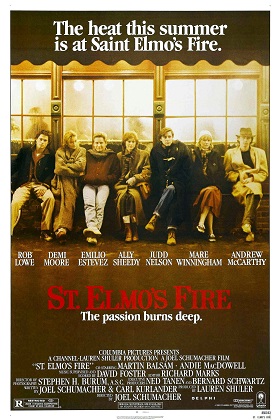
Embracing the Melodrama Part II #73: St. Elmo’s Fire (dir by Joel Schumacher)


St_elmo's_fire

Oh my God!  Aren’t rich, white people just like the worst!?

Actually, usually I would never say something like that.  I usually find class warfare to be tedious and I personally think poor people can be just as annoying as rich people.  I had no interest in the whole Occupy Wall Street thing and I once referred to V For Vendetta as being V For Vapid.

No, I may not be much of a class warrior but then again, that may be because I never met any of the characters at the center of the 1985 film St. Elmo’s Fire.  Seriously, if anything could turn me into a slogan-spouting, window-smashing revolutionary, it would be having to deal with any of the self-centered, entitled characters in St. Elmo’s Fire.

St. Elmo’s Fire is about a group of seven friends, three of whom are played by actors who co-starred in The Breakfast Club.  These friends all met at and are recent graduates from Georgetown University.  St. Elmo’s Fire follows them as they laugh, love, drink, do drugs, and try to figure out what they want to do with the rest of their lives.

For instance, there’s Billy (Rob Lowe), who has big hair and wears one dangling earring.  Billy was in a fraternity and spends most of the movie wishing that he still was.  Billy also plays the saxophone and he has a wife and a kid who he has pretty much abandoned … well, you know what?  I like Rob Lowe.  He seems like a fun guy and his DirectTV commercials were all classics but oh my God, does he ever give a bad performance in St. Elmo’s Fire.  Some of it is because Billy is not a very likable character.  He’s supposed to be the rough-around-the-edges, secretly sensitive rebel type but ultimately, he just comes across as being a loser.

And then there’s Jules (Demi Moore), who does too much cocaine and, as a result, finds herself fearing that she’s on the verge of being sold into a sexual slavery.  Jules doesn’t get to do much other than be rescued by the other characters.  Fortunately, when it looks like the group is drifting apart, Jules attempts to commit suicide and brings everyone back together.  Way to be a plot device, Jules!

Wendy (Mare Winningham) is the sweet but insecure virgin who has a crush on Billy.  Wendy works as a social worker and ends up getting insulted by the very people that she’s trying to help.  Winningham gives one of the film’s better performances but you can’t help but feel that Wendy deserves better friends.

Speaking of good performances, Andrew McCarthy also gives a pretty good one.  McCarthy plays Kevin Dolenz, the idealistic writer who everyone is convinced is gay because he hasn’t had sex in 2 years.  However, Kevin is actually in love with his best friend’s girlfriend.  As written, Kevin runs the risk of coming across as being insufferably moralistic but McCarthy gives a likable performance.  He turns Kevin into the nice guy that we all want to know.

And then there’s the Breakfast Club alumni.

Alec Newberry (Judd Nelson) was the vice-president of the Georgetown Democrats but now, because it pays better, he’s taken a job working for a Republican senator.  Alec’s girlfriend is Leslie (Ally Sheedy).  Alec obsessively cheats on Leslie, claiming that he can’t be loyal to her unless she’s willing to marry him.  The group of friends is largely centered around Alec and Leslie though it’s never really clear why.  Alec and Leslie are boring characters and, as a result, they’re a boring couple.

And then there’s Kirby (Emilio Estevez).  Estevez gives a likable performance but he often seems to be appearing in a different movie from everyone else.  Kirby is working on his law degree and he’s in love with a hospital intern named Dale (Andie MacDowell).  Unfortunately, Dale isn’t as interested in Kirby as he is in her so Kirby responds by stalking her and trying to change her mind.  There’s an earnestness and sincerity to Kirby that makes you like him, even if his behavior is actually rather creepy.

As for the film itself — well, it’s directed by Joel Schumacher and there’s a reason why Schmacher has the reputation that he does.  As a director, Schumacher is good at gathering together an attractive cast but he has close to no idea how to tell a compelling story.  St. Elmo’s Fire plods along, dutifully telling its story but providing little insight or surprise.

If you’ve read some of my previous reviews, you’re probably expecting this to be the point where I argue that St. Elmo’s Fire works as a time capsule.  But, honestly, this film doesn’t have enough insight to really work as a time capsule.  I mean, if you love 80s hair and 80s fashion, you might enjoy St. Elmo’s Fire but, then again, you could always just do a google image search and have the same basic experience.

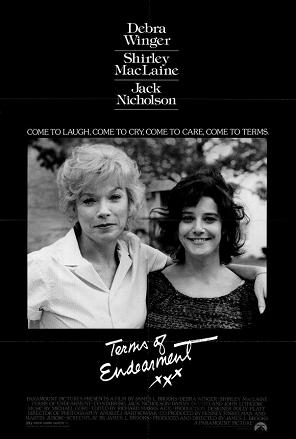
Embracing the Melodrama Part II #72: Terms of Endearment (dir by James L. Brooks)


Terms_of_Endearment,_1983_film

I have to admit that, when I first sat down and watched the 1983 best picture winner Terms of Endearment, I was actually taken by surprise.  Before I actually saw it, I was under the impression that Terms of Endearment was considered to be one of the weaker films to win best picture.  I had read a few reviews online that were rather dismissive of Terms, describing it as being well-made but overrated.

But then, a few weeks ago, I watched Terms of Endearment on Netflix.  The film started with a scene of new mother Aurora Greenwood (Shirley MacClaine) obsessively checking on her daughter, Emma.  Stepping into the bedroom, Aurora is, at first, scared that Emma’s dead.  Without bothering to take off her high heels, Aurora nearly climbs into the crib to check on her.  Fortunately, Emma starts to cry.

And I laughed because I’ve been told about how my mom used to obsessively check in on me when I was a baby.  And, while my mom was never the type to wear high heels around the house, I could still imagine her climbing into a crib to check on me and my sisters.

And then, when Emma (now played by Debra Winger) married Flap Horton (a very young Jeff Daniels) over the objections of her mother, I smiled but I didn’t laugh because, in this case, I was relating to Emma.  Because the fact of the matter is that every girl has known a boy like Flap Horton, the smart and funny guy who is destined to ultimately hurt her.

And when Flap got a job in Des Moines and Emma moved from Houston to Iowa, I knew — as did Aurora — what was going to happen.  I knew that Flap would deal with his insecurity over not being a good provider for his wife and children by cheating on his wife.  And when he did, I wanted to cry with Emma.

But then I wanted to cheer when Emma has an affair of her own.  In the role of Sam, John Lithgow doesn’t have much screen time in Terms of Endearment but he does get the best line.  When a rude cashier claims that she doesn’t feel that she was being rude to Emma, Sam replies, “Then you must be from New York.”

Meanwhile, the widowed Aurora is having an affair of her own.  Jack Nicholson plays Garrett Breedlove, a former astronaut who now has both a drinking problem and a house with a pool.  Garrett gets Aurora to loosen up.  Aurora makes Garrett realize that he actually is capable of being a decent guy.  MacClaine and Nicholson both won Oscars for their performances here and they deserved them.

And then, Emma was diagnosed with cancer.  And I cried and cried because, at this point, I had come to think of Emma and Aurora as being real people.  And when Emma told her friends that she was dying and she spent her final days with her children, I sobbed because it made me think about my mom.  And now I’m sobbing as I write this review.

But it’s a great film, even if it did make me cry.  Because, in the end, you’re glad that you got to know these characters.  And, even through the tears, the film leaves you happy that you got to spend some time with them.

And isn’t that what a great film is supposed to do?

Embracing the Melodrama Part II #71: Cocaine: One Man’s Seduction (dir by Paul Wendkos)


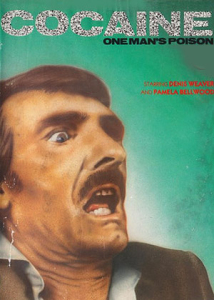
CocaineNow, I originally saw the 1983 made-for-TV movie Cocaine: One Man’s Seduction on Netflix so I have absolutely no first hand knowledge of how this film was advertised.  However, I have it on very good authority (i.e., I read it on another blog) that the image above is from the film’s VHS packaging.

Just looking at this image, you would be justified in thinking that Cocaine: One Man’s Seduction was an early David Cronenberg film.  Seriously, it looks like a deleted scene from Scanners and Dennis Weaver’s head is about to explode.

But no!  There are no scanners in Cocaine: One Man’s Seduction.  David Cronenberg did not direct this film.  As far as I can tell, it wasn’t even filmed in Canada.  Instead, Cocaine: One Man’s Seduction is about one man who gets seduced cocaine.

You may have noticed that I enjoy reminding you that this film is called Cocaine: One Man’s Seduction.  That’s because that’s a great title.  If the film had just been called Cocaine, you might watch the film expecting it to be set on a 1970s film set.  And if the film had just been called One Man’s Seduction, viewers may have watched the film expecting a Double Indemnitystyle film noir.  But Cocaine: One Man’s Seduction leaves no doubt about what we’re about to see.

Add to that, it’s a very melodramatic title and the name of this series of reviews is, after all, Embracing the Melodrama Part 2!

Anyway, Cocaine: One Man’s Seduction is about a real estate agent named Eddie Grant (Dennis Weaver).  He’s the type of semi-successful white-collar suburban guy who you just know is going to have a really over-the-top midlife crisis.  He has a wife (Karen Grassle) who loves him.  He has a son (James Spader — yes, that James Spader!) who wants to put off going to college for a year.  Eddie also has a job where he’s viewed as being an over-the-hill relic.  People looking to buy a new home simply are not impressed with Eddie’s cheap suits, mild manner, and old-fashioned scotch-after-work style.

What Eddie needs is a new wardrobe and aviator sunglasses.  And, as we all know from watching movies set in the 70s and 80s, nothing gets you into aviator sunglasses faster than snorting a line of coke.

Soon, Eddie is driving a fast car, he’s wearing nicer suits, and he’s keeping a lot of secrets.  Then, one day, his son — JAMES SPADER! — happens to look inside Eddie’s shave kit and discovers where dad has been hiding his cocaine.

Now, this is where I was expecting Jeff VanVondern to show up and say, ” I see a bunch of people that love you like crazy and they feel like they are losing you. And they wanna fight to get you back.”  But apparently, people in the 80s did not need an intervention to get them to go to rehab.  Instead, they just needed to have a dramatic nose bleed at work and nearly overdose on someone else’s kitchen floor.  They also needed to be called out by James Spader.

Of course, it also helps that Eddie is friends with a recovering cocaine addict who is played by a very thin-but-already-bald Jeffrey Tambor.  Jeffrey Tambor is already something of a hyperactive actor (and that’s why we love him!) so when you combine that natural tendency with a character who is supposed to be coked up, it’s something that simply has to be seen.

Anyway, Cocaine: One Man’s Seduction is a fairly good example of the-worst-that-can-happen-will-happen cinema.  If nothing else, it has some worth as a time capsule and it’s undeniably interesting to see James Spader play a role that one would normally never associate with James Spader.

Cocaine: One Man’s Seduction is currently seducing viewers on Netflix.

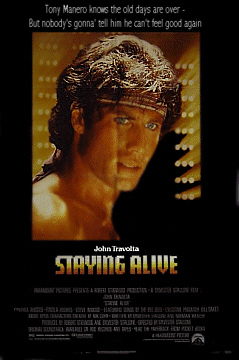
Embracing the Melodrama Part II #70: Staying Alive (dir by Sylvester Stallone)


StayingaliveOh my God, this is so bad.

The 1983 film Staying Alive is a sequel to Saturday Night Fever.  That’s right, Tony Manero’s back!  And, if possible, he’s even dumber than before.

Actually, that’s not fair.  The whole point of Saturday Night Fever was that Tony really was not that dumb.  He was poorly educated.  He was a prisoner of his culture and his economic situation.  If he acted stupid, it was because he lived in a world that distrusted intelligence.  If he was selfish, it was because that was his way of dealing with his own insecurities.  If we got frustrated with him, it’s because we knew he was capable of more than he realized he was.  In Saturday Night Fever, John Travolta gave such good performance and Tony was such a carefully drawn character that we forgave him for the many times that he let us down.

But, in Staying Alive, Tony is just an idiot.  Somehow, he’s managed to escape Brooklyn.  He now works as a waiter and a dance instructor and goes on auditions for Broadway shows.  He has no contact with his old friends.  (He never even mentions the night that one of them jumped off a bridge.)  He lives in one of those scary New York flophouses — apparently the same one that Travis Bickle called home in Taxi Driver — but otherwise, Tony’s doing pretty well for himself.  The only problem is that Tony is now a complete and total moron.

That really is the only conclusion that one can draw from John Travolta’s performance here.  It’s not just that Travolta gives a bad performance in a role for which he was once nominated for an Oscar.  It’s that Travolta gives such a bad performance that he actually transcends the accepted definition of bad.  He resurrects all the tics from his Saturday Night Fever performance but he goes so overboard with them that you feel like you’re watching someone do an imitation of John Travolta playing Tony Manero than actually watching John Travolta.

Speaking of self-parody, Staying Alive was directed by Sylvester Stallone.  Now, I know that when you think of the ideal director for a dance movie, Sylvester Stallone is probably the first name that comes to mind.

As for the film itself, Tony gets a job working in the chorus of a Broadway show called Satan’s Alley and, wouldn’t you know it, he eventually replaces the male lead.  Tony finds himself torn between the bitchy (and, somewhat inevitably, British) star of the show (Finola Hughes) and his long-suffering, on-and-off again girlfriend Jackie (Cynthia Rhodes).

Jackie, incidentally, is also the lead singer in a band.  The band’s guitarist, Carl, is in love with her.  Guess who plays Carl?  Frank Stallone!  That’s right, the director’s brother.  There is a hilarious scene where Carl plays guitar while shooting a death glare at Tony.  Frank really nails that death glare.

But, ultimately, the main appeal of Staying Alive is that we get to see Satan’s Alley, which is probably the most unintentionally hilarious fake Broadway show to ever be immortalized on film.  Satan’s Alley is about one man’s journey into Hell and… well, that really sums it up, doesn’t it?  If you asked someone who has never danced, never listened to music, and perhaps never actually stepped outside of their bedroom to write a Broadway musical, chances are that they would come up with something like Satan’s Alley.

And they’d probably cast Tony Manero as the lead!

Embracing the Melodrama Part II #69: Bad Boys (dir by Rick Rosenthal)


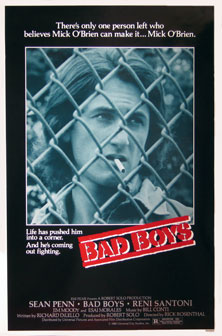
Bad_Boys_(1983_film_poster)First off, I am not about to review the Michael Bay film where Will Smith and Martin Lawrence shoot people and blow things up.  Instead, this Bad Boys is a film from 1983 where Sean Penn doesn’t shoot anyone but that’s mostly because he can’t get his hands on a gun.  And, at one point, a radio does blow up.  So, perhaps this Bad Boys has more in common with the Michael Bay Bad Boys than I originally realized.

Anyway, Bad Boys is about Mick O’Brien (Sean Penn), who is a 16 year-old criminal from Chicago.  One night, when one of his crimes goes wrong, Mick’s best friend (Alan Ruck) is killed and Mick accidentally runs over the brother of rival gang leader, Paco (Esai Morales).  Mick is sent to juvenile detention where he and his sociopathic cellmate, Horowitz (Eric Gurry), team up to overthrow the two “leaders” of their block, Viking (Clancy Brown, with scary blonde hair) and Tweety (Robert Lee Rush).  Meanwhile, Paco is arrested for raping Mick’s girlfriend, JC (Ally Sheedy), and soon finds himself living on the same cell block as Mick.

And it all leads to … violence!

(In the movies, everything leads to violence.)

Bad Boys is one of those films that seems to show up on cable at the most random of times.  I’ve never quite understood why because it’s not like Bad Boys is a particularly great film.  It’s hard to see anything about this film that would lead a programmer to say, “Let’s schedule 100 airings of Bad Boys!”  If anything, it’s the epitome of a good but not that good film.  On the one hand, you have to appreciate a film that attempts to take a serious look at both juvenile crime and the true life consequences of tossing every “lawbreaker” into a cell and locking the door.  People fetishize the idea of punishing criminals but they rarely consider whether those punishments actually accomplish anything beyond satisfying society’s obsessive need for revenge.  (And it’s interesting to note that the problems of 1983 are not that much different from the problems of 2015.)  On the other hand, Bad Boys is way too long, heavy-handed, and repetitive.  This was one of Sean Penn’s first roles and, much like the film itself, he’s good without being that good.  Watching his performance, you get the feeling that James Dean would say, “Nice try.”

However, the film is saved by two actor.  First off, there’s Clancy Brown as the stupid but intimidating Viking.  With his bad skin, blonde hair, and a permanent snarl on his face, Brown makes Viking into a character who is both ludicrous and scary.  And then there’s Eric Gurry as the small and demonic Horowitz.  According to his imdb page, Gurry long ago retired from acting but anybody who sees Bad Boys will never forget him.

Embracing the Melodrama Part II #68: Mazes and Monsters (dir Steven Hilliard Stern)


M_M_DVDIt’s amazing the things that you find when you randomly search the DVD section of Half-Price Books.  For instance, I found a very cheap DVD of the 1982 made-for-TV film Mazes and Monsters and I simply had to buy it.

Why?

Well, just look at the cover above.  Look at the ominous castle.  Look at the shadowy dragons flying around it.  Look at that Shining-style maze.  Look at the ominous tag line: “Danger lurks between fantasy and reality.”  And especially be sure to look at Tom Hanks gazing serenely over it all.

“Wow,” I thought, “Tom Hanks fights a dragon?  This is something that I’ve got to see!”

Well, there are no dragons in Mazes and Monsters.  There are a few monsters but they’re only briefly seen figments of Tom Hanks’s imagination.  The film is about a group of college students who obsessively play an RPG called Mazes and Monsters.  When one of the students (an annoying genius who wears wacky hats and is played by an actor with the surprisingly poetic name of Chris Makepeace) suggests that they play Mazes and Monsters “for real” in some caverns near the college, it leads to Robbie (Tom Hanks) have a mental breakdown.  Soon, Robbie is convinced that he’s actually a monk.  He breaks up with his girlfriend because he doesn’t want to violate his vow of celibacy.  (Of course, the real fantasy is that a college student obsessed with playing Mazes and Monsters would have a girlfriend in the first place but anyway…)  He keeps seeing imaginary minotaurs lurking in the shadows.  Finally, he runs off to New York on a quest to find “the great Hall.”  It’s up to his friends to find him and hopefully impart an important lesson about the dangerous reality of RPG addiction.

Or something.

Listen, to be honest, if not for Tom Hanks, there would be no reason to watch Mazes and Monsters.  It’s poorly acted.  It’s written and directed with a heavy hand.  There’s some nice shots of downtown New York City but otherwise, it’s visually drab.

But, because Tom Hanks is in it and he’s playing a role that demands that he go totally over-the-top in his performance, Mazes and Monsters is totally worth watching.  If you’ve ever wanted to see Tom Hanks wander around New York City while dressed like a monk, this is the film for you.  If you’ve ever wanted to see Tom Hanks start to tremble while explaining that, as a monk, he’s not allowed to kill minotaurs, this is the movie for you.  Most of all, if you’ve ever wanted to see Tom Hanks shrieking, “THERE’S BLOOD ON MY KNIFE!” while standing in an old school phone booth, this is definitely the movie for you!

Seriously.

Considering that Tom Hanks is currently viewed as being some sort of elder statesman of American film (and, even more importantly, Hanks seems to view himself as being some sort of national treasure), there’s something oddly satisfying about seeing him before he became THE Tom Hanks.  It’s good to be reminded that, at one time, he was just another young actor doing his best in a crappy made-for-TV movie.