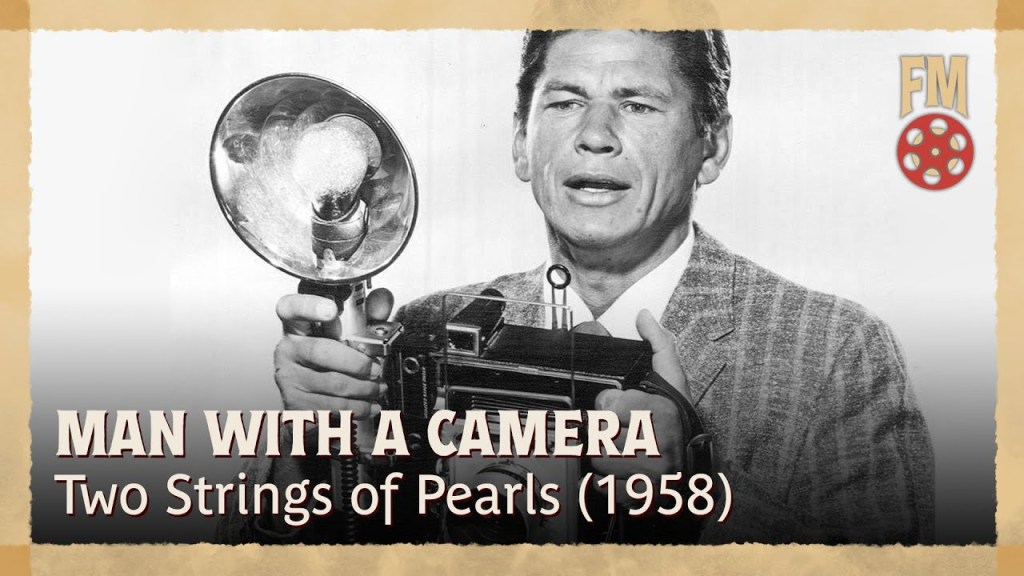
Charles Bronson’s MAN WITH A CAMERA (TV Series) – S1, E9: Two Strings of Pearls!


This episode, which originally aired on December 12th, 1958, opens in Rome, where Mike Kovac (Charles Bronson) is about to catch a plane back to the United States. While there he bumps into a beautiful young lady named Betty (Audrey Dalton) with whom he had a brief love affair five years earlier. But now she’s going by the name Sharon Rodgers, and she’s with her uncle Jonathan (King Calder) and her sister Mona (Elaine Edwards). What’s worse, she pretends that she doesn’t know who Mike is at all. This doesn’t set well with our ace photographer, whose offended voiceover states “I don’t mind girls popping up out of my past, but I don’t like them changing their names and pretending they don’t know me anymore.” As Mike investigates the situation more closely, he comes to realize that good ole Uncle Jonathan is using the girls to pull a con on a jewelry dealer named Bartolo (Alberto Morin). While Mike still has feelings for Betty / Sharon, he can’t abide a thief, a cheat, or a con artist, so he’ll do whatever he has to do to bring them down.

“Two Strings of Pearls” is a love episode. There are scenes where Mike and Betty discuss their relationship all those years ago, including the wonderful times they shared on that Transatlantic Crossing, and then the heartbreak they both felt when Betty decided not to show up for their planned meeting at the Savoy Hotel in London. Mike, who has had a hard time getting over her, just wants to know why she chose not to meet him. Betty, who we now know really is named Sharon, can’t put her reasons into words other than she just seemed to know their lifestyles weren’t compatible. I have to admit that she’s correct since Kovac is a boy scout, and she’s a working cog in a con artist operation. Just look at how this operation plays out… once Mike learns that they’ve targeted the jeweler Bartolo, he gives Betty a quick chance to get out, and when she hesitates, he sets out to make sure they all go to prison. Score one for female intuition!

“Two Strings of Pearls” is a solid episode, but I must admit that I enjoy it more when the series focuses on solving crimes and battling bad guys than when it focuses on the regrets of lost love. While Bronson and Audrey Dalton work fine together as the former sweethearts, both of my favorite scenes involve Kovac’s interactions with Barnes, Uncle Jonathan’s henchman, played by veteran character actor Bert Remsen. First, Barnes pushes Kovac into a swimming pool at a lovely garden party they’re both attending. This doesn’t set well at all with our hero who gets really pissed. Later, during the episode’s exciting conclusion, Kovac squares the ledger when he chases Barnes across the airport runway and executes a perfect form tackle before he can get away with the money. Sadly, Kovac has to face Sharon one last time as she’s arrested and going to jail. Oh well, she made her choices!
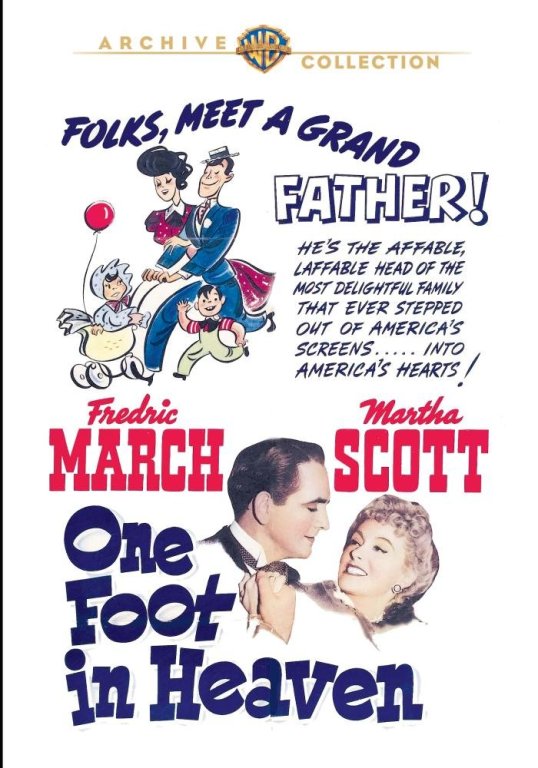
Lisa Reviews An Oscar Nominee: One Foot In Heaven (dir by Irving Rapper)


I have to admit that One Foot In Heaven is a film that I probably never would have watched if not for the fact that it received an Oscar nomination for Best Picture.

This film from 1941 tells what I presume to be a true — or, at the very least, a true-ish — story.  Fredric March plays William Spence.  The film opens in 1904 with Spence explaining to his future in-laws that he’s spontaneously decided to drop out of medical school because he feels that he’s been called to become a Methodist minister.  Though no one is happy or particularly encouraging about William’s decision to abandon the financial security of medicine to work as a minister, William feels that it’s what he was meant to do.

We follow William and his wife, Hope (Martha Scott), as they move from town to town, living in dingy parsonages and barely paying the bills by doing weddings.  Though Hope is frustrated by the constant moving and the less-than-ideal living conditions, she remains supportive of William.  They start a family and William goes from being a stern and somewhat judgmental man to becoming an inspiring minister.  He even changes his opinion about the sinfulness of going to the movies.  (All things considered, that’s probably for the best.)  Eventually, William, Hope, and the family end up ministering to a congregation in Colorado.  Determined to finally give his wife the home that she deserves, William tries to rebuild both the church and the parsonage.  It turns out to be more difficult than he was expecting.

That’s pretty much the film.  There’s not really much conflict to be found, until the final 30 minutes or so when William struggles to convince a bunch of snobs to help him achieve his dream of building a new church.  The film opens with a title card thanking the Methodists for their help in the production of the film, which should tell you everything you need to know about the film’s attitude towards Protestantism.  William does debate an agnostic at one point but it’s not much of a debate.  William, after all, is played by the authoritative Fredric March while the agnostic’s name isn’t even listed in the credits.  It’s a well-made film, in that sturdy way that many 1941 studio productions were, but — unless you’re just crazy about the history of Methodism — it’s not particularly interesting.

On the plus side, Fredric March gives a good performance as William Spence.  March was one of the best actors of Hollywood’s Golden Age and he gives a sympathetic performance as a stern but well-meaning man who respects tradition but who is still willing to admit that he has much to learn.  Probably the film’s most effective scene is when William reluctantly watches a movie with his son.  March captures William’s transformation from being a disapproving father to an entertained filmgoer.  It’s one of the few moments when the film really feels alive.

So, how did One Foot In Heaven receive a Best Picture nomination in the same year that saw nominations for films like Citizen Kane, The Little Foxes, Suspicion, and The Maltese Falcon?  One Foot In Heaven is well-made and totally uncontroversial.  It’s the type of film that, if it were made today, it would probably be directed by Ron Howard and it would star someone like James Marsden or Garrett Hedlund.  One Foot In Heaven is not particularly memorable but there’s nothing particularly terrible about it either and it probably felt like a “safe’ film to nominate.  Still, it’s probably significant that One Foot In Heaven didn’t receive any nominations other than one for Best Picture.  It lost that Oscar to another film about family, How Green Was My Valley.