Review: The Hobbit: An Unexpected Journey (dir. by Peter Jackson)


kinopoisk.ru

It’s hard to believe that’s it’s been 11 years since Peter Jackson released The Lord of the Rings: The Fellowship of the Ring on the masses in 2001. There were much trepidation from Tolkien fans that Jackson (who had been known mostly for low-budget splatter horror-comedies) wouldn’t be able to handle the monumental task of adapting what many consider the greatest novel ever written in the 20th century. Tolkien’s epic fantasy became the standard by which fnatasy epics would be compared to for decades to come and still do. To say that Jackson succeeded in this epic task would be an understatement. The Lord of the Rings trilogy would hoard awards from 2001 to 2003 and also box-office receipts to make any dwarf-lord green with envy.

It’s now 2012 and we finally have the release of Jackson’s next trip into Middle-Earth as he adapts another of Tolkien’s beloved novels. This time he tackles The Hobbit which for some Tolkien fans remains their favorite of the author’s works. It’s a novel that might not have the epic scope and breadth of The Lord of the Rings, but what it lacks in that department it more than makes up in being a fun, adventure tale of a curious hobbit named Bilbo Baggins, a wizard named Gandalf the Grey and a fellowship of twelve dwarfs led by one Thorin Oakenshield of Erebor.

The Hobbit was originally written as a children’s book, but in later years Tolkien would retcon some parts of the novel to better fit with his magnum opus in The Lord of the Rings.It’s this revised version of that children’s story that Peter Jackson, Fran Walsh, Philippa Boyens and Guillermo Del Toro would adapt for the big-screen. Initially a two-film set that would tell the story of Bilbo and his merry band of adventurers, but it has since been expanded to become a trilogy as Jackson and his writers take a page out of Tolkien’s bag of tricks and try to tie-in this latest trilogy to the Lord of the Rings which precedes it by a over a decade.

The first film in this new trilogy is called The Hobbit: An Unexpected Journey and we begin by returning to sometime before the beginning of the first trilogy’s first film. We see the aged Bilbo reminiscing of his adventures 60 years hence and deciding to put it to pen and paper as a sort of memoir of that adventure to reclaim the lost dwarf-hold of Erebor. It’s in this opening that we get to see Frodo once more (played once again by Elijah Wood who doesn’t seem to have aged) prior to him taking up the One Ring.

Bilbo recounts to Frodo the realm of Erebor deep inside the Lonely Mountain east of the Shire to Frodo and how it’s wealth in silver, mithril, gold and precious gems became well-known throughout Middle-Earth. Yet, as Bilbo warns, it’s the very sickness of avarice by Erebor’s Thror the King which seals the dwarf-hold’s doom. We learn that hoards of wealth does more than light up the dwarf king’s eyes with greed but also brings the attention of one of the very last dragon’s in Middle-Earth. The arrival of Smaug to Erebor signals the death of not just that dwarf realm, but the surrounding human town of Dale. The surviving dwarfs of Erebor flee in a massive diaspora towards any safe haven willing to take them in. What was once a proud and powerful realm has now been sundered and it’s afterwards that we get to the meat of the film’s story.

Martin Freeman as a younger Bilbo Baggins was more than just great casting but one which the film needed if one was to believe that this young Bilbo would grow old to be the Ian Holm one fans of the first trilogy have come to know well. His performance as Bilbo Baggins of Bag End becomes the anchor from which the rest of the company would revolve around. When we first meet Freeman as Bilbo he’s not the adventurer that he would become, but a hobbit that’s respectable and one not for doing anything foolish like going on adventures. Yet, his lot in life changes as Gandalf maneuvers the situation so that he becomes embroiled in the quest by Thorin Oakenshield (played by Richard Armitage) to retake his ancestral lands of Erebor and it’s massive wealth from Smaug who has taken it for his lair.

While many would think that a film called The Hobbit would focus on Bilbo I thought the way the film unfolded that this story was all about the dwarfs with extra focus on the single-minded Thorin who comes off initially as both condescending, superior and dismissive of poor old Bilbo. The film never fails to show how much Thorin thinks so less of Bilbo yet throughout the film’s two and a half and more running time we see cracks in Thorin’s ice-cold demeanor towards the young hobbit. By film’s end we see just how wrong Thorin has been of Bilbo’s worth and it makes for one of the film’s more emotional scenes when Thorin realizes this as well.

The Hobbit: An Unexpected Journey is not just about a brooding dwarf prince and his motley band of dwarfs getting into one trouble after the next once they’ve left the Shire with Bilbo. The film also brings on a parallel storyline which tries to lay down the foundation that would tie this new trilogy with the first one. It’s the storyline of the Great Necromancer that Gandalf and a fellow wizard, Radagast the Brown, suspect might be the Great Enemy returned. We learn soon enough during the White Council in Rivendell (attended by Gandalf, Galadriel, Elrond and Saruman the White) that this so-called Necromancer might be Sauron looking to regain his former strength and gather an army to him.

It’s this second storyline that get’s sandwiched within the Thorin Oakenshield Fellowship quest that comes off a bit awkward in the film’s overall narrative flow. Where the film is all about fun adventuring and camaraderie when the dwarfs and Bilbo are on the screen, when they’re not and the film tries to tell us about Sauron’s eventual return the film slows down. These scenes are not uninteresting. On it’s own these sequences bring back the epic tone of the original trilogy and brings it into this film, but it’s that very grandiose theme that seems out of place in what is simply a “men on a mission” story.

Fortunately, we don’t spend too much time dwelling on this side-story. The final third of the film is all about Thorin and company needing to escape from one goblin lair and orc ambush to another. The last 45 minutes or so flies back swiftly after a very uneven first two hours that would make more than a few theater-goers look at their watch. The wait is worth it as we see that Jackson hasn’t forgotten how to choreograph and stage fantasy action scenes. While the use of CGI might be more evident this time around than the previous three films they’re still small compared to other blockbuster films of it’s type. It’s still all about WETA practical effects, make-up and costumes that combine to create a world that’s become familiar yet still have a sense of newness to them as we see new areas of Middle-Earth only mentioned in brief passing in the original trilogy.

The Hobbit: An Unexpected Journey is a wonderful return to the world of Middle-Earth. It is not without it’s missteps and flaws, but it also gets saved by some great performances from the ensemble cast which makes up the dwarfs. The aerial shots of the New Zealand’s eclectic geography shows just how much cinematographer Andrew Lesnie has become such a major component of making Middle-Earth come alive. Even the return of Howard Shore as the film’s composer was a welcome that brought more than a few smiles.

There’s no way of talking about The Hobbit without bringing up the stylistic gamble Peter Jackson has taken in filming this film and the rest of the trilogy in 48fps instead of the traditional 24fps (frames per second) that filmmakers have been using for almost a hundred years now. It’s an aesthetic choice that gives the film a overly realistic look akin to watching a stage production live. Everything looks too perfect and the High-Frame Rate (HFR) takes away some of the cinematic look which many have grown up seeing every time they watch a film. This new filming style works in certain areas like wide shots of the outdoor scenes. Whether it’s the emerald green rolling hills of the Shire to the snowcapped Alpine peaks of the Misty Mountains, these scenes in HFR came out beautiful. It’s when the film switches over to a much more enclosed and personal space within rooms and halls that we get the unusual “soap opera” look some have complained about. It takes a bit of getting used to, but some make the adjustment quickly enough while others may never make the adjustment.

Yet, it is when the film shows a CGI-created sequence that the HFR fails. While the doubling of the frame rate during filming has made the 3D in the film come off smoothly it did make some of the CG-effects come off as too video game-like. A sequence earlier in the film where we see a flashback of Thorin and the dwarfs of Erebor trying to retake another fallen dwarf hold in Moria (Khazadum in dwarfish) looks like a cinematic cutscene as a dwarf army charges and battles it out with an orc and goblin force which had taken Moria as it’s own.

All the scenes where HFR fails to come off as believable turn out better when The Hobbit was seen in traditional 24fps. I actually think that downscaling the film from it’s original HFR to a more traditional film frame speed of 24fps gave the film an even more magical look than the original trilogy. Jackson and his team of filmmakers have two more films to release and hopefully take some of the criticism this first film has received about HFR that they tweak and work on making the new style much more believable instead of taking the audience out of the film’s narrative.

The Hobbit: An Unexpected Journey doesn’t come off as grandiose as the original trilogy and for some that might come as a disappointment. Yet, as an adventure film it more than does it’s job to fully entertain it’s audience while, at the same, time reminding it’s audience how much this film and this trilogy will lead into The Lord of the Rings. I recommend that people just see the film and decide on their own whether it’s a worthy addition to the Middle-Earth saga as seen through the eyes of Peter Jackson. I, for one, think it is and with two more films left we shall see whether Jackson’s return to Middle-Earth has been a triumphant one or not.

Trailer: The Hobbit: An Unexpected Journey (2nd Official)


It just a littleunder 3 months before Peter Jackson takes us back to Middle-Earth with the first of three films that will make up The Hobbit trilogy.

There’s not much else to say other than this latest trailer for The Hobbit: An Unexpected Journeyjust continues to whet the appetite for all things Middle-Earth. It’s much more action-packed with some nice new scenes instead of just rehashing what was in the original teaser trailer from year ago.

Enough words. Just watch the trailer below and decide for yourself whether another trip to Middle-Earth (before all the War of the Ring brouhaha of the first trilogy) is worth your monies.

The Hobbit: An Unexpected Journey premieres worldwide on December 14, 2012.

Trailer: Maniac (Red Band)


Last November I posted news about plans to remake William Lustig’s classic grindhouse slasher flick, Maniac, and how the most unexpected choice of Elijah Wood for the role of the serial killer Frank.

The film had it’s premiere at this year’s Cannes Film Festival and the response to the film by filmmaker Frank Khalfoun seem to be positive. Horror remakes have always been hit-or-miss. If such positive reactions are to be believed then 2012’s Maniac may just be the horror hit of the year.

The film hasn’t been picked up by a North American distributor so any sort of release date for the US is still up in the air. Until then enjoy the first trailer of the film and a good red band trailer to boot.

News: “Maniac” Remake Gets A Killer Wood


If there was ever a film that many people who hate grindhouse and exploitation films always like to point out as a perfect example of films that should never have been made it would be William Lustig’s classic 80’s splatter film, Maniac. This film has been called depraved, misogynistic, obscene and those are just the tame labels heaped on this horror film.

There had been talks down the years to make a direct sequel to the film, but the many plans to do so always never got past the development stage. In late 2010, the remake rights to Maniac was obtained by a French company and it looks like the world will soon be seeing a new take on this controversial film hitting the theaters in a year or so.

The film will be produced by the kings of horror remakes, Alexandre Aja and Grégory Levasseur, with Franck Khalfoun (director of the underrated P2) set to helm the project. It’s the role of the serial killer Frank which has been much discussed by fans of the film who either hate or love that a remake was being of it. While names such as Tom Sizemore has been discussed the role finally landed on the lap of a very unexpected choice: Elijah Wood.

Elijah Wood would be the last pick many fans of the original film would make, but I think this pick is interesting in many ways. For one thing, Wood can definitely pull off the serial killer look, just not the beefy way Joe Spinell did. Wood already has done the serial killer role as the mute and creepy Kevin in Sin City. Wood’s casting as Frank can also go a long way in making sure this remake puts it’s own stamp on the character and story. Finally, Wood has the boy next door look that goes against the stereotypical film serial killer.

While I’m still hoping that Aja would do more original film projects instead of remaking past horror films, I am impressed at how he has done with past horror remakes like The Hills Have Eyes and Piranha. Even though he’s producing and not directing I hope he still brings the sort of manic glee to the production that the two previously mentioned films seemed to have which translated to the screen.

My opinion is that if this remake recreates the Disco Boy scene in all its glory then the remake will be the greatest ever.

So, grindhouse fans what do you think of this remake and the casting?

Source: Bloody Disgusting

Film Review: Eternal Sunshine of the Spotless Mind (dir. by Michel Gondry)


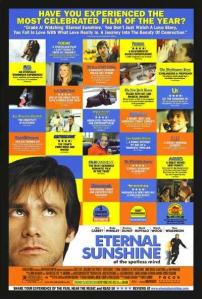
Last week, I started a poll to determine which film I should watch on Sunday and review on Monday.  Well, a lot of votes were cast and you, the readers of Through The Shattered Lens, proved to me once again that you are the greatest readers ever by picking one of my favorite films of all time.  From 2004, it’s the Charlie Kaufman-scripted, Michel Gondry-directed Eternal Sunshine of the Spotless Mind.

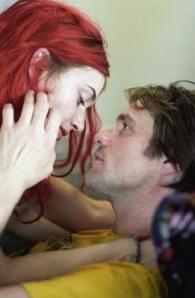
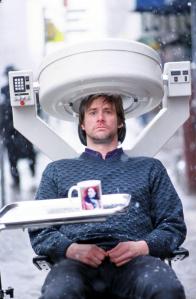
The plot plays out like something from a Philip K. Dick story.  I don’t want to reveal too much because I don’t want to ruin the film for anyone who hasn’t seen this film.  Eternal Sunshine is one of those rare films that carries with it the joy of discovery.  Depressed Joel (played by Jim Carrey) discovers that his ex-girlfriend Clementine (Kate Winslet) has hired Lacuna Inc. to totally erase all memories of him from her mind.  Embittered, Joel decides to go through the same process.  The Lacuna technicians (Elijah Wood and Mark Ruffalo) comes to Joel’s apartment in the middle of the night and start the process of erasing his memories of Clementine.  However, as Joel is losing his past, he realizes that he doesn’t want to lose his time with Clementine.  Hence, Joel finds himself running through his rapidly fading memories of Clementine, trying to save at least some scrap of her memory from being erased.  Meanwhile, as Joel fights to save his identity, Ruffalo entertains himself by inviting his girlfriend (Kirsten Dunst) over to Joel’s apartment while Elijah Wood sneaks off so he can meet his new girlfriend — who is none other than Clementine.

The genius of this Charlie Kaufman’s screenplay is that it takes an idea that seems very much “out there” and uses it to explore emotions that we’ve all felt.  Who doesn’t have someone that they wish they could wipe from their mind?  Me, I wish I could forget the exchange student from Keele University who broke up with me via e-mail.  I’d love to obliterate all memory of the frat boy who told me I was “white trash” or the former love of my life who managed to break my nose and my heart with just one movement of his hand.  We all have those people in our lives and what we forget is that by wiping out all the bad memories, we lose all the good ones as well.  Yes, Paul Walsh may have made me cry with his e-mail but, for two months before that, he held me while I cried and I can’t remember what I was crying about but I do remember feeling like I had never been held like that before.  And Dane may have hurt me terribly but now, every time I doubt myself, I simply remember that I’ve already survived the worst that could happen.  As for that frat boy who called me “white trash” — well, fuck him.  Yeah, there’s really no downside to erasing him from my mind.  In fact, I’ve already started because, to be honest, I can’t remember his name for the life of me.

Ironically enough considering the title, there’s very little sunshine to be found in this film.  Not only is every scene drenched in melancholy but, quite literally, director Michel Gondry appears to have exclusively filmed on overcast days.  For such a deliriously romantic film — one that celebrates the idea of enduring love — Eternal Sunshine of the Spotless Mind is almost totally told in tones of gray and darkness.  In fact, as I watched the film last night, I was struck by the fact that often times, the only color in the film was provided by the Clementine’s ever-changing hair.  (Interestingly enough, Joel mentions Clementine’s hair as one of the things that he especially wants to forget about her.)  That the film works as both a dark comedy and a love story despite the grim images is a testament to the talents of both screenwriter Charlie Kaufman and director Michel Gondry.  (On the basis of the director’s later films — the latest being the enjoyable but shallow Green Hornet — I kind of suspect that Kaufman perhaps deserves a little bit more credit that Gondry.)

I think it’s also a testament to the talents of the film’s cast, all of whom gel into a perfect ensemble and allow the audience to believe in the film no matter how odd the film’s events may seem.  As I watched them last night, I found myself thinking about how much I truly love to watch good acting.  As long as a film has one or two good performance, it can be out-of-focus, choppily edited, and an hour or two too long.  By the same token, I find nothing more offensive than a million-dollar film full of expensive technology and boring performances. (Hello, Avatar.  How are you, Battle L.A?)  When I find a film, like Eternal Sunshine, that is actually both well-made and well-acted, I’m pretty much in love.

As the two lovers, Jim Carrey and Kate Winslet have a very surprising and very real chemistry together.  Watching them, you believed in their love and then you just as strongly believed in their hate.  This is one of those odd love stories where you not only believed that the two of them would actually get together but you also completely understood how and why Joel eventually drove Clementine away.  Carrey makes Joel’s depression believable without allowing it to get tedious or repetitive while Kate Winslet — well, where to begin?  Kate Winslet is probably one of the best actresses ever and this is one of her best performances.  I’ve always had a bit of a girlcrush on Winslet — there’s an honesty to her performances that few other actresses can match.  When she’s onscreen, the audience is with her.  She never puts up the whole “film star” barrier and, as a result, she inhabits her characters completely and brings them to life with both their strengths and their flaws.  And Clementine has got her share of flaws.  (I remember that when my mom saw this movie, she absolutely hated Clementine and the ever-changing color of her hair.)  Winslet doesn’t shy away from making Clementine human and, as a result, I think she elevated everyone else in the film as well.

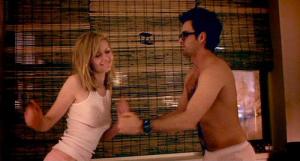
As good as Carrey and Winslet are, the supporting roles are well-played as well and, as in all great movies, they give the impression of a world that existed before the movie started and one that will continue after the end credits.  I especially loved the performances of the Lacuna Staff, from Tom Wilkinson’s bland yet intimidating doctor to the creepy geekiness of Elijah Wood.  Mark Ruffalo and Kisten Dunst have a few great scenes where they’re partying the night away in Joel’s apartment while Joel’s memory is slowly erased.  The sight of a very hairy Ruffalo and a very giggly Dunst dancing in their matching panties pretty much epitomizes “geek love” for me.  I know that some people have complained that the scenes with Ruffalo and Dunst seemed out-of-place when compared to the ones between Carrey and Winslet but actually, I love the chemistry between Ruffalo and Dunst.  Even playing one of the nerdiest characters ever, Mark Ruffalo is still hot.  As for Dunst, she’s basically playing the same character that she always plays.  (As my friend Jeff recently put it, “Kirsten Dunst In Her Underwear” is as much of a film genre as drama, comedy, and science fiction.)  But I’ve always thought that she’s a likable enough actress (plus, by going red for Spiderman, she also indirectly helped this redhead’s social life) and she actually provides a nice (if surprising) moral center for Eternal Sunshine.

(Also, I’ll admit right now that if my boyfriend had a job that allowed him to hang out into a different stranger’s apartment every night, I’d probably sneak over and dance around in my underwear as well.)

It took me a while and a handful of viewings to really appreciate Eternal Sunshine of the Spotless Mind.  When I first saw it, I thought it was a strange film.  I liked it but I never expected that it would become one of my favorite movies.  However, with each viewing, I find myself relating to and loving this film just a little bit more.  So, thank you to everyone who voted in my poll and who gave me a chance to fall in love with this film all over again.

Love ya. 🙂

Poll: Lisa Marie Submits To Your Will


Last year, I gave up control to the reader of the site and you know what?  I kinda liked it in a sneaky, dirty little way.  So I figured, why not do it again?

Of course, I’m sure you’ve already guessed that I’m referring to my What Movie Should Lisa Marie Review poll.  This is the poll that led to me reviewing Anatomy of a Murder. 

Here’s how it works.  Earlier today, I put on a blindfold and then I randomly groped through my DVD collection until I had managed to pull out ten movies.  I then promptly stubbed my big toe on the coffee table, fell down to the floor, and spent about 15 minutes cursing and crying.  Because, seriously, it hurt!  Anyway, I then took off the blindfold and looked over the 10 movies I had randomly selected.  Two of them — Dracula A.D. 1972 and A Blade in the Dark — were movies that I had already reviewed on this site.  So I put them back and I replaced them with two movies of my own choosing — in this case, Eternal Sunshine of the Spotless Mind and The Unbearable Lightness of Being.

Between now and next Sunday (March 27th), people will hopefully vote in this poll.  On Sunday, I will watch and review whichever movie has received the most votes.  Even if that movie turns out to be Incubus. *shudder*  (Have I mentioned how much I love Eternal Sunshine of the Spotless Mind?)

Now, of course, there’s always the possibility that no one will vote in this poll and I’ll end up looking silly.  Those are the risks you take when you set up an online poll.  However, I have a backup plan.  If nobody votes, I will just spend every day next week shopping for purses at Northpark Mall and then blogging about it.  And by that, I mean blogging every single little detail.  So, it’s a win-win for me.

Anyway, here’s the list of the 10 films:

1) Barbarella — From 1968, Jane Fonda plays Barbarella who flies around space while getting molested by …. well, everyone.  Directed by Roger Vadim.

2) Barry Lyndon — From 1975, this best picture nominee is director Stanley Kubrick’s legendary recreation of 18th-century Europe and the rogues who live there.

3) Caligula — Yes, that Caligula.  From 1979, it’s time for decadence, blood, and nudity in the Roman Empire.  Starring Malcolm McDowell, Helen Mirren, Peter O’Toole, John Gielgud, John Steiner, and Theresa Ann Savoy.

4) Eternal Sunshine of the Spotless Mind — Oh my God, I love this movie.  Jim Carrey breaks up with Kate Winslet and deals with the pain by getting his mind erased by Tom Wilkinson, Mark Ruffalo, Kirsten Dunst, and an amazingly creepy Elijah Wood.

5) Incubus — From 1969, this low-budget supernatural thriller not only stars a young William Shatner but it also features the entire cast speaking in Esperanto.  For.  The.  Entire.  Movie.

6) Inland Empire — If you want to give Lisa nightmares, you can vote for David Lynch’s disturbing 3-hour film about lost identity, sexual repression, human trafficking, and talking rabbits.

7) Kiss Me Deadly — From 1955, this Robert Aldrich-directed cult classic features hard-boiled P.I. Mike Hammer and a host of others chasing after a mysterious glowing box and accidentally destroying the world in the process.

8 ) Mandingo — From 1975, this infamous little film is a look at slavery, incest, and rheumatism in the pre-Civil War South.  Starring James Mason, Ken Norton, Perry King, and Susan George.  Supposedly a really offensive movie, one I haven’t sat down and watched yet.

9) Sunset Boulevard — From 1950, hack screenwriter William Holden ends up the kept man of psychotic former screen goddess Gloria Swanson.  Directed by Billy Wilder.

10) The Unbearable Lightness of Being — From 1988, Philip L. Kaufman’s adaptation of Milan Kundera’s classic novel (one of my favorite books, by the way) features Daniel Day-Lewis, Juliette Binoche, and Lena Olin having sex and dealing with ennui.  After I first saw this movie, I insisted on wearing a hat just like Lena Olin did.

Everyone, except for me, is eligible to vote.  Vote as often as you want.  The poll is now open until Sunday, March 27th.

(Edit: Voting is now closed but check below for the results! — Lisa)