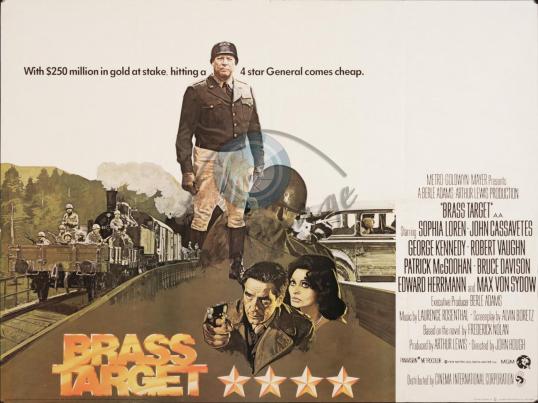
A Movie A Day #127: Brass Target (1978, directed by John Hough)


Everything’s a conspiracy!

At least, that is the claim made by Brass Target, a twisty and unnecessarily complicated thriller that argues that General George S. Patton (played here by George Kennedy, who is even more blustery than usual in the role) did not, as widely believed, die as the result of a car accident but was actually killed by an assassin using rubber bullets.  Why was Patton targeted for assassination?  Was he targeted by Nazis angered by Germany’s defeat or maybe Russians who knew that Patton had argued in favor of invading the Soviet Union towards the end of the war?  Would you believe it was all because Patton was investigating the theft of Nazi gold and his subordinates, the flamboyantly gay Colonel Donald Rogers (Robert Vaughn) and Rogers’s always worried lover, Colonel Walter Gilchrist (Edward Herrmann), were fearful that he was getting too close to discovering the truth?

John Cassevetes, who hopefully used part of his paycheck to fund either The Killing of a Chinese Bookie, Opening Night, or Gloria, plays Joe De Lucca, the burned out OSS colonel who is assigned to track down the Nazi gold but who really just wants to go back home to New York.  Patrick McGoohan, sporting an accent that is supposed to be American, plays De Lucca’s former friend and colleague, Colonel Mike McCauley, who now lives in a German castle.  Max von Sydow is the assassin, who also has a day job as the chairman of a refugee relocation committee.  Sophia Loren plays Mara, a Polish war refugee who, by pure coincidence, has slept with not just De Lucca but almost everyone involved with the conspiracy.  Bruce Davison is the young colonel who acts as Du Lucca’s supervisor.  Even Charles “Lucky” Luciano (played by the very British Lee Montague) is featured as a minor part of the conspiracy.

That is an impressive cast for a less than impressive movie.  Brass Target never provides a convincing reason as to why the conspirators would decide that killing Patton was their only option and, once the conspiracy gets underway and the movie starts to follow around Von Sydow for some Day of the Jackal/Black Sunday-style preparation scenes, the search for the Nazi gold is forgotten.  For some reason, though, I have a soft spot for this frequently ridiculous movie.  There are enough weird moments and details, like Vaughn’s twitchy performance, McGoohan’s accent, the way Kennedy blusters about the Russians being rude to him, and glamorous Sophia Loren’s miscasting, that Brass Target is always watchable even if it is never exactly good.
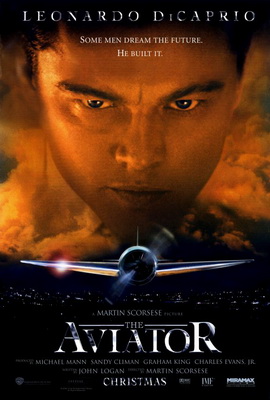
Shattered Politics #74: The Aviator (dir by Martin Scorsese)


The_Aviator_Poster

“The way of the future.” — Howard Hughes (Leonardo DiCaprio) in The Aviator (2004)

As I recently rewatched the 2004 best picture nominee, The Aviator, I realized that, in the film’s scheme of things, Ava Gardner was far more important than Katharine Hepburn.  (Or, perhaps it would be more appropriate to say that Kate Beckinsale’s Ava Gardner was far more important than Cate Blanchett’s Katharine Hepburn.)

Over the course of the film, both Hepburn and Gardner are involved with billionaire-turned aviator-turned film director Howard Hughes (Leonardo DiCaprio).  Throughout the film, Katherine is portrayed as being flighty, pretentious, and overdramatic.  There’s a lot of dark humor to the scene where Katherine breaks up with Howard, largely because Katharine is incapable of not acting as if she’s making a film.  Her every word is so carefully rehearsed that you have to agree when Howard says that she’s incapable of not giving a performance.  Ava, on the other hand, is always direct.  She has a sense of humor.  She has no trouble telling Howard off.  Whereas Katharine put on airs of being an incurable romantic, Ava tells Howard flat out that she doesn’t love him and is only using him to forward her career.

But, while Katharine Hepburn gets more screen time, it’s Ava Gardner who actually saves Howard’s business.  Towards the end of the film, after Howard has had a nervous breakdown and has locked himself in a hotel room, it’s Ava who suddenly shows up, cleans him, and dresses him.  She’s the one who gives Howard the strength to leave his room and to face down the corrupt senator (Alan Alda) who is investigating his business.

Of course, Howard Hughes is best known for once being the world’s richest recluse.  In the 1960s, Howard locked himself away in a hotel room in Las Vegas and spent the next decade laying naked in bed and watching television.  The Aviator doesn’t deal with this period of Howard’s life but it’s full of scenes where we catch glimpses of Howard’s future.  Throughout the film, we watch as Howard obsessively washes his hands.  We watch as he gives precise instructions on how even the simplest of tasks are to be accomplished.  We watch as he grows increasingly paranoid about the germ-filled outside world.  The film suggests that Howard’s obsessive compulsive disorder both served to make him a great engineer and a great filmmaker while, at the same time, ultimately destroying him.

The Aviator was the second film that DiCaprio made with Scorsese.  And, as bad as DiCaprio may have been in Gangs of New York, he’s absolutely brilliant in The Aviator.  As a character, Howard Hughes has so many quirks and tics that it would have been easy for DiCaprio to go overboard.  Instead, he gives a surprisingly subtle performance.  And, even more importantly as far as I’m concerned, he actually sounds authentically Texan when he speaks.

In many ways, much of The Aviator reminds me of Gangs of New York.  Both films are gorgeously produced period epics that try to cover a lot of material.  Both films are absolute cat nip for history nerds like me.  But, whereas Gangs of New York leaves one feeling vaguely dissatisfied, The Aviator actually improves with subsequent viewings.  Whereas the action in Gangs had no center, The Aviator revolves around Howard and the actor playing him.

While the Aviator starts off with Howard making movies and romancing Katharine Hepburn, it’s at its best when Howard appears before a committee chaired by Sen. Owen Brewster (Alan Alda) and passionately defends both himself as an engineer and a businessman and the right of innovators everywhere to freely pursue their passion.  The film suggests that Brewster was bribed by Howard’s main business rival, Juan Trippe (Alec Baldwin, in unapologetic villain mode), and it’s hard not to applaud when Howard stands up for himself.

Speaking of which, it’s odd, so soon after reviewing Alan Alda in The Seduction of Joe Tynan, to see Alda playing a far less ethical politician in The Aviator.  That said, Alda’s corrupt performance in The Aviator is a hundred times better than his cutesy work in Joe Tynan.  If anything, Alda gives a performance here that will remind everyone of why they don’t care much for their congressman.

The Aviator was nominated for best picture but it lost to the far more low-key Million Dollar Baby.  Scorsese would have to wait until the release of The Departed for one of his films to finally win best picture.

Shattered Politics #72: Welcome to Mooseport (dir by Donald Petrie)


Welcome_To_Mooseport

The 2004 film comedy Welcome to Mooseport would probably be totally forgotten if not for one thing.  This is the film that was supposedly so bad that co-star Gene Hackman looked at the final cut and then probably looked over at the Oscars he won for The French Connection and Unforgiven and then probably looked back at the final cut and then announced, “I quit!”  There’s a reason why Hackman now spends his time writing novels and, according to most accounts, Welcome to Mooseport is that reason.

In Welcome to Mooseport, Gene Hackman plays Monroe “Eagle” Cole, the former President of the United States.  From the minute we first hear the President’s name, we know exactly what type of film Welcome to Mooseport is going to be.  It’s not enough to give Hackman’s a character a totally over-the-top name like Monroe Cole.  He also has to have a cutesy nickname.  The entire time I watched the film, I found myself wondering if Monroe Cole was listed on the presidential ballots as being Monroe “Eagle” Cole.  Personally, I always find it funny when people feel the need to include their nickname in the credits.  Is it really important for every William out there to let everyone know that some people call him Billy?

Anyway, Eagle is apparently the most popular president ever.  However, he’s also recently divorced and his ex-wife (Christine Baranski, playing the same role that she played in Bulworth) wants all of his property.  Eagle is forced to retire to one of the few residences that he has left, his vacation home in Mooseport, Maine.  In order to keep his wife from claiming that home, Eagle decides to run for mayor of Mooseport…

Now, right here, we’ve got a huge issue.  Eagle’s only motivation for running for mayor is because he doesn’t want to have to give over his vacation home to his wife.  But that could be anyone’s motivation.  One does not have to be President to want to keep the house in a divorce.  It would have been more interesting if Eagle, now out of office and struggling to adjust to no longer being the most powerful man in the world, ran for mayor because he really wanted the job.

But anyway, Eagle is not the only person running for mayor.  Hardware store owner Hardy Harrison (Ray Romano) is also running.  At first, Hardy wants to withdraw but then he sees Eagle flirting with Hardy’s longtime girlfriend (Maura Tierney) and Hardy suddenly decides that he’s going to run and he’s going to win.

I actually like Ray Romano as an actor and he doesn’t give a bad performance here.  But, at the same time, it’s obvious that his scenes were written to capitalize on his TV persona.  It’s easy to imagine stumbling across a rerun of Everybody Loves Raymond where Ray runs for mayor and has a panic attack when he loses.  The difference, of course, is that Ray Barone would not have been running against Gene Hackman (much less a former President).

Needless to say, Welcome to Mooseport has a sitcom feel to it.  After every line, you find yourself waiting for a laugh track.  Gene Hackman feels incredibly out-of-place in the film and there’s a discomfort to his performance.  Watching him in this film, you can see the wheels turning in his brain.  You can literally see Gene Hackman thinking, “I’m too old for this shit.”

And I guess he was because, in the 11 years since Welcome to Mooseport was first released, Gene Hackman has not appeared in another film.  Which is bad news for everyone waiting for Welcome to Mooseport Part II

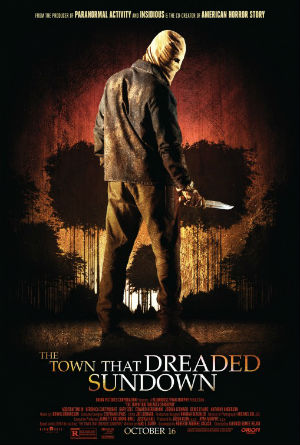
Film Review: The Town That Dreaded Sundown (dir by Alfonso Gomez-Rejon)


The_Town_That_Dreaded_Sundown_(2014_film)_poster

The Town That Dreaded Sundown is the latest classic horror remake.  In this case, it’s a remake of a 1976 docudrama about a real-life serial killer who, shortly after World War II, haunted the streets of my former hometown of Texarkana, Texas.  (You can read my review here.)  The original was a low-budget but effectively creepy little film that was shot on the streets of Texarkana and was full of authentic Texas atmosphere.  (It helped that it was directed by Charles B. Pierce, a Texarkana native, as opposed to some jerk from up north.)  What made the film all the more haunting was the fact that — in both the movie and in real life — the Phantom Killer was never captured.

So, how does the remake compare?

*Sigh*

(For the record, I’m not only signing but I’m also massively rolling my mismatched,  heterochromatic eyes.)

Listen, I will give this film credit for attempting to be something more than just your usual horror remake.  It actually does have a fairly clever premise.  Instead of retelling the original story, the remake of The Town That Dreaded Sundown begins with a bunch of people in present-day Texarkana sitting around and watching the original film.  There’s even an eccentric character named Charles B. Pierce, Jr. (Denis O’Hare) who we are told is the son of the original director.  It’s a clever idea, one that wisely acknowledges the effectiveness of the original film while also commenting on the continuing mystery surrounding both the identity and the fate of the Phantom Killer.

And, when someone dressed like the original Phantom Killer starts to murder young couples in Texarkana, we — just like the characters — are left to wonder whether it’s the spirit of the Phantom or if it’s someone imitating the murders from the original film or whether it’s something else altogether.

That’s certainly the question faced by Jami (Addison Timlin), who survives being attacked by this new Phantom but then grows obsessed with trying to discover who he is.  Addison Timlin gives a really good performance here.  She’s likable and sympathetic, the perfect “final girl.”

In fact, the entire film is well-cast.  Anthony Anderson is a lot of fun as a cocky Texas Ranger while Gary Cole and Joshua Leonard do good work as members of local law enforcement.  Denis O’Hare, who I will always think of as being Russell on True Blood, brings a certain dissipated nobility to his role.  The victims are all sympathetic and the killer is creepy.

But, with all that in mind, I was disappointed with the remake of The Town That Dreaded Sundown.  The reason the original film worked is because it was made by a member of the Texarkana community.  Charles B. Pierce knew the town and he understood why the Phantom Killer continued to haunt the citizens.  What his movie lacked in technical polish, it made up for in authenticity.

Though the remake features a narrator and duplicates the original’s obsession with letting us know whether each scene is taking place on the Texas-side or the Arkansas-side of the town, there’s still absolutely nothing authentic about it.  Whereas the original was filmed entirely on location, the remake was mostly filmed in Shreveport with only three days devoted to getting some location footage of downtown Texarkana.  As someone who has lived in both Shreveport and Texarkana, allow me to assure you that you can totally tell the difference.

The remake was produced by Ryan Murphy (of Glee and American Horror Story fame) and the film really does feel like a lesser season of American Horror Story.  It’s a film that has so little use for subtlety (just check out Edward Herrmann going totally overboard as a hypocritical preacher) that its creepy moments are totally smothered by all the heavy-handed cartoonishness that surrounds them.

Ultimately, the remake fails because it has no feel for or understanding for my homestate.  It was made by people who obviously know nothing about Texas or Arkansas beyond what they’ve seen in other movies produced, directed, and written by other northerners.

The 1976 Town That Dreaded Sundown worked because it was authentic.  Despite a few good ideas, the remake is just too generic to do justice to the original.


Here’s Your Chance To Tell Lisa Marie What To Watch!


So, guess what I did this morning?  That’s right — I put on a blindfold, a stumbled over to my ever-growing Blu-ray, DVD, and even VHS collection and I randomly selected 12 films!

Why did I do this?

I did it so you, the beloved readers of Through the Shattered Lens, could once again have a chance to tell me what to do.  At the end of this post, you’ll find a poll.  Hopefully, between now and next Monday (that’s March 24th), a few of you will take the time to vote for which of these 12 films I should watch and review.  I will then watch the winner on Tuesday and post my review on Wednesday night.  In short, I’m putting the power to dominate in your hands.  Just remember: with great power comes great … well, you know how it goes.

Here are the 12 films that I randomly selected this morning:

The Baader Meinhof Complex (2008) — This German film was nominated for Best Foreign Language Film.  It tells the true life story of the left-wing German terrorist group, The RAF.

The Cat’s Meow (2001) — From director Peter Bogdonavich, this film speculates about the events that led to the shooting of silent film director Thomas H. Ince.  Starring Kirsten Dunst as Marion Davies, Edward Herrmann as William Randolph Hearst, and Eddie Izzard as Charlie Chaplin.

Heavenly Creatures (1994) — The close relationship between two teenage girls (Melanie Lynesky and Kate Winslet) leads to both a vibrant fantasy world and real-life murder.  Directed by Peter Jackson.

In A Lonely Place (1950) — In this film noir from director Nicholas Ray, Humphrey Bogart plays a screenwriter who may (or may not) be a murderer.

Liquid Sky (1983) — In this low-budget, independent science fiction film, an alien lands in New York and soon several members of the city’s underground art scene are vaporized.  Not surprisingly, it all has to do with heroin.

Made in Britain (1983) — A very young Tim Roth makes his debut in this British film.  Roth plays Trevor, a Neo-Nazi who — despite being intelligent and charismatic — also seems to be intent on destroying himself and everything that he sees.

Much Ado About Nothing (2013) — In between The Avengers and Agents of SHIELD, Joss Whedon found the time to direct this adaptation of Shakespeare’s play.

Peyton Place (1957) — In this Oscar-nominated film, the sordid secrets of an outwardly idyllic New England town are exposed.

Pretty Poison (1968) — Having just been released from a mental institution, Dennis (Anthony Perkins) finds himself involved with teenager Sue Anne (Tuesday Weld), who — despite her wholesome appearance — is actually psychotic.

Troll 2 (1990) — A family moves to Nilbog, a small town that is populated by vegetarian goblins.  This movie is widely considered to be one of the worst ever made.

Walkabout (1971) — In this visually stunning Nicolas Roeg film, a teenage girl and her younger brother find themselves stranded and left for dead in the Australian outback.  They try to survive with the help of an Aborigine.

Zabriskie Point (1970) — In this 1970 film, the great Italian director Michelangelo Antonioni takes a look at the 60s counter-culture.  Airplanes are stolen, buildings explode, and orgies magically materialize in the middle of the desert.

The poll will be open until Monday, March 24th.

Happy voting!

44 Days of Paranoia #30: Nixon (dir by Oliver Stone)


For our latest entry in the 44 Days of Paranoia, we take a look at Oliver Stone’s 1995 presidential biopic, Nixon.

Nixon tells the life story of our 37th President, Richard Nixon.  The only President to ever resign in order to avoid being impeached, Nixon remains a controversial figure to this day.  As portrayed in this film, Nixon (played by Anthony Hopkins) was an insecure, friendless child who was dominated by his ultra religious mother (Mary Steenburgen) and who lived in the shadow of his charismatic older brother (Tony Goldwyn).  After he graduated college, Nixon married Pat (Joan Allen), entered politics, made a name for himself as an anti-communist, and eventually ended up winning the U.S. presidency.  The film tells us that, regardless of his success, Nixon remained a paranoid and desperately lonely man who eventually allowed the sycophants on his staff (including James Woods) to break the law in an attempt to destroy enemies both real and imagined.  Along the way, Nixon deals with a shady businessman (Larry Hagman), who expects to be rewarded for supporting Nixon’s political career, and has an odd confrontation with a young anti-war protester who has figured out that Nixon doesn’t have half the power that everyone assumes he does.

Considering that his last few films have been W., Wall Street: Money Never Sleeps, and SavagesI think it’s understandable that I’m often stunned to discover that, at one point in the distant past, Oliver Stone actually was a worthwhile director.  JFK, for instance, is effective propaganda.  Nixon, which feels a lot like an unofficial sequel to JFK, is a much messier film than JFK but — as opposed to something like Savages — it’s still watchable and occasionally even thought-provoking.  Thanks to Hopkins’ performance and, it must be admitted, Stone’s surprisingly even-handed approach to the character, Nixon challenges our assumptions about one of the most infamous and villified figures in American history.  It forces us to decide for ourselves whether Nixon was a monster or a victim of circumstances that spiraled out of his control.  If you need proof of the effectiveness of the film’s approach, just compare Stone’s work on Nixon with his work on his next Presidential biography, the far less effective W.

(I should admit, however, that I’m a political history nerd and therefore, this film was specifically designed to appeal to me.  For me, half the fun of Nixon was being able to go, “Oh, that’s supposed to be Nelson Rockefeller!”)

If I had to compare the experience of watching Nixon to anything, I would compare it to taking 10 capsules of Dexedrine and then staying up for five days straight without eating.  The film zooms from scene-to-scene, switching film stocks almost at random while jumping in and out of time, and not worrying too much about establishing any sort of narrative consistency.  Surprisingly nuanced domestic scenes between Anthony Hopkins and Joan Allen are followed by over-the-top scenes where Bob Hoskins lustily stares at a White House guard or Sam Waterston’s eyes briefly turn completely black as he discusses the existence of evil.  When Nixon gives his acceptance speech to the Republican Convention, the Republican delegates are briefly replaced by images of a world on fire.  Familiar actors wander through the film, most of them only popping up for a scene or two and then vanishing.  The end result is a film that both engages and exhausts the viewer, a hallucinatory journey through Stone’s version of American history.

Nixon is a mess but it’s a fascinating mess.

Other Entries In The 44 Days of Paranoia 

  1. Clonus
  2. Executive Action
  3. Winter Kills
  4. Interview With The Assassin
  5. The Trial of Lee Harvey Oswald
  6. JFK
  7. Beyond The Doors
  8. Three Days of the Condor
  9. They Saved Hitler’s Brain
  10. The Intruder
  11. Police, Adjective
  12. Burn After Reading
  13. Quiz Show
  14. Flying Blind
  15. God Told Me To
  16. Wag the Dog
  17. Cheaters
  18. Scream and Scream Again
  19. Capricorn One
  20. Seven Days In May
  21. Broken City
  22. Suddenly
  23. Pickup on South Street
  24. The Informer
  25. Chinatown
  26. Compliance
  27. The Lives of Others
  28. The Departed
  29. A Face In The Crowd