Film Review: Thunderbolt and Lightfoot (dir by Michael Cimino)


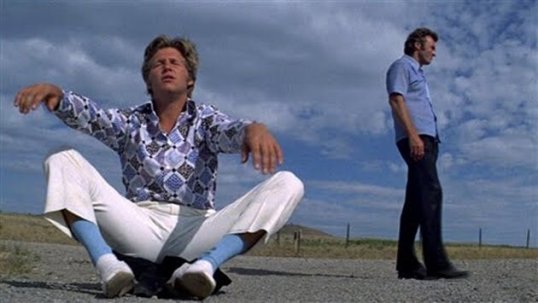
1974’s Thunderbolt and Lightfoot opens with two men, one young and one middle-aged, facing a moment of truth.

The younger of the two is Lightfoot (Jeff Bridges), a wild and hyperactive rich kid who is in his 20s and who steals a corvette right off of a used car lot.  The other man is simply known by his nickname, Thunderbolt (Clint Eastwood).  When we first see Thunderbolt, he’s giving a sermon in a small Montana church.  When a gun-wielding man steps into the church and promptly starts firing at Thunderbolt, he takes off running.  Pursued by his attacker, Thunderbolt runs through a field and just happens to jump onto Lightfoot’s speeding corvette.  Lightfoot runs over the Thunderbolt’s pursuer.  Thunderbolt slips into the car and Lightfoot drives on for a bit.  Lightfoot is excited and talkative.  Thunderbolt is more concerned with popping his shoulder back into its socket.  A stop at a gas station leads to the men stealing someone else’s car.

And so it goes for a good deal of the movie.  Thunderbolt and Lightfoot is a road movie, the majority of which is taken up with scenes of the two men just hanging out.  Thunderbolt and Lightfoot take an instant liking to each other.  When Lightfoot picks up a prostitute (Catherine Bach), he makes sure to ask that she bring along a friend for Thunderbolt.  When a criminal punches Lightfoot, Thunderbolt is quick to punch back.  “That’s for the kid,” Thunderbolt says.  That’s the type of friendship that they have.  Jeff Bridges is handsome and full of energy as Lightfoot and Clint Eastwood smiles more in this film than I think I’ve seen him smile in any other film.  For once, Eastwood is not playing a perpetually grumpy stranger or a supercop.  Instead, he’s just a blue collar guy who enjoys having a friend to travel with.

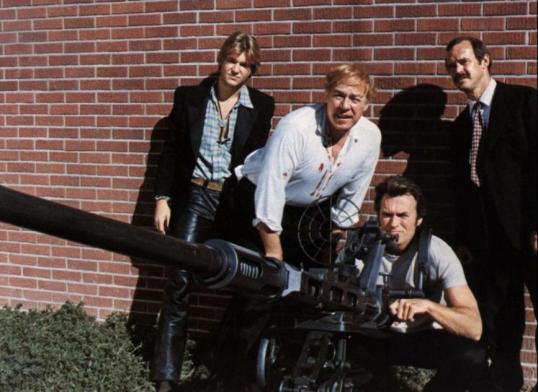
Eventually, Thunderbolt and Lightfoot meet up with two of Thunderbolt’s former associates.  Red (George Kennedy) is a brutal brawler who, it is suggested, served with Thunderbolt in the Korean War.  Goody (Geoffrey Lewis) is a gentle soul who takes orders from Red but still can’t bring himself to shoot anyone, no matter how much Red demands that he pull the trigger.  Red and Goody have always assumed that Thunderbolt stole the loot from a bank robbery that they pulled off.  Thunderbolt explains that he didn’t steal the money.  He just got arrested after hiding it.  Lightfoot suggests that maybe the four of them could pull off another bank heist….

Kennedy and Lewis are perfectly cast as the two criminals who end up working with Thunderbolt and Lightfoot.  In many ways, the relationship between Red and Goody mirrors the relationship between our lead characters.  The main difference is that Red is sadistic and quick to loose his temper, whereas Thunderbolt controls his emotions and tries not to hurt anyone while committing his crimes.  Lightfoot looks up to Thunderbolt and Goody looks up to Red.  Again, the difference is that Thunderbolt actually cares about Lightfoot, whereas Red is incapable of truly caring about anyone but himself.  Eastwood, Bridges, Kennedy, and Lewis make quite a team and it’s hard not to worry about all four of them, especially when the film takes an unexpectedly dramatic turn during its third act.

I really wasn’t expecting Thunderbolt and Lightfoot to make me cry but the final thirty minutes of the film brought tears to my eyes as what started out as a buddy comedy turned into a tragedy.  (I shouldn’t have been surprised.  I’ve seen enough 70s movies that I really should have known better than to have expected a happy ending.)  Thanks to the perceptive script by Michael Cimino (who would go on to make The Deer Hunter and Heaven’s Gate) and the performances of Eastwood and Bridges, the movie’s final moments carry quite a punch and they leave you wondering if Thunderbolt and Lightfoot’s road trip was worth the price that was ultimately paid.  The film works as not only a tribute to friendship but also as a fatalistic portrait of life on the backroads of America.

Thunderbolt and Lightfoot was the first Eastwood film to receive an Oscar nomination, with Jeff Bridges competing for Best Supporting Actor.  (He lost to Robert De Niro’s star turn in The Godfather, Part II.)  Eastwood, reportedly, felt that he deserved a nomination for his performance as Thunderbolt and, considering that that Oscar itself was won by Art Carney for his pleasant but hardly revelatory work in Harry and Tonto, Eastwood was correct.  Instead, Eastwood would have to wait for another 18 years before he finally received Academy recognition for starring in, producing, and directing Unforgiven.

The Best Of Times (1986, directed by Roger Spottiswoode)


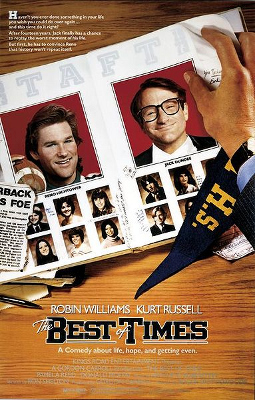
For years, banker Jack Dundee (Robin Williams) had been haunted by a pass that he dropped in high school.  The pass was perfectly thrown by quarterback Reno Hightower (Kurt Russell) but Jack couldn’t bring it in and, as a result, Taft High lost to its rival, Bakersfield.  Adding to Jack’s humiliation is that he now works for The Colonel (Donald Moffat), a confirmed Bakersfield fan who also happens to be Jack’s father-in-law.  When Jack visits a “massage therapist” (Margaret Whitton) and tells her about his problems, she suggests that he needs to replay the game.  Getting everyone interested in replaying the game is not easy.  No one wants to be humiliated a second time and Reno, who now fixes vans for a living, fears the he’s lost his edge.  Jack dresses up in the Bakersfield mascot’s uniform and vandalizes the town.  Finally, everyone is ready for the game.  Now, it’s a matter of town pride.

The Best of Times is a likable comedy about getting older and wishing you could have just one more chance to be young again and to have your entire future ahead of you.  Jack is haunted by that one dropped pass, feeling that it has cast a cloud over his entire life.  Reno is still a town hero but he’s struggling financially and in debt to Jack’s bank.  Replaying the game isn’t going to fix their lives but it is going to give them one last chance to relive their former glory and maybe an opportunity to learn that, even if they are getting older, they’re still living in the best of times.  The world that these two men live in is skillfully drawn and believable, with character actors like Moffat, M. Emmet Walsh, R.G. Armstrong, and Dub Taylor adding to the local color.  Jack and Reno’s wives are played by Holly Palance and Pamela Reed and they are also strong and well-developed characters.  Finally, Robin Williams and Kurt Russell are a strong comedic team.  Russell is perfectly cast as the aging jock and Williams gives one of his more restrained performances as Jack, allowing us to see the sadness behind Jack’s smile.

The stakes aren’t particularly high in The Best Of Times.  It’s just a football game between some middle-aged men looking to regain their youth.  But the story sticks with you.

The Getaway (1972, directed by Sam Peckinpah)


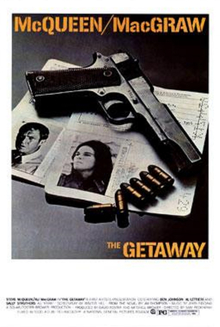
Doc McCoy (Steve McQueen) is doing a ten-year sentence in a Texas state prison when he’s offered a chance at parole.  The only condition that Jack Benyon (Ben Johnson) gives Doc is that, once out of prison, Doc is going to have to plan and carry out a bank robbery with two other criminals, Frank (Bo Hopkins) and Rudy (Al Lettieri).  Desperate for his freedom and to be reunited with his wife, Carol (Ali MacGraw), Doc agrees.  On the outside, Doc carries out the robbery but it turns out that no one can be trusted.  With everyone double-crossing everyone else, Doc and Carol head for the border, pursued by the police, Rudy, and Benyon’s brother, Cully (Roy Jenson).

Based on a novel by Jim Thompson, The Getaway is a fast-paced and violent heist film.  It was on this film that Ali MacGraw and Steve McQueen first met and famously fell for each other.  Married to producer Robert Evans, Ali MacGraw left him for McQueen.  Their very real chemistry gives the film its forward momentum and it is so palpable that it doesn’t matter that the stunningly beautiful Ali MacGraw couldn’t really act.  Steve McQueen, on the other hand, is at his coolest in The Getaway.  McQueen was an actor who didn’t need much dialogue to say a lot and The Getaway features him at his tough and ruthless best.  Doc is not one of the good guys.  He’s a bad guy but not as bad as Rudy, Frank, Jack, and Cully.

As was typical of Peckinpah, The Getaway is full of small moments and details that make the movie’s world come to life.  While Doc and Carol flee across Texas, Rudy has a twisted loves story of his own with Fran (Sally Struthers, in a role that will surprise anyone who only knows her as Gloria Stivic).  Jack Dodson plays Fran’s kindly husband and gives a performance that reminds us of the human cost of crime.  Slim Pickens has a wonderful cameo as an old cowboy whose truck is hijakced by Jack and Carol.  Those who thought of Peckinpah as just being a director of violent thrillers often overlooked the moments of humanity that regularly emerged amongst all the bloodshed.

The Getaway was not given the critical acclaim it deserved when it was released but today, it’s regularly recognized as a career best for both Sam Peckinpah and Steve McQueen.

Film Review: The Great Smokey Roadblock (dir by John Leone)


First released in 1977, The Great Smokey Roadblock tells the story of Elegant John Howard (Henry Fonda).

Elegant is not really his first name.  It’s a nickname, one to let us know that, in the world of independent truckers, John Howard was one of the good guys.  He never crashed his rig.  He never overcharged for a job.  He always arrived on time and in good shape.  John Howard was a good man but then he turned 60 and he got sick.  He spent months in the hospital, unable to work.  His truck was repossessed.  The movie starts with John sneaking out of his hospital room, stealing back his truck, and hitting the road in search of one final job.  Though John says he just wants to make enough money to get his truck back, the truth is that John is terminally ill.  If he’s going to die, he wants to die doing what he loves.  Of course, dying while driving could lead to some trouble for anyone else who happens to be on the road at the time but still, you have to respect John’s determination.  He’s a true American, independent to his core.

(My Dad occasionally made a living driving a truck so perhaps that’s why I’m partial to films like this one.)

John picks up a hitchhiker, a religious young man named Beebo Crozier (Robert Englund).  John picks Beebo up because Beebo was walking through the desert in a suit.  Beebo claims that he’s walking to Florida but John tells him that he can’t do that.  John will drive Beebo to Florida.  Of course, John also expects Beebo to pay for the gas that his truck uses because it’s not like John has any money.  At first, Beebo accuses John of cheating him.  (Henry Fonda cheating someone!?  Perish the thought!)  Soon, however, John has become Beebo’s mentor.

Everyone respects John but no one wants to hire him.  The only offer that John gets is from sleazy Charlie Le Pere (Gary Sandy), who has an agenda of his own.  Finally, John visits his old friend, Penelope (Eileen Brennan).  Penelope is a madam whose brothel has just been closed down.  John agrees to transport Penelope and her girls (including Susan Sarandon) to a new location on the East Coast.  Penelope offers to help John pay the bills.  Elegant John’s a pimp now!  (I was about to say that this seemed like an odd turn-of-events for Henry Fonda but then I remembered that he starred in The Cheyenne Social Club with Jimmy Stewart.)

There’s not really much of a plot to The Great Smokey Roadblock.  John, Beebo, Penelope, and the girls travel from one location to another.  They get thrown in jail by a notoriously corrupt deputy named Harley Davidson (Dub Taylor).  After they escape, they become minor celebrities.  Two counterculture journalists (played by Austin Pendleton and John Byner) show up and help them broadcast their story and the film comes to a halt while Pendleton and Byner exchange what sounds like improvised dialogue.  The police attempt to set up a roadblock to stop Elegant John and his Six Mystery Women.  I guess that’s the Great Smokey Roadblock of the title.

It’s a weird movie, in that the humor is extremely broad and often crude but Henry Fonda is playing a man who is not only terminally ill but who actually looks like he’s terminally ill.  (Henry Fonda himself was reportedly very ill during the filming of The Great Smokey Roadblock.)  As such, it’s a rather melancholy comedy, one in which every joke seems like it might be the last one that Elegant John will ever hear.  In the 70s, not even a trucker comedy could have a happy ending and, as such, The Great Smokey Roadblock feels like a drive-in film for the existential set.  The film’s plot doesn’t really add up to much and is full of plot holes that serve as evidence of a troubled production.  That said, there’s something rather charming about seeing a pre-Nightmare On Elm Street Robert Englund playing a gentle guy who ends up as Henry Fonda’s protegee.  Fonda and Englund play off each other well and their scenes together are the best thing about The Great Smokey Roadblock.

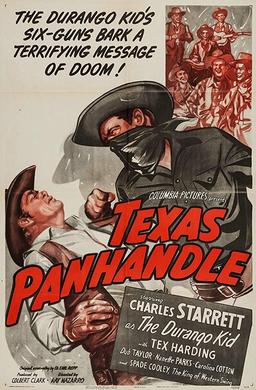
Texas Panhandle (1945, directed by Ray Nazarro)


Secret Service agent Steve Buckner (Charles Starrett) is told by his boss that his activities as the Durango Kid have led some in the Agency to suspect that Steve is himself an outlaw.  Even after Steve explains that he only takes on the Durango Kid identity when he needs to step outside of the law to protect innocent people, Steve is still suspended pending an investigation.

With nothing better to do, Steve rides off to the Texas panhandle, where he learns that outlaws have been robbing settlers and stealing government gold.  Working as the Durango Kid, Steve discovers that it’s not just outlaws that are targeting the new arrivals but it’s also the corrupt head of the local land office, Ace Gatlin (Forest Taylor).  Helping out Steve are settler Tex Harding and Cannonball (Dub Taylor), who works at the saloon and sings a few songs.

This is a standard Durango Kid film.  It has all the usual gunfights and horse chases but it doesn’t have Smiley Burnette.  Dub Taylor takes Smiley’s place as the comedic sidekick and, while Taylor isn’t bad, he’s still no Smiley Burnette.  Dub Taylor’s characters were usually more buffoonish than the clever helpers played by Smiley Burnette and, as a result, the Durango Kid movies with Taylor feel more juvenile than the ones with Smiley.  That’s the case here.

This installment is interesting because it reveals that Steve’s superiors knew about his Durango Kid side hustle and were as a confused about why he needed it as everyone else was.  Steve reveals he would rather lose his job than give up being Durango.  Luckily, at the end of the movie, he gets a telegram telling him that the investigation is over and he’s been reinstated with the Secret Service.  All’s well that ends well.

Lawless Empire (1945, directed by Vernon Keays)


For years, outlaws have controlled the frontier town of Dusty Gulch but now their power is threatened by the homesteaders who are moving into the area.  Led by the crusading Rev. Tex Harding, the homesteaders are being progress and reform to the frontier.

Duke (Ethan Laidlaw) and his gang have launched a campaign of intimidation against the new arrivals.  Luckily, the Durango Kid (Charles Starrett) rides into town to protect the homesteaders.  Duke’s boss, businessman Blaze Howard (John Calvert), decides that the town needs a sheriff to go after the Kid.  Blaze offers the job to newcomer Steve Ranson, not realizing that Steve is not only the Durango Kid but also the brother of the former sheriff, who was murdered by Blaze’s men.

Lawless Empire is one of the few Durango Kid films not to feature Smiley Burnette as Durango’s sidekick.  Instead, Durango rides into town with Bob Wills and his Texas Playboys and, while Willis does perform a song or two, there’s still considerable less singing than in the films that featured Burnette.  The role of comic relief is provided by Dub Taylor in the role of Cannonball.  Cannonball gets a job sweeping up Blaze’s saloon and he feeds whatever information he learns back to Durango.  When Blaze figures out what’s going on, he deliberately supplies Cannonball with bad information but it doesn’t make any difference.  The Durango Kid is always one step ahead of the bad guys.

Lawless Empire is a little more serious than the other Durango Kid films.  Steve is not only trying to clean up the town but he’s also seeking to avenge his brother so there’s not as much room for as much comedy as usual.  Lawless Empire does have all of the usual gunfights and horse chases and the film gets off to an exciting start with Durango making his first appearance with his gun already drawn so that he can disarm Duke and his men.  Even without Smiley around to help him out, Durango brings law to a lawless empire.


The TSL Horror Grindhouse: Creature From Black Lake (dir by Joy N. Houck, Jr.)


It’s Bigfoot time!

1976’s Creature From Black Lake tells the story of two students at the University of Chicago.  Pahoo (Dennis Fimple) and Rives (John David Carson) decide that they want to spend their Spring Break on the Arkansas/Louisiana border, researching the legend that a Bigfoot-like creature that lives in the bayous.  (The creature is obviously based on the legendary Fouke Monster, who was also the subject of the 1972 documentary, The Legend of Boggy Creek.)

Pahoo and Rives head down South, looking to interview anyone who has seen the Creature From Black Lake.  Some people are willing to talk to them and they tell stories involving the Creature causing cars to crash, killing dogs, and attacking fisherman.  The Creature does not sound nice at all.  Still, the majority of the people in town don’t really feel like opening up to two Yankee monster hunters.  They’re worried that Pahoo and Rives are only in town because they want to portray everyone as being a bunch of ignorant rednecks who are scared of things that go bump in the night.

And really, they have every right to be concerned.  I grew up all over the South and the Southwest.  My family briefly lived in Fouke, the home of the Fouke Monster.  (No, I never saw or heard the monster, mostly because the monster doesn’t exist.)  When I was a kid, I lived in both Louisiana and Arkansas, among other states.  From my own personal experience, I can tell you that there is no one more condescending than a Northerner who is visiting the South for the very first time.   “Why is it so hot?”  “Why is everyone down here so polite?”  “Why can’t I find a Wawa!?”  Seriously, it gets old really quickly.  Now, to their credit, Pahoo and Rives are actually pretty polite and considerate when talking to the people who think that they have seen the Creature From Black Lake.  But still, one can understand why the town isn’t exactly thrilled to have them asking about monsters.

Anyway, after interviewing both Jack Elam and Dub Taylor about their experiences with the monster and getting yelled at by the local sheriff (played by Bill Thurman), Pahoo and Rives head out to the local swamp, hoping to find the creature themselves.  That, of course, turns out to be a huge mistake on their part.

Creature From Black Lake is a deliberately-paced film, which is a polite way of saying that it’s a bit slow.  Obviously inspired by The Legend of Boggy Creek, a good deal of the film is taken up with scenes of Pahoo and Rives interviewing people about their encounters with the monster.  That said, the film definitely picks up when Pahoo and Rives head into the swamp themselves and their eventual meeting with the monster is well-directed.  I have to admit that I spent this entire film dreading the moment when it would be revealed that the Monster was actually misunderstood and peaceful and I appreciated that the film did not go that route.  The creature turns out to be no one’s friend and is genuinely menacing.

The cast is full of familiar county character actors, all of whom do a good job bringing their characters to life.  Dennis Fimple and John David Carson are likable as the two students.  This film was also an early credit for cinematographer Dean Cudney and, just as he would later do for John Carpenter, Cudney creates a perfectly ominous atmosphere of isolation.  Creature From Black Lake may start out slow but, ultimately, it’s an effective creature feature.


Horror Film Review: Burnt Offerings (dir by Dan Curtis)


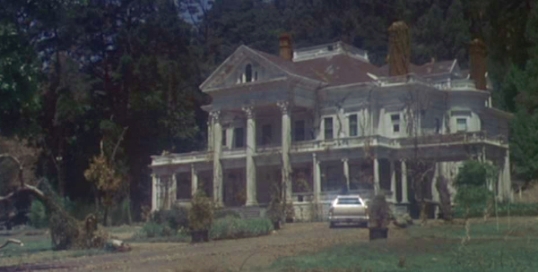
This 1976 film is about a family so obnoxious that their own house tries to kill them!

Well, maybe it’s not entirely the family’s fault. The film suggests that the house would have tried to kill anyone who lived there because the house itself is possessed by ghosts or Satan or something of that nature. Still, you can’t help but feel that the house took some extra joy out of destroying the Rolf family.  I know that I got some extra joy out of watching them get destroyed.

Ben (Oliver Reed) is a writer. Ben’s wife, Marian (Karen Black), is a flake who becomes obsessed with the house as soon as she sees it. Their son 12 year-old son, Davey (Lee Montgomery), is …. well, there’s no nice way to say this. He’s a brat. He’s the type of kid who you would be terrified of your kid befriending at school because then he’d want to come hang out at your house all the time. The movie doesn’t seem to realize that he’s a brat but the audience does. And finally, Aunt Elizabeth (Bette Davis) is Bette Davis, which means that she spends most of the movie delivering her lines in the most overdramatic and arch way possible.

The Rolfs are renting the house for the summer. The owners of the house are the Allardyces (Burgess Meredith and Eileen Heckart) and you would think that people would know better than to rent a house from Burgess Meredith. I mean, how many horror films in the 70s specifically featured Meredith as some sort of emissary of the devil? The Rolfs are asked to do two things: look after the house and look after Mrs. Allardyce, who lives on the top floor and never wants to be disturbed. The Rolfs are assured that they’ll never see Mrs Allardyce and the Rolfs are like, “Sure! That makes sense!”

Anyway, as soon as the Rolfs move in, the house starts to make weird noises and shingles start flying off the roof and, at one point, Ben nearly drowns his son in the pool.  And while it’s kind of understandable, considering how annoying his son is, it’s still not a good look.

Yep, it’s pretty obvious that the house is evil but Marian loves it, almost as if she’s becoming …. possessed! Meanwhile, Ben keeps having visions of a sinister looking chauffeur (Anthony James, whose creepy smile is the only memorable thing about this film) and Davey keeps standing too close to the outside chimney. You don’t want to do that when a house hates your guts.

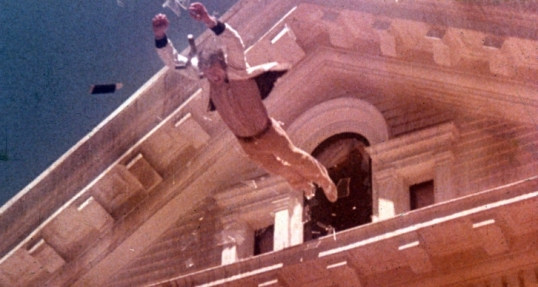
It all leads to the inevitable ending, which involves people getting tossed out of windows and *ahem* crushed by chimneys. The family’s so obnoxious that you can’t help but cheer when that chimney comes down.  In fact, to be honest, as little as I think of this movie, I always specifically watch it just to see that chimney come down on one certain character.  Things might not work out well for the Rolfs or anyone else watching this rather slow and predictable movie but at least the house survives.

Fly, baby, fly!

Now, I will admit that I do own this film on DVD, simply because I love the commentary track.  Director Dan Curtis, star Karen Black, and the film’s screenwriter, William F. Nolan, watch and discuss the film and it quickly becomes obvious that none of them remember much about making it.  While Karen Black tries to keep the peace, Curtis and Nolan bicker over who is most responsible for the parts of the film that don’t work.  When Anthony James shows up as the creepy chauffeur, Dan Curtis says that he doesn’t remember his name and then gets visibly annoyed when Karen Black spends the next few minutes talking about what a good actor Anthony James is.  It’s all enjoyably awkward and, as someone who has hosted her share of live tweets, I couldn’t help but sympathize with everyone’s efforts to find something positive to say about Burnt Offerings.

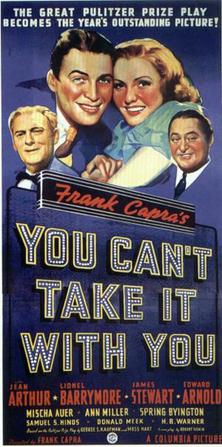
Lisa Reviews An Oscar Winner: You Can’t Take It With You (dir by Frank Capra)


(With the Oscars scheduled to be awarded on March 4th, I have decided to review at least one Oscar-nominated film a day.  These films could be nominees or they could be winners.  They could be from this year’s Oscars or they could be a previous year’s nominee!  We’ll see how things play out.  Today, I take a look at the 1938 best picture winner, You Can’t Take It With You!)

“You can’t take it with you.”

If there’s any one belief that defines the worldview of Martin Vanderhof (Lionel Barrymore), it’s this.  It doesn’t matter how much money you make in your life.  It doesn’t matter how successful you are at business or anything else.  The fact of the matter is that, when your time is up, you won’t be able to take any of that stuff with you.  Instead, Grandpa Vanderhof (as he’s called by his large family) believes that the most important thing to do during your lifetime is to make friends and pursue what you’re truly interested in.

Vanderhof has another belief, one that particularly appealed to be me.  He has never paid income tax.  He doesn’t see the point of giving money to the government when he doesn’t feel that they’ll make good use of it.  When an outraged IRS agent (Charles Lane) stops by Vanderhof’s sprawling house and demands that Vanderhof pay his taxes, Vanderhof refuses.  When the IRS man argues that the income tax is necessary to pay for the Presidency, the Congress, and the Supreme Court, Vanderhof offers to give him five dollars.  “Hell yeah!” I shouted at the TV.  With an attitude like that, Vanderhof should have moved down here to Texas.  We would have elected him governor.

Grandpa Vanderhof is the head of a large and cheerfully eccentric family, all of whom live together under the same roof.  Penny (Spring Byington) writes novels because, years ago, a typewriter was accidentally delivered to the house.  Her husband, Paul (Samuel S. Hinds), has a basement full of fireworks.  Essie (Ann Miller) loves to dance and spends almost the entire movie twirling from room to room.  Her husband, Ed (Dub Taylor), is a xylophone player.

Of course, it’s not just family living in the Vanderhof House.  There’s also Potap Kolenkhov (Mischa Auer), a Russian who is “teaching” Essie how to dance.  There’s Rheba the maid (Lillian Yarbo) and Donald (Eddie Anderson) the handyman.  Actually, the house appears to be open to just about anyone who wants to stay.

And then there’s Penny’s daughter, Alice (Jean Arthur).  Alice is the most “normal” member of the family.  She has just become engaged to Tony Kirby (James Stewart) and she is still trying to figure out how to introduce Tony’s stuffy parents (Edward Arnold and Mary Forbes) to her eccentric family.  What she and Tony don’t know is that Mr. Kirby is currently trying to buy up all the houses that are near a competitor’s factory.  Only one homeowner has refused to sell.  The name of that homeowner?  Martin “Grandpa” Vanderhof.

It all leads, of course, to one chaotic dinner party, one lively night in jail, and a huge fireworks display.  It also leads to true love, which is nice.  Jimmy Stewart and Jean Arthur are even more adorable here than they were in Mr. Smith Goes To Washington.

Based on a Pulitzer-winning play by George S. Kaufman, You Can’t Take It With You was the second comedy to win the Oscar for Best Picture.  The first comedy to win was 1934’s It Happened One Night.  It’s probably not coincidence that both of these films were directed by Frank Capra.

Seen today, You Can’t Take It With You seems a bit slight for an Oscar winner.  Grandpa Vanerhof is a lovable eccentric.  Tony’s father is a stuffy businessman.  Hmmm … I wonder whose philosophy is going to be victorious at the end of the movie?  Still, predictability aside, it’s a delightfully enjoyable film.  While it never quite escape its stage origins, it features wonderful performances from all the usual members of the Capra stock company.  James Stewart and Jean Arthur are a charming couple while Lionel Barrymore gives a performance that is so warmly likable that it’s hard to imagine that, just 9 years later, he would be so perfectly cast as the heartless Mr. Potter in It’s A Wonderful Life.  Of course, my favorite member of the member was Essie, mostly because I also like to dance from room to room.  While it’s hard to justify awarding it Best Picture over The Adventures of Robin Hood and Grand Illusion, You Can’t Take It With You is still a wonderfully fun movie.

It’ll make you smile and laugh.  Who can’t appreciate that?

http://www.youtube.com/watch?v=0WY9RAroTS0


A Movie A Day #244: Death of a Gunfighter (1969, directed by Allen Smithee)


At the turn of the 20th century, the mayor and the business community of Cottonwood Springs, Texas are determined to bring their small town into the modern era.  The Mayor (Larry Gates) has even purchased one of those newfangled automobiles that have been taking the country by storm.  However, the marshal of Cottonwood Spings, Frank Patch (Richard Widmark), is considered to be an embarrassing relic of the past.  Patch has served as marshal for 20 years but now, his old west style of justice is seen as being detrimental to the town’s development.  When Patch shoots a drunk in self-defense, the town leaders use it as an excuse to demand Patch’s resignation.  When Patch refuses to quit and points out that he knows all of the secrets of what everyone did before they became respectable, the business community responds by bringing in their own gunfighters to kill the old marshal.

Death of a Gunfighter is historically significant because it was the very first film to ever be credited to Allen Smithee.  The movie was actually started by TV director Robert Totten and, after Widmark demanded that Totten be fired, completed by the legendary Don Siegel.  Since Totten worked for 25 days on the film while Siegel was only on set for 9, Siegel refused to take credit for the film.  When Widmark protested against Totten receiving credit, the Director’s Guild of America compromised by allowing the film to be credited to the fictitious Allen Smithee.

In the years after the release of Death of a Gunfighter, the Allen (or, more often, Alan) Smithee name would be used for films on which the director felt that he had not been allowed to exercise creative control over the final product.  The Smithee credit became associated with bad films like The O.J. Simpson Story and Let’s Get Harry which makes it ironic that Death of a Gunfighter is not bad at all.  It’s an elegiac and intelligent film about the death of the old west and the coming of the modern era.  It also features not only one of Richard Widmark’s best performances but an interracial love story between the marshal and a brothel madame played by Lena Horne.  The supporting cast is full of familiar western actors, with Royal Dano, Harry Carey, Jr., Larry Gates, Dub Taylor, and Kent Smith all making an impression.  Even the great John Saxon has a small role.  Though it may be best known for its “director,” Death of a Gunfighter is a film that will be enjoyed by any good western fan.