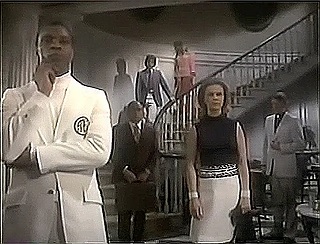
Retro Television Review: The Hunted Lady (dir by Richard Lang)


Welcome to Retro Television Reviews, a feature where we review some of our favorite and least favorite shows of the past!  On Sundays, I will be reviewing the made-for-television movies that used to be a primetime mainstay.  Today’s film is 1977’s The Hunted Lady!  It  can be viewed on YouTube.

Detective Susan Reilly (Donna Mills) reluctantly teams up with a chauvinistic cop named Sgt. Arizzio (Alan Feinstein) to investigate a United States senator who has presidential ambitions.  Arizzio believes that the senator is being back by the Mafia and that it would be disastrous for the country if a mob-connected politician ended up in the White House.  (Being mob-connected didn’t seem to hurt John F. Kennedy but still….)

Now, Detective Reilly and Sgt. Arizzio working together to take down a corrupt senator sounds like an intriguing premise for a movie, right?  Well, oddly enough, that’s not what this movie is actually about.  Instead, it’s about Susan going on the run after she’s framed for Arizzio’s murder.  She escapes from police custody with the help of her father.  Though she’s still recovering from being shot earlier in the film, Susan makes her way to Reno and attempts to hide out from both the cops and the Mafia assassin that has been sent to kill her.

Susan hiding out in Reno.  Hmmm …. sound like an intriguing premise for a movie, right?  Well, don’t get to attached to Susan pretending to be a professional gambler because it turns out that bullet wound was more serious than she realized and she ends up passing out from blood loss.  When she awakens, she’s in a free clinic that is run by Dr. Arthur Sills (Robert Reed).  Dr. Sills doesn’t ask Susan too many questions about her past and even hires Susan on as a nurse.  Susan and Dr. Sills fall in love and try to clear the name of a Native American who has been accused of blowing stuff up.

Doing some research, I was not surprised to discover that The Hunted Lady was originally developed as a possible television show.  The show would have played out like a combination of Charlie’s Angels and The Fugitive, with Susan moving from town to town and getting involved with a new set of guest stars each week.  With both the police and the mob trying to track her down, Susan would try to clear her name while also helping out strangers.  Unfortunately, The Hunted Lady wasn’t exactly a hit in the ratings and Susan’s further adventures went untold.

The main problem with The Hunted Lady is an obvious one.  The idea of the Mafia trying to install one of their guys in the White House is considerably more intriguing that Susan falling in love with Dr. Sills while working at a free clinic.  The whole time that Susan was helping the doctor’s patients, I was thinking, “But what about the senator?”  Donna Mills was surprisingly convincing as a tough cop but she had next to no chemistry with Robert Reed.  If anything, Reed looked annoyed at just having to be there.

Anyway, here’s hoping that Susan cleared her name eventually.  You can only run for so long.
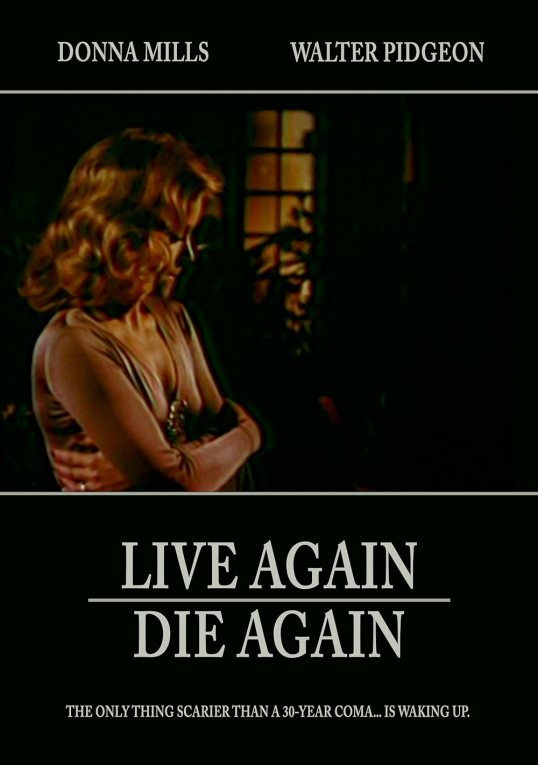
Retro Television Reviews: Live Again, Die Again (dir by Richard A. Colla)


Welcome to Retro Television Reviews, a feature where we review some of our favorite and least favorite shows of the past!  On Sundays, I will be reviewing the made-for-television movies that used to be a primetime mainstay.  Today’s film is 1974’s Live Again, Die Again!  It  can be viewed on YouTube.

30 years ago, Caroline Carmichael (Donna Mills) died.

Except, she really didn’t.  Instead, when on the verge of death, she was put into cryogenic suspension.  She has spent the last three decades in suspended animation and, as a result, she has not aged in all that time.  In fact, her hair still looks perfect.  (I have some doubts about the scientific validity of any of this but let’s just go with it.)  As this movie begins, Caroline Carmichael finally wakes up.

Caroline has an entirely new world to discover.  At a party to celebrate her awakening, Caroline is shocked to discover that, while she still appears to be young, all of her friends are now in their 60s. Her husband, Thomas (Walter Pidgeon), is now old and sickly.  Her beautiful home is now looked after by a strict and suspicious housekeeper (Geraldine Page).    Her two children (played by Mike Farrell and Vera Miles) both appear to be older than her.  In fact, her daughter was so traumatized by Caroline’s “death,” that she is now terrified of being left alone with her mother.

You might expect that this film would be dedicated to Caroline adjusting to the world of the 70s and that it might feature some thoughts on whether it’s ethical to keep someone in suspended animation for 30 years.  And there are elements of that.  Caroline is amazed by all the tall buildings.  Her daughter’s reaction to Caroline’s return is hardly heart-warming and even Caroline’s whiny son doesn’t seem to be quite as happy about it as one might expect.  Her husband has spent the last 30 years of his life waiting for Caroline to wake up and it’s hard not to consider how many opportunities for happiness or success that he missed as a result.

That said, the film itself quickly becomes more of a gothic murder mystery, as Caroline comes to realize that someone is trying to kill her.  That’s kind of a shame because I actually found all of the cryogenic stuff to be much more interesting and the idea that one could basically just stop aging for 30 years was an intriguing one.  It’s an interesting question.  If it could save your life at some undetermined point in the future, would you be frozen?  Myself, I think I would be reluctant to do so because you never know what type of world you might wake up in.  Caroline is lucky enough to wake up wealthy in the 70s but what if you woke up and discovered that your entire family had died while you were in your coma?  What if you woke up and discovered that your country had become some sort of socialist Hellhole?  Imagine if someone went into hibernation in 1994 and then woke up in 2024?  They would probably want to go back to sleep.

The film was written Joseph Stefano, who also did the script for Psycho and was one of the producers behind The Outer Limits.  Not surprisingly, the script is full of snappy dialogue and the cast features two Psycho cast members, Vera Miles and Lurene Tuttle.  Director Richard Colla keeps the action moving and, early on in the film, he does a good job of depicting Caroline’s disorientation with finding herself in an entirely new world.  The film is well-acted by the entire cast, with Donna Mills especially doing a good job as Caroline.  This was an intelligent, well-made, and — most importantly — short made-for-TV movie.  At a time when almost all movies and TV shows seem to be too long for their own good, it’s hard not appreciate Live Again, Die Again‘s 73-minute runtime.

The Unnominated: Play Misty For Me (dir by Clint Eastwood)


Though the Academy of Motion Picture Arts and Sciences claim that the Oscars honor the best of the year, we all know that there are always worthy films and performances that end up getting overlooked.  Sometimes, it’s because the competition too fierce.  Sometimes, it’s because the film itself was too controversial.  Often, it’s just a case of a film’s quality not being fully recognized until years after its initial released.  This series of reviews takes a look at the films and performances that should have been nominated but were, for whatever reason, overlooked.  These are the Unnominated.

In 1971, Clint Eastwood made his directorial debut with Play Misty For Me.

Eastwood plays Dave Garver, a DJ at a Carmel-By-The-Sea jazz station who has ambitions to some day go national.  Every night, a woman named Evelyn (Jessica Walter) calls Dave and asks him to “Play Misty for me.”  Eventually, Dave meets Evelyn in a bar and he takes her home with him.  After sleeping with her, Dave tells Evelyn that he’s only interested in having a casual relationship.  Evelyn, however, reveals that she has a far different interpretation of casual.  Soon, Evelyn is dropping by Dave’s house unannounced and acting rather clingy, even appearing to attempt suicide when Dave tries to tell her that he’s not interested in having a serious relationship with her.

At first, it’s hard not to feel bad for Evelyn.  Yes, she’s obviously unstable.  Yes, she’s clingy.  Yes, the scene in which she intentionally ruins Dave’s interview for a national job is difficult to watch.  But there’s something so sincere and desperate about her need to have someone in her life that, again, it’s hard not to have sympathy for her.  When she claims that Dave took advantage of her when they first met, she’s got a point.  Dave obviously felt that Evelyn was a one-night stand that he would never have to see again.  Evelyn feels differently.

Things chance when Dave eventually runs into his former girlfriend, Tobie Williams (Donna Mills).  Dave and Tobie tentatively restart their relationship.  When Evelyn finds out, she goes from being clingy to be homicidal.  She goes from trashing Dave’s place to attacking Dave’s housekeeper to attacking Dave and Tobie themselves.

An assured directorial debut, Play Misty For Me shows that Eastwood had a strong directorial sensibility from the start.  (It also shows, during an extended sequence in which Dave and Tobie attend a jazz festival, that Eastwood was always capable of being rather self-indulgent.)  Eastwood uses the film to deconstruct his own confident persona, with Dave going from being a somewhat callous womanizer to ultimately being terrified for his life.  The film is dominated by Jessica Walter’s performance as Evelyn.  Walter is sad and terrifying, often in the same scene.  Though the film doesn’t dig into what happened in Evelyn’s past to drive her to such extremes, Jessica Walter’s performance leaves no doubt that she’s someone who has been hurt by the world and is now so desperate for love and protection that she’ll strike out at anyone who she feels is denying it to her.

As a horror movie that was directed by an actor who, at the time, was still not a favorite of the critics, it’s perhaps not surprising that the Academy ignored Play Misty For Me.  Still, it’s a shame.  If nothing else, Jessica Walter’s performance was far more memorable that Janet Suzman’s nominated turn in the painfully dull Nicholas and Alexandra.  It’s a brave performance and one that more than deserved to be honored.

Previous entries in The Unnominated:

  1. Auto Focus 
  2. Star 80
  3. Monty Python and The Holy Grail
  4. Johnny Got His Gun
  5. Saint Jack
  6. Office Space

Retro Television Reviews: The Bait (dir by Leonard J. Horn)


Welcome to Retro Television Reviews, a feature where we review some of our favorite and least favorite shows of the past!  On Sundays, I will be reviewing the made-for-television movies that used to be a primetime mainstay.  Today’s film is 1973’s The Bait!  It  can be viewed on YouTube!

Tracey Fleming (Donna Mills) is the widow of a cop and an undercover detective herself.  Unfortunately, her superior, Captain Maryk (Michael Constantine), is not convinced that Tracey has what it takes to be in a dangerous situation and, as a result, Tracey spends most of her time riding the bus and busting perverts and low-level drug dealers.  When four woman are raped and murdered by the same serial killer, Tracey writes up a report on what she thinks is motivating the killer.  Captain Maryk is, at first, skeptical about Tracey’s claim that the killer is fueled by a puritanical rage but, when it turns out that the killer has been wiping off his victims’s lipstick (just as Tracey speculated that he was), Maryk starts to think that Tracey might have something to offer the investigation.

Tracey becomes the bait in an operation to lure out the killer.  Leaving behind her son and her mother, Tracey moves into an apartment in the neighborhood that is believed to be the center of the killer’s activities.  Tracey is given a job as a survey taker and soon, she’s walking around the neighborhood and asking random men for their opinions on current events and women’s liberation.  A local waitress (Arlene Golonka) recognizes Tracey as a detective but Tracey lies and say that she’s no longer with the force.  When the killer makes the waitress his next victim, Tracey becomes even more determined to capture him but will she able to get Marsyk and the rest of the force to give her the room to investigate the murders?

This may sound like an intriguing whodunit but, for some reason, The Bait reveals early on that the murderer is a bus driver named Earl Stokely (played, in a very early performance, by William Devane).  There’s really nothing to be gained by revealing the killer’s identity as early as the film does.  Perhaps if the film was split between scenes of Tracey investigating the neighborhood and Earl stalking Tracey, that would have generated some sort of suspense but, with the exception of one bus ride, Tracey and Earl barely even interact before he comes after her at the film’s end.  Devane does give a good performance as a homicidal lunatic but, when viewed today, it’s impossible to watch him in this film without spending most of the time thinking, “Hey, that’s the usually Kennedyesque William Devane, playing a killer bus driver!”

I was not surprised to learn that The Bait was intended to be a pilot for a weekly television series that would have followed the future investigations of Tracey Fleming.  Donna Mills was likable in the lead role and she had a good chemistry with the other actors playing her colleagues so it’s easy to imagine a series in which Tracey solved a new case every week while Marsyk continually underestimated her.  Ultimately, though, that series never happened and The Bait would be the sole televised adventure of Detective Tracey Fleming.

Retro Television Reviews: Fantasy Island 3.5 “The Chain Gang/The Boss”


Welcome to Retro Television Reviews, a feature where we review some of our favorite and least favorite shows of the past!  On Tuesdays, I will be reviewing the original Fantasy Island, which ran on ABC from 1977 to 1986.  Almost entire show is currently streaming is on Youtube!

What I’ve long-feared has happened.

Tubi has removed the original Fantasy Island from its site.  The recently-canceled Fox version can be viewed but not the original.  Don’t get me wrong.  I liked the new Fox version.  But these are Retro Television Reviews and a show that premiered in 2021 is not yet retro.

Fortunately, quite a few episodes are on YouTube and it’s probable that the original complete series will again end up streaming somewhere.  So, I’m going to try to continue to review this show.  I can’t guarantee that I won’t run out of episodes at some point.  For instance, it doesn’t appear that much of seasons 6 or 7 can be found, even on YouTube.  (Unfortunately, it appears that only the first three seasons of Fantasy Island have been released on DVD.)  But I’m going to do my best!

Episode 3.5 “The Chain Gang/The Boss”

(Dir by Michael Vejar, originally aired on October 19th, 1979)

Tattoo has decided that he wants to be an artist!  Mr. Roarke demands to know why because God forbid Tattoo have a life outside of spotting the plane.  Tattoo admits that he wants to get the island women to pose for him.  Mr. Roarke orders Tattoo to abandon his art career and head down to the docks to meet the plane.

The plane is carrying two guests who hope, much like Tattoo, to change their lives.

Cindy Carter (Donna Mills) is a switchboard operator who has a crush on her boss, Brent Bailey (Brett Halsey).  Her fantasy is to be the boss of her own company.  Mr. Roarke grants her wish and soon, Cindy is in charge of her own multi-national corporation.  In fact, her corporation owns Brent Bailey’s business!  Cindy also gets a executive assistant named Gary Pointer (Roddy McDowall).  Unfortunately, it turns out that Brent isn’t a very nice person and he’s been siphoning money out of the pension fund.  He threatens to frame Cindy to keep her from approving an audit of the fund.  However, with Gary’s support and eventual love, Cindy stands up to Brent and reveals his wrong-doing.  Mr. Atwell (Stacy Keach, Sr.), the presumed-dead head of the company, suddenly shows up at the stockholder’s meeting and announces that he faked his own death to discover who was embezzling from the pension fund.  The stockholders applaud as Brent Bailey is taken away from the police.  It’s all rather silly and melodramatic but the likable presence of Roddy McDowall kept the story entertaining.

Meanwhile, Mike Jenner (Dennis Cole) came to the Island to confront Eddie Collins (Cameron Mitchell), the criminal that Mike believes murdered his father and framed him for a theft.  (There’s a lot of theft in this episode.)  Mr. Roarke reveals that Eddie lives in a nearby fishing village.  Mike goes to the village, spots Eddie, and punches him.  Eddie hits back….

….and both of them are sentenced to spend a year on a chain gang!

Fantasy Island has a chain gang!?  And the chain gang is overseen by a redneck named Captain Hawks (R.G. Armstong)!?  Why has this never been mentioned before?  I mean, is it normal to sentence paying guests to spend a year on the chain gang?

Anyway, Eddie and Mike set aside their difference and break out out the prison camp.  (Fantasy Island has prison camps!?)  During their escape, Eddie gets trapped in quicksand.  Mike does eventually rescue him but only after Eddie confesses to having framed Mike’s father.  As soon as Eddie confesses, Mr. Roarke shows up in his jeep.  Apparently, Mike is now free to leave the Island with his fiancee (Pat Klous) while Eddie is sent to the Fantasy Island prison for the rest of his life.  Much as the other fantasy was saved by the reliable likability of Roddy McDowall, this episode was saved by Cameron Mitchell’s grouchy presence.  One could always trust Mitchell to give it his all while playing a bad guy.

With the fantasies taken care of, Tattoo returns to his art.  When he asks his model to pose naked, she destroys all of his paintings while Mr. Roarke laughs and laughs.  Mr. Roarke really does hate his assistant.

Retro Television Reviews: The Love Boat 2.1 and 2.2 Marooned / The Search / Issac’s Holiday: Parts 1 & 2


Welcome to Retro Television Reviews, a feature where we review some of our favorite and least favorite shows of the past!  On Wednesdays, I will be reviewing the original Love Boat, which aired on ABC from 1977 to 1986!  The series can be streamed on Paramount Plus!

This week, the second season begins with a super-sized episode!

Episodes 2.1 & 2.2 “Marooned / The Search / Issac’s Holiday”

(Dir by Paul Stanley, originally aired on September 16th, 1978)

The second season of The Love Boat started with double-sized episode, promising twice the romance, twice the comedy, and twice the running time!

(Subsequently, this episode was split in two for syndication, hence the double numbering.)

Among the passengers on this cruise is none other than Isaac Washington (Ted Lange)!  The Love Boat’s iconic bartender has decided to spend his vacation where he works and he’s bought a ticket to sail on the Pacific Princess.  It might seem strange to want to spend your vacation at the office but in Isaac’s case, I can see the appeal.  As we saw during the first season, no one works harder than Isaac.  He somehow always manages to be behind every single bar on the ship and it often appears that he’s the only bartender on the boat!  To top it off, he’s always on call.  He’s earned a vacation and he’s earned the right to be served for once.  From the minute Isaac boards the boat, he’s playfully asking the crew to do things for him and none of them mind because he’s their friend Isaac.  One of the key reasons why The Love Boat worked was that the friendships between the members of the crew felt very real.  As such, there’s never any doubt that Isaac would want to spend his vacation with Gopher, Doc, and Julie.

(Interestingly enough, the Captain doesn’t seem to realize that Isaac’s on the boat until Isaac takes his seat at the captain’s table.)

Of course, there are some problems with Isaac’s vacation.  Isaac quickly notices that the substitute bartender, Wally (played by Norm Crosby), is a bit sullen and not very knowledgeable about his drinks.  As well, Isaac has lied to a passenger named Mara (Lola Falana), telling her that he’s a wealthy race car driver.  Bitter old Wally just can’t wait to tell Mara the truth.

Even worse, when Captain Stubing goes to visit a nearby island, Deputy Captain Cunningham (Dick Martin) is left in charge and he quickly proves himself to be thoroughly incompetent.  (The show makes a point of assuring viewers that Cunningham actually works for a different cruise line and is just training on the Pacific Princess.)  Cunningham ignores the news that a hurricane is on the way.  When the hurricane hits, it’s falls on Isaac to take charge and make sure the passengers are safe.  Of course, to do this, he has to admit that he’s not a race car driver.  He’s just a bartender who, in a just world, would probably be a captain.

Meanwhile, Stubing, Doc, Gopher, Julie, and a group of passengers (Avery Schreiber, Barbi Benton, Edie Adams, and Audra Lindley) are all being held captive on that nearby island.  Their captor is an eccentric hermit named David Crothers (played by John Astin, who was often cast as eccentric hermits).  David has a gun, one that later turns out to be full of not bullets but dirt.  Unfortunately, the hurricane that threatens the Pacific Princess also maroons everyone else on the island and they have to wait for someone to rescue them.  Injured by a falling tree, Gopher spends his time deliriously speaking to imaginary women in foreign accents.  Doc, for once, actually gets to do some medical stuff and assures everyone that Gopher will be fine.  Interestingly enough, no one seems to be that worried about being captured by a crazed hermit.  Perhaps that’s because John Astin is just too naturally friendly to be viewed as a threat.

Finally, Jeannie Carter (Donna Mills) is on the boat because she’s been told that one of the passengers is her long-lost mother.  Soap opera actor Mike Adler (David Birney) offers Jeannie the moral and emotional (and romantic) support to confront the woman but the woman (Laraine Day) turns out to be Mike’s mother as well!  Agck!

The 2nd season premiers, with its mix of melodrama, broad comedy, romance, and hurricane-strength winds, is pretty much exactly what most viewers would want out of a show like The Love Boat.  Isaac gets to save the day while John Astin hams it up and David Birney, Donna Milles, and Laraine Day wring every emotion that they can out of their soap opera-style storyline.  It’s a fun and undemanding show, one that gets by on its breezy style and the likable chemistry between the cast.

This episode is also important because it was the second episode (after the first season’s supersized episode) in which the opening credits featured video images of the guest stars as well as their names.  This would continue in every subsequent episode and eventually become of the show’s trademarks.

Next week: Julie’s parents board the boat!

Retro Television Reviews: Haunts of the Very Rich (dir by Paul Wendkos)


Welcome to Retro Television Reviews, a feature where we review some of our favorite and least favorite shows of the past!  On Sundays, I will be reviewing the made-for-television movies that used to be a primetime mainstay.  Today’s film is 1972’s Haunt of the Very Rich!  It  can be viewed on YouTube!

The 1972 made-for-TV movie Haunts of the Very Rich opens with a lengthy shot of Lyle (Tony Bill) and Laurie (Donna Mills) sharing a very long kiss.  Obviously, they’re very happy and why shouldn’t they be?  They’re young.  They’re beautiful.  They’re in love.  They’re newly married.  And …. they’re on an airplane!

It’s a private plane, one that’s heading towards a resort called The Portals of Eden.  There’s only a few other people on the plane.  David Woodrough (Lloyd Bridges) is a businessman who is looking forward to spend some time away from his wife, especially if it means a chance to get to know one of the other passengers, Ellen Blunt (Cloris Leachman).  Annette Larner (Anne Francis) is also traveling alone and is hoping she might finally be able to get some sleep without having to take a handful of pills beforehand.  Rev. Fellows (Robert Reed) appears to have lost his faith.  And then there’s Al Hunsicker (Ed Asner).  Hunsicker’s a little bit confused about how he ended up on the airplane.  As far as he knows, he’s supposed to be on his way to a business meeting in Dallas.  Portals of Eden?  Al’s never heard of the place!  Of course, nobody on the plane really seems to be sure where they’re going or how they even got on the plane in the first place.  Strangely, Al appears to be the only one who finds any of this to be strange.

When the plane lands, they discover that the Portals of Eden is a large hotel sitting at the edge of a tropical wilderness.  Their host, the always polite Mr. Seacrist (Moses Gunn), welcomes them but avoids answering anyone’s questions.  Seacrist tells them to enjoy their stay.

For the first day, that’s exactly what everyone does.  They relax.  They indulge in a little pampering.  David gets to know Ellen.  Al is still worried about getting to his business meeting but he is assured that he can always fly out to Dallas the following day.

The night, a violent storm hits.  The next day, everyone wakes up to discover that the resort is nearly deserted.  There’s no electricity.  There’s no way to call out.  There’s not much food.  Seacrist tells them not to worry.  He assures them that help is on the way.  As the guests wait to be rescued, they finally start to wonder just how exactly the ended up at the resort in the first place.  They realize that they’ve almost all had a recent brush with death.  David swears to Ellen that he’ll file for divorce as soon as they get back home but what if they don’t have a home to which to return?  Occasionally, the guests hear a plane flying overhead.  At one point, they even see one land.  But every time, just when it seems like they’re on the verge of finally being rescued, the plane vanishes.

And things just get stranger from there.

If Jean-Paul Sartre had ended up in the United States, writing for The Bold and the Beautiful, the end result would probably look a lot like Haunts of the Very Rich.  Considering that this is a made-for-TV movie from the early 70s, Haunts of the Very Rich is a surprisingly effective and atmospheric little horror film.  The story itself won’t exactly win any points for originality.  You’ll guess the secret of Portals of Eden long before any of the characters in the film.  But still, it’s a well-directed and nicely acted film, one that’s topped off with a suitably surreal (if somewhat abrupt) finale.

Haunts of the Very Rich can currently be found on YouTube and I recommend it for anyone who likes their melodrama served with a side of existential dread.

Retro Television Reviews: The Love Boat 1.11 “Lonely at the Top/Silent Night/Divorce Me, Please”


Welcome to Retro Television Reviews, a feature where we review some of our favorite and least favorite shows of the past!  On Wednesdays, I will be reviewing the original Love Boat, which aired on ABC from 1977 to 1986!  The series can be streamed on Paramount Plus!

It’s time to spend the holidays on the big seas!

Episode 1.11 “Lonely at the Top/Silent Night/Divorce Me, Please”

(Dir by Alan Baron, originally aired on December 10th, 1977)

Yay!  It’s a Christmas cruise!

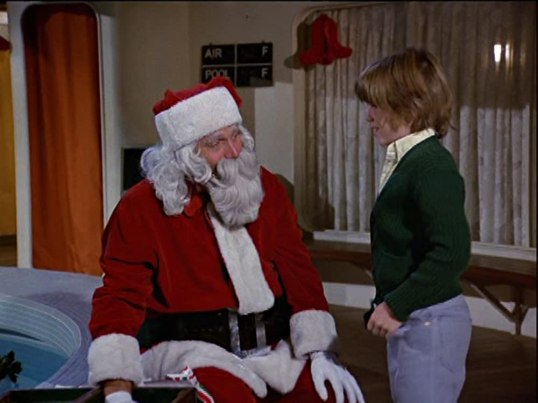
Every season, The Love Boat did a special Christmas episode.  Last year, MeTV presented a marathon on Love Boat Christmases and what I discovered is that every Christmas episode featured the crew working through the holidays and missing their families.  Nearly every Christmas episode also featured someone dressing up as Santa Claus and at least one veteran of the Golden Age of Hollywood.

The very first Christmas episode opens with the Julie, Isaac, Gopher, and Doc talking about how much they miss their families.  We find out that Gopher’s family lives on a farm.  Julie is from Oregon.  Doc is from Las Vegas.  (The show always tried to portray Doc as being some sort of Sinatra-style swinger, despite the fact that he was played by the very even-tempered Bernie Kopell.)  Their conversation is interrupted by Captain Stubing who explains that 1) he’s divorced and 2) he’s a middle-aged man who doesn’t get along with his stepmother.  Not only does he not have a family but the sea is his home and he has more to worry about than everyone’s holiday spirit.

Much as with Doc being a swinger, Captain Stubing being a stern taskmaster was a recurring theme during the first season of The Love Boat.  The crew was always talking about how Stubing had a reputation for demanding perfection for those working under him and being quick to fire anyone who failed to live up to his standards.  And yet, we never really see anything that would back up Stubing’s fearsome reputation.  Just as how Bernie Kopell was a bit too even-tempered to be believable as a legendary playboy, Gavin MacLeod was a bit too naturally pleasant to be believable as someone who would strike fear in the hearts of his crew.  While I have no idea what Gavin MacLeod was like offscreen, when he’s onscreen he comes across as being likable and friendly.  Whenever Captain Stubing is meant to be upset or disappointed with his crew, he comes across as being more petulant than fearsome.  That’s certainly the case in this episode.  Captain Stubing may say that he’s not into the holidays but you never believe him.

Of course, that works to this episode’s advantage.  Realizing that he’s failing to bond with his crew and that his lack of holiday spirit is rubbing everyone the wrong way, Stubing turns to Father Mike (Dick Sargent) for advice.  Father Mike is escorting a group of children to an orphanage in Mexico but he still takes time to give Stubing some counseling.  Let the crew know that you care about them, Father Mike says.  Stubing attempts to do so but his attempts at small talk are so awkward that the crew just becomes more frightened of him.  Finally, Stubing resorts to dressing up like Santa Claus.  The crew may be scared of him but Father Mike’s orphans love him.  Anyway, it all works out in the end and believe it or not, I actually did find myself getting invested in this very silly storyline.  Gavin MacLeod may not have been believable as a stern captain but he was likable enough that it’s hard not to feel bad about him having a bad holiday.

While this is going on, Dan Barton (John Gavin) and his wife, Lila (Donna Mills), attempt to enjoy the holiday cruise.  The only problem is that Dan has just been released from prison and he is struggling to adjust to being on the outside.  No soon has Dan boarded the ship then he spots his former law partner, Walter (Dean Santoro).  Walter committed the crime that Dan went to prison for and Dan becomes obsessed with getting revenge on him.  Lila, meanwhile, wonders if Dan will ever give up his anger.  There’s something a bit jarring about going from Captain Stubing dressing up like Santa Claus to Dan Barton plotting to murder someone.  John Gavin gave a good performance but the shift in tone between his story and the rest of the episode was almost too extreme.  It’d be like if they had made an episode of The Office where Pam suddenly found herself tempted to cheat on Jim with a member of the documentary crew.  Tonally, it just felt out of place.

Finally, everyone thinks that Paul (Shecky Greene) and Audrey Baynes (Florence Henderson) are the perfect couple but actually, they’re both sick of each other and they spend most of their time thinking about getting a divorce.  The gimmick here is that we hear their thoughts.  So, Paul will tell Audrey how much he loves her and then we’ll hear him think something like, “Yeah, I’d love to toss you overboard.”  It’s a one joke premise that gets old pretty quickly.  Also, needless to say, this is The Love Boat and not The Divorce Boat.  Things work out.

My reaction to this episode was a bit mixed but, to be honest, I like Christmas shows.  Even if they’re not perfect, I still like them.  And it was hard for me not to smile at the Christmas tree in the ship’s lounge or at all the decorations hanging on the ship’s walls.  The Captain’s story had a lot of Christmas spirit and I enjoyed that.  If you can’t spend the holidays at home, The Love Boat seems like a good substitute.

Who Is The Black Dahlia? (1975, directed by Joseph Pevney)


In 1947 Los Angeles, the body of 22 year-old Elizabeth Short is discovered in an empty lot.  Short, who was nicknamed The Black Dahlia because she always wore black, was an aspiring actress who was violently tortured before being chopped in half.  Her murder remains one of Hollywood’s most infamous unsolved crimes.

In this made-for-television movie, Ronny Cox and Efrem Zimbalist, Jr. play the two detectives who are assigned to investigate Short’s murder.  Though they struggle to find any clues identifying who could have killed Short, they do learn about her life and how she went from being a naïve innocent who came to Hollywood with stars in her eyes to being a hardened and cynical woman who may have been supporting herself through sex work when she was murdered.  The film makes use of frequent flashbacks, in which Elizabeth Short is played by Lucie Arnaz.  Her friends and acquaintances are played by familiar television faces like Henry Jones, Mercedes McCambridge, June Lockhart, Brooke Adams, Donna Mills, and Tom Bosley.  Also be sure to keep an eye out for Sid Haig, playing a tattoo artist.

What Elizabeth Short went through over the course of her short time in Hollywood was probably too graphic to be put on television in the 70s but this movie still does a good job of recounting the basic facts of her life and murder.  Because the film is based on fact, no one is ever arrested for Short’s murder.  The only suspect is a doctor who turns out to have an alibi.  The movie instead focuses on Short trying make it in Hollywood and discovering that it’s a cruel town.  Lucie Arnaz was far better than I was expecting in the role of Elizabeth and brought a lot of vulnerability to the role.  The film ended with a title card, asking anyone who had information about the murder of Elizabeth Short to call the LAPD.  The case remains open to this day.

Hanging By A Thread (1979, directed by Georg Fenady)


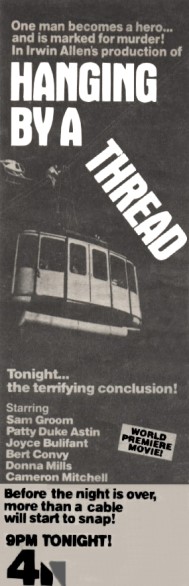
A group of old friend who call themselves the Uptowners’ Club (yes, really) want to go on a picnic on top of a remote mountain.  The only problem is that they have to ride a cable car up to the mountain and there are reports of potentially bad weather.  It’s not safe to ride in a cable car during a thunderstorm.  Drunken ne’er-do-well Alan (Bert Convy) doesn’t care and, since his family owns both the mountain and the tramway, his demands that he and his friends be allowed to ride the cable car are met.  One lightning strike later and the members of the Uptowners’ Club are stranded in a cable car that is perilously suspended, by only a frayed wire, over treacherous mountain valley.

With no place to go, there’s not much left for the members of the Uptowners’ Club to do but bicker amongst themselves and have lengthy flashbacks that reveal every detail of their own sordid history.  Paul (Sam Groom) is angry with Alan because Alan is now engaged to his ex-wife (Donna Mills).  Sue Grainger (Patty Duke) is angry with everyone else because they don’t want to admit how their old friend Bobby Graham (Doug Llewellyn) actually died.  The other members of the Uptowners’ Club are angry because there’s not much for them to do other than watch Duke and Convy chew on the scenery.  Because of the supposedly fierce winds, someone is going to have to climb out on top of the cable car and repair it themselves.  Will it be Paul or will it be cowardly drunk Alan?  On top of everything else, Paul is set to enter the witness protection program and has got hitmen who want to kill him.

This made-for-TV disaster movie was produced by Irwin Allen.  Are you surprised?  It’s also three hours long and amazingly, Leslie Nielsen is not in it.  It’s hard to understand how anyone could have produced a cable car disaster film and not given a role to Leslie Nielsen.  Cameron Mitchell’s in the film but he’s not actually in the cable car so it’s a missed opportunity.  Any film that features Patty Duke detailing how her friends got so drunk that they ended up killing the future host of The People’s Court is going to at least have some curiosity value but, for the most part, Hanging By A Thread gets bogged down by its own excessive runtime and lack of convincing effects.  Hanging By A Thread came out at the tail end of the 70s disaster boom and it shows why the boom didn’t continue into the 80s.