Walt Disney Pictures has finally released the first official trailer for their upcoming sci-fi, action-adventure film John Carter (film was originally titled John Carter of Mars). The film is based on the Edgar Rice Burroughs novel, A Princess of Mars, which would go one to become the first in Burroughs’ Barsoom series.
The film will star Taylor Kitsch (last seen in X-Men Origins: Wolverine as Gambit) in the title role and Lynn Collins (also from Wolverine as Silver Fox) as the aforementioned princess from the original novel. John Carter looks to be a mixture of live-action and fully-realized CGI characters who make up some of the inhabitants of Mars.
It will be interesting how Disney will market this film with little to no big stars and with a director more known for directing Pixar animated films like Finding Nemo and Wall-E in Andrew Stanton.
John Carter is set to have a March 9, 2012 release date.
If there was ever a Marvel Comics character who was perfectly suited to star in a grindhouse film it would be Frank Castle aka The Punisher. He’s a character who takes the term anti-hero past its limits and who makes other film vigilantes seem like sissy, choir boys. In December 2008 Lionsgate released a sort of reboot of The Punisher by Jonathan Hensleigh and starring Thomas Jane in the titular role. This time around the role of Frank Castle goes to Ray Stevenson (The Other Guys, Thor, Kill the Irishman) with German-filmmaker Lexi Alexander taking on the director’s reins.
Punisher: War Zone takes much of the characters in the film from story-arcs found in the Marvel Knight’s Punisher MAX series which took the character and his stories into a darker realm of violence. This latest film definitely owes much of it’s darker and more violent tone from that comic book line while at the same time creating a look which brings to mind the garish and over-the-top grindhouse action films of the early 80’s. The film quickly establishes who the Punisher is and what motivates him to take on and kill (heavy emphasis on kill) the criminal underworld of the city. In an opening sequence that probably out-violences every other film released in 2008, the Punisher wipes out a gathering of mobsters in every bloody way as possible. Blood and gore flows and splatters a-plenty in the first 10-15 minutes of this film.
There’s a semblance of a story which involves Castle mistakenly killing an undercover FBI agent which causes him a momentary crisis of conscience, but it really doesn’t last too long as there are more criminals to kill, main and blow up. If there’s one thing the Punisher knows how to do best it’s those three things. Ray Stevenson in the title role doesn’t get to emote much, but does a great job in showing the characters ice-cold ruthlessness paired with a sort of dead-man walking persona which rings true to how the Punisher has been written up of late. His Frank Castle is dead inside and only when he’s the Punisher does he even show any sort of life (even if it’s the barest hint). His foil this time around brings one of the Punisher’s earliest arch-enemies in the disfigured mobster (caused by the Punisher) Jigsaw (played with over-the-top campy relish by Dominic West). Where Castle is deadly serious to the point of morbidity his opposite was all garish with a liberal dose of crazy.
Punisher: War Zone really dispenses with any complexities to it’s plot and just finds reasons and excuses for the Punisher to go on another killing spree against criminals that for some it might not be enough. As a lover of grindhouse and exploitation films what this film offers was enough and really goes a long way in entertaining in such an 80’s fashion. It’s a film that revels in its violent absurdities and campy storytelling. Even the acting by all in the film passes the line of campy and into a sort of Looney Tunes level which makes the extreme violence and gore of the killings more cartoonish than realistic. This was a film that celebrated it’s grindhouse roots from the actors, the filmmakers all the way down to it’s cinematographer and art directors. It’s disposable entertainment and it knows it so doesn’t bother to try and hide that fact and just tries to entertain in every manner possible and then some.
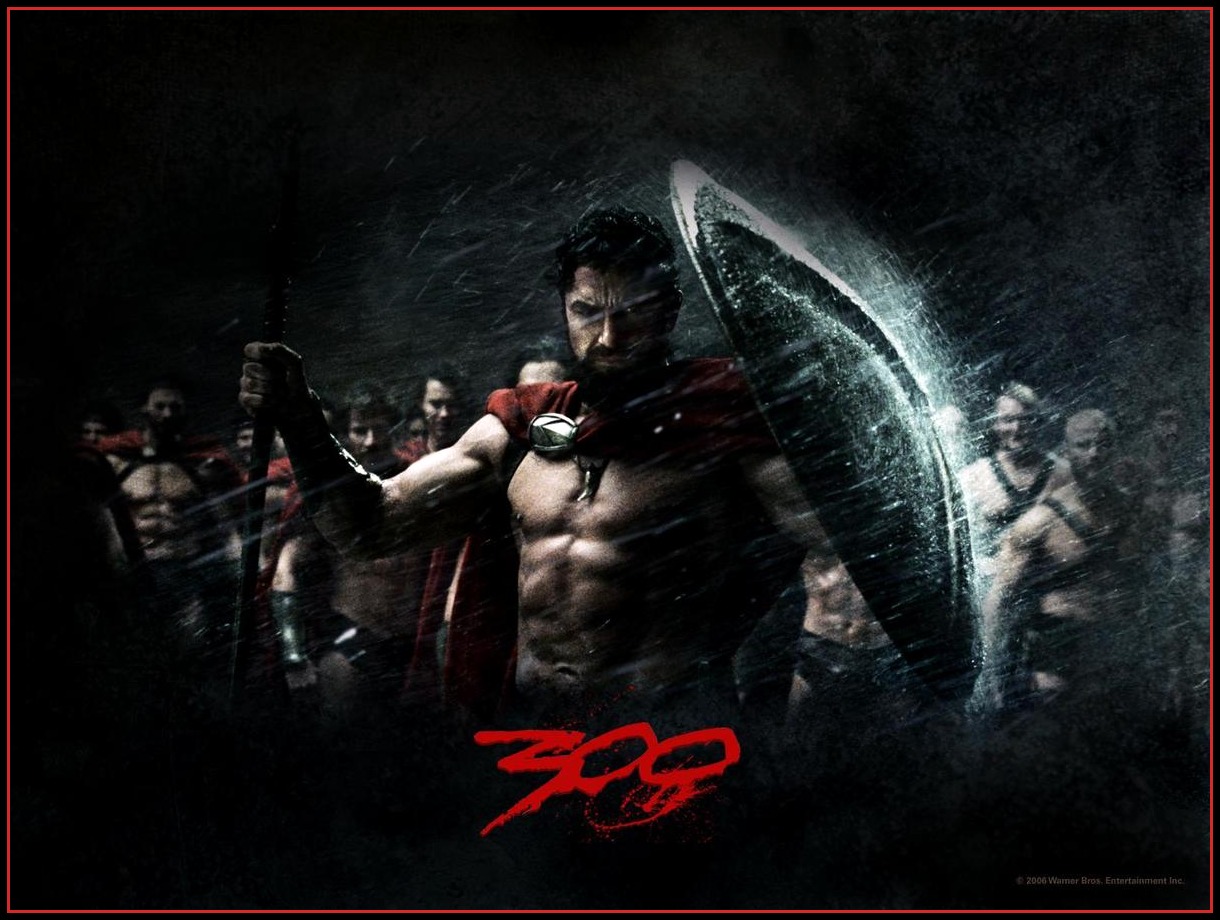
I will get it out of the way and say that this was not and was not meant to be a historically accurate depiction of Ancient Greece. It was never meant to be even when it was still just an Eisner-Award winning graphic novel from the mind of iconic graphic novelist and artist Frank Miller. With that out of the way I was able to watch and enjoy Zack Snyder’s film adaptation on its own terms without the criticism of historical accuracies looming dangerously over my head. 300 deserves the label of being an event film. From start to finish, Snyder’s film practically screams blockbuster and popcorn and I wouldn’t have it any other way.
Frank Miller’s 300 was at its time an interesting depiction of one of history’s greatest military last stands. Miller already known for hyperstylizing the look and feel of the noir genre with his Sin City graphic novels, takes the same approach with his depiction of King Leonidas and his 300 Spartans taking a final last stand against Persian God-King Xerxes at a narrow mountain pass called Thermopylae (literally meaning Hot Gates in Greek). Zack Snyder took this graphic novel and painstakingly stayed true to the visuals Miller and his colorist wife, Lynn Varley put on paper. Looking back at my memory of some of the panels and images from the graphic novel. Snyder and his crew of art directors, cinematographers and CGI-artists were successful in translating almost every page of the graphic novel onto the screen.
Like Robert Rodriguez’s adaptation of Miller’s Sin City, Zack Snyder’s 300 pretty much brings the graphic novel to moving life. This means he stuck to the source material quite literally which limits his own take on the graphic novel. Like Rodriguez, Snyder doesn’t really put his own signature stamp as a director to the film. It’s not too much of criticis since he does a great job of translating Miller’s work onto film, but one wonders what sort of personal touches he could’ve added to the finished look that wasn’t lifted from Miller’s style and whether it would’ve changed the overlook look and feel of the film.
The story is quite simple and just takes the basic summary of the historical event itself. Spartan King Leonidas (played with visceral gusto and machismo by Scottish thespian Gerard Butler) makes a decision to go to war and confront the encroaching and fast approaching massive Persian Army led by Xerxes (Rodrigo Santoro) intent on conquering the Hellenic city-states of the Greek Peninsula. Persian ambassadors ride forth to demand oaths of fealty from those city-states ahead of the army’s path. Sparta is one such city-state, but different from the rest of its Hellenic brethrens. Sparta has gone down in history as a word synonymous with unbending dedication to a strict, ascetic warrior code. Warfare and battle were what Spartans were born and trained to do from an early age. Weakness and physical imperfections weeded out from the time of birth (the film explains just what happens to male newborns with physical imperfections and deformities). The answer Leonidas gives the Persian delegation could be seen as somewhat extreme, but not contrary to his nation’s warrior-culture of never surrendering and seeing death in battle the greatest glory for a Spartan to achieve. From this sequence right up to the end of the film we get to see just how much of a warrior culture the Spartans were in extreme detail.
It’s during the prolonged battle scenes between Leonidas’ Spartans and Xerxes army which will have everyone chomping at the bit. If you have to see this film for any particular reason outside of watching superbly-trained underdogs slaughtering and endless supply of enemy troops then you will most likely be disappointed by the slower scenes away from Thermopylae. Indeed, this film an its original source material would’ve worked even better without the extra filler Snyder and his writers added to give the film more depth. I’m all for more emotional depth and characterization in my films but when a movie is all about a bloody and heroic last stand of a few against the many, scenes which slow the story down does more to break the rhythm and tone of a film than add to it. Othe than a deeper understanding of the kind of partnership Leonidas had with Gorgo, his Spartan Queen, most of the subplots added by Snyder and his writers could easily have been left out and still ge a kick ass action epic.
It’s the action scenes which reall stand out visually. Some people might see the style tricks of speed ramping certain action sequences then slowing it down considerably to show the minute detail of the battle scene as being to gimmicky, but I would disagree and say it actually gives the movie a mythical quality in its storytelling. One thing I have to say about Zack Snyder as a director (his remake of George A. Romero’s Dawn of the Dead better than what detractors have made it out to be) is that he knows how to film action and with special mention to bloody and gory action. He makes these scenes of dismemberments, decapitations, and disembowlments look like a piece of performance art.
These scenes of carnage would be considered extremely gratuitious if it didn’t look so made up good. Even the way the blood flows, spurts and splashes look like something Jackson Pollock would take interest in. The speed up and slow down of the sequences also gives the fight scenes a certain rhythm that once an audience picks up on will follow it through to the end. This is why the scenes back in Sparta with a duplicitous politician and his powerplay to assume control and power seem such a downer instead of enhancing the sacrifice of Leonidas and his men. Those scenes just feel tacked on and completely superfluous. Luckily, there’s not enough of them to slow down the frantic pace developed by the battle itself.
The performances by all actors involved really doesn’t require too much criticism or reflection over. Gerard Butler does a great and convincing job as the Spartan King and his conviction in confronting Xerxes and his army with so few seem very believable. It’s not a star-making performance but it does show that Butler can add a bit of gravitas to a character and role so basic in characterization. Lena Hedley is radiant as his partner and Queen. Despite the weird sounding name of Gorgo, Hedley plays the strong-minded and equally influential wife to Butler’s Leonidas. It’s only her scenes back in Sparta as she tries to rally her people to support their king which keeps these slower sequences from fully pulling down the film. The performances were good enough to keep the acting in the film from becoming too campy or too serious. It’s an action film and with enough action going on in the movie I could forgive the writers (both Miller and the screenwriters) from scrimping on character build up.
All in all, Zack Snyder’s film adaptation of Frank Miller’s 300 succeeds in bringing the book to moving life. Throughout the run of the film it was hard not to get lost in the beautiful visuals. Whether it was the muted color pallette which puts most of the scenes in an almost sepia-tone look to over-emphasizing certain colors to set a certain mood. From oversaturation of reds in one sequence to one where everything seem to be tinted with the many shades of blues at night. This is what 300 will be best remembered for. It’s technical use of CGI to paint the environment in unrealistic but beautiful ways which gives the scenes a lyrical and mythical look to them once the actors were superimposed over them. The film really was a painting come to life and it shows once again how computer and digital filmmaking technology have now afforded directors in making what used to be impossible technically to something that could be done with the limit being the artist’s imagination.
This film will not win many acting, directing and even screenwriting awards (which it didn’t once award season rolled around), but it doesn’t have to for people to enjoy it. It will entertain and pull its audience into a living and modern retelling of a legend. Whether all that happened on the screen was exactly as it happened in 480 B.C. doesn’t matter. What it does show is that through retelling down the years even all the embellishments added to the story of Leonidas and his men doesn’t diminish the fact that what they did and accomplished was how legendary heroes were made and remembered.
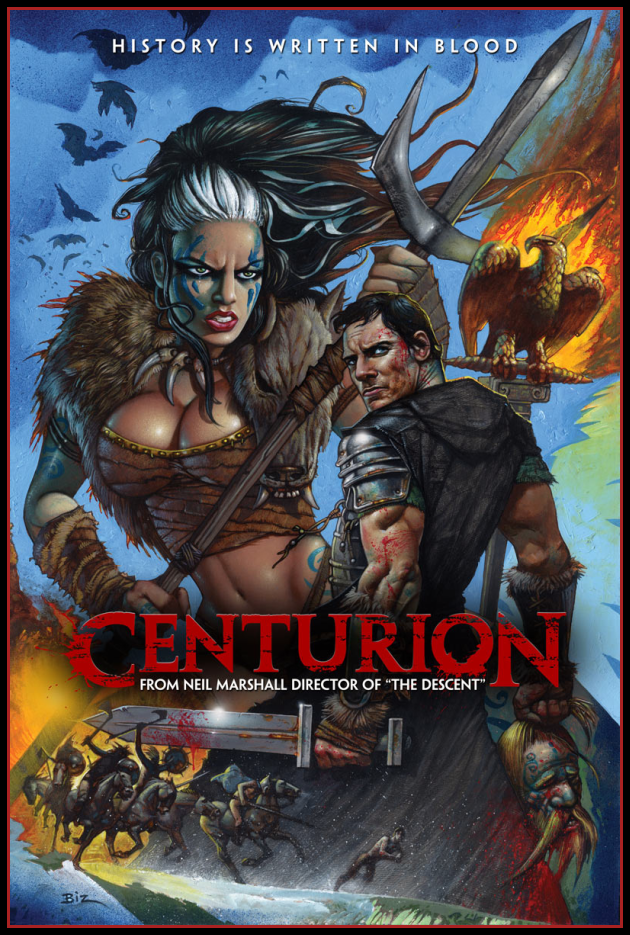
I’ll outright say and admit that one of my favorite filmmakers has to be British-filmmaker Neil Marshall who burst into the scene almost a decade ago with his genre mash-up werewolf film, Dog Soldiers. Since then he has come out with a film every couple years which follows what’s becoming a trademark style of his.He would take a well-worn and used genre and mash it together with a few others to create a film that’s wholly his own. He did this with his follow-up films in The Descent and Doomsday. Now it’s 2010 and we have his latest film and it follows his usual style. Centurion is an adventure, chase and men on a mission film that doesn’t reinvent the genres it’s smashing together but instead embraces their traditions and creates a rip-roaring yarn which moves at a frenetic pace with characters who grow and expose their motivations as the film progresses to it’s bittersweet finale.
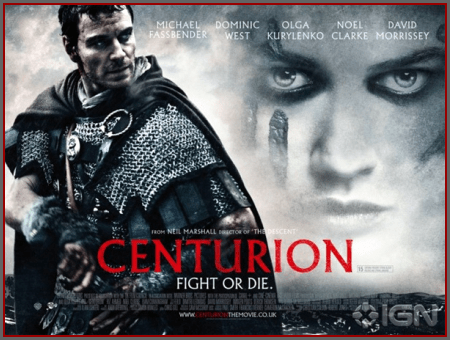
Neil Marshall will always be known to fanboys and the action crowd even if the elites of the film industry continues to dismiss the man as nothing more than competent filmmaker. In Centurion he shows that he could work within a traditional sword and sandal story and still show his signature style. We have it’s main character of Roman centurion Quintus Dias (played with a subdued and introspective seriousness by Michael Fassbender) who gets captured by the Picts of Britain during Rome’s occupation of the island. Unlike most Romans captured by the guerilla-warfare conducting Picts, Quintus has learned to speak Pict thus has become a valuable capture. But his loyalty to his Empire and its people dashes the hopes of the Picts ever learning anything from Quintus and decides to play some sport with him as the hunted prey.
It’s during the hunt for Quintus by a band of Pict warriors that he stumbles upon the Roman Ninth Legion led by General Titus Flavius Virilus (Dominic West). Once freed from his captors and hunters, Quintus is more than happy to rejoin his fellow Roman centurions in their hunt to once and for all destroy Pict leader Gorlacon (Urlich Thomsen) and his Pict army. To aid them in their search for this enemy army is the mute Brigantes scout, Etain (played with silent fury by Olga Kurylenko), who knows the lands where the Picts hide and do their hit-and-run raids.
It’s once the whole Ninth Legion has been led into the thick forests by Etain that the trap was sprung with Etain herself the catalyst for what amounts to as the massacre of the Legion. It’s this event which Marshall in his own way tries to explain one of history’s mysteries: The mysterious fate of the Roman Ninth Legion. Historians have never agreed as to why the Legion disappeared from Roman and historical records and Marshall’s film is one theory.
The rest of the film has the handful of the Legion who has survived trying, at first, to free their general from Pict captivity and when that mission fails with deadly results the remaining men who has chosen to follow Quintus try to make a run back to Roman lines. On their heels like a she-wolf leading a pack of wolves is Etain whose thirst for vengeance for what the Romans did to her (raped her as a young child and cut out her tongue in addition to wiping out her family and tribe) pushes her to get these Romans with near-supernatural drive. It’s rare to find a film where the main villain is a woman, but one whose abilities surpasses that of the men she’s hunting and whose motivations make her more than a tad sympathetic to her cause.
Centurion does action well with sequences involving a jump off of a steep cliff and into the river below to last stand inside an abandoned Roman fort. Marshall knows how to stage and shoot these scenes so we never lose sight of where the participants are. Most filmmakers nowadays try to hide their inability to choreography action sequences by using quick cut editing, hand-held camera jittery viewpoints and, at times, just shooting it from a distance. Neil Marshall doesn’t do anyone of these gimmicks and tricks which just shows that while his hybrid style in terms of storytelling might be new and refreshing he still embraces the traditional ways if it serves his films properly.
The acting in this film was quite good from not just its leads in Fassbender and Kurylenko but from everyone. This film’s ensemble cast includes veteran British actors just as Liam Cunningham, Paul Freeman and David Morrissey. Other supporting players such as Imogen Poots, Urlich Thomsen and Dominic West do a great job in the limited roles they’re given. The fact that Kurylenko utters not one word in her scenes yet commands each and everyone she’s in shows just how well Marshall can direct not just action pieces but how to direct his actors in doing their jobs.
This film doesn’t do anything to reinvent the action genre that is it’s foundation, but what it does is show that action films sometimes could be just as good when it’s filmmaker leans on practices from traditions past. Outside of the CGI-blood used to show the brutality of the fights and deaths this film is quite lacking in the CG department. Shot on location in the highlands of Scotland and studios near and around London, Centurion is quite a throwback to the sword and sandal films which dominated the film industry during the late 50’s and most of the 60’s. Marshall’s latest will not win any mainstream awards, but the genre crowd will definitely embrace it as something that will entertain and thus welcome it with cult status.
I have been a huge fan of Neil Marshall. The British filmmaker burst into the genre scene with his cult-classic werewolf-siege flick, Dog Soldiers. He then follows that up with the excellent all-female cast monster mash, The Descent. His third outing was a bit mixed for some, but I definitely had a great time with Doomsday. Marshall really knows the genre he works in and also enjoys staying in it.
His fourth film is a historical thriller set during the Roman occupation of Britain during the 2nd Century A.D. The film was originally called The Ninth Legion during the production, but has since been officially changed to Centurion. The basic premise of the film is Marshall’s telling of the legend of the 9th Legion and their disappearance north of Hadrian’s Wall. He’s made it known that the film will not be historically accurate and wasn’t meant to be. The film will be his way to re-tell the legend of the legion’s disappearance, it’s cause and wrap an action-thriller around it.
Starring in the film are Dominic West, Michael Fassbender (last seen as the British operative Hickox in Inglourious Basterds) and Olga Kurylenko. The film is tentatively dated to be released in the U.K. on April 23, 2010. No set date has been announced for a NA release, but I’m sure it will get one. It better.

 Through the Shattered Lens