First released in 1979, ….And Justice For All will always be remembered for one scene.
Yell it with me, “YOU’RE OUT OF ORDER! THE WHOLE TRIAL IS OUT OF ORDER! THEY’RE OUT OF ORDER!”
When attorney Arthur Kirkland (Al Pacino) starts screaming in the middle of the courtroom, it’s a cathartic moment. We’ve spent nearly two hours watching as Arthur deals with one insane situation after another. One of Arthur’s partners, Warren (Larry Bryggman), cares more about his car than actually delivering the right documents to a judge. Another of Arthur’s partners, Jay (Jeffrey Tambor), has a nervous breakdown and, after shaving his head, ends up throwing cafeteria plates at people in the courthouse. Arthur has three clients, one of whom is indigent, one of whom is innocent, and one of whom is a wealthy and despised judge (John Forsythe) who has been accused of a rape that Arthur suspects he committed. The system offers no mercy for Arthur’s innocent (or, at the very least, harmless) clients while going out of it’s way to defend the judge. Meanwhile, another judge (Jack Warden), is driven to take suicidal risks, like flying a helicopter until it runs out of fuel and comes down in a nearby harbor. The assistant district attorney (Craig T. Nelson) only cares about his political ambitions and finally, after one incident after another, Arthur snaps. And it’s cathartic because we’re all on the verge of snapping as well.
That final moment, with its signature Al Pacino rant, is such a strong and iconic scene that it’s easy to forget that the film itself is actually rather uneven. The script, by Barry Levinson and Valerie Curtin, owes a good deal to the work of Paddy Chayefsky. Just as Chayefsky often wrote about men being driven mad by institutional failure, ….And Justice For All features character after character snapping when faced with the screwed-up realities of the American justice system. The final “out of order” speech is obviously meant to be this film’s version of Howard Beale’s “I’m as mad as Hell and I’m not going to take it!” speech from Network and, much like George C. Scott in the Chayefsky-written The Hospital, Arthur spends a lot of time talking about what he doesn’t like about his job. The thing that sets ….And Justice For All apart from the best works of Chayefsky is that Levinson, Curtin, and director Norman Jewison all take Arthur Kirkland at his word while one gets the feeling that Chayefsky would have been a bit more willing to call out Arthur on his self-righteousness. Arthur has every right to be angry when Warren forgets to give a judge an important document while Warren is substituting for him in court. At the same time, Arthur is the one who trusted Warren to do it. In the end, the document was not about one of Warren’s client. In fact, Warren knew absolutely nothing about the case or Arthur’s client. The document was about Arthur’s client and Arthur was the one who decided trust someone who had consistently shown himself to not be particularly detailed-orientated. One gets the feeling that Chayefsky would not have let Arthur off the hook as easily as Levinson, Curtin, and Jewison do. Arthur’s perpetual indignation can sometimes be a little hard to take.
It’s a very episodic film. Arthur goes from one crisis to another and sometimes, you do have to wonder if Arthur has ever had any human or legal interactions that haven’t ended with someone either going insane or dying. There’s no gradual build-up to the film’s insanity, it’s right there from the beginning. And while this means the narrative often feels heavy-handed, it also makes that final speech all the more cathartic. It’s an uneven film and, of all of the characters that Pacino played in the 70s, Arthur is probably the least interesting. But that final rant makes up for a lot and, fortunately, Pacino was just the actor to make it memorable. For all it’s flaws, the final few minutes of ….And Justice For All make the film unforgettable.
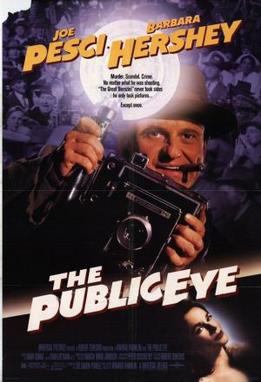 New York in the 1940s. Leon “Bernzy” Bernstein (Joe Pesci) is nearly a legend in the city, a freelance news photographer with a police radio in his car and a darkroom in his trunk. Bernzy is a solitary man who lives for his work, the type who has many acquaintances but few friends. He gets the pictures that no one else can get but his dream of seeing a book published of his photographs seems to be unattainable. As more than one snobbish publisher tells him, tabloid photographs are not art.
 Chicago. 1915. Up-and-coming gangster Al Capone (Eric Roberts) berates his younger brother, Jimmy (Adrian Pasdar), for not being aggressive enough in a street fight. Not wanting to follow his brothers into a life of organized crime, Jimmy runs away from home and eventually finds himself in Harmony, Nebraska. Claiming to be a World War I vet named Richard Hart, Jimmy impresses everyone with both his marksmanship and his incorruptible nature. Soon, the new Richard Hart has been named town marshal. While Al Capone is taking over the Chicago rackets, Richard is keeping the town safe with his Native American deputy, Joseph Littlecloud (Jimmie F. Skaggs), and starting a family with the local school teacher, Kathleen (Ally Sheedy). When illegal liquor from Chicago starts to show up on a nearby Indian reservation, Richard Hart comes into conflict with the Chicago Outfit and his secret is finally revealed.
 Through the Shattered Lens