Horror Film Review: Premature Burial (by Roger Corman)


Poor Guy Carrell (Ray Milland!)

The character at the center of the 1962 Edgar Allan Poe adaptation, The Premature Burial, Guy spends his days terrified of being buried alive.  Like his father before him, Guy suffers from a disease that can make him appear to be dead despite actually being alive.  Guy is convinced that his father was buried alive and swears that he could even hear his father crying for help inside of his tomb.  Though his fiancée, Emily (Hazel Court), insists that Guy is driving himself mad with his fears, Guy continue to spend his time trying to invent a coffin from which one can easily escape.  Even after Emily and Guy are married, Guy continues to obsess.

Finally, faced with the prospect of opening his father’s tomb to discover whether or not his father truly was buried alive, Guy appears to drop dead of a heart attack.  But is he really dead or is he about to be buried alive!?  And who is responsible for the series of mysterious events that apparently drove Guy to collapse of fright?  Watch the film to find out!  Or read the Edgar Allan Poe short story.

This was the third of Roger Corman’s Edgar Allan Poe adaptations and it’s the first one to not feature Vincent Price as the lead character.  For the most part, the members of the small cast all do a good job with their roles.  Ray Milland is both sympathetic and a little frightening as the obsessed Guy.  Heather Angel is properly enigmatic as Guy’s overprotective sister and Hazel Court will keep you guessing as far as her character’s motivations are concerned.  Dick Miller has a small but key role as a grave digger who seems to take just a little bit too much enjoyment from his work.  The film’s atmosphere is properly gothic and, if the film isn’t as visually audacious as the first two Poe films, Corman still finds time to include a creepy and psychedelic dream sequence.

That said, Vincent Price is still very much missed.  Corman reportedly wanted to use Price but, because Corman produced and financed the film  himself, Corman’s former business partners at American International Pictures would not allow Price to appear in the film.  (Price was under exclusive contract to AIP.)  By the time Corman and AIP worked out their disagreements and again joined forces, Ray Milland had already been cast in the lead role.

While the actors all do a good job, it’s hard to deny that Guy Correll would have been an ideal role for Vincent Price, even if it would have meant essentially re-doing his performance from The Pit and the Pendulum.  It’s not just that the film misses Price’s theatrical acting style.  The film also misses the energy that Price brought to the previous two Poe films.  The Premature Burial moves at a stately pace and, in the end, it’s a bit too slow and respectable for its own good.  Price would have jazzed things up and made a decent film into a truly memorable one.  Fortunately, Price would return for the later Poe adaptations.

Horror Film Review: X: The Man With X-Ray Eyes (dir by Roger Corman)


X: The Man With The X-Ray Eyes (1963, dir by Roger Corman, DP: Floyd Crosby)

Eyes.  They’re one of the most important parts of our body but they’re also frightening easy to damage. Unlike the heart or the liver or the brain, they don’t have a protective covering of skin and bone.  They sit exposed and  are easily injured.  They can be ripped out of one’s head, which is a scary thought.  As well, they tend to grow weaker over time.  I love my multi-colored eyes and I think they’re one of my best features but I still spend a lot of time wishing that they weren’t quite as vulnerable as they are.  I often say that I’m blind without my contacts or my glasses.  That’s not quite true, of course.  I can see enough to get by if I forget to put in my contacts but I still have to do a lot of squinting, enough so that most people can take one look at me and say, “You forgot to put in your contacts, didn’t you?”  In my case, my eyesight has definitely gotten even worse over the past few years.  I’ve been told that’s normal but it still freaks me out.  I worry about waking up one day and not being able to see anything at all.

Director Lucio Fulci, a diabetic who was slowly going blind during the final years of his life, was infamous for including scenes of eyes being either pierced or gouged out in his films.  The New York Ripper even featured one scene where an eye was slit in half with a razor blade.  (This occurred in a close-up, no less!)  In Joe D’Amato’s Beyond the Darkness, there’s a scene where a mad taxidermist replaces the eyes of his dead fiancée with glass and for me, that’s one of most disturbing elements of the film.  Horror directors understand the vulnerability of the eyes and the sadness when life is extinguished from those eyes.  Eyes are said to be the windows to soul and when those eyes are lifeless, it’s a reminder that a living soul is a fleeting thing.

Perhaps that’s why 1963’s X: The Man With The X-Ray Eyes is such an effective work of art.  Directed by Roger Corman, the film tells the story of Dr. James Xavier (Ray Milland), a doctor who has developed eye drops that, when taken, allow one to have x-ray vision.  Dr. Xavier claims that the eye drops will allow doctors to more easily diagnose their patients and certainly, he has a point there.  His friend, Dr. Sam Brant (Harold J. Stone), points out that the eyes are directly connected to the brain and that using experimental eye drops on them could potentially drive a person mad.  Dr. Xavier proves Dr. Brant’s point by losing his tempter and accidentally pushing him out of a window.

Ah, x-ray vision.  It all starts out fun.  Dr. Xavier is performing miracle surgeries and seeing what everyone looks like naked.  (The swinging jazz party scene is a classic example of how 60s B-movies teased audiences while never quite showing everything.) But once he’s forced to go on the run from the police, Xavier finds himself making a living as a carnival psychic while still trying to refine his eyedrops.  Xavier’s sleazy manager (Don Rickles) tries to turn Xavier into a faith healer but, with Xavier’s x-ray vision growing more erratic and more intense, Xavier ends up running off to Vegas with a former colleague, Dr. Diane Fairfax (Diana Van der Vils).

And again, it’s all fun and games as Xavier uses his powers to cheat at cards.  But then the megalomania kicks in and, after Xavier basically announces that he’s cheating, he finds himself being chased through the desert by a police helicopter and freaking out as more and more of the universe is revealed to him.  Much like a Lovecraftian protagonist who has been driven mad by the sight of the Great Old Ones, Xavier finds himself overwhelmed by the center of the universe.  At a tent revival, a preacher shouts, “If thine eye offends thee, pluck it out!”

The film’s final image is a shocking one and it stays with you.  (There were rumors that the film originally ended with Xavier shouting, “I can still see!” but Corman himself said that never happened.)  Even without that final image, this would be one of Corman’s best films, a surprisingly intelligent and rather sad story about a man who, in trying to see what is usually hidden, was driven mad by what he discovered.  Ray Milland was well-cast as Dr. Xavier and watching him go from being a somewhat stiff but good-hearted scientist to a raving madman at a revival is quite an experience, a testament to the vulnerability that all humans share.  In the name of science, Xavier goes from being a respected researcher to being chased through the desert by a helicopter.  The man who wanted to be able to see everything finds himself wishing to be forever blinded.  Sometimes, the film suggests, it’s best not to be able to see everything around us.  Sometime, the mysteries of the universe should remain mysteries and the rest of us should respect our own vulnerabilities.

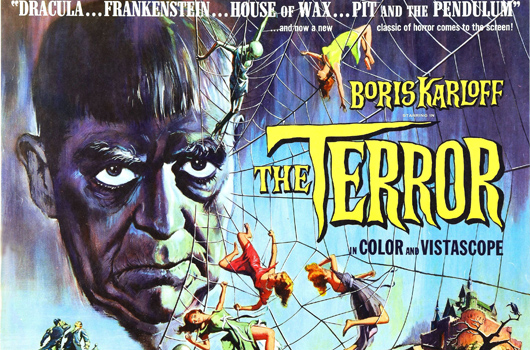
Horror on the Lens: The Terror (dir by Roger Corman, Francis Ford Coppola, Jack Hill, Monte Hellman, Dennis Jakob, and Jack Nicholson)


Have you ever woken up and thought to yourself, “I’d love to see a movie where a youngish Jack Nicholson played a French soldier who, while searching for a mysterious woman, comes across a castle that’s inhabited by both Dick Miller and Boris Karloff?”

Of course you have!  Who hasn’t?

Well, fortunately, it’s YouTube to the rescue.  In Roger Corman’s 1963 film The Terror, Jack Nicholson is the least believable 19th century French soldier ever.  However, it’s still interesting to watch him before he became a cinematic icon.  (Judging from his performance here and in Cry Baby Killer, Jack was not a natural-born actor.)  Boris Karloff is, as usual, great and familiar Corman actor Dick Miller gets a much larger role than usual.  Pay attention to the actress playing the mysterious woman.  That’s Sandra Knight who, at the time of filming, was married to Jack Nicholson.

Reportedly, The Terror was one of those films that Corman made because he still had the sets from his much more acclaimed film version of The Raven.  The script was never finished, the story was made up as filming moved alone, and no less than five directors shot different parts of this 81 minute movie.  Among the directors: Roger Corman, Jack Hill, Monte Hellman, Francis Ford Coppola, and even Jack Nicholson himself!  Perhaps not surprisingly, the final film is a total mess but it does have some historical value.

(In typical Corman fashion, scenes from The Terror were later used in the 1968 film, Targets.)

Check out The Terror below!

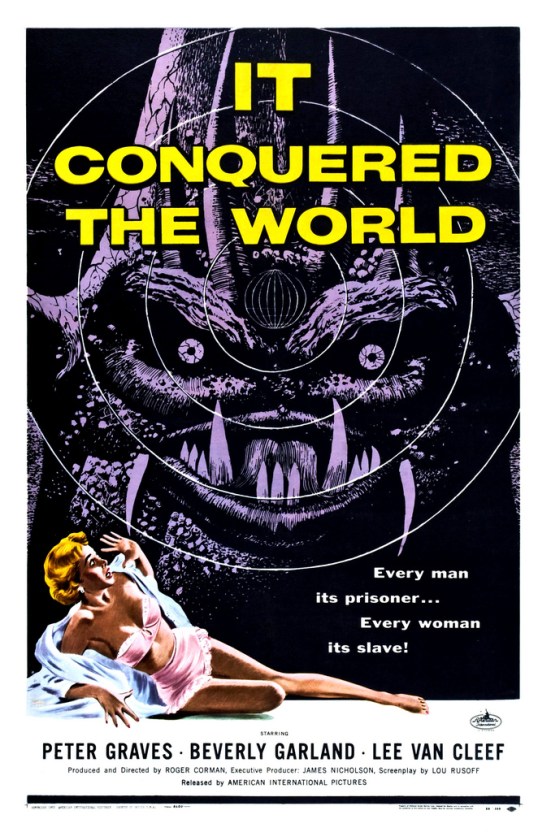
Horror Film Review: It Conquered The World (dir by Roger Corman)


“Man is a feeling creature, and because of it, the greatest in the universe….”

So says scientist Paul Nelson (Peter Graves) towards the end of 1956’s It Conquered The Universe.  Paul may be a scientist but he understands the importance of emotion and imagination and individuality.  He knows that it’ll take more than just cold logic to save humanity from destruction.

Unfortunately, Paul’s best friend, Tom Anderson (Lee Van Cleef), disagrees.  Tom worked at Los Alamos.  Tom helped to develop the atomic bomb.  Tom is convinced that humanity will destroy itself unless a greater power takes over.  Tom feels that he has discovered that greater power.  Tom has recently contacted a Venusian and invited it to come to Earth.  Upon arriving, the Venusian promptly disrupts all electrical power on Earth.  It sends out bat-like creatures that inject humans with a drug that takes control of their minds and turns them into a compliant slaves.  Paul tells Tom that robbing people of their free will is not going to save the Earth but Tom remains committed to the Venusian, even as it becomes obvious that the Venusian’s main concern is with its own survival.

It Conquered The World is very much a film of the 1950s.  Along with tapping into the era’s paranoia about nuclear war and UFOs, it also features Peter Graves delivering monologues about freedom and the inherent superiority of the human race.  When Paul confronts Tom, he not only accuses Tom of selling out the Earth but he also attacks Tom’s patriotism.  When Tom’s wife, Claire (Beverly Garland), confronts the alien and orders it to leave her plant along, she does it while wearing high heels and a tight sweater and holding a rifle.  The one female scientist (played by Karen Kadler) spends most of her screentime being menaced while wearing a white slip and there’s a platoon of bumbling but unbrainwashed soldiers hanging out in the woods.  If one looked up 1956 in the dictionary, there’s a very good chance this film would be the definition.

At the same time, the film’s story feels like a metaphor for modern times.  When the Venusian-controlled police turn authoritarian and start threatening to punish anyone who questions their orders, we’re reminded of the excesses of the COVID lockdowns.  When the editor of the town’s newspaper is shot by a policeman who says that words are no longer necessary in the new world, it’s hard not to think of all the writers, commentators, artists, and ordinary citizens who have run afoul the online cancellation brigade.  When Paul is reduced to riding a bicycle from place to place, it’s hard not to think of the environmental Luddites, with their hatred of anything that makes life more convenient.  When Tom rationalizes his activities by saying that humanity must be saved from itself, he’s expressing an opinion that is very popular among several people today.  Tom’s embrace of cold logic feels very familiar.  Of course, today, people don’t need a Venusian to order them to accept authoritarianism.  Instead, they’re more than happy to do on their own.

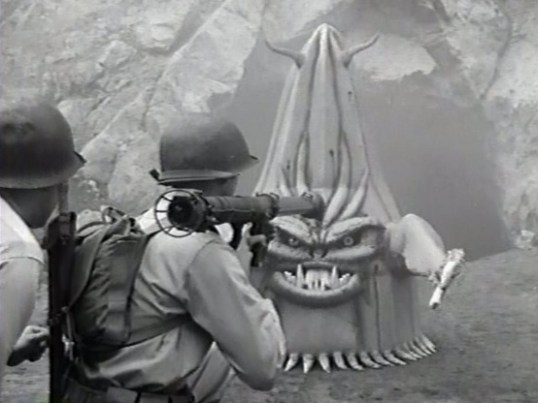
It Conquered The World was directed by Roger Corman.  It was his eighth film as a director and it remains one of his most entertaining.  As one might expect from a low-budget sci-fi film, It Conquered The World produces it’s share of laughs.  It’s hard not to smile at the sight of the extremely serious Peter Graves peddling his bicycle from location to location.  (It doesn’t help that Graves never takes off his suit or loosens his tie.)  And the Venusian simply has to be seen to be believed:

At the same time, It Conquered The World holds up well.  Lee Van Cleef and Beverly Garland both give performances that transcend the material, with Van Cleef especially doing a good job of paying a man struggling to rationalize his bad decisions.  It Conquered The World holds up today, as both a portrait of the 50s and 2024.

Horror on the Lens: The Little Shop of Horrors (dir by Roger Corman)


Hi!  Welcome to Horrorthon!  It’s a tradition around these parts that we offer up a classic (or not-so-classic) horror film for our readers to watch every day in October.  As we have just lost the great Roger Corman, it seems appropriate to start things off with one of his best films.

And so, without further ado….

Enter singing.

Little Shop…Little Shop of Horrors…Little Shop…Little Shop of Terrors…

For the 2024 Horrorthon’s first plunge into the world of public domain horror films, I’d like to present you with a true classic.  From 1960, it’s the original Little Shop of Horrors!

When I was 19 years old, I was in a community theater production of the musical Little Shop of Horrors.  Though I think I would have made the perfect Audrey, everybody always snickered whenever I sang so I ended up as a part of “the ensemble.”  Being in the ensemble basically meant that I spent a lot of time dancing and showing off lots of cleavage.  And you know what?  The girl who did play Audrey was screechy, off-key, and annoying and after every show, all the old people in the audience always came back stage and ignored her and went straight over to me.  So there.

Anyway, during rehearsals, our director thought it would be so funny if we all watched the original film.  Now, I’m sorry to say, much like just about everyone else in the cast, this was my first exposure to the original and I even had to be told that the masochistic dentist patient was being played by Jack Nicholson.  However, I’m also very proud to say that — out of that entire cast — I’m the only one who understood that the zero-budget film I was watching was actually better than the big spectacle we were attempting to perform on stage.  Certainly, I understood the film better than that screechy little thing that was playing Audrey.

The first Little Shop of Horrors certainly isn’t scary and there’s nobody singing about somewhere that’s green (I always tear up when I hear that song, by the way).  However, it is a very, very funny film with the just the right amount of a dark streak to make it perfect Halloween viewing.

So, if you have 72 minutes to kill, check out the original and the best Little Shop of Horrors

Retro Television Review: Miami Vice 2.19 “The Fix”


Welcome to Retro Television Reviews, a feature where we review some of our favorite and least favorite shows of the past!  On Mondays, I will be reviewing Miami Vice, which ran on NBC from 1984 to 1989.  The entire show can be purchased on Prime!

This week, Crockett and Tubbs discover a judge may be taking bribes.

Episode 2.19 “The Fix”

(Dir by Dick Miller, originally aired on March 7th, 1986)

Roger Ferguson (Bill Russell) is a powerful man in Miami.  A former basketball player turned lawyer, Ferguson could have been elected mayor but instead, he chose to take an appointment to the bench.  In his art deco courtroom, Judge Ferguson hands down sentences and sets bail.  In fact, sometimes, he sets bail at a surprisingly low amount.  After a drug lord is released on a $5,000 bond and immediately catches a plane for Colombia, Crockett and Tubbs come to suspect that the Judge might be taking bribes.

And he is!  Judge Ferguson has a gambling problem and a corrupt lawyer named Benedict (Harvey Fierstein, clean-shaved but recognizable from the minute he starts to speak) is taking advantage of that fact.  In fact, Ferguson is so in debt that he’s had to borrow from a notorious loan shark named Pagone (Michael Richards — yes, the future Kramer from Seinfeld).  Pagone is now demanding that the judge convince his son, a basketball player named Matt (Bernard King), to throw his next game.

There were some good things about this episode.  It was directed by Dick Miller and yes, that is the same Dick Miller who, as a character actor, appeared in countless Roger Corman films.  As a director, Miller had a good sense of style.  The opening sequence, where the Vice Squad arrests a drug lord at an aviary, is genuinely exciting and well-done.  There was also some moments of genuine humor, largely supplied by the contrast between Crockett’s intensity and Tubbs’s laid-back cool.

The problem is with the casting, some of which is not entirely the show’s fault.  In 1986, no one knew that casting Harvey Fierstein and Michael Richards as ruthless villains would come across as being unintentionally humorous in 2024.  Richards does not give a bad performance as Pagone but, whenever he threatens the judge, he sounds just like Kramer demanding the day off for Festivus.  As for Bill Russell and Bernard King, I looked them up on Wikipedia after watching the show and I was not surprised to discover that they were both actual basketball players.  Both of them gave earnest performances but it was easy to see that neither one of them was a natural or a trained actor.  It wasn’t quite as bad as when actual basketball players used to show up on Hang Time but still, they definitely seemed to be struggling to keep up with the veteran actors in the cast.

This is yet another episode that ends with Crockett staring in horror as someone is shot on a yacht.  (In this case, it’s Judge Ferguson committing suicide after killing Pagone.)  Seriously, what was the yacht budget for this show?

Smokey Bites The Dust (1981, directed by Charles B. Griffith)


Sheriff Hugh “Smokey” Turner (Walter Barnes) of Cyco County, Arkansas is determined to capture teenage car thief and prankster, Roscoe Wilton (Jimmy McNichol).  Roscoe is determined to disrupt the high school homecoming dance by abducting the homecoming queen, Peggy Sue (Janet Julian).  Peggy Sue is, at first, determined to escape from Roscoe but changes her mind as they flee from her father, who just happens to be Sheriff Turner.

From producer Roger Corman, Smokey Bites The Dust is an 88-minute car chase film where the most spectacular getaways and crashes are lifted from other Roger Corman productions.  Eagle-eyed viewers will spot footage from Eat My Dust, Grand Theft Auto, and Moving Violations.  In order to explain why the cars keep changing from scene to scene, the chase moves from county-to-county where both Roscoe and Sherriff Turner inevitably end up ditching (or crashing) their old car and then stealing a new vehicle to continue the pursuit.

That’s not much of a plot so the run time is padded out with several subplots.  A local moonshiner tries to sell his special brew to a group of Arabs.  Peggy Sue’s boyfriend, Kenny (William Forsyth, in one of his first films), joins in the chase.  Dick Miller flies around in a helicopter and also gets involved in the chase.  None of it makes any sense and none of it is particularly amusing but Roger Corman undoubtedly made a lot of money pushing this thing into Southern drive-ins and letting people assume it was some sort of a sequel to Smokey and the Bandit.

Most of the acting is pretty bad.  When it comes to being an incompetent sheriff, Walter Barnes is no Jackie Gleason.  Jimmy McNichol comes across as being seriously disturbed.  Of the main cast, Janet Julian is alone in giving an appealing and naturalistic performance as Peggy Sue.  While Julian (who has since retired from acting) never became the star she deserved to be, she is remembered for her later turn as Christopher Walken’s lawyer and girlfriend in 1990’s King of New York.

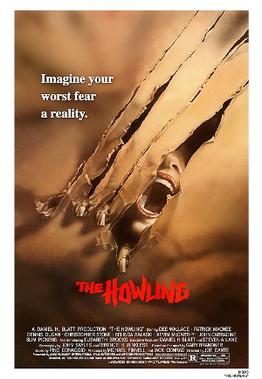
Horror Film Review: The Howling (dir by Joe Dante)


The 1981 film, The Howling, takes place at The Colony.

The Colony is a lovely place, a nice resort out in the middle of the countryside.  It’s a place that celebrity therapist George Waggener (Patrick Macnee) sends his clients so that they can recover from trauma.  It’s a bit of a grown-up version of the ranch to which Dr. Phil used to send juvenile delinquents.  Of course, the Colony is full of adults and they’re an eccentric bunch.  I mean, one of them — named Erle Kenton — is actually played by John Carradine!  That’s just how eccentric the place is.  Sheriff Sam Newfield (Slim Pickens) keeps an eye on the place but everyone knows that there’s nothing to worry about when it comes to The Colony.  Dr. Waggner does good work.

Karen White (Dee Wallace) is a Los Angeles news anchor who was held hostage by a serial killer named Eddie Quist (Robert Picardo).  While she was with Eddie, she was forced to not only watch videos of Eddie’s crimes but she also saw something happen with Eddie that terrified her to such an extent that she has blocked it from her mind.  Karen was rescued by the police but she is haunted by nightmares.  Dr. Waggner arranges for Karen and her husband, Bill Neill (Christopher Stone, who was married to Dee Wallace when they co-starred in this film), to spend some time at the Colony.

Bill loves the Colony, especially after he attracts the eye of Marsha (Elisabeth Brooks), the resort’s resident seductress.  Karen, however, is less enamored of the place.  The Colony feels off to her and she’s not happy about the howling in the distance or the fact that Bill has suddenly started to grow distant from her.  Could it be that The Colony is actually crawling with werewolves and that Bill has become one of them?  (It’s totally possible and, to The Howling‘s credit, it doesn’t waste any time letting us know that.)  Karen’s friend, Terry Fisher (Belinda Balanski), and her boyfriend, Chris Halloran (Dennis Dugan), do some research of their own into Eddie Quist, The Colony, and whether or not werewolves exists and they meet a helpful bookstore owner named Walter Paisley (Dick Miller).

To understand the approach that director Joe Dante and screenwriter John Sayles take to The Howling, one needs to only consider the names of some of the characters.  George Waggner.  Bill Neill. Terry (which can be short for Terence) Fisher.  Fred (or is that Freddie) Francis.  Erle Kenton.  Sam Newfield.  Jerry Warren.  All of these characters are named after horror film directors.  This is the type of werewolf film where Chris Halloran has a copy of The Three Little Pigs sitting on his desk.  Veteran actors like Kevin McCarthy, John Carradine, Slim Pickens, and Kenneth Tobey show up in small roles.  Roger Corman mainstay Dick Miller plays yet another character named Walter Paisley and he kicks Forrest J. Ackerman out of his bookstore.  Roger Corman himself plays a man making a phone call.  After a werewolf is shot on live TV, the program immediately cuts to a dog food commercial and we see a blank-faced child telling his unconcerned parents that someone just turned into a wolf.  The Howling was made by people who obviously love B-horror and that love is present in every frame of the film.

Like Dante’s Piranha, The Howling is a film with a sense of humor but it’s not a comedy.  The werewolves are still impressive, even forty-two years after the film was first released.  The character of Eddie Quist (“I’m going to give you a piece of my mind”) is a terrifying monster and the sight of his signature smiley face will fill you with dread, especially when it shows up in a place where it really shouldn’t be.  The film cynically ends on a note of noble sacrifice that will apparently not make much difference, with the suggestion being that human beings are either too distracted or too jaded to realize that there are monsters among them.  The Howling is a fast-paced and well-directed homage to B-horror and it’s still terrifically entertaining.

Horror on the Lens: The Terror (dir by Roger Corman, Francis Ford Coppola, Jack Hill, Monte Hellman, Dennis Jakob, and Jack Nicholson)


Have you ever woken up and thought to yourself, “I’d love to see a movie where a youngish Jack Nicholson played a French soldier who, while searching for a mysterious woman, comes across a castle that’s inhabited by both Dick Miller and Boris Karloff?”

Of course you have!  Who hasn’t?

Well, fortunately, it’s YouTube to the rescue.  In Roger Corman’s 1963 film The Terror, Jack Nicholson is the least believable 19th century French soldier ever.  However, it’s still interesting to watch him before he became a cinematic icon.  (Judging from his performance here and in Cry Baby Killer, Jack was not a natural-born actor.)  Boris Karloff is, as usual, great and familiar Corman actor Dick Miller gets a much larger role than usual.  Pay attention to the actress playing the mysterious woman.  That’s Sandra Knight who, at the time of filming, was married to Jack Nicholson.

Reportedly, The Terror was one of those films that Corman made because he still had the sets from his much more acclaimed film version of The Raven.  The script was never finished, the story was made up as filming moved alone, and no less than five directors shot different parts of this 81 minute movie.  Among the directors: Roger Corman, Jack Hill, Monte Hellman, Francis Ford Coppola, and even Jack Nicholson himself!  Perhaps not surprisingly, the final film is a total mess but it does have some historical value.

(In typical Corman fashion, scenes from The Terror were later used in the 1968 film, Targets.)

Check out The Terror below!

Horror on the Lens: The Terror (dir by Roger Corman, Francis Ford Coppola, Jack Hill, Monte Hellman, Dennis Jakob, and Jack Nicholson)


Have you ever woken up and thought to yourself, “I’d love to see a movie where a youngish Jack Nicholson played a French soldier who, while searching for a mysterious woman, comes across a castle that’s inhabited by both Dick Miller and Boris Karloff?”

Of course you have!  Who hasn’t?

Well, fortunately, it’s YouTube to the rescue.  In Roger Corman’s 1963 film The Terror, Jack Nicholson is the least believable 19th century French soldier ever.  However, it’s still interesting to watch him before he became a cinematic icon.  (Judging from his performance here and in Cry Baby Killer, Jack was not a natural-born actor.)  Boris Karloff is, as usual, great and familiar Corman actor Dick Miller gets a much larger role than usual.  Pay attention to the actress playing the mysterious woman.  That’s Sandra Knight who, at the time of filming, was married to Jack Nicholson.

Reportedly, The Terror was one of those films that Corman made because he still had the sets from his much more acclaimed film version of The Raven.  The script was never finished, the story was made up as filming moved alone, and no less than five directors shot different parts of this 81 minute movie.  Among the directors: Roger Corman, Jack Hill, Monte Hellman, Francis Ford Coppola, and even Jack Nicholson himself!  Perhaps not surprisingly, the final film is a total mess but it does have some historical value.

(In typical Corman fashion, scenes from The Terror were later used in the 1968 film, Targets.)

Check out The Terror below!