Late Night Retro Television Review: Pacific Blue 3.1 “Inside Straight”


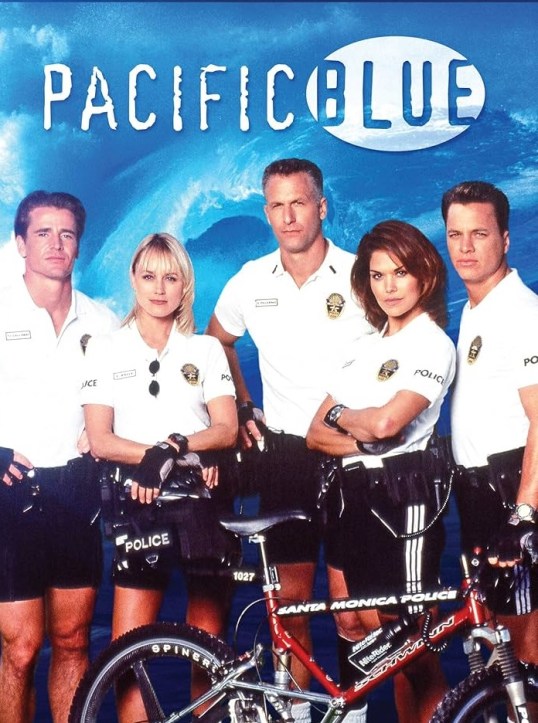
Welcome to Late Night Retro Television Reviews, a feature where we review some of our favorite and least favorite shows of the past! On Tuesdays, I will be reviewing Pacific Blue, a cop show that aired from 1996 to 2000 on the USA Network!  It’s currently streaming everywhere, though I’m watching it on Tubi.

Everyone’s book for another season of bicycles and law-breaking.

Episode 3.1 “Inside Straight”

(Dir by Michael Levine, originally aired on August 3rd, 19997)

One night, while on a date with Chris, TC spots a man holding a gun.  TC draws his own gun and yells at the man to drop his weapon.  The man turns around.  He fires so TC shoots and the man goes down.  It turns out that the man was an undercover narcotics detective with a spotless record.

TC is suspended and the bike patrol basically stops doing their job and instead proceed to harass the dead man’s wife and his partner until they discover that the wife and the partner were having an affair and, conveniently, the cop was actually shot by someone who happened to be standing behind TC.  It seems like simple forensic evidence (like the amount of bullets on the scene) should have proven that without the bike patrol even getting involved but I guess the cops in Malibu or wherever this show takes place are extremely incompetent.

Meanwhile, the poker game of mobster Joseph Tataglia (Joseph Campanella) gets held up,  The thief is a degenerate gambler who tries to frame TC’s older brother, Teddy (Andy Buckley — how, it’s David Wallace from The Office!).  The real thief is easily exposed and captured.  I’m not really sure what the point of this story was.  Tataglia last appeared during the first season but this episode acts as if he’s been a continual presence in the show for the past two seasons.  I imagine viewers were confused as to who he was or why he had so much pull with Palermo.

There’s a scene where TC is subjected to an intense interrogation from Internal Affairs and I have to admit that it made me laugh because TC and Palermo were wearing their dorky bicycle cop uniforms while being yelled at by someone in a suit.

Another scene features Victor and Cory telling Chris and TC that there’s a huge crowd waiting to see the movie that they want to see.  Victor says TC might have to flash his badge to get tickets.  Police arrogance is annoying in general but it’s even worse coming from people who ride bicycles.

It appears that nothing had changed with the start of a new season.

The TSL Grindhouse: Bummer (dir by William Alan Castleman)


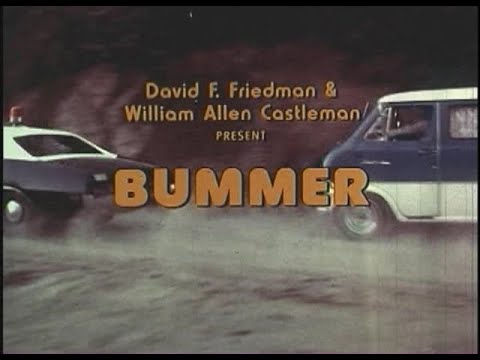
The 1973 film Bummer tells the story of a California rock band known as The Group.

The Group plays groovy music with a mellow feel.  The music they play doesn’t sound so much like actual 70s California rock as much as it sounds like what someone from the big band era would have assumed mellow 70s California rock sounded like.  The Group is led by the charismatic Duke (Kipp Whitman).  The lead guitarist and the drummer look like groovy dudes as well.  But then there’s Butts (played by the great character actor, Dennis Burkley), the bass player.  Butts is a big fat slop with a beard, unwashed hair, and a genuine aura of grime.  Duke’s girlfriend tells Duke that he really should kick Butts out of the band.  The problem is that Duke owns the van that the Group travels around in.  It’s the type of 70s van that was probably nicknamed “The Second Base Mobile.”

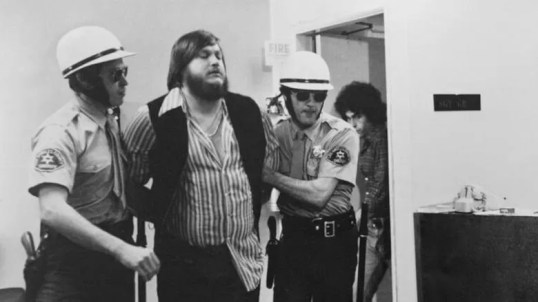
Well, Duke really should have considered kicking Butts out of the band because it turns out that Butts is crazy.  He’s a sociopath with a mother fixation and, when he realizes that he’s the only member of the band who isn’t getting laid on a regular basis, he goes crazy and starts assaulting and murdering groupies.

It’s a bummer!

This film was produced by David Friedman, the genial sexploitation producer who is best-known for his collaborations with Herschell Gordon Lewis.  Lewis did not direct Bummer and I have to say that I was a little bit surprised to discover that because there’s a scene at a strip club that goes on for so long and which features so many pointless close-ups of pervy men staring up at the dancers that I immediately assumed that Lewis must have, at the very least, snuck onto the set and supervised it.  Instead, the film was directed by William Allen Castleman, who also did directed Johnny Firecloud and The Erotic Adventures of Zorro.  So be it.  I’m still convinced that Lewis has something to do with this movie.

Bummer is one of those films about how wasteful the younger generation is, with their mellow rock music and their bongs and their groupies.  The film’s main message seems to be that anyone under the age of 30 is intellectually vapid and spiritually empty but at least they look good without their clothes on.  It’s a mix of exploitation and nostalgia.  “You know who didn’t murder groupies?” the film seems to be saying, “Glenn Miller, that’s who.”

The film is pretty dull.  Scenes drag.  It takes forever for any sort of plot to develop.  Most of the cast is forgettable but Dennis Burkley makes an impression as the unhinged bass player and watching him in this, it’s easy to understand why be became such a busy character actor.  There’s an authentic edge to Burkley, one that comes through even in this film.  One of the groupies is played by Carol Speed, who would later appear in Disco Godfather and warn people about the dangers of “whack attack.”  Oddly enough, the film looks surprisingly good.  Cinematographer Gary Graver worked on films like this in between working on Orson Welles’s The Other Side Of The Wind.

In the end, Bummer lives up to its title.

Film Review: Stay Hungry (dir by Bob Rafelson)


In the 1976 film Stay Hungry, Jeff Bridges plays Craig Blake.

When we first meet Craig, he doesn’t have much of a personality, though we still like him because he’s played by Jeff Bridges.  Living in Alabama, he’s a young rich kid who, after the death of his parents, divides his time between his nearly empty mansion and his country club.  Craig suffers from a good deal of ennui and seems to spend a lot of time writing letters to his uncle in which he promises that he’s going to eventually get his life together.  Craig eventually gets a job at a real estate firm that is managed by Jabo (Joe Spinell).  We know that the real estate firm is shady because Joe Spinell works there.

Craig is assigned to handle the purchase of a small gym so that he can eventually close the place and allow it to be torn down to make room for an office building.  However, Craig soon falls for the gang of colorful eccentrics whose lives revolve around the gym and bodybuilder Joe Santo (Arnold Schwarzenegger, who gets an “introducing” credit, even though this was his fourth film).  The friendly Franklin (Robert Englund) is Santo’s “grease” man.  Anita (Helena Kallianiotes) is tough and can kick anyone’s ass.  The receptionist, Mary Tate (Sally Field), is a free spirit with whom Craig soon falls in love.  In fact, the only less than likable person at the gym is the former owner, Thor Erickson (R.G. Armstrong), a heavy-drinking perv who has a hole in the floor of his office that he uses to peek down at the women’s locker room.

There’s not much of a plot here.  Instead, the film plays out in a rather laid back manner, with Santo befriending Craig and showing him the joy of embracing life.  Arnold Schwarzenegger actually won an award (well, a Golden Globe) for his performance here and it must be said that he’s very good as the gentle and easy-going Santo.  Because he’s huge and he’s Schwarzenegger, we expect him to be intimidating.  Instead, he’s a soft-spoken guy who is quick to smile and who doesn’t even get upset when he finds out that Mary Tate and Craig are now involved.  There’s even a surprising scene where Joe Santo picks up a fiddle and starts playing with a bluegrass band.  Schwarzenegger is so likable here that it’s easy to wonder where his career might have gone if he hadn’t become an action star.  Even early in his career (and when he was still speaking with a very thick accent), Schwarzenegger shows off a natural comic timing.  He’s fun to watch.

In fact, he’s so much fun that the rest of the film suffers whenever he’s not onscreen.  The cast is full of talented people but the film’s loose, plotless structure keeps us from truly getting too invested in any of them.  (Santo is training for Mr. Universe so at least he gets an actual storyline.)  Sally Field and Jeff Bridges are cute together but their romance is never quite as enchanting as it seems like it should be.  The main problem with the film is that, when it ends, one still feels like Craig will eventually get bored with the gym and return back to his mansion and his country club.  One doesn’t get the feeling that Craig has been changed so much as Craig just seems to be slumming for the heck of it.

There are charming moments in Stay Hungry.  I’m a Southern girl so I can attest that the film captured the feel of the South better than most films.  If you’re a Schwarzenegger fan, you have to see this film because it really does feature Arnie at his most charming and natural.  Unfortunately, despite all that, the film itself never really comes together.

Suburban Commando (1991, directed by Burt Kennedy)


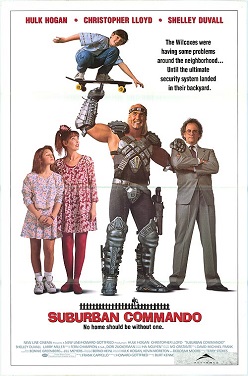
After screwing up a mission to save the leader of his planet from the intergalactic gangster Suitor (William Ball), Shep Ramsey (Hulk Hogan) is ordered to take a vacation.  When Shep gets mad and accidentally damages the controls of his spaceship, he’s forced to hide out on Earth while his ship repairs itself.  After stealing some clothes from a biker, Shep rents a room from Charlie (Christopher Lloyd) and Jenny Wilcox (Shelley Duvall).  Charlie is an architect who hates his job, his boss (Larry Miller), and a malfunctioning traffic light in the middle of town.   Charlie doesn’t trust Shep but when Suitor comes to Earth in search of his number one foe, Charlie and Shep are going to have to work together to save Charlie’s family.

Suburban Commando was originally envisioned as being an Arnold Schwarzenegger/Danny DeVito film.  Schwarzenegger and DeVito decided to do Twins instead and Suburban Command was (eventually) made with Hulk Hogan and Christopher Lloyd.  The idea behind the film had potential but the film itself never comes to life, thwarted by a low-budget and a cast that generates little in the way of chemistry.  Things start out well when Hogan is in outer space and the film parodies Star Wars but, once Hogan goes on vacation, the story crashes down to Earth in more ways than one.  Hogan was more of a personality than an actor and it’s impossible to see him as being anyone other than Hulk Hogan, even if he is flying through space and wearing intergalactic armor at the start of the movie.  Hogan getting angry in space is funny because space is not where you would expect to find him.  Hogan getting angry in the suburbs just feels like a half-baked sitcom.  Lloyd is too naturally eccentric to be believable as someone trapped in a go-nowhere job.  It’d hard to buy Christopher Lloyd as someone who would be scared to tell off his boss or who would need an alien warrior to come down and show him how to loosen up.  There’s a lot talented people in the cast but the ensemble never really gels.

This was the last film to be directed by veteran filmmaker Burt Kennedy.  Kennedy was best-known for his westerns, including Welcome to Hard Times, Support Your Local Sheriff, and Hannie Caulder.  He was not known for his wacky comedies and this film shows us why.

Film Review: The Doors (dir by Oliver Stone)


I like The Doors.

That can be a dangerous thing to admit, about both the band and Oliver Stone’s 1991 film.  Yes, both the band and the film could be a bit pretentious.  They both tended to go on for a bit longer than necessary.  They were both centered around a guy who wrote the type of poetry that I used to love back in my emo days.  It’s all true.

But, with The Doors as a band, I find that I can’t stop listening to them once I start.  Even if I might roll my eyes at some of the lyrics or if I might privately question whether any blues song really needs an organ solo, I can’t help but love the band.  They had a sound that was uniquely their own, a psychedelic carnival that brought to mind images of people dancing joyfully while the world burned around them.  And say what you will about Jim Morrison as a poet or even a thinker, he had a good voice.  He had the perfect voice for The Doors and their rather portentous style.  From the clips that I’ve seen of him performing, Morrison definitely had a stage presence.  Morrison died young.  He was only 27 and, in the popular imagination, he will always look like he’s 27.  Unlike his contemporaries who managed to survive the 60s, Morrison will always eternally be long-haired and full of life.

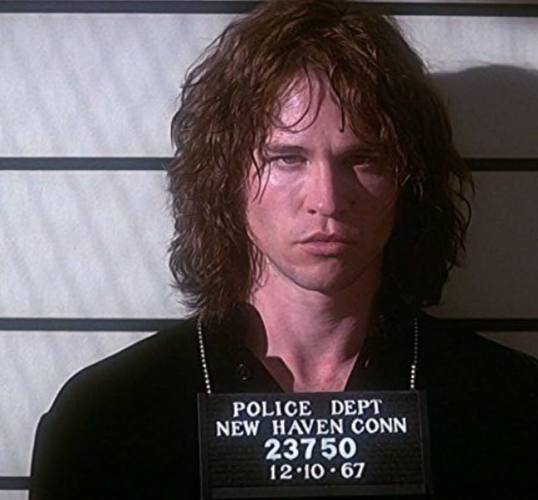
As for The Doors as a movie, it’s definitely an Oliver Stone film.  It’s big.  It’s colorful.  It’s deliberately messy.  Moments of genuinely clever filmmaking and breath-taking visuals are mixed with scenes that are so heavy-handed that you’ll be inspired to roll your eyes as dramatically as you’ve ever rolled them.  Stone loved the music and that love comes through in every performance scene.  Stone also loves using Native Americans as symbols and that can feel a bit cringey at times.  Why would Jim Morrison, whose was of Scottish and Irish ancestry, even have a Native American spirit guide?  At its best The Doors captures the chaos of a world that it’s the middle of being rebuilt.  The 60s were a turbulent time and The Doors is a turbulent movie.  I’ve read many reviews that criticized The Doors for the scene in which Morrison gets involved in a black magic ceremony with a journalist played by Kathleen Quinlan.  I have no idea whether or not that scene happened in real life but the movie is so full of energy and wild imagery that the scene feels like it belongs, regardless of whether it’s true or not.  Stone turns Jim Morrison into the warrior-artist-priest that Morrison apparently believed himself to be and the fact that the film actually succeeds has far more to do with Oliver Stone’s  enthusiastic, no-holds-barred direction and Val Kilmer’s charismatic lead performance than it does with Jim Morrison himself.

The Doors spent several years in development and there were several actors who, at one time or another, wanted to play Morrison.  Everyone from Tom Cruise to John Travolta to Richard Gere to Bono was considered for the role.  (Bono as Jim Morrison, what fresh Hell would that have been?)  Ultimately, Oliver Stone went with Val Kilmer for the role and Kilmer gives a larger-than-life performance as Morrison, capturing the charisma of a rock star but also the troubled and self-destructive soul of someone convinced that he was destined to die young.  Kilmer has so much charisma that you’re willing to put up with all the talk about opening the doors of perception and achieving a higher consciousness.  Kilmer was also smart enough to find the little moments to let the viewer know that Morrison, for all of his flamboyance, was ultimately a human being.  When Kilmer-as-Morrison winks while singing one particularly portentous lyric, it’s a moment of self-awareness that the film very much needs.

(When the news of Kilmer’s death was announced last night, many people online immediately started talking about Tombstone, Top Gun, and Top Secret.  For his part, Kilmer often said he was proudest of his performance as Jim Morrison.)

In the end, The Doors is less about the reality of the 60s and Jim Morrison and more about the way that we like to imagine the 60s and Jim Morrison as being.  It’s a nonstop carnival, full of familiar faces like Kyle MacLachlan, Michael Madsen, Crispin Glover (as Andy Warhol), Frank Whaley, Kevin Dillon, and a seriously miscast Meg Ryan.  It’s a big and sprawling film, one that is sometimes a bit too big for its own good but which is held together by both Stone’s shameless visuals and Val Kilmer’s charisma.  If you didn’t like the band before you watched this movie, you probably still won’t like them.  But, much like the band itself, The Doors is hard to ignore.

#SundayShorts – WANTED DEAD OR ALIVE (1986) 


Since Sunday is a day of rest for a lot of people, I present #SundayShorts, a weekly mini review of a movie I’ve recently watched. Today’s movie is WANTED DEAD OR ALIVE from 1986. 

Former CIA agent Nick Randall (Rutger Hauer) now works as a bounty hunter. After the authorities find out that Malak Al Rahim (Gene Simmons) is responsible for blowing up buildings in Los Angeles, Nick’s former employers request his assistance. With the help of his old friend Philmore (Robert Guillaume), Nick signs on to take Malak out and end his reign of terror! 

WANTED DEAD OR ALIVE is one of those movies I enjoyed watching back in the mid-80’s as a junior high teenager. Rutger Hauer makes for a badass bounty hunter and Gene Simmons makes for a mean villain. Robert Guillaume plays Hauer’s friend and primary law enforcement contact in the movie. He was just coming off his 158 episode run on the TV show BENSON (1979-1986). Although he was good in the film, I still remember being surprised when Benson kept saying the F-word. If you like 80’s action movies and Rutger Hauer, like I do, WANTED DEAD OR ALIVE is still a fun watch. 

Five Fast Facts:

  1. Rutger Hauer plays Nick Randall, a descendant of Josh Randall, who was played by Steve McQueen on the WANTED DEAD OR ALIVE TV series that ran from 1958-1961. 
  2. Actor Ted White who portrays Pete, Charlie Higgins friend in the bar & the store robbery, also portrayed killer Jason Voorhees in FRIDAY THE 13TH: THE FINAL CHAPTER (1984).
  3. According to writer and director Gary Sherman, Mel Gibson was also considered for the part of Nick Randall since he was still largely unknown outside of Australia at the time. The producers settled on Rutger Hauer for the role because it would have cost twice as much to get Gibson for the role.
  4. Gary Sherman also directed the 1982 film VICE SQUAD starring Season Hubley, Gary Swanson, and Wings Hauser. I loved Rutger Hauer and Wings Hauser in the 80’s. Wings’ son Cole plays Rip Wheeler on the YELLOWSTONE TV series. 
  5. Gene Simmons from the rock band KISS specialized in playing bad guys on screen in the 1980’s. Aside from WANTED DEAD OR ALIVE, he was also a villain in RUNAWAY (1984) and NEVER TOO YOUNG TO DIE (1986). 

I’ve included the trailer for WANTED DEAD OR ALIVE below.

Late Night Retro Television Review: Baywatch Nights 2.6 “The Cabin”


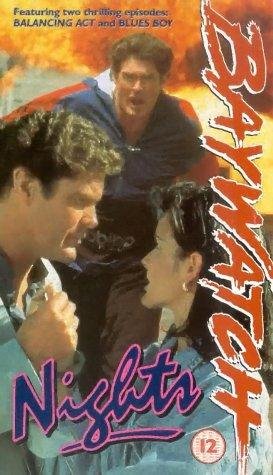
Welcome to Late Night Retro Television Reviews, a feature where we review some of our favorite and least favorite shows of the past!  On Tuesdays, I will be reviewing Baywatch Nights, a detective show that ran in Syndication from 1995 to 1997.  The entire show is currently streaming on YouTube!

This week, Baywatch Nights travels not to the beach but instead to a cabin in the woods!

Episode 2.6 “The Cabin”

(Dir by Reza Badiyi, originally aired on November 3rd, 1996)

The sixth episode of Baywatch Nights‘s second season opens with a young woman who is being terrified in a cabin in the woods.  The woman is dressed for the 1990s but she’s being chased by an axe-wielding man named Horse Calhoun (Dennis Burkley), who is dressed for the 1890s.  The woman manages to escape Horse and his axe and let’s get credit where credit is due.  It’s a truly well-done sequence, featuring Dennis Burkley giving a ferocious and scary performance as Horse.

Diamont hires Mitch and Ryan to investigate the cabin, specifically because he thinks that the cabin is haunted and he wants to get the opinion of two skeptics.  (Ryan believes in ghosts but thinks that they are rare.  Mitch does not believe in ghosts but says they still scare him.  I have to go with Mitch on this one.)  Diamont specifically tells Mitch and Ryan not to enter the cabin until he is able to join them later.  So, of course, as soon as they arrive, Mitch and Ryan go right into the cabin.

That turns out to be a mistake.  While Ryan keeps herself busy putting away groceries, Mitch explores the cabin and soon discovers that they’re not alone.  There’s a woman (Lisa Stahl) is a bathtub who encourages Mitch to “take off your clothes” and join her.  There’s a decadent, cigar-chomping man (Danny Woodburn) who seems to be very amused with himself.  And, of course, there’s Horse Calhoun, rampaging down hallways and throwing axes at Mitch’s head.

The cabin, it turns out, is home to a portal, one that leads back to a New York brothel in the 1890s.  One hundred years ago, an insanely jealous Horse Calhoun killed everyone at the brothel.  Can Mitch and Ryan return to their own time before Horse adds them to his list of victims?

This episode is an example of Baywatch Nights at its best.  The plot is totally ludicrous and the low-budget forces the show to keep things simple (it’s a rather rustic brothel) but the idea behind the plot is properly creepy and Woodburn, Stahl, and especially Burkley all do a good job bringing their undead characters to life.  (Heh heh….)  Burkley makes Horse into a fierce madman, one who throws his axes with the authority of someone who no longer cares who might get in the way of the blade.  Finally, this episode featured a lot of Hasselhoff/Harmon chemistry.  Harmon was earnest and determined while Hasselhoff …. well, he was the Hoff.  We’re lucky to have him.

The Cabin was Baywatch Nights as its best.

Film Review: Heroes (dir by Jeremy Kagan)


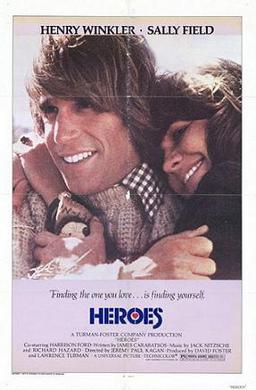
The 1977 film, Heroes, tells the story of Jack Dunne (a young Henry Winkler).

Jack spent four years fighting in Vietnam.  Since returning to America, he has struggled to adjust to civilian life.  Though he’s mentally blocked out much of what happened in Vietnam, he’s haunted by nightmares,  When we first meet him, he’s a patient at a mental health facility in New York City.  He has big plans, though.  He wants to open up a worm farm in Eureka, California.  He’s convinced that he can make a ton of money selling worms to fisherman and he wants all of the old members of his unit to join him in the venture.  After Jack escapes from the hospital, he boards a bus heading for California.

He also meets Carol (Sally Field), who is supposed to be getting married in four days but who has decided to board a bus and take an impromptu vacation instead.  When Carol is told that the bus is already full and she’ll have to wait for the next one, Jack bribes the ticket agent to get Carol on the bus.  Once on the bus, Jack makes himself into a nuisance, continually bothering the driver (Val Avery) and embarrassing Carol.  (In the film’s defense, it’s later established that Jack isn’t just being a jerk for fun.  The driver’s uniform makes Jack nervous.  That said, it’s hard not to feel bad for the driver, who is just doing his stressful job to the best of his ability.)  Carol and Jack do eventually strike a tentative friendship.  They’re linked by the fact that they’re both trying to escape from something.

At a diner, Jack tells her that he served in Vietnam.

“I protested the war,” Carol says.

“I fought it,” he replies.

Carol eventually joins with Jack in his quest to track down the three people who he expects to go into business with.  One of them is missing.  One of them never returned home from the war.  And the third, Ken (Harrison Ford), is living in a trailer and raising rabbits for a living.  Ken is also a stock car racer, though he eventually admits that he rarely wins.  In fact, he seems to spend most of his time drinking and shooting off the M16 that he keeps in his car’s trunk.  Meeting Ken sends Jack spiraling into depression but, with Carol’s help, Jack is finally starts to come to terms with the reality of what happened to him and his friends in Vietnam.

Heroes was one of the first films to sympathetically portray the plight of Vietnam veterans struggling to adjust to life back in the United States and it certainly deserves a lot of credit for its good intentions.  (Indeed, it’s implied that a part of Carol’s concern from Jack comes from her own guilt over how the anti-war movement treated the returning soldiers.)  That said, the film itself is an awkward mix of drama and comedy.  The first half of the film, in which Henry Winkler comes across like he’s doing a manic Al Pacino impersonation, is especially uneven.  Winkler and Field are both naturally likable enough that the film remains watchable but, during the first half of the film, most viewers will never buy their relationship for a second.  It’s hard to believe that the driver wouldn’t have kicked Jack off the bus as soon as he started to cause trouble and the other passengers often seem to be unrealistically charmed by Jack’s behavior.  If I’m on a crowded bus and some dude insists on walking up and down the aisle and taunting the driver, I’m probably going to get off at the first stop and refuse to get back on.  Traveling with a bunch of strangers is already nerve-wracking enough without having to deal with all of that.

Not surprisingly, things improve once Harrison Ford shows up.  This was one of Ford’s last character parts before he was cast as Han Solo in Star Wars.  (Heroes, however, was released after Star Wars, which explains why Ford is mentioned prominently in the trailer despite having a relatively small role.)  Ford gives a strong performance as the amiable but ultimately self-destructive Ken.  Ford plays Ken as someone whose quick smile is a cover for the fact that his entire life is a mess.  Whereas Jack wears his emotions on his sleeve (and Winkler never stops projecting those emotions), Ken is someone who has repressed his anger and his sadness and Ford gives an internalized and controlled performance.  Perhaps not coincidentally, Winkler calms down a bit when he’s acting opposite Ford and, as a result, his own performance starts to improve.

After the meeting with Ken, Jack starts to realize that it’s not going to be as easy to start his business as he thought.  Jack starts to come down from his manic high and, even more importantly, Henry Winkler stops overacting and instead, starts to dig into the sadness at the heart of Jack’s life.  During its second half, the film finally settles on being a drama and Heroes becomes a much stronger story as a result.  Even Jack and Carol’s relationship seems to make more sense during the second half of the film.  Things end on a note of cautious optimism, which also acknowledging that life can never go back to what it was before the war.

Today, if anyone watches Heroes, it’s probably going to be for Harrison Ford.  (I imagine the presence of Harrison Ford is the reason why it’s currently available on Netflix.)  It’s a bit of an uneven film, one that feels as if it should have been stronger than it actually was.  Still, it’s a worthwhile time capsule of 1977 and America’s struggle to come to terms with the Vietnam War.  Today, we’re still struggling to come to terms with what happened in Iraq and with the botched withdrawal from Afghanistan and, again, it seems like the country is too busy trying to move on to take the time to take care of its veterans.  It’s sad that so many people only seem to care about the soldiers who fight in popular wars.  Heroes was a plea to America not to forget its veterans.  It’s a plea that still needs to be heard.

Live Tweet Alert: Join #FridayNightFlix for Laserblast!


As some of our regular readers undoubtedly know, I am involved in a few weekly live tweets on twitter.  I host #FridayNightFlix every Friday, I co-host #ScarySocial on Saturday, and I am one of the five hosts of #MondayActionMovie!  Every week, we get together.  We watch a movie.  We tweet our way through it.

Tonight, at 10 pm et, I will be hosting #FridayNightFlix!  The movie? 1978’s Laserblast!

Which film has Kim Milford, Roddy McDowall, Eddie Deezen, Keenan Wynn, Rainbeaux Smith, Gianni Russo, Dennis Burkley, and two Claymation aliens!?  This film!

If you want to join us this Friday, just hop onto twitter, start the movie at 10 pm et, and use the #FridayNightFlix hashtag!  I’ll be there tweeting and I imagine some other members of the TSL Crew will be there as well.  It’s a friendly group and welcoming of newcomers so don’t be shy.

Laserblast is available on Prime, Tubi, YouTube, Pluto, and almost every other streaming service!  On twitter, I’ll be sharing a commercial-free link for the film begins.

See you there!

Spring Break on the Lens: Laserblast (dir by Michael Rae)


Before I say anything else, I should admit that I fully understand why some of you are going to say that the 1978 science fiction film, Laserblast, is not a spring break film.

First off, it takes place not on the beach but in the desert.  There is a scene that takes place at a pool but it’s one of those cheap pools that all of the desert towns have.

Secondly, the film itself doesn’t take place during the spring.  It takes place during the summer, when the sun is bright and harsh.  The teenagers in the film might not be in school but that’s just because it’s their summer vacation.

I get it.

But, as far as I’m concerned, Laserblast is spiritually a spring break film, even if it isn’t technically one.  I mean, just look at the film’s hero, Billy.  As played by the very handsome Kim Milford, Billy is a mellow guy with blonde hair, stoned eyes, and the attitude of someone who can say, “Right on!” and make you believe that everything will be right and on.  Billy even drives a totally 70s van.  Everything about Billy and his girlfriend, Kathy Farley (Rainbeaux Smith), screams Malibu.  Even in the desert and in the summer, they are the ideal spring break couple.

Billy, of course, gets in some trouble over the course of the film.  He stumbles across a space gun in the desert.  Billy doesn’t know what we know, that the space gun was accidentally left there by two adorable claymation aliens who previously visited Earth so that they could kill the gun’s owner.  Billy just thinks it’s a cool gun.  Soon, Billy is blowing up the town and turning into a green-skinned monster.  Billy even blows up a sign that’s advertising Star Wars, which is made doubly interesting by how much Kim Milford resembles Mark Hamill.  (The same year that Laserblast came out, Hamill and Milford acted opposite each other in Corvette Summer, with Milford’s mellow confidence providing a nice counter to Hamill’s somewhat hyperactive earnestness.)  Much like a drunk spring breaker who ends up vomiting into the ocean, Billy has found something that he enjoys and he’s allowing it to take over his life.  The space gun represents every vice and addiction that’s out there to tempt people into risking their lives and their sanity and their totally 70s van.  (We don’t see much of the inside of the van but I’m willing to bet that it has shag carpeting and a strobe light.)  The spring breakers in The Real Cancun spent their week drinking themselves into a stupor.  Billy, on the other hand, spends a week blowing stuff up and turning into a monster.  Of course, that’s the great thing about spring break.  How you spend your time is your business.

Laserblast is a low-budget film, one that is often listed as being one of the worst films ever made.  Myself, I love the film because I think the aliens are cute and I enjoy Kim Milford’s performance as Billy.  Actually, for a film that didn’t cost much to make, Laserblast has a surprisingly impressive cast.  Technically, it’s not a shock to see Roddy McDowall in the film, since McDowall apparently accepted every role that he was offered in the 70s.  But Roddy’s trademark neurotic eccentricity is still welcome in the small role of Billy’s doctor.  The great character actor Dennis Burkley shows up as a fascist deputy.  Gianni Russo, who played Carlo Rizzi in The Godfather, plays a government agent who shows up from out of nowhere and who wears a cream-colored suit that makes him look like a wedding DJ.  Keenan Wynn, who also apparently accepted any role he was offered in the 70s, plays Rainbeaux Smith’s drunk grandfather.  Best of all, Eddie Deezen, who was best known for playing stereotypical nerd characters in films like Grease, shows up as a bully named Froggy!  After getting bullied by Eddie Deezen, who wouldn’t pick up the first space gun they found and start blasting rocks?

Laserblast is fun, just like spring break.  I like it, just like spring break.  So does Arleigh so be sure to check out his review, as well!