Brains, Laughs, and Decline: The Uneven Legacy of Return of the Living Dead


Subverting the Zombie Canon: Satire, Genre-Bending, and Decay in the Return of the Living Dead Series

When talking about cult horror films, the Return of the Living Dead series holds a special place—not only as a spin-off from George A. Romero’s seminal Night of the Living Dead, but as a unique creative force in its own right. Thanks to a legal split between Romero and co-writer John Russo over rights to the “Living Dead” name, Russo and director Dan O’Bannon got to imagine a parallel zombie universe. This franchise quickly carved out its own identity, mixing horror, black comedy, and punk spirit in a way that both paid tribute to and upended zombie tropes.

Reinventing Zombie Lore with a Wink

The original Return of the Living Dead (1985) starts with a clever “what if” twist: what if Romero’s Night wasn’t just a movie, but a dramatized cover-up of a real government disaster? This meta idea instantly frames the film as self-referential and playful, setting a tone unlike anything out at the time.

Central to the film’s identity is the invention of 2-4-5 Trioxin, a fictional military chemical designed to clear marijuana crops which instead raises the dead—zombies with surprising new abilities. Unlike the slow, drooling zombies Romero popularized, these ghouls sprint, talk, and set traps. Their hunger is peculiar as well: they crave brains exclusively, as it eases the pain of being undead. And the old rules of zombie combat? Forget shooting them in the head. These zombies resist it, raising the stakes and scare factor.

This refreshing rewrite of zombie rules allowed the movie to be both frightening and fun. The zombies were smart but still monstrous, turning classic horror expectations on their head in a way that invited both laughter and fear—a tricky balance that few horror comedies manage.

Playing with Comedy, Panic, and Punk Rock

One of the greatest strengths of the original film is how it embraces horror-comedy so naturally. It doesn’t shy away from being funny while still delivering tension. James Karen and Thom Mathews excel as the main pair—Karen’s frantic, over-the-top panicked man paired with Mathews’ straight, slowly succumbing counterpart create a perfect comedic rhythm. Their slow transformation into zombies adds a tragic dimension to what could have been simple slapstick. Meanwhile, Don Calfa’s mortician character and Clu Gulager’s warehouse owner provide a grounded center amidst chaos.

The punk subculture flavor adds another unique texture. Linnea Quigley’s famous graveyard striptease encapsulates the 1980s’ blend of irreverence, sexuality, and horror obsession. The scene is shocking, hilarious, and iconic—one of those moments that encapsulates everything this film is about: having fun with taboos while not losing the darker undercurrents of mortality and decay.

Beyond laughs, there’s biting satire here. The film skewers the government and military’s hubris—scientists create a superweapon they can’t control, leading to chaos and destruction. This reflects 1980s American anxieties about bioweapons, government cover-ups, and nuclear fears. Horror and comedy collide to reflect cultural distrust and paranoia.

The Problem of the Sequel: Part II’s Familiar Ground

When Return of the Living Dead Part II came out in 1988, it felt like the franchise was stuck in a loop. With much of the original cast returning in near-identical roles, and lines and situations seemingly recycled, the film circles back to the same story. This self-copying invites a mix of amusement and disappointment: it seems the filmmakers didn’t believe they could improve on the original and decided to replicate it instead.

While it has its moments—good practical effects and a rollicking tone reminiscent of the first film—it leans harder into comedy, sometimes at the expense of the horror. The suburban setting and clearer military lockdown raise the action stakes, but the humor feels broader and less sharp, which can make the movie seem a bit cartoonish.

In a way, Part II comments on the pitfalls of horror franchises: once you’ve struck gold with an unexpected idea, sequels often struggle to regain that freshness. This installment is entertaining, but signals the beginning of the franchise’s creative plateau.

Much Darker Territory: Part III’s Horror and Romance

With Return of the Living Dead 3 in 1993, things take a major tonal shift. Brian Yuzna’s direction removes much of the comedy and replaces it with body horror, gore, and a genuinely tragic romance. The story centers on Curt and Julie, two teenagers tragically pulled into the military’s secret zombie experiments. After Julie is accidentally killed and resurrected, she becomes a zombie who feeds on brains but manages her hunger through extreme self-inflicted pain.

This grim take pushes the franchise into more serious, intense horror territory, with heavy themes of love, loss, and bodily autonomy threaded throughout. Julie’s tortured transformation is both tragic and unsettling, symbolizing not only the loss of life but also the torment of trying to hold onto humanity while losing it from within.

Yuzna’s effects are grisly in the finest tradition of ‘90s practical SFX. The film revives the franchise’s sense of danger and stakes by mixing romance with horror, delivering something emotionally resonant and viscerally impactful. While it diverges sharply from the earlier comedic tone, Part III proves the series’ flexibility and capacity for reinvention.

Creative Collapse: Parts IV and V’s Direct-to-Cable Downfall

Sadly, the wheels come off with Return of the Living Dead 4: Necropolis and 5: Rave to the Grave, both made in 2005 and directed by Ellory Elkayem. Shot back-to-back and released direct-to-cable, these films are pale shadows of the earlier entries.

They ditch the original’s clever mix of horror and humor entirely. Instead, we get generic corporate conspiracies, confusing Eastern European settings, weak scripts, and inconsistent zombie characterizations. The zombies lose their unique “brains only” horror and instead act like run-of-the-mill undead. Even the acting is amateurish, with only Peter Coyote standing out briefly as a sinister scientist.

Part 5 further muddies continuity by introducing Trioxin as a rave drug, leading to a chaotic rave/zombie apocalypse scenario that is both baffling and poorly paced. The low-budget effects and uneven pacing betray the exhaustion and lack of passion behind these entries.

These final two films underscore a common fate for franchises that outlive their creative spark—once inventive mythology becomes shallow cliché, and attempts to cash in feel uninspired. Instead of honoring their roots, they become muddled and forgettable.

Why the Series Matters

Despite its uneven legacy, Return of the Living Dead remains important for what it dared to do in horror cinema. The first film’s originality influenced countless horror comedies and redefined how zombies could be portrayed. Its self-awareness and invention paved the way for postmodern horror, where genre is as much about commentary as it is fear.

The third film’s daring shift to tragic body horror further demonstrated the potential for zombie films to explore complex emotional and societal themes beyond gore or giggles.

While the later sequels falter, their failure serves as a cautionary tale about the dangers of diluting distinct voices and creative risks in franchise filmmaking.

Ultimately, Return of the Living Dead survives in cultural memory as a zombie series that captured the spirit of its time—punk rebellion, Cold War paranoia, and genre self-mockery—with flashes of brilliance that continue to entertain and inspire.
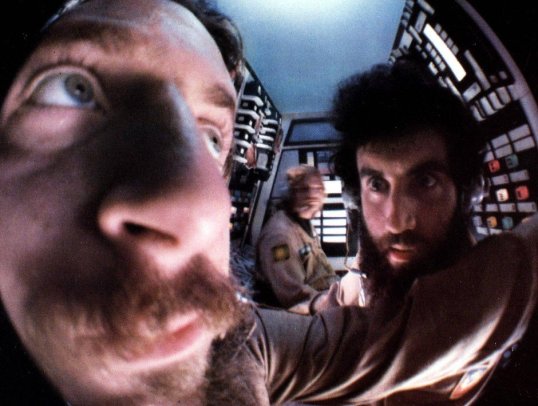

Film Review: Dark Star (dir by John Carpenter)


Dark Star (1974, dir by John Carpenter, DP: Douglas Knapp)

What’s it like to live in outer space?

That’s the question posed by 1974’s Dark Star and the answer seems to be that it’s boring as Hell.  Lt. Doolittle (Brian Narelle), Sgt. Pinback (future director and screenwriter Dan O’Bannon), Boiler (Cal Kuniholm), and Talby (Andreijah “Dre” Pahich) have been floating in their spaceship for over twenty years.  (Because of the vagaries of the space-time continuum, they’ve only aged three years in all that time.)  The leader of their mission, Commander Powell (Joe Saunders) was killed when he was accidentally electrocuted at the start of the mission.  The crew put his body in suspended animation so that they could still ask him question despite the fact that he’s not quite alive.  (When they do talk to Powell, Powell is very resentful about the whole situation.)  Doolittle, a former surfer, has taken over as commander of the ship though no one seems to be quite sure what their mission is.

The men struggle to find ways to pass the time as they float endlessly through space.  Some of them watch the asteroids in the distance.  Doolittle fantasizes about surfing.  Pinback plays jokes on people and claims to be an imposter who killed the real Pinback before the start of the mission.  The spaceship is a cluttered mess and the crew looks more like a collection of long-haired hippies than a group of rigorously trained astronauts.  They spend their time getting on each other’s nerves.

They do have a few things that they have to deal with over the course of the film.  The men aren’t particularly smart and whatever discipline they had was abandoned long ago.  As a result, their ship constantly seems to be on the verge of literally falling apart.  A dangerous alien that looks like a beach ball gets loose on the ship.  Even worse, one of the ship’s talking bomb is having an existential crisis.  It’s been over 20 years and it has yet to be used to blow anything up.  What, the bomb wonders, is the purpose of being a bomb if you can’t blow anything up?  Then again, what is the purpose of being in space if there’s nothing left to explore or to discover?

Dark Star is a film that requires a bit of patience.  It moves at its own deliberate pace and a lot of the humor comes from the contrast between the shabbiness of the film’s crew and Stanley Kubrick’s far sleeker vision of space travel in 2001: A Space Odyssey.  Both Dark Star and 2001 are existential films about man’s search for meaning in the stars.  In 2001, Dave Bowman finds that meaning, even if he doesn’t realize it.  The crew of the Dark Star however have to deal with very real possibility that there is no meaning.  Dark Star‘s comedy comes from poking fun at the concept that going into space would make people any less frustrated than they already are on Earth.

Essentially a stoner comedy set in space, Dark Star was John Carpenter’s feature debut.  It started out as a student film but Carpenter and Dan O’Bannon were able to raise an extra $10,ooo  to extend it to feature length.  Largely overlooked when it was first released, it was re-released in 1979.  By that point, Carpenter had directed Halloween and O’Bannon had written Alien, a film that had more than a little in common with Dark Star’s shabby future and its dangerous alien.  While Dark Star definitely shows its origins as a student film, I’ve always enjoyed it.  It’s hard not appreciate the film’s ambition.  And, in its way, it’s probably one of the most realistic vision of life in space ever captured on film.  Humans, the film says, will always be humans.  They’ll always screw things up but occasionally, if they’re lucky, they’ll also get to surf amongst the stars.

Film Review: Alien Romulus (dir. by Fede Alvarez)


Lately, I don’t trust myself much when it comes to writing movie reviews. I once raved about Batman Begins when it first came out, only to have a friend/co-worker read it, check the movie out based on my thoughts. He returned with a look of disgust on his face…”That was terrible! Grumble grumble Batman, I could barely understand him.”, he said.

I dance around it, when I can. I’m almost Fifty, at an age and a point in my life where I’m easily amused by almost anything, particularly in a world where everything’s in a doomscroll. Sitting in a darkened room, watching a story play out just feels good, even if the story isn’t great. Add to this the notion that everyone will have a film of the week screen captured and spoiled by Saturday Morning (if not already), and sometimes there doesn’t feel like a need to write about these things. You don’t need me, but I’m happy to be here. I’m not helping anyone in making a decision on whether they should see a film, I’m simply cataloging my experience. That’s the beauty of it. No two experiences are similar, and it’s a joy to read how others felt about a movie while discovering my own viewpoints through my writing. This is all still fun to do, I’m finding.

So what does any of this have to do with Fede Alvarez’s Alien Romulus? Not much. I just needed to get thoughts on the page so I could rev up to writing about the film. I also wanted to warn you that I could be high on the euphoria of going to the movies. My take might not be yours, but I’m also playing Devil’s Advocate in trying to weigh what I thought they could have improved on.

Living as miners on a world where sunlight is rare, life is hard for Rain Carradine (Cailee Spaeny, Priscilla, Pacific Rim: Uprising) and her brother, Andy (David Jonsson, HBO’s Industry). When her friends discover a discarded ship called Romulus near an asteroid field, they decide to loot it for the tools they need for an extended hypersleep to a better destination. This becomes a problem when they discover they’re not alone on the ship they targeted. Can they escape these threats before meeting their end?

I was really impressed by Alien Romulus in a number of ways. One, I argued that the last trailer gave away too much information on the plot. I was terribly incorrect. For all that was shown, it barely touched the surface of the entire story. I found that pretty refreshing in this day and age where movie trailers rarely leave anything out. Two, there are a number of practical effects used in this film, from the animatronic, jumpy facehuggers that get more up close and personal than one would ever want to the classic Xenomorph scaling walls and dripping acid. I felt like it learned a bit or two from Alien Covenant (of which I’m not a fan) and considerably toned down the CGI where it could. The results are damn good, given this is the 9th go around in the Alien Franchise (if you want to include the two Alien vs. Predator films). Alvarez really gets the atmosphere right. Hallways are creepy and dimly lit, feeling much like Creative Assembly did with Alien Isolation (which of course built theirs from the original Alien). The space station, flight sequences and the asteroid belt are all on par what with we saw with Prometheus. The film even manages to travel in some new directions with both Xenomorph development and by the end will have you wanting to rewatch the series again. Is it all perfect? No, but I can’t say anything like that about Alien Resurrection.

From an acting standpoint, this movie clearly belongs to both Cailee Spaeny and David Jonsson. They easily carry the film with their performances. With the exception of Isabela Merced (Dora the Explorer), I can’t say much about the other characters. I can at least say her character and performance here was far better than what she did in Madame Web earlier this year. Those three are only ones that are given any true character development through the course of the film. This isn’t to say that we don’t get good performances from Archie Renaux (Tyler), Aileen Wu (Navarro), and Spike Fearn (Bjorn). They just weren’t as memorable to me. We know the others want to move on to better things, but we never really get to know them well enough to root for or against them.

For the horror aspect, let’s face it. After so many movies, it’s a little difficult to be afraid of the Xenomorph. And yet, more with the facehuggers than with the human sized aliens, Alien Romulus does find a way to make the monsters creepy and amazingly quick. I had a few moments where I did my usual “watch the corners”, and avoided looking at the screen directly. There aren’t too many jumpscares, though they are there.

If Romulus suffers from any problems, it’s that the cast was too small for all of the elements thrown at them. I understand that it’s more of a personal story, so you’re not having a group of decimated Marines like in James Cameron’s Aliens or even a number of dead prisoners such as you had with David Fincher’s Alien3, but it was easier to get a feel of how dangerous the Xenomorphs when people were hunted left and right in different ways. The death sequences in Romulus all felt interesting, but there just weren’t enough of them for my taste. Another problem I had with the film was that it tried too hard in the last act to pay homages to other films in the series. Some of them worked well (particularly one introducing some to weapons) , and others kind of didn’t. At one point, you’re finding that the movie pulls lines and or whole sequences from the other films, which doesn’t make sense in some situations given where Romulus sits in the Alien timeline.

Imagine watching a fight in space between two Green Lanterns and one says to the other “Do you bleed?” as a reference to Batman v. Superman. Sure, it might be nice to hear, but who bleeds in space? It’s somewhat similar with Romulus in that fashion. Is that all Nostalgia is now, just re-spitting lines from older films that were more effective back then? Sitting in the front row on the sides (my favorite area), I want to say there were at least 4 walkouts during my showing, with one person coming back with drinks.

Musically, Benjamin Wallfisch does a good job here. He doesn’t try to recreate Jerry Goldsmith’s score the way Jed Kurzel did with Alien Covenant, though there are some wild heavy beats that could work better in a trance song. The sound in the film is also pretty nice, with the skittering and screeching bounding off the walls perfectly in the Regal RPX setup.

Overall, I really enjoyed Alien Romulus. While there are some elements I would have fixed (particularly with characterization and moving away from trying to reference the other films), I feel It’s a solid entry in the series, especially when I compare it to Alien Covenant or Alien Resurrection.

4 Shots From 4 James Karen Horror Films: Frankenstein Meets The Space Monster, Poltergeist, Return of the Living Dead, Return of the Living Dead Part II


4 Shots From 4 Films is just what it says it is, 4 shots from 4 of our favorite films. As opposed to the reviews and recaps that we usually post, 4 Shots From 4 Films lets the visuals do the talking.

Yesterday, we lost one of the great character actors, James Karen.  Over the course of his long career, Karen appeared work in almost genre imaginable, including horror.  Today, we pay tribute to him with….

4 Shots From 4 James Karen Horror Films

Frankenstein Meets The Space Monster (1965, dir by Robert Gaffney)

Poltergeist (1982, dir by Tobe Hooper)

Return of the Living Dead (1985, dir by Dan O’Bannon)

Return of the Living Dead Part II (1988, dir by Ken Wiederhorn)

Film Review: Alien (dir. by Ridley Scott)


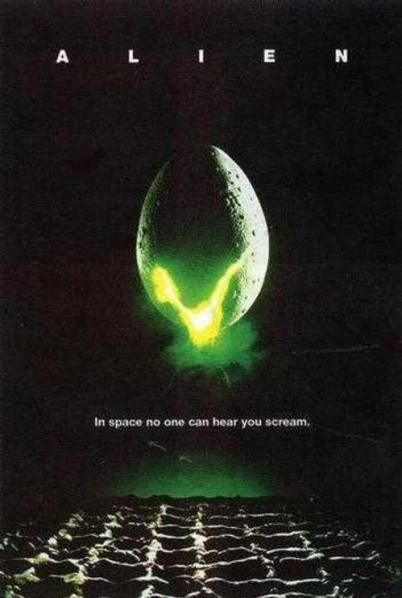
AlienPosterToday is 4.26, also known as “Alien Day”, and named after the planet in James Cameron’s Aliens (LV-426 / Acheron). It’s a celebration of the entire Alien Franchise, but I’m only focused on the first film as I finally saw it in the theatre in 2017.

This isn’t so much a review as it’s just my history with Ridley Scott’s Alien. You can find actual reviews all over the internet, and I know very few people who didn’t enjoy the movie. This piece assumes you’ve seen the film and are familiar with it. There are also spoilers within, though with a nearly 40 year old film, I’m not sure if it can be classified as such.

When I was little, my older brother and I shared a room in my grandmother’s house. Below our bunk beds was a open space that contained a set of boxes and each box contained a collection of our toys – board games, knick knacks, things like that. If you needed something, you went under the bed to fetch it. Only thing is, I always reached into those boxes with my eyes closed.

I have a vague memory of when my older brother received 3 toys that affected the way I looked at things. The first was a board game for the movie Alien. On it, you had a map of the Nostromo, about 3 Astronaut pieces and one for the Alien. I can’t recall the exact nature of how it was played, but I do remember it having to do with finding a way to reach the Narcissus – the escape ship – before the Alien reached your character. Each player also had their own Alien they could use to hunt the other characters before they could escape.

alien-board.jpg

The Alien Board Game. Fox marketed toys for Alien (an R rated film), possibly fearing the mistake they made with Star Wars.

The second was a movie viewer. I had to do some hunting around the net to find it, and thanks to The Toy Box, I was able to locate one. These viewers (made by Fisher Price and by Kenner) were really popular, especially after the Star Wars boom. You loaded it with a tape and it would play out a scene. For the Alien tape my brother had, it would play out the egg opening face hugger jump sequence. I rewound that too many times, and perhaps it’s the reason I’m afraid of spiders. I don’t really know for sure. The tape used below goes through most of the film’s plot, so if you haven’t watched the film by now, consider yourself spoiled.

The last toy was the reason I never went into the toy boxes. My brother owned an 18 Inch tall Alien figure, complete with a glow in the dark headpiece and a functional second set of teeth. It was one of the scariest things I’d seen as a kid.

All of this was thanks in part to Star Wars. With the mistake Fox made in giving the merchandising rights for Star Wars to Lucas and Lucasfilm, Ltd., they missed out a major chunk of revenue. So when Alien was set to launch 2 years later, they greenlit an entire toy line for the film, even though the movie was rated “R” and the toys demographic couldn’t really see the movie without parental supervision. For the time, that was a pretty amazing thing.

Back in the early 1980s, my father invited my older brother and I to his place to see Alien. I was about six or seven years old at the time, with my brother a few years older. My parents worked nights, so we pretty much lived with my grandmother. He was always into movies and he acquired a RCA Videodisc Player, along with that film and First Blood. Although I was sick, I still went and watched it. I vomited twice during the playthrough, but it was so worth it.

I’d come to find out years later from my Mom that my Dad really didn’t need to invite us. He was just too scared of the movie to watch it alone. According to family legend, Alien was a date movie for my parents, and halfway into the film, my Dad (along with most guys, I’ve heard), was using my Mom as a shield. Mind you, this was a guy who kept multiple firearms in the house and knew how to use them.

Alien was the brainchild of Dan O’Bannon and Ronald Shusett. Having worked on Dark Star for John Carpenter, O’Bannon wanted to create another space film, but with a more serious tone. They came up with the story, inspired by 1958’s B-movie classic It! The Terror From Outer Space and decided to roll with it. The feel for their story would be more like a set of space truckers hauling ore and picking up a stowaway space possum in their cargo.

And that’s Alien in a nutshell. A crew of seven astronauts heading towards Earth in their mining vessel are awakened from hyper sleep when their spaceship – The Nostromo – picks up a distress signal from a nearby planetoid. They are given orders to investigate the signal, but when one of them is incapacitated by an alien life form, it brings trouble to the rest of the crew once they all return to the ship. Can they survive?

The casting for Alien is damn near flawless. There isn’t a single person that feels out of place. The characterization for everyone is straightforward, from the wisecracking pair of Harry Dean Stanton and Yaphet Kotto to the very systematic Ian Holm as the Nostromo’s Science Division expert, it doesn’t take long for one to get to know them or at least wonder if they’ll make it through the story unscathed.  Whether it’s Veronica Cartwright’s Lambert, who is nervous and jittery mid way through the film (and with good reason) or Sigourney Weaver’s Ripley who sees the potential threat before it gets out of hand, everyone here plays their part well.

Ridley Scott was a young director brought on board to create the film. Now, normally, this is where the movie would be made and that really would be that. Scott’s visit to an art gallery in Paris would change the make up of the movie, according to the behind the scenes documentary. What set Alien aside from other space/horror fanfare were the influences of two major artists at the time, Jean Giraud and H.R. Giger.

Jean_Henri_Gaston_Moebius_Giraud_blog.kierankelly.net_mobieus_alien1

Concept Art by Jean Giraud, a.k.a. Moebius.

Having seen his work in France, Ridley Scott felt that Giger had to be brought on board. Giger agreed to use some of his designs for the film and actually helped create the entire Space Jockey set. For the late 1970s, Giger’s look – elongated bones with sexual undertones – had to be a shock to audiences. Giraud, known to many fans as Moebius, was one of the greatest illustrators to have lived. Giraud was previously brought on to work on Alejandro Jodorowsky’s adaptation of Dune, but after that fell through, he ended up working with Scott for a bit, mainly coming up with the designs for the suits in the Nostromo. Together, both their designs would be used to bring something entirely new to audiences at the time. Also on hand was Carlo Rambaldi (E.T. the Extra-Terrestrial, Dune), who helped design the Alien’s mouth and motor features. In the effects department, Dennis Ayling, Nick Allder, and even Batman’s Anton Furst had a hand in setting the atmosphere for the Nostromo and LV-426. The result is a sense of claustrophobia. The Nostromo’s hallways aren’t the immaculate ones you’d find on board the Enterprise or the roomy ones on the Millennium Falcon. They’re tight, dimly lit with an obvious function over form factor to them. It’s a space rig.

With older monster films, the creature usually is just one form. Giger’s Alien had three distinct forms used, which has always made me curious for the initial audience reactions. The first encounter is with a the Facehugger, an arachnid like creature with a tail that restricts the breathing of its potential victim. Add to this the notion that it uses molecular acid for blood. How do you even fight such a thing? Imagine thinking this is the “big bad” you’re going to see throughout the movie. Scott was particular in having the advertising reference as little as it could about the Alien itself (though the toy line kind of ruined that).

Just when you’re comfortable with the possiblity of facehuggers crawling around, the movie switches gears and introduces us to the Chestburster, a phallic snake of a creature (thanks again to Giger). . The scene was fantastic. Although the cast was told what was supposed to happen with Kane (John Hurt), they weren’t completely filled in on how it was supposed to occur. It was a two part process. The first involved trying to hold down Kane, and the second was setup with John Hurt in the table to have the “push through”. So, when Kane lets out that one big scream, everyone’s reactions are real. You can see that both Parker (Yaphet Kotto) and Dallas (Tom Skerritt) are completely stunned. Veronica Cartwright (and her character Lambert) caught the worst of all this and also had the best reaction. When the Chestburster appears, the effects blood pumps caught Cartwright full on and it was all kept on film. I’m told that the scene in its initial run had people curling in their seats, standing to move to the back of the theatre (for some distance) or walking out altogether. What I wouldn’t give for a Time Travelling DeLorean and an Opening Night movie ticket to that.

So now, there’s a snake running loose on the ship. The film spares very little time before our newborn becomes an adult. Mostly sleek and skeletal, the adult Alien is the stuff of nightmares, but thanks to Scott, and Cinematographer Derek Vanlint, we don’t see much of the Alien until the last act of the movie. Like the Batman, we only see it pounce, and that’s a testament both to the lighting used and the editing of shots. Scott’s close-ups on the Alien’s mouth and forehead doesn’t give anyone enough time to fully make out what it is entirely. Credit also goes to Bolaji Badejo, who portrayed the Alien. At 6’10”, Badejo was perfect for the creature sense of stature and movement, particularly with Harry Dean Stanton’s Brett having to stare up at him in shock.

BigAlienHead

The production wasn’t without an issue here or there. Giraud’s suits – which had a samurai feel to them – had problems with the ventilation, so some of the actors nearly experienced exhaustion while working in them. This was later remedied, of course.

Alien remains one of Jerry Goldsmith’s best scores, though it’s also a simple one. The music isn’t so much horrific as it just classical. The music in Alien isn’t really used to imply any kind of horror (save for perhaps one sequence), but perhaps that’s a good thing. The music lets the movie do the talking instead of throwing zingers. There’s very little I can say about the score outside of that.

Alien would go on to spawn seven extra films, though personally, only James Cameron’s Aliens (1986) and Ridley Scott’s Prometheus (2012) are the two worth seeing. Alien 3 (1992) is beautiful, thanks to David Fincher and Cinematographer Alex Thomson, but also kind of damaged the timeline.

So, turn out the lights, settle in with the food of your choice and enjoy Alien Day.

SpaceJockey

The Space Jockey. Much of Giger’s designs looked like bone.

* – A thank you goes out to Kevin Carr of Fat Guys At the Movies. He once featured It! The Terror From Outer Space years ago during the weekend Live Tweets he used to host. It was a treat to watch.

Boobs, Music, and Sci-Fi: Heavy Metal (1981, directed by Gerald Potterton)


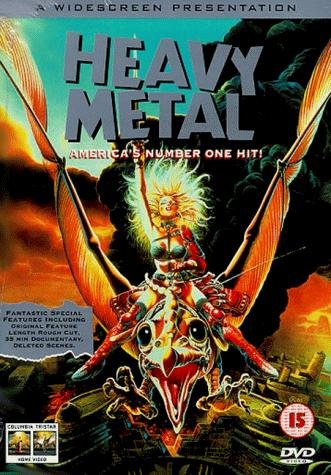
Heavy MetalI think I was twelve when I first saw Heavy Metal.  It came on HBO one night and I loved it.  So did all of my friends.  Can you blame us?  It had everything that a twelve year-old boy (especially a 12 year-old boy who was more than a little on the nerdy side) could want out of a movie: boobs, loud music, and sci-fi violence.  It was a tour of our secret fantasies.  The fact that it was animated made it all the better.  Animated films were not supposed to feature stuff like this.  When my friends and I watched Heavy Metal, we felt like we were getting away with something.
Based on stories from the adults-only Heavy Metal Magazine, Heavy Metal was divided into 8 separate segments:

Soft Landing (directed by Jimmy T. Murakami and John Bruno, written by Dan O’Bannon)

Heavy Metal opens brilliantly with a Corvette being released from a space shuttle and then flying down to Earth, surviving reentry without a scratch.  Who, after watching this, has not wanted a Space Corvette of his very own?

http://www.youtube.com/watch?v=DWMPe3wF9jQ

Grimaldi (directed by Harold Whitaker)

On Earth, a terrified young girl listens a glowing green meteorite called the Loc-Nar tells her that it is the source of all evil in the universe.  This sets up the rest of the film, which is made up of stories that the Loc-Nar tells about its influence.  The Loc-Nar is the film’s MacGuffin and, seen today, one of Heavy Metal’s biggest problems is that it has to find a way to force the Loc-Nar into every story, even if it meant sacrificing any sort of consistency about what the Loc-Nar was capable of doing.  Even when I was twelve, I realized that the Loc-Nar was not really that important.

Harry Canyon (directed by Pino Van Lamsweerde, written by Daniel Goldberg)

In this neo-noir tale, futuristic cabby Harry Canyon (voiced by Richard Romanus) is enlisted to help an unnamed girl (voiced by Susan Roman) to find the Loc-Nar.  Slow and predictable, Harry Canyon does feature the voice of John Candy as a police sergeant who attempts to charge Harry for police work.

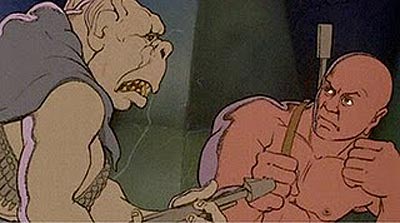
den_1268427864Den (directed by Jack Stokes, written by Richard Corben)
Nerdy teenager David (voiced by John Candy) finds a piece of the Loc-Nar and is transported to the world of Neverwhere, where he is transformed into Den, a muscular, bald warrior.  As Den, David gets to live out the fantasies of Heavy Metal‘s target audience.  On his new planet, Den rescues an Earth woman from being sacrificed, overthrows an evil queen and a sorcerer, and gets laid.  A lot.  Den is the best segment in Heavy Metal, largely because of the endearing contrast between the action onscreen and John Candy’s enthusiastic narration.

Captain Sternn (directed by Paul Sebella and Julian Harris, written by Bernie Wrightson)

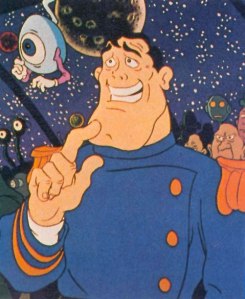
heavy-metal_captain-sternOn a space station orbiting the Earth, Captain Lincoln F. Sternn is on trail for a countless number of offenses.  Though guilty, Captain Sternn expects to be acquitted because he has bribed the prosecution’s star witness, Hanover Fiste.  However, Hanover is holding the Loc-Nar in his hand and it causes him to tell the truth about Captain Sternn and eventually turn into a bloodthirsty giant. Captain Sternn saves the day by tricking Hanover into getting sucked out of an air lock.
Captain Sternn was a reoccurring character in Heavy Metal Magazine and his segment is one of the best.  Eugene Levy voices Captain Sternn while Joe Flaherty voices his lawyer and Dean Wormer himself, John Vernon, is the prosecutor.  Even National Lampoon co-founder Douglas Kenney provided a voice.

 B-17 (directed by Barrie Nelson, written by Dan O’Bannon)

After the Loc-Nar enters Earth’s atmosphere, it crashes into a bullet-riddled World War II bomber, causing the dead crewmen within to reanimate as zombies.  Scored to Don Felder’s Heavy Metal (Takin’ a Ride), B-17 is one of the shorter segments and its dark and moody animation holds up extremely well.

http://www.youtube.com/watch?v=ELUP-oZQKM4

So Beautiful and So Dangerous (directed by John Halas, written by Angus McKie)

Nubile Pentagon secretary Gloria is beamed aboard a spaceship that looks like a giant smiley face.  While she has sex with the ship’s robot captain, the two crew members (voiced by Harold Ramis and Eugene Levy) pour out a long line of cocaine and shout “Nosedive!” before snorting up every flake.  So Beautiful and So Dangerous is so juvenile and so ridiculous that it is actually all kinds of awesome.

Taarna

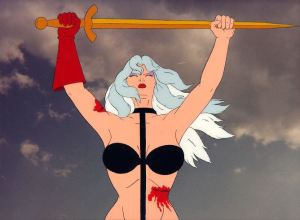
SacrificedIn the film’s final and most famous segment, Taarna, the blond warrior was featured on Heavy Metal‘s poster, rides a pterodactyl across a volcanic planet, killing barbarians, and finally confronting the Loc-Nar.  She sacrifices herself to defeat the Loc-Nar but no worries!  We return to Earth where, for some reason, the Loc-Nar explodes and the girl from the beginning of the film is revealed to be Taarna reborn.  She even gets to fly away on her pterodactyl.  Taarna was really great when I was twelve but today, it is impossible to watch it without flashing back to the Major Boobage episode of South Park.
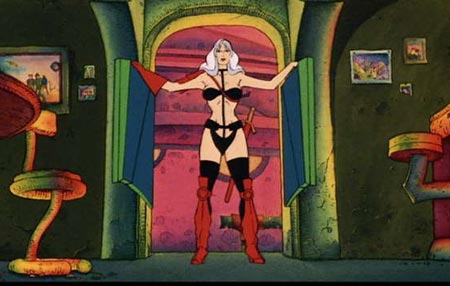
Much like Taarna, Heavy Metal seems pretty silly when I watch it today.  But when I was twelve, it was the greatest thing ever.

Taarna_Heavy_Metal


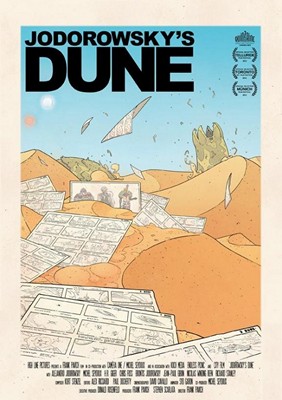
Film Review: Jodorowsky’s Dune (dir by Frank Pavich)


Jodorowsky's_Dune_poster

I have to admit that I’m always a little bit cynical whenever I hear various film fans bemoaning films that were never made.  These are the films that were nearly made but ended up being abandoned because the production company ran out of money or maybe a lead actor died or maybe the studio refused to release it or else they released it in a heavily edited form.  There’s a certain tendency among hipsters to decide that any movie that they will never be able to see would automatically have been the greatest film ever.  It’s rare that anyone ever suggests that maybe it’s for the best that Stanley Kubrick never made his version of Napoleon or that maybe Ridley Scott’s version of I Am Legend would have been just as bad as the version that starred Will Smith or even that the footage that we have of Orson Welles’s unfinished The Other Side of The Wind doesn’t look that impressive.

In fact, some day, I want to see a documentary about an abandoned film where everyone says, “Oh my God, I’m glad that movie never got made.  It would have sucked!”

However, that documentary is never going to be made.  The great thing about praising a film that was never made was that you don’t have to worry about anyone watching the film and then going, “You have no idea what you’re talking about!”

For instance, I recently watched an excellent documentary called Jodorowsky’s Dune.  This film tells the story of how the iconoclastic director Alejandro Jodorowsky attempted to make a film out of the science fiction novel Dune in the mid-70s.  During the documentary, Jodorowsky explains that his version of the story would, in many ways, be different from the book.  Since I’ve never read the book nor have I seen any of the various adaptations that actually were eventually produced, I can’t say whether Jodorowsky’s changes would have been an improvement.  For that matter, I can’t say whether or not Jodorowsky’s film would have been great or if it would have been a legendary misfire.  I’ve seen El Topo and The Holy Mountain so I’m pretty sure that his version of Dune would have been uniquely his own.  But there’s no way for me — or anyone else for that matter — to say whether or not the film would have been any good because, after assembling an intriguing cast (Orson Welles, Mick Jagger, Salvador Dali, and David Carradine) and recruiting several talented artists and technicians (H.R. Giger, Dan O’Bannon, Chris Foss, and Moebius), Jodorowsky was never able to make his film. The Hollywood studios took one look at Jodorowsky’s vision and said, “There’s no way were paying for that.”

However, the documentary goes on to make a very intriguing argument that Jodorowsky’s Dune may be the most influential film never made.  Many of the people who collaborated with Jodorowsky would go on to work on other science fiction films and, when they did, they brought with them many of the ideas and concepts that were originally developed for Dune.  The documentary not only suggests that this might be true but also offers up some pretty compelling evidence, showing us how everything from Raiders of the Lost Ark to Prometheus has featured scenes that originally appeared in Jodorowsky’s Dune storyboards.

I may not be totally convinced that Jodorowsky’s Dune would have been the greatest film ever made but I love this documentary.  The majority of it is spent just listening as Jodorowsky, alternating between English and Spanish, tells us the story of what he hoped to do with Dune and how, ultimately, he could not do it.  Jordorowsky’s love of film and art is obvious with each word that he says.  Whether he’s talking about meeting Salvador Dali or passionately advocating for creativity and imagination, Alejandro Jodorowsky is never less than charming and inspiring.

If you love movies, you’ll love Jodorowsky’s Dune.  If you don’t love movies, Jodorowsky’s Dune will change your mind.

http://www.youtube.com/watch?v=jEW6kZnxRQs

Horror Scenes I Love: Alien


Lisa Marie Bowman had chosen her favorite scene from Dario Argento’s Suspiria as her latest “Scenes I Love” post and it’s quite the scene. I will match her choice with a horror scene which remains one of my favorite scenes in film history. It is also a scene from one of the best scifi-horror films ever made and, I would dare to even say, one of the best films ever created. The scene I speak of comes from Ridley Scott’s classic and iconic film Alien.

Anyone who has ever watched this classic scifi-horror will always gravitate towards talking about one particular scene. The scene is the first time the crew of the space tug Nostromo gets together to a meal as a group after the crisis which saw one of their own crew members attacked by an alien creature. This scene started off quite normal. Professionals enjoying food and good company. It’s through Ridley Scott’s direction and the exceptional performances of all involved which elevates the scene to one of the greatest. Through the scene’s depiction of normalcy we start to get a sense that something may not be right even before Kane begins to cough and have convulsions. For me it was a prolonged shot of crew member Ash during the banter around the table. His expression is all subdued smile then for just a split second we see him glance at Kane eating and being merry but he knows something is wrong and about to happen.

Even if people didn’t pick up that moment from Ash it still created a subconscious effect on the audience so that when Kane did begin to cough and convulse uncontrollably the audience was already on the razor’s edge. When the climactic event which punctuates this scene finally occurs the surprise on all the actors, especially that of actress Veronica Cartwright, has gone done as in film history as a classic. It helped that their reactions were quite genuine. Even knowing that the chestburster alien would pop out it was not being told that fake blood would squirt out that made their reaction of surprise and disgust so real. The extended version of this scene even had Cartwright slipping and falling as she screamed in horror at all the blood which had splashed on her.

One last thing which made this scene one I love and also one which I think makes it one of the greatest scenes in film history is that it was done in one take and that single take came out perfectly. This is a scene that has influenced many filmmakers since but its effect has never been fully replicated.


Quickie Review: Return of the Living Dead (dir. by Dan O’Bannon)


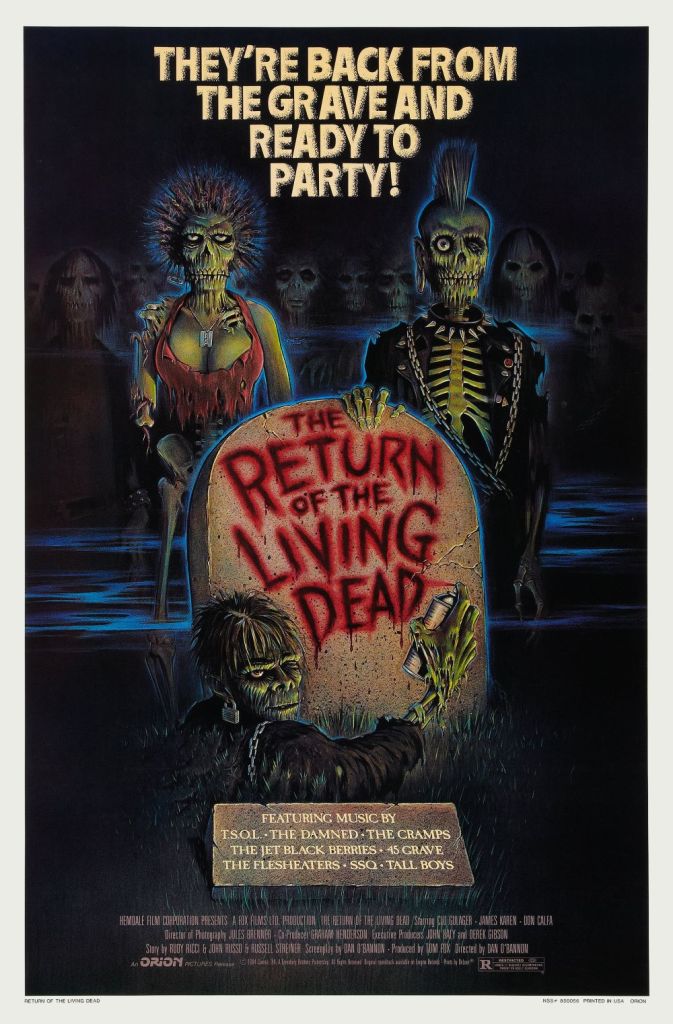
Return of the Living Dead has to go down as one of the funniest and inventive take on the zombie subgenre that began after the release of George A. Romero’s Night of the Living Dead. Due to a dispute between Romero and John Russo (co-producer of the original NOTLD), the sequels to Night of the Living Dead that were produced and directed by Romero dropped the “Living Dead” part in their titles. Russo retained the rights to create sequels using those words while Romero just kept the word “Dead” in the follow-up films to Night. It took Russo awhile, but he finally got to use those naming rights with 1985’s Return of the Living Dead.

Even though there were some acrimony between Romero and Russo, the screenplay for Return of the Living Dead makes several complimentary nods to Night of the Living Dead. The film’s premise was what if Romero’s first film was actually based on a true event and that the government and the military covered it up before people got a wind of it. The film takes that simple premise and creates an action-packed horror-comedy that still stands the test of time.

Unlike Romero’s films, Return of the Living Dead actually gives an explanation as to what causes the dead to return to life with a singular purpose of attacking the living. The cause of all this undead mayhem was due to a bioweapon nerve toxin called 2-4-5 Trioxin which was originally designed by the military to defoliate marijuana crops. To say that the side-effects of the gas had some interesting effects was an understatement. The zombies created by Trioxin do attack the living but they’re also much more livelier and smarter (retaining agility, strength and mental capacity of their previous life) than the traditional Romero-zombies. They also do not feed on just humans. They also feed on other animals. The last major difference between the Romero-zombies and the Trioxin-zombies was that the latter only wanted to feed on live brains to end the pain of being dead. These differences made for a much faster-paced horror movie. As much as I consider the Romero zombie films as the best out there, I hold a special place in my horror-fan heart for these Trioxin dudes.

The story by John Russo would be turned into a screenplay and directed by Dan O’Bannon also made Return of the Living Dead behave more as a horror-comedy than just a straight-up horror. The dialogue between the characters were full of great one-liners that would’ve sounded cheesy if not for the great and game performances from the cast. Clu Gulager as Burt Wilson (owner of the medical supplies warehouse where the lost canister of Trioxin was being stored in) did a great job being incredulous at the events happening around him. His back and forth with his friend Ernie (played with Peter Lorre eyes by Don Calfa), the local mortuary’s gun-toting mortician, keep the film lively and hilarious in-between scenes of horror.

The scene stealers in the film must go to a bumbling pair of Burt’s employees who inadvertently release the toxic and reanimating gas from the warehouse’s inventory of Trioxin canister. James Karen as the worldly and cynical Frank was a riot from start to end. His over-the-top performance had me in stitches. He played Frank with such a manic, panicky style that it was difficult not to get caught up in his hysterics. To balance out Frank’s Hardy with his more subdued, but no less panicked Laurel, was Thom Mathews as Freddy. Mathews would later appear in other horror movies in the decade and even reprise a similar role in this film’s sequel. His performance as the straight man to Karen’s fool was also very good. His slow decline into becoming one of the zombies after the initial inhalation of the Trioxin gas in the film’s introduction was funny and sad. Of all the zombies in the film he gets the brunt of the slapstick sequences, especially once he starts hunting his girlfriend for her brains. His professing of his love for her and at the same time wanting her to give up her brain was hilarious, if not creepy as well.

Another thing that Return of the Living Dead had that made it different from Romero’s zombie movies were the scenes of gratuitious nudity throughout the film. A majority of the nude scenes were courtesy of scream queen Linnea Quigley as the punk rock Trash whose morbid obsession with all things death made her an early victim for the zombies and later on as one of their leaders. I know that kids my age at that time replayed over and over the scene of her strip-tease down to nothing atop a graveyard headstone. Even now many fans of the film consider that sequence as one of their favorite.

Return of the Living Dead still counts as one of the best zombie movies out there and preceded the UK’s Shaun of the Dead by two decades as a great horror-comedy. There was a sequel a few years later to capitalize on the popularity of the first film. It tried to capture the hilarity and horror of the first one but did not measure up in the end.

Review: Lifeforce (dir. by Tobe Hooper)


“I mean, in a sense we’re all vampires. We drain energy from other life forms. The difference is one of degree. That girl was no girl. She’s totally alien to this planet and our life form… and totally dangerous.” — Dr. Hans Fallada

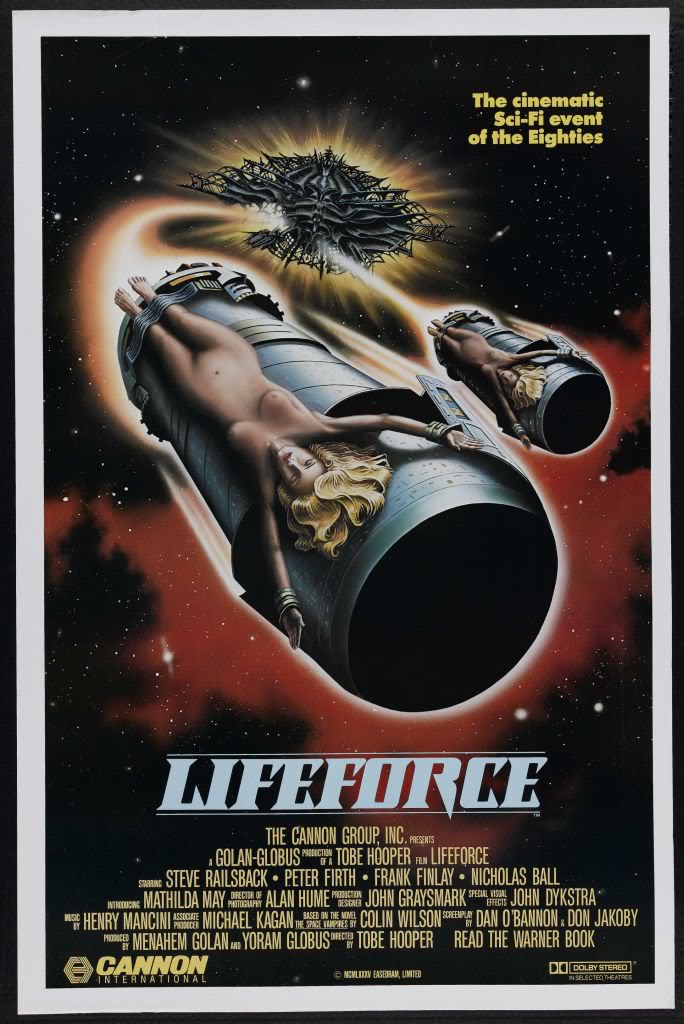
1985’s Lifeforce, directed by Tobe Hooper, was critically panned and barely registered at the box office. Yet in the decades since its release, something curious has happened: the film has gathered a loyal cult following among fans of science fiction and horror. Hooper’s film fuses so many genre conventions that it resists classification—too strange for pure sci-fi, too grandiose for standard horror. The result is a striking and eccentric reinvention of the vampire myth, a lavish but uncanny blockbuster that feels imported from an alternate cinematic timeline.

The film begins squarely in the realm of science fiction. Conceived during the public fascination with Halley’s Comet ahead of its 1986 return, Lifeforce rode the wave of comet-themed media flooding the decade. Most were cheap cash-ins. Hooper’s film stood out for its ambition and its visual scale.

Coming off Poltergeist, Hooper received an unusually large budget—a far cry from the lean, feral energy of The Texas Chainsaw Massacre. The story follows the crew of the shuttle Churchill as they discover a massive alien spacecraft hidden in the comet’s tail. Inside, frozen in suspended animation, are three humanoid figures. The ship’s dignified name feels ironic, even doomed; considering what’s to come, Demeter might have been more fitting. Like the sailors of Stoker’s novel, these astronauts inadvertently ferry an ancient predatory force home—yet this time, the threat arrives from the stars.

The horror unfolds once the crew retrieves its mysterious “specimens.” Members die in gruesome succession until only one survivor, Colonel Tom Carlsen (Steve Railsback), escapes in a pod back to Earth. Railsback’s performance is an intriguing mix of unhinged emotion and grim conviction. His intensity suits a film that constantly walks the line between pulp spectacle and cosmic tragedy.

When the story shifts to London, Lifeforce transforms into a supernatural thriller with procedural undertones. Peter Firth’s Colonel Colin Caine becomes the viewer’s compass: calm, authoritative, and determined to impose order on mounting chaos. As London succumbs to panic and outbreak, his steady professionalism anchors the outlandish events. His partnership with Railsback’s haunted, psychic Carlsen gives the middle act its volatile energy.

Among the supporting cast, Frank Finlay leaves one of the strongest impressions as Dr. Hans Fallada, a scientist fascinated by death and metaphysical energy. He serves as both philosopher and investigator, treating the vampiric invasion as a riddle of life itself. His restrained curiosity lends weight to scenes that might otherwise descend into absurdity. While the city collapses, Fallada studies the phenomenon with eerie calm, treating catastrophe as an experiment in cosmic entropy.

Patrick Stewart also makes a memorable, if brief, appearance as Dr. Armstrong, the head of a psychiatric hospital linked to the Space Girl’s psychic presence. His role builds to the film’s most grotesque and bizarre sequence: an exchange of minds, sudden possession, and an unnervingly intimate kiss with Railsback. The moment condenses everything Lifeforce represents—erotic, macabre, and unconcerned with boundaries. Stewart brings a gravitas that makes the absurd strangely compelling, a counterweight to Railsback’s volatility and Mathilda May’s silent allure.

May, as the unnamed Space Girl, says little but dominates the film through presence alone. She embodies an alien ideal of beauty and destruction, gliding through scenes with a composure that’s both sensual and predatory. Her nudity, much debated at the time, plays less as exploitation and more as elemental symbolism—the human body as an expression of both creation and death, desire and annihilation.

Supporting figures from the British military and government round out the ensemble, emphasizing the film’s descent into bureaucratic chaos. Michael Gothard’s Kane, a Ministry of Defence officer struggling to reconcile logic with the inexplicable, captures the helplessness of institutional order collapsing under cosmic threat. His pragmatic exchanges with Firth highlight competing instincts between reason and survival.

As the infection spreads, Lifeforce expands into a vision of urban apocalypse that fuses British science fiction and American spectacle. London becomes a nightmare tableau—crowds of shriveled corpses feed on energy while arcs of blue plasma swirl through the sky. The city’s fall evokes both George A. Romero’s zombie apocalypse and the metaphysical unease of Nigel Kneale’s Quatermass stories. Amid the insanity, Finlay and Firth remain the emotional touchstones, keeping the audience oriented as narrative logic begins to dissolve.

For all its ambition, however, Lifeforce suffers from erratic pacing and tonal whiplash. The first act unfolds with deliberate, moody wonder, then abruptly veers into frenzied exposition and psychic melodrama once the story reaches Earth. The balance between unsettling mystery and outright spectacle often collapses under its own weight. Scenes that should evoke cosmic terror sometimes tip into unintended camp, particularly in the dialogue-heavy middle stretch. Hooper’s direction, though visually imaginative, occasionally struggles to maintain coherence amid the script’s shifting identities—part creature feature, part disaster epic, part metaphysical drama. The editing, especially in the theatrical cut, undercuts tension with rushed transitions that leave emotional beats hanging. Railsback’s manic performance, while strangely compelling, can also verge on excess, blurring the line between conviction and chaos.

Tonally, the film wavers between awe and amusement. For some viewers, its earnest delivery will read as self-parody; for others, its collision of erotic horror and science fiction grandeur gives it a singular vitality. Lifeforce’s flaws are inseparable from its daring. It dares to fail boldly, and in that failure finds a kind of messy transcendence—larger than reason, too strange to fade.

In the end, Lifeforce lingers as one of the strangest hybrids of its era: part gothic fable, part erotic horror, part apocalyptic science fiction. It was too eccentric to find mainstream success, yet its sincerity and scope give it lasting resonance. The ensemble performances and tonal daring hold the film together, transforming potential chaos into something mythic—a story about possession, contagion, and humanity’s fatal pull toward the unknown.

Beneath its spectacle, the film engages in a deeper dialogue between gothic and cosmic horror traditions. Its characters represent a spectrum of responses to the incomprehensible: Fallada’s intellectual curiosity, Firth’s stoic resolve, Railsback’s frenzy, and May’s serene seduction. Together they form a portrait of human fragility in confrontation with the infinite. Where gothic horror finds fear in the collapse of reason, cosmic horror finds it in the vast indifference of the universe.

By fusing these lineages, Lifeforce becomes a mythic apocalypse that feels both intimate and vast—an encounter between flesh and void, terror and temptation. Its fusion of genres, ideas, and performances ensures its peculiar power endures, a reminder that some of the strangest failures of 1980s cinema are also its most visionary.