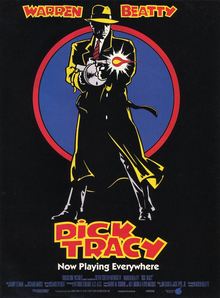
Dick Tracy (1990, directed by Warren Beatty)


The year is 1937 and “Big Boy” Caprice (Al Pacino) and his gang of flamboyant and often disfigured criminals are trying to take over the rackets.  Standing in their way is ace detective Dick Tracy (Warren Beatty), the yellow trench-wearing defender of the law.  Tracy is not only looking to take down Caprice but he and Tess Trueheart (Glenne Headly) are currently the guardians of The Kid (Charlie Korsmo), a young street kid who witnessed one of Caprice’s worst crimes.  Tracy’s investigation leads him through a rogue’s gallery of criminals and also involves Breathless Mahoney (Madonna), who has witnessed many of Caprice’s crimes but who also wants to steal Tracy’s heart from Tess.

Based on the long-running comic strip, Dick Tracy was a labor of love on the part of Warren Beatty.  Not only starring but also directing, Tracy made a film that stayed true to the look and the feel of the original comic strip (the film’s visual palette was limited to just seven colors) while also including an all-star cast the featured Madonna is an attempt to appeal to a younger audience who had probably never even heard of Dick Tracy.  When Dick Tracy was released, the majority of the publicity centered around Madonna’s participation in the film and the fact that she was dating Beatty at the time.  Madonna is actually probably the weakest element of the film.  More of a personality than an actress, Madonna is always Madonna no matter who she is playing and, in a film full of famous actors managing to be convincing as the members of Dick Tracy’s rogue gallery, Madonna feels out of place.  Michelle Pfeiffer would have been the ideal Breathless Mahoney.

It doesn’t matter, though, because the rest of the film is great.  It’s one of the few comic book films of the 90s to really hold up, mostly due to Beatty’s obvious enthusiasm for the material and the performances of everyone in the supporting cast who was not named Madonna.  Al Pacino received an Oscar nomination for playing Big Boy Caprice but equally good are Dustin Hoffman as Mumbles, William Forsythe as Flaptop, R.G. Armstong as Pruneface, and Henry Silva as Influence.  These actors all create memorable characters, even while acting under a ton of very convincing makeup.  I also liked Dick Van Dyke as the corrupt District Attorney.  Beatty knew audience would be shocked to see Van Dyke not playing a hero and both he and Van Dyke play it up for all its worth.  Beatty embraces the comic strip’s campiness while still remaining respectful to its style and the combination of Danny Elfman’s music and Stephen Sondheim’s songs provide just the right score for Dick Tracy’s adventures.  The film can be surprisingly violent at times but the same was often said about the Dick Tracy comic strip.  It wasn’t two-way wrist radios and trips to the Moon.  Dick Tracy also dealt with the most ruthless and bloodthirsty gangsters his city had to offer.

Dick Tracy was considered to be a box office disappointment when it was originally released.  (Again, you have to wonder if Beatty overestimated how many fans Dick Tracy had in 1990.)  But it holds up well and is still more entertaining than several of the more recent comic book movies that have been released.
Film Review: The Van (dir by Stephen Frears)


1996’s The Van opens with a depressed Bimbo Reeves (Donal O’Kelly) attempting to drink away his troubled thoughts.  As he explains to his friend, Larry (Colm Meaney), he has been “made redundant.”  After two decades of working at a Dublin bakery, he has lost his job and, it would appear, his reason for living.

Now, I have to stop right here and point out how disturbing that term sounds.  “Made redundant,” sounds like the worst possible way to tell someone that they’re out a job.  Admittedly, I don’t live in Ireland or in the UK.  Perhaps if I did and if had grown up hearing the term, it wouldn’t disturb me quite so much.  But, to my American ears, being told that you’re redundant feels like not only being stabbed  but also then having the blade twisted.  Not only are you out of a job but you’re also useless.  You’re redundant.  Here in America, we tell people that they’ve been “fired,” and that obviously carries some disturbing connotations with it as well.  The original people to be fired were people who lost their jobs as a result of being burned at the stake.  But somehow, going up in flames seems preferable to being told that you’re totally and completely useless.

Bimbo is depressed.  Larry, who has a much more easy-going nature than his friend, tries to cheer him up.  Afterall, Bimbo has his “redundancy check.”  Bimbo and his wife, Maggie (Ger Ryan), purchase a food van and Bimbo decides to go into business for himself.  He’ll sell food from his van.  After refurbishing the van (which truly did look horrible when it was initially purchased), he’s ready to go into business with Larry as his only employee.

It seems like a good idea and, at first, the food van is a success.  Ireland is doing well in the World Cup and it leads to a lot of hungry customers.  Unfortunately, it also leads to conflict between Bimbo and Larry as they discover that being a boss and being an employee is a lot different than just being friends.  In the end, the question becomes what is more important, the business or the friendship?

Based on a novel by Roddy Doyle, The Van is the third part of the Barrytown trilogy.  Despite being named Larry in this film instead of Des, Colm Meaney is basically playing the same character that he played in The Commitments and The Snapper.  (Though I’m not sure, I think the film’s opening “1990” title card is meant to let us know that The Van is actually a prequel to those two films.)  It’s also the least engaging of the three films, largely because it doesn’t have the narrative momentum provided by the music in The Commitments or the pregnancy in The Snapper.  Instead, it’s just a story of two friends who get on each other’s nerves.  Donal O’Kelly doesn’t give a bad performance as Bimbo but he’s still overshadowed by Colm Meaney’s charismatic and larger-than-life Larry.  As a result, there’s not much of a question as to which friend the audience will side with.  Even though Bimbo’s complaints are often justified, we’re on Larry’s side all the way.

The Van is not a particularly memorable film but the message still comes through.  Life goes on, in both Dublin and elsewhere.


Film Review: The Snapper (dir by Stephen Frears)


Sharon Curley (Tina Kellegher) is 20 years old, a member of a large, working class Dublin family.  Her father is Des Curley (Colm Meaney), plain-spoken, a bit old fashioned, but also someone who sincerely loves his family and works hard to give them the best that he can.  Des is someone who brags about the fact that he hasn’t cried in over 20 years.  Of course, when he says that, he means that he hasn’t cried sober.  Crying drunk, especially while watching the World Cup, doesn’t count.

Speaking of drinking, one night out with her friends leads to Sharon finding herself pregnant.  As Sharon is young and unmarried, the identity of the father becomes a subject of gossip in her close-knit neighborhood.  At first, Sharon refuses to tell anyone who the father is.  Eventually, she confesses that the father was a Spanish sailor who picked her up and gave her the greatest night of passion of her life.  Of course, Sharon’s lying.  The father is actually a rather unimpressive middle-aged man named George Burgess (Pat Laffan).  George picked her up while she was inebriated.  He’s the type of person who kept her panties after they had sex but expects to be thanked for not showing them to his friends.  George reacts to the prospect of becoming a father by disappearing.

Sharon struggles, with both the gossip and the knowledge that her neighbors, people who she has known her entire life, are judging her for being pregnant and unmarried.  Continually, she is asked, “Who are you having the baby for?,” as if she’s doing a favor for the man who knocked her up and then abandoned her.  Sharon decides to keep the baby and even has a laugh at the thought of naming it Georgina.  Des, at first, has a hard time understanding Sharon’s decision but eventually, he supports his daughter.  He even reads all of the pamphlets on pregnancy and giving birth.  When a young man at the hospital mentions that he’s waiting on the delivery of his third child, Des offers him a pamphlet on “family planning.”

Made for British television and released theatrically in 1993, The Snapper is based on a book by Roddy Doyle.  The book was a sequel to The Commitments but, because 20th Century Fox owned the rights to The Commitments, the family’s name was changed for the film version of The Snapper.  The Rabbittes became the Curleys and there’s certainly no mention of the fact that Sharon’s brother once managed a soul band.  That said, Colm Meaney reprises his role as the befuddled but loving family patriarch. He and Tina Kellegher give performances in The Snapper that feel authentic and honest.  Every laugh, every smile, and even every tear feels earned.

Much as The Commitments did with music, The Snapper uses a domestic drama, the type that has inspired countless glossy films, to examine the realities of being working class in 20th Century Dublin.  With the tight-knit community full of judgment and not much support, Sharon learns who she can and cannot depend on but she also learns that’s she’s far stronger than anyone, including herself, knew.  The Snapper is a wonderful snapshot of life.

Musical Film Review: The Commitments (dir by Alan Parker)


First released in 1991 and based on a novel by Roddy Doyle, The Commitments is the story of a manager with a dream and a band with a chip on its collective shoulder.

Living in working class Dublin, Jimmy Rabbitte (Robert Arkins) dreams of managing a band.  He’s a fan of old school soul and rock and roll music, the type that was played by black artists in the American South.  Jimmy feels that the Irish have a special connection to that music because, as he explains it, “the Irish are the blacks of Europe.”  (I think one could argue that the black people living in Europe are the blacks of Europe but we’ll go with it.  I understand Jimmy’s argument, even if it is the sort of thing that would send social media into a tizzy if it were made today.)  Jimmy puts an ad in the paper and discovers that there are a lot of aspiring musicians in Ireland and very few of them know much about soul music.  Even Jimmy’s father (a delightful Colm Meaney) seems to believe that he could be a part of the band.  In the end, Jimmy puts together the band himself, recruiting an unlikely collection of friends and barely know acquaintances.  He finds a lead singer in the talented but unruly Deco Cuffe (Andrew Strong), a pianist in the religious Steven (Michael Aherne), a saxophonist in Dean Fay (Felim Gormley), a guitarist in Outspan Foster (Glen Hansard), and three back-up singers in Bernie (Bronagh Gallagher), Imelda (Angeline Ball), and Natalie (Maria Doyle).  He also finds a mentor in trumpeter Joey “The Lips” Fagan (Johnny Murphy), an American who claims to have played with everyone who is anyone and who names the band The Commitments.  They’re a working class band and one that doesn’t always mix well with each other.  Deco’s gets on everyone’s nerves from the start but, as Dean puts it at the unemployment office, he’s much happier being a saxophonist on the dole than a plumber’s assistant on the dole.

There’s a raw energy to The Commitments, as both a film and a band.  Both the film’s comedy and its music comes from a very real pain.  No one in the film is rich.  No one has been given much of a chance by British society.  Deco may be obnoxious but he also epitomizes the wild spirt of someone who refuses to be tamed by society.  Jimmy Rabbitte may occasionally be a bit in over his head but it’s hard not to admire his refusal to surrender.  From the minute the band comes together, it’s obvious that they’re not going to last.  Nearly every gig ends in disaster and Joey, despite his knowledge of soul, is a bit rigid in his demands of the band.  When Dean improvises, Joey acts as if it’s the end of the world that Dean would rather play jazz than soul.  Joey sees jazz as being elitist.  Dean sees it as being a way to express his own artistic vision.  The wonderful thing about The Commitments is that they’re both allowed to be right.

The band might not last but the film leaves you happy that they still had their moment.  The Commitments is a film that feels alive, not just with artistic desire but with the anger of people who have been pushed to the side by the establishment.  For a while, the band gives them a chance to express that anger and, afterwards, it’s gratifying to see that the majority of the members still carry the legacy of The Commitments with them, with some members continuing to pursue music and others returning to their everyday lives in Dublin.  It’s a good film, one that celebrates both music and humanity.


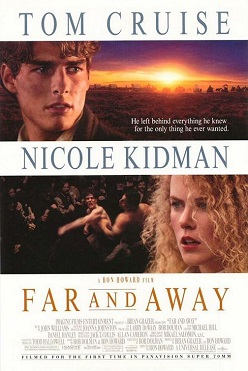
Far and Away (1992, directed by Ron Howard)


The year is 1892 and Joseph Donnelly (Tom Cruise) is a poor tenant famer in Ireland, used and exploited by the wealthy landowners.  Joseph falls in love with Shannon Christie (Nicole Kidman), the rebellious daughter of his landlord.  Shannon dreams of going to America, where rumor has it that land is being given away in the territory of Oklahoma on a first come/first serve basis.  Shannon even has some valuable spoons that she can use to raise money once they arrive in America.  Joseph, after being challenged to a duel by the Christies’ money manger, Stephen Chase (Thomas Gibson), also decides that heading to America might be a good idea.

Life in America is not as easy as Joseph and Shannon thought it would be.  They first end up in the dirty town of Boston, where Shannon loses her spoons and Joseph works for a corrupt political boss (Colm Meaney) and makes money as a bare-knuckles boxer.  They’ll reach Oklahoma eventually but not before Stephen and the Christies come to Boston and Joseph ends up working on the railroad and getting called “that crazy mick” multiple times.

Far and Away was Ron Howard’s attempt to make an American epic, in the style of John Ford.  It doesn’t work because Tom Cruise is too contemporary to be believable as a 19th century Irish immigrant and Howard tries so hard to push everything to an epic scale that it just makes it even more obvious how slight and predictable the movie’s story is.  Far and Away is full of big movie moments but it lacks the small human moments necessary to really engage its audience.  I will always remembers Far and Away because it was one of those films that seemed to take up permanent residence on HBO when I was growing up.  I didn’t really care about the film’s flaws back then.  Nicole Kidman was attractive and tall and she had wild red hair and back then, that’s all a movie needed to hold my attention.  Unlike Cruise, Nicole Kidman can effortlessly move between historical and contemporary films and, of the two leas, she comes off the best.  The movie is really stolen, though, by Colm Meaney, playing a ruthless political boss who could have taught Boss Tweed a thing or two.

Tomorrow is St. Patrick’s Day, when we will be celebrating the legacy of immigrants like the Christies and the Donnellys.  Far and Away tries to pay tribute to their courage and their refusal to give up, even when things were tough and deadly on the frontier.  For me, though, Far and Away will always just make me think of HBO in the 90s.

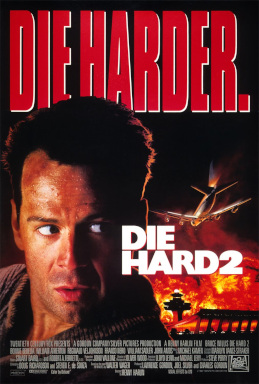
Holiday Film Review: Die Hard 2: Die Harder (dir by Renny Harlin)


During 1990’s Die Hard 2, John McClane (Bruce Willis) asks himself, “How can the same shit happen to the same person twice?” and he does have a point.

I mean, consider the situation.  In 1988, McClane spent his Christmas sneaking around a skyscraper and saving his wife from a group of sadistic mercenaries.  Two years later, John McClane spends his Christmas sneaking around an airport and saving his wife from a group of sadistic mercenaries.

There are a few differences of course.  In 1988, the mercenaries were only interested in stealing as much money as they could and each mercenary had his own properly ghoulish personality.  In 1990, the mercenaries are really more of a cult, led by the fanatical Col. Stuart (William Sadler).  And, along with trying to make some money, they are also trying to free General Ramon Esperanza (Franco Nero), a Central American drug lord and former CIA asset.  Despite the fact that the mercenaries are played by familiar actors (like Robert Patrick, John Leguizamo, Tony Ganois, and Vondie Curtis-Hall), none of them are quite as memorable as the henchmen that Alan Rickman commanded in the first film.  And while Sadler has charisma and makes a big impression during his first scene, his character is nowhere near as interesting or entertaining as Hans Gruber.  Franco Nero, it must be said, is as dashing as ever.  He really seems to be having fun in this movie.

A lot more people die in Die Hard 2 than died in the first Die Hard and the majority of them are innocent bystanders.  This isn’t like the first film, where Harry Ellis died because his coke-addled mind led him to believe that he could outsmart Gruber.  The victims in Die Hard 2 include a friendly church caretaker and over 200 passengers of an airplane that Stuart tricks into crashing on an airport runway.  The scene where the plane crashes remains disturbing no matter how many times that you see it and it truly makes you hate Colonel Stuart.  When the plane crashes, despite McClane’s futile efforts to warn the pilots, McClane sobs and it’s a powerful scene because it’s the first scene in which McClane has not had a quip or a one-liner ready to go.  In this scene, McClane fails to save the day and, for a few minutes, he’s helpless.  I usually end up crying with McClane.  Today, those tears are also a reminder of what a good actor Bruce Willis truly could be whenever he let down his defenses and allowed himself to be vulnerable on screen.

Die Hard 2 is usually dismissed as not being as good as the first movie and …. well, that’s correct.  It’s not as good but then again, few actions films are.  There’s a reason why Die Hard continues to be held in such high regard.  That said, Die Hard 2 is not bad.  The stakes are a bit higher and the action scenes a bit more elaborate, as you would expect from a film directed by Renny Harlin.  Bruce Willis plays McClane with the blue collar swagger that made his such an awesome hero in the first film.  Bonnie Bedelia and William Atherton also return from the first film and Atherton once again gets his comeuppance in a crowd-pleasing moment.  The cast is full of character actors, all of whom get a chance to make an impression.  Dennis Franz is the profane head of security who eventually turns out to be not such a bad guy.  John Amos is the major who eventually turns out to be not such a good guy.  Colm Meaney has a few heart-breaking moments as the pilot of the doomed airplane.  My favorite supporting performance is given by Fred Thompson, bringing his quiet authority to the role of tough but fair-minded Air Traffic Control director.  Watching Die Hard 2, it does feel as if the viewer has been dropped in the middle of these people’s lives.  Everyone seems real.  No one seems like a mere plot device.

Is Die Hard a Christmas movie?  You bet it is!  But so is Die Hard 2 and it’s not a bad one.