Embracing the Melodrama #51: Mystic River (dir by Clint Eastwood)


mystic-river

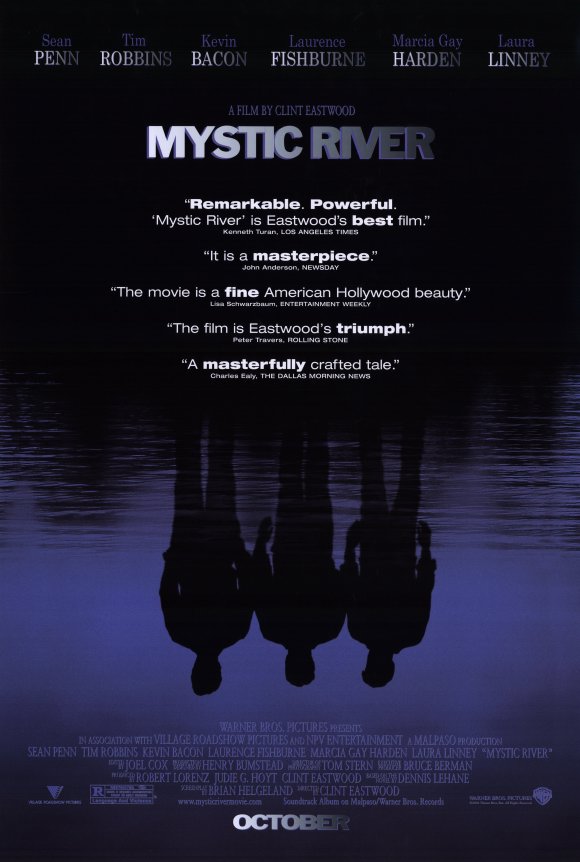
Much like In The Bedroom, 2003’s Mystic River is a film that deals with guilt, murder, and vengeance in New England.  Whereas In The Bedroom deals with the guilt of just four people, Mystic River deals with the guilt of an entire neighborhood.

Mystic River opens in Boston in 1975.  Three young boys are writing their names in wet cement when a car pulls up beside them.  An angry-looking man (played by the always intimidating John Doman) gets out of the car and announces that he’s a police officer and that the three boys are under arrest.  He orders them to get in the car.  Of the three boys, Jimmy and Sean refuse but meek Dave gets into the car, where he’s greeted by a leering old man.  Jimmy and Sean watch as the car drives away with their friend trapped in the back seat.  Dave is held prisoner and abused by the two men for four days until he finally manages to escape.

Twenty-five years later, the three boys have grown up but are still haunted by what happened.  Sean is now a detective with the Massachusetts State Police.  Jimmy is an ex-con who now owns a local store and who, despite being married to Annabeth (Laura Linney), the daughter of a local gangster, is trying to lead a law-abiding life.  As for Dave (Tim Robbins),  he is married to Celeste (Marcia Gay Harden) and manages to hold down a job but he’s also the neighborhood pariah.

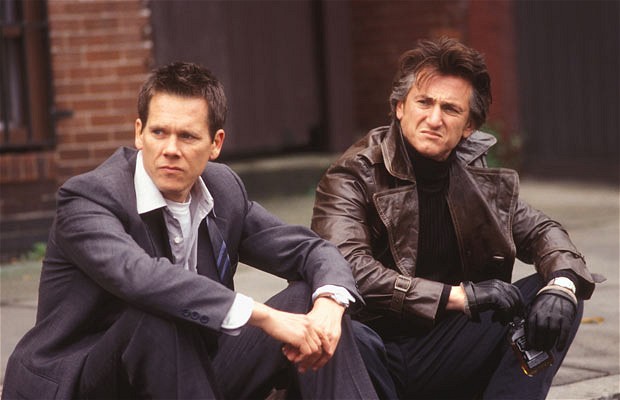
Mystic River 1

When Jimmy’s daughter Katie (Emmy Rossum) is brutally murdered, Sean and his partner Whitey Powers (Laurence Fishburne) are assigned to the case.  The distraught Jimmy, however, starts to investigate the murder himself and, after talking to Celeste, he discovers that, on the night Katie died, Dave came home with blood on his clothes and claiming that he had a fight with a mugger.  That’s all the evidence that Jimmy and his friends need to believe that Dave is the murderer…

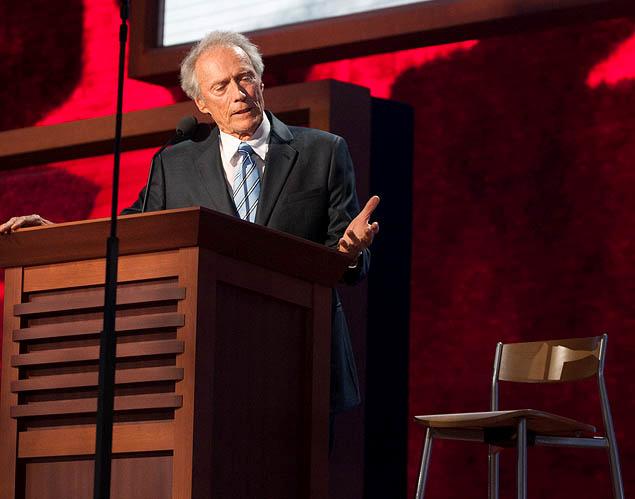
I have a lot of friends who will probably never forgive Clint Eastwood for not only endorsing Mitt Romney in 2012 but for also giving the “empty chair” speech at the Republican Convention.  From the way that a lot of them reacted, you would think that Eastwood had filmed himself drowning puppies as opposed to simply expressing his own cantankerous opinions about current events.  (Honestly, do you know any 82 year-olds who weren’t disgruntled in 2012?)  Myself, I thought the empty chair speech was an act of brilliant performance art, one that not only highlighted the fact that most politicians really are just empty chairs but also exposed just how humorless most political activists truly are.  (Admit it — if John Fugelsang had done that same routine at the 2004 Democratic convention and referred to the empty chair as being President Bush, most of the people who went on and on about how terrible it was that Eastwood was being disrespectful to the President would still be using it to create Facebook memes.)

Eastwood

Unfortunately, I sometimes find myself wondering why Clint Eastwood the director sometimes seem to struggle to be as interesting, innovative, and thought-provoking as the empty chair speech.  It sometimes seems that for every Eastwood film that works, there’s a handful films like Hereafter, Changeling, and Jersey Boys.  These aren’t bad films as much as they’re just uninspired films.  (Well, Hereafter is pretty bad…)  Ultimately, Eastwood is more of a storyteller than a Martin Scorsese-style innovator.  If Eastwood has a good story to tell, the film will work.  If he has a weak story — well, then the film will be weak.

Fortunately, with Mystic River, Eastwood has a good story and the end result is one of the best films of his uneven directorial career.  Eastwood uses a fairly standard murder mystery to explore themes of guilt, redemption, and paranoia.  Jimmy may be looking for revenge and Sean may be doing his job but ultimately, both of them are trying to absolve themselves from the consequences of their childhood decisions.  If Dave is guilty, then Jimmy will justified in having let him get in that car.  If Dave is innocent, Sean can finally step up and save him.

And complicating all of this is the Neighborhood, which is as much a character in this film as Jimmy, Dave, and Sean.  The Neighborhood will never allow anyone to forget or live down the past.  When, towards the end of the film, Jimmy is declared to be the “king of the neighborhood” by Annabeth, there’s little doubt that she’s right.  The question is whether Jimmy’s kingdom is one worth ruling.

Mystic River

Scenes That I Love: Eli Wallach Searches For The Gold In The Good, The Bad, and the Ugly


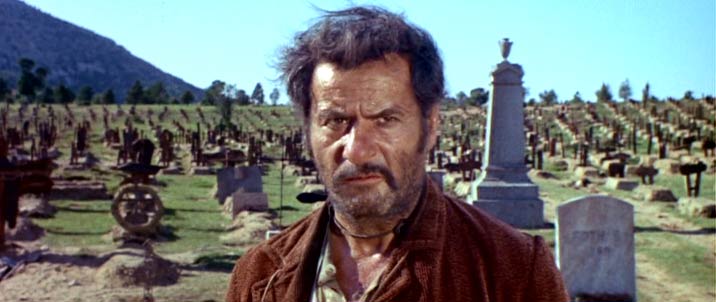
Eli Wallach

I just heard that, earlier today, the legendary character actor Eli Wallach passed away at the age of 98.  Wallach made his film debut in 1956’s Baby Doll and made his final film appearance 54 years later in Wall Street: Money Never Sleeps.  I have to admit that I don’t really remember much about Wall Street or Wallach’s performance in the film.  However, I do remember his wonderful cameo appearance in The Ghost Writer.

And, of course, everyone remembers Eli Wallach’s best role, that of Tuco in Sergio Leone’s classic spaghetti western The Good, The Bad, and the Ugly.  In the role of a comedic yet ruthless bandit, Wallach brought a lot of life to Leone’s epic portrait of greed in the west.  His unabashedly flamboyant performance provided a wonderful (and much-needed) contrast to the more stoic performances of Clint Eastwood and Lee Van Cleef.

For me, the best scene in The Good, The Bad, and the Ugly is one in which not a single bullet is fired nor a word uttered.  In this scene, Tuco has finally discovered the cemetery where a stolen shipment of gold has been buried.  All he has to do is find Arch Stanton’s grave and he’ll be a very rich man.  What Tuco did not take into consideration was just how many other graves there would be in the cemetery.

This is a rare moment in the film in which Tuco is not speaking but just watch Wallach’s performance here to see how much a great actor can do with just body language and facial expressions.  (Needless to say, Ennio Morricone’s classic score helps out as well.)

Eli Wallach, R.I.P.

Trailer: Jersey Boys


Here’s the trailer for Clint Eastwood’s upcoming film adaptation of Jersey Boys.  While some are predicting that Jersey Boys will be a player at the Oscars, I’m afraid that I have to agree with the assessment of Awards Watch.   This trailer looks a bit bland.  However, I’m hopeful that Christopher Walken will, at least, get a best supporting actor nomination because, seriously, how can you not want to see Christopher Walken nominated?

Scenes I Love: In the Line of Fire


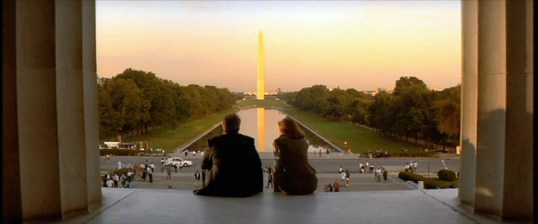
LincolnMemorial_InTheLineOfFire

1993’s In the Line of Fire was and continues to be one of my favorite action-thrillers. What’s not to like about a film that has John Malkovich playing a rogue and mentally-unstable CIA assassin who has decided that he wants to assassinate the current President of the United States. Then there’s Clint Eastwood as the last living Secret Service agent who failed to prevent Kennedy’s assassination in Dallas.

The film was directed by Wolfgang Petersen and was both tense and thrilling in equal amounts. Yet, the film also took some time to develop the relationship between Eastwood’s aging Secret Service agent with a much younger, but capable agent played by Rene Russo. This is a relationship that starts off as quite adversarial but one that gradually moves past that into one of respect then romance.

It was the scene with the two characters taking a break from the dangers of their job to debate the role of women in the Secret Service. It makes Eastwood’s character sound very old-fashioned and while it annoys Russo’s character to no end there’s a sort of playful and flirty byplay between the two throughout the scene. It’s a scene that culminates with Eastwood’s character predicting through years of experience that Russo’s agent character has shown interest in him and thus planting the seeds of a budding romance.

This is the scene I’ve chosen to continue the march towards next week’s Valentines Day.

10 Good Things That Lisa Marie Saw On TV In 2012


Someday, I want to have my own tv network.  I’ll call it Lisa Marie Television (or LMTV for short) and it’ll be like Lifetime but with the Lisa Marie difference.  What’s the Lisa Marie difference?  Sweetheart, if you have to ask, you’ll never know.  El. Oh. El.

Anyway, as I wait for that day to come, I’m going to continue my series of posts on my favorites of 2012 by telling you about some of the best things that I saw on television over the course of the previous year:

1) SyFy Movies On Saturday

For me, one of the highlights of 2012 has been meeting and getting to know the Snarkalecs on twitter.  Who are the Snarkalecs?  We’re just a group of very witty people who are capable of appreciating films like Two-Headed Shark Attack and Arachnoquake.  Every Saturday night, we watch and live tweet whatever’s playing on the SyFy network.  It’s the perfect way to end the week.  My favorite SyFy film of 2012?  Jersey Shore Shark Attack.

2) The Basic Lupine Urology episode of Community

A great crime has occurred at Greendale Community College.  A yam has been callously destroyed and the study group is going to find out who was responsible and make sure the perpetrator is punished to the full extent of the law.  This spot-on perfect parody of Law and Order was one of the highlights of Community’s third season.  Donald Glover and Danny Pudi were simply adorable playing good cop/bad cop.

3) Joe Manganiello and Alexander Skarsgard on True Blood

The latest season of True Blood may have been uneven but whenever Alexander Skarsgard or Joe Manganiello showed up on-screen, the show was perfect (especially if they happened to be naked at the time).

4) South Park

As always.  This year highlights have included the classic anti-bullying episode and the annual Halloween episode.

5) Survivor: Philippines

The previous season of Survivor was one of the best, featuring truly interesting competitors like Jonathan Penner, Lisa Whelchel, Abi-Marie, and Malcolm.  Perhaps best of all, the season ended with the most deserving survivor winning the million bucks.

6) Clint Eastwood’s Chair Speech

A lot of very snide comments have been made about Eastwood’s speech at the Republican National Convention but, personally, I think it was brilliant political theater.  Even better, his two main points — that the President is essentially an empty suit and the Vice President is a jackass — are looking more and more true with each passing day.

7) The Joe Biden/Paul Ryan Vice Presidential Debate

Speaking of great political theater…. The 2012 Presidential election was dominated by debates but there’s only one that was truly memorable and it was the Vice Presidential debate between Joe Biden and Paul Ryan.  While Paul Ryan talked about disaster in his overly serious grad student way, Joe Biden grinned like an aging serial killer deep in the throes of senility.  This was less a political debate and more a case of performance art.

8) The London Olympics

I loved watching the London Olympics this year and not just because of the Fab Five, either.  The Danny Boyle-directed opening ceremonies were amazing to watch and I had fun going on twitter to ridicule NBC’s hilariously bad coverage of the games.

9) Liz & Dick on Lifetime

Oh, c’mon — it was fun!

10) The Office Made A Comeback…Sorta

After one of the worst seasons in the history of primetime television, The Office has redeemed itself slightly with its current (and final) season.  Even Catherine Tate has become tolerable.

Tomorrow, I’ll continue my look back at the past year with a list of my 10 favorite novels of 2012.

6 Late Reviews: Atlas Shrugged: Part II, Project X, This Means War, A Thousand Words, Trouble With The Curve, The Vow


2012 is quickly drawing to an end and seriously, where has the time gone?  I’m seriously running behind in reviewing all of the films that I’ve seen in 2012 so, in the interest of getting caught up, here are six quick (and late) reviews of some of the film that I saw earlier this year.

(Fortunately, seeing as how we live in a world of Netflix, DVD, Blu-ray, and On Demand service, it’s never too late to review any film.)

1) Atlas Shrugged: Part II (dir by John Putch)

Picking up where the first Atlas Shrugged ended, Atlas Shrugged: Part II continues to tell the story of how America was ruined by elitist do-gooders and how the smartest people in the world responded by uttering the phrase, “Who Is John Galt?” and then vanishing.

There’s a lot of bad stuff that I could say about Atlas, Shrugged Part II.  I could point out how close to nothing actually happens in the film.  I understand that this is the second part of a proposed film trilogy but, seriously, that’s all that Atlas Shrugged Part II has in common with The Two Towers.  With the exception of the great Patrick Fabian (who has a lot of fun playing a weasel), the cast isn’t memorable and the film is full of slow spots.

Part II was made by a different director and with a far more professional cast than Part I but that proves to be a mistake.  Part of the odd charm of Atlas Shrugged, Part I was that it was such a low-budget, pulpy affair.  Atlas Shrugged, Part II is a lot more slick and, as a result, it feels a lot less sincere.

That said, I couldn’t help but enjoy Atlas Shrugged, Part II because, much like For Greater Glory, the film flew so completely in the face of conventional cinematic political statements.  Atlas Shrugged Part II might not be a great (or even a good) film but it annoyed all of the professional film critics and it’s always amusing to watch the same critical establishment that embraced Avatar whine about how any other film is too heavy-handed.

Am I, therefore, recommending Atlas Shrugged, Part II?  Not really.  I tend to learn towards the Libertarian point of view when it comes to politics and even I found the film to be tedious.  That said, if you ever really want to annoy your wannabe hipster friend (the same one who leaves a hundred comments a day over at the A.V. Club), Atlas Shrugged, Part II might make the perfect holiday present.

2) Project X (dir by Nima Nourizadeh)

In California, two loathsome high school students — Costa (Oliver Cooper) and J.B.(Johnathan Daniel Brown) — throw a birthday party for their friend Thomas (Thomas Mann).  Thomas is a stereotypical nice guy but he’s also friends with Costa and J.B. and that makes him loathsome by association.  The party quickly gets out of control and eventually, houses are destroyed and a SWAT team is called in to restore order.

Oh!  And the entire film is presented as being a bunch of “found footage.”  What that means is that we have to sit through all the usual stuff of people acting awkward in an attempt to convince us that we’re not watching a movie, despite the fact that we clearly are.

Project X fails on so many levels that it’s hard to even know where to begin.

It’s impossible to sympathize with the film’s three main characters and let’s just say that Oliver Cooper is no Jonah Hill.

There’s no real build-up to the party getting out of control and hence, most of the film’s comedy falls flat.  This is the type of film where a midget happens to show up at the party just so he can then be tossed into an oven.  Uwe Boll would probably call that genius but, for the rest of us, it just feels like desperation on the part of the filmgoers.  (You can just here them going, “Midgets are always funny!”)

Finally, worst of all, Project X is the latest film to use the whole found footage gimmick as a way to try to explain away the fact that it’s just not a very good movie.  Seriously, mediocre filmmakers of America — it’s time to move on to a new gimmick!

3) This Means War (dir. by McG)

Two CIA Agents (Chris Pine and Tom Hardy) set aside their friendship and go to war when they realize that they’re both attempting to win the heart of the same woman (played by Reese Witherspoon).   Fortunately for them, they’ve both managed to fall in love with the one woman in the world too stupid to realize that there’s anything strange going on.  Chelsea Handler is also in this film.  She plays Witherspoon’s best friend and delivers all of her lines in this kind of depressed monotone that seems to suggest that she’d rather be co-starring with Whitney Cummings.  Eventually, a lot of things explode and well, anyway … bleh.

Seriously, This Means War has absolutely no right to be as boring as it is.  Outside of this film, Chris Pine and Tom Hardy are both hot, Reese Witherspoon is likable, and even Chelsea Handler still makes me laugh on occasion.  And yet, when all four of these people are put together in the same film, the end result is a mess that just gets more and more annoying with each passing second.

Most of the blame has to be put on the director.  McG never finds a consistent tone for his film and never seems to be sure whether he’s parodying or celebrating the conventions of both action films and romantic comedies.

Myself, I just find it funny that people actually address him as “McG.”

4) A Thousand Words (dir by Brian Robbins)

Jack (Eddie Murphy) is a literary agent who talks too much.  So, one night, a tree with a thousand leaves magically appears in his back yard.  Every time that Jack says a word, a leaf falls off of the tree.  Luckily, Jack happens to know a new age guru (Cliff Curtis) who explains that once every leaf has fallen, Jack will die.  As a result, the formerly glib Jack learns the importance of saying just the right thing and he becomes a better husband, father, and son as a result.

A Thousand Words is just as bad as the above plot synopsis suggests and that’s all that really needs to be said about it.  Wasting a thousand words talking about A Thousand Words would be a mistake indeed.

5)  Trouble With The Curve (dir by Robert Lorenz)

Widower Gus (Clint Eastwood) is an aging baseball scout who is slowly losing his eyesight.  Mickey (Amy Adams) is Gus’s daughter, a driven lawyer who has a strained relationship with her father.

And together … they solve crimes!

No, not really.  Instead, Gus is given one last assignment and Mickey, who is both concerned for her father’s well-being and wants to try to repair their fractured relationship, accompanies him.  At first, Gus doesn’t want Mickey around but she eventually proves her worth to him and gets to flirt with a young scout played by Justin Timberlake as well.  So, it’s a win-win.

 I don’t know much about baseball (beyond the fact that my sister Erin yells at the TV a lot whenever the Rangers are playing) but Trouble With The Curve is such a predictable movie that you really don’t have to know much about the game to be able to follow the plot.  That said, Trouble With The Curve might be predictable but it’s also a genuinely sweet and likable film.  Timberlake and Adams make for a really cute couple and it’s always fun to watch Eastwood growl at a world that never fails to disappoint him.

6) The Vow (dir by Michael Sucsy)

Paige (Rachel McAdams) and her husband Leo (Channing Tatum) are in a horrific car accident.  Paige is sent flying through the windshield and when she recovers consciousness, she no longer remembers being married or anything else about her life after she first met Leo.  While Leo attempts to get Paige to fall in love with him for a second time, Paige’s parents (Sam Neill and Jessica Lange) attempt to convince her to divorce him and return to her previous life as a pampered law student with a rich fiancée (played by Scott Speedman).

The Vow is a lot like Trouble With The Curve in that it’s totally predictable but, at the same time, it’s so sweet and likable that anyone who complains about the film being too predictable probably doesn’t have a heart.  Rachel McAdams and Channing Tatum have a lot of chemistry and anyone who complains that this film is too much like a Lifetime movie has obviously never experienced a really great Lifetime movie.
Film Review: The Dead Pool (directed by Buddy Van Horn)


Hi there!  Today, I will be concluding my look at the Dirty Harry series with the final film in the franchise, 1988’s The Dead Pool.

Harry’s back and he’s still carrying a gun.  He’s also older, wrinklier, grouchier, and suddenly famous because he’s just given testimony in a mob boss’s trial.  You would think that Harry would already be famous seeing as how he not only killed the Scorpio Killer but he also rescured the Mayor from all those communists.  But, I guess that’s what Harry gets for living in the same city that’s been sending Nancy Pelosi to Congress for the last 100 years.

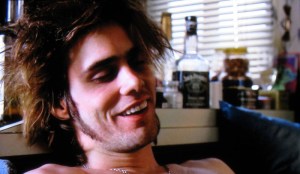
Harry and his new partner (Evan C. Kim) are assigned to investigate the death of rock star Johnny Squares (Jim Carrey).  Harry immediately suspects that the murderer was pretentious film director Peter Swan (Liam Neeson).  This is largely because Swan makes the type of horror films that inspire Harry to snarl with disdain.  It also turns out that Swan has been playing a “dead pool” game and that the various celebrities on his list have been getting killed.  And guess what?  Harry’s name is also on that list…

The Dead Pool was the final Dirty Harry film and, in many ways, it also feels like the most generic.  Whereas Dirty Harry actually had quite a lot on its mind and the first three sequels at least pretended to be concerned about something more than just mayhem, The Dead Pool is often content to be a rather cartoonish action film.  With the exception of a rather witty car chase involving a remote-controlled toy car that’s been strapped with an explosive, the action scenes are predictable and Eastwood’s character could just as easily have been named Spinner Mason or Eli Goldworthy.  There’s simply no huge reason for this film to be a Dirty Harry film, beyond the fact that it wouldn’t show up on AMC every few weeks if it wasn’t.

And yet, it’s impossible for me not to like The Dead Pool.  Though the film might feel generic overall, there’s still the occasional moments that hint that the movie is actually a bit smarter than it might first appear to be.  Considering that the film largely takes place on a movie set and features a film critic among its victims, it’s tempting to see The Dead Pool as being almost a spoof on both the Dirty Harry films themselves and the controversy that’s been generated by their violent content.  It makes sense that Harry Callahan’s name would appear on Swan’s dead pool list because, after spending four films battling serial killers, fascists, communists, gangsters, white trash, and a countless amount of bank robbers, the only opponent left for Harry to face is his own reputation.

The Dead Pool has one of the more interesting casts of the Dirty Harry films.  After dominating the previous films in the series,Clint Eastwood steps to the side and instead, allows his supporting cast to run off with the movie.  It’s a little bit bizarre to see Jim Carrey playing  a rock star (and even more bizarre to see him lip-synching to Welcome to Jungle) but that odd touch seems strangely appropriate for a film that doesn’t seem to be too concerned with much more than being entertaining.  Evan C. Kim is one of Harry’s more likable partners and Liam Neeson, complete with pony tail and superior attitude, is a lot of fun to watch as he spoofs every single pretentious filmmaker that you’ve ever been unfortunate enough to have taken a film class with. 

For a lot of reasons, The Dead Pool was the last of the Dirty Harry films.  It was a box office disappointment and, even way back in 1988, Eastwood looked a just little bit old for an action hero.  Eastwood has said that he has no interest in playing the character again and that’s probably for the best because, after five films, you have to wonder just what exactly was left for Harry to deal with.  (That said, I’ve always thought of Gran Torino as being the unofficial sixth Dirty Harry film.)

Well, that concludes my look at the Dirty Harry film series and, not coincidentally, it also concludes the month of September as well!  Starting tomorrow, along with all the other usual great stuff that you expect from us at the Shattered Lens, we’re going to be starting horror month!

Enjoy!

Film Review: Sudden Impact (dir. by Clint Eastwood)


Today, we continue our look at the Dirty Harry film series by considering the fourth installment in the franchise, 1983’s Sudden Impact.

“Go ahead.  Make my day…”

Yes, this is the film where Police Inspector “Dirty” Harry Callahan (played, as always, by Clint Eastwood) delivers that classic one liner.  In this case, he says it to a man holding a gun to a waitress’ head.  The implication, I guess, is that the gunman would make Harry’s day by killing the innocent woman that he’s holding hostage and therefore, giving Harry an excuse to shoot him in the head.  That line really does get to the heart of one of the main themes that runs through all of the Dirty Harry movies in general and Sudden Impact in specific.  Harry’s life would be a lot of easier if people would simply stop getting in the way and just let him shoot anyone that he wants to.

At the start of Sudden Impact ,we discover that Harry Callahan is still on the San Francisco police force and Captain McKay (Bradford Dillman) is still his antagonistic boss.  Eight years have passed since the end of the Enforcer and Harry is a bit grayer and definitely grumpier.  Whereas the previous three films in the franchise made a (minimal) effort to humanize him, the Harry of Sudden Impact is a snarling, forehead vein-throbbing killing machine.  After years of dealing with sleazy criminals and weak-willed liberals, Harry now appears to wake up each morning and ask himself, “How many people can I find an excuse to kill today?”

Not surprisingly, all those years of shooting people have apparently made Harry the most targeted man in San Francisco.  Within the first 20 minutes of the film, three separate and unconnected groups of criminals attempt to kill Harry.  His superiors demand that Harry take a vacation before the entire city of San Francisco is destroyed.  Harry snarls in response so his bosses do the next best thing and order him to go to the coastal town of San Paulo to help with an unsolved murder.

San Paulo has a problem.  Local lowlifes are turning up dead, shot once in the head and once in the genitals.  Along with the gruesome way that they die, all of them seem to be acquainted with a frightening woman named Rae (played by Audrey J. Neenan).  The chief of police (Pat Hingle) doesn’t seem to be trying too hard to solve the crimes and he openly resents Harry’s attempts to help.  (He’s even less happy about the fact that the mobsters who were trying to kill Harry in San Francisco have followed him out to  San Paulo.)  Harry, however, is determined to solve the crime even while dealing with the unwanted gift of a rather ugly bulldog (given to him by his latest partner, who is played by series regular Albert Poppwell) and romancing an artist (a rather unconvincing Sondra Locke) who has some very strong thoughts of her own on both the sorry state of the criminal justice system and what should be done to improve it.

Sudden Impact was the only one of the Dirty Harry films to officially be directed by Clint Eastwood.  Even if his name wasn’t listed in the opening credits, you would probably be able to guess that Eastwood directed this. From the film’s opening  nighttime scene, during which time the screen is almost totally black except for the occasional flash of a gun being aimed, the film features Eastwood’s signature noir-influenced visual style but it doesn’t contain any of the thematic ambiguity that typifies Eastwood’s better films.

Sudden Impact is an entertaining and well-made action film but it’s also my least favorite of the Dirty Harry series.  Whereas the first three installments at least tried to play around with figuring out what made Harry tick (and, occasionally, even allowing Harry’s methods to be questioned by sympathetic characters like Chico in Dirty Harry or Kate Moore in The Enforcer), Sudden Impact is content to just to let Harry kill some of the most cardboard villains in the franchise’s history.  The end results are crudely effective but ultimately rather forgettable, with none of the eccentric touches that occasionally distinguished the next film in the series, The Dead Pool.  There’s a reason why Sudden Impact is best remembered for a one-liner that’s uttered during the film’s first 10 minutes and which doesn’t really have anything to do with anything else that happens in the movie.

Speaking of The Dead Pool, that’s the film we will be looking at tomorrow as we conclude this series on the Dirty Harry franchise.

Film Review: The Enforcer (dir. by James Fargo)


Today, we continue our look at the Dirty Harry film series by reviewing the third film in the series, 1976’s The Enforcer.

There’s a moment, towards the end of this film, where Harry (played as always by Clint Eastwood) is preparing to blow away one of the bad guys.  Before firing, Harry mutters something under his breath.  The first time I watched the film, I couldn’t make out what Harry was saying so I turned on the captioning and watched the scene again to discover just what exactly Harry had said before dispensing justice.

The line: “You fucking fruit.”

Yes, The Enforcer finds Harry at his most reactionary and it’s a good thing too.  Whereas Magnum Force found Harry fighting his fellow cops, The Enforcer could have just as easily been called Harry Vs. Occupy San Francisco.  This time around, the bad guys are members of something called The People’s Revolutionary Strike Force.  They’re led by a psychotic ex-pimp named Bobby Maxwell (played by an actor with the wonderful name of Deveren Bookwalter) and they’re fond of saying things like, “For the people!” before striking.  To be honest, The Enforcer’s villains are some of the most forgettable in the history of the franchise but that’s appropriate.  As opposed to the original Dirty Harry and Magnum Force, The Enforcer is less concerned with being a struggle between equals and more about Harry killing people.

The Enforcer opens with Harry preventing yet another armed robbery.  This time, he manages to destroy the entire store while doing so and ends up costing the city of San Francisco several million dollars.  Harry’s new superior, Capt. McKay (played by Bradford Dillman) isn’t amused and, as a punishment, temporarily transfers Harry over to the Personnel Department.  I have to say that McKay is a very brave man since Harry blew up the last superior who attempted to reprimand him.

Working Personnel, Harry has to sit in on interviews for promotions.  While doing so, he is informed that the Mayor has ordered them to find three women to promote to inspector.  “Women!?” Harry growls in shocked response.

While Harry is busy attempting to impede the march of progress, his old partner DiGiorgio (John Mitchum) stumbles upon Bobby and the revolutionaries stealing weapons.  As often happens with Harry’s partners, DiGiorgio is killed by the bad guys and Harry is transferred back to Homicide so he can investigate the death.  Helping Harry out is his new partner — Kate Moore (Tyne Daly), one of the three women who have recently been promoted to inspector.

While Harry and his new partner are busy tracking down Bobby, Capt. McKay tries to pin the crime on yet another revolutionary force, a group of black militants led by Big Ed Mustapha.

Big Ed is played by Albert Poppwell, who previously appeared in Dirty Harry as the “I’s got to know” robber.  When Harry first meets him, Harry says, “Haven’t I met you before?”  Though the film never explicitly says so, I like to think that the two characters are one in the same.

As for Bobby and the People’s Revolutionary Strike Force, they’re busy kidnapping the mayor and demanding $5,000,000 for his release.  Of course, it’s up to Harry and Moore to rescue the mayor and put all the “fucking fruits” back in their place….

Looking over other reviews of the Dirty Harry franchise, The Enforcer often seems to be dismissed as almost an afterthought.  Daly’s performance is usually praised (and quite rightfully so because she does give the film’s best performance) but the rest of the film is usually dismissed.  To a certain extent, that’s understandable.  As I mentioned before, Bobby Maxwell is not that interesting of a villain and Harry is at his most one dimensional here.

That said, I think The Enforcer is actually underrated.  There might not be much nuance to Eastwood’s performance here but he gets by on charisma alone and he has a likable chemistry with Daly.  As opposed to what we’ve been conditioned to expect from most other films, Harry and Moore’s relationship never turns romantic.  Instead, by the end of the film, they truly are equals.

The Enforcer was followed, nearly a decade later, by Sudden Impact.  We’ll take a look at that film tomorrow.

Film Review: Magnum Force (dir by Ted Post)


Today, we continue our look at the Dirty Harry film franchise by taking a look at the second film in the series, 1973’s Magnum Force.

Despite the fact that Dirty Harry famously ended with Harry Callahan throwing away his badge in disgust, Magnum Force reveals that Callahan (played again by Clint Eastwood) is still a member of the San Francisco Police Department.  He’s got a new partner (Felton Perry, a likable actor in a thankless role) but he’s still butting heads with his superiors at the department.  He’s also still got a way with the one-liners.  When Lt. Briggs (Hal Holbrook) brags that he never once had to draw his gun while he was in uniform, Callahan replies, “A man’s got to know his limitations.”

While Callahan is busying himself with doing things like gunning down robbers and preventing an attempt to hijack a plane, a group of motorcycle cops are gunning down the town’s criminals.  They begin by killing a mobster who has just beaten a murder charge on a technicality but soon, they’re gunning down anyone who has ever so much as been suspected of committing a crime.  Alone among the detectives investigating the murders, Callahan believes that the killers are cops and, even worse, he suspects that his old friend Charlie McCoy (played by Mitchell Ryan) might be a member of the group…

Though it suffers when compared to Dirty Harry, Magnum Force is still an exciting and effective action film that is clearly a product of the same period of time that gave us such classics of paranoid cinema as The Parallax View and Three Days of the Condor.  Whereas Dirty Harry took an almost documentary approach to capturing life and death in San Francisco, Magnum Force is a film that is full of dark shadows and expressionistic angles.

In Dirty Harry, the Scorpio Killer was both an obvious outsider and an obvious force of destruction.  The film’s dramatic tension came from the fact that he was so clearly guilty and yet nothing could be done to stop him.  The villains in Magnum Force are the exact opposite of Scorpio.  As chillingly played by David Soul, Robert Urich, Tim Matheson, and Kip Niven, the killer cops are distinguished not by their otherness but by their total lack of individuality.

In the film’s best scene, they confront Harry in a parking garage and basically tell him that he’s either with them or against him.  Sitting on their motorcycles, wearing their leather jackets, and with their grim faces hidden behind their aviator sunglasses, these cops are the ultimate representation of  faceless fascism.  After listening to their excuses, Harry asks if they consider themselves to be heroes.

“All of our heroes are dead,” one of them replies, delivering the film’s best line.

Obviously, Magnum Force was made to be an answer to those critics who claimed that Dirty Harry was a fascist film and it is a bit jarring, at first, to see Harry “defending” the system.  (“I hate the goddamn system but until something better comes along…”)  When Harry tells the killer cops, “I’m afraid you’ve misjudged me,” it’s not hard to see that this is the same message that Eastwood meant to give his critics.

However, what makes the killer cops in Magnum Force such interesting villains is that they are, ultimately, tools of the system that they’re attempting to destroy.  By killing off criminals as opposed to arresting them and putting them on trial, the killer cops are minimizing the risk of the flaws inherent in the system being exposed.  Hence, by defending the system, Harry is helping to expose and destroy it.

When I told Jeff that I was planning on watching and reviewing all of the Dirty Harry films, he suggested that I watch them in reverse-order.  His logic was that, since the films tended to get worse as the series progressed, watching them backwards would allow me to end my project on a happy note as opposed to a note of bitter disappointment.  I took his advice and I’m glad I did.  While I disagree with him about whether or not The Dead Pool is a better film than Sudden Impact, I do have to agree that the first two Dirty Harry films are dramatically better (and quite different in tone) from the ones that subsequently followed.

Tomorrow, we’ll look at the third film in the series, 1976’s The Enforcer.