Welcome to Late Night Retro Television Reviews, a new feature where we review some of our favorite and least favorite shows of the past! On Fridays, I will be reviewing Friday the 13th, a show which ran in syndication from 1987 to 1990. The show can be found on YouTube!
This week’s episode of Friday the 13th: The Series is actually really good!
Episode 1.7 “Doctor Jack”
(Dir by Richard Friedman, originally aired on November 9th, 1987)
Dr. Vincent Howlett (Cliff Gorman) has a reputation for being a miracle worker. He’s the surgeon who is called in to do the difficult operations that no other surgeon would have the courage to try. Somehow, despite all of the complex surgeries that he has been involved in, he has never lost a patient. The local Toronto hospital is very happy to have Dr. Howlett on staff.
However, Dr. Howlett’s success rate is not just a case of medical skill. He owns a special, lucky scalpel. He purchased it from a knife dealer who earlier purchased it from — you guessed it! — the cursed antique shop. The scalpel is from the Victorian era and it once belonged to none other than Jack the Ripper! The scalpel can make any surgery a success but it demands blood as payment. So, before every surgery, Dr. Howlett has to go out and find someone to murder.
Searching the scalpel as a part of their mission to track down all of the cursed antiques, it doesn’t take long for Ryan, Micki, and Jack to track the scalpel down to Dr. Howlett. However, when Ryan tries to steal the scalpel, a chase through the hospital ensues. When Jack distracts Howlett long enough for Ryan and Micki get away, Jack ends up getting thrown down an elevator shaft.
Jack survives his fall but he’s suffered some terrible internal injuries. In fact, he’s going to need surgery! Fortunately, the best surgeon in Canada is on staff at the hospital. As much as Ryan and Micki want to steal that scalpel, they know that Howlett is going to need it if he’s going to save Jack’s life.
Meanwhile, Jean Flappen (Eva Mai Hoover) is stalking the hallways of the hospital, carrying a gun and hoping to get revenge on Dr. Howlett for the murder of her daughter….
Yikes! Hospital’s are creepy in general but they’re even more creepy when the head surgeon is carrying around a scalpel that once belonged to Jack the Ripper. (Of course, in reality, it’s doubtful that Jack the Ripper was actually a doctor. In all probability, he was a butcher in all definitions of the word.) This episode makes great use of the hospital setting, creating an atmosphere of perpetual unease. It was a genuinely scary location and, for once, the fact that Friday the 13th didn’t have a huge budget worked to show’s advantage. The shots of the empty and shadowy hospital hallways, without even an extra or two populating them, were truly ominous.
Cliff Gorman also gave a wonderful performance as Dr. Howlett, playing him as the type of arrogant jerk who knows that he can get away with being unlikable because he’s the best at his profession. The scene where Howlett can’t find his scalpel and has a sudden meltdown really drives home the idea that the owners of the cursed antiques have become addicted to using them. As soon as Howlett can’t hold his scalpel in his hands, his smooth façade crumbles and he starts going through what can only be called withdrawal.
With its creepy atmosphere and Gorman’s sinister performance, Dr. Jack is the best episode of Friday the 13th that I’ve reviewed so far.
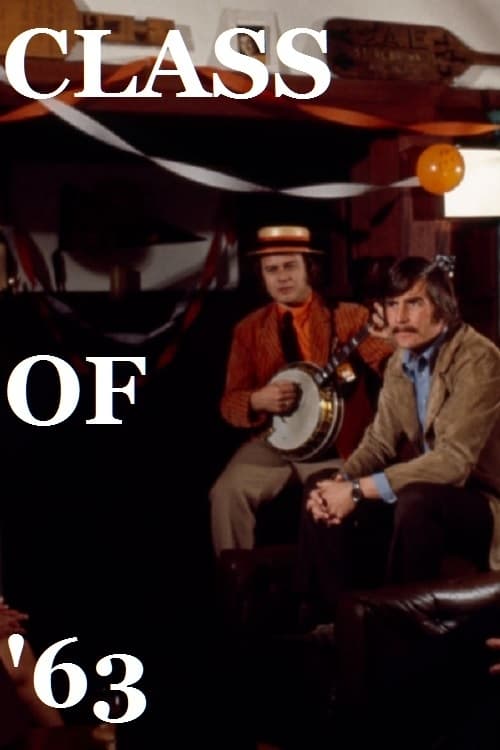
Welcome to Retro Television Reviews, a feature where we review some of our favorite and least favorite shows of the past! On Sundays, I will be reviewing the made-for-television movies that used to be a primetime mainstay. Today’s film is 1973’s Class of ’63! It can be viewed on YouTube!
It’s college reunion time! Alumni of all ages and from all over the country are returning to the place where they became adults and spent the best years of their lives.
Joe Hart (James Brolin), of the Class of ’63, returns to the campus but he immediately feels like a bit like an outsider. As opposed to his former classmates, many of whom are desperately trying to recapture their fading youth, Joe is quiet and sensitive and he’s aware of the passage of time. He hasn’t come back to college so that he can relive his carefree fraternity days. Instead, his main interest is whether or not his former fiancée will be there.
And it turns out that Louise Swerner (Joan Hackett) is there! She’s accompanied by her husband and fellow member of the Class 0f 63, Mickey Swerner (Cliff Gorman). From the minute that Mickey appears, it’s obvious that he has both a chip on his shoulder and a lot of insecurity. He is visibly annoyed when people fail to immediately recognize him. He and Louise have a strained marriage and he’s not particularly happy with how excited she is to see Joe again. While Mickey tries to convince everyone that he’s grown up to be a winner, Louise and Joe get reacquainted and it becomes obvious that they still love each other. Will Louise and Joe leave the reunion together and should they be more concerned with the fact that Mickey just happens to have a sniper rifle in his luggage? And what to make of Dave McKay (Ed Lauter), the former classmate who seems to be just a little bit too excited to see everyone?
It’s an interesting film and I have to say that it didn’t quite go the direction that I was expecting it to. Despite the presence of the rifle and Mickey’s obvious instability, the film is less a thriller and more a look at what it means to grow up and the difficulty of letting go of the past. None of the characters are caricatures. Joe and Louise may seem perfect together but the film makes clear that they’re also idealizing their time together. With neither one of them really happy with their current life, they’ve both fallen into the trap of wondering, “What if?” Meanwhile, Mickey may be flawed but it’s impossible not to have some sympathy for him. As hostile as Cliff can be, it’s obvious that the person that he hates the most is himself and Cliff Gorman does a good job of capturing Mickey’s raging insecurity. Gorman’s intensity provides a good balance to Brolin’s more laid back performance and, by the end of the film, one can understand why and how Louise was able to fall in love with two men who superficially seem to be so different.
Class of ’63 is a good drama, one that requires a little patience but which ultimately rewards the audience for sticking with it.
Welcome to Retro Television Reviews, a new feature where we review some of our favorite and least favorite shows of the past! On Fridays, I will be reviewing Half Nelson, which ran on NBC from March to May of 1985. Almost all nine of the show’s episodes can be found on YouTube!
The adventures of Rocky Nelson continue!
Episode 1.4 “Uppers and Downers”
(Dir by James Sheldon, originally aired on April 5th, 1985)
When a burglar alarm goes off in Beverly Hills, it’s Rocky Nelson (Joe Pesci) of Beverly Hills Patrol to the rescue! Reaching the mansion of a local businessman (played by Cliff Gorman), Rocky discovers that the alarm was set off by a racoon.
(“A racoon is Beverly Hills!?” Gorman’s wife says, in a tone that suggests that racoons are unknown creatures in California.)
Rocky also happens to spot the next door neighbor (Nancy Stafford) leading her personal trainer into her house, whispering that she’s going to show him her bedroom. At first, Rocky is amused but, later that day, Rocky hears that the personal trainer has been found, floating in Stafford’s swimming pool. Stafford claims that the trainer had a heart attack while swimming but, upon arriving at the scene, Rocky immediately figures out that the trainer died in the house and was then dragged out to the pool. Stafford swears that she didn’t kill him and Rocky believes her. However, when the autopsy report reveals that the trainer was dead before he was put in the pool, Stafford is arrested and charged with murdering him by hitting him over the head.
Despite being told by his boss (Fred Williamson) to stay away from the case, Rocky feels that he has to prove Stafford’s innocence. Rocky’s first plan is to have his associates, Kurt (Bubba Smith) and Beau (Dick Butkus), disguise themselves as mortuary attendants and steal the trainer’s body from the crematorium. Rocky then takes the body to a coroner who does a second autopsy and discovers that not only did the trainer have a heart attack but that he was also poisoned! Someone slipped the trainer a pill that was specifically designed to cause a heart attack. Now, it’s up to Rocky to discover who that person was and clear Stafford’s name before Stafford’s husband (Brett Halsey, a veteran of Italian horror and spaghetti westerns) files for divorce.
Rocky deduces that the trainer was probably targeted by a jealous husband. Rocky decides to disguise himself as a physical trainer so that he can get close to all of the dead man’s former clients. How does Rocky prepare for this role? He does calisthenics with his landlord, Dean Martin. When Rocky mentions that he needs someone to determine whether or not his clients are lying to him, Dean Martin suggests that he steal a lie detector from the set of “Burt’s new film.” (I’m guessing that Burt was a reference to Burt Reynolds, Dean’s co-star in two CannonballRun films.) Rocky promptly goes down to the studio backlot and steals a bunch of Burt Reynolds’s property.
(The backlot was a prominent and amusing part of the show’s pilot but it was ignored during last week’s episode. I was glad to see it back for this episode because Dean Martin instructing Joe Pesci to steal Burt Reynolds’s lie detector will never not be amusing.)
Rocky meets with all of the dead trainer’s clients and tricks them into hooking themselves up to the lie detector by telling them that it’s a instrument that will check their heart rate. Rocky discovers that any number of people could have wanted the trainer dead. However, those of us in the audience already knows that Cliff Gorman is the murderer because we witnessed Gorman gloating about it earlier in the episode. Rocky eventually figures it out as well and tricks Gorman into confessing by pretending to take one of the heart attack pills while driving Gorman around Beverly Hills.
Thanks to the visit to the studio lot and Dean Martin’s eccentric performance, this episode was an improvement on last week’s. That said, it still suffered from the fact that the murder itself wasn’t that interesting (with Gorman’s ruthless businessman not getting much characterization beyond being evil). Despite being second and third-billed in the opening credits, neither Victoria Jackson nor Fred Williamson got to do much in this episode and considering that both of those performers had their own unique and eccentric style, it feels like a bit of waste to just have them sitting in the office and uttering just a handful of lines per episode. The main appeal of the show continues to be Joe Pesci, who brings a lot of streetwise charm to Rocky. In the episodes that I’ve watched so far, Pesci is likable and engaging as Rocky and I think his performance would surprise a lot of people who are used to Pesci playing killers with hair-trigger tempers. Rocky is smart and tough but ultimately rather friendly. In his performance in HalfNelson, one can see hints of his later performance in The Irishman, I just wish the rest of this show was as consistently good.
Next week: Joe Pesci faces off against John Saxon! That sounds promising! We’ll see how it goes.
Tonight’s episode of Friday the 13th The Series finds Micki and Ryan tracking down a cursed scarecrow. The scarecrow guarantees a good crop but only after three people have had their heads chopped off. AGCK!
Listen, folks, scarecrows are scary enough even when they aren’t chopping off people’s heads. I’ve lived around farms. Scarecrows are scary as Hell!
On tonight’s episode of Friday the 13th: The Series, Ryan is convinced that an old comic book monster has come to life and is now killing people! Could it all be connected to a cursed pen that was sold to the creator of the comic book?
Watch and find out!
Tonight’s special guest star is Ray Walston, who played embittered comic book creator Jay Star. From what I’ve recently learned about how the comic book industry treats its artists and writers, I can’t really blame him for being bitter.
Tonight’s episode of Friday the 13th: The Series finds Micki, Ryan, and Jack investigating a series of slashings that might be connected to a renowned surgeon named Vincent Howlett (played by Cliff Gorman, who also played an actor based on Dustin Hoffman in Bob Fosse’s All That Jazz). Howlett has a 100% success rate and he owes it all to his antique scalpel. Unfortunately, it turns out that there’s a deadly and bloody price for Howlett’s success in the operating room….
This episode was written by Marc Scott Zicree, who also wrote the definitive guide to the original Twilight Zone. The plot — with its theme of a man doing great evil so that he can do great good — certainly feels like it wouldn’t have been out of place as an episode of Rod Serling’s classic anthology series.
This episode originally aired in 1987, on November 9th (hey, that’s my birthday!)
The 1992 film, Hoffa, opens in 1975, with two men sitting in the backseat of a station wagon. One of the men is the controversial labor leader, Jimmy Hoffa (Jack Nicholson). The other is his longtime best friend and second-in-command, Bobby Ciaro (Danny DeVito). The two men are parked outside of a roadside diner. They’re waiting for someone who is late. Jimmy complains about being treated with such disrespect and comments that this would have never happened earlier. Jimmy asks Bobby if he has his gun. Bobby reveals that he does. Jimmy asks him if he’s sure that there’s a loaded gun in the diner, as well. Bobby goes to check.
Jimmy Hoffa, of course, was a real person. (Al Pacino just received an Oscar nomination for playing him in The Irishman.) He was a trucker who became a labor leader and who was eventually elected president of the Teamsters Union. He was a prominent opponent of the Kennedys and that infamous footage of him being interrogated by Bobby Kennedy at a Senate hearing seems to sneak its way into almost every documentary ever made about organized crime in the 50s. Hoffa was linked to the Mafia and was eventually sent to prison. He was freed by the Nixon administration, under the condition that he not have anything to do with Teamster business. When he disappeared in 1975, he was 62 years old and it was rumored that he was planning on trying to take over his old union. Everyone from the mob to the CIA has been accused of having had Hoffa killed.
Bobby Ciaro, however, was not a real person. Apparently, he was a composite character who was created by Hoffa’s screenwriter, David Mamet, as a way for the audience to get to know the enigmatic Jimmy Hoffa. Bobby is presented as being Hoffa’s best friend and, for the most part, we experience Jimmy Hoffa through his eyes. We get to know Jimmy as Bobby gets to know him but we still never really feel as if we know the film’s version of Jimmy Hoffa. He yells a lot and he tells Bobby Kennedy (a snarling Kevin Anderson) to go to Hell and he talks a lot about how everything he’s doing is for the working man but we’re never really sure whether he’s being sincere or if he’s just a demagogue who is mostly interested in increasing his own power. Bobby Ciaro is certainly loyal to him and since Bobby is played by the film’s director, it’s hard not to feel that the film expects us to share Bobby’s admiration. But, as a character, Hoffa never really seems to earn anyone’s loyalty. We’re never sure what’s going on inside of Hoffa’s head. Jack Nicholson is always entertaining to watch and it’s interesting to see him play a real person as opposed to just another version of his own persona but his performance in Hoffa is almost totally on the surface. With the exception of a few scenes early in the film, there’s doesn’t seem to be anything going on underneath all of the shouting.
The majority of Hoffa is told via flashback. Scenes of Hoffa and Bobby in the film’s present are mixed with scenes of Hoffa and Bobby first meeting and taking over the Teamsters. Sometimes, the structure of the film is a bit cumbersome but there are a few scenes — especially during the film’s first thirty minutes — that achieve a certain visual poetry. There’s a scene where Hoffa helps to change a man’s flat tire while selling him on the union and the combination of falling snow, the dark city street, and Hoffa talking about the working man makes the scene undeniably effective. The scenes where Hoffa spars with Bobby Kennedy are also effective, with Nicholson projecting an intriguing blue collar arrogance as he belittles the abrasively ivy league Bobby. Unfortunately, the rest of the movie doesn’t live up to those scenes. By the time Hoffa becomes a rich and influential man, you realize that the film isn’t really sure what it wants to say about Jimmy Hoffa. Does it want to condemn Hoffa for getting seduced by power or does it want to excuse Hoffa’s shady dealings as just being what he had to do to protect the men in his union? The film truly doesn’t seem to know.
Hoffa is definitely not an offer that you shouldn’t refuse but, at the same time, it’s occasionally effective. A few of the scenes are visually appealing and the cast is full of character actors like John C. Reilly, J.T. Walsh, Frank Whaley, and Nicholas Pryor. It’s not a disaster like The Gang Who Couldn’t Shoot Straight.Hoffa is an offer that you can take or leave.
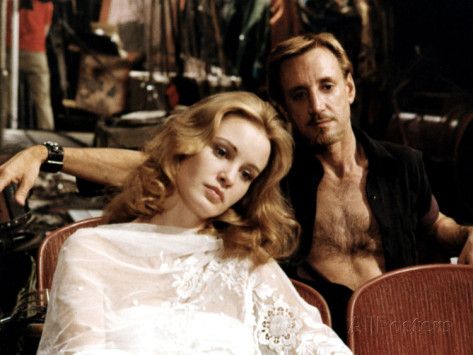
So sings Joe Gideon (Roy Scheider) at the end of the 1979 film, All That Jazz. And he’s right! It’s hardly a spoiler to tell you that All That Jazz ends with Joe Gideon in a body bag. It’s not just that Gideon spends a good deal of the film flirting with the Angel of the Death (Jessica Lange). It’s also that, by the time the film ends, we’ve spent a little over two hours watching Joe engage in non-stop self-destruction. Joe is a director and a choreographer who is so in love with both death and show business that his greatest triumph comes from choreographing his own death.
Joe wakes up every morning, pops a handful of pills, stares at himself in the mirror and says, “It’s showtime!” He spends his day choreographing a Broadway play. He spends his nights editing his latest film, a biopic about Lenny Bruce called The Stand-Up. He’s particularly obsessed with a long monologue that Lenny (played by Cliff Gorman) delivers about the inevitability of death. When he’s not choreographing or editing, he’s smoking, drinking, and cheating on his girlfriend (Ann Reinking). It’s obvious that he’s still in love with his ex-wife (Leland Palmer) and that she loves him too but she’s also too smart to allow herself to get fully sucked back into his self-destructive orbit. He loves his daughter (Erzsébet Földi) and yet still ignores her when she begs him not to die.
Joe and the Angel of Death
When Joe has a heart attack and ends up in the hospital, he doesn’t change his behavior. Instead, he and the Angel of Death take a look back at his youth, which was spent hanging out in strip clubs and desperately trying to become a star. Joe Gideon, we see, has always know that he’s going to die early so he’s pushed himself to accomplish everything that he can in what little time he has.
As a result of his drive and his refusal to love anyone but himself, Gideon is widely recognized as being an artistic genius. However, as O’Connor Flood (Ben Vereen, essentially playing Sammy Davis, Jr.) puts it, “This cat allowed himself to be adored, but not loved. And his success in show business was matched by failure in his personal relationship bag, now – that’s where he really bombed. And he came to believe that show business, work, love, his whole life, even himself and all that jazz, was bullshit. He became numero uno game player – uh, to the point where he didn’t know where the games ended, and the reality began. Like, for this cat, the only reality – is death, man. Ladies and gentlemen, let me lay on you a so-so entertainer, not much of a humanitarian, and this cat was never nobody’s friend. In his final appearance on the great stage of life – uh, you can applaud if you want to – Mr. Joe Gideon!”
Now, of course, Connor doesn’t really say all that. Gideon just imagines Connor saying that before the two of them launch into the film’s final musical number, Bye Bye Life. It should be a totally depressing moment but actually, it’s exhilarating to watch. It’s totally over-the-top, self-indulgent, and equally parts sincere and cynical. It’s a Bob Fosse production all the way and, as a result, All that Jazz is probably about as fun as a movie about the death of a pathological narcissist can be. This is a film that will not only leave you thinking about mortality but it will also make you dance.
All That Jazz was Bob Fosse’s next-to-last film (he followed it up with the even darker Star 80) and it’s also his most openly autobiography. Roy Scheider may be playing Joe Gideon but he’s made-up to look exactly like Bob Fosse. Like Joe Gideon, Bob Fosse had a heart attack while trying to direct a Broadway show and a film at the same time. Gideon’s girlfriend is played by Fosse’s real-life girlfriend. The character of Gideon’s ex-wife is clearly meant to be a stand-in for Gwen Verdon, Fosse’s real-life ex-wife. When the film’s venal Broadway producers make plans to replace the incapacitated Gideon, Fosse is obviously getting back at some of the producers that he had to deal with while putting together Chicago. It’s a confessional film, one in which Fosse admits to his faults while also reminding you of his talent. Thank God for that talent, too. All that Jazz is self-indulgent but you simply can’t look away.
It helps that Gideon is played by Roy Scheider. Originally, Scheider’s Jaws co-star Richard Dreyfuss was cast in the role but he left during rehearsals. Dreyfuss, talented actor that he was, would have been all-wrong for the role of Gideon. One can imagine a hyperactive Dreyfuss playing Gideon but one can’t imagine actually feeling much sympathy for him. Scheider, on the other hand, brings a world-weary self-awareness to the role. He plays Gideon as a man who loves his talent but who hates himself. Scheider’s Joe Gideon is under no illusions about who he is or how people feel about him. When Fosse’s own instincts threatens to make the film unbearably pretentious, Scheider’s down-to-Earth screen presence keeps things grounded.
I love All That Jazz. (Admittedly, a good deal of that love is probably connected to my own dance background. I’ve known my share of aspiring Joe Gideons, even if none of them had his — or Bob Fosse’s — talent or drive.) It’s not for everyone, of course. Any musical that features actual footage of open heart surgery is going to have its detractors. For the record, Stanley Kubrick called All That Jazz “the best film I think I’ve ever seen.” It won the Palme d’Or at Cannes and it was nominated for Best Picture, though it ultimately lost to the far more conventional Kramer vs. Kramer.
All that Jazz would be the last of Fosse’s film to receive a best picture nomination. (Fosse directed five features. 3 of them were nominated for Best Picture, with the other two being Cabaret and Lenny.) 8 years after filming his cinematic doppelganger dying during heart surgery, Fosse would die of a heart attack. Gwen Verdon was at his side.
When San Francisco-based private investigator Michael Brennen (O.J. Simpson) gives a ride to Joey Crawford (John Spencer) on Christmas Eve, he doesn’t know that it’s going to lead to the biggest case of his career. When Joey asks Michael to help him track down his ex-girlfriend, Michael assumes that Joey would never be able to pay for his investigative services. But one week later, Michael gets something in the mail from Joey. Inside the envelope, there’s a picture of both Joey’s ex and a thousand dollar bill. Ever after he discovers that Joey was mysteriously killed the night before, Michael decides to take on the case. His investigation will take him not only to Joey’s ex but it will also lead to him uncovering a drug ring that involves one of San Francisco’s most prominent families.
Simpson not only starred in this made-for-TV movie but he also served as executive producer. Watching the movie, it’s obvious that it was meant to serve as a pilot for a Michael Brennen TV series and it’s also just as obvious why that series never happened. O.J. Simpson was not a terrible actor but, ironically for someone who set records as an NFL player, there was nothing tough about him. Simpson may be playing a two-fisted, cash-strapped P.I. but, in every scene, he comes across like he can’t wait to hit the golf course. Simpson’s pleasant demeanor may have served him well in other areas of his life but it didn’t help him with this role. Whenever Simpson has to share a scene with John Spencer, Candy Clark, Cliff Gorman, or any of the other members of this film’s surprisingly talented supporting cast, Simpson’s bland screen presence and lack of gravitas becomes all the more apparent.
Of course, when seen today, the main problem with Cocaine and Blue Eyes is that it’s impossible to watch without thinking, “Hey, didn’t the star of this movie get away with killing his wife and an innocent bystander?” Even the most innocuous of lines take on a double meaning when they’re uttered by O.J. Simpson. It doesn’t help that the movie opens with Michael visiting his estranged wife and their children on Christmas Eve and getting chased around the neighborhood by a guard dog. When the movie was made, this scene was probably included so that O.J. could show off some of the moves that made him a star at UCLA and with the Bills. Seen today, the scene takes on a whole different meaning.
Without O.J. Simpson, Cocaine and Blue Eyes could easily pass for being an extended episode of Magnum P.I., Simon and Simon, or any other detective show from the 80s. With Simpson, it becomes a pop cultural relic. I don’t think it’s ever been released on DVD but it is available on YouTube, where it can be viewed by O.J. Simpson completists everywhere.
With the Trancers series done, I’ve decided to move onto the Angel series. I honestly had no idea what I was in for here. The box art appears to have a 12 year-old on the cover once as “High School Honor Student by day,” and then “Hollywood Hooker by night.” The DVD has the first three films on it. I’m quite sure that the girl on the cover is neither Donna Wilkes, Betsy Russell, or Mitzi Kapture.
Anyways, as I watched it, I knew this movie reminded me of a film I saw late last year. It took me some time because this movie is so subtle about it. Then it came to me. That movie of course being Crackdown Mission (1988).
Crackdown Mission (1988, dir. Godfrey Ho)
Why not? Might as well have been. That’s the Godfrey Ho movie where he spliced Pierre Kirby into the Taiwanese film Girl with a Gun (1982).
Girl with a Gun (1982, dir. Yao-Chi Chen)
Girl with a Gun was a Taiwanese remake of Ms. 45 (1981).
Ms. 45 (1981, dir. Abel Ferrara)
Ms. 45 being Abel Ferrara’s reworking of Death Wish (1974).
Death Wish (1974, dir. Michael Winner)
Death Wish arguably getting the pivotal opening rape from A Clockwork Orange (1971).
A Clockwork Orange (1971, dir. Stanley Kubrick)
You can go on and on with this. There’s also Rape Squad (1974), Fighting Back (1982), the Death Wish sequels, and so many more of these things. Heck, Death Wish even got a porno version called Sex Wish (1976). We even got the kiddie version, as I recall, of this same thing one year after Angel with The Legend of Billie Jean (1985).
If I got Gary on the line, he could probably take me back even further with movies like Something Wild (1961) or other films I don’t recall. Don’t need to though because this movie takes you back about as far as you can go anyways.
The movie opens up and we meet our lead character Angel, played by Donna Wilkes–and what the hell is that?
I would say that Donna Wilkes playing a 15 year-old at the age of 23 was a product of sleazy 80s movies, but I’d be lying through my teeth because of this.
The Poor Little Rich Girl (1917, dir. Maurice Tourneur)
Mary Pickford was 24 when she played the role of a little girl.
As for the child prostitute bit, let’s get that out of the way too because it goes back almost as far as well.
Baby Face (1933, dir. Alfred E. Green)
That’s the scene where we find out her father has been pimping her out since she was 14 years old. Barbara Stanwyck was 25 when she did Baby Face.
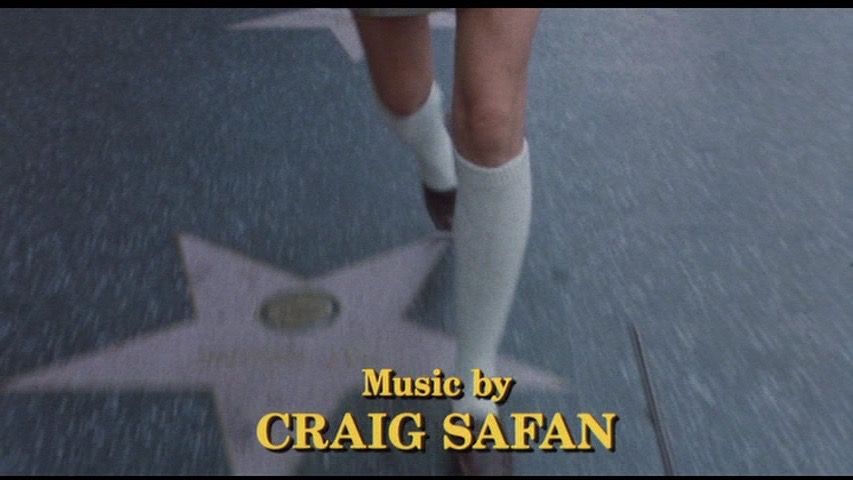
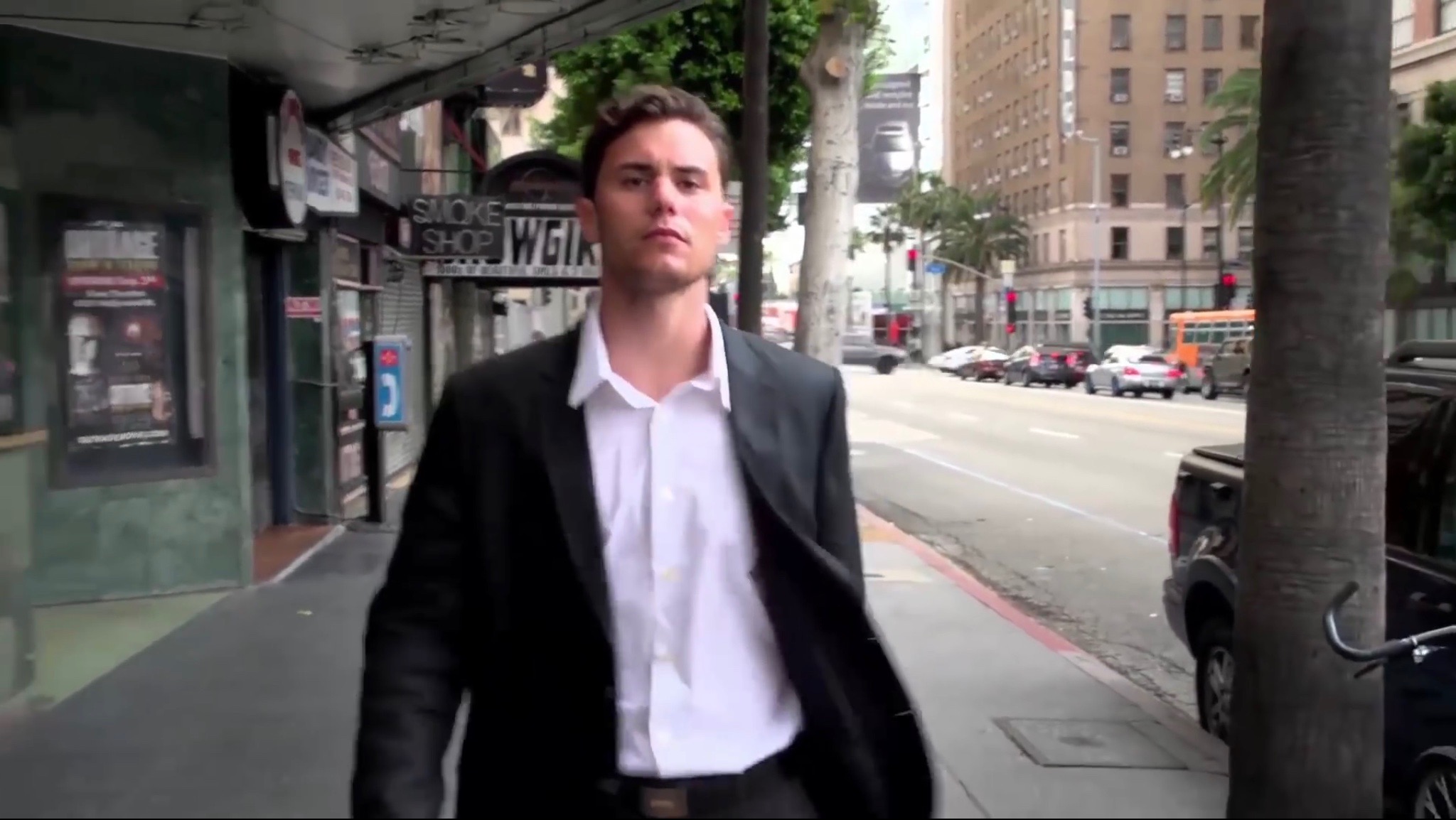
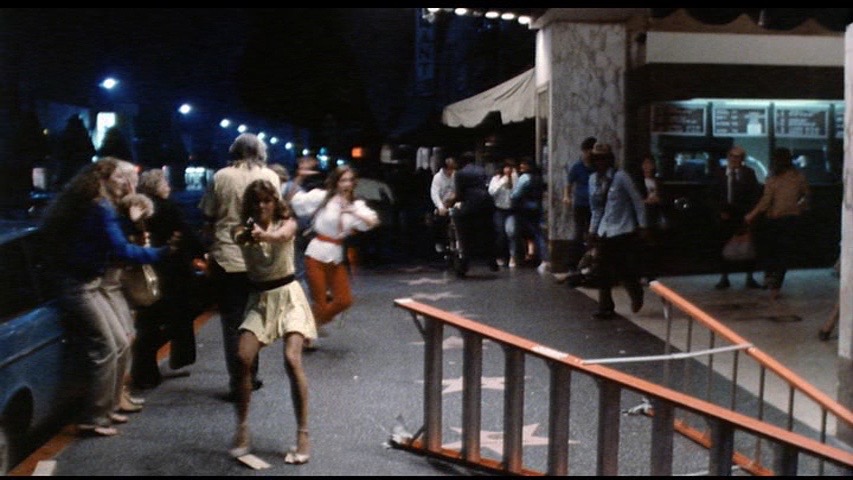
After seeing Angel come out of where she lives, we see her walk part of the Hollywood Walk of Fame.
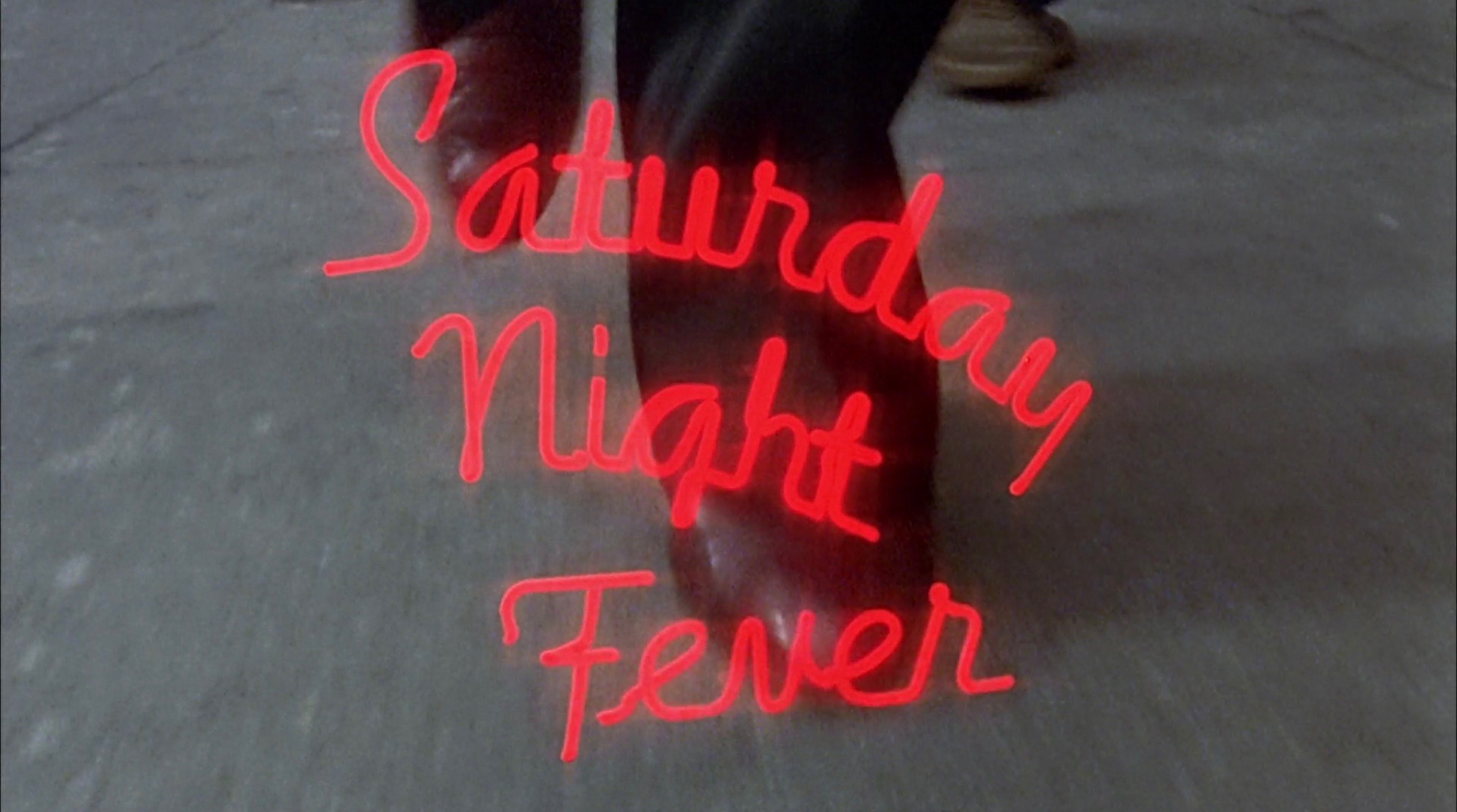
Along with these shots of her feet, we also see her say hi to some people cleaning Rex Allen’s star, fix her hair in a window, and then board a school bus. The music plays sad and tragic. It’s hardly upbeat, but was this meant to be a Saturday Night Fever reference? As I recall, Tony Manero is a similar character to Angel.
Saturday Night Fever (1977, dir. John Badham)
I would say that I wasn’t really sure, but considering the opening walk in Birdemic 2 was intended to be a Saturday Night Fever reference,…
Birdemic 2: The Resurrection (2013, dir. James Nguyen)
then I think I am safe saying it is a reference to that movie.
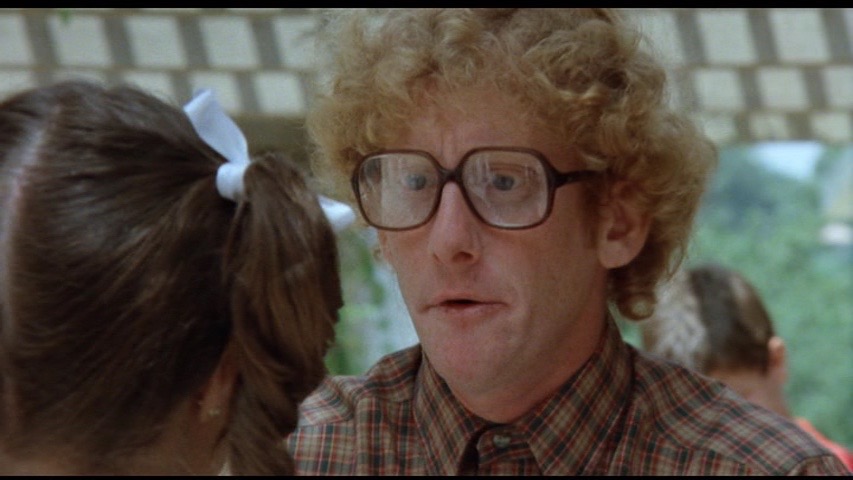
After getting her homework assignment, we meet this guy…
who looks like he got lost on his way to the Revenge of the Nerds (1984) set. He is here to make it clear that Angel is more mature than her age, but that she is keeping up the illusion that she is still very much a little girl. He tries to ask her out, but she turns him down saying her mother doesn’t like her dating. Now without any time wasted, we cut to home, she dolls up, and we’re out to the streets within the first 8 minutes of the movie.
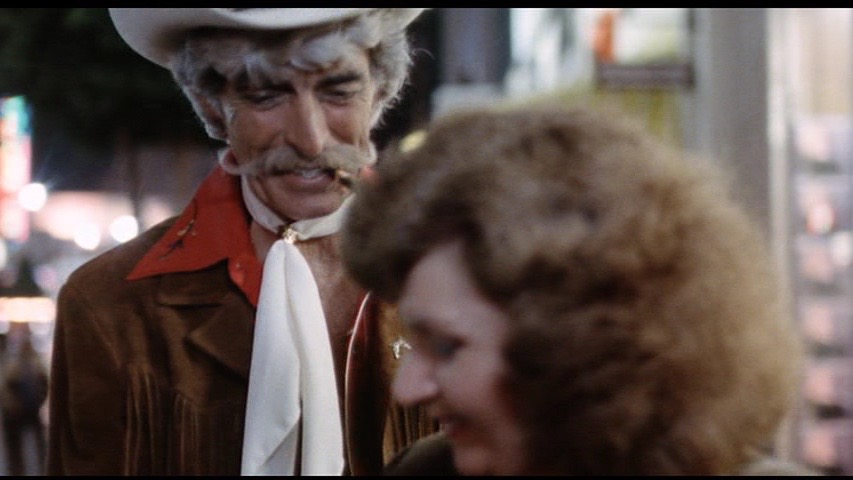
We immediately meet Kit Carson played by Rory Calhoun probably because Bill Williams, who played Kit Carson on TV, had stopped acting in 1981 after making Night of the Zombies (1981) and Goldie and the Boxer Go to Hollywood (1981). Given the titles, and that they starred porn star Jamie Gillis and O.J. Simpson respectively, I’m sure Bill would have done this movie if he could have. Rory Calhoun will be our reference to silent era cowboys for the movie. In particular, Tom Mix. Yes, he brings up Tom Mix so we are sure to get the reference. He also wears the white hat.
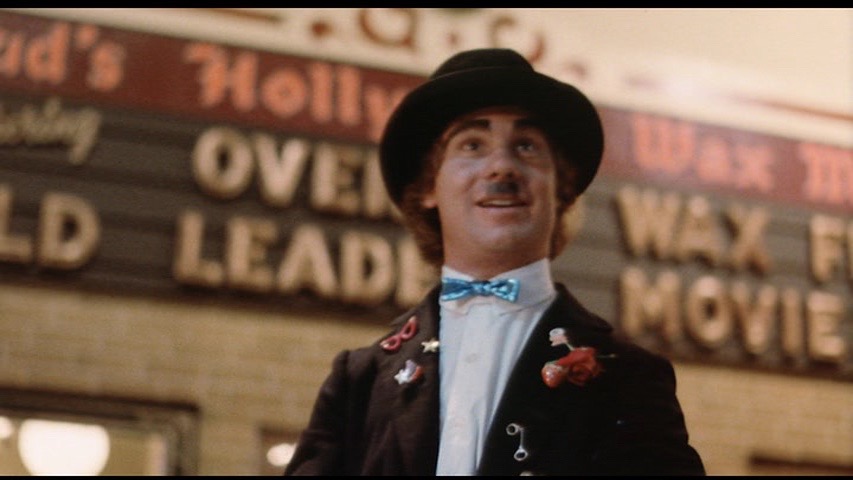
You got this so far? Donna Wilkes is Mary Pickford and Rory Calhoun is Tom Mix. Who’s next?
Charlie Chaplin of course!
I believe the movie wants these portions of the film to blur the lines between people peddling sex, and other people peddling Old Hollywood nostalgia. All of this going on while walking on stars for people who are dead, long forgotten, live far from this seedy place, or are going out on sad ends to their careers in their old age.
We see a variety of other colorful characters too. The movie makes sure we hear Kit tell the cops that he has fake bullets in his guns for foreshadowing purposes. A guy who looks like Jim Varney tries to hit on her. Then after turning down one guy, we see Angel riding with a much older guy. However, she sees right through him and figures out he’s a cop. That’s when we meet the another main character of the film named Mae played by Dick Shawn. How are we introduced to him?
He tells Angel not to let “fatso go yet”, sticks his head in the window, and tells him, “Why don’t you go home now and spank your monkey numb nuts!” That way know right off the bat that he is very protective of Angel.
Next we are introduced to Lt. Andrews…
played by none other than Cliff Gorman. Emory from The Boys in the Band (1970).
The Boys in the Band (1970, dir. William Friedkin)
It’s no coincidence that they introduce Mae back to back with Lt. Andrews seeing as Mae and Emory are similar characters.
You want to hear something really odd? Maud Adams’ first role listed on IMDb is an uncredited appearance in The Boys in the Band.
The Boys in the Band (1970, dir. William Friedkin)
The odd part is that Maud Adams is the villain in the third Angel movie.
Angel III: The Final Chapter (1988, dir. Tom DeSimone)
There’s one more connection here that’s worth mentioning. One of the movies Dick Shawn did in between It’s a Mad, Mad, Mad, Mad World (1963) and Penelope (1966) was a film called A Very Special Favor (1965). A Very Special Favor starring who else but Rock Hudson. The Rock Hudson movie where he actually says this.
A Very Special Favor (1965, dir. Michael Gordon)
Andrews is here to tell us about a killer on the loose who is murdering hookers. He gives us some info about him like he’s probably bisexual, a necrophiliac, and other things. Honestly, that stuff will barely play into this movie at all. It certainly won’t add anything material to the film. Now we cut to said killer played by John Diehl.
Most people probably remember him from Miami Vice. I’ve never watched the show though. I know, tsk tsk to me. He plays every serial killer from every 80s and early 90s movie ever made that had such a character in it. I’ll show you just how much of a stereotype he is later on. You’d think Mae was the major stereotype of the film, but it’s the killer.
Now we get a tender moment between Chaplin, who is called Yo-Yo Charlie (Steven M. Porter), and the soon to be dead hooker named Crystal (Donna McDaniel). According to IMDb, Yo-Yo Charlie will make a return in the sequel. That’s not good. Anyways, he gives her a spinning top, she is soon picked up literally and figuratively by the killer, and then stabbed in the back. I actually like what they did here. In any other movie her death would have started the film to be the opening kill, which also would have established there’s a killer on the loose. Here her death has meaning, still kicks off the plot, and foreshadows a much more important death later in the film that bookends this opening kill. We also have warmed up to her in the short time we have known her so the silent stab in the back actually has some bite and we feel for Charlie when he finds out she’s dead. It helps to set a different tone for the movie than a slasher film.
Then we see the killer with her body.
That will be the last time you see any reference to the necrophilia thing. It’s one of those things in here that makes me feel the movie was rushed because it will suddenly have amnesia about something that seems like it would be pretty important.
Then we cut back to the streets so we can hear Rory Calhoun drop some more names. He mentions Ken Maynard, Buck Jones, and I believe he is about to say William S. Hart when Angel sticks her finger in his back so I can make a reference to Field of Dreams (1989).
Field of Dreams (1989, dir. Phil Alden Robinson)
Field of Dreams (1989, dir. Phil Alden Robinson)
We have one final major character to be introduced to at this point. That’s why Mae and Angel go back to where they live so we can meet the landlord named Solly played by Susan Tyrrell. Mae accuses her of making the movie Truth (2015), but…
it turns out she is simply doing foreshadowing by numbers. She calls it Fruit With Gun. Mae calls it “shit.” Solly also has a gun about half the size of Angel for later plot convenience.
Now we get a couple of short scenes of Angel at home to start to reveal her background that will explain why her mother and father aren’t around. It’s also there so that we know that both Angel and the killer have troubled backgrounds when it comes to their parents. Except they have dealt with it in completely different ways, but ways that have both lead them to the streets. That’s when we get this scene.
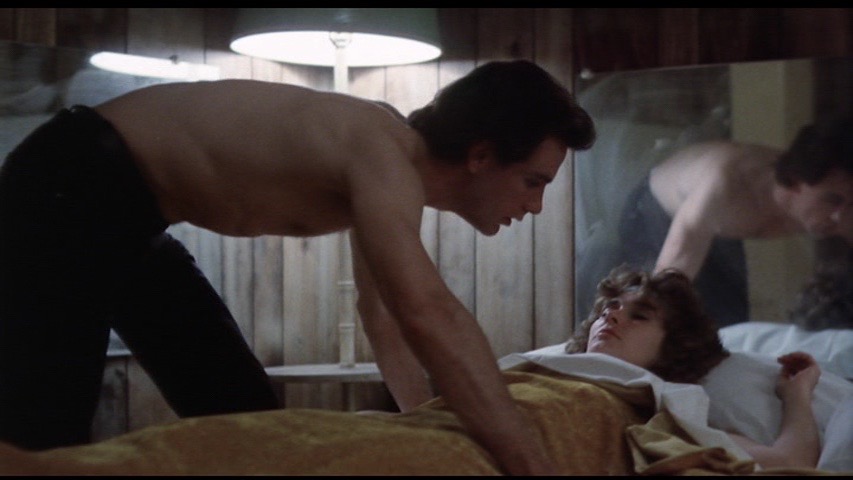
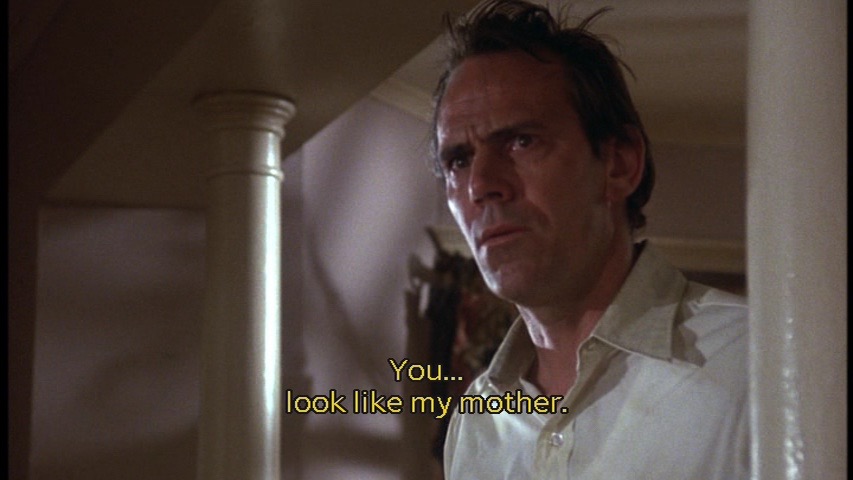
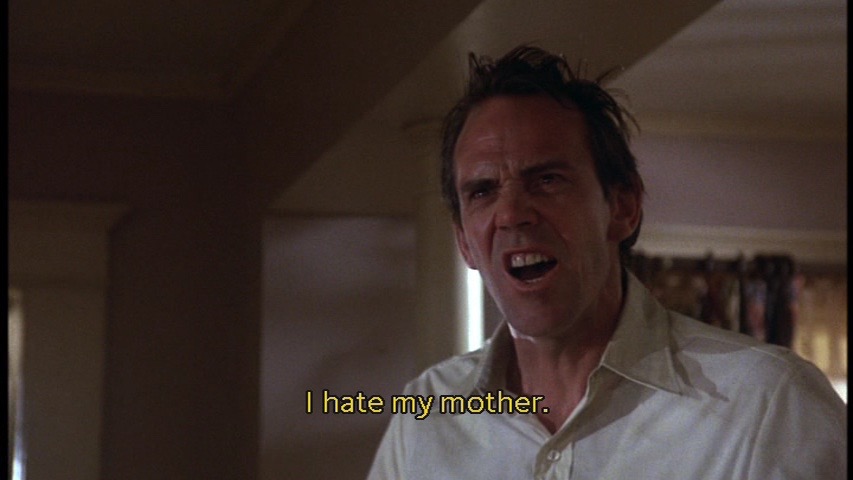
Yep, he makes out with an egg while a creepy picture of him and his mother hangs in the background till he crushes the egg, then kisses the picture. This movie came out in 1984. By 1986 they were already making fun of this exact kind of character.
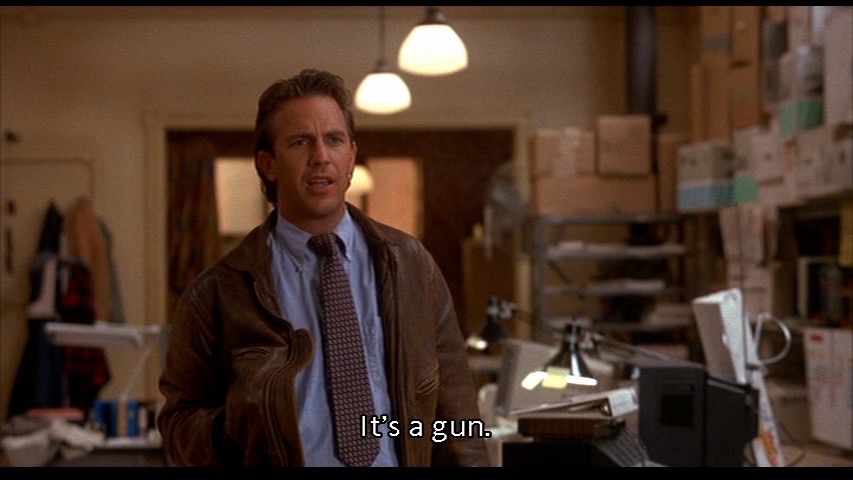
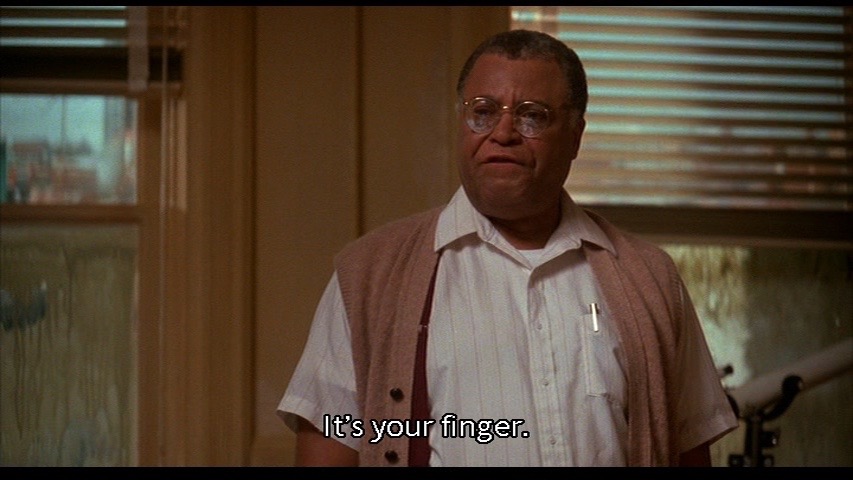
Ruthless People (1986, dir. Jim Abrahams, David Zucker, & Jerry Zucker)
Ruthless People (1986, dir. Jim Abrahams, David Zucker, & Jerry Zucker)
Ruthless People (1986, dir. Jim Abrahams, David Zucker, & Jerry Zucker)
Ruthless People (1986, dir. Jim Abrahams, David Zucker, & Jerry Zucker)
Might as well be the Bedroom Killer from Ruthless People (1986).
At this point we are about 25 minutes into the movie so it’s like it all of a sudden wakes up and remembers she’s supposed to be a high school student so we better cut back there now. Sometimes there’s an actual reason, and other times it is just there to work naked ladies into the movie because they could have done the scene without having them there. This time around we meet Ric who will be our Biff Tannen for the movie except with little to no plot significance.
You might recognize actor David Underwood if you owned a Sega CD back in the day.
Sewer Shark (1992, dir. John Dykstra)
It’s a shame he didn’t overact this part like he did Ghost in Sewer Shark.
We also meet Patricia Allen played by Elaine Giftos who works for Angel’s school.
She’s here so that the film will have a way of having Angel’s secret about not having her parents around anymore come out and give the last kill an extra punch to the stomach. Throughout this movie I kept thinking I had seen her in something else. Apparently that place was a single episode of Magnum P.I.
Magnum P.I.
I’m not sure what that says about me other than I must like that show more than I thought I did.
Now we finally come around so that our characters can discover the hooker from the beginning has been murdered. Charlie is quite broken up about it. He’s even holding the top he gave her, which is now covered in blood. Mae, Angel, and Kit have a run in with Andrews about their friend being murdered. But with no wasted time at all, we are reintroduced to another unimportant hooker friend from the beginning who runs right over to the killer and leaves with him. In short order she’s dead.
We see Angel arrive with a client who has a Quebec license plate?
Your guess is as good as mine about that one. He finds the dead hooker, then Angel finds her too. The movie cuts to the killer bare ass naked scrubbing himself. The scene seems to go on forever. You’d think this is some sort of I need to wash myself clean thing, but just like the necrophilia bit, it doesn’t amount to anything. At times it feels like there was originally a script for this movie that didn’t include his character because he almost feels like an afterthought. That, or there was a script that did have more for his character, but was cut so this film would only get an R rating.
Now we get one of several scenes in this movie that seem to only exist to remind us that Cliff Gorman, Dick Shawn, Rory Calhoun, and Susan Tyrrell are good actors. Say what you will about the movie, Donna Wlikes, and the fact that Lisa hasn’t reviewed her comeback film 90210 Shark Attack (2014), but they surrounded her with quality.
After Angel gets harassed by Sewer Shark, we cut to the locker room to see cheerleaders getting dressed. It’s weird because it suddenly feels like you’ve slipped out of Angel and into Debbie Does Dallas (1978).
We get a scene of our killer at a porno theater to remind us that Taxi Driver (1976) exists. Would have made my day if he were watching Bat Pussy (1973). He’s arrested and brought in for a lineup so that he can break free to nearly kill Angel and Andrews. This is when the movie gets on the fast track to its conclusion. This is only at about the halfway point, but the remainder of the film will be everything unraveling till Angel is pushed past the tipping point and decides to go Ms. 45 on the streets to get the killer.
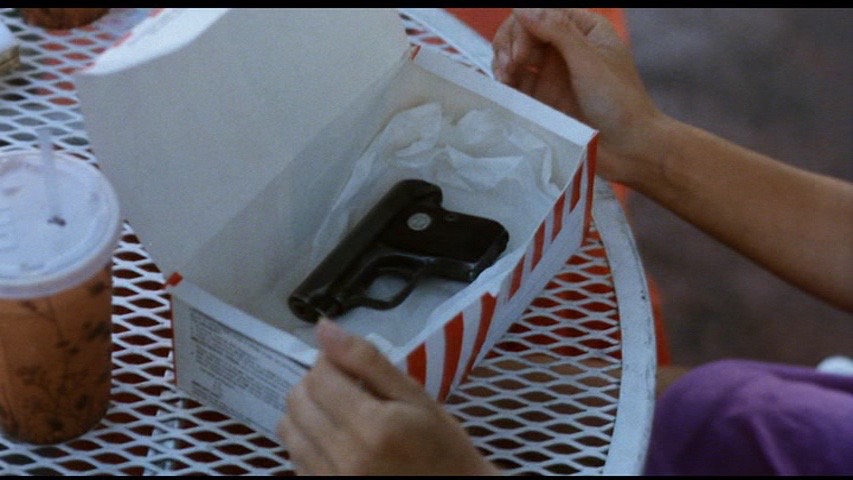
After we find out that Angel has been on the street since she was 12, the next important scene is between Mae and Angel. Angel buys a gun…
so that we can then see her visit a church and nearly drop it in the “Offerings” box. She comes close, but puts some money into it instead. Then empowering music plays as we get a long shot of her walking from the back to the front of the church.
Angel pays a visit to Kit’s place now. Not really so we can see her get a shooting lesson, but so that we can setup the ending by making us aware that Kit does indeed know how to shoot. He carries fake bullets when he works the streets, but the guns are real.
Now Angel gets kidnapped by Sewer Shark and his gang just so that we know that she not only has the gun and has been shown how to use that gun, but is willing to fire it if necessary. It’s a minor scene that doesn’t have much importance to the film in the end. Unlike the next scene when it cuts to naked women in the locker room showering. Actually this scene does serve a purpose beyond naked women. It’s there so that we can overhear that Sewer Shark has spread rumors about her, which ultimately leads Patricia to find Angel’s gun. To toss an extra cherry on top of her trauma, the Andy Dick looking guy from earlier actually tries to buy her services. It’s all enough that she now goes to Andrews to talk to him about what’s going on.
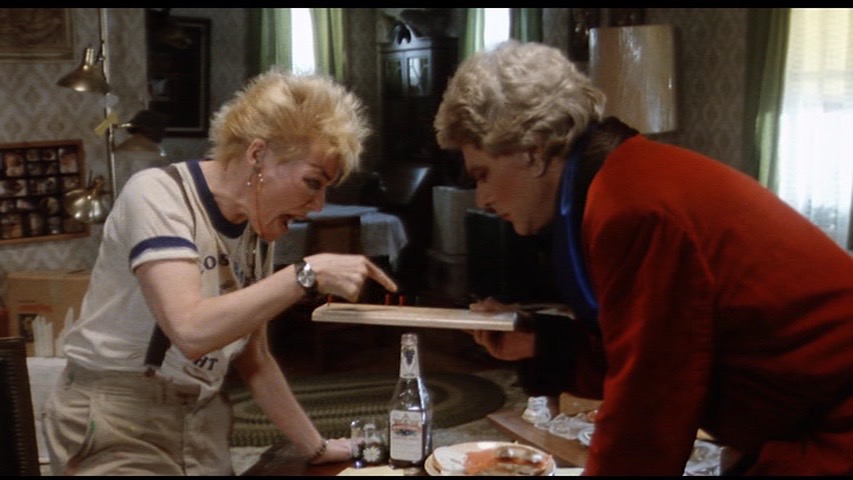
Now the film loops us back to the death of Crystal. It starts with Mae and Solly arguing over a game of cribbage like an old married couple. They are funny in this scene. Just like I could go for a TV Show made up of Bea Arthur tending bar from The Star Wars Holiday Special, I could also go for a whole movie with these two.
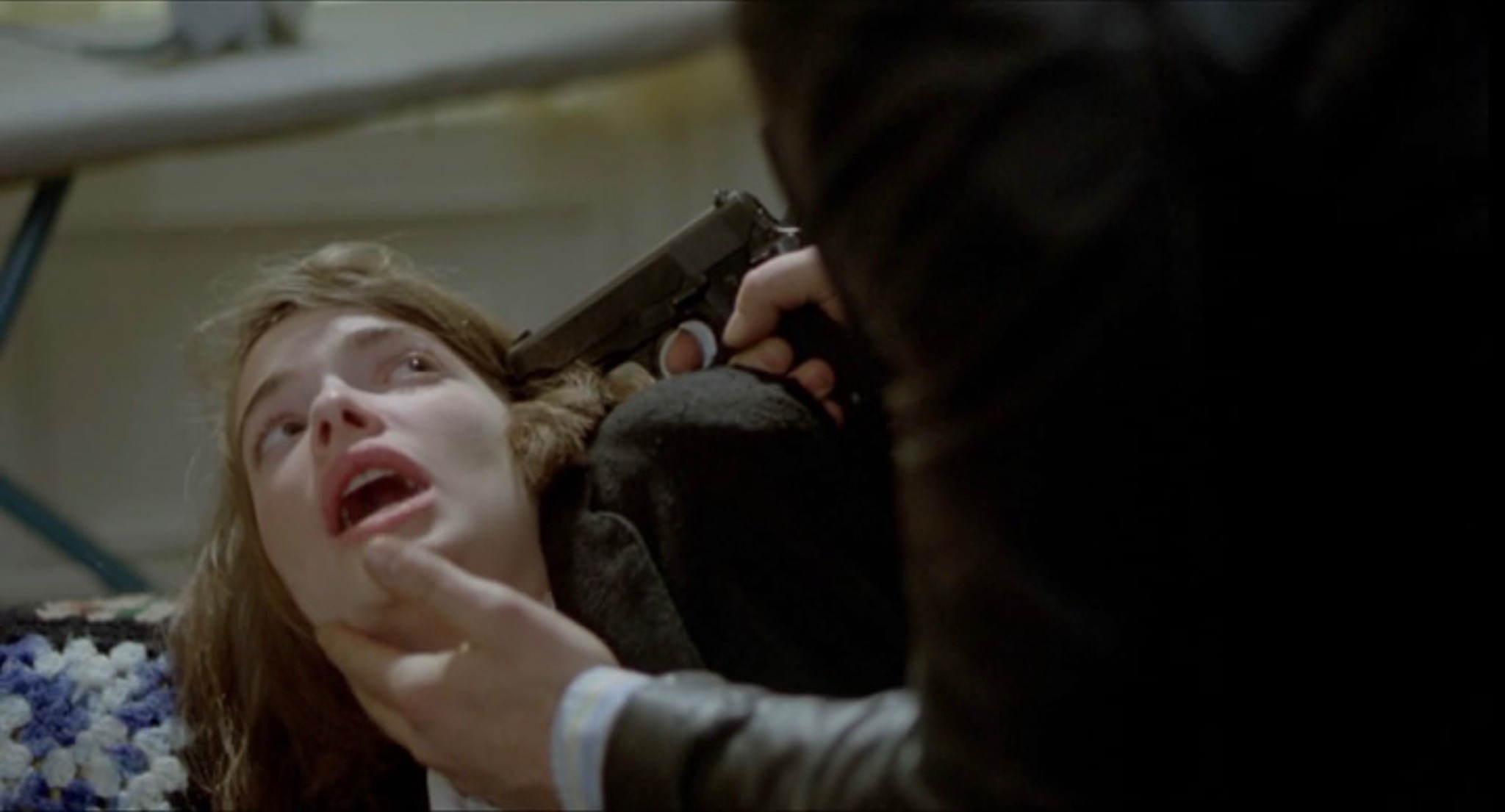
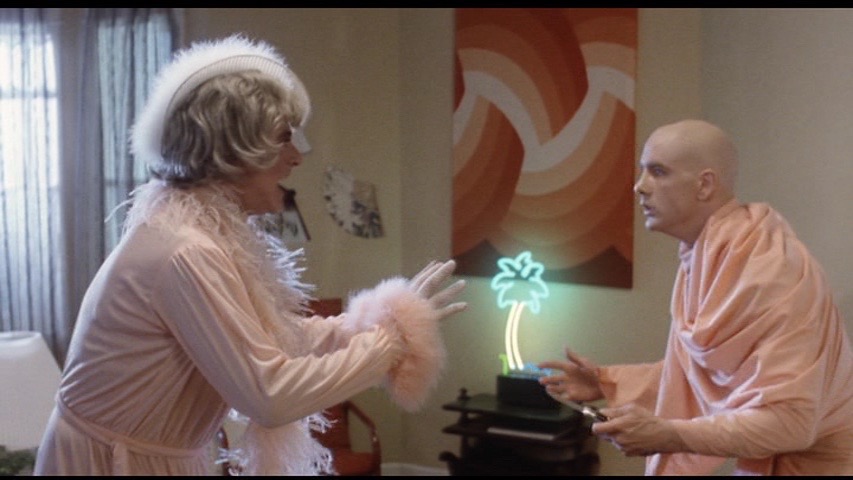
This scene is the equivalent of Charlie giving the girl his spinning top. We also get a scene where Mae tries to cover for Angel when Patricia comes to visit by pretending to be her mother. That works about as well as trying to convince the killer who now comes for Mae that it matters that he is a guy.
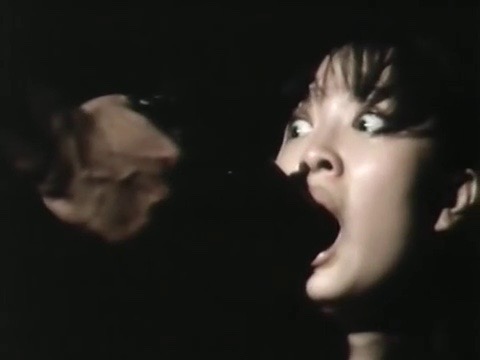
Look familiar?
Ms. 45 (1981, dir. Abel Ferrara)
Ms. 45 (1981, dir. Abel Ferrara)
They both die, but the difference is that they stuck in the conversation with Patricia here to remind us that Mae doesn’t deserve this whereas Ms. 45 edges in this one-sided conversation…
Ms. 45 (1981, dir. Abel Ferrara)
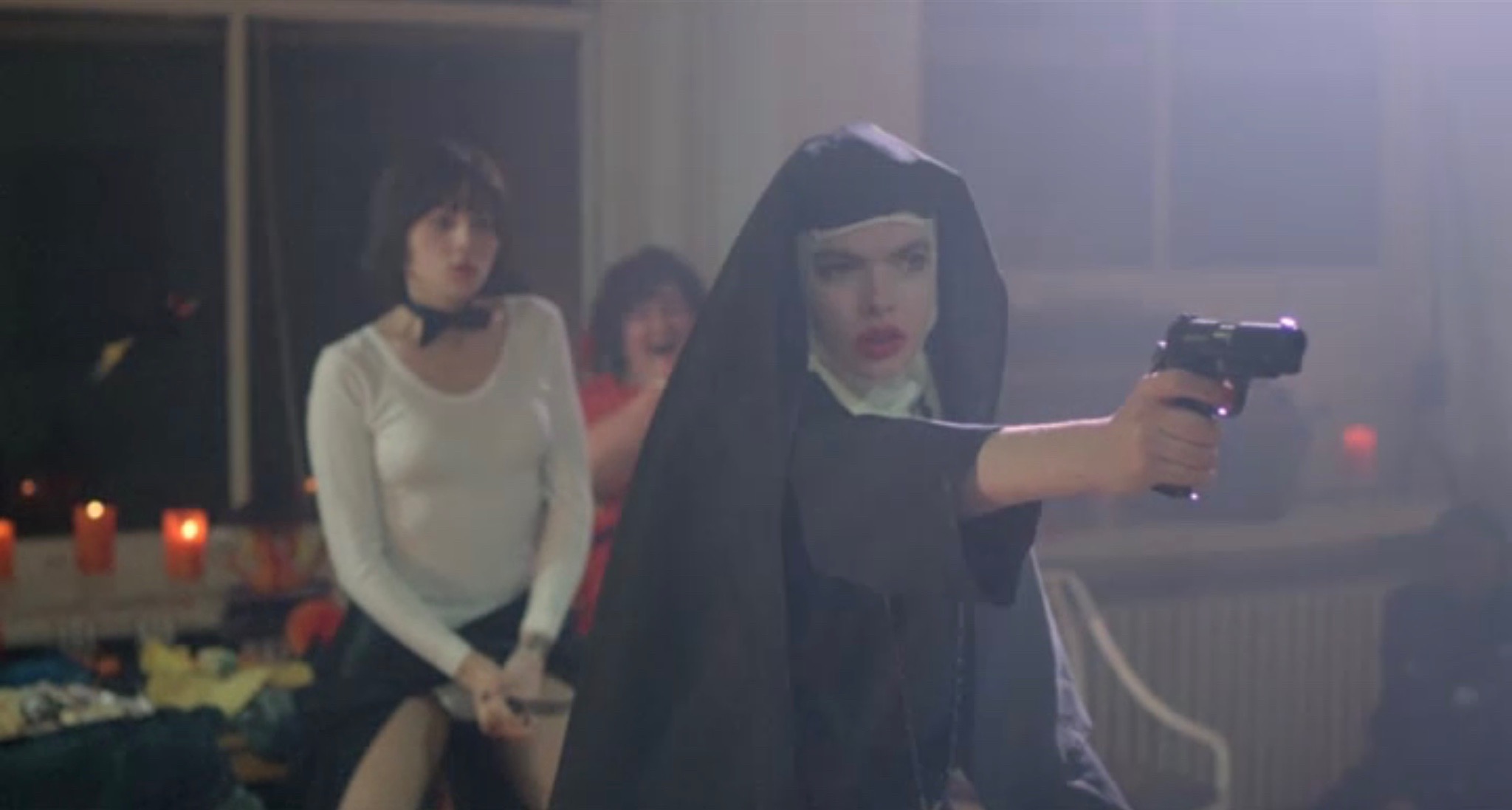
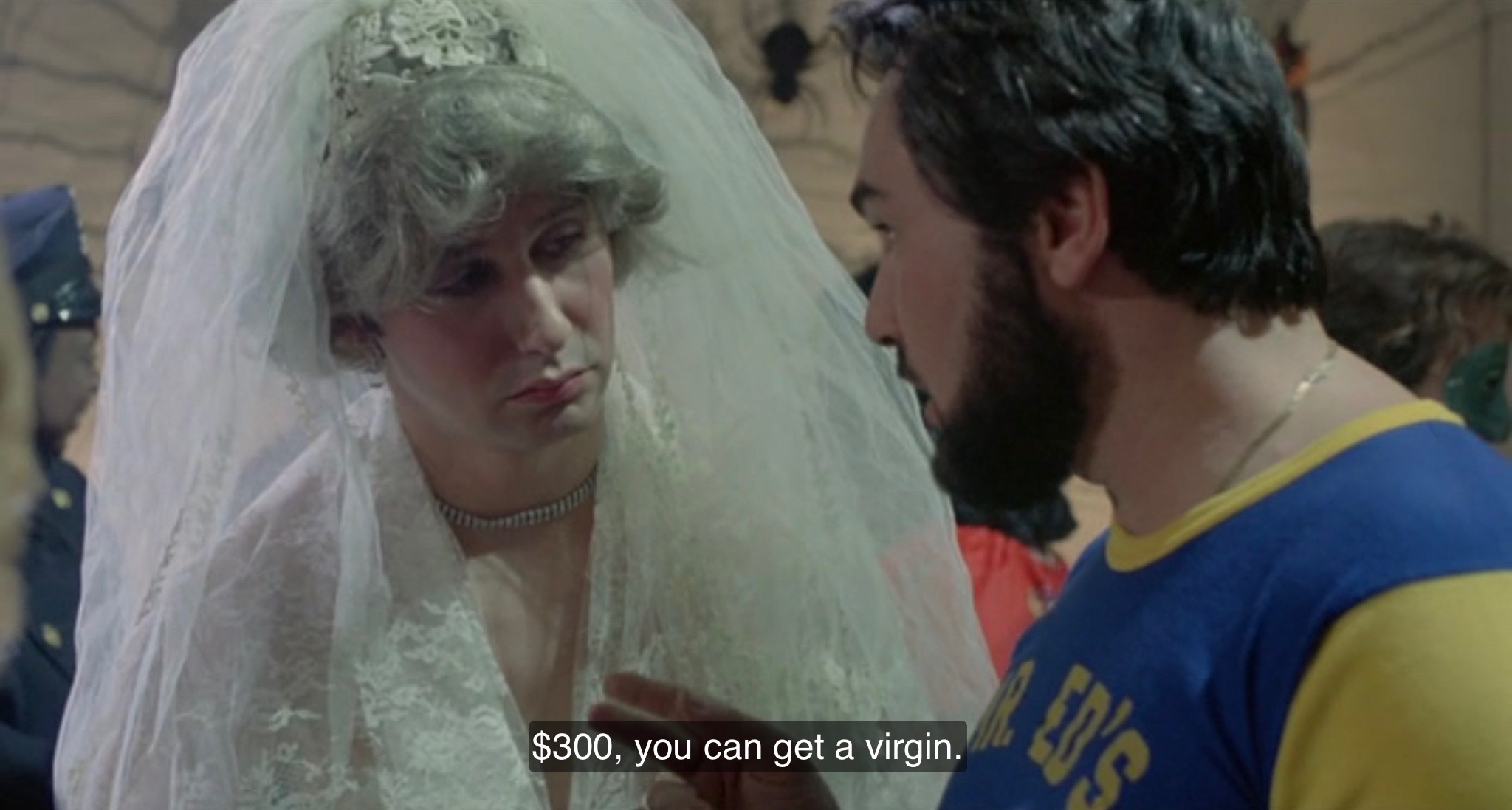
so that we know it’s okay that he was shot and killed. That’s most likely why we first met Mae looking like that guy in this movie.
You could even make an argument that the character of Mae and the casting of Cliff Gorman is the LGBTIQ response to that final scene where she guns down the man dressed as a woman, then adds on that she is shocked when a genetic girl (a betrayer of the cause?) stabs her in the back. This movie even won Best Feature at the San Francisco International Lesbian & Gay Film Festival so it’s not reaching too much on my part.
This is the last straw for Angel. She takes Solly’s giant gun to the streets in order to chase down the killer. They do it complete with repeating the opening scene, except with her walking us following her from behind, at night, in her night clothes, and armed.
Her already fractured innocence now gone.
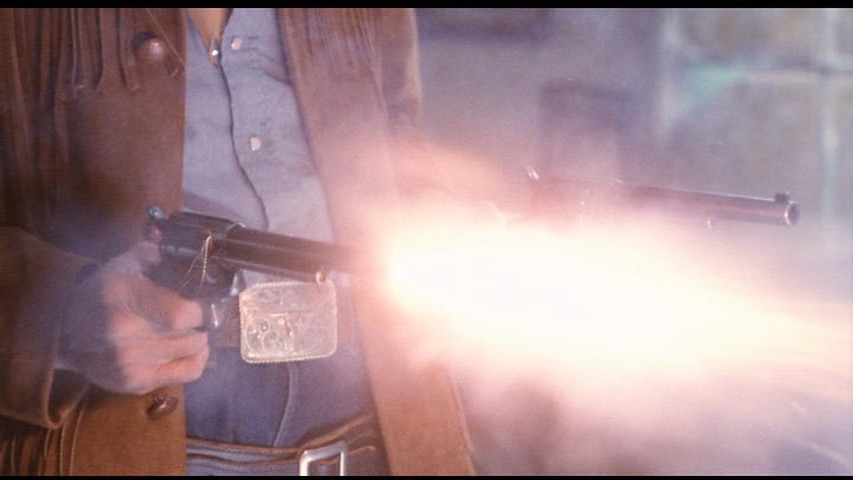
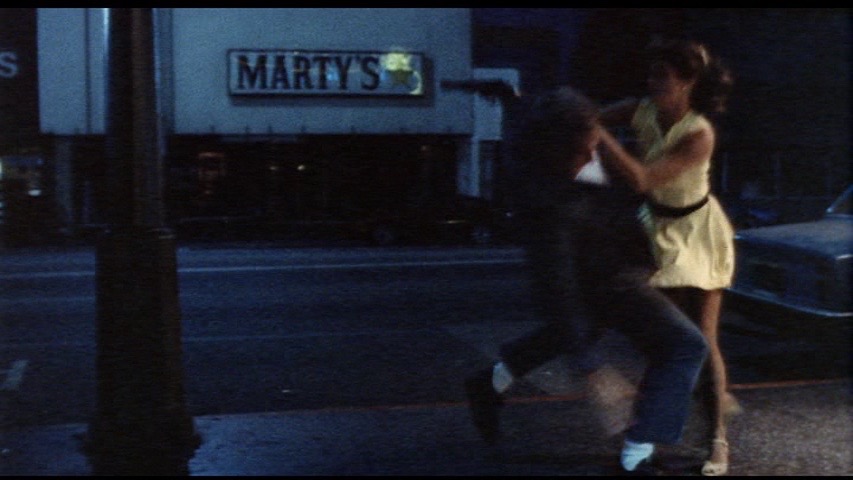
He probably would have gotten away hiding amongst the Hare Krishnas, but he comes out and tries to attack her with his knife. All the while, Andrews chasing after both of them along with Kit. There is a goof during this chase. She shoots at him here.
However, when they cut to this shot, she appears to have teleported away.
Then they cut back there to show she is indeed still around.
This is one of those parts where the film again reminds you it was probably made quickly.
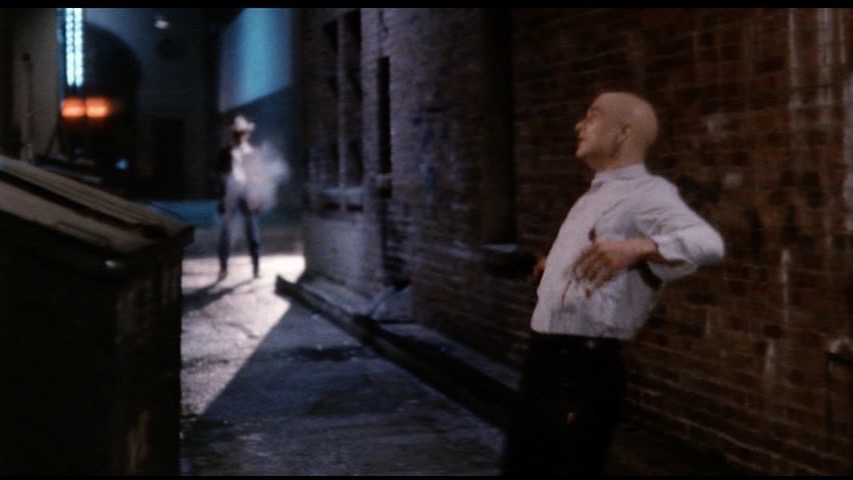
Seeing as it is the 80s, there is always a secluded alleyway or parking lot for the movie to go. We see Kit shot down before Andrews comes in to take shots at the bad guy and check on Kit. Kit tells him to go after Angel. The chase continues into another alleyway where the film comes its conclusion. Andrews calls to Angel, but she ignores him. The killer grabs Angel and shoots Andrews in the arm. She breaks free, causing Andrews to cover her to take any bullets, but doesn’t have to because Kit rises to the occasion to save both of them.
That’s when the movie essentially has its version of the ending of Targets (1968). Kit and Andrews look at him perplexed as the killer dies saying “It hurts. It hurts.”
With the plot finished, and a cowboy in the picture, they walk off into the not sunset of a neon lit alleyway end.
That’s the first Angel movie. Apparently, Ross Hagen was in here somewhere as “Urban Cowboy.” I have no idea where he was in this film.
The movie as a whole isn’t too bad. They certainly knew what they were doing when they picked the references, the shots they used, the casting, and surprisingly good main song for the movie. I also love the street life shots. I’m a sucker for movies that do that. I also liked the way they juxtaposed innocence in Angel with those who have lost theres to one degree or another while having Angel’s character make that journey herself walking down the Walk of Fame as a schoolgirl to a hooker with a gun. It seems that now days when I write one of these long looks at movies that probably don’t deserve this kind of attention, I either find they are much worse than I thought like Trancers 6 or much better than I thought like with this movie.
It is very much a movie of its time. The world had just come out of two decades of turmoil and was suddenly thrown into one that seemed to want to pretend the previous twenty years didn’t happen. It was also a time when you had a new breed of youth still co-existing with people who were from a time very far removed from the 80s as represented by Kit. To give you an example, Lillian Gish who was born in 1893, was not only alive when this came out, but made two more movies after it before dying in 1993. Mary Pickford had only died 3 years prior to this in 1979. Charlie Chaplin died 7 years prior in 1977.
Movies too had strayed for two decades into cinema the likes of which hadn’t been seen in the United States since movies like Baby Face an other pre-codes of the early 30s. However, after The Godfather and Star Wars films were so successful, the studios returned to the kind of films they made prior to the lifting of the production code. The difference being that they were no longer bound by such a code, but by the purse strings of whoever was funding the picture. That, and on occasion the clout of people working on the film, such as a directors like Tarantino.
Overall, I’d recommend seeing Angel. Especially as a counterpart to Ms. 45 (1981). Just fair warning again, it will feel rushed at times. I have a feeling that, just as with Trancers, this series will drop to watchable next, dreadful with the third film, and unbelievably bad with the fourth film which my “Angel Collection” triple feature doesn’t even acknowledge exists.





 When San Francisco-based private investigator Michael Brennen (O.J. Simpson) gives a ride to Joey Crawford (John Spencer) on Christmas Eve, he doesn’t know that it’s going to lead to the biggest case of his career. When Joey asks Michael to help him track down his ex-girlfriend, Michael assumes that Joey would never be able to pay for his investigative services. But one week later, Michael gets something in the mail from Joey. Inside the envelope, there’s a picture of both Joey’s ex and a thousand dollar bill. Ever after he discovers that Joey was mysteriously killed the night before, Michael decides to take on the case. His investigation will take him not only to Joey’s ex but it will also lead to him uncovering a drug ring that involves one of San Francisco’s most prominent families.















 Through the Shattered Lens