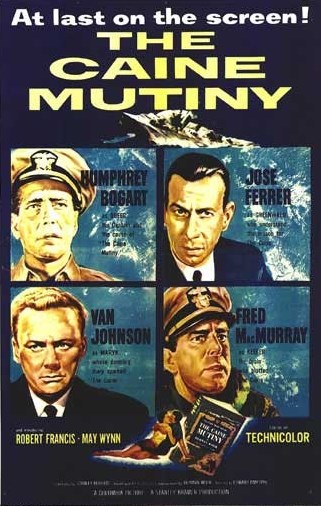
Lisa Reviews An Oscar Nominee: The Caine Mutiny (dir by Edward Dmytryk)


Mutiny_0

It’s the 1940s and World War II is raging.  The U.S. Navy is model of military discipline and efficiency.  Well, except for the U.S.S. Caine, that is.  The Caine is something of a disorganized mess, where no one takes his job seriously and sailors have names like Meatball (Lee Marvin) and Horrible (Claude Akins).  The men love Lt. Commander DeVriess (Tom Tully), largely because he has given up on trying to enforce any sort of discipline.  However, DeVriess has recently been relieved of his command.  As he leaves, Meatball gives him a new watch, a gift from all the men.  DeVriess admonishes them, snapping that the gift is violation of Naval regulations.  He then puts the watch on his wrist and leaves the ship.

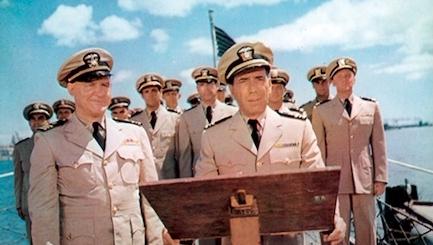
DeVriess’s replacement is Captain Francis Queeg and, at first, we have reason to be hopeful because Captain Queeg is being played by Humphrey Bogart.  Surely, if anyone can get this ship into shape, it’ll be Humphrey Bogart!  From the moment he arrives, Queeg announces that he’s going to enforce discipline on the Caine and if that means spending hours yelling at a man for not having his shirt tucked in, that’s exactly what Queeg is prepared to do.  However, it also quickly becomes apparent that the awkward Queeg has no idea how to talk to people.  He is also overly sensitive and quick to take offense.  Whenever Queeg makes a mistake (and he does make a few), he’s quick to blame everyone else.
the-caine-mutiny-deck

Realizing that the men are turning against him, Queeg even begs his officers for their help.  He asks them if they have any suggestions.  They all sit silently, their heads bowed as Queeg somewhat poignantly rambles on about how his wife and his dog both like him but the crew of the Caine does not.

Queeg’s officers are a diverse bunch, none of whom are quite sure what to make of Queeg or the state of the Caine.  Ensign Willie Keith (Robert Francis) is a wealthy graduate of Princeton University who, at first, likes Queeg but quickly comes to doubt his abilities.  On the other hand, Lt. Steve Marsyk (Van Johnson) has doubts about Queeg from the start but, as a career Navy man, his natural instinct is to respect the chain of command above all else.

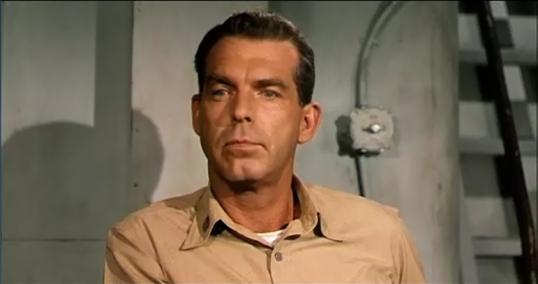
And then there’s Lt. Tom Keefer (Fred MacMurray).  Keefer is a self-styled intellectual, a novelist who is always quick with a snarky comment and a cynical observation.  (If The Caine Mutiny were remade as a B-horror film, Lt. Keefer’s name would probably be Lt. Sardonicus.)  From the minute the viewers meet Lt. Keefer, our inclination is to like him.  After all, he seems to be the only person in the film who has a sense of humor.  If we had to pick someone to have dinner with, most of us would definitely pick the erudite Tom Keefer over the humorless and socially awkward Francis Queeg.  As such, when Keefer starts to suggest that Queeg might be mentally unstable, our natural impulse is to agree with him.

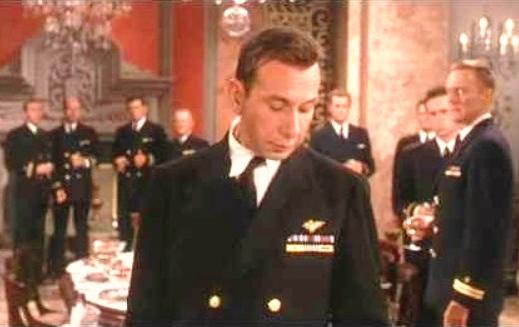
It’s Tom Keefer who first suggests that it may be necessary to take the command away from Queeg.  And yet, when it comes time to take action, it’s Keith and Marsyk who do so while Keefer stands to the side and quietly watches.  And, once the Caine arrives back in the U.S., it Keith and Marsyk who are court martialed.  Will they be found guilty of treason or will their lawyer, Lt. Barney Greenwald (Jose Ferrer), prove that Queeg was unfit for command?
the-caine-mutiny-ferrer

Made in 1954 and based on a novel by Herman Wouk, The Caine Mutiny is one of those big and glossy 1950s productions that holds up a lot better than you might expect.  The film has its flaws.  In the role of Keith, Robert Francis is a bit on the dull side and a subplot in which he courts May Wynn feels unneccessary and only serves to distract from the main story.  But, for the most part, it’s an intelligent and well-directed film.  Humphrey Bogart turns Queeg into a pathetic and lonely figure and you can’t help but feel sorry for him when he talks about how his dog loves him.  Van Johnson also does well as Marsyk, effectively portraying a well-meaning character who is in over his head.  Jose Ferrer gets a great drunk scene at the end of the film and, of course, you can’t go wrong with Lee Marvin as a smirking sailor, even if Marvin only appears for a handful of minutes.
Fred MacMurray The Caine Mutiny

But for me, my favorite character (and performance) was Fred MacMurray’s Tom Keefer.  Technically, Keefer is not meant to be a likable character.  He’s totally passive aggressive.  He’s pretentious.  He’s smug.  At times, he’s rather cowardly.  And yet, Tom Keefer remains the most memorable and interesting character in the entire film.  He gets all of the good one-lines and MacMurray delivers them with just the right amount of barely concealed venom.  (“If only the strawberries were poisoned…” he says as he considers dinner aboard the Caine.)  It’s a great role and Fred MacMurray gives a great performance.  And you know what?  I don’t care how bad a character he may have been.  I still want to read Tom Keefer’s book!

The Caine Mutiny was nominated for best picture of 1954.  However, it lost to On The Waterfront.

Horror on the Lens: The Norliss Tapes (dir by Dan Curtis)


Today’s Horror on the Lens is The Norliss Tapes, a 1973 made-for-TV movie that was also a pilot for a television series that, unfortunately, was never put into productions.

Reporter David Norliss (Roy Thinnes) has disappeared.  His friend and publisher, Stanford Evans (Don Porter), listens to the tapes that Norliss recorded before vanishing.  Each tape details yet another paranormal investigation.  (Presumably, had the series been picked up, each tape would have been a different episode.)  The first tape tells how Norliss investigated the mysterious death of an artist who apparently returned from the grave.

For a made-for-TV movie, The Norliss Tapes is pretty good.  It’s full of atmosphere and features a genuinely menaching yellow-eyed zombie monster.

Enjoy!


Embracing the Melodrama Part II #23: The Defiant Ones (dir by Stanley Kramer)


Defiant_Ones_poster

Stanley Kramer is one of those old school filmmakers who directed several films that were acclaimed when they were originally released but who tends to be dismissed by contemporary film critics.  Kramer specialized in making films about social issues and he deserves to be applauded for attempting to look at issues that Hollywood, at that time, would have preferred to ignore.  However, as Mark Harris points out in his excellent book Pictures At A Revolution, Kramer started out as a producer and, even after he started directing, he never lost his producer sensibility.  As a result, a Kramer film would typically address issues that were guaranteed to generate a lot of free publicity but, at the same time, Kramer would never run the risk of truly alienating his audience by digging too deeply into those issues.  As a result, Kramer’s films have come to represent a very safe and middlebrow version of 50s and early 60s style liberalism.

Now, I have previously reviewed 4 Stanley Kramer films on this site and I have to admit that I was somewhat dismissive of most of them.  I felt that Ship of Fools was shallow.  I thought that Guess Who’s Coming To Dinner collapsed under the combined weight of a self-satisfied script and Kramer’s refusal to let Sidney Poitier’s character be anything other than idealized perfection.  R.P.M. is a guilty pleasure, specifically because Kramer was so out-of-touch with the film’s subject matter.  I did give Judgment at Nuremberg a good review, describing it as one of Kramer’s rare films that still holds up today.

And now, I’m going to give another Kramer film a good review.

Kramer’s 1958 film The Defiant Ones features a classic Kramer situation.  White Joker (Tony Curtis) and black Noah (Sidney Poitier) are both prisoners in the deep south.  Joker is an unrepentant and violent racist while Noah … well, Noah is Sidney Poitier.  He’s determined, he’s not afraid to speak his mind, and most of all, he’s dignified.  That’s not meant to be a complaint about Poitier’s performance in The Defiant Ones.  In the role of Noah, Poitier has a great screen presence and it’s impossible not to root for him.  Whereas Curtis tends to chew up every piece of scenery that he gets nears (and, again, that’s not really a complaint because Curtis’s overacting is totally appropriate for his character), Poitier keeps the film grounded.

When the prison bus that is transporting them crashes, Joker and Noah are able to escape.  Fleeing on foot, they make their way through the wilderness and attempt to hide from the police.  As quickly becomes obvious, Joker and Noah hate each other but, because the sheriff had a sense of humor, they have also been chained together.  In other words, they’re stuck with each other and, in order to survive, they’re going to have to learn to coexist.

No, it’s not exactly subtle but it works.

As a filmmaker, Kramer was never known for being visually inventive and, as a result, his films often had to resort to heavy-handed monologues to make their point.  But, in The Defiant Ones, the chains act as a great visual symbol for race relations in America.  Joker and Noah literally can’t escape from each other and they have to work together if they’re going to survive.  The chains make that obvious and, as a result, this is the rare Kramer film where nobody has to give a big speech to get across Kramer’s message.  As a result, The Defiant Ones preaches without ever getting preachy.

Though the film is dominated by Poitier and Curtis, it also features some excellent supporting work.  Lon Chaney, Jr, for instance, has a great cameo as world-weary man who helps the two convicts in their flight.  Cara Williams is surprisingly poignant as a lonely, unnamed woman who tries to both protect Joker and get rid of Noah.  And finally, there’s Theodore Bikel, playing the role of Sheriff Max Muller.  Max is the most surprising character in the film, the head of a posse that’s set out to recapture Noah and Joker.  As opposed to most of his men, Max is a humane and caring man who struggles to control the more bloodthirsty men who are serving under him.

Message films tend to get dated rather quickly but The Defiant Ones holds up surprisingly well.

Horror On TV: Twilight Zone 1.22 “The Monsters Are Due On Maple Street”


TheTwilightZoneLogo

As Halloween comes to a close, so does both horror month here at the Shattered Lens and our series of televised horrors. What better way to finish out this feature than with one of the best known and most popular episodes of The Twilight Zone?

There’s a lot I could say about The Monsters Are Due On Maple Street but really, all that needs to be acknowledged is that it’s a classic and it features one of the best endings ever. As well, it also contains an important message about paranoia and conformity that remains as relevant today as when the episode was first broadcast.

The Monsters Are Due On Maple Street was written by Rod Serling and directed by Ron Winston. The episode was originally broadcast on March 4th, 1960.

A Quickie With Lisa Marie: Battle for the Planet of the Apes (dir. by J. Lee Thompson)


And so, we reach the end of the original series of Planet of the Apes films.  Battle for the Planet of the Apes was the cheapest of the Apes films and most critics agree that it’s also the worst.  Sad to say, I happen to agree with them.  If nothing else, Battle For The Planet of the Apes is the only one of the original Apes films that fails to even reach the meager level of quality of Tim Burton’s remake.

The film begins a decade after the end of Conquest of the Planet of the Apes.  A nuclear war has destroyed what was left of human society.  It’s never made clear if that war was between apes and human or between humans and humans.  All that is clear is that the Apes are now firmly in charge of the world.  Caesar (Roddy McDowall) leads the Apes civilization.  Humans, while clearly second class citizens, are treated relatively well by the Apes.  Early on in the film, Caesar views archival footage of his parents and learns of what the future holds.  He immediately makes move to try to prevent that future from occurring.

However, all is not well.  Gorilla general Aldo (Claude Akins) hates humans and is secretly plotting a military coup to overthrow Caesar.  Meanwhile, over in the Forbidden City (a.k.a. New York), there’s a tribe of radiation-scarred humans who are being led by Kolp (Severn Darden), the sadistic torturer from Conquest of The Planet of the Apes.  Driven mad by the ravages of war, Kolp and his followers are plotting to launch their own last-ditch attack on Caesar and the apes.

So much of this film can be legitimately criticized, from the cheap look (the apes are no longer characters but instead just actors in rubber masks) to the predictable storyline.  So, instead of focusing on what’s wrong with this film, I’m going to highlight the handful things that actually did work.  While few of the performers make any effort to invest their characters with any sort of life, both McDowall and Darden give strong performances.  Darden, in particular, makes a great villain and it’s a shame that he didn’t get a better film in which to show off.  Predictable as the film is, there’s a few memorable touches, my favorite being Kolp and his followers converting a bunch of school busses into armored attack vehicules.

As well, Battle for the Planet of the Apes may ultimately feel like an unnecessary chapter in the whole Planet of the Apes saga but the film, at the very least, makes the effort to provide some sort of continuity with the other films in the series.  Kolp and his followers are obviously meant to be the ancestors of the bomb-worshipping mutants from Beneath the Planet of the Apes and, in one of my favorite little touches, Kolp’s assistant is named Mendez.  If you’ll remember, the leader of the mutants in Beneath was named Mendez the Tenth. 

It’s those little touches that show that the filmmakers, at the very least, respected their viewers enough to maintain the continuity of the series.  As bad a film as Battle is (and it’s definitely not very good), it can still teach a valuable lesson to today’s filmmakers.