Jimmy Stewart is one of the great actors of all-time, and he’s personally one of my very favorites. I did not realize a movie had been made about him until I stumbled across this trailer today. Check it out!
Tag Archives: Christopher McDonald
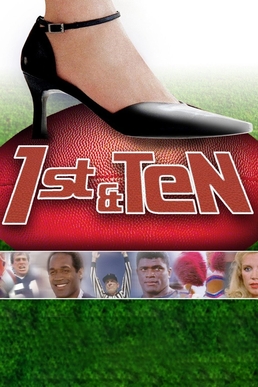
Late Night Retro Television Review: 1st & Ten 2.5 “California Freeze Out”
Welcome to Late Night Retro Television Reviews, a feature where we review some of our favorite and least favorite shows of the past! On Wednesdays, I will be reviewing 1st and Ten, which aired in syndication from 1984 to 1991. The entire series is streaming on Tubi.
Victory’s yours …. for that taking….
Ugh, let’s do this.
Episode 2.5 “California Freeze Out”
(Dir by Bruce Seth Green, originally aired on September 22nd, 1986)
Training camp continues!
Oh, Good Lord, does it continue.
And look, I get it. This was a low-budget show that relied on stock footage for the majority of its game footage. There was probably only so much footage available. Not every episode could feature a game. And training camp is an important part of football and I’m sure that, back in 1986, HBO was proud of that set they built for the ugly bar where all the players hang out. It’s not a bad set. You look at it and you can literally smell the rancid combination of sweat and urine that seems to follow most male athletes.
But seriously …. I’M TIRED OF TRAINING CAMP! Its time to move on!
As for this episode …. hey, Waldren is already back from rehab and he’s clean! That was quick. However, shady quarterback Johnny Valentine continues to hang out with drug dealers and Waldren gives into temptation. He ends up at a raucous drug party that’s busted by the cops. Waldren jumps out of a window. His date is accidentally shot. You might think that Johnny Valentine would be in trouble considering how anti-drug the league has become but it turns out that Johnny is a star and busting him would effect ad revenue. So, Johnny gets off scot-free.
Meanwhile, O.J. Simpson — whoops, sorry, I meant to say T.D. Parker, don’t hurt me, Vengeful Spirit of O.J. — recruits a young player named Rick Lambert (Marcus Allen) to be the team’s new running back. Marcus Allen gave such a stiff performance that I immediately realized that he had to have been an actual player and it turns out that I was right. You can always tell the actual players because they’re the ones who can never summon up any emotion when they stumble through their lines. O.J. was the epitome of a player who became a bad actor but he came across as being …. well, not quite Olivier but maybe David Niven, while acting opposite Marcus Allen. Maybe that’s why Allen was added to the cast, to make O.J. look good.
Anyway, here’s hoping that O.J. and the rest of the Bulls slash their way out of training camp soon!
The Films of 2025: Happy Gilmore 2 (dir by Kyle Newacheck)
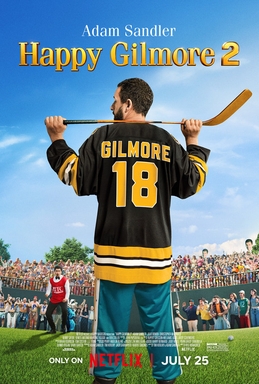
I love 1996’s Happy Gilmore and, over the past few months, I have very much been looking forward to the release of the long-delayed sequel, Happy Gilmore 2. Still, I was a bit concerned when I opened the film on Netflix and discovered that the sequel had a nearly two-hour running time. (The original clocked in at an efficient and fast-paced 90 minutes.) Comedy is all about timing and, in general, shorter is funnier. I know that Judd Apatow and Adam McKay might disagree with me on that but let’s be honest. For all of the acclaim that it was met with, when was the last time you actually felt any desire to rewatch The King of Staten Island? For that matter, if you have to pick between Anchorman or Anchorman 2, which are you going to pick? The 90 minute original or the sequel that takes more than two hours to tell essentially the same story?
Having now watched the film, I can say that Happy Gilmore 2 does run a bit too long. There are a few sequences that could have been trimmed without hurting the film. I can also say that I thoroughly enjoyed the film. I laughed more often than not. It’s a funny film but it’s also a surprisingly touching one.
Taking place 29 years after the first film, Happy Gilmore 2 features an older and slightly more mature Happy. It also features an older and slightly more mature Adam Sandler and, to its credit, the film acknowledges that. It doesn’t try to convince us that Sandler and Gilmore are still the young hell-raisers that they once were. (Happy’s Happy Place has changed considerably.) I’ve often written that there are two Adam Sandlers. There’s the youngish Sandler who made silly and often stupid films where he basically just hung out with his friends and didn’t seem to put much effort into anything. That’s the Sandler who has won multiple Razzie awards. And then there’s the older and wiser Adam Sandler, the sad-eyed character actor who gives sensitive performances as world-weary characters. This is the Adam Sandler who seems to be overdue for an Oscar nomination. If an alien came to Earth and only watched Adam Sandler’s serious films, they would probably think he was one our most-honored actors. While Happy Gilmore 2 is definitely a comedy, it still features quite a bit more of the serious Sandler than I was expecting.
At the start of the movie, Happy is not in a happy place. His grandmother has passed away. His wife, Virginia, was killed by an errant tee shot. He has four rambunctious sons and a daughter, Vienna (played by Sunny Sandler, who was so good in You Are So Not Invited To My Bat Mitzvah). After Virginia’s death, Happy gave up golf. He lost his money. He lost his grandmother’s house. Now, he’s working in a grocery store and he’s an almost forgotten figure. He’s also an alcoholic, keeping bottles of liquor hidden around the house. (A tiny liquor bottle is hidden in the cuckoo clock.) And while this film is certainly not Uncut Gems or even The Meyerowitz Stories, Sandler still does a good job of capturing the reality of Happy’s depression. There’s a true sense of melancholy running through the film’s first hour, as Happy returns to golf to try to make enough money to pay for Vienna to attend a prestigious dance academy. The second hour, in which Happy leads a team of pro golfers against a team of “extreme” athletes is far more goofier but Happy’s love for his family is a theme that runs through the entire film.
Aging is the other theme that runs through the film. Forced to play with three younger players (including Eric Andre and Margaret Qualley) at a local golf course, the rusty Happy grimaces when he hears one of them say, “Is he trying to do the Happy Gilmore swing?” When Happy rejoins the PGA, he discovers that all of the younger players now hit the ball as hard as he used to. An obnoxious tech bro (Benny Safdie) wants to start a new, extreme golf league, one that will “continue the revolution” that Happy started. Happy finds himself defending traditional golf and it’s an acknowledgement that both Gilmore and Adam Sandler have grown up and have come to appreciate that not everything needs to change. Sometimes, you just want to play a nice round of golf on a pretty course without having to deal with the sensory overload of the 2020s.
It’s a funny movie. Even when he’s playing it straight, Sandler still knows how to deliver a funny line. Ben Stiller returns as Hal L., who is now an addiction recovery specialist. (His techniques include ordering people to wash his car.) Christopher McDonald also returns as Shooter McGavin, having escaped from a mental asylum and now fighting, alongside Happy, to save the game that they both love. As someone who always felt that Shooter kind of had every right to be upset during the first film, I was happy to see him get a bit of redemption. Several professional golfers appear as themselves. A running joke about Scottie Scheffler getting arrested and then forcing all of his cellmates to watch golf made me laugh a lot more than I was expecting it too.
The sequel is full of shout-outs to the first film. A fight in a cemetery reveals that everyone who died during and after the first film just happens to have a gravestone and it was actually kind of a nice tribute. (Even the “Get Me Out Of Here” Lady gets a headstone.) It’s a sequel that truly appreciates and values the legacy and the fans of the first film. It’s also a sequel that seems to truly love the game of golf, which is not necessarily something that could be said about the first film.
Happy Gilmore 2 is a worthy sequel, even if it is a bit long. It made me laugh but, at the same time, it was hard not to be touched by the obvious love that Happy had for his family and that they had for him. (It didn’t hurt that Happy’s daughter was played by Sandler’s daughter.) In the first film, Happy played golf for his grandmother. In the second film, he returns to the game for his daughter. It’s all about family, as Adam Sandler’s unexpectedly heartfelt performance makes clear.
So, I Watched Grind (2003, Dir. by Casey La Scala)
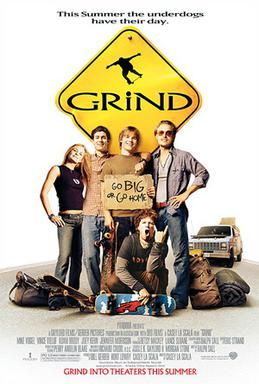
Grind is about four annoying skaters who are obsessed with bodily functions and who want to get sponsored so they travel across the country and try to con their way into competing in events. Adam Brody plays the skater who lets them use his college fund to pay for their road trip, which was really stupid of him to do. They got sponsored but not because they’re any good. They just happen to meet a skater named Jamie (Jennifer Morrison) who knows their hero (Jason London) and helps them out because she’s nice. I’m nice too but I wouldn’t have helped out those chuckleheads. I guess the lesson here is that you should just stand around and eventually, someone will give you some money.
When I started Grind, I thought it seemed familiar but I could have sworn that I have never seen it before. Then Matt (Vince Vieluf), one of the most disgusting character to ever appear in a movie, told a woman that he was a representative of the “Release Them Twins Foundation,” and I remembered that, when this movie came out, MTV used to show the commercial for it a hundred times a day. I remembered thinking, at the time, that it looked like the dumbest movie ever made and it turns out I was right.
If I had to choose between rewatching Grind or watching two hours of projectile vomit, it wouldn’t be a choice because they’re pretty much the same thing.
I Watched 61* (2001, Dir. by Billy Crystal)
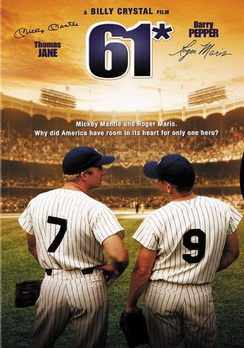
61* is about two baseball player and two friends who couldn’t seem to be more different.
Roger Maris (Barry Pepper) is an introverted family man who doesn’t like it when reporters show up at his house in search of a story or a quote. He’s a good ball player, one of the best, but he doesn’t want to be a celebrity. Mickey Mantle (Thomas Jane) is a larger-than-life personality, a beloved figure on the field and in the dugout. Mickey loves being famous and the fans love him. Both Maris and Mantle are members of the New York Yankees. Because Mantle is struggling with his drinking, he becomes Maris’s roommate when they’re on the road. In 1961, the two friends both go after Babe Ruth’s record of 60 home runs in a season. The press presents their season as a battle, a race to see who will be the first to hit the sixty-first home run of the season. Mantle and Maris, though, are just swinging the bat and making plays.
I really enjoyed 61*, which is a baseball film made by and for people who love baseball. I liked the contrast between the quiet Maris and the charismatic Mantle. Even though Maris is a hard worker and a good ballplayer, Mantle is the fan favorite and the one that people actually want to break the record. I appreciated that Maris and Mantle remained friends even when the press tried to turn them into rivals. That’s what teamwork is all about. Barry Pepper and Thomas Jane were great as Maris and Mantle and the movie showed how each man dealt with the stress of possibly breaking Babe Ruth’s record.
(Why is there an asterisk in the title? Babe Ruth set his record in a season that only had 154 games. The 1961 baseball season was 8 games longer. The asterisk was added as a reminder that Maris and Mantle had 8 more games than Ruth did to try to break the record. Baseball fans understand how important accurate statistics are to a player’s career and a team’s season.)
61* celebrates the way baseball used to be, a game played by athletes who had to depend on skill and teamwork instead of performance enhancing drugs. The movie opens with Maris’s family watching as Mark McGuire closes in on breaking the record. McGuire would only briefly hold the record. He would lose it, for 48 minutes, to Sammy Sosa and then, three years after winning it back, he would lose it a second time to Barry Bonds. Of course, Roger Maris won the record without using steroids so, as far as I’m concerned, it still belongs to him.
If you’re a baseball fan, 61* is a film that you have to see.
Late Night Retro Television Reviews: Gun 1.2 “Ricochet”
Welcome to Late Night Retro Television Reviews, a feature where we review some of our favorite and least favorite shows of the past! On Tuesdays, I will be reviewing Gun, an anthology series that ran on ABC for six week in 1997. The entire show is currently streaming on Tubi!

This week, on Gun, Martin Sheen plays a cop who might be investigating the final murder of his career!
Episode 1.2 “Ricochet”
(Dir by Peter Horton, originally aired on April 19th, 1997)
The second episode of Gun opens with the death of a Japanese businessman. He’s found shot on a cliffside that overlooks the ocean. The gun that shot him is discovered and taken by a homeless man named Lazy Eye Pete (Bud Cort). Pete is a cheerfully eccentric type, one who sings for money and who is dedicated to taking care of his pet dog, Chester. But, as soon as Pete gets that gun, his personality starts to change and he even ends up pulling the gun on a group of teenagers who were attempting to mug him. In the end, Pete sells the gun to a friend of his.
Also searching for that gun is Detective Van Guinness (Martin Sheen). Guinness, who suffers from ulcers and who takes his job very personally, has promised his girlfriend (Tess Harper) that he will retire from the force. However, he doesn’t want to go out on a simple or an unsolved case. Fortunately, for Guinness, he’s assigned the complicated case of the dead businessman. Unfortunately, for him, his girlfriend is not at all amused by his refusal to retire.
Van’s partner (Kirk Baltz) thinks that the businessman was killed during a robbery but Guinness disagrees. Guinness thinks that the businessman was murdered by either his wife (Nancy Travis) or his amoral attorney (Christopher McDonald). The wife and the attorney are sleeping together and they’ve also come up with a plan to somehow fix the California state lottery. (I couldn’t really follow what their plan was but then again, I’ve also never played the lottery.) The attorney thinks that the wife is the murderer. The wife thinks that the attorney is the murderer. The truth is a bit more complicated but, in order to full understand what happened, Van Guinness is going to have to find that gun.
Though the plot was a bit too complicated for its own good (Seriously, what was going on with the whole lottery subplot?), the second episode was a definite improvement over the first episode, with director Peter Horton keeping the action moving at a steady pace and establishing the consistent tone that the previous episode lacked. Ricochet played out like a true ensemble piece, splitting its attention between Martin Sheen, Bud Cort, Nancy Travis, and Christopher McDonald. All four of the actors did a good job bringing their characters to life. I especially liked Christopher McDonald’s amoral attorney. Nobody plays a crooked attorney with quite the style and wit of Christopher McDonald!
Next week: Rosanna Arquette and James Gandolfini appear in an episode directed by the show’s co-creator, James Steven Sadwith.
Live Tweet Alert: Join #FridayNightFlix for Happy Gilmore!
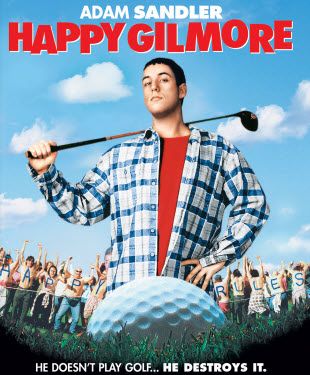
As some of our regular readers undoubtedly know, I am involved in a few weekly live tweets on twitter. I host #FridayNightFlix every Friday, I co-host #ScarySocial on Saturday, and I am one of the five hosts of #MondayActionMovie! Every week, we get together. We watch a movie. We tweet our way through it.
Tonight, at 10 pm et, #FridayNightFlix has got 1996’s Happy Gilmore!
How much do you like Shooter McGavin?
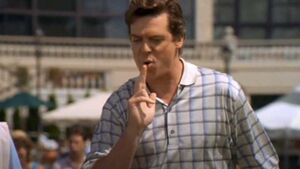
If you want to join us this Friday, just hop onto twitter, start the movie at 10 pm et, and use the #FridayNightFlix hashtag! It’s a friendly group and welcoming of newcomers so don’t be shy.
Happy Gilmore is available on Prime! See you there!
Guilty Pleasure No. 53: Happy Gilmore (dir by Dennis Dugan)
Poor Shooter McGavin! As played by the great Christopher McDonald, Shooter McGavin is the often unacknowledged hero of the 1996 comedy classic, Happy Gilmore.
I know, I know. Most people will tell you that Shooter is actually the bad guy. He’s the snooty pro golfer who tries to keep aspiring hockey player-turned-golfer Happy Gilmore (Adam Sandler) from competing on the PGA tour. And it is true that he does allow himself to get consumed with jealousy over Happy’s popularity. And he does definitely cross the line when he buys and holds hostage the house where Happy’s grandmother has spent almost her entire life. (“She’s so old! Look at her! She’d old!” Happy exclaims at one point.) But try to look at it from Shooter’s point of view.
Shooter has spent years playing golf. He’s practiced. He’s paid his dues. He’s done what he had to do to earn his spot as America’s best golfer. And now, he finally has a chance to win his first championship. And what happens? A very loud hockey player shows up from out-of-nowhere and totally changes the sport. What really has to be galling is that Happy’s not even a good player. He can’t putt. He has no strategy. His only skill is the distance that he can hit the ball. And yet, despite all that, Happy becomes a media superstar. The only people willing to stand up to Happy and defend the honor of the game are Bob Barker and …. Shooter McGavin.
Really, Shooter doesn’t really start to go after Happy until Happy’s fans starts to purposefully antagonize him. Remember Happy’s ex-boss showing up to heckle Shooter even though he still had that nail in his head? Seriously that’s not right. I mean, who shows up to support the dude who put a nail in your head? Shooter McGavin had every reason to be concerned about that.
Despite the fact that Shooter was treated rather unfairly, Happy Gilmore is definitely a favorite of mine. I pretty much love the entire film, from Carl Weathers’s enjoyably demented performance as Happy’s mentor to the famous scene of Bob Barker beating Happy to a pulp. For those who only know Adam Sandler from his later, lazier comedies, Happy Gilmore will be a bit of a revelation because Sandler and the entire cast actually seem to be making an effort to make a good and funny comedy. The staid world of golf turns out to be the perfect foil for Sandler’s manchild antics. And for those who prefer Sandler when he’s playing serious roles, he actually does a pretty good job in Happy Gilmore’s few sincere moments. His scenes with his grandmother are actually rather sweet.
Happy Gilmore remains Sandler’s best comedy and it’s a personal favorite of mine. Every time I watch it, I laugh and that’s a good thing. I also like to think that Shooter and Happy eventually set aside their differences and got their own talk show on ESPN. They deserved it.
Previous Guilty Pleasures
- Half-Baked
- Save The Last Dance
- Every Rose Has Its Thorns
- The Jeremy Kyle Show
- Invasion USA
- The Golden Child
- Final Destination 2
- Paparazzi
- The Principal
- The Substitute
- Terror In The Family
- Pandorum
- Lambada
- Fear
- Cocktail
- Keep Off The Grass
- Girls, Girls, Girls
- Class
- Tart
- King Kong vs. Godzilla
- Hawk the Slayer
- Battle Beyond the Stars
- Meridian
- Walk of Shame
- From Justin To Kelly
- Project Greenlight
- Sex Decoy: Love Stings
- Swimfan
- On the Line
- Wolfen
- Hail Caesar!
- It’s So Cold In The D
- In the Mix
- Healed By Grace
- Valley of the Dolls
- The Legend of Billie Jean
- Death Wish
- Shipping Wars
- Ghost Whisperer
- Parking Wars
- The Dead Are After Me
- Harper’s Island
- The Resurrection of Gavin Stone
- Paranormal State
- Utopia
- Bar Rescue
- The Powers of Matthew Star
- Spiker
- Heavenly Bodies
- Maid in Manhattan
- Rage and Honor
- Saved By The Bell 3. 21 “No Hope With Dope”
Fatal Instinct (1993, directed by Carl Reiner)
 Ned Ravine (Armand Assante) is a cop who is also a lawyer. His shtick is to make an arrest and then defend that person in court. He’s married to Lana (Kate Nelligan), who is having an affair with a mechanic named Frank (Christopher McDonald). Lana has taken out a life insurance policy on Ned, one that has a triple indemnity clause. If he’s shot on a northbound train and then falls off and drowns in a nearby stream, Lana and Frank will make a lot of money. However, Lana and Frank are not the only people who want to kill Ned Ravine. One of Ned’s former clients, Max Shady (James Remar), has just been released from prison and is seeking revenge. The main reason why Ned hasn’t figured out that everyone is trying to kill him is because he’s been distracted by the seductive Lola (Sean Young), a client who asked him to look over some legal papers and who has an improbable connection to Lana.
As you might guess by the plot and Carl Reiner’s directorial credit, Fatal Instinct is a spoof of detective movies, with the majority of the jokes being inspired by Basic Instinct, the remake of Cape Fear, Double Indemnity, and Body Heat. How much you laugh will depend on how well you know those films. There’s a scene in Ned’s office where Ned notices that Lola isn’t wearing panties. He helpfully produces a pair from inside his desk and hand them to her. In 1994, that scene was funny because Basic Instinct and whether or not Sharon Stone was aware of how her famous interrogation scene was being filmed were still a huge part of the pop cultural conversation. Today, it might just seem weird.
Carl Reiner has always been an uneven filmmaker and that trend continues in Fatal Instinct, where he tries to do to erotic thrillers what Mel Brooks did to westerns and Airplane! did to disaster films. Unfortunately, Reiner often gets bogged down by the film’s plot, which should really be the last thing anyone should be worried about when it comes to a spoof like this. Some of the jokes are funny and some of them aren’t but, because Reiner doesn’t duplicate the joke-every-minute style of a film like Airplane!, there’s a lot more time to think about the jokes that fall flat.
Fatal Instinct does have a good cast, featuring a lot of actors who probably should have become bigger stars than they did. I especially liked Kate Nelligan’s and Christopher McDonald’s performances as the two triple indemnity conspirators. Sherilyn Fenn plays Ned’s loyal secretary and seeing her give such a fresh and likable performance in this otherwise uneven film makes me regret even more that, outside of Twin Peaks, she never really got the roles that she deserved.
The Things You Find on Netflix: The Stand at Paxton County (dir by Brett Hedlund)
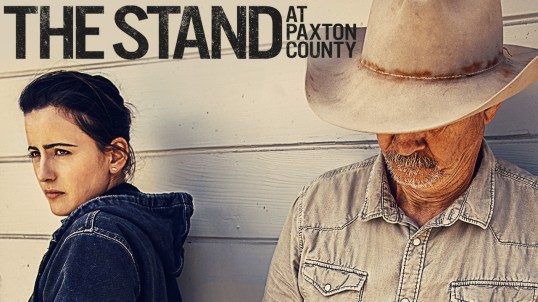
The Stand at Paxton County, which is currently playing on Netflix, opens with an ominous title card warning us that what we’re about to see is “based on a true story.”
I may be alone in this but I find the term “based on a true story” to be fascinating. It’s signifies that the film that we’re about to watch was inspired by something that actually happened but it’s not actually a recreation of that event. It’s an invitation to watch and to try to figure out how much is true and how much is just a product of a screenwriter’s imagination. “Based on a true story” is a real cinematic tease.
The Stand at Paxton County tells the story of Janna Connelly (Jacqueline Toboni), an army medic who is still haunted by her memories of serving in Afghanistan. When her rancher father, Dell (Michael O’Neill), has a heart attack, Janna returns home to Paxton County, North Dakota. What she discovers is that, after she left home, the ranch fell into disrepair. Dell only has one ranch hand, a seemingly amiable doofus named Brock (Greg Perrow) and it doesn’t appear that Brock’s been doing a very good job.
When Sheriff Bostwick (Christopher McDonald) shows up to do a compliance check on the ranch, he finds a lot of problems. When he returns with a cold-eyed veterinarian named Dr. Morel (Marwa Bernstein), Dell is informed that his ranch is in such disrepair that the sheriff can take away his livestock and essentially put Dell out of business!
How can the sheriff get away with this, Janna asks. Dell explains that, years ago, the voters of the state voted down a proposition that would have given law enforcement the right to confiscate a rancher’s livestock. However, a bunch of unelected lobbyists and left-wing activists went ahead and forced the law through the state legislature! Now, the sheriff can pretty much do whatever he wants and anyone who tries to stand up for their Constitutional rights is subject to harassment and perhaps even murder!
While all of this is going on, Brock vanishes from the ranch. It turns out that Brock is a professional bad employee who goes from ranch to ranch and goes out of his way to mess things up so that the ranchers lose their livestock. The livestock is then sold to the highest bidder or sometimes the sheriff will just keep a horse for himself. With Brock gone, Janna hires sexy Matt (Tyler Jacob Moore) to be the new ranch hand and then sets out to get justice for her father.
I had mixed feelings about The Stand at Paxton County. On the one hand, I’m not a fan of the government regulation in general and I’m always happy to watch a libertarian-themed film. Christopher McDonald’s smug and corrupt sheriff felt like a stand-in for all of the authoritarian-minded politicians and bureaucrats who have recently come out of the woodwork and used the COVID-19 pandemic to increase their own power. (“Hey, it’s Clay Jenkins!” I said as soon as the sheriff showed up.) So, on that level, I enjoyed the film.
Unfortunately, The Stand at Paxton County doesn’t just stick to criticizing the government for overstepping their authority. Instead, it also portrays animal rights activists as being a part of a sinister financial conspiracy and that’s where it lost me. It’s a lot easier to buy into the idea of a corrupt sheriff than it is to imagine the head of the PSCA sitting in a darkened war room and ordering his minions to torment one rancher, all so he can resell the rancher’s livestock. That doesn’t mean that activists should be immune from criticism or that there isn’t a legitimate argument to be made that even well-intentioned regulations are vulnerable to abuse. But the film’s portrayal of its central conspiracy just got a bit too cartoonish to be effective. Once the villains went from being smug to being downright evil, it became impossible to take the movie seriously. If the film had simply stuck to criticizing government overreach instead of imagining a shadowy conspiracy, it would have been a lot more effective.
The Stand at Paxton County has some lovely shots of the North Dakota countryside and Christopher McDonald is a wonderfully smarmy villain. I always appreciate a film that has an anti-authoritarian subtext but The Stand At Paxton County is ultimately dragged down by its own heavy hand.
 Through the Shattered Lens