There’s literally been hundreds of film adaptations of Mary Shelley’s novel Frankenstein, or the Modern Prometheus. Everyone from James Whale to Terrence Fisher to Paul Morrissey to Kenneth Branagh to Marcus Nispel has taken a shot at interpreting the legend and the monster’s been played by everyone from Boris Karloff to Christopher Lee to Robert De Niro to Srdjan Zelenovic (who was pretty freaking hot and yummy for a creature stitched together out of random corpses in Flesh for Frankenstein).
However, the very first cinematic version of Frankenstein came out in 1910. Produced by Thomas Edison’s film company, this 10-minute, silent film starred an actor named Charles Ogle as the monster. Frankenstein, himself, was played by Augustus Phillips while his fiancée was played by Mary Fuller. The film was directed by a fellow known as J. Searle Dawley. Dawley reportedly directed over a hundred silent films and most of them are lost to history.
For about 6 decades, it was assumed that Dawley’s Frankenstein was lost as well. However, in the mid-70s, it turned out that one remaining print of the film still existed and was apparently sitting up in someone’s attic in Wisconsin. It also turned out that the film was still in viewable condition.
And now, thanks to a combination of YouTube and the fact that every movie made before 1922 is now in the public domain, I’ve had the opportunity to see this movie for free and even better, here’s your chance to see it for free. Understand that when I say better, I’m speaking from the point of view of someone who is fascinated by history in general and cinematic history in specific. In many ways, this film epitomizes everything that makes it difficult for modern audiences to appreciate the excitement once generated by silent film. The acting is overly theatrical and watching the film makes you appreciate the eventual development of the dolly shot and the zoom lens even more. Add to that, the music that was selected to accompany this video is way too obvious and heavy-handed. I would suggest, before watching, that you mute the video and put your own preferred music on instead.
Still, the film does have a lot of historic interest. I don’t think you can truly judge and appreciate the films of today unless you know something about the films of the past. Watching a movie like the 1910 Frankenstein not only makes you realize how far films have come as an art form but also how much of the medium’s inherent earnestness has been lost with each advance in technology.
Anyway, with all that said, here is the 1910 version of Frankenstein…
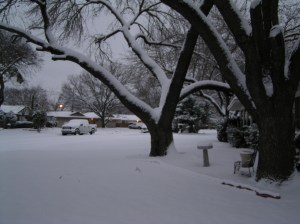
If you’re following the news then you probably heard that Dallas got hit with like a 100 inches of snow yesterday. Seriously, more snow fell yesterday than has even fallen in recorded history (or, at the very least, in my recorded history). You want to talk about Snowmageddon? Well, we had a Snowpocalypse.
The neighborhood on Friday morning (picture taken by Erin Nicole Bowman)
So, I spent most of yesterday cooped up inside with my sister and our cat and once we got over the whole fun of being able to go outside and scream, “SNOW DAY!” at the top of our lungs, there really wasn’t much to do. So, in an attempt to fight off cabin fever, I raided my DVD collection and we ended up watching one of the old Christopher Lee-as-Dracula-films from Hammer Studios. Specifically, we ended up watching Dracula A.D. 1972.
The film opens in 1872 with a genuinely exciting fight on a runaway carriage that ends with the death of both Count Dracula (Christopher Lee) and his nemesis, Prof. Van Helsing (Peter Cushing). However, as Van Helsing is buried, we see one of Dracula’s disciples (played by Christopher Neame, who had an appealingly off-kilter smile) burying Dracula’s ashes nearby. The camera pans up to the clear Victorian sky and, in a sudden and genuinely effective jumpcut, we suddenly see an airplane screeching across the sky.
Well, it’s all pretty much downhill from there. Suddenly, we discover that a hundred years have passed and we are now in “swinging” London. The city is full of red tourist buses, hippies wearing love beads, and upright policemen who always appear to be on the verge of saying, “What’s all this, then?” We are introduced to a group of hippies that are led by a creepy guy named Johnny Alculard (also played — quite well, actually — by Christopher Neame). One of those hippies (Stephanie Beacham) just happens to be the great-great-granddaughter of Prof. Van Helsing. Apparently, she’s not really big on the family history because she doesn’t notice that Alculard spells Dracula backwards. Then again, her father (played by Peter Cushing, of course) doesn’t either until he actually writes the name down a few times on a piece of a paper.
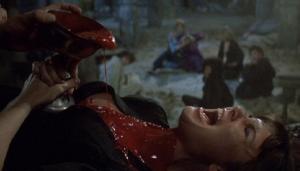
Anyway, the film meanders about a bit until finally, Alculard convinces all of his hippie friends to come take part in a black mass. “Sure, why not?” everyone replies. Well, I don’t have to tell you how things can sometimes get out-of-hand at black mass. In this case, Dracula comes back to life, kills a young Caroline Munro, and eventually turns Johnny into a vampire before then setting his sights on the modern-day Van Helsings.
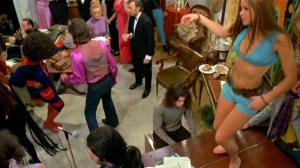
Dracula A.D. 1972 was Hammer’s attempt to breathe some new life into one of its oldest franchises and, as usually happens with a reboot, its critical and (especially) commercial failure ended up helping to end the series. Among even the most devoted and forgiving of Hammer fans, Dracula A.D. 1972 has a terrible reputation. Christopher Lee is on record as regarding it as his least favorite Dracula film. And the film definitely has some serious flaws. Once you get past the relatively exciting pre-credits sequence, the movie seriously drags. There’s a hippie party sequence that, honest to God, seems to last for about 5 hours. As for the hippies themselves, they are some of the least convincing middle-aged hippies in the history of fake hippies. You find yourself eagerly awaiting their demise, especially the awkward-looking one who — for some reason — is always dressed like a monk. (Those crazy hippies!) But yet…nothing happens. All the fake hippies simply vanish from the film. Yet, they’re so annoying in just a limited amount of screen time that the viewer is left demanding blood. Add to that, just how difficult is it to notice that Alculard is Dracula spelled backwards? I mean, seriously…
To a large extent, the charm of the old school Hammer films comes from the fact that they’re essentially very naughty but never truly decadent. At their heart, they were always very old-fashioned and actually quite conservative. The Hammer films — erudite yet campy, risqué yet repressed — mirrors the view that many of my fellow Americans have of the English. For some reason, however, that Hammer naughtiness only works when there’s the sound of hooves on cobblestone streets and when the screen is populated by actors in three-piece suits and actresses spilling out of corsets. Dracula A.D. 1972 did away with the support of the corset and as a result, the film is revealed as a formless mess with all the flab revealed to the world.
Still, the film isn’t quite as bad as you may have heard. First off, the film — with its middle-aged hippies — has a lot of camp appeal. It’s the type of film that, once its over, you’re convinced that the term “groovy” was uttered in every other scene even though it wasn’t. As with even the worst Hammer films, the film features a handful of striking images and Christopher Neame is surprisingly charismatic as Alculard.
As with the majority of the Hammer Dracula films, the film is enjoyable if just to watch the chemistry between Christopher Lee and Peter Cushing. Both of these actors — so very different in image but also so very stereotypically English — obviously loved acting opposite of each other and whenever you see them on-screen together, it’s difficult not to enjoy watching as each one tried to top the other with a smoldering glare or a melodramatic line reading. As actors, they brought out the best in each other, even when they were doing it in a film like Dracula A.D. 1972. In this film, Cushing is like the father you always you wished you had — the stern but loving one who protected you from all the world’s monsters (both real and cinematic).
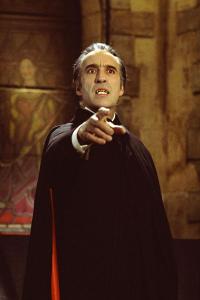
As for Lee, he’s only in six or seven scenes and he has even fewer lines but, since you spend the entire film wondering where he is, he actually dominates the entire movie. Lee apparently was quite contemptuous of the later Hammer Dracula films and, oddly enough, that obvious contempt is probably why, of all the Draculas there have been over the years, Lee’s version is the only one who was and is actually scary. F0rget all of that tortured soul and reluctant bloodsucker crap. Christopher Lee’s Dracula is obviously pissed off from the minute he first appears on-screen, the embodiment of pure destructive evil. And, for whatever odd reason, the purity of his evil brings a sexual jolt to his interpretation of Dracula that those little Twilight vampires can only dream about. Even in a lesser films like Dracula A.D. 1972, Christopher Lee kicks some serious ass.
So, in conclusion, I really can’t call Dracula A.D. 1972 a good film nor can I really suggest that you should track down a copy of the DVD. I mean, I love this stuff and I still frequently found my mind wandering whenever Cushing or Lee wasn’t on-screen. However, it’s not a terrible movie to watch if you happen to find yourself trapped in the house by a mountain of snow.
I have to write this review quickly because I have a feeling that, in another 30 minutes or so, my body’s immune system will succeed in destroying any trace of Season of the Witch.
In Season of the Witch, Nicolas Cage and Ron Perlman play two Crusaders who eventually get disillusioned with killing people so they desert the army, end up in a small village somewhere, and are informed that the town is being destroyed by the plague because a curse has been put on the town by a witch. Cage and Perlman are then recruited by the local town’s cardinal (Christopher Lee, who is pretty much wasted under all of this really nasty plague makeup) to take the witch to a monastery that is located somewhere else. You’re never really sure where any one location is in relation to another in this film, which is a bit of a problem since the majority of the film is taken up with the journey to the monastery.
Anyway, the Monks at the monastery have this ancient book that apparently contains all these incantations that can be used against evil. This book is the only one left in existence which leads to the question of why nobody ever bothered to make more than a handful of copies of all of these amazingly important books. I mean, seriously, people. So the idea is to take this witch to the monastery and read this book which will end the plague.
So, we go through the whole journey thing and a few unimportant characters are killed off along the way and Cage and Perlman discuss the meaning of life and faith and, at first, we’re led to doubt whether or not the accused witch is actually guilty but then she starts causing all of these supernatural, witch-like thing to happen so I guess the filmmakers got bored with that whole subplot early.
Then we reach the monastery and a whole other movie starts. Seriously, I cannot begin to put into words just how massively the tone of the film changes once they reach the monastery. The film actually becomes good in a kind of silly, over-the-top way as soon our knights are dealing with all of these flying demons and there’s disfigured monks all over the place, and the priest gets to say, “We’re going to need more holy water,” at one point. (“Yay!” I nearly shouted out in the audience, “Catholic action movie one-liners!”) The tone changes so massively that Season of the Witch actually becomes a really fun and entertaining little action movie but, unfortunately, just as soon as things start to get really fun — bang! Movie is over. Thank you for coming out tonight, folks. Now get the Hell outta here.
Season of the Witch is, to put it politely, a mess. This isn’t all that surprising as the movie is being released in January and January is, of course, reserved for either Oscar contenders going into wide release, films starring Jason Statham, or movies that are being released because the studio is contractually obligated. Ron Perlman, being a veteran of both Guillermo Del Toro and Jean-Pierre Jeneut, knows exactly how play his role but Cage just rides around on his horse looking like he’s late for Halloween party. Director Dominic Sena appears to have a mancrush on Zack Snyder and does the whole speed up the camera randomly then go into slow-mo even more randomly thing but it doesn’t really add up to anything more than just confusion.
Finally, I left this film feeling very betrayed because, seriously — how can you call your film Season of the Witch and not feature the classic Donovan song?
Sometimes, you have to be careful which films you choose to watch over the course of the day.
Such as, last Friday night, I heard the news that Jill Clayburgh had died and I ended up watching An Unmarried Woman. This, along with the fact that I also watched the Black Swan trailer, led to me dancing around the house in my underwear, en pointe in bare feet, and doing a half-assed pirouette in the living room. And I felt pretty proud of myself until I woke up Saturday morning and my ankle (which I don’t think has ever properly healed from the day, seven years ago, that I fell down a flight of stairs and broke it in two places) literally felt like it was on fire. That was my body’s way of saying, “You ain’t living in a movie, bitch. Deal with it.”
So, come Sunday, I decided to play it safe by watching something that I was sure wouldn’t lead to any imitative behavior on my part. Since I had previously reviewed Earthquake on this site, I decided that I would devote some time to the movies that started the entire 1970s disaster movie genre — Airport. Watching Airport led to me watching Airport’s three sequels.
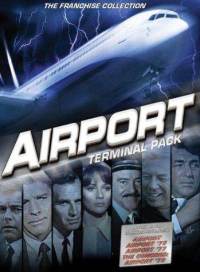
I was able to do this largely because I own the Airport Terminal Pack, a two-disk DVD collection that contains all four of the Airport films and nothing else. There’s no special features or commentary tracks. That’s probably a good thing because these films are so extremely mainstream that I doubt the commentary tracks would be all that interesting except to people who love “Me and Jennings Lang had the same lawyer…” style stories.
The movies are a mixed bag of ’70s sexism, mainstream greed, and casts that were described as being “all-star” despite the fact that they featured very few stars. They’re all worth watching as time capsules of a past time. Some of them are just more worthy than others.
Below are my thoughts on each individual film in the collection…
Airport (directed by George Seaton)
First released in 1970, Airport was nominated for 10 Academy Awards (including best picture), broke box office records, and started the whole 70s disaster movie trend. It also has to be one of the most boring, borderline unwatchable movies ever made. The fact that I managed to sit through the whole thing should be taken as proof that I’m either truly dedicated to watching movies or I’m just insane. Take your pick.
Anyway, the film is painstakingly detailed account of the every day operations of an airport. Yeah, sounds like a lot of fun, doesn’t it? Burt Lancaster runs the airport. His brother-in-law Dean Martin flies airplanes. Both of them have mistresses but we’re told that’s okay because Lancaster’s wife expects him to talk to her and Martin’s wife is cool with him fucking around as long as he comes home at night. I would be tempted to say that this is a result of the film having been made in 1969 and released in 1970 but actually, it’s just an introduction to the sexual politics of the typical disaster film. Men save the day while women get in the way. And if you think things have changed, I’d suggest you watch a little film calledf 2012…
The only interesting thing about the film is that Lancaster’s mistress is played by Jean Seberg who, ten years earlier, had helped change film history by co-starring in Jean-Luc Godard’s classic film Breathless. Nine years later, after years of being hounded by the American press and the FBI for her radical politics, Seberg committed suicide.
Airport 1975 (directed by Jack Smight)
As opposed to its predecessor, Airport 1975 is actually a lot of fun in its campy, silly way. This is the one where a small private plane (flown by Dana Andrews, the star of the wonderful film noir Laura) collides with a commercial airliner. The entire flight crew is taken out and head stewardess Karen Black has to pilot the plane despite the fact that she’s obviously cross-eyed. Luckily, since Black is a stewardess, she has a pilot boyfriend who is played by Charlton Heston. Heston talks her through the entire flight despite the fact that she was earlier seen trying to pressure him into not treating her like an idiot. Anyway, Heston does his usual clench-jaw thing and if you need a drinking game to go with your bad movie, just take a shot every time Heston calls Black “honey.” You’ll be drunk before the plane lands.
There’s some other stuff going on in this movie (for instance, Gloria Swanson appears as “herself” and doesn’t mention Sunset Boulevard or Joseph Kennedy once!) but really, all you need to know is that this is the film where Karen Black acts up a storm and random characters keep saying, “The stewardess is flying the plane!?”
Odd trivia fact: Airport 1975 was released in 1974.
Airport ’77 (directed by Jerry Jameson)
In Airport ’77, a group of art thieves attempt to hijack an airplane which, of course, leads to the airplane crashing into the ocean and somehow sinking down to the ocean’s floor without splitting apart. The crash survivors have to try to figure out how to get to the surface of the water before they run out of oxygen.
In this case, our resident sexist pilot is Jack Lemmon who has a really ugly mustache. He wants to marry head stewardess Brenda Vaccarro. Vaccarro doesn’t understand why they have to get married to which Lemmon responds, “Because I want a wife and kids!” The film also gives us Lee Grant as a woman who is married to Christopher Lee but who is having an affair with another man. She also drinks a lot and dares to get angry when she realizes that the airplane is underwater. While this sort of behavior is acceptable from Dean Martin, Charlton Heston, and Jack Lemmon, the film punishes Lee Grant by drowning her in the final minutes.
Technically, Airport ’77 is probably the best of the Airport films. The cast does a pretty good job with all the melodrama, the film doesn’t drag, and a few of the scenes manage to generate something resembling human emotion. (For instance, when the blind piano player died, I had a tear in one of my freaky, mismatched eyes.) Unfortunately, the movie’s almost too good. It’s not a lot of fun. Everyone plays their roles straight so the silly plot never quite descends into camp and the key to a good disaster film is always camp. This film also has the largest body count of the series, with most of the cast dead by the end of the movie. (And, incidentally, this film did nothing to help me with my fear of water…)
The Concorde: Airport ’79 (directed by David Lowell Rich)
The last Airport movie is also the strangest. Some people have claimed that this film was meant to be a satire of the previous Airport films. I can understand the argument because you look at film like Concorde and you say, “This must be a joke!” However, the problem with this theory is that there are moments of obvious “intentional” humor in this film (i.e., J.J. from Good Times smokes weed in the plane’s bathroom, another passenger has to go to the bathroom whenever she gets nervous) and none of them show any evidence of the type of wit and outlook necessary to come up with anything this silly on purpose. Add to that, the film’s story is credited to Jennings Lang, a studio executive. Studio execs do not take chances. (Plus, the actual script was written by Eric Roth, who went on to write the amazingly humorless The Curious Case of Benjamin Button).
No, this film is meant to be taken seriously and oh my God, where do I start?
Our pilots are George Kennedy and Alain Delon. The head stewardess (and naturally, Delon’s girlfiend) is played by Sylvia “Emanuelle” Kristel who, at one point, says, “You pilots are such men!” “Hey, they don’t call it a cockpit for nothing, honey,” Kennedy replies.
Meanwhile, Robert Wagner is trying to destroy the Concorde because one of the passengers is his girlfriend who has proof that Wagner has been selling weapons to America’s enemies. So, he attempts to blow the plane up with a guided missile and when that fails, he sends a couple of fighter planes after them. Kennedy responds by opening up the cockpit window — while breaking the sound barrier mind you — and firing a flare gun at their pursuers.
After this, there’s stop over in Paris where Delon arranges for Kennedy to sleep with a prostitute who assures Kennedy that he made love “just like a happy fish.”
The next day, everyone returns to the exact same Concorde — despite the fact that just a day earlier they’d nearly been blown up by a squadron of fighter planes — and take off on the second leg of the flight. Let me repeat that just to make sure that we all understand what this film is asking us to believe. After nearly getting blown up by a mysterious squad of fighter planes, everybody shows up the next morning to get on the exact same plane.
Oh, and it never occurs to Wagner’s ex-girlfriend that Wagner might have something to do with all of this.
Now sad to say, Concorde is the one of those films that’s a lot more fun to talk about than to actually watch. It should be a lot more fun in its badness than it actually is. Still, the movie has just enough camp appeal to make it fun in a “what the fuck…” sorta way.
And that’s how the Airport series comes to an end.
1) Simon, King of the Witches— I’ve never seen this film but I caught this trailer on one of the 42nd Street compilation DVDs. It doesn’t really make me want to see the film but I love the trailer because it is just so totally and utterly shameless. Seriously, could this thing be more early 70s? As well, I’ve always wondered — would witches actually have a king? I mean, seriously, get with the times.
The film, by the way, stars Andrew Prine who apparently had a really promising film career until his girlfriend, Karyn Kupicent, died mysteriously in 1964. A lot of people believed that Prine killed her though he always denied any guilt and there’s really no evidence to connect him to the crime. Interestingly, even more people seem to think that Kupicent was murdered because she knew something about John F. Kennedy’s assassination. Finally, true crime author Steve Hodel has suggested that Kupicent was actually murdered by his father, Dr. George Hodel. (Steve also claims that George was the Black Dahlia killer, the Zodiac killer, Chicago’s lipstick killer, and that George was responsible for just about every unsolved murder in history. Oedipus much?)
2) The Town That Dreaded Sundown — Though I didn’t consider this while selecting this trailer, this is another film that features the unfortunate Robert Prine. I’ve seen this film exactly one time when it showed up on late night television once. Unfortunately, considering that it was 4 in the morning and the movie was obviously heavily edited for television (not to mention that constant commercial interruptions), I didn’t really get to experience the film under ideal circumstances. As a result, I’ve been trying to track this movie down on DVD ever since. It’s not an easy film to find.
One of the reasons this movie fascinates me is because it’s not only based on a true unsolved crime but it actually follows the facts of the case fairly closely. In the late 40s, Texarkana was stalked by a masked gunman known as the Phantom Killer. The case was never solved and its gone on to become a bit of a local legend in the rural Southwest. Part of my interest in this case comes from the fact that I grew up in the rural Southwest. It’s the part of the country I know best and this film was actually filmed in the southwest as opposed to just an arid part of Canada. Interestingly enough, the Phantom Killer had a lot of similarities to the later Zodiac Killer. However, as far as I know, Steve Hodel has yet to accuse his father of haunting Texarkana.
The film itself was made by Charles B. Pierce, a filmmaker who was based in Arkansas and made several independent films in that state. Perhaps this explains why the trailer refers to “Texarkana, Arkansas” even though everyone knows that the only part of Texarkana that matters is the part that’s in Texas.
3) Nightmares in a Damaged Brain — This is one of the infamous “video nasties” (trust the English to not only ban movies but to come up with a stupid and annoying label for those movies). Like many of those films, this is a gory Italian film that seems to bathe in the sordid.
It’s also fairly difficult film to find. The DVD I own is actually a copy of the severely cut version that was eventually released in England, of all places.
(Another thing about the English — why is it that a culture that obsessively uses the word “cunt” in casual conversation seems so driven to distraction by a little fake blood? It’s as if someone told them that banning movies would somehow make up for the attempted genocide of Catholics in Northern Ireland.)
However, even in cut form, this is a disturbingly dark and frequently depressing film. Evil seemed to radiate through my entire apartment the whole time I was watching it and that atmosphere is captured in the movie’s trailer.
As a sidenote, the gore effects in this film are credited to Tom Savini. At the time of the film’s release, Savini announced that he actually had nothing to do with this movie.
4) To the Devil a Daughter— I recently read a biography of Christopher Lee in which he cited this movie, along with the original Whicker Man, as one of his personal favorites. It was also the film debut of Natassia Kinski, the daughter of Klaus Kinski. Considering Klaus’s reputation, the title is ironic.
5) Vampire Circus — This is another movie that I’ve never seen but I’ve heard great things about it. Supposedly, its one of the last great Hammer vampire films. Reportedly, it was controversial at the time of its release because it featured vampires attacking English children. (Which, if nothing else, at least prevented from growing up to kill little Irish children.) Seeing the trailer leaves me even more frustrated that it has yet to be released, in the States, on DVD.
6) Dr. Butcher, M.D.— This is actually a rather odd zombie/cannibal film hybrid from Italy. It was originally titled Zombie Holocaust but the American distributors retitled it Dr. Butcher. I love this trailer for much the same reason I love the Simon, King of the Witches trailer. It is just pure and shameless exploitation. Plus, it features some of the best moments of the great Donal O’Brien’s performance as the “title” character. I recently forced my sister Erin to watch Zombie Holocaust. Ever since, whenever I start to ramble too much, she simply looks at me and says, “Lisa’s annoying me. About to perform removal of vocal chords…” She actually does a fairly good impersonation. Consider this just more proof that the Grindhouse brings families closer together.
Masters of Horror has been good but very uneven in its execution during it’s two season run on Showtime. Haeckel’s Tale is the last episode for Season One (Takashi Miike’s episode never got an official airing) and it sure ends the season on a disturbingly kinky compilation of twisted grotesqueries. The story is from a Clive Barker short story that’s been adapted by Mick Garris (fellow Masters of Horror director and also its brainchild) and produced by George A. Romero to be directed by John McNaughton.
One wonders why Romero would be producing instead of directing the piece. Scheduling conflicts prohibited Romero from taking the director’s chair and he instead recommended John McNaughton (his one film which earned him Master of Horror status is one of the best horror films of the last quarter century: Henry – Portrait of a Serial Killer). The fact that Romero was originally chosen to direct Barker’s Garris adapted short story means there’s got to be zombies or some form of undead within. I, for one, was glad that Romero decided that he wouldn’t be able to direct and chose another in his stead. Barker’s short story does indeed include zombies but it also has a heavy sense of the old classic technicolor Hammer Films vibe to it. Haeckel’s Tale under the capable hands of McNaughton takes those Hammer Films conventions and ramps it up into overdrive.
Even though John McNaughton really has only one true horror film under his belt (he also directed a little-known cult scifi-horror called The Borrowers which had fledgling effects shop KNB EFX still doing things guerilla-style), but his work in Henry: Portrait of a Serial Killer more than earned him his horror creds. In Haeckel’s Tale, John McNaughton clearly has a bit of fun making the only true period piece in the whole Masters of Horror series. McNaughton goes for the classic Hammer Films look for this episode and it shows in the gothic, fog-shrouded atmosphere in the outdoor scenes. The look of the costumes and even the dialogue harkens back to those Christopher Lee and Peter Cushing Hammer Films.
The story is a mixture of the Frankenstein tale with a some Cemetary Man (aka Dellamorte Dellamore) mixed in. Haeckel’s Tale begins somewhere around the 1800’s and I’m assuming close to the end of it from the costume worn by Steve Bacic who played Mr. Ralston who arrives to seek the help of Miz Carnation who is purported to be a necromancer who can grant him his wish to have his dead wife brought back to life for him. Miz Carnation rebuffs Ralston, but after some begging she makes a deal with him to hear Haeckel’s Tale. If he still wants his wife brought back to life after hearing it then she would do so.
Ernst Haeckel (played by Derek Cecil)is a young medical professor whose obsession to conquer death mirrors that of a certain eccentric European scientist he so admires. Unlike his idol, Haeckel’s attempt to use electricity to put the spark of life back into a corpse fails dramatically. He’s soon investigating the rumor of a certain traveling necromancer who goes by the name of Montesquino (played by Joe Polito) who he thinks to be a fraud, but he soon finds out that Montesquino is all he says he is when Haeckel stumbles upon Wolfram (played by Stargate SG-1‘s own Maybourne, Tom McBeath) and his stunning young wife Elise (the drop-dead gorgeous Leela Savasta).
Haeckel quickly lusts after the young Elise, but as Wolfram will later tell him as the story nears it’s climax (in more ways than one), Elise cannot be satisfied by him or Haeckel. Her obsession with a dead husband she loves and cannot let go brings Haeckel to a scene that he cannot comprehend nor accept as something she truly wants. I must say that Leela Savasta’s performance as the dead-obsessed Elise is only surpassed by Anna Falchi’s own work as “She” in Dellamorte Dellamore. Leela’s pretty much spending most of her screentime fully naked and writhing around in an orgy not typical of most horror movies. It’s also in this orgy scene where we get the biggest Clive Barker feel to the story. Anyone how has read Barker earlier work knows the man can mix horror and sex like no other.
The ending of the episode brings to it a slight twist with Miz Carnation being more than she says she is. This Masters of Horror episode is not the best of the lot, but it is one of the better looking ones in terms of cinematography and it’s leads. It also doesn’t have much in terms of genuine scares. The story gradually builds up the dreads and disturbing images but never anything that will put a genuine heart-stopping scare on the viewer. Like McNaughton’s own foray into horror with Henry, Haeckel’s Tale lets the story’s own disturbing themes on obsession and the darker side of love put the horror in the story. It does have a nice gore-laden sequence courtesy of Howard Berger and Greg Nicotero and their KNB FX team.
In the end, Haeckel’s Tale is a very good episode which has its flaws like the rest of the Masters of Horror episodes. What sets it apart from the rest of the series entries is its unique Hammer Films look and the return of McNaughton back in the director’s chair as a horror filmmaker. It’s no Henry: Portrait of a Serial Killer, but Haeckel’s Tale will have enough disturbing images to burn itself to its audiences’ minds.



 Through the Shattered Lens