Review: Red Dawn (dir. by John Milius)


“I don’t know. Two toughest kids on the block I guess. Sooner or later they’re going to fight.”

[guilty pleasure]

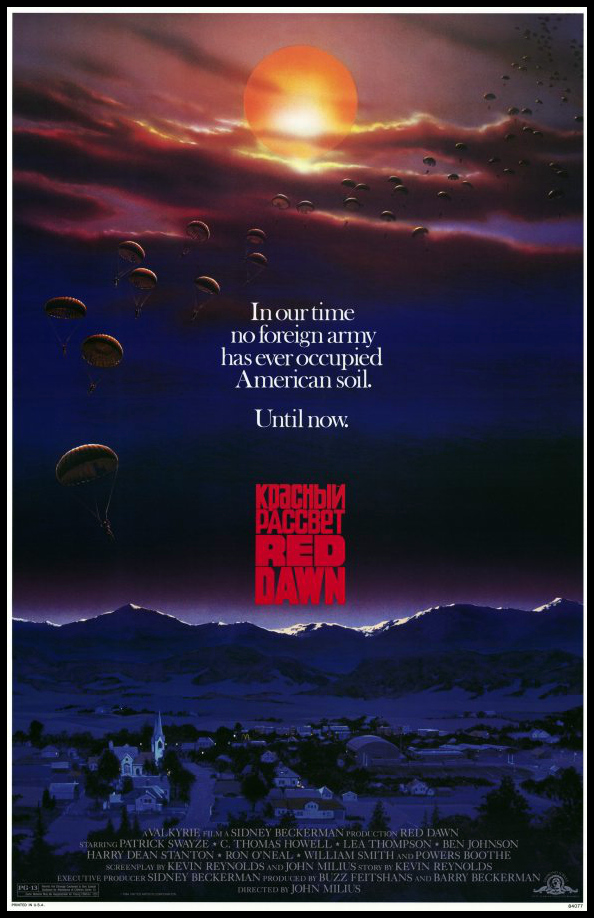
Anyone who grew up during the 1980’s would say that some of the best action films were made and release during this decade. I won’t disagree with them and probably would agree to a certain point. This was the decade when action films evolved from the realism of the 70’s to the excess and ultra-violence of the 80’s. This was the decade which ushered in such action heroes as Schwarzenegger, Stallone and Willis. It was also the decade which released one of the most violent films ever released by a major motion picture studio. It’s a film that has been remembered through the prism of nostalgia. I speak of the 1984 war film by John Milius simply titled Red Dawn.

John Milius is one of those filmmakers who never conformed to the stereotype of liberal Hollywood. He was an unabashed Republican (though he considers himself more of a Zen anarchist) in a liberal studio system who happened to have written some of the most revered films of the 1970’s (Jeremiah Johnson, Apocalypse Now, Dirty Harry). He came up with a follow-up to his hugely successful Conan the Barbarian in the form of a war film set in current times (mid-80’s) America that he called Red Dawn. It was a story which takes an alternate history of the Cold War where Soviet forces and it’s allies launch a successful preemptive invasion of the United States. Before people think that this was the idea born of a conservative, warmongering mind it’s been documented that Milius’ inspiration for this film was a real Pentagon hypothetical exercise of what would happen if the Soviet Union conducted a conventional invasion of the United States and how the government and it’s population would react and resist such an occupying force. The  story would finally get it’s final treatment with major input from screenwrtier Kevin Reynolds’ own story which added a certain Lord of the Flies vibe to the group of teenagers who form the bulk of the film’s cast.

The film actually starts off with an impressive sequence of your typical Midwestern high school day with students seated in their classrooms. One moment this Rockwellian image gets a surprise from soldiers parachuting in the field outside the school. Thus we have the beginning of the Soviet invasion with one of the teachers being gunned down for trying to peacefully interact with the airborne troopers. The rest of the film is about a group of highschoolers led by senior Jed Eckert (Patrick Swayze) and his younger brother Matt (Charlie Sheen) as they flee with a handful of their classmates the massacre at their school and soon their whole town as well.

Red Dawn uses the first half of the film to show the confusion and chaos created by the sudden appearance of foreign soldiers on America soil attacking civilians and, soon enough, whatever American military response that manages to react in the area. We’re put in the shoes of Jed and his band of teenagers as they try to survive the roving bands of Soviet and Cuban soldiers patrolling the plains and countryside surrounding their hometown of Calumet, Colorado. We see American civilians packed into re-education camps and rumors of KGB secret police making certain troublemakers disappear and worst. It’s the America Cold War nightmare scenario where the Soviet Evil Empire has taken a foothold on US soil and the government and military nowhere in sight to help it’s population.

The second half of the film solves this scenario by arming the teenagers led by Jed into a sort of teen guerrila force using their school’s mascot as their rallying cry. It’s the shouts of “Wolverines!” which has become part of American pop-culture as we get to see these teenagers conduct hit-and-run strikes on enemy patrols and forward bases while at the same time arming those they free from camps. It’s during this part of the film where the violence gets ramped up to an almost ridiculous level. It’s no wonder that for almost two decades this film would be considered by Guinness World Records as the most violent film ever put on the big-screen. Milius and his filmmaking crew do not skimp on the use of blood squibs as Jed and his ragtag band of teen fighters gun down Soviets, Nicaraguans and Cuban soldiers by the score every minute during a long montage in the middle of the film.

Red Dawn in terms of storytelling is actually quite good in the grand scheme of the narrative being told, but even through the prism of nostalgia and rose-tinted glasses the characters in the film get the short-end of the stick. With the exception of Swayze’s eldest teen Jed as leader of the Wolverines the rest of the band’s teenage characters look like your typical casting call stereotypes who fill in the required roles in any ensemble cast. There’s Darren Dalton as the high school class president jealous of the group’s leader Jed, but unable to act on it. We have C. Thomas Howell as Robert the mousy one when the film begins who becomes a hardened and cold-hearted killer as the film goes on. Everyone fits in neatly to their assigned role and noen of the young actors (at the time) bring much to their characters.

This film continues to be remembered fondly by it’s fans both new and old because of the “what-if” scenario being played out on the screen. I would say that if there ever was a pure American film I would think Red Dawn manages to fit the bill. It’s a film which highlights the so-called individualism and can-do attitude Americans see for themselves. How it’s up to each individual to fight to protect their loved ones and for what is theirs. Some have called this film as a conservative’s wet-dream, but I rather think it’s a film that should appeal more to Libertarians as it focuses on individual liberties and self-preservation when the government and military tasked to protect them have failed.

John Milius has always been a maverick in Hollywood and his unpopular political beliefs have kept him from doing more work in the film industry, but one cannot deny the fact that he made one of the most iconic films of the 1980’s. Whether one agreed with the film’s politics and thought it to be a good film or not was irrelevent. Red Dawn has become part of American pop-culture and will continue to be a major example of the excess of 80’s action filmmaking for good or ill. Plus, even the most liberal people I know find the basic story of fighting to protect the nation from invaders something that feeds their innermost fantasy of playing the good guys fighting the good fight. Red Dawn is a great example of the underdog film that just happens to have teenagers kicking Soviet military ass.


6 Trailers To Prevent Me From Getting Into One Of My Bitchy Moods


I am so freaking depressed right now.  Why?  Because, as I sit here typing this, I am about to embark on my last weekend as a carefree, hedonistic young woman.  That’s right.  I’ve kinda sort got a birthday (bleh) on November 9th.  Yes, I’m a Scorpio.  Are you surprised?  Anyway, getting older means getting boring and that really sucks and I’ll just leave it at that.  Let’s see if a new edition of Lisa Marie’s Favorite Grindhouse and Exploitation Trailers can cheer me up.

1) Survive (1976)

From director Rene Cardona, Jr. comes “the most shocking episode in human survival!”  This is why I hate to fly.  Well, that and intrusive security measures… (True story: when me and my sisters went to Italy, all four of us were patted down and frisked by the grabby fascists at DFW and it was such a demeaning experience that I ended up crying during the entire subsequent flight.)

2) The Hideous Sun Demon (1959)

It’s thermo-dynamic horror from outer space!  Sometimes, I wish I had been born in 1942 or ’43 so that I could have had the experience of seeing trailers like this every single day but then again, I’d also probably be really old right now.  Plus, my name would probably be something like Vivien because I like to think that my mom would have named me Vivien Leigh.

3) The Asphyx (1973)

This trailer is about death, which is what I’ll be one step closer to on the 9th.

4) The Wraith (1986)

Apparently, even Charlie Sheen was young once.

5) The Fury (1979)

I recently watched this one on DVD and I have to give this trailer an aging nod of approval because it actually makes the film look kinda sorta exciting.  It’s actually one of the most boring movies I’ve ever seen.

6) Cat People (1982)

Watching this trailer makes me wish I could turn into a cat and live forever.

Well, I’m sorry to say that the movies cannot stop the march of time, regardless of how much I wish they could.  But at least they do make my time here just a little bit more bearable.

A Quickie with Lisa Marie: Wall Street: Money Never Sleeps (Dir. by Oliver Stone)


Sometimes, words escape even me. 

I’ve been trying for about three days now to figure out how to explain why Wall Street: Money Never Sleeps is one of the most disappointing films of 2010.  Notice I didn’t use the term “worst film.”  There’s enough in the movie that works (Michael Douglas is fun to watch as Gordon Gekko and there’s a handful of scenes that perfectly capture the modern atmosphere of financial panic) to keep it from being a truly awful movie.  But just because the movie isn’t awful, that  doesn’t necessarily mean that it’s any good.

Oh, Wall Street — how did you fail?  Let me count the ways.

1) Michael Douglas gives a great performance but he actually has less screen time here than he did in the original Wall Street.  Yes, it’s fun to watch Gekko claw his way back up to the top but, once you take those scenes out of the equation, you still have about 1oo minutes of non-Gekko material to slog through.

2) Instead most of the screen time goes to Shia LeBouf.  Let me repeat that — most of the screen time goes to Shia LeBouf.  In this film, Shia plays a cocky young financial genius.  Let me repeat that.  In this film, Shia LeBouf plays a genius.  Back before Shia became the human face of the Transformers franchise, I’ll admit that I thought he was kinda cute in his geeky, awkward way.  However, in Wall Street, his character isn’t supposed to be geeky or awkward.  He’s supposed to be some sort of financial genius.

3) We’re also supposed to automatically sympathize with Shia LeBouf’s character because, while he’s a part of the system that created the recession, he’s also dedicated to funding some sort of green energy project.  Much like James Cameron in Avatar, Oliver Stone trots out a simplistic environmental theme here and expects to be praised just for mentioning it.  The message is: “Love my film or Mother Earth gets it.”

4) The film’s plot: Shia LeBouf’s mentor and boss — played by Frank Langella — commits suicide after being run out of business by evil millionaire Josh Brolin.  So, Shia takes a job working with Brolin.  Meanwhile, Shia is also engaged to the daughter of Gordon Gekko.  This leads to him taking Gekko on as a mentor.  Shia apparently wants to take Brolin down.  Or does he?  Unfortunately, LeBouf doesn’t seem to know for sure and that comes across in his performance.  As a result, the majority of the film is about as exciting as watching anyone else go to work.

5) Josh Brolin’s the villain here.  We know he’s a villain because everyone else in the film keeps insisting he’s the villain and Brolin plays the role as if he’s auditioning for a role in the next James Cameron film.  Which is to say, Brolin gives a dull and lifeless performance.

6) The little guy who is creating this alternate source of energy that Shia is so obsessed with?  The little guy is played by Austin Pendleton who, I swear to God, is one of the most annoying character actors ever.  Seriously, Pendleton, stop fucking smiling all the time! 

7) Having seen both this and the original Wall Street, I can now say that I have no idea how the stock market works and I really don’t care to learn.  I just want everyone to stop yelling and throwing paper all over the place.  Seriously, Stone tries to make the “market” scenes exciting here but, once you get over the fact that Stone knows how to use a zoom lens, they’re pretty dull.  Lucio Fulci and Jean Rollin — they would have found a cool way to film those scenes.  Stone just resorts to the same old tricks.

8) That little smiley face looks so cute with his sunglasses on.

9) As with the original Wall Street, this is yet another film about little boys and their daddy issues.  Which father figure will Shia choose?  Meanwhile, Shia’s mother (a grating performance from Susan Sarandon) and his girlfriend (Carey Mulligan) are portrayed as total fools.  Mulligan, after her performance in An Education, especially deserve better than to be stuck playing some sexist fantasy of a human being.  Sarandon is blamed for the housing collapse while Mulligan’s character is cheated out of a fortune towards the end of the film.  The message here, I guess, is don’t let women have money because we’ll just fuck everything up.  I love how I can always count on “progressive” filmmakers to prove themselves to be a bunch of pigs at heart.

10) Charlie Sheen shows up for a really awkward cameo.  He’s supposed to be playing his Bud Fox character from the original film but, watching his performance, you get the feeling that Charlie doesn’t remember being in the original film.  Showing up at a charity dinner with a separate date on either ar, Bud Fox is presented as being just as corrupt as Gordon Gekko.  Michael Douglas, quite frankly, looked somewhat embarrassed by the whole scene.  However, as awkward as the scene was, it did manage to perfectly capture the theme of this movie:

Eventually, even Bud Fox will grow up to be Charlie Sheen.

A Quickie With Lisa Marie: Wall Street (dir. by Oliver Stone)


Yesterday, me and my friend Jeff were planning on seeing Wall Street: Money Never Sleeps.  However, there was one problem — I’d never seen the original Wall Street.  Though I owned the movie on DVD, I’d never actually bothered to sit down to watch it.  Don’t get me wrong, I knew that this was the movie that won Michael Douglas an Oscar.  I knew that Douglas played a character named Gordon Gekko who, at one point in the film, delivered the line, “Greed is good.”  Who hasn’t seen that clip?

So, yesterday, before leaving to see the sequel (which I’ll be reviewing in the near future), I sat down and watched the original. I discovered that there’s a reason why everyone remembers Gordon Gekko’s little “Greed is good” speech.  It’s literally the only memorable part of the entire movie.

Wall Street tells the tale of Bud Fox (Charlie Sheen), a young stock broker who becomes a protegé to an intense and amoral businessman named Gordon Gekko (Michael Douglas).   Gekko specializes in taking over other companies and putting people out of work.  He wants to take over an airline that employs Bud’s father.  Bud’s father is played by Martin Sheen and he’s such a self-righteous, judgmental, blue-collar asshole that you find yourself hoping that Gekko does put him out of work.  Anyway, Bud engages in insider trading (which is apparently a crime though I’m not sure as the film seems to assume that everyone already understands how the stock market works) yet then finds his conscience awakened when Gekko’s greed threatens his dad’s job.  Yes, this is yet another one of those laughably masculine films in which an overage boy has to pick a father figure.  

I guess we’re supposed to care about whether or not he picks the right father but seriously, Bud Fox is such a dull character and Charlie Sheen is so miscast that I found myself wondering when the film’s real hero was going to show up.  I had some hope when James Spader popped up in a supporting role but no, the lead character here is Bud Fox and he’s played by Charlie Sheen.

Not surprisingly, this is pretty much a male-dominated film.  There’s only two notable female characters in the film.  Darryl Hannah plays a ditz and Sean Young plays a bitch and neither one gets a chance to even have fun with the stereotypes.  However, we all know that this film is really just about Gordon Gekko plunking his twanger over money and Bud Fox jackin’ the beanstalk to Gekko.

However, once you see Michael Douglas’s performance as Gordon Gekko, it’s a bit easier to understand why he causes Bud to walk Willie the One-Eyed Wonder Worm.  Douglas truly is amazing in this role.  In fact, Douglas is so charismatic in the role that it actually hurts the movie.  It’s hard to take much pleasure in listening to Martin Sheen talk about how much he loves his union when you realize that all he’s doing is taking up time that could have been devoted to Michael Douglas fucking over poor people.  I don’t know if a bad film can ever be truly redeemed by just one good performance but Douglas definitely makes Wall Street — with all of its awkward moralizing and sexist (and sexual) confusion — worth seeing.

As little as I thought of Wall Street, I still found myself excited about seeing the sequel.  Why?  Because I knew Michael Douglas was coming back and Martin Sheen wasn’t.  Perhaps, I thought, this sequel will simply focus on Gekko being an over-the-top, charming viper instead of forcing us to sit through a repeat of the first film’s heavy-handed moralizing and simplistic political posturing.  Of course, I was wrong but that’s another review for another day.

Oh, one last note: Oliver Stone’s direction is far better than his script.  I once read an old review from Pauline Kael in which she said that Oliver Stone directed “as if someone held a gun to his head and shouted, ‘Go!'”  and this is certainly the case with Wall Street.  That said, I still find it hard to stay interested in any scene that features stock brokers screaming at each other and tossing around little bits of paper.  Seriously, how does the Stock Market work?  Whenever I see any footage from the New York stock exchange, it just looks incredibly silly.