Film Review: The Don Is Dead (dir by Richard Fleischer)


“The Don is Dead!” shouts the title of this 1973 film and it’s not lying.

After the powerful and respect leader of the Regalbuto crime family dies, the Mafia’s governing body meets in Las Vegas to debate who should be allowed to take over the family’s operations.  Frank Regalbuto (a smoldering Robert Forster) wants to take over the family but it’s agreed that he’s still too young and hot-headed.  Instead, control of the family is given Don Angelo DiMorra (Anthony Quinn), an old school Mafia chieftain who everyone agrees is a man of respect.  Don DiMorra will serve as a mentor to Frank while Frank’s main enforcers, The Fargo Brothers, will be allowed to operate independently with the understanding that they will still respond if the mob needs them to do a job.  Tony Fargo (Forrest) wants to get out of the rackets all together while his older brother, Vince (Al Lettieri), remains loyal to the old ways of doing things.

Frank is not happy with the arrangement but he has other things to worry about.  He knows that there’s a traitor in his family.  While he and the Fargo brothers work to uncover the man’s identity so that they can take their revenge, Don Angelo falls in love with a Vegas showgirl named Ruby Dunne (Angel Tompkins).  However, Ruby is engaged to marry Frank and, when Frank returns from taking care of the traitor, he is tipped off as to what has been happening in his absence.  Frank goes crazy, nearly beating Ruby to death.  Don Angelo declares war on Frank and the Fargo brothers are forced to decide which side they’ll serve.

In the 1970s, almost every crime film was either a rip-off of The French Connection or The Godfather.  The Don Is Dead is unique in that it attempts to rip off both of them at the same time.  The film opens French Connection-style with a couple of hoods trying to double-cross Frank during a drug deal, leading to shoot-out.  (Keep an eye out for Sid Haig as one of Frank’s men.)   The film is full of scenes that are meant to duplicate the gritty feel of The French Connection though, needless to say, none of them are directed with the cinema verité intensity that William Friedkin brought to that classic film.  Meanwhile, Anthony Quinn plays a character who is very much reminiscent of Don Vito Corleone, even pausing at one point to tell Frank that “drugs are a dirty business.”  The Godfather‘s Abe Vigoda and Al Lettieri show up in supporting roles and Robert Forster gives a performance that owes more than a little to James Caan’s Oscar-nominated turn as Sonny Corleone.  (Interestingly enough, both Quinn and Forster were among the many actors considered for roles in The Godfather.)

Unfortunately, the film itself is slowly-paced and never really draws us into the plot.  Director Richard Fleischer, who directed a lot of films without ever developing a signature style, brings none of the intensity that William Friedkin brough to The French Connection nor can he duplicate Francis Ford Coppola’s operatic grandeur.  The Don is Dead plays out like a particularly violent made-for-TV movie.  There’s a lot of talented people in the cast but they’re defeated by thinly drawn characters.  Robert Evans often said that Coppola was hired to direct The Godfather because, as an Italian-American, he would bring an authenticity to the material that a non-Italian director would not be able to do.  The Don Is Dead would seem to indicate that Evans knew what he was talking about.

Retro Television Reviews: See The Man Run (dir by Corey Allen)


Welcome to Retro Television Reviews, a feature where we review some of our favorite and least favorite shows of the past!  On Sundays, I will be reviewing the made-for-television movies that used to be a primetime mainstay.  Today’s film is 1971’s See The Man Run!  It  can be viewed on YouTube!

Two criminals have kidnapped the 18 year-old daughter of Dr. Thomas Spencer (Eddie Albert).  They call the number that they have for Dr. Spencer and they tell the man that answers that they are going to kill his daughter unless he pays them a large amount of money.

What the criminals don’t know is that Dr. Spencer has recently changed his phone number and his old number was given to a struggling actor named Ben Taylor (Robert Culp).  When the kidnappers call, Ben has just gotten out of bed and he’s still a bit too groggy to explain to them that they have the wrong number.  Though he suspects that the whole thing might be an elaborate prank, he decides to call the real Dr. Spencer and tell him about the phone call.  However, when the doctor answers, Ben does such a bad job of explaining the situation that Dr. Spencer thinks that Ben is the kidnapper.  Begging Ben not to hurt his daughter, Dr. Spencer says that he’ll pay anything and that he won’t even call the police.

This gives Ben and his wife, Joanne (Angie Dickinson), an idea.  When the kidnappers call back, Ben pretends to be Dr. Spencer.  After the kidnappers tell Ben the amount of money that they want, Ben then calls Dr. Spencer and, pretending to be the kidnapper, relays the message but he also adds an extra $50,000 to the ransom demand.  Ben and Joanne’s plan is to collect the ransom from Dr. Spencer, take their cut, and then deliver the ransom to the kidnappers.

It’s a complicated plan and, throughout the course of the day, both Ben and Joanne have their moments of doubt.  But they stick with it, because Joanne wants the money and Ben wants the chance to not only prove himself as an actor but to also show Joanne that he’s not the loser that she insists that he is.  Complicating matters, though, is that Dr. Spencer’s wife (June Allyson) has called the police without telling Dr. Spencer.  Though Dr. Spencer doesn’t know it, the cops are determined to be there when he hands off the ransom to the man who claims to have his daughter.

Clocking in at a briskly-paced 73 minutes, See The Man Run is an enjoyable thriller, one that is full of unexpected twists and which features a fierce performance from Angie Dickinson and a rather poignant one from Robert Culp.  Culp is convincing rather he’s playing a kidnapper, a doctor, or just an out of work actor who doesn’t realize that he’s gotten in over his head.  As smart as he may be, Ben cannot escape from his own insecurities and his fear of being betrayed.  It all leads to a diabolically clever surprise ending, one that proves that you can run only so far before you stumble.

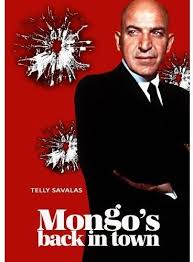
Mongo’s Back In Town (1971, directed by Marvin J. Chomsky)


During the Christmas season, Mongo (Joe Don Baker) returns home.  However, Mongo hasn’t just come back for the holidays.  Mongo is professional killer, one of the best in the business.  His older brother, mob boss Mike Nash (Charles Cioffi), has a job for him.  He wants Mongo to wipe out a rival gangster.  Mongo’s willing to do it but he expects to be properly compensated for his trouble.  Family is family but Mongo’s a professional and a professional has to get paid.  Lt. Pete Tolsted (Telly Savalas) and his partner, Gordon (Martin Sheen), are the two cops who know that Mongo is bad news and who are determined to discover why Mongo is back in town.  Meanwhile, Mongo is falling in love with the naive Vicki (a very young Sally Field), a young woman who has fled West Virginia and is looking to restart her life in the big city.

This made-for-TV movie may not contain any huge surprises but it’s worth tracking down just for the cast.  Joe Don Baker, Telly Savalas, Martin Sheen, and Sally Field, all in the same movie and all at the top of their considerable game?  That’s more than worth the effort.  Joe Don Baker, in particular, is good.  Unfortunately, Baker doesn’t always get the respect that he deserves an actor.  It’s true that he’s appeared in his share of bad films and his range is limited.  But whenever he was cast in the right role — like in this movie or the first Walking Tall — he was a force of nature.  What’s most interesting about Mongo is that he doesn’t really like his work and he resents that it’s something that he’s been trapped into doing but, at the same time, he’s so good at it that it’s hard not to wonder what other career he could have possibly found as much success in.

Mongo’s Back In Town was released theatrically overseas under the title Steel Wreath.  (Maybe someone realized that Mongo’s Back In Town makes the movie sound like a screwball comedy.)  It can be viewed, under its original title, on YouTube.


Cannes Film Review: Missing (dir by Costa-Gavras)


The 1982 film Missing takes place in Chile, shortly after the American-backed military coup that took out that country’s democratically elected President, Salvador Allende.

Of course, the film itself never specifically states this.  Instead, it opens with a narrator informing us that the story we’re about to see is true but that some names have been changed “to protect the innocent and the film.”  The film takes place in an unnamed in South America, where the military has just taken over the government.  Curfew is enforced by soldiers and the sound of gunfire is continually heard in the distance.  Throughout the film, dead bodies pile up in the streets.  Prisoners are held in the National Stadium, where they are tortured and eventually executed.  Women wearing pants are pulled out of crowds and told that, from now on, women will wear skirts.  The sky is full of helicopters and, when an earthquake hits, guests in a posh hotel are fired upon when they try to leave.  About the only people who seem to be happy about the coup is the collection of brash CIA agents and military men who randomly pop up throughout the film.

Again, the location is never specifically identified as Chile.  In fact, except for the picture of Richard Nixon hanging in the American embassy, the film never goes out of its way to point out that the film itself is taking place in the early 70s.  If you know history, of course, it’s obviously meant to be Chile after Allende but the film itself is set up to suggest that the story its telling is not limited to one specific place or time.

Charlie Horman (John Shea) is an American who lives in the country with his wife, Beth (Sissy Spacek).  Charlie is a writer who occasionally publishes articles in a local left-wing newspaper.  In the aftermath of the coup, Charlie is one of the many people who go missing.  All that’s known is that he was apparently arrested and then he vanished into the system.  The authorities and the American ambassador insist that Charlie probably just got lost in the confusion of the coup and that he’ll turn up any day.  Even though thousands have been executed, everyone assumes that Charlie’s status as an American would have kept him safe.  As brutal as the new government may be, they surely wouldn’t execute an American….

Or, at least, that’s what Ed Horman (Jack Lemmon) believes.  Ed is Charlie’s father, a businessman from New York who simply cannot understand what’s going on.  He can’t understand why his son and his daughter-in-law went to South America in the first place.  He can’t understand why his government is not doing more to find his son.  And, when he eventually arrives in South America himself, Ed cannot understand the violence that he sees all around him.

Working with Beth, Ed investigates what happened to his son.  At first, Ed blames Beth for Charlie’s disappearance and Beth can barely hide her annoyance with her conservative father-in-law.  But, as their search progresses, Beth and Ed come to understand each other.  Beth starts to see that, in his way, Ed is just as determined an idealist as Charlie.  And Ed learns that Charlie and Beth had good reason to distrust the American government…

Costa-Gavras is not exactly a subtle director and it would be an understatement to say that Missing is a heavy-handed film.  The Embassy staff is so villainous that you’re shocked they don’t all have mustaches to twirl while considering their evil plans.  When, in a flashback, Charlie meets a shady American, it’s not enough for the man to be a CIA agent.  Instead, he has to be a CIA agent from Texas who heartily laughs after everything he says and who brags on himself in the thickest accent imaginable.  When Charlie talks to an American military officer, it’s not enough that the officer is happy about the coup.  Instead, he has to start talking about how JFK sold everyone out during the Bay of Pigs.

As the same time, the film’s lack of subtlety also leads to its best moments.  When Beth finds herself out after curfew, the city turns into a Hellish landscape of burning books and dead bodies.  As Beth huddles in a corner, she watches as a magnificent white horse runs down a dark street, followed by a group of gun-toting soldiers in a jeep.  When Ed and Beth explore a morgue, they walk through several rooms of the “identified” dead before they find themselves in a room containing the thousands of unidentified dead.  It’s overwhelming and heavy-handed but it’s also crudely effective.  While the film itself is a bit too heavy-handed to really be successful, those scenes do capture the horror of living under an authoritarian regime.

(Interestingly, Missing was a part of a mini-genre of films about Americans trapped in right-wing South American dictatorships.  While you can’t deny the good intentions of these films, it’s hard not to notice the lack of films about life in Chavez’s Venezuela or the political dissidents who were lobotomized in Castro’s Cuba.)

Missing won the Palme d’Or at the 1982 Cannes Film Festival (an award that it shared, that year, with the Turkish film Yol) and it also received an Oscar nomination for best picture of the year.  (It lost to Gandhi.)

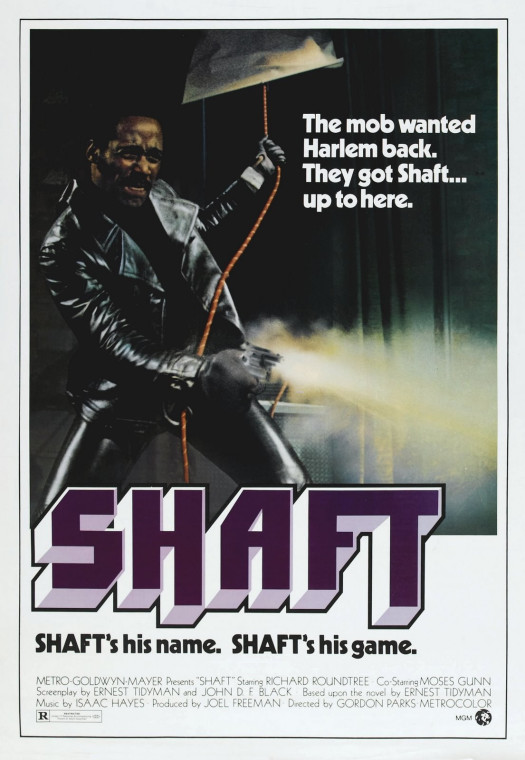
That’s Blaxpolitation! 12: SHAFT (MGM 1971)


gary loggins's avatarcracked rear viewer

“That Shaft is a bad mother…”

“Shut your mouth!”

“But I’m talkin’ about Shaft”

“We can dig it!”

  • – lyrics from Isaac Hayes’ “Theme from SHAFT

1971’s SHAFT, starring Richard Roundtree as “the black private dick that’s a sex machine to all the chicks”, is the movie that kicked off the whole 70’s Blaxploitation phenomenon.  Sure, Mario Van Pebbles’ indie SWEET SWEETBACK’S BADASSSSS SONG was released three months earlier, but it’s X-rating kept younger audiences out of the theaters. SHAFT reached more people with it’s R rating, and the publicity machine of MGM behind it. In fact, John Shaft not only saved the day in the film, but helped save the financially strapped MGM from bankruptcy!

The opening sequence alone makes it worth watching, as the camera pans down the gritty mean streets of New York City (42nd Street, to be exact!) and that iconic funky theme song by Isaac…

View original post 458 more words

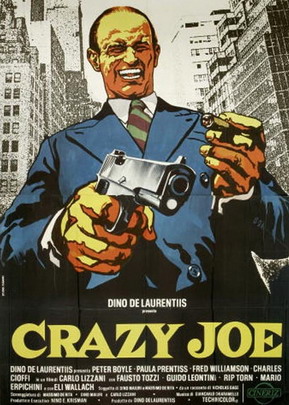
A Movie A Day #147: Crazy Joe (1974, directed by Carlo Lizzani)


Crazy Joe (Peter Boyle) is a gangster with a chip on his shoulder and a self-taught intellectual who can (misquote) Sartre and Camus with the best of them.  Sick of being taken for granted, Joe and his brother, Richie (Rip Torn), attempt to challenge the Mafia establishment.  The mob sets Joe up and gets him sent to prison.  While doing time, Joe befriends a Harlem gangster named Willy (Fred Williamson).  Refusing to associate with the other Italian prisoners, Joe allies himself with the black inmates and even helps to start a riot over the prison’s inhumane conditions.  When he is released, Joe hits the streets of New York with a vengeance, now backed up by Willy and his criminal organization.
Crazy Joe is based on the life of Joey Gallo, who was briefly a New York celebrity, hobnobbing with actors like Jerry Orbach and writers like Norman Mailer before he was gunned down at Umberto’s Clam Shop in Little Italy.  Though the names were changed to protect the guilty, Eli Wallach plays Vito Genovese, Charles Cioffi plays Joe Columbo, and Luther Adler is Joe Profaci.  Fred Williamson’s character is based on the infamous Nicky Barnes.

Crazy Joe is a good and violent mix of the gangster, prison, and blaxploitation genres.  Despite wearing an unfortunate toupee, Peter Boyle is great at putting the crazy in Crazy Joe and Fred Williamson ups the coolness factor of any movie he appears in.  Keep an eye out for Henry Winkler, giving a very un-Fonzie performance as Joe’s right-hand man.

Somebody’s Watching Me: Jane Fonda in KLUTE (Warner Brothers 1971)


gary loggins's avatarcracked rear viewer

Original Cinema Quad Poster - Movie Film Posters

I was going to post on KLUTE last week, but between my Internet service going on the fritz and getting swept up in Oscar Fever, I never got around to it. Better late than never though, and KLUTE is definitely a film worth your time. It’s a neo-noir directed by that master of 70’s paranoia, Alan J. Pakula, who’s also responsible for THE PARALLAX VIEW, ALL THE PRESIDENT’S MEN, and SOPHIE’S CHOICE. KLUTE is both an intense thriller and character study, with an Oscar-winning performance by Jane Fonda.

PI John Klute is sent to New York City to investigate the disappearance of his friend, Tom Gruneman. Seems Gruneman has been sending obscene letters to Bree Daniels, a call girl he met there. Klute sets up shop in her apartment building, shadowing her and tapping her phone. When he finally goes to question her, Bree says she doesn’t remember Gruneman, but it’s possible he could…

View original post 370 more words

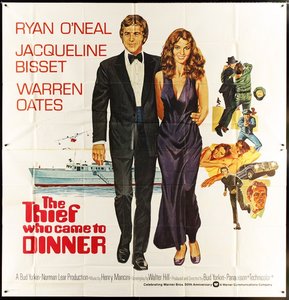
Film Review: The Thief Who Came To Dinner (1973, directed by Bud Yorkin)


0033bee5_mediumIn The Thief Who Came To Dinner, Ryan O’Neal plays Webster McGee, a Houston-based computer programmer.  After deciding that living in a capitalist society means that everyone steals from everyone else, Webster quits his boring job and decides to become a real thief.  Figuring that they can afford to lose a little wealth, Webster only targets the rich and powerful.  After he steals some incriminating documents from a crooked businessman (Charles Cioffi), Webster uses those documents to blackmail his way into high society.  Soon, Webster owns a mansion of his own and is living with a gorgeous heiress (Jacqueline Bisset, who played a lot of gorgeous heiresses back in the day).  Webster also has an insurance investigator after him.  Dave Reilly (Warren Oates) knows that Webster is a thief but he also can not prove it.  As Dave obsessively stalks him, Webster plots one final heist.

Until I saw it on TCM on Monday, I had never heard of The Thief Who Came To Dinner.  Directed in a breezy style by Bud Yorkin, The Thief Who Came To Dinner was an early script from Walter Hill.  Though the film is much more comedic than his best known work, it’s still easily recognizable as coming from Hill’s imagination.  The obsessive Dave and the coolly professional Webster are both prototypical Hill characters and their adversarial yet friendly rivalry would be duplicated in several subsequent Hill films.

The Thief Who Came To Dinner is an engaging movie that doesn’t add up to much.  The normally stiff Ryan O’Neal gives one of his better performances, though he struggles to hold his own whenever he has to act opposite the far more energetic Warren Oates.  Ned Beatty, Gregory Sierra, John Hillerman, Michael Murphy, and Austin Pendleton all appear in minor roles, making the film’s cast a veritable who’s who of 70s character actors.  And, of course, the film features Jacqueline Bisset at her loveliest.

The Thief Who Came To Dinner may not be well-known but it is an enjoyable and satisfying piece of 70s entertainment.

Embracing the Melodrama Part II #62: Time After Time (dir by Nicholas Meyer)


TimeAfterTime79So, I just gave the 1979 film Home Before Midnight a fairly negative review but I simply cannot end the 70s section of Embracing the Melodrama on such a negative note!  So, before we move on to the 80s, allow me to suggest another film from 1979 that you could watch while you’re not watching Home Before Midnight!

Time After Time opens in London.  The year is 1893.  Writer H.G. Wells (Malcolm McDowell) is having a dinner party so that he can show off his latest invention, a time machine.  Among his guests is a surgeon named John Stevenson (David Warner).  What nobody at the party suspects is that Stevenson also goes by the name Jack the Ripper and that he enjoys killing prostitutes.  When a detective from Scotland Yard shows up at Wells’s home, Stevenson jumps into the time machine and escapes into the future.  Since Stevenson does not have the “non-return key,” the machine returns back to 1893 but Stevenson has apparently escaped.

Wells uses the machine to pursue Stevenson and soon finds himself in 1979 San Francisco.  Wells had expected to find that the future would be a utopia but instead, he discovers the world of 1979 is loud, polluted, violent, angry, and dangerous.  (Kinda like the world of 2015…)  As Wells pursues Stevenson, he struggles to adjust to the world of the “future,” and he also meets a bank clerk, Amy Robbins (Mary Steenburgen).

Time After Time is probably the sweetest movie ever made about Jack the Ripper and that’s largely because of the romance between both Wells and Amy and the two actors who played them.  After watching Time After Time, I was not surprised to learn that McDowell and Steenburgen got married shortly after appearing in this film.  They were so incredibly sweet together!

Add to that, considering the he’s best known for playing villains and other menacing types, it’s interesting to see Malcolm McDowell plays such a gentle and nice character.  Wells’ befuddlement is charming to watch.  There’s a great scene where Amy calls Wells on a landline phone and Wells stares down at the receiver in frightened amazement.

Time After Time is a really good and likable movie.  It’s sweet and it proves that even hunting for Jack the Ripper can be a romantic experience if it’s done with the right person.  Watch it and enjoy!

Back to School #31: All The Right Moves (dir by Michael Chapman)


For the past week, we’ve been taking a look at 80 of the best, worst, most memorable, and most forgettable films ever made about being a teenager and going to high school.  We’ve been posting the reviews in chronological order and now, 30 reviews since we started this series with a film from 1946, we have reached the 1980s, a decade this is often considered to be the golden age of teen films.  For our 31st Back To School review, we take a look at 1983’s All The Right Moves.

How did you spend your Labor Day weekend?  Me, I spent it visiting with my family down at my uncle’s place.  Sunday afternoon, I was laying out by the pool and listening to my cousins Peter Paul and Paul Peter have a conversation.  (And yes, I do call both of them “Paulie.”)  They were talking about the Dallas Cowboys and I have to admit that I could not understand a word that they were saying.  It was like attending a Latin Mass, in that all I could do was hope that I was nodding at the right moment.  I can’t help it.  Football goes right over my head.  I know that the players are trying to score touchdowns and I know that whenever fall and winter come around, everyone I know is going to be complaining about the Cowboys.  But that’s it. (I also know that, what we in America call soccer, the rest of the world calls football.  But, to be honest, I really don’t care.)   Football talk might as well be a secret language.

However, I’m clearly in the minority as far as that’s concerned.  America loves football and so does Texas.  (Yes, I do consider my home state to be its own independent nation.  Take that, Vermont.)  And the American film industry has a long tradition of making movies — like All The Right Moves — about football.

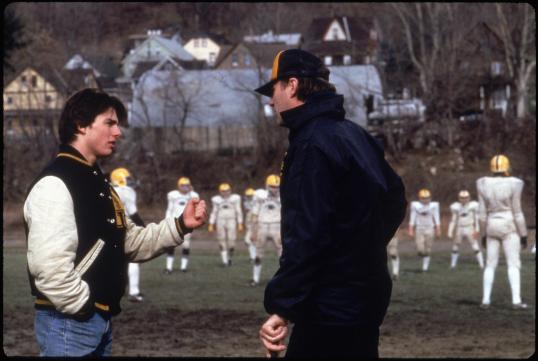
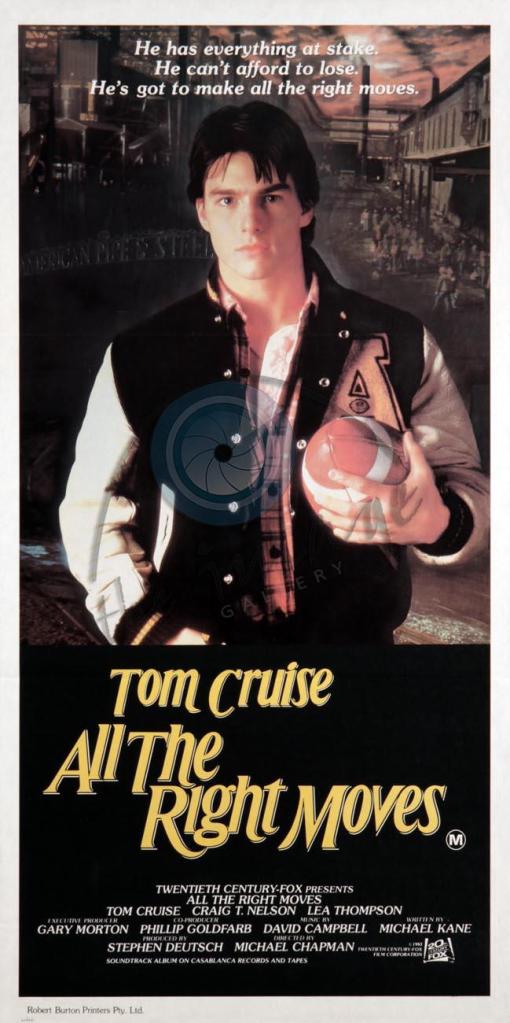
In All The Right Moves, Tom Cruise plays Stefan Djordjevic.  Stefan lives in a poor town in Pennsylvania and happens to be one of the stars of the Ampipe High School football team.  And that’s a pretty good thing because this town is obsessed with football.  The proud Coach Nickerson (Craig T. Nelson) is under constant pressure to win and Nickerson responds by pushing all of his players.  However, it finally looks like his approach is going to pay for both him and Stefan.  Nickerson is being considered for a college coaching  job.  Meanwhile, Stefan has a chance to get a scholarship to play football in college.  Interestingly, Stefan’s ambition is not to play professional football.  Instead, he wants to go to a good college so he can get an engineering degree.  Stefan’s main fear is to end up like everyone else in the town, working in a steel mill and not having any way to escape from a life of poverty.

still-of-tom-cruise-and-craig-t.-nelson-in-all-the-right-moves-(1983)

All The Right Moves starts out as a standard sports film but, halfway through, it takes an unexpected turn.  Ampipe High plays a game against their main rival, Walnut Heights High School.  This is the big game.  This is the game that most sports movies end with.  This is the game that you watch knowing that Nickerson and Stefan will overcome their differences (Nickerson is stubborn, Stefan is cocky) and that they will manage to narrowly win.

Except, of course, Ampipe doesn’t win.  As the result of a last minute mistake, Ampipe loses their lead and they lose the big game.  Nickerson yells at the team in the locker room.  Stefan yells back and Nickerson kicks him off the team.  Suddenly, Stefan finds himself with no future.  And Nickerson finds himself and his family being targeted by the angry, football-crazed citizens of the town…

For a football movie, All The Right Moves is actually pretty good.  Of course, it’s not really about football.  It’s about the desperation of people who have found themselves trapped in a cycle of poverty and how something as seemingly inconsequential as the high school football team can become an entire town’s life.  It’s about how two stubborn men — Stefan and Nickerson — allow their own fear of being trapped to keep them from thinking and acting rationally.

The film is also distinguished by good performances from Tom Cruise (who, in the same year, would play a much different high school senior in Risky Business), Craig T. Nelson, and Chris Penn (who plays Stefan’s best friend on the team).  However, the film’s best performance comes from Lea Thompson, who is so good in the role of Lisa, Stefan’s girlfriend, that you can’t help but wish that the film had been more about her than him.  In probably the film’s best scene, she calls out Stefan for being selfish and points out that, regardless of what happens in Stefan’s future, she’s going to be stuck in the town that he’s so desperate to escape from.  The scene where she and Stefan make love is sensitively handled and it also features a split-second or so of Tom Cruise full front nudity.

So, there’s always that.

It’s no Risky Business or Fast Times At Ridgemont High but, as far as high school football films are concerned, All The Right Moves is not a bad one.

all_the_right_moves_ausdaybill