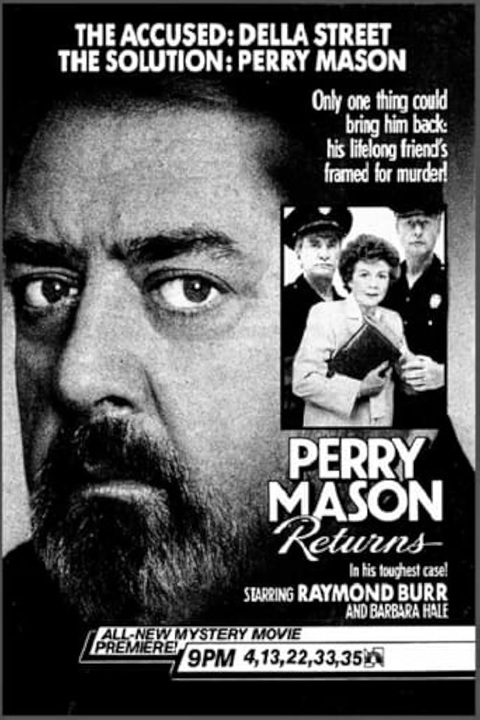
When his former secretary, Della Street (Barbara Hale), is arrested for murdering wealthy businessman Arthur Gordon (Patrick O’Neal), Judge Perry Mason (Raymond Burr) resigns from the bench so that he can defend her in court.
Perry Mason Returns reveals who the killer is when the murder happens. The killer is a lowlife named Robert Lynch (James Kidnie), who is wearing a gray wig and a frumpy dress so that everyone will mistake him for Della. It doesn’t take Perry and private detective Paul Dark, Jr. (William Katt) long to discover that Lynch is the murderer but, after someone shoots Lynch, they have to figure out who hired Lynch to kill Gordon. Gordon had recently disinherited his entire family so Perry and Paul have a lot of suspects to consider. 30 minutes in, I thought I knew who the killer was but it turned out I was wrong.
My Aunt Kate loved her detective stories and, when I was growing up, I would always watch them with her whenever we were visiting for the holidays. Watching Perry Mason Returns really made me feel nostalgic, even if it also made me feel dumb for not being able to guess who the killer was. Perry gives up being a judge so that he can defend Della Street in court. That’s true love. William Katt, who plays Paul Drake’s son, was Barbara Hale’s real-life son so I think that proves my theory that Della loved both Perry and Paul.
Perry Mason Returns was fun to watch. It had more action than I was expecting because Paul Drake, Jr. was always getting into tight situations. The movie really tried to make William Katt into an action star. The murder mystery held my attention and, of course, Perry got the murderer to confess on the stand and on the record. Some things never change! One thing that really amused me was that, as soon as Perry took the case, everyone naturally assumed he would win. Della wasn’t worried for a minute, even though she was facing life in prison. “You didn’t tell me Perry Mason was her lawyer!” Robert Lynch yelled at the person who hired him. He knew the gig was up. Perry Mason always wins!
Watching Perry Mason Returns, I felt like I was a kid again, watching movies with my Aunt Kate and trying to solve the mystery with her. All of the Perry Mason made-for-TV movies are on YouTube so I’ll be reviewing more of them in the future.
Welcome to Retro Television Reviews, a feature where we review some of our favorite and least favorite shows of the past! On Tuesdays, I will be reviewing the original Fantasy Island, which ran on ABC from 1977 to 1984. The show is once again on Tubi!
It’s time for a trip to 1984.
Episode 7.17 “Awakening of Love/The Imposter”
(Dir by Bob Sweeney, originally aired on March 17th, 1984)
Wendy Collins (Robin Mattson) is a beautiful model who cannot overcome her trust issues. She fears that she might be frigid and she even resists Roarke’s attempts to make her fantasy of finding true love come true by setting her up with photographer (Rod McCrary). Wendy finally reveals the truth to Roarke. She grew up in a troubled home and, as a result, she has a hard time trusting people. She’s only had one lover and the lover was….
“An older man?” Roarke asks.
“A woman,” Wendy reveals.
The camera zooms in on Roarke looking shocked.
Welcome to 1984! Now, today, it’s pretty obvious what would happen. Wendy would fall in love with the photographer’s assistant, Carla (Renee Lippin), and she would realize that there was nothing wrong with that. But this episode aired in 1984, which means that Wendy has to find the courage to tell the photographer that her previous lover was a woman and that the photographer will then have to be willing to say that it doesn’t matter. Basically, Wendy’s fantasy is to be reassured that she’s straight despite having had one same-sex relationship.
Yes, well, hmmm …. hey, what’s going on in the other fantasy?
Arthur Crane (John Davidson) has a compulsive disorder that leads to him assuming other people’s identities. That’s quite a serious problem and Fantasy Island plays it for laughs. Roarke tells Lawrence to follow Arthur around the Island and to keep Arthur from taking on anyone else’s identity. Lawrence is terrible at his job. (Tattoo could have done it!) Arthur pretends to be a movie producer. Arthur pretends to be Mr. Roarke. (Okay, that did make me laugh.) Arthur pretends to be a doctor so Mr. Roarke zaps Arthur into an alternate universe where he is a doctor and he’s going to have to perform surgery on someone who has had a cerebral hemorrhage. Arthur points out that he doesn’t really have any medical skills or training.. Then he looks at the comatose patient and discovers that it’s ….. HIMSELF!
This storyline had potential but it was done in by some seriously bad acting and the fact that the fantasy was comedic so the viewer knows from the start that Arthur is not going to accidentally kill himself on the operating table.
This was a rather dated trip to the Island. The main theme seemed to be that Lawrence was thoroughly incompetent.
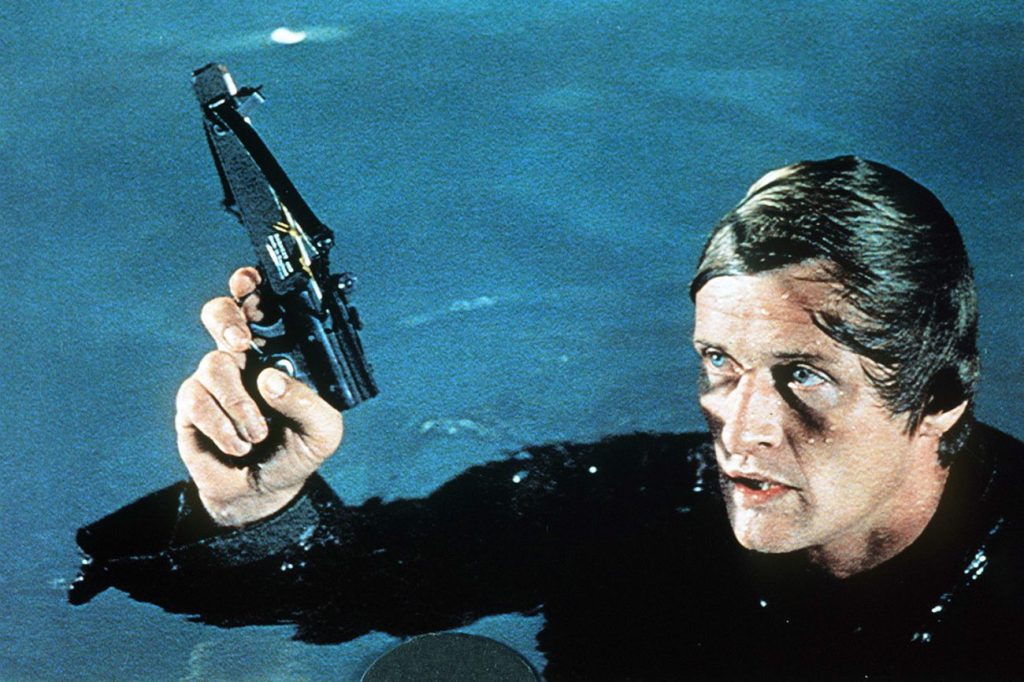
I’ve been having the best time reviewing Rutger Hauer films every Sunday. Today, I revisit THE OSTERMAN WEEKEND from 1983. Hauer made this film the year after BLADE RUNNER, so he was in the prime of his career. It also teams him up with an all-star supporting cast and master director Sam Peckinpah.
THE OSTERMAN WEEKEND opens with CIA Director Maxwell Danforth (Burt Lancaster) watching a recording of agent Laurence Fassett (John Hurt) making love to his wife. When Fassett hits the shower, two KGB assassins come in and kill her. Consumed by grief, Fassett hunts down the assassins and uncovers a Soviet spy network known as Omega. Fassett has identified three American men as top Omega agents… television producer Bernard Osterman (Craig T. Nelson with an awful, glued-on mustache), plastic surgeon Richard Tremayne (Dennis Hopper) and stock trader Joseph Cardone (Chris Sarandon). Rather than arrest the men and risk alarming the KGB, Fassett proposes to director Danforth that they try to turn one of the three men to the side of the West in hopes that this person will provide the information needed to bring down the Omega network.
Enter controversial television journalist John Tanner (Rutger Hauer). Fassett knows that Tanner has been close friends with Osterman, Tremayne, and Cardone since all four attended Berkeley together, and he believes that Tanner can successfully turn one of them. Although initially highly skeptical, the super patriotic Tanner begins to change his mind when Fassett shows him videotaped evidence of his old friends talking with a Russian agent in various capacities. Tanner reluctantly agrees to try turn one of his friends at their annual “Osterman Weekend” reunion which is coming up that week at Tanner’s house. He does have one condition… that Danforth, the CIA director will appear as a guest on his show. Danforth agrees to this condition. So that weekend, Tanner and his wife Ali (Meg Foster) welcome their old friends and their wives into their home, while Fassett has video camera equipment installed and hangs out in a van spying on the festivities. There’s no doubt it will turn out to be an awkward weekend, and you can’t help but wonder if Fassett may have more sinister motives than he’s letting on.
I’ll go ahead and say that I had a great time watching THE OSTERMAN WEEKEND for the first time in thirty-plus years. I’ve often read a criticism that the plot of this film is “incomprehensible.” Based on a book by Robert Ludlum, the story is purposely designed to keep you guessing up until its big reveal, but I didn’t have any trouble following it all. I’d say the biggest issue is that it doesn’t really stand up under close scrutiny. Some of the actions of the various characters don’t always make a lot of sense in light of the movie’s big twist near the end, but that didn’t take away from my personal enjoyment of the film. I just went along with the plot wherever it took me, and that was easy for me to do based on the cast that we have assembled. Any movie that includes Rutger Hauer, Burt Lancaster, John Hurt, Craig T. Nelson, Dennis Hopper, Chris Sarandon, Meg Foster, Helen Shaver, and Candy Yates will get a watch from me. Heck, Tim Thomerson even shows up as a motorcycle cop at one point. It’s a who’s who of excellent actors who always make their films watchable. In my opinion, it’s Hauer, Hurt, Foster and Nelson who do the most with their characters and take home the acting honors for their work here. Burt Lancaster is one of the all-time greats, and he does a good job, but it’s a one note character so there isn’t much he can do. Hopper and Sarandon are also fine, but their characters don’t really stand out. Their screen wives, Shaver and Yates, seem to be here mostly for eye candy because their tops are off for an abnormally large amount of their screen time! Speaking of eyes, the Hauer / Foster team up has to be on the list of the most striking combo pair of eyes in the history of cinema. Foster has the most noticeable eyes of any actress I’ve ever seen.
This is the great Sam Peckinpah’s final film, and I don’t agree with the people who complain that his career ended with a whimper. THE OSTERMAN WEEKEND is not in the same league as THE WILD BUNCH, RIDE THE HIGH COUNTRY, THE STRAW DOGS, or THE GETAWAY, but not many films are, including most of his own. And this movie is certainly visionary in one area, and that is found in its main theme about the damage that can be done with the manipulation of the media, including physical media, like videotape and audiotape. The primary driver of the film from the very beginning to the very end is the danger of false information that looks and sounds true. I can promise you that as I type this, and as you read it, there are people all over this world trying to make lies sound or appear true so they can share them on the news and on social media. I invite you to question everything you read, watch or hear on any outlet where you receive your news. Peckinpah’s final film beats this into our heads, just 40 years earlier.
Sam Peckinpah was known for his stylish and violent action sequences. THE OSTERMAN WEEKEND is more of a paranoid thriller, but it does feature some good action. There’s a chase sequence early in the film where Hauer’s wife and son are kidnapped, and he’s forced to commandeer the truck of honeymooners John Bryson (a Peckinpah regular) and Anne Haney (Greta from LIAR LIAR) to take off in hot pursuit. The scene features Peckinpah’s signature stunts, slow motion, and a myriad of cool tracking shots. There’s another fun scene where Hauer is using a baseball bat to defend himself against his pal Craig T. Nelson, who’s been shown to be a martial arts expert. It’s an exciting scene even if Hauer does get his ass kicked, in slow motion no less. And I always appreciate a movie with some good crossbow action, especially when it’s being wielded by a lady. The poster of the film prominently features a lady with a crossbow and we get to see Meg Foster step into that role in the actual film. She gets one especially gruesome, blood gurgling kill.
Overall, I think THE OSTERMAN WEEKEND is a good film. It is not nearly as bad as the critics of the time labeled it, and it’s not as good as Peckinpah’s best work, but you can certainly do a lot worse. It has a great cast, a timely message, a lot more sex and nudity than I remembered, and some cool action sequences. It’s definitely worth a watch!
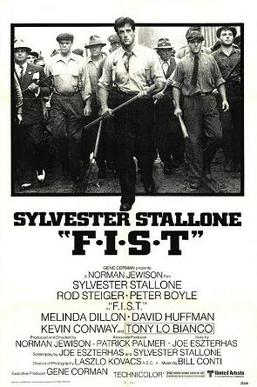
Actually, Stallone plays Johnny Kovak, a laborer who becomes a union organizer in 1939. Working with him is his best friend, Abe Belkin (David Huffman). In the fight for the working man, Abe refuses to compromise to either the bosses or the gangsters who want a piece of union. Johnny is more pragmatic and willing to make deals with ruthless mobsters like Vince Doyle (Kevin Conway) and Babe Milano (Tony Lo Bianco). Over thirty years, both Johnny and Abe marry and start families. Both become powerful in the union. When Johnny discovers that union official Max Graham (Peter Boyle) is embezzling funds, Johnny challenges him for the presidency. When a powerful U.S. senator (Rod Steiger) launches an investigation into F.I.S.T. corruption, both Johnny and Abe end up marked for death.
Obviously based on the life and mysterious disappearance of Jimmy Hoffa, F.I.S.T. was one of two films that Stallone made immediately after the surprise success of Rocky. (The other was Paradise Alley.) F.I.S.T. features Stallone in one of his most serious roles and the results are mixed. In the film’s quieter scenes, especially during the first half, Stallone is surprisingly convincing as the idealistic and morally conflicted Kovak. Stallone is less convincing when Kovak has to give speeches. If F.I.S.T. were made today, Stallone could probably pull off the scenes of the aged, compromised Johnny but in 1978, he was not yet strong enough as an actor. Far better is the rest of the cast, especially Conway, Lo Bianco, and Boyle. If you do see F.I.S.T., keep an eye on the actor playing Johnny’s son. Though he was credited as Cole Dammett, he grew up to be Anthony Keidis of the Red Hot Chili Peppers.
The box office failures of both F.I.S.T. and Paradise Alley led Stallone back to his most famous role with Rocky II. And the rest is history.
Today’s horror on the lens in 1978’s House of Evil!
When Richard Crenna buys a new house, he recruits a few friends to help him fix it up. Unfortunately, it turns out that the house is haunted by the devil himself. House of Evil — which is also known as The Evil — is an entertaining little time waster. If the idea of being in a house with the devil doesn’t scare you, just check out some of those the 1970s fashion choices!
I’m currently in the process of watching the 36 films that I’ve recorded on my DVR since March. Last night, I was extremely excited as I looked up the 7th film on the DVR and I discovered that I was about to watch the 1977 revenge classic, Rolling Thunder!
Among those of us who love old grindhouse and exploitation film, Rolling Thunder has achieved legendary status. Based on a script by Paul Schrader (though I should point out that Schrader’s script was rewritten by Heywood Gould and Schrader himself has been very critical of the actual film) and directed by John Flynn, Rolling Thunder is quite literally one of the best revenge films ever made. It’s also a great Texas film, taking place and filmed in San Antonio. Quentin Tarantino has frequently cited Rolling Thunder as being one of his favorite films and he even used the name for his short-lived distribution company, Rolling Thunder Pictures.
Rolling Thunder also has one of the greatest trailers of all time. In fact, if not for the trailer, I probably would never have set the DVR to record it off of Retroplex on March 25th. The Rolling Thunder trailer is included in one of the 42nd Street Forever compilation DVDs and, from the minute I first watched it, I knew that Rolling Thunder was a film that I had to see.
Watch the trailer below:
Everything about that trailer — from the somewhat portentous narration at the beginning to the way that Tommy Lee Jones calmly says, “I’ll get my gear,” at the end, is pure genius.
But what about the film itself? Well, having finally seen the film, I can say that Rolling Thunder is indeed a classic. It’s also one of the most brutal films that I’ve ever seen, containing scenes of truly shocking and jarring violence. In fact, the violence is so shocking that it’s also, at times, rather overwhelming. This is one of those films that you will probably remember as being far more violent than it actually is. Because, while Rolling Thunder features its share of shoot-outs and garbage disposal limb manglings, it’s actually a very deliberately paced character study.
When we first meet Maj. Charles Rane (William Devane), he’s sitting on a plane and looking down on San Antonio. He’s in full military dress uniform. Setting across from him, also in uniform, is John Vohden (Tommy Lee Jones). The year is 1973 and Rane and Vohden have both just spent the past seven years as prisoners in a Vietnamese camp. While they were prisoners, they were tortured every day. Now, they’re returning home and neither one of them is quite sure what’s going to be waiting for them.
Over the imdb, you can find a few complaints from people who feel that Rolling Thunder gets off to a slow start. And it’s true that it takes over 30 minutes to get to the pivotal scene where Maj. Rane loses both his hand and his family. But that deliberate pace is what makes Rolling Thunder more than just a revenge flick with a kickass name. That first half-hour may seem to meander but what it’s actually doing is setting both Rane and Vohden up as strangers in their own country.
The film gets a lot of mileage out of comparing Rane to Vohden. Rane is good with words. When he gets off the plane, he gives a perfect (and perfectly empty) speech about how the whole war experience has made a better American out of him. Rane knows how to fool people but it quickly becomes apparent that, on the inside, Rane feels empty.
Vohden, meanwhile, is not an articulate man. He’s not invited to give a speech when the plane lands. Vohden cannot fake the emotions that he does not feel. At first, Rane and Vohden seem to be complete opposites (and the film wisely contrasts Jones’s trademark taciturn style of acting with Devane’s more expressive technique) but eventually, we learn that they’re actually two sides of the same coin. Both of them have been left empty as a result of their wartime experiences and, in the end, Vohden is the only one who can truly understand what’s going on in Rane’s head while Rane is the only one who can understand Vohden. When Rane needs help getting revenge, Vohden is the one that he turns to. It’s not just because Vohden knows how to kill. It’s also because John Vodhen is literally the only man to whom Charles Rane can relate.
Why does Rane need revenge? After the local bank awards him with 2,000 silver dollars (“One silver dollar for every day you spent in the Hell of Hanoi!,” he is told at the presentation), Rane returns home to discover that a group of men have broken into his house. One of them, known as the Texan (an absolutely chilling performance from James Best), demands that Rane tell them where the silver dollars are hidden. When Rane responds by giving only his name, rank, and serial number, Slim (Luke Askew) reacts by forcing Rane’s arm into the kitchen sink and then turning on the garbage disposal. (A scene was apparently shot that literally showed Rane’s hand getting ripped off by the garbage disposal but it was judged to be too graphic even for this grim little movie.) Even as the disposal mangles Rane’s arm, Rane refuses to tell them where the money is. Instead, he just flashes back to being tortured at the camp and we realize that Rane’s experiences have left him immune to pain.
Of course, the Texan doesn’t realize this. Instead, he glares at Rane and mocks him by declaring him to be “one macho motherfucker.”
When Rane’s wife and son walk in on the men, Slim and the Texan murder them and leave Rane for dead. However, Charles Rane isn’t dead. He survives but he claims that he can’t remember anything about the men who attacked him. It’s only after Rane is released from the hospital and starts to practice firing a shotgun with the hook that has replaced his hand that we realize that Rane does remember. Recruiting a local waitress who also happens to be an amateur beauty queen (Linda Haynes, giving the type of great performance that makes me wonder why I’ve never seen her in any move other than Rolling Thunder) to help, Rane sets out to track down “the men who killed my boy.”
Linda Hayes in Rolling Thunder, giving a great performance in a somewhat underdeveloped role
It’s very telling that Rane continually says that he’s after the men who “killed my boy” but he never mentions his wife. When Rane first arrived home, he had one conversation with his wife. He complained that she had changed her hair and that she wasn’t wearing a bra. “Nobody wears them anymore,” She replied before telling him that, during his seven year absence, she had fallen in love with another man, Cliff (Lawrason Driscoll). And, up until she’s murdered by the Texan, that’s the last conversation that we see Rane have with his wife. Rane still lives in the house and he still tries to talk to his son (even though his son seems more comfortable around Cliff than around Rane) but Rane becomes a stranger to his family. While his wife sleeps in the house, Rane insists on staying out in the garage and continuing to go through the daily routine of calisthenics that he used to maintain his sanity while he was a prisoner.
(When Cliff asks Rane what it was like to be tortured, Rane literally forces Cliff to pull back on his arms in the same way that his Vietnamese captors had to. As I watched these scenes, I was reminded that 2008 presidential candidate John McCain cannot lift his arms above his shoulders as a result of the torture he suffered while a POW.)
When Rane goes to El Paso to recruit Vohden for his mission of revenge, we notice that Vohden also appears to be incapable of speaking to his wife. When Vohden leaves, he says goodbye to his father but not his wife. It’s probably not a coincidence that, when Vohden and Rane find Slim and the Texan, they’re at a brothel, a place where men are in charge, women are subservient, and primal needs are satisfied without the risk of emotional attachment. (It’s also probably not a coincidence that Slim is also identified as having recently returned from Vietnam. He complains that, unlike Rane and Vohden, he was never captured by the enemy and, as a result, he didn’t get a parade when he came back home.) Rolling Thunder is a film about emotionally stunted men who are incapable of interacting in any way other than violence. By the end of the film, you’re left wondering whether Rane’s mission was about revenge or about his own need to destroy.
And what an ending! When I say that the violence in Rolling Thunder is overwhelming, I’m talking about two scenes in particular. There’s the scene where Rane loses his hand and watches as The Texan casually executes his wife and son. And then there’s the ending. The final shootout was quick but it was also so brutal that I was literally shaking by the end of it.
(The scenes leading up the final shootout also featured one of the few humorous moments to be found in this otherwise grim film. When Vohden — who is inside the brothel with a prostitute — starts to put his rifle together, the prostitute asks him what he’s doing. “Oh,” Vohden says, in that perfectly weary way that only Tommy Lee Jones can do, “just going to kill a bunch of folks.”)
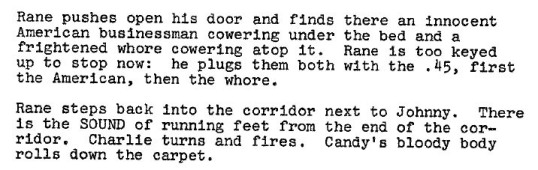
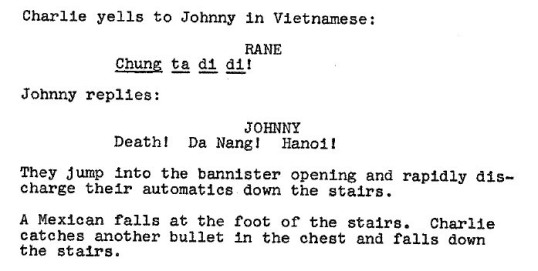
I mentioned earlier that Paul Schrader is reportedly not a fan of Rolling Thunder. Apparently, in his original script, Charles Rane was portrayed as being a poorly educated racist, a bit of a prototype for the character that Robert De Niro played in Taxi Driver. Ranes’s final rampage was meant to be an example of the war in Vietnam coming home and it was made much clearer that Rane’s violence was as much fueled by his own racism as by a desire for revenge. Schrader has said that his anti-fascist script was turned into a fascist movie.
A scene from Paul Schrader’s original script
With all due respect to Mr. Schrader (who I think is a very underrated filmmaker), Rolling Thunder is anything but a fascist movie. Instead, it’s a brutal and somewhat disturbing character study of a man who will never truly escape the war in which he fought. The fact that Rane is played by super smooth William Devane (as opposed to the redneck that Schrader apparently envisioned) only serves to make the film’s critique of hyper masculinity all the more disturbing. It’s interesting to note that, on their own, Rane and Vohden are never presented as being particularly likable or heroic. Instead, we root for them because the people who have hurt them are even worse.
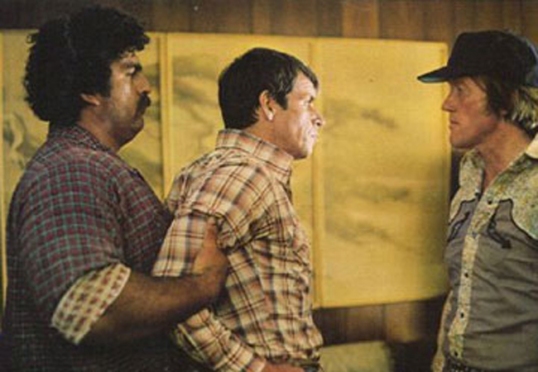
This was how Schrader envisioned Johnny and Rane.
Though it may be far different from what Paul Schrader originally envisioned, John Flynn’s Rolling Thunder is a film that works on every level. It is both a visceral revenge film and a character study of a disturbed man. It’s a powerful film that will leave you shaken and it’s one that I will probably never erase from my DVR.
There are some movies that you just don’t dare delete.
 Sylvester Stallone is Jimmy Hoffa!




 Through the Shattered Lens