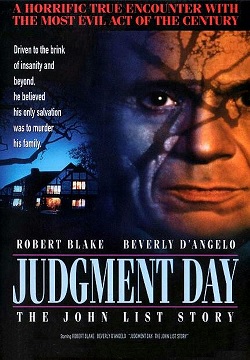
October True Crime: Judgment Day: The John List Story (dir by Bobby Roth)


In 1971, a 46 year-old account named John List committed a shocking crime.

To the outside world, John List was a normal suburbanite.  He was perhaps a little bit strict but then again, it was 1971 and all of the traditional morals that John List had grown up with were being challenged in the streets and in the movies.  Neither he nor his family were particularly sociable but again, it was assumed that they just liked the privacy that was afford to them by the mansion in which they lived.  List was married to Helen.  They lived with their three teenage children and List’s 84 year-old mother.  John List was a hard worker, he taught Sunday School, and, again, he was seen as being perfectly normal.

On November 9th, 1971, John List methodically murdered his wife, his children, and his mother.  He left his mother in her upstairs apartment while the rest of his family was laid out, in sleeping bags, in the ballroom.  (Detectives later surmised that List stopped in the middle of his murder spree to have lunch and then attended his son’s soccer game before taking him home and killing him.)  List left behind several notes, explaining that he was in a bad financial situation and that he feared that his family was heading down an immoral path that would have condemned their souls to Hell if he hadn’t killed them first.  And then, John List vanished.

For the rest of the 70s and the 80s, John List was phantom.  Some speculated that he had committed suicide while others thought that he had changed his identity and had probably remarried.  In 1987, the classic thriller The Stepfather was released in theaters.  Inspired by List’s crimes, The Stepfather starred Terry O’Quinn as Jerry Blake, a real estate agent who was obsessed with creating the perfect family.  The Stepfather imagined its killer as a friendly but rigid man who snapped whenever his illusion of perfection was threatened.  It also imagine him as someone who moved from town to town, searching for a new family that wouldn’t let him down.

As for the real John List, it turned out that those who suspected him of having changed his identity were correct.  And, just as The Stepfather suggested, he had remarried and was actually now a real stepfather.  List remained free until his story was included in a 1989 episode of America’s Most Wanted.  A forensic scientist included a bust of what John List might have looked like in 1989 and a viewer realized that the bust looked a lot like an accountant named Bob Clark.  “Bob Clark” was arrested and eventually, he confessed that he was actually John List.  Despite his attorney’s attempt to argue that he was not guilty by reason of insanity, John List was eventually convicted of five counts of murder.  He spent the rest of this life in prison, dying of natural causes in 2008.

The 1993 film Judgement Day: The Story of John List tells the story of List’s crimes and his subsequent attempt to build a new life for himself.  John List is played by Robert Blake, which turns out to be a bit of a problem as Blake gives such a twitchy and obviously unstable performance that it’s hard to believe that he could have successfully gone into hiding for 18 years.  Carroll Baker and Beverly D’Angelo are not given much to do as, respectively, List’s mother and List’s first wife while David Caruso appears as the detective who is determined to catch List.  Though this film was made long before CSI: Miami, I still found myself expecting Caruso to say something quippy and put on his sunglasses.

Judgment Day doesn’t add much to the story of John List.  It certainly doesn’t offer up any new insight into what led to List becoming a murderer, beyond the fact that List himself was just kind of a jerk.  It’s pretty much a by-the-numbers production that’s only interesting today because of Blake’s subsequent legal problems.  (For the record, I’ve always felt Robert Blake was innocent.)  When it comes to John List films, stick with The Stepfather.

The Unnominated: Star 80 (dir by Bob Fosse)


Though the Academy of Motion Picture Arts and Sciences claim that the Oscars honor the best of the year, we all know that there are always worthy films and performances that end up getting overlooked.  Sometimes, it’s because the competition too fierce.  Sometimes, it’s because the film itself was too controversial.  Often, it’s just a case of a film’s quality not being fully recognized until years after its initial released.  This series of reviews takes a look at the films and performances that should have been nominated but were,for whatever reason, overlooked.  These are the Unnominated.

First released in 1983, Star 80 is an examination of fame, obsession, misogyny, and finally madness.  All four of those qualities are exemplified in the character of Paul Snider (Eric Roberts), a man with a charming smile, a ludicrous wardrobe, and the personality of a pimp.  When we first see Paul Snider, he’s naked and he’s covered in blood and he’s ranting about how the world is trying to destroy him.  Even if he wasn’t holding a rifle, he would be terrifying.  Suddenly, we flash back to a few years earlier.  Snider is being dangled out a window by two men.  Snider pathetically begs to be pulled back into the room.  The men laugh at him before pulling him up.  Snider, looking fairly ridiculous in a cheap suit that he probably thinks makes him look like a celebrity, fights off tears as he says he deserves to be treated with dignity.

Star 80 is based on a true story.  Mariel Hemingway plays Dorothy Stratten, the actress and Playboy playmate who was murdered by Paul Snider.  Snider, who often claimed credit for having “made” Dorothy, was married to her at the time, though Dorothy had filed for divorce and was dating director Peter Bogdanovich.  Unwilling to let her go and return to being a small-time hustler, Snider shot Dorothy and then himself.  Director Bob Fosse, who was best known for directing musicals like Cabaret and All That Jazz, was attracted to the story because he understood that type of world that produces sleazes like Paul Snider.  According to Eric Robets, Fosse even said that he probably would have ended up like Paul Snider if not for his talent.

Snider, the film quickly establishes, really doesn’t have any talent beyond the ability to manipulate people who are too naïve to see through his bullshit.  Snider wants to be a star.  He wants to be rich.  He wants people to kiss his ass.  When he meets Dorothy, he sees her as his ticket.  Dorothy’s mother (a poignant performance from Carroll Baker) sees straight through him from the start.  Tragically, Dorothy doesn’t realize the truth abut who he is until they’re already in Hollywood.  As Dorothy tries to break away from him, Paul desperately tries to find some sort of success, all the while complaining that the world is conspiring to keep him from being a man. 

Eric Roberts dominates the film and it’s one of the scariest performances that I’ve ever seen.  Roberts is convincing when he’s ranting and raving against the world that he feels is against him but what’s even more disturbing is that he’s convincing when he’s turning on the charm.  Paul Snider may not be smart.  Paul Snider may not be talented.  But he know how to gaslight.  He knows how to destroy someone’s fragile confidence, largely because his own confidence has been shattered so many times that he’s become an expert in exploiting insecurity.  Snider is a tacky dresser and nowhere near as smooth as he thinks but, intentionally or not, he uses that to his advantage.  He tries so hard to impress that it’s easy to see how someone could feel sorry for him and want to help him.  However, because Fosse lets us know from the start what Snider is really going on inside of Sinder’s head, we never make the mistake of trusting him.  We know who Paul Snider is because we’ve all known a Paul Snider.

Eric Roberts’s performance is so intense that it’s unfortunate but not surprising that it was overlooked at the 1983 Oscars.  He was playing a truly repellent character and he did it so convincingly that I imagine many viewers had a hard time realizing that Eric Roberts was not Paul Snider but was instead an actor playing a terrible character.  Some probably said, “Why should we honor such a loathsome character?” and again, the answer is because there are many Paul Sniders out there.  Roberts captured much more than just one man’s breakdown.  He captured a sickness at the heart of a fame-driven culture.

Of course, Paul Snider was not the only symptom of that sickness to be depicted in Star 80.  Every man that Dorothy either uses her in some way or just views her as being a commodity.  Hugh Hefner (Cliff Robertson) presents himself as being a fatherly mentor but Robertson plays him as being just as manipulative and ultimately narcissistic as Paul Snider.  Director Aram Nicholas (Roger Rees, playing a character based on Peter Bogdanovich) seems to love Dorothy but their relationship still feels out-of-balance.  Aram, afterall, is the director while Dorothy is the actress.  The private detective (Josh Mosel) that Paul hires to spy on Dorothy seems to have no lingering guilty over the role he played.  Even Snider’s roommate (David Clennon) is more interested in talking about his dog and his car then about the murder/suicide of two people with whom he lived.

It’s a dark film and not one to be watched when depressed.  At the same time, it’s a portrait of obsessiveness, misogyny, and an overwhelming need to be “someone” that still feels relevant today.  Along with Sweet Charity, it was the only Bob Fosse film not to be nominated for Best Picture.  (This was back when there were only five best picture nominees.  Three of the nominated films — Terms of Endearment, Tender Mercies, and The Right Stuff — hold up well.  Two of the nominees — The Dresser and The Big Chill — are a bit more iffy.)  Eric Roberts was not nominated for the best performance of his career.  Again, it’s a shame but not a surprise.  This was a dark and disturbing film, a true Hollywood horror story.  One imagines that most members of the Academy wanted to escape it far more than they wanted to honor and be reminded of it.

Previous entries in The Unnominated:

  1. Auto Focus 

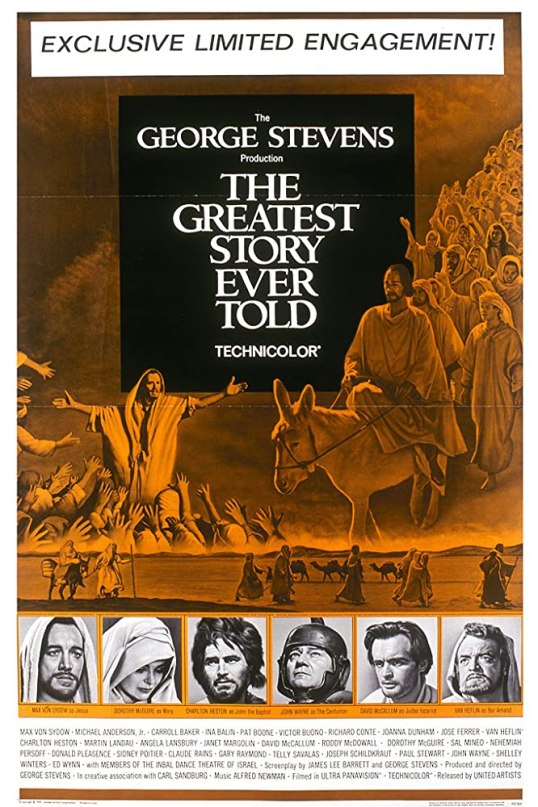
Film Review: The Greatest Story Ever Told (dir by George Stevens)


The 1965 biblical epic, The Greatest Story Ever Told, tells the story of the life of Jesus, from the Nativity to the Ascension.  It’s probably the most complete telling of the story that you’ll ever find.  It’s hard to think of a single details that’s left out and, as a result, the film has a four hour running time.  Whether you’re a believer or not, that’s a really long time to watch a reverent film that doesn’t even feature the campy excesses of something like The Ten Commandments.

(There’s actually several different version of The Greatest Story Ever Told floating around.  There’s a version that’s a little over two hours.  There’s a version that’s close to four hours.  Reportedly, the uncut version of the film ran for four hour and 20 minutes.)

Max von Sydow plays Jesus.  On the one hand, that seems like that should work because Max von Sydow was a great actor who gave off an otherworldly air.  On the other hand, it totally doesn’t work because von Sydow gives an oddly detached performance.  The Greatest Story Ever Told was von Sydow’s first American film and, at no point, does he seem particularly happy about being involved with it.  von Sydow is a very cerebral and rather reserved Jesus, one who makes his points without a hint of passion or charisma.  When he’s being friendly, he offers up a half-smile.  When he has to rebuke his disciples for their doubt, he sounds more annoyed than anything else.  He’s Jesus if Jesus was a community college philosophy professor.

The rest of the huge cast is populated with familiar faces.  The Greatest Story Ever Told takes the all-star approach to heart and, as a result, even the minor roles are played by actors who will be familiar to anyone who has spent more than a few hours watching TCM.  Many of them are on screen for only a few seconds, which makes their presence all the more distracting.  Sidney Poitier shows up as Simon of Cyrene.  Pat Boone is an angel.  Roddy McDowall is Matthew and Sal Mineo is Uriah and John Wayne shows up as a centurion and delivers his one line in his trademark drawl.

A few of the actors do manage to stand out and make a good impression.  Telly Savalas is a credible Pilate, playing him as being neither smug nor overly sympathetic but instead as a bureaucrat who can’t understand why he’s being forced to deal with all of this.  Charlton Heston has just the right intensity for the role of John the Baptist while Jose Ferrer is properly sleazy as Herod.  In the role Judas, David McCallum looks at the world through suspicious eyes and does little to disguise his irritation with the rest of the world.  The Greatest Story Ever Told does not sentimentalize Judas or his role in Jesus’s arrest.  For the most part, he’s just a jerk.  Finally, it’s not exactly surprising when Donald Pleasence shows up as Satan but Pleasence still gives a properly evil performance, giving all of his lines a mocking and often sarcastic bite.

The Greatest Story Ever Told was directed by George Stevens, a legitimately great director who struggles to maintain any sort of narrative momentum in this film.  Watching The Greatest Story Ever Told, it occurred to me that the best biblical films are the ones like Ben-Hur and The Robe, which both largely keep Jesus off-screen and instead focus on how his life and teachings and the reports of his resurrection effected other people.  Stevens approaches the film’s subject with such reverence that the film becomes boring and that’s something that should never happen when you’re making a film set in Judea during the Roman era.

I do have to admit that, despite all of my criticism of the film, I do actually kind of like The Greatest Story Ever Told.  It’s just such a big production that it’s hard not to be a little awed by it all.  That huge cast may be distracting but it’s still a little bit fun to sit there and go, “There’s Shelley Winters!  There’s John Wayne!  There’s Robert Blake and Martin Landau!”  That said, as far as biblical films are concerned, you’re still better off sticking with Jesus Christ Superstar.

Lisa Reviews An Oscar Nominee: How The West Was Won (dir by Henry Hathaway, George Marshall, John Ford, and Richard Thorpe)


(With the Oscars scheduled to be awarded on March 4th, I have decided to review at least one Oscar-nominated film a day.  These films could be nominees or they could be winners.  They could be from this year’s Oscars or they could be a previous year’s nominee!  We’ll see how things play out.  Today, I take a look at the 1963 best picture nominee, How The West Was Won!)

How was the west won?

According to this film, the west was won by the brave men and women who set out in search of a better life.  Some of them were mountain men.  Some of them worked for the railroads.  Some of them rode in wagons.  Some of them gambled.  Some of them sang songs.  Some shot guns.  Some died in the Civil War.  The thing they all had in common was that they won the west and everyone had a familiar face.  How The West Was Won is the history of the west, told through the eyes of a collection of character actors and aging stars from Hollywood’s Golden Age.

In many ways, How The West Was Won was the Avatar of the early 60s.  It was a big, long, epic film that was designed to make viewers feel as if they were in the middle of the action.  Avatar used 3D while How The West Was Won used Cinerama.  Each scene was shot with three synchronized cameras and, when the film was projected onto a curved Cinerama screen, it was meant to create a truly immersive experience.  The film is full of tracking shots and, while watching it on TCM last night, I tried to imagine what it must have been like to see it in 1963 and to feel as if I was plunging straight into the world of the old west.  The film’s visuals were undoubtedly diminished by being viewed on a flat screen and yet, there were still a few breath-taking shots of the western landscape.

The other thing that How The West Was Won had in common with Avatar was a predictable storyline and some truly unfortunate dialogue.  I can understand why How The West Was Won was awarded two technical Oscars (for editing and sound) but, somehow, it also picked up the award for Best Writing, Screenplay or Story.  How The West Was Won is made up of five different parts, each one of which feels like a condensed version of a typical western B-movie.  There’s the mountain man helping the settlers get down the river story.  There’s the Civil War story.  There’s the railroad story and the outlaw story and, of course, the gold rush story.  None of it’s particularly original and the film is so poorly paced that some sections of the film feel rushed while others seem to go on forever.

Some of the film’s uneven consistency was undoubtedly due to the fact that it was directed by four different directors.  Henry Hathaway handled three sections while John Ford took care of the Civil War, George Marshall deal with the coming of the railroad, and an uncredited Richard Thorpe apparently shot a bunch of minor connecting scenes.

And yet, it’s hard not to like How The West Was Won.  Like a lot of the epic Hollywood films of the late 50s and early 60s, it has its own goofy charm.  The film is just so eager to please and remind the audience that they’re watching a story that could only be told on the big screen.  Every minute of the film feels like a raised middle finger to the threat of television.  “You’re not going to see this on your little idiot box!” the film seems to shout at every moment.  “Think you’re going to get Cinerama on NBC!?  THINK AGAIN!”

Then there’s the huge cast.  As opposed to Avatar, the cast of How The West Was Won is actually fun to watch.   Admittedly, a lot of them are either miscast or appear to simply be taking advantage of a quick payday but still, it’s interesting to see just how many iconic actors wander through this film.

For instance, the film starts and, within minutes, you’re like, “Hey!  That’s Jimmy Stewart playing a mountain man who is only supposed to be in his 20s!”

There’s Debbie Reynolds as a showgirl who inherits a gold claim!

Is that Gregory Peck as a cynical gambler?  And there’s Henry Fonda as a world-weary buffalo hunter!  And Richard Widmark as a tyrannical railroad employee and Lee J. Cobb as a town marshal and Eli Wallach as an outlaw!

See that stern-faced settler over there?  It’s Karl Malden!

What’s that?  The Civil War’s broken out?  Don’t worry, General John Wayne is here to save the day.  And there’s George Peppard fighting for the Union and Russ Tamblyn fighting for the Confederacy!  And there’s Agnes Moorehead and Thelma Ritter and Robert Preston and … wait a minute?  Is that Spencer Tracy providing narration?

When Eli Wallach’s gang shows up, keep an eye out for a 36 year-old Harry Dean Stanton.  And, earlier, when Walter Brennan’s family of river pirates menaces Karl Malden, be sure to look for an evil-looking pirate who, for about twenty seconds, stares straight at the camera.  When you see him, be sure to say, “Hey, it’s Lee Van Cleef!”

How The West Was Won is a big, long, thoroughly silly movie but, if you’re a fan of classic film stars, it’s worth watching.  It was a huge box office success and picked up 8 Oscar nominations.  It lost best picture to Tom Jones.

(By the way, in my ideal fantasy world, From Russia With Love secured a 1963 U.S. release, as opposed to having to wait until 1964, and became the first spy thriller to win the Oscar for Best Picture.)

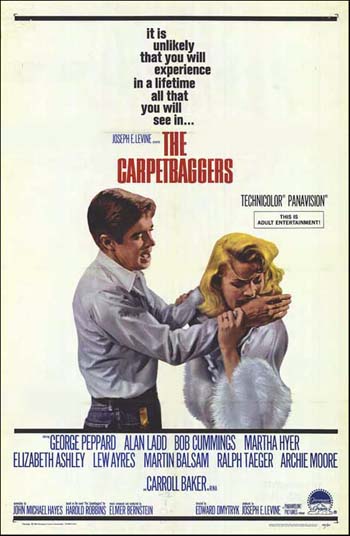
Embracing the Melodrama Part II #28: The Carpetbaggers (dir by Edward Dmytryk)


The_Carpetbaggers_1964_poster

The 1960s was apparently a bad time for talented old school Hollywood filmmakers getting sucked into making big budget, excessively lengthy films.  Joseph L. Mankiewicz spent most of his career making movies like All About Eve and then, in 1963, he ended up directing Cleopatra.  Elia Kazan went from A Face In The Crowd to The Arrangement.  John Huston went from Treasure of the Sierra Madre and The African Queen to directing not only The Bible but Reflections in a Golden Eye as well.

And then there’s Edward Dmytryk.  Dmytryk may not be as highly regarded by modern critics as Mankiewicz and Huston but he still directed some of the best film noirs of the 1940s.  His 1947 film Crossfire was nominated for best picture and probably should have won.  In 1952, he directed one of the first true crime procedural films, The Sniper.  His 1954 best picture nominee, The Caine Mutiny, featured one of Humphrey Bogart’s best and most unusual performances.

And yet, in 1964, he somehow found himself directing The Carpetbaggers.

The Carpetbaggers tells the story of Jonas Cord (George Peppard).  Jonas is the son of the fabulously wealthy Jonas Cord, Sr. (Leif Erickson).  At the start of the film, father and son do not get along.  Senior resents that Junior is more interested in piloting airplanes than in learning the family business.  Junior is angry that Senior has married Jonas’s ex-girlfriend, actress Rina Marlowe (Carroll Baker).  In fact, as far as Jonas, Jr. is concerned, Nevada Smith (Alan Ladd) is more of a father to him than his actual father.

Nevada Smith is Jonas, Sr.’s best friend and occasional business partner.  He’s a former cowboy who, we are told in a lengthy bit of exposition, is legendary for tracking down and killing the three men who killed his parents.  (As we listen to Jonas, Jr. tell the entire lengthy story, we find ourselves thinking, “Okay, so why not make a movie out of that story?”  Well, they did.  Two years after the release of The Carpetbaggers, Steve McQueen starred in Nevada Smith.)  Nevada’s also a film star whose career is in deep decline.

Speaking of deep decline, Jonas, Sr. ends up having a heart attack and dramatically dropping dead before he can get a chance to disinherit his son.  Jonas, Jr. inherits the Cord fortune and the Cord business and proceed to spend the next two and a half hours abusing everyone who gets close to him.  He even mistreats his loving and neurotic wife, Monica (Elizabeth Ashley, giving the only really memorable performance in the entire film).

Yes, there’s really no reason to have any sympathy at all for Jonas Cord, Jr. but the film insists that we should because he’s the main character and he’s played by the top-billed star.  We’re also told that he’s a brilliant aviation engineer and I guess we’re supposed to admire him for being good at what does.  We also discover that Jonas believes that his mother was insane and that she passed down her insanity to him.  He fears that he’ll pass the crazy gene to any of children that he might have so that’s why he pushes everyone away.  Just in case we don’t understand how big a deal this is to him, the camera zooms in for a closeup whenever Jonas is reminded of his mother.

(In the 60s, all mental instability was represented via zoom lens.)

However, Jonas isn’t just into airplanes!  He also buys a movie studio, specifically because Rina Marlowe is under contract.  Soon, Jonas is directing movies his way.  Jonas also finds himself falling in love with another actress (Martha Hyer) so, of course, he starts treating her badly in an effort to push her away.

What can be done to save the tortured soul of Jonas Cord?  Maybe he just need to get beaten up by Nevada Smith…

The Carpetbaggers was based on a novel by Harold Robbins.  The novel was apparently quite a scandal when it was originally published.  People read it and they wondered, “Who was based on who?”  Well, if you’ve ever seen The Aviator, it’s not that difficult to figure out.  Jonas Cord, eccentric movie mogul and obsessive pilot, was obviously meant to be Howard Hughes.  Rina Marlowe was meant to be Jean Harlow, a fact that can be guessed just by looking at the last names.  And I’m guessing that Nevada Smith was probably based on former President Warren G. Harding because … well, why not?

I suppose that, by the standards of 1964, the film version of The Carpetbaggers would have been considered risqué.  For a modern audience, the main appeal of something like The Carpetbaggers is to see what was once considered to be shocking.  The film is overlong, George Peppard doesn’t exactly figure out how to make Jonas into the compelling  rogue that he needs to be, the clothes and the sets are a lot more interesting than any of the dialogue (but not interesting enough to carry a nearly 3 hour movie), and the film’s pacing is so off that some scenes seem to go on forever while others are way too short.  But, as a cultural and historical artifact, The Carpetbaggers does hold some interest.

The Carpetbaggers was made at a time when Hollywood felt it was under attack from both television and European cinema.  With a film like The Carpetbaggers, the studios were saying, “See!?  Television will never be able to make a film this long and big!  And those Europeans aren’t the only ones who can make a movie about sex!”  Of course, as so often happened during this time, the studios failed to take into account that size and length don’t always equal quality (and ain’t that the truth?).  As for the sex — well, we hear a lot more than we actually see.  The Carpetbaggers is one of those films where everyone talks about sex, largely because showing sex wasn’t really an option.  (And it should be noted that most of the sex talk is delivered in the language of euphemism.)  As a result, The Carpetbaggers feels incredibly tame by today’s standards.  As a result, your main reaction to The Carpetbaggers will probably be to marvel at what was considered daring and shocking 50 years ago.

(And before we get too cocky and quick to dismiss those who came before us, let’s consider how our current films will look to movie audiences five decades from now…)

As far as biopics of Howard Hughes are concerned, The Carpetbaggers in no Aviator.  However, it is an occasionally interesting historical artifact.

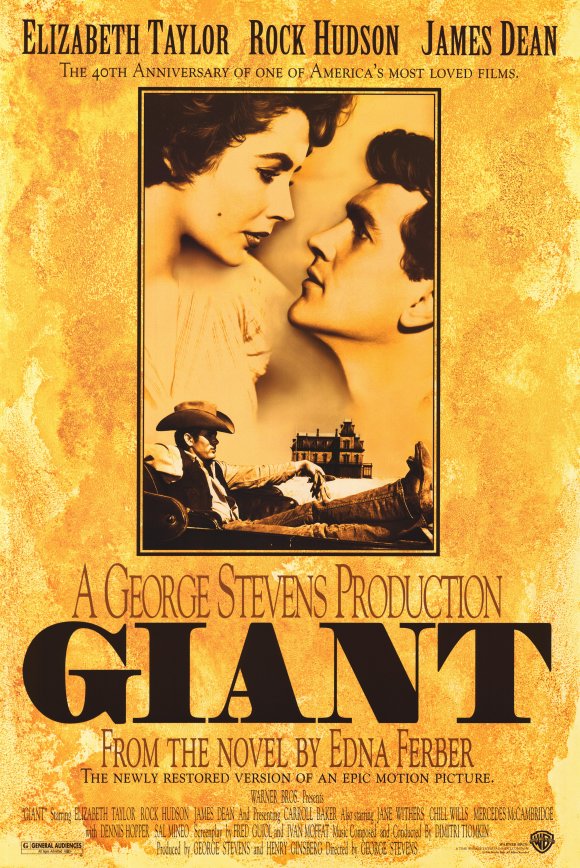
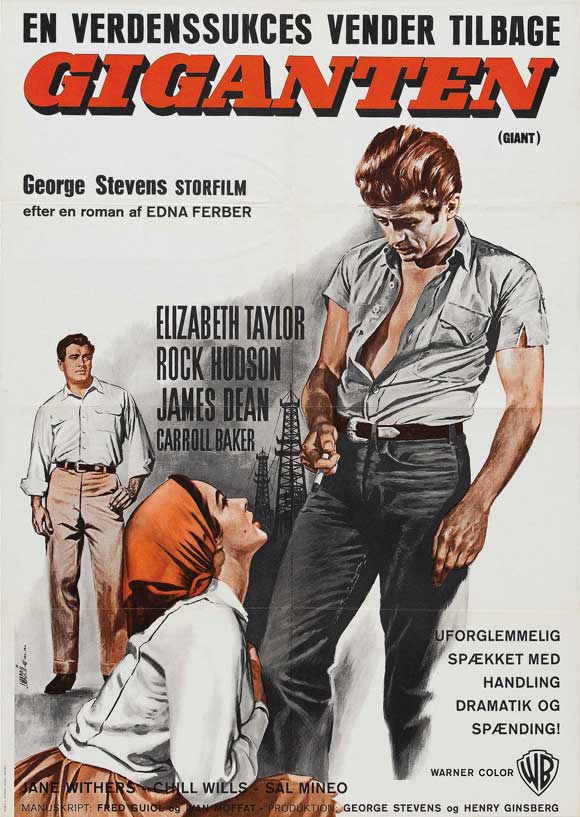
Embracing The Melodrama #12: Giant (dir by George Stevens)


Giant

Let’s continue to embrace the melodrama by taking a look at the 1956 best picture nominee, Giant.

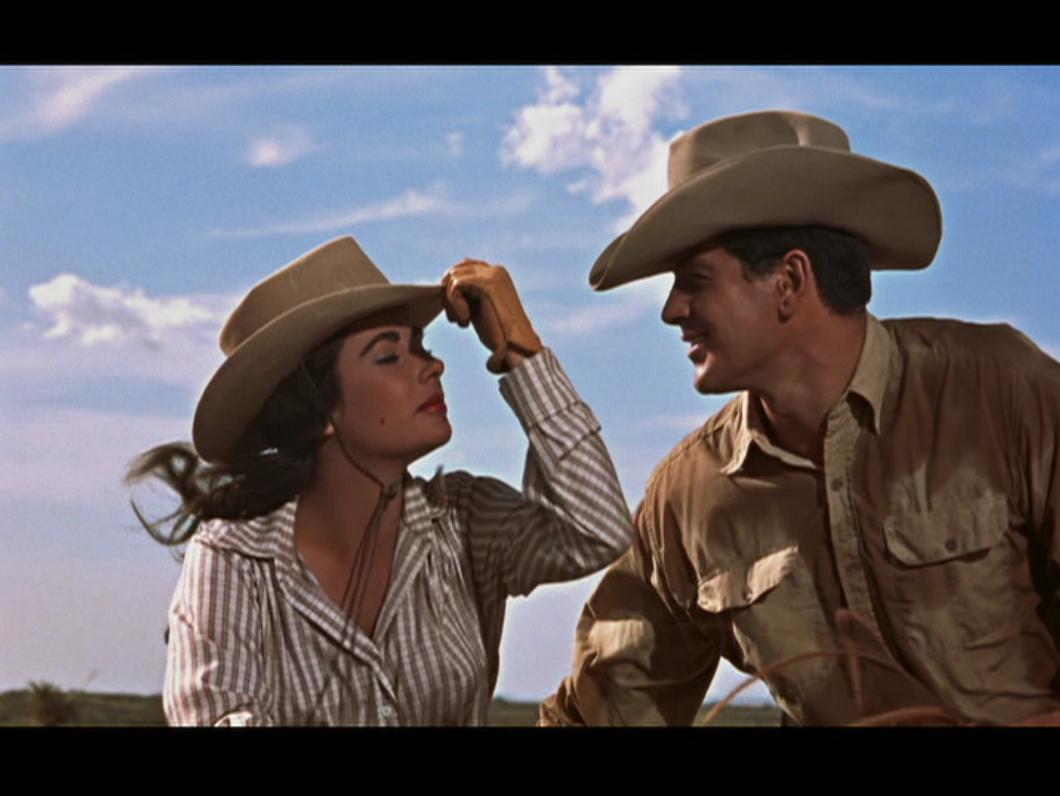
Giant is a film about my home state of Texas.  Texas rancher Bick Benedict (Rock Hudson) goes to Maryland to buy a horse and ends up returning to Texas with a bride, socialite Lesley Lynnton (Elizabeth Taylor).  At first, Lesley struggles to adapt to the harsh and hot Texas landscape.  Bick’s sister, Luz (Mercedes McCambridge) takes an instant dislike to Lesley and Bick is annoyed by Lesley’s concern over the living conditions of the Mexicans that work on Bick’s ranch.  It sometimes seems like the only person who appreciates Lesley is Jett Rink (James Dean), an ambitious ranch hand who secretly loves her and who is planning on becoming a rich man.  That’s exactly what happens when oil is found on the land around Bick’s ranch.  While Bick stubbornly clings to the past, oilman Jett represents both the future of Texas and the nation.  Meanwhile, Bick and Lesley’s son (played by a very young Dennis Hopper) challenges his father’s casual bigotry when he falls in love with a Mexican girl.

Taylor and Hudson

Giant is appropriately named because it is a huge film.  Clocking in at 201 minutes, Giant tells a story that spans several decades and features a big cast that is full of familiar faces, all struggling for their chance to somehow stand out from everyone else around them.  Even the film’s wonderful panoramic shots of the empty Texas landscape only serve to remind us of how big the entire film is.  To a certain extent, the size of Giant‘s production is to be understood.  In the 1950s, Hollywood was having to compete with television and they did this by trying to make every film into a major event.  You watch a movie like Giant and you practically hear the old Hollywood moguls shouting at America, “See!?  You can’t get that on your precious TV, can you!?”

For those of us watching Giant today, the length is both a blessing and a curse.  It’s a curse because the movie really is too damn long.  The opening scenes drag and many of them really do feel superfluous.  It’s hard not to feel that the real story doesn’t really start until about 90 minutes into the movie.  And once the story really does get started,  there’s still way too much of it for it all to be crammed into one sitting.  Oddly enough, you end up feeling as if this extremely long film is still not telling you everything that you need to know.  If Giant were made today, it would probably be a two-part movie on either HBO or Lifetime and it would definitely feature a lot more sex.

However, to be honest, one of the reasons that I did enjoy Giant was because it was as big as it was.  I mean, the film is about Texas so of course it should be a little excessive!  Everything’s bigger in Texas and that includes our movies.  Add to that, Giant may be too long but it uses that length to deals with issues that are still relevant today — oil, immigration, and racial prejudice.  Rock Hudson may not have been a great actor but he is at least convincing as he transitions from bigotry to tolerance.

But really, when it comes to Giant, most people are only interested in James Dean.  And they definitely should be because Dean gives a great and compelling performance here.  Dean brings all of the emotional intensity of the method to material that one would not naturally associate with method acting and the end result is amazing to watch.  Giant was released after Dean had been killed in that infamous car wreck.  I can only imagine what it must have been like to be sitting in a theater in 1956 and to see this compelling and charismatic actor towering above the world on the big screen while aware, all the time, that his life had already been cut short and he would never been seen in another film.

James Dean

Even better, Dean’s new style of acting clashes perfectly with Hudson’s old style of acting, making the conflict between Bick and Jett feel all the more real and intense.  Much as Bick represents old Texas and Jett represents the new Texas, Hudon and Dean represented the two sides of Hollywood: the celebrity and the artist.  Needless to say, Dean wins the battle but, surprisingly, Hudson occasionally manages to hold his own.

I can’t necessarily say that Giant is an essential film.  A lot of people are going to be bored by the excessive length.  But if you’re a fan of James Dean or if you’re from Texas, Giant is a film that you need to see at least once.

elizabeth_taylor_giant_swedish_movie_poster_2a