Jack-O (1995, directed by Steve Latshaw)


Back in frontier times, a warlock named Walter Machden (John Carradine) terrorized the citizens of the town of Oakmoor Crossing so they tracked him down and lynched him.  Before he was hung, Machden cursed the town.  A demon with a jack-o-lantern for a head terrorized the town until the Kelly Family defeated him and buried him underneath a cross.

Jump forward one hundred years.  It is Halloween night and some drunk teenagers knock over the cross.  Jack-O comes back to life and kills the teenagers.  Jack-O sets out to get revenge on the Kelly family but, for some reason, he decides to kill their neighbors, some more teenagers, and a TV cable guy before going after his targets.  It’s up to young Sean Kelly (Ryan Latshaw) to figure out how to defeat Jack-O for a second time.

The most interesting thing about Jack-O is that it features John Carradine, even though he died a full seven years before the movie was released.  That either means that Jack-O had an unusually long post-production period or the Carradine scenes were shot for another movie and were clumsily inserted into Jack-O.  Carradine was not the only deceased star to make an appearance in Jack-O.  Cameron Mitchell, who passed away in 1994, also makes an appearance as a horror movie host.  Because you can’t have a movie with Carradine and Cameron Mitchell without including Linnea Quigley, she appears as a babysitter who takes a lengthy shower.  Fortunately, Linnea Quigley is still with us.

Overall, Jack-O is regrettable.  The demon, with his Jack-O-Lantern head, is more likely to inspire laughs than screams and it never makes sense that Jack-O would take so much time to kill everyone except for the people that he is actually looking to kill.  The best death involves a toaster but Jack-O doesn’t do anything with the toaster.  Instead, someone just slips and sticks a utensil in the toaster, leading to a shocking death.  Combine the poor acting with the poor special effects with notably ragged editing that often makes it unclear how much time has passed between scenes and you have a Halloween film that is no holiday.

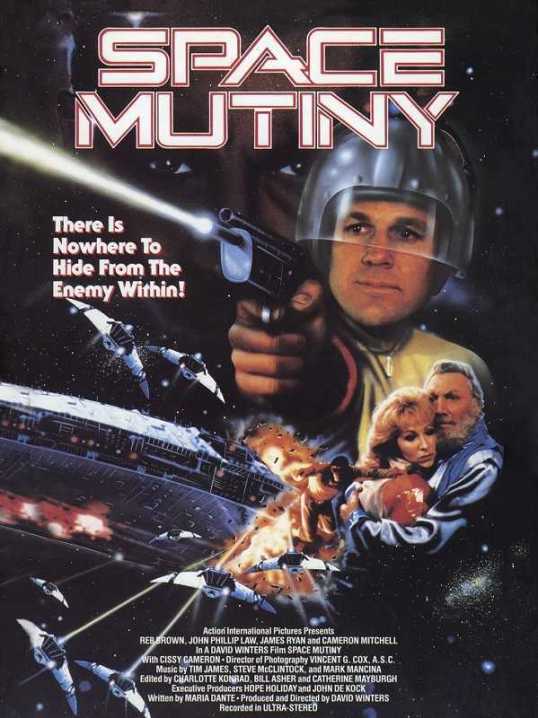
The TSL’s Grindhouse: Space Mutiny (dir by David Winters)


“Arggggh!”

— Dave Ryder (Reb Brown) in Space Mutinty (1988)

Space Mutiny, a sci-fi epic from 1988, is full of dialogue about all sorts of political and philosophical concerns but none of it is quite as memorable as the quote above.  Dave Ryder says, “Argggggh!” a lot over the course of Space Mutiny.  He’s the newly appointed head of security for the Southern Sun, a gigantic spaceship that has spent the last 260 years traveling from Earth to a new planet.  Being head of security is important because there are some people on the Southern Sun who are plotting a mutiny.  Dave Ryder decides that the most effective way to battle the mutineers is to yell loudly and frequetly.  “ARGGGGGH!’ Ryder yells whenever he’s being shot at.  “ARGGGGGGGH!” he screams when he finds himself on a very slow and gradual collision course with the head of the mutineers.

When Dave isn’t saying stuff like, “Argggggh!,” he’s saying stuff like, “Go!  Go!  Go!”  When the bad guys open fire on him and his men, it’s time for them to “Go!  Go!  Go!”  When the mutineers are being chased, Dave is quick to tell everyone to “Go!  Go!  Go!”  He’s like the physical fitness trainer from Hell.  He never actually yells “Feel the burn!” but you can be damn well sure that he’s thinking it.  In fact, there’s a point in the movie where “Feel the burn!” actually would have been a good line.  Dave and his girlfriend, Lea (Cissie Cameron), set a mutineer on fire.  It’s actually a bit of a sadistic scene and it doesn’t come across as being the big hero moment that it’s obviously meant to be.  But, then again, Dave isn’t yelling because he’s a nice guy.  He’s yelling because he’s played by Reb Brown.  Reb Brown yelled all the way through Strike Force Commando.  Why wouldn’t he do the same for Space Mutiny?

Of course, Dave isn’t the only person barking out orders on the Southern Sun.  Cameron Mitchell plays the ship’s captain, a wise old man who looks like Santa Claus.  John Phillip Law is Kalgon, the main mutineer.  He laughs a lot.  Cissie Cameron is the captain’s daughter.  She falls for Ryder, despite the fact that she appears to be old enough to be Ryder’s mother.  (In real life, Reb Brown and Cissie Cameron are married and Cissie is only a few years older than Reb.  In Space Mutiny, she’s stuck with an unflattering hair style and is made up to look like an aging cheerleading coach.)  There’s also a woman who works on the ship’s bridge.  She’s killed in one scene, just to mysteriously turn up alive in the scene that follows.  In space, no one can hear the script supervisor.  Finally, there’s a group of alien witches who board the ship and spend the entire movie dancing in front of a ball of electricity.  Since they don’t actually interact with any of the main characters, it’s obvious that they were added to pad out the film’s running time.

One of the more interesting things about Space Mutnity is that Kalgon actually has a point.  It does seem kind of stupid to spend several hundred years traveling to just one planet when there’s other planets nearby that the ship could just as easily reach.  Indeed, the mission of the Southern Sun never makes that much sense and the Captain seems to be delusional in his insistence that it does.  The Captain’s unending faith and his long-flowing beard makes him come across like a minor biblical prophet, the type who always had to ask a major prophet to interpret his visions for hm.  The Captain does not come across like someone who really knows what he’s doing.  I don’t care how much Ryder screams, Kalgon had a point!

Today, Space Mutiny is best known for being featured on an episode of Mystery Science Theater 3000 and for later being taken apart by the Rifftrax crew.  Space Mutiny, though, is such an extremely silly movie that you really don’t even need any professionals to help you snark your way through it.  The film offers up such a treasure trove of material then even the most humorless among your friends will be a comedic genius by the time it ends.  It’s a fun movie, made even more so by the fact that the filmmakers apparently meant for the film to be taken seriously.  There’s a lot of talk about important issues like freedom, duty, and faith.  In the end, what you’ll remember is the screaming.

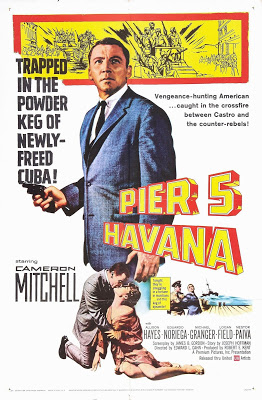
Pier 5, Havana (1959, directed by Edward L. Cahn)


Shortly after the Cuban Revolution, Steve Daggett (Cameron Mitchell) comes to Havana.  He’s searching for his friend, Hank Miller (Logan Field).  An alcoholic, Hank has been missing for several days.  When Steve arrives, he discovers that the local police are less than helpful.  He is also reunited with his former girlfriend, Monica Gray (Allison Hayes), who also happens to be Hank’s estranged wife.  Since separating from Hank, Monica has taken up with Fernando Ricardo (Eduardo Noriega), a wealthy land owner who, so far, has been spared from Castro’s revolution.

It doesn’t take long for Steve to discover that no one wants him to stay in Havana.  When he goes to meet an informant on a pier, he’s instead assaulted by two men who order him to be on the next plane to Miami.  When Steve refuses to leave, both his life and Monica’s are put in danger.  Steve’s investigation eventually leads him to a plot to overthrow Fidel Castro and return Batista to power.

Pier 5, Havana is a low-budget, B-noir that is mostly interesting due to its historical context.  The movie went into production a month after Castro took over Cuba and certain scenes were actually shot on location in Havana.  Because it was a quick shoot meant to capitalize on current events, the movie was rushed into theaters before Castro officially allied his country with the Soviet Union.  As a result, Pier 5, Havana is one of America’s few pro-Castro films.  While the film doesn’t fully embrace Castro, it does present his new government as being preferable to return of Batista’s dictatorship.

As for the film itself, it’s a fairly standard mystery.  Edward L. Cahn, who also directed Flesh and the Spur and Jet Attack, was a director who shot fast and in a workmanlike style.  (Pier 5 Havana was one of seven films that he directed in 1959 alone.)  Cameron Mitchell is surprisingly but effectively subdued as the two-fisted hero and he provides the hard-boiled narration as well.  As always, Allison Hayes is an effective femme fatale.

Pier 5, Havana is a fast-paced B-movie with some good performances and some interesting footage of Havana right after the revolution.

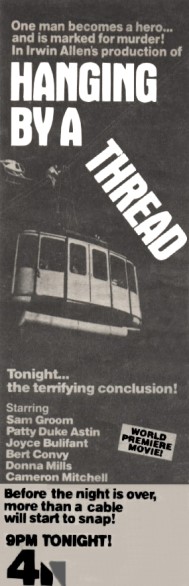
Hanging By A Thread (1979, directed by Georg Fenady)


A group of old friend who call themselves the Uptowners’ Club (yes, really) want to go on a picnic on top of a remote mountain.  The only problem is that they have to ride a cable car up to the mountain and there are reports of potentially bad weather.  It’s not safe to ride in a cable car during a thunderstorm.  Drunken ne’er-do-well Alan (Bert Convy) doesn’t care and, since his family owns both the mountain and the tramway, his demands that he and his friends be allowed to ride the cable car are met.  One lightning strike later and the members of the Uptowners’ Club are stranded in a cable car that is perilously suspended, by only a frayed wire, over treacherous mountain valley.

With no place to go, there’s not much left for the members of the Uptowners’ Club to do but bicker amongst themselves and have lengthy flashbacks that reveal every detail of their own sordid history.  Paul (Sam Groom) is angry with Alan because Alan is now engaged to his ex-wife (Donna Mills).  Sue Grainger (Patty Duke) is angry with everyone else because they don’t want to admit how their old friend Bobby Graham (Doug Llewellyn) actually died.  The other members of the Uptowners’ Club are angry because there’s not much for them to do other than watch Duke and Convy chew on the scenery.  Because of the supposedly fierce winds, someone is going to have to climb out on top of the cable car and repair it themselves.  Will it be Paul or will it be cowardly drunk Alan?  On top of everything else, Paul is set to enter the witness protection program and has got hitmen who want to kill him.

This made-for-TV disaster movie was produced by Irwin Allen.  Are you surprised?  It’s also three hours long and amazingly, Leslie Nielsen is not in it.  It’s hard to understand how anyone could have produced a cable car disaster film and not given a role to Leslie Nielsen.  Cameron Mitchell’s in the film but he’s not actually in the cable car so it’s a missed opportunity.  Any film that features Patty Duke detailing how her friends got so drunk that they ended up killing the future host of The People’s Court is going to at least have some curiosity value but, for the most part, Hanging By A Thread gets bogged down by its own excessive runtime and lack of convincing effects.  Hanging By A Thread came out at the tail end of the 70s disaster boom and it shows why the boom didn’t continue into the 80s.

The Hanged Man (1974, directed by Michael Caffey)


In this made-for-TV western, Steve Forrest stars as James Devlin.  A hired killer and a notorious outlaw, Devlin has finally been captured and is sent to the gallows.  At first, it seems as if the hanging’s been a success and Devlin’s life has been extinguished at the end of the rope.  But then, while his body is at the funeral home and is being prepared for burial, Devlin suddenly opens his eyes and reveals that he’s alive.

No one can figure out how Devlin manage to survive being hung, especially not Devlin.  However, Devlin is now alive and free to leave town.  Has Devlin been sent back to Earth to serve God or did he just get lucky?  Devlin may not be sure himself but he is determined to turn around his old ways.  That starts with protecting a widow (Sharon Acker) and her son (Bobby Eilbacher) from Lew Halleck (Cameron Mitchell), a greedy businessman who wants their land and is prepared to go to any lengths to get it.  Devlin is not only still as good with a gun as he was before his execution but, having survived his hanging, he can now read minds!

The Hanged Man was designed to be a pilot for a weekly TV series and watching it, it’s easy to imagine how the show would have developed.  Devlin would have traveled around the old west, helping out a new guest star every episode and presumably trying to discover why he had been returned to life.  It’s not a bad idea for a show, though the pilot film doesn’t do enough with it.  Despite the fact that Devlin might be undead and that he now has the power to read minds, it really is just a conventional western, featuring the saintly widow and the evil land baron and all of the other familiar tropes of the genre.  It may begin with Devlin coming back to life but it ends with a shoot-out that could have been lifted from any number of old TV shows.

Still, as far as made-for-TV westerns are concerned, this one is entertaining enough.  Steve Forrest is a good hero and, as always, Cameron Mitchell is a good villain.  I wish they had done more with the supernatural aspects of the story but The Hanged Man is good enough for undemanding fans of the genre.

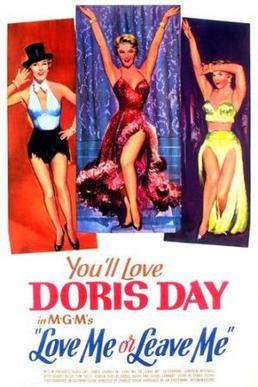
An Offer You Can’t Refuse #16: Love Me or Leave Me (dir by Charles Vidor)


The 1955 film, Love Me or Leave Me, is a biopic about singer Ruth Etting.

Don’t know who Ruth Etting is?  Well, don’t feel too bad.  I didn’t know who she was either, at least not until I watched this movie.  Judging from the trailer that I’ve embedded at the top of this review, she was apparently well-known enough in the 50s for a biopic about her to be a big deal.  Having now watched Love Me or Leave Me and having done some independent research, I know that Ruth Etting was a popular singer in the 20 and 30s and that she was, for a while, married to a gangster named Marty Snyder (played, in the film, by James Cagney).  I also know that, after her marriage to Snyder ended, she married a composer named Johnny Alderman (played by Cameron Mitchell).

I still couldn’t tell you just how closely Love Me or Leave Me actually sticks to the facts of Etting’s life.  I imagine that there was a quite a bit of liberty taken with the truth, if just because the film was made in 1955 and it’s one of those big, glossy productions where all of the sets are ornate and all of the clothes are to die for and all of the dialogue has an edge that’s somehow both tough and sentimental.  It feels less like real life and more like the way that you would imagine life to be.

The film begins in the roaring 20s, with Marty Snyder intervening when Ruth nearly gets fired for kicking an obnoxious admirer.  For Marty, it’s obsession at first sight and, even after Ruth refuses to spend a weekend in Miami with him, Marty continues to help her out in her career.  Marty uses his considerable clout (and the fact that everyone is scared to death of him and his temper) to get Ruth on the radio and then eventually a job with the Ziegfeld Follies.  Despite the fact that Ruth is in love with Johnny and Johnny is in love with her, she ends up marrying Marty because she feels that she owes her entire career to him.  Even after they get married, Marty continues to be obsessively jealous.  It all eventually leads to a shooting, an arrest, and a final song from Doris Day.

It’s very much a film of the 50s.  I imagine that audiences in 1955 thought it made perfect sense that Ruth would feel that she owed it to Marty to marry him despite the fact that she never really asked him to do anything for her.  Seen today, though, Marty comes across as being a stalker and you really want someone to sit Ruth down and have a conversation with her about it and maybe explain concepts like gaslighting and restraining orders to her.

My advise, though, would be to not think too much about it because seriously, the film’s sets are beautiful, the musical numbers are entertainingly excessive, and Doris Day gives a really good performance.  For those who only know her from the romantic comedies that she did with Rock Hudson, Love Me or Leave Me is a revelation.  She’s likable and she’s tough and she sings as if the world depended upon it and watching her in Love Me Or Leave Me, you not only understand why Ruth Etting became a star but also why Doris Day did as well.  James Cagney also gives a good performance as Marty Snyder, bringing all of his swaggering charisma to the role.  As a fan of exploitation films, the most interesting thing about Love Me or Leave Me to me was getting to see Cameron Mitchell play a nice guy for a change.  Mitchell does an okay job with the role, though Johnny is never as interesting a character as Marty.  In the end, it’s an entertaining film, an ornate visual feast that works as long as you don’t think about it too much.

Love Me or Leave Me is an offer that you can’t refuse.

Previous Offers You Can’t (or Can) Refuse:

  1. The Public Enemy
  2. Scarface
  3. The Purple Gang
  4. The Gang That Could’t Shoot Straight
  5. The Happening
  6. King of the Roaring Twenties: The Story of Arnold Rothstein 
  7. The Roaring Twenties
  8. Force of Evil
  9. Rob the Mob
  10. Gambling House
  11. Race Street
  12. Racket Girls
  13. Hoffa
  14. Contraband
  15. Bugsy Malone

Viva Knievel (1977, directed by Gordon Douglas)


Last night, I watched one of the greatest movies of all time, Viva Knievel!

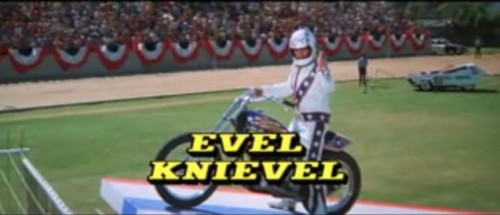
Viva Knievel! starts with the real-life, motorcycle-riding daredevil Evel Knievel breaking into an orphanage in the middle of the night, waking up all the children, and giving each of them their own Evel Knievel action figure.  When one of the kids says, “You actually came!,” Evel replies that he always keeps his word.  Another one of the orphans then throws away his crutches as he announced that he can walk again!

From there, Viva Knievel! only gets better as Evel preaches against drug use, helps his alcoholic mechanic (Gene Kelly) bond with his son, and flirts with a glamorous photojournalist (Lauren Hutton).  Evel was married at the time that Viva Knievel! was produced but his wife and family go unmentioned as Evel, Kelly, and Hutton travel through Mexico, jumping over fire pits, and battling drug dealers.

Evel’s former protegee, Jessie (former child evangelist Marjoe Gortner), has fallen in with a bad crowd and gotten messed up on the same drugs that Evel spends the entire movie preaching against.  An evil drug trafficker (Leslie Nielsen, a few years before Airplane! and The Naked Gun) pressures Jessie to convince Evel to do a dangerous stunt.  The plot is to replace Evel’s trusted mechanic with a crooked mechanic (Cameron Mitchell) who will sabotage the jump.  When Evel dies, he will be shipped back to the U.S. in a coffin and, hidden within the walls of the coffin, will be several kilos of cocaine.  Oh, the irony!  Evel Knievel, America’s number one spokesman against drugs, will be responsible for bringing them into the United States!  Can Evel thwart the nefarious plans of Leslie Nielsen while still finding time to fall in love with Lauren Hutton and break Gene Kelly out of a psychiatric ward?  If anyone can do it, Evel can.

Even Dabney Coleman’s in this movie!

From the start, Viva Knievel! is a vanity project but in the best, most loony and entertaining way possible.  There are many well-known actors in this film and all of them take a backseat to Evel Knievel, whom they all speak of as if he’s a cross between Gary Cooper and Jesus Christ.  Watching this movie, you learn three things: 1) Evel Knievel was high on life but not dope, 2) Evel Knievel always kept his word, and 3) Evel Knievel always wore his helmet.  He even makes sure that Lauren Hutton is wearing one before he takes her for a spin on his motorcycle.  You also learn that Evel Knievel liked to get paid.  He nearly beats up his manager (Red Buttons) when he thinks that he’s been cheated but they’re still friends afterwards because how could anyone turn down a chance to be in Evel’s presence?

There are plenty of stunts and jumps to be seen in Viva Knievel!, though watching Leslie Nielsen play a villain is almost as fun as watching Evel jump over a fire pit.  Judging from his performance here, Evel Knievel probably could have had a film career.  He had a natural screen presence and delivered even the worst dialogue with sincerity.   Unfortunately, three months after Viva Knievel! opened in the United States, Evel attacked a promoter with an aluminum baseball bat and ended up doing 6 months in jail.  Evel said it was because the promoter was spreading lies about him but, regardless, Evel lost most of his sponsorships and his toyline was discontinued.  Viva Knievel! sunk into an obscurity from which it has only recently reemerged.  Viva Knievel! is cheesy fun, a relic of a bygone era.  Watch it, think about whatever problems you may be dealing with in your own life, and then ask yourself, “What would Evel do?”


Sex And Drugs And BLOOD AND BLACK LACE (Allied Artists/Woolner Brothers 1964)


gary loggins's avatarcracked rear viewer


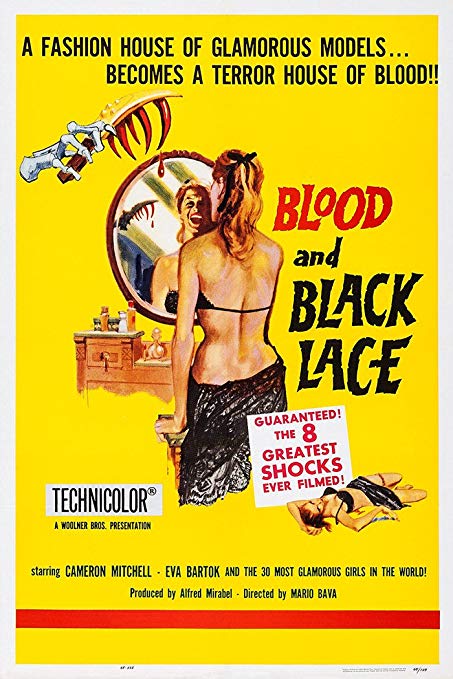
Welcome to the weirdly wonderful world of giallo, pioneered by the late Italian maestroMario Bava . Though Bava’s THE GIRL WHO KNEW TOO MUCH (released stateside as EVIL EYE) is considered by connoisseurs the first, it was BLOOD AND BLACK LACE that defined the genre, with its comingling of crime drama, murder mystery, and horror elements coalescing into something truly unique. I hadn’t seen this film in decades before a recent rewatch, and was again dazzled by Bava’s technique. The film has proved to be highly influential in the decades-later slasher genre, yet has its roots set firmly in the past.

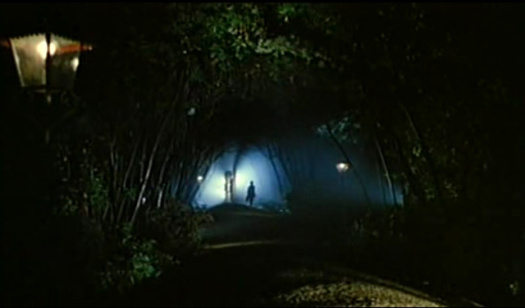
The opening sequence is a stunner, as we see the beautiful model Isabelle walking through a woodsy pathway on a dark and stormy night, stalked and then brutally murdered by a faceless, trenchcoated killer. From there, we’re introduced to the remaining cast, members of the haute couture fashion…

View original post 464 more words

Embracing the Melodrama Part III #1: No Down Payment (dir by Martin Ritt)


Back in 2014 and 2015, I did a series of reviews that I called Embracing the Melodrama, in which I reviewed some of the best (and worst) melodramas ever made.  All together, I reviewed 186 films as a part of Embracing the Melodrama, everything from Sunrise to Reefer Madness to The Towering Inferno to Cocaine: One Man’s Seduction.  I had so much fun doing it that I’ve decided to do it again.

No, don’t worry.  I’m not going to attempt to review 186 films this time.  Instead, for Embracing The Melodrama Part III, I am going to limit myself to reviewing 8 films.  I’ll be posting one Embracing the Melodrama review a day, from now until next Sunday.

Let’s kick things off with 1957’s No Down Payment, a film about life in … THE SUBURBS!

(cue dramatic music)

The suburbs!

Is there any place in America that’s more dramatic?  Is it any wonder that, since the early 50s, films have regularly been using the suburbs as an example of everything that’s apparently wrong with America?  Every year sees at least one major film about how terrible life is in the suburbs.  Last year, for instance, George Clooney directed a film called Suburbicon, which was regularly cited as a possible Oscar contender before it was released and everyone was reminded of the fact that George Clooney is a terrible director.  That said, I can understand why filmmakers continue to be drawn to the suburbs.  Secret affairs.  Dangerous drugs.  Duplicitous children.  Fractured families.  Barbecuing alcoholics.  Undercover occultists.  You can find them all in the suburbs!

No Down Payment opens with David (Jeffrey Hunter) and Jean Martin (Patricia Owens) driving down a California highway and looking at the billboards that dot the landscape.  Every billboard advertises a new community, inviting people to make a new and better life away from the crowded city.  David and Jean smile, amused by how blatant all of the ads are.  That’s when they see the billboard that’s advertising their new home:

Sunrise Hill Estates

A Better Place For Better Living

Soon, David and Jean are moving into their new home and meeting their new neighbors.  It turns out that most of the houses in Sunrise Hill Estates are available for “no down payment” and the majority of the residents are struggling financially.  Though David may look at all of his neighbors and say, “Looks like everybody here is living a wonderful life,” the truth is something far different.

(If David’s line sound a bit too on the nose and obvious, that’s because almost all of the dialogue in No Down Payment was too on the nose and obvious.  As a side note, “on the nose” is an extremely strange expression.)

David’s neighbors include:

Herm Kreitzer (Pat Hingle) and his wife, Betty (Barbara Rush).  Herm owns an appliance store and sits on the town council.  Herm is gruff but likable.  He’s the leader of his neighborhood and he welcomes the Martins with a backyard party.  Herm’s employee, Iko (Aki Aleong), wants to move to Sunrise Hill but no one is willing to give him a reference because he’s not white.

Troy Boone (Cameron Mitchell) and his wife, Leola (Joanne Woodward).  We know that Troy is going to be trouble because he’s played by Cameron Mitchell.  We know that we’re going to like Leola because she’s played by Joanne Woodward.  Troy’s an auto mechanic and a veteran.  He wants to be appointed the chief of police but the town is reluctant to hire him because he doesn’t have a college education.  Leola wants to have a child but Troy says that they can’t even think about that until he has a good job.

And then there’s Jerry Flagg (Tony Randall) and his wife, Isabelle (Sheree North).  Jerry is a used car salesman and he’s also a drunk.  Jerry spends most of the movie hitting on other women and embarrassing Isabelle.  Jerry has no impulse control and, as a result, he’s heavily in debt.  His only hope is that he can convince a family to buy an expensive car that they really don’t need.  When last I checked, that’s what a used car salesman is supposed to do.

The film deals with a lot of issues — prejudice, sexism, economic insecurity — that are still relevant today.  Unfortunately, the film itself is a bit slow and what was shocking in the 50s seems rather jejune today.  Watching the film, you get the feeling that, as with many films of the 50s, all of the interesting stuff is happening off-screen.  That said, the film has an interesting cast.  Jeffrey Hunter and Patricia Owens are a bit dull as the Martins but then you’ve got their neighbors!  Any film that features Cameron Mitchell glowering can’t be all bad but the best performance comes from Tony Randall, who is memorably sleazy and desperate as Jerry Flagg.  For a fun experiment, watch this film right before watching Will Success Spoil Rock Hunter?

Tomorrow, we’ll continue to embrace the melodrama with 1961’s Common Law Wife!

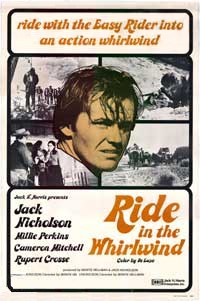
A Movie A Day #348: Ride In The Whirlwind (1966, directed by Monte Hellman)


Three cowboys — Vern (Cameron Mitchell), Wes (Jack Nicholson), and Otis (Tom Filer) — are riding their horses across the old west when they come upon a cabin that is inhabited by one-eyed Blind Dick (Harry Dean Stanton) and his friends.  Though they suspect that Dick may be an outlaw, the cowboys accept his offer to stay the night.  The next morning, they wake up to discover that they are surrounded by a posse.  Mistaken for members of Dick’s gang, Vern and Wes go on the run.  Eventually, they find themselves hiding out at the home of Evan (George Mitchell), Catherine (Katherine Squire), and their daughter, Abigail (Millie Perkins).  While Wes and Vern wait for their chance to escape, the posse grows closer and closer.

A minimalistic western with a fatalistic outlook, Ride In The Whirlwind is today best known for being a pre-Easy Rider credit for Jack Nicholson.  Nicholson not only co-produced the film but he also wrote the script.  With that in mind, it’s not surprising that Nicholson not only gets the best lines but that he also comes close to getting the girl.  Of all the roles that Nicholson played before his star-making turn in Easy Rider, Wes probably comes the closest to being what would be considered to be a typical Jack Nicholson role.  Wes is sarcastic, quick with a quip, and alienated by mainstream society (represented here by the relentless posse).  Nicholson gives a confident performance and it is interesting to see him co-starring with some of the same actors, like Harry Dean Stanton, who would continue to be associated with him once he became a star.  Though the film may be dominated by Nicholson, Stanton also makes a strong impression and comes close to stealing the whole movie.

(Also of note is an early appearance by Rupert Crosse.  Years later, Crosse was set to co-star with Nicholson in The Last Detail but his early death led to Otis Young being cast in the role.)

With its dark outlook and anti-establishment theme, Ride In The Whirlwind was before its time and it struggled at the American box office.  (According to Monte Hellman, it was very popular in France.)  It would be another three years before American culture would catch up with Nicholson’s anti-establishment persona and Easy Rider would make him a star.