The Fabulous Forties #12: D.O.A. (dir by Rudolph Mate)


DOA1950

The 12th film contained in Mill Creek’s Fabulous Forties box set is the classic film noir D.O.A.  Before I get into reviewing this film, there’s an oddity that I feel the need to point out.  According to the back of the Fabulous Forties box, D.O.A. was released in 1949.  However, according to Wikipedia, imdb, and almost every other source out there, D.O.A. was released in 1950.  In short, it’s debatable whether or not D.O.A. actually belongs in the Fabulous Forties box set but it really doesn’t matter.  D.O.A. is a classic and, along with Night of the Living Dead, it is undoubtedly one of the best B-movies to ever slip into the public domain.

D.O.A. opens with a lengthy tracking shot, following a man named Frank Bigelow (Edmond O’Brien) as he walks through the hallways of a San Francisco police station.  Frank walks with a slow, halting movement and it’s obvious that he is not a healthy man.  When he finally steps into a detective’s office, Frank announces that he’s come to the station to report a murder — his own.

Frank is a small-town accountant who came to San Francisco for a vacation.  After a long night of drinking, Frank woke up feeling ill.  When he went to a doctor, he was informed of two things.  Number one, he was in overall good health.  Number two, he only had a few days to live.  Sometime during the previous night, Frank was poisoned with a “luminous toxin.”  There was no antidote.

The rest of the film follows Frank as he attempts to figure out who poisoned him and why.  It’s an intriguing mystery and I’m not going to ruin it by going into too many details.  Over the course of his investigation, the increasingly desperate Frank comes across a gangster named Majak (Luther Adler).  This leads to a lengthy scene in which Majak’s psychotic henchman, Chester (Neville Brand), repeatedly punches Frank in the stomach.  It’s a scene that, even in our far more desensitized times, made me cringe.  I can only imagine how audiences in 1950 reacted.

(There’s also a shoot-out at a drug store that can stand alongside almost any modern-day action sequence.  Regardless of whether the film was made in 1949 or 1950, it still feels like a movie that could have just as easily been made in 2016.)

But really, the mystery is secondary.  Instead, D.O.A. is truly about Frank and how he deals with the knowledge that he is going to die.  Before being poisoned, Frank is the epitome of complacent, middle-class suburbia.  He’s engaged to Paula (Pamela Britton) but he’s in no hurry to marry her.  He’s got all the time in the world.  When Frank goes to San Francisco, he epitomizes the bourgeoisie on vacation.  He goes to the 1940s equivalent of a hipster nightclub, not because he’s actually interested in what the scene is all about but because he’s a tourist looking for a story to tell the folks back home.  When he checks into his hotel, he leers at every passing woman with a casual sexism that would not be out-of-place on an old episode of Mad Men.  Frank is floating through life, confident in his own complacency.

It’s only after he’s poisoned that Frank actually starts to live.  He goes from being passive to being aggressive.  Knowing that he’s going to die, he no longer has anything to lose.  Only with death approaching does Frank actually start to live.  Frank’s realization that he waited to long to live makes his final line all the more poignant.

D.O.A. is a classic!  Watch it below, you won’t be sorry!

Horror on TV: The Twilight Zone 1.13 — “The Four of Us Are Dying”


TheTwilightZoneLogo

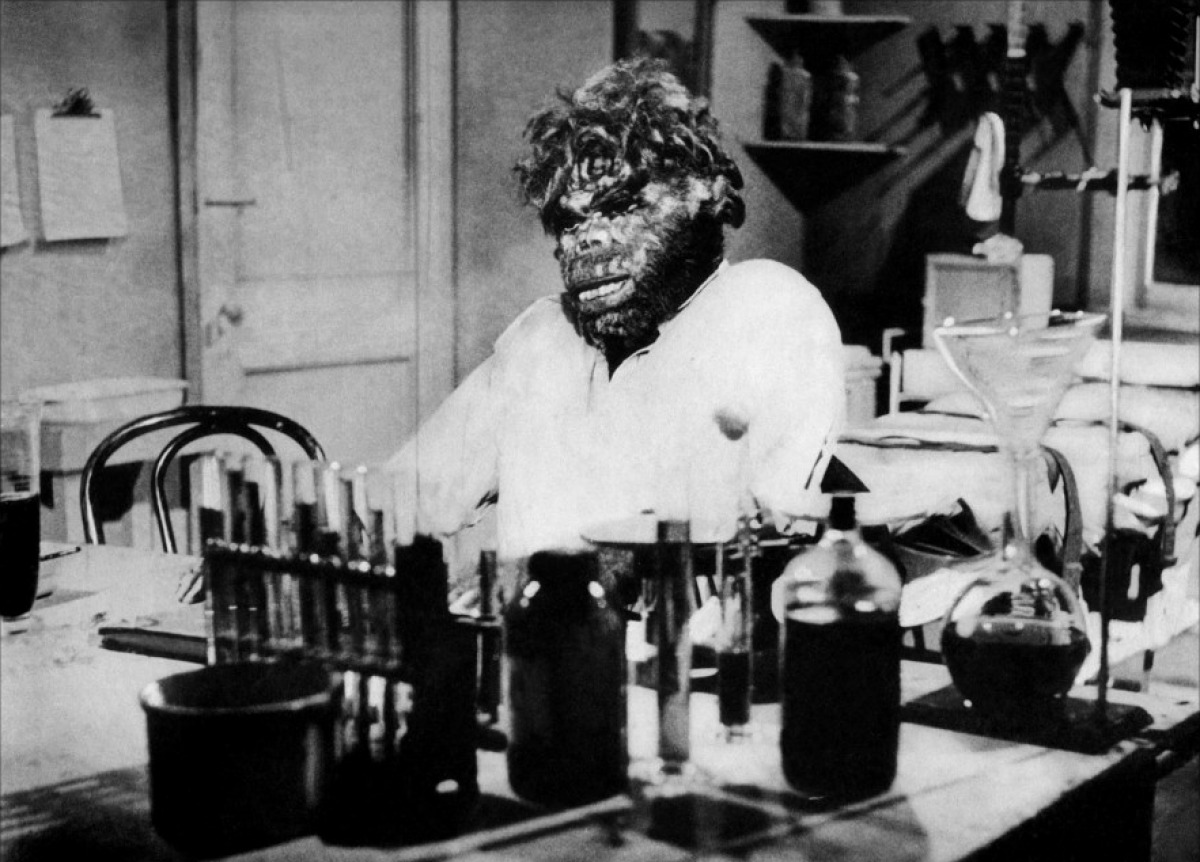
In this episode of the Twilight Zone, a con man (Harry Townes) has the ability to change his face to make himself appear like anyone he wants to be. Needless to say, this ability doesn’t quite work out as well for him as he might have hoped.

This episode originally aired on January 1st, 1960.

(If the video is not showing up below — some browsers apparently have problems showing embedded videos from Hulu — you can watch the episode at http://www.hulu.com/watch/440771.)

Embracing the Melodrama Part II #29: Pretty Poison (dir by Noel Black)


Prettypoison1

“I don’t care if critics like it; I hated it.  I can’t like or be objective about films I had a terrible time doing.”

— Tuesday Weld on Pretty Poison (1968)

It’s actually rather depressing to read that Tuesday Weld hates Pretty Poison because it really is an underrated gem, a nifty little thriller that acts as sly satire on youth, conformity, and small town life.  The main reason that the film works is because of the performances delivered by both Weld and her co-star, Anthony Perkins.

But then again, when we the viewers think back on a movie, we remember what we saw as a member of the audience and sometimes, we forget that just because a film is fun to watch, that doesn’t necessarily mean that it was enjoyable to make.  When actors and other technicians think back on a film they were involved with, they remember the experience of actually making it.  Reportedly, Weld did not get along with the director of Pretty Poison and couldn’t wait to get away from him.

Interestingly enough, in Pretty Poison, Tuesday Weld plays a teenage girl who doesn’t get along with her mother and who can’t wait to get away from her.  Perhaps being miserable while making Pretty Poison helped Weld to bring a miserable character to life.

Pretty Poison opens with a nervous-looking man named Dennis Pitt (Anthony Perkins) watching a group of high school cheerleaders practicing on a field.  His attention is focused on one cheerleader in particular, the blonde Sue Ann Stepanek (Tuesday Weld).  Even before the opening credits have ended, the film has established a familiar dynamic.  Sue Ann is the fresh-faced example of small town American innocence.  Dennis is the type of creepy older guy that every girl has had to deal with at some point in her life.  (When I was in high school, there were always guys like Dennis hanging out around the mall.  When I was in college, the Dennis Pitts of the world were the guy who still hung out around the dorms even though they hadn’t been a student in a decade.)

Having established this dynamic early on, Pretty Poison spends the rest of its running time turning that dynamic upside down.

Dennis has recently been released from a mental hospital.  Under the watchful eye of his parole officer (John Randolph), Dennis gets a mind-numbingly dull job at a local mill and tries to live a normal life.  When Dennis finally does get a chance to talk to Sue Anne, he lies to her and tells her that he’s a secret agent and that he’s in town on a mission.  Sue Anne responds to Dennis’s awkward flirting and soon, she’s accompanying him on his “missions.”  During one such mission near the mill, they’re spotted by a security guard.  Sue Anne responds by enthusiastically murdering him.

Yes, the cheerleader’s a sociopath.

Sue Anne’s tyrannical mother (Beverly Garland) does not approve of her relationship with Dennis.  Sue Anne wants her mother out of the way and she expects her secret agent boyfriend to help her out…

Pretty Poison is a sharp mix of dark comedy and heightened drama, one that gets progressively darker as it progresses.  From the minute the film first shows Sue Anne intensely practicing on that field while Dennis watches her, it’s pretty obvious that the film was meant to be an allegory for American society in 1968.  Sue Anne is the perfect, all-American cheerleader who kills people because she can.  Dennis is the neurotic outsider who knows that he’ll never be able to get anyone to believe the truth.

And it all works, largely because both Anthony Perkins and Tuesday Weld are so well-cast.  It is, of course, impossible to watch Perkins without first thinking about Psycho but he actually manages to make Dennis into a very different character from Norman Bates.  If Norman was a psycho who, at first sight, looked like an innocent, Dennis is an innocent who, at first sight, looks like a psycho.  Tuesday Weld, meanwhile, turns Sue Anne into a disturbingly plausible killer, the type who, within minutes, can alternate between moodiness and giddiness, all the while squealing with orgasmic joy while bashing in someone’s head.

Tuesday Weld may hate Pretty Poison but it’s still a pretty good movie.

Horror on The Lens: It Conquered The World (dir by Roger Corman)


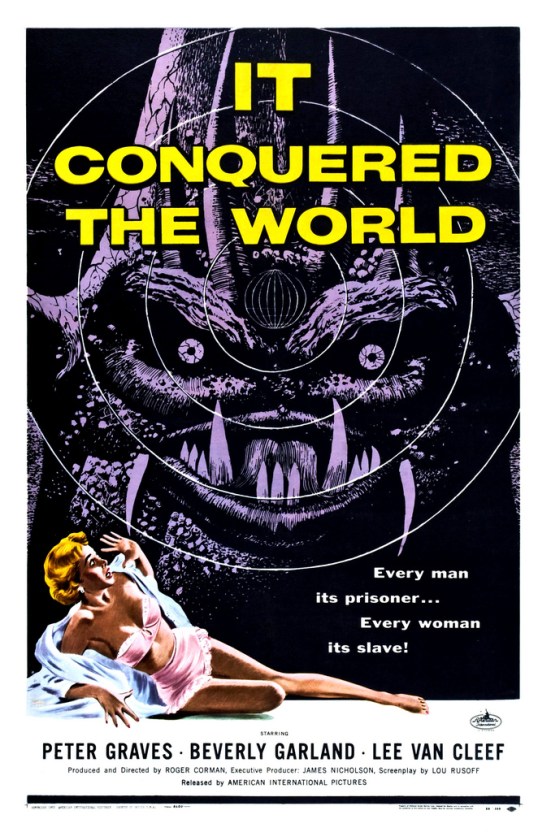
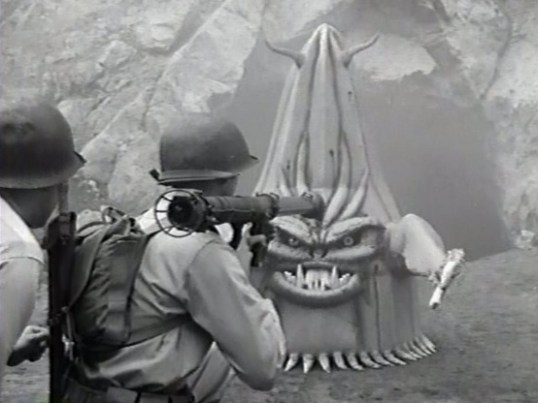
For today’s horror on the lens, we present a film from the legendary Roger Corman.  First released in 1956, It Conquered The World tells the tragic story of what happens when it … well, conquers the world.  It, by the way, is one of the most iconic of the 1950 sci-fi monsters.  It is kind of a crab-like thing but … well, just watch the film.  It’s kind of hard to describe.

The film also features future spaghetti western star Lee Van Cleef as the human scientist who foolishly helps It conquer the world.  Van Cleef’s wife is played by one of the greatest B-movie actresses of all time, Beverly Garland.  Hoping to thwart It is Peter Graves who spends the majority of the film riding around on a bicycle.  Also keep an eye out for Dick Miller and Jonathan Haze, who both play soldiers here and who would later co-star in tomorrow’s horror on the lens.