Retro Television Review: St. Elsewhere 2.17 “Vanity”


Welcome to Retro Television Reviews, a feature where we review some of our favorite and least favorite shows of the past! On Fridays, I will be reviewing St. Elsewhere, a medical show which ran on NBC from 1982 to 1988.  The show can be found on Hulu and, for purchase, on Prime!
This week’s episode was available on neither Hulu nor Prime.  I had to watch a really terrible upload that I found on Daily Motion.  Bleh.

Episode 2.17 “Vanity”

(Dir by Mark Tinker, originally aired on March 7th, 1984)

I was relieved to see that this episode featured Kathy Martin returning to the hospital.  I was seriously worried that Peter White had killed her.  With Peter in jail for attacking Wendy Armstrong, Kathy doesn’t tell anyone that Peter raped her.  From the minute we first see her, it’s clear that Kathy is suffering from severe PTSD.  As a character, Kathy Martin was not always treated well by this show.  During the first season, she was often portrayed as being a caricature, the quirky pathologist who liked to have sex in strange places.  This episode finally allowed Kathy to emerge as a fully-developed character and Barbara Whinnery gave a strong performance in the role.

Peter is in jail.  Despite Wendy’s anger, Dr. Morrison regularly visits him.  Morrison says that Peter is obviously sick and needs help but, at the same time, he hasn’t accepted that Peter is also the Ski Mask Rapist.  (Peter wasn’t wearing his mask when he attacked Wendy.)  As for Peter, he continues to feel sorry for himself.

Dr. Craig is upset when he receives a cop of the documentary about him and he discovers that he comes across like an arrogant martinet.  Dr. Craig threatens to sue the director (played, again, by Michael Richards) though one gets the feeling that Craig is mainly angry because he knows the documentary is true.

Nurse Rosenthal gets reconstructive breast surgery.  Joseph, the construction worker who has been having attacks of blindness, is successfully operated on.  Sometimes, things work out well at the hospital.  Not often, but sometimes.

Finally. Mr. Entertainment (Austin Pendleton) returns, singing to patients and upsetting his supervisor.  (Mr. Entertainment now works as a janitor at the hospital.)  To be honest, the majority of this episode was devoted to Mr. Entertainment and it was a bit too much.  Austin Pendleton is a good actor but Mr. Entertainment is such a cartoonish character that I mentally checked out of his story.

This was an odd episode.  There was a lot to work but it was almost all overshadowed by Mr. Entertainment.  Sometimes, you can tell a writer has fallen so in love with a minor character that they’ve forgotten about what the audience is actually interested in.  The episode felt like an example of that.
Retro Television Review: St. Elsewhere 2.6 “Under Pressure”


Welcome to Retro Television Reviews, a feature where we review some of our favorite and least favorite shows of the past! On Fridays, I will be reviewing St. Elsewhere, a medical show which ran on NBC from 1982 to 1988.  The show can be found on Hulu and, for purchase, on Prime!

This week, the hospital staff is under pressure!

Episode 2.6 “Under Pressure”

(Dir by David Anspaugh, originally aired on November 30th, 1983)

What a depressing episode!

It’s another day at St. Eligius and almost everyone seems to be in a bad mood.  Patients are complaining that Dr. Craig is so obsessed with his heart transplant that he’s ignoring them.  Dr. Westphall wakes up in a bad mood and continue to be in a bad mood for the entire episode.  Dr. Morrison is upset because he’s treating two Irish teens who nearly killed each other because one is Protestant and the other is Catholic.  (One of the teens is played by a young Eric Stoltz.)  Bobby Caldwell has to figure out how to put together the face of one of the Irish boys.  Ehrlich is complaining  nonstop.  Morrison is missing his wife.  Auschlander is dealing with his approaching mortality.  (There’s a wonderful moment when Norman Lloyd rolls his eyes while Auschlander listens to Westphall whine.)

Finally, a man calling himself Mr. Entertainment (Austin Pendleton) took over one of the hospital’s elevators and sang to the patients.  That cheered some people up.  It would have annoyed the Hell out of me.  Mr. Entertainment is checked into the psych ward, where he meets the new head psychiatrist, Michael Ridley (Paul Sand).  (Hugh Beale apparently no longer works at the hospital.  Both he and Dr. Samuels were dropped after the first season, with no onscreen explanation.)  The episode ends with Mr. Entertainment singing for a collection of nurses and doctors and bringing some happiness to their lives.

Everyone in this episode is under pressure.  That’s fine.  That’s realistic.  Being a doctor cannot be an easy job.  But it just made for a rather melancholy episode and I have to admit that I couldn’t wait for the end credits and that meowing cat.

Perhaps next week will be better.

Film Review: The Great Smokey Roadblock (dir by John Leone)


First released in 1977, The Great Smokey Roadblock tells the story of Elegant John Howard (Henry Fonda).

Elegant is not really his first name.  It’s a nickname, one to let us know that, in the world of independent truckers, John Howard was one of the good guys.  He never crashed his rig.  He never overcharged for a job.  He always arrived on time and in good shape.  John Howard was a good man but then he turned 60 and he got sick.  He spent months in the hospital, unable to work.  His truck was repossessed.  The movie starts with John sneaking out of his hospital room, stealing back his truck, and hitting the road in search of one final job.  Though John says he just wants to make enough money to get his truck back, the truth is that John is terminally ill.  If he’s going to die, he wants to die doing what he loves.  Of course, dying while driving could lead to some trouble for anyone else who happens to be on the road at the time but still, you have to respect John’s determination.  He’s a true American, independent to his core.

(My Dad occasionally made a living driving a truck so perhaps that’s why I’m partial to films like this one.)

John picks up a hitchhiker, a religious young man named Beebo Crozier (Robert Englund).  John picks Beebo up because Beebo was walking through the desert in a suit.  Beebo claims that he’s walking to Florida but John tells him that he can’t do that.  John will drive Beebo to Florida.  Of course, John also expects Beebo to pay for the gas that his truck uses because it’s not like John has any money.  At first, Beebo accuses John of cheating him.  (Henry Fonda cheating someone!?  Perish the thought!)  Soon, however, John has become Beebo’s mentor.

Everyone respects John but no one wants to hire him.  The only offer that John gets is from sleazy Charlie Le Pere (Gary Sandy), who has an agenda of his own.  Finally, John visits his old friend, Penelope (Eileen Brennan).  Penelope is a madam whose brothel has just been closed down.  John agrees to transport Penelope and her girls (including Susan Sarandon) to a new location on the East Coast.  Penelope offers to help John pay the bills.  Elegant John’s a pimp now!  (I was about to say that this seemed like an odd turn-of-events for Henry Fonda but then I remembered that he starred in The Cheyenne Social Club with Jimmy Stewart.)

There’s not really much of a plot to The Great Smokey Roadblock.  John, Beebo, Penelope, and the girls travel from one location to another.  They get thrown in jail by a notoriously corrupt deputy named Harley Davidson (Dub Taylor).  After they escape, they become minor celebrities.  Two counterculture journalists (played by Austin Pendleton and John Byner) show up and help them broadcast their story and the film comes to a halt while Pendleton and Byner exchange what sounds like improvised dialogue.  The police attempt to set up a roadblock to stop Elegant John and his Six Mystery Women.  I guess that’s the Great Smokey Roadblock of the title.

It’s a weird movie, in that the humor is extremely broad and often crude but Henry Fonda is playing a man who is not only terminally ill but who actually looks like he’s terminally ill.  (Henry Fonda himself was reportedly very ill during the filming of The Great Smokey Roadblock.)  As such, it’s a rather melancholy comedy, one in which every joke seems like it might be the last one that Elegant John will ever hear.  In the 70s, not even a trucker comedy could have a happy ending and, as such, The Great Smokey Roadblock feels like a drive-in film for the existential set.  The film’s plot doesn’t really add up to much and is full of plot holes that serve as evidence of a troubled production.  That said, there’s something rather charming about seeing a pre-Nightmare On Elm Street Robert Englund playing a gentle guy who ends up as Henry Fonda’s protegee.  Fonda and Englund play off each other well and their scenes together are the best thing about The Great Smokey Roadblock.

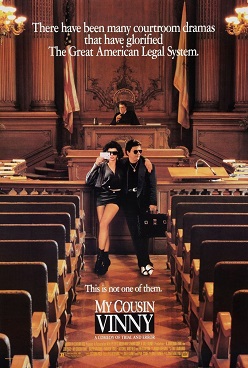
MY COUSIN VINNY (1992) – Joe Pesci heads way down south!


There are certain movies in my life that I consider “comfort movies.” These are the movies that I love so much that they always help me relax because I feel better just by watching them. I often turn on a comfort movie when I really need to fall asleep. Examples in my life include most of Charles Bronson’s filmography, RIO BRAVO, the ZATOICHI films, THE OTHER GUYS, and pretty much anything directed by Alex Kendrick. MY COUSIN VINNY fits comfortably under my categorization of a comfort movie.

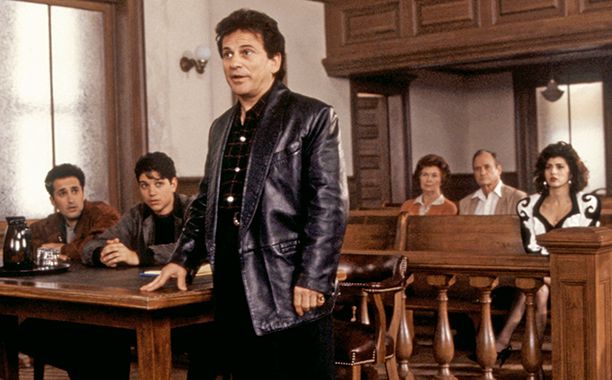
The movie opens with friends Bill Gambini (Ralph Macchio) and Stanley Rothenstein (Mitchell Whitfield) taking the scenic route down south as part of a cross-country trip to attend college at UCLA. Unfortunately, while in Alabama, the two are arrested soon after leaving a convenience store. Thinking they are being charged for accidentally shoplifting a can of tuna, it turns out the actual charges are robbery and murder as the place was robbed and the clerk killed soon after they left. Knowing they are in big trouble, Bill calls his cousin Vinny Gambini (Joe Pesci), who’s pretty much the only lawyer that he knows. The problem, Vinny has never actually tried a murder case. Vinny heads down south with his fiance Mona Lisa Vito (Marisa Tomei) where he must contend with a judge (Fred Gwynne) who doesn’t like him, a prosecutor (Lane Smith) who has way more experience than him, and a mountain of circumstantial evidence that he has almost no hope of contradicting. Will Vinny be able to prove his cousin’s innocence before they end up with life in prison, or even worse?

There are many reasons that I love MY COUSIN VINNY. The cast consists of a couple of my personal favorite actors in Joe Pesci and Ralph Macchio. GOODFELLAS is certainly one of the best movies ever made, and Joe Pesci gives an unbelievably powerful performance, a performance that would win him the Academy Award. Pesci took a short break from filming MY COUSIN VINNY to attend the Acadamy Award ceremony and pick up the gold. He even took the statue to the set to show the cast and crew. Maybe that helped inspire Marisa Tomei to give her own Academy Award winning performance in this film. My favorite scene of the entire movie is when Vinny is treating Mona Lisa as a hostile witness on the stand, just before she proceeds to prove that nobody knows more about cars than she does. It’s such a satisfying scene as she makes the prosecutor’s “expert” look like a novice. As for Ralph Macchio, many times in my life I’ve made the statement that I wanted to be the karate kid when I was growing up. I think I was in the fifth grade when I saw the film for the very first time. I’ve been a fan of Ralph Macchio, and in love with Elisabeth Shue, ever since. It’s the kind of movie I’d just sit around thinking about when I was a kid. I even wanted to learn karate, but being just a little over 4 feet tall at the time, I didn’t need to be getting into any fights. I also like that MY COUSIN VINNY was partially filmed in the town of Covington, GA. My wife and I were driving from Arkansas to Myrtle Beach back in 2020 and we stayed the night in Covington. I had done a little research while I was looking for a place to stop for the night, and I found out that Covington is sometimes referred to the “Hollywood of the South” due to the large number of movies and TV shows that are filmed there. We snapped a couple of shots of the downtown before heading on down the road. But I think the thing I love most about MY COUSIN VINNY is also the reason I love movies like THE KARATE KID and ROCKY so much. I love movies where a person is completely underestimated, and rightfully so. But then, through some combination of intelligence, hard work, heart, and will, that same person is able to rise to the occasion and prevail against those very same people who underestimated them. Vinny has no business in the courtroom, but somehow, he’s able to win the case, and he does it in a smart, funny and exciting way. I love an underdog, and MY COUSIN VINNY just makes me feel good!  

Retro Television Review: Miami Vice 2.14 “Yankee Dollar”


Welcome to Retro Television Reviews, a feature where we review some of our favorite and least favorite shows of the past!  On Mondays, I will be reviewing Miami Vice, which ran on NBC from 1984 to 1989.  The entire show can be purchased on Prime!

This week, Sonny’s latest girlfriend gets involved in the drug trade.

Episode 2.14 “Yankee Dollar”

(Dir by Aaron Lipstadt, originally aired on January 17th, 1986)

It’s another night in Miami.  Sonny Crockett is looking forward to driving out to the airport and picking up his latest girlfriend, a flight attendant named Sarah (Audrey Matson).  For two years, Sarah has been working the Miami to Bogota to Paris and back route.  She doesn’t make a lot of money but, as is typical for this show, she lives in a small but very nicely furnished house.

Unfortunately, Sarah dies shortly after Sonny picks her up.  She goes into cardiac arrest, the result of a balloon of cocaine bursting inside of her.  It turns out that Sarah was working as a drug mule, all so she could make a quick five grand and buy a used BMW.

Seriously, what are the chances that Sonny Crockett’s girlfriend would turn out to be a drug smuggler?  Maybe she thought she was dating Sonny Burnett.  Or maybe, like so many others on this show, she allowed her desire for the finer things in life — like a BMW — to lead her astray.  This is one of the major themes of Miami Vice.  In a society where conspicuous consumption rules, people will do anything to appear richer than they actually are.

When Sonny and Rico arrest Sarah’s brother, Tim (Clayton Rohner), they discover that he works for a wealthy businessman named Charlie Glide (Ned Eisenberg).  Everyone knows that Charlie Glide (a great name, by the way) is involved in the drug trade but no one has ever been able to pin anything on him.  In the past, Charlie avoided cocaine but he’s now looking to branch out.  Sonny and Rico go undercover to try to bring Charlie down.

Of course, it doesn’t work.  Charlie is smart enough to figure out that Sonny and Rico are trying to set him up.  Even after Crockett and Tubbs drag him down to the police station and Charlie makes a deal for immunity in return for setting up two other drug dealers (Anne Carlisle and Pepe Serna), he still tries to double cross the cops.  And even though the double cross doesn’t quite work, Charlie remains smug in his knowledge that he has immunity.

Except, of course, he doesn’t have immunity from all crimes.  Earlier in the episode, Charlie’s executive assistant, Max Rogo (Austin Pendleton), used Charlie’s gun to execute Tim.  Even though Crockett and Tubbs know that Max is the one who pulled the trigger and that Max is the one who decided to kill Tim, they still arrest Charlie for the murder.  (Max was apparently killed in an earlier shootout so it’s not like he’s around to tell the truth.)  “You changed the rules!” Charlie shouts as he’s dragged away.

This episode is Miami Vice at its most cynical.  Crockett and Tubbs can’t get Charlie for the crime he committed so, instead, they set him up for a crime he didn’t commit.  They did change the rules in that they decided they no longer have to follow them.  The episode is full of characters so desperate for money that they’ll do just about anything, even smuggling a lethal drug in their body.  Crockett can only watch helplessly as Sarah dies and, even as Charlie is taken away, there’s never any doubt that he’ll be replaced by someone else, the drug trade will continue, and more people will die just because they wanted to be able to afford a few extra things.  Crockett and Tubbs are fighting a war that can never be won.  Whatever victories they get ultimately feel hollow.  Arresting Charlie won’t bring Sarah back and it won’t stop more innocent people from dying.  Ned Eisenberg was wonderfully smug as Charlie Glide and Austin Pendleton was appropriately creepy as the always-smiling Max Rogo.  This was a good episode, one that challenged the traditional cop show narrative.  How long can one fight a losing war?

Film Review: My Cousin Vinny (dir by Jonathan Lynn)


In the 1992 film, My Cousin Vinny, two college students from New York City, Bill Gambini (Ralph Macchio) and Stan Rothstein (Mitchell Whitfield), make the mistake of driving through Alabama.  The two students stop off at a convenience store.  When the clerk is subsequently shot dead during a robbery, Bill and Stan are arrested for the crime.  The viewers know they’re innocent.  Bill and Stan know they’re innocent.  But the entire state of Alabama seems to be determined to send Bill and Stan to prison for life.

Fortunately, Bill’s cousin, Vinny (Joe Pesci, star of Half Nelson), is a lawyer.  Unfortunately, he just recently passed the bar exam and he has yet to actually try a case.  Still, Vinny and his fiancée, Mona Lisa Vito (Marisa Tomei), come down to Alabama.  Vinny takes the case, lying to the judge (Fred Gwynne) about his qualification as a trial attorney.  Vinny is momentarily impressed when the prosecutor (Lane Smith) shares with him all of the files about the case.  “It’s called disclosure, dickhead!” Lisa snaps at him, revealing that she actually has more common sense than Vinny.  That becomes increasingly important as Vinny tries to keep Bill and Stan from spending the rest of their lives in prison.

To be honest, considering how much I complain about stereotypical portrayals of the South, I really shouldn’t like My Cousin Vinny as much as I do.  Almost every character in the film is a stereotype to some extent or another, from the farmers and rednecks who take the witness stand to Fred Gwynne’s no-nonsense judge who rules that Vinny is in contempt of court because he’s wearing a leather jacket.  Fortunately, though, the Southern stereotypes don’t bother me because both Vinny and Lisa are New York stereotypes.  Just as the judge and the townspeople seem to confirm every prejudice that someone like Vinny would have against the South, Vinny seems to be the epitome of everything that people in the South dislike about the North.  When Vinny first shows up on the scene, he’s loud and brash and obnoxious.  But, as the film progresses, Vinny reveals himself to not only be a better attorney than anyone was expecting but he also calms down and adjusts to the more relaxed pace of life in the country.  Just as Vinny reveals himself to be not as bad as everyone originally assumed, both the Judge and the prosecutor are also allowed to reveal some hidden depths.  Neither one is the cardboard authority figure that viewers might expect.  The Judge does sincerely want justice to be done and the prosecutor sincerely wants to keep the county safe, even if he is prosecuting two innocent men.  Just as Vinny learns not to be too quick to judge them, they learn not to be too quick to judge Vinny.  The end message is that everyone is innocent until proven guilty and deserves a fair hearing, whether in a court of law or just in the courts of public and private opinion.  It’s not a bad message.  In fact, it’s one that more than a few people could still stand to learn today.

Of course, the best thing about the film is Marisa Tomei, who not brings a lot of energy to the film but whose hair is amazing and whose clothes are to die for.  Tomei won an Oscar for her performance in My Cousin Vinny, a victory that was so controversial that there were unfounded rumors that presenter Jack Palance had read the wrong name by mistake.  (As we all learned a few years ago when Warren Beatty and Faye Dunaway actually did read the wrong winner, the accountants aren’t going to let anyone get away with that.)  Watching the film last night, it was obvious to me that Tomei deserved that Oscar because Lisa is the heart of the film.  Pesci, Gwynne, and Lane Smith are all give good performances but, without Marisa Tomei’s performance, My Cousin Vinny would ultimately just be another culture clash comedy.  A lesser actress would have just played Lisa as being a stereotype.  But Tomei turned Lisa into the most believable and sincere character in the film.  While Lisa won the case, Tomei saved the movie.

(And needless to say, I’m a fan of any movie that features a Lisa saving the day.)

My Cousin Vinny holds up as an enjoyable film.  Watch it the next time you’re losing faith in humanity.

Film Review: Sunset (dir by Jamison M. LoCascio)


What do you get when you mix sanctimonious liberalism with the type of production values that one would normally associate with an evangelical-produced film about the rapture?

The 2018 film, Sunset, opens with a birthday party and it’s all downhill from there.  Elderly Henry (Liam Mitchell) may have just wanted to celebrate the fact that his wife Patricia (Barbara Bleier) had managed to survive another year despite being in poor health and almost constant pain but he made the mistake of inviting Julian (Austin Pendleton,  who always seems to get cast in roles like this) to the party and all Julian wants to do is talk politics.

Julian is concerned that the United States has been carpet-bombing the Middle East.  Henry thinks that the Middle East is getting what they deserve because a group of terrorists set off a nuclear bomb in Los Angeles and apparently destroyed the West Coast.  Julian isn’t so sure that the destruction of Los Angeles justified the destruction of the rest of the world.  (Take that, City of Angels.)  Fortunately, before things can get too intense, Chris (David Johnson) says, “Let’s get this party started!” and all of the political talk is abandoned.

However, the next morning, everyone wakes up to discover that missiles will soon be hitting the East Coast!  (This movie made me happy to live in the middle of the country.)  Everyone is making plans to evacuate the coasts and move to the red states, where they’ll presumably demand a state income tax and a Wawa on every street corner.  (To quote the Texas waitress in Hell or High Water, “Some asshole from New York ordered a trout.  We ain’t got no goddamned trout.”)  However, Patricia refuses to leave her house because she’s old and in constant pain and she wants to end her life on her own terms.  Of course, since Patricia refuses to leave, that means that Henry is now obligated to stay there with her and die as well, despite the fact that he has a sister in Missouri who would probably take him in.  Way to go, Patricia.

While Patricia is getting ready to kill her husband, the other people who were at her party are making plans as well.  Chris uploads a YouTube video where he talks about how scared he is about the end of the world.  Ayden (Juri Henley-Cohn) and Breyanna (Suzette Gunn) do a Google search on the effects of nuclear war and they decide that they don’t want any part of that.  (I wouldn’t want any part of it either.  Nuclear war sounds gross.)  Smarmy little Julian pops up occasionally and basically spouts the type of boomer political blather that makes Stephen King’s twitter feed so tedious.  Every few minutes, someone turns on a radio or television and we hear a reporter talking about how the world is about to end.   This is a low-budget film so we don’t actually see any of those reporters, we just hear their voices.

Usually, this is where I would point out that the film at least has good intentions regardless of its aesthetic shortcomings but …. eh.  Good intentions can only go so far and the aesthetic short comings here are dramatic.  This is one of those films where people are dealing with a huge, emotional event but everyone seems to spend their time speaking as if they were a Wikipedia article come to life.  Add to that the fact that Patricia’s desire to die in her house seems more selfish than noble and you’ve got a film that really doesn’t work.

That said, I did like the final five minutes of the film and not just because they indicated that the film was almost over.  Those final five minutes do give the film a much-needed sense of grace.  One gets the feeling that the entire film was made so that the director could have those final five minutes and, regardless of how bad the rest of the movie may be, the ending does have an isolated impact.  If you just saw those five minutes (and not the 80 minutes that came before them), you would be sincerely moved.

Anyway, as far as films about the end of the world go, Sunset didn’t end it quickly enough for me.

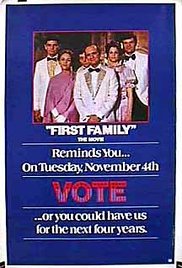
A Movie A Day #20: First Family (1980, directed by Buck Henry)


first-familyLike any newly inaugurated President, Manfred Link (Bob Newhart) faces many new challenges.  The biggest challenge, though, is keeping control of his family and his White House staff.  His wife (Madeline Kahn) is an alcoholic.  His 28 year-old daughter (Gilda Radner) is so desperate to finally lose her virginity that she is constantly trying to sneak out of the White House.  General Dumpson (Rip Torn) wants to start a war.  Press Secretary Bunthorne (Richard Benjamin), Ambassador Spender (Harvey Korman), and Presidential Assistant Feebleman (Fred Willard) struggle and often fail to convince everyone that all is well.
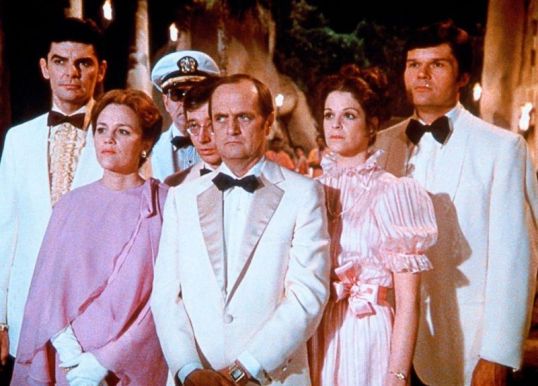
President Link needs to form an alliance with the African country of Upper Gorm, a country that speaks a language that only one man in America, Prof. Alexaner Grade (Austin Pendleton), can understand.  The President of Upper Gorm (John Hancock) orders that the kidnapping of Link’s daughter.  Holding her hostage, he demands that Link send him several white Americans so that the citizens of Upper Gorm can know what it is like to have a minority to oppress.

First Family not only featured a cast of comedy all-stars but it was also directed by one of the funniest men in history, Buck Henry.  So, why isn’t First Family funnier?  There are a few amusing scenes and Newhart can make a pause hilarious but, for the most part, First Family feels like an episode from one of Saturday Night Live‘s lesser seasons.  Reportedly, Henry’s first cut of First Family tested badly and Warner Bros. demanded that certain scenes, including the ending, be reshot.  Perhaps that explains why First Family feels more like a sitcom than a satire conceived by the man who wrote the script for The Graduate and whose off-center perspective made him one of the most popular hosts during Saturday Night Live‘s first five seasons.  Famously, during one SNL hosting gig, Henry’s head was accidentally sliced open by John Belushi’s samurai sword.  Without missing a beat, Henry finished up the sketch and performed the rest of the show with a band-aid prominently displayed on his forehead.  Unfortunately, there’s little sign of that Buck Henry in First Family.

first-family-2


Film Review: Finding Dory (dir by Andrew Stanton)


finding_dory

Finding Dory, the latest film from Pixar, tells the story of Dory (Ellen DeGeneres), a regal blue tang (for our readers in Vermont, that’s a fish) who suffers from short-term memory loss.  You may remember her from Pixar’s previous movie about fish, Finding Nemo.  In that movie, she helped a clownfish named Marlin (Albert Brooks) find his son, Nemo (voiced, in Finding Dory, by Hayden Rolence).  In the sequel, it’s Marlin and Nemo who are now helping Dory to find her parents.

Dory has spent years searching for her parents.  Of course, it would be easier if she didn’t suffer from short-term memory loss.  It seems that every time she sets out to track her parents down, she ends up getting distracted and forgets what she was doing.  However, while helping to teach a class about migration, Dory has a sudden flashback to her parents (voiced, quite charmingly, by Eugene Levy and Diane Keaton).  She sets out once again, determined to find her parents.  This time, Marlin and Nemo are accompanying her.  As Dory continually frets, she’s can’t do it alone because she can’t remember directions.

Though her memories are fuzzy and her flighty nature leads to some conflict with Marlin (who is just as cautious and overprotective of Nemo as he was in the first film), Dory eventually finds her way to where her parents were last seen.  And, in doing so, Dory discovers that she and her parents originally lived at a water park, the California Marine Life Institute.

(One of my favorite parts of the film is that apparently, Sigourney Weaver recorded several greetings and other messages that are played continuously over the Institute’s PA system.  “Hello, I’m Sigourney Weaver and welcome to the Marine Life Institute.”  Dory becomes convinced that Sigourney Weaver is some sort of God-like being who is leaving personal messages for her.  At one point, Dory exclaims, “A friend of mine, her name’s Sigourney, once told me that all it takes is three simple steps: rescue, rehabilitation, and um… one other thing?”)

Since this is a Pixar movie, Dory meets the usual collection of oddball and outcast sealife at the Institute, all of whom help her out while overcoming their own insecurities, providing properly snarky commentary, and hopefully bringing a tear or two to the eyes of even the most jaded of viewers.  Finding Dory is full of familiar voices, everyone from Idris Elba to Bill Hader to Kate McKinnon.  But, for me, the most memorable of all the voices (with the exception of Ellen DeGeneres herself) was Ed O’Neill’s.  O’Neill brought Hank, the bitter but ultimately good-hearted seven-legged octopus, to poignant life.  I imagine that, should there be another sequel, it will be called Finding Hank.

Finding Dory continues the annual tradition of Pixar films making me cry.  Finding Dory is an incredibly sweet and truly heartfelt movie but, at the same time, it’s also an extremely witty comedy.  This is one of those Pixar films where the joy comes not only from looking at the amazing animation but also from listening to truly clever dialogue being delivered by some of the best voice actors around.  DeGeneres does such a great job bringing Dory to life that, as the movie ended, my first instinct was to run out and buy a regal blue tang of my very own.  But then I read an article on Wikipedia, which explained why I shouldn’t do that.

(Basically, blue tangs may look cute but they have big, scary spikes that can cut up your hand.  As well, they don’t do well in captivity.  So, if you’re planning on getting a Dory of your very own, you might be better off just rewatching this movie…)

It’ll make you laugh.  It’ll make you cry.  Finding Dory is another great film from Pixar.

http://www.youtube.com/watch?v=UGWv91YZua4

Film Review: The Thief Who Came To Dinner (1973, directed by Bud Yorkin)


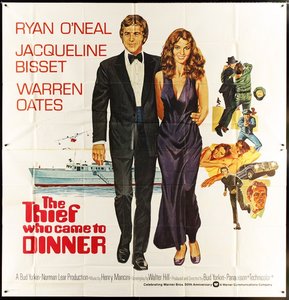
0033bee5_mediumIn The Thief Who Came To Dinner, Ryan O’Neal plays Webster McGee, a Houston-based computer programmer.  After deciding that living in a capitalist society means that everyone steals from everyone else, Webster quits his boring job and decides to become a real thief.  Figuring that they can afford to lose a little wealth, Webster only targets the rich and powerful.  After he steals some incriminating documents from a crooked businessman (Charles Cioffi), Webster uses those documents to blackmail his way into high society.  Soon, Webster owns a mansion of his own and is living with a gorgeous heiress (Jacqueline Bisset, who played a lot of gorgeous heiresses back in the day).  Webster also has an insurance investigator after him.  Dave Reilly (Warren Oates) knows that Webster is a thief but he also can not prove it.  As Dave obsessively stalks him, Webster plots one final heist.

Until I saw it on TCM on Monday, I had never heard of The Thief Who Came To Dinner.  Directed in a breezy style by Bud Yorkin, The Thief Who Came To Dinner was an early script from Walter Hill.  Though the film is much more comedic than his best known work, it’s still easily recognizable as coming from Hill’s imagination.  The obsessive Dave and the coolly professional Webster are both prototypical Hill characters and their adversarial yet friendly rivalry would be duplicated in several subsequent Hill films.

The Thief Who Came To Dinner is an engaging movie that doesn’t add up to much.  The normally stiff Ryan O’Neal gives one of his better performances, though he struggles to hold his own whenever he has to act opposite the far more energetic Warren Oates.  Ned Beatty, Gregory Sierra, John Hillerman, Michael Murphy, and Austin Pendleton all appear in minor roles, making the film’s cast a veritable who’s who of 70s character actors.  And, of course, the film features Jacqueline Bisset at her loveliest.

The Thief Who Came To Dinner may not be well-known but it is an enjoyable and satisfying piece of 70s entertainment.