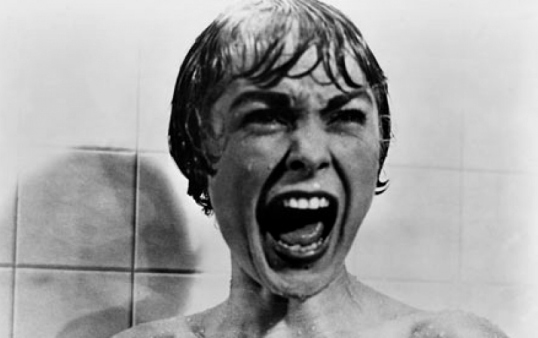
It would be difficult to get through October and not point out one of the best scenes in horror ever.
There’s Janet Leigh’s performance which conveyed the utter terror the scene wanted to convey. We have Bernard Hermann’s discordant film score highlighting the attack. Despite being a very bloodless sequence the way Hitchcock filmed the scene made audience imagine that they were actually witnessing something more violent and gory.
We all have Alfred Hitchcock to thank for this most iconic of all horror scenes.
I recently saw the 1970 film WUSA on Movies TV. After I watched it, I looked Joanne Woodward up on Wikipedia specifically to see where she was born. I was surprised to discover that she was born and raised in Georgia and that she attended college in Louisiana.
Why was I so shocked? Because WUSA was set in New Orleans and it featured Joanne Woodward speaking in one of the most worst Southern accents that I had ever heard. A little over an hour into the film, Woodward’s character says, “What’s all the rhubarb?” And while “What’s all the rhu…” sounds properly Southern, the “…barb” was pronounced with the type of harshly unpleasant overemphasis on “ar” that has given away many Northern actors trying to sound Southern. Hence, I was shocked to discover that Joanne Woodward actually was Southern.
That said, her pronunciation of the word rhubarb pretty much summed up every problem that I had with WUSA. Actually, the real problem was that she said “rhubarb” in the first place. It came across as being the type of thing that a Northerner who has never actually been down South would think was regularly uttered down here. And I will admit that WUSA was made 16 years before I was born and so, it’s entirely possible that maybe — way back then — people down South regularly did use the word rhubarb. But, for some reason, I doubt it. I know plenty of old Southern people and I’ve never heard a single one of them say anything about rhubarb.
As for WUSA, it’s a long and slow film. A drifter named Reinhardt (Paul Newman) drifts into New Orleans and, with the help of an old friend who is now pretending to be a priest (Laurence Harvey), Reinhardt gets a job as an announcer at a right-wing radio station. He reads extremist editorials that he doesn’t agree with and whenever anyone challenges him, he explains that he’s just doing his job and nothing matters anyway.
Reinhardt also gets himself an apartment and spends most of his time smoking weed with long-haired musician types, the exact same people that WUSA regularly denounces as being a threat to the American way. Living in the same complex is Geraldine (Joanne Woodward), a former prostitute who has a scar on her face and who says stuff like, “What’s all the rhubarb?” She falls in love with Reinhardt but finds it difficult to ignore what he does for a living.
Meanwhile, Geraldine has another admirer. Rainey (Anthony Perkins) is an idealistic and neurotic social worker who is regularly frustrated by his efforts to do good in the world. Reinhardt makes fun of him. The local crime boss (Moses Gunn) manipulates him. And WUSA infuriates him. When Rainey realizes that WUSA is a part of a plot to elect an extremist governor, Rainey dresses up like a priest and starts carrying around a rifle.
Meanwhile, Reinhardt has been assigned to serve as emcee at a huge patriotic rally. With Geraldine watching from the audience and Rainey wandering around the rafters with his rifle, Reinhardt is finally forced to take a stand about the people that he works for.
Or maybe he isn’t.
To be honest, WUSA is such a mess of a film that, even after the end credits roll, it’s difficult to figure out whether Reinhardt took a stand or not.
Anyway, WUSA is not a lost masterpiece and I really wouldn’t recommend it to anyone. The film’s too long, there’s too many scenes of characters repeating the same thing over and over again, and neither Newman nor Woodward are particularly memorable. (You know a movie is boring when even Paul Newman seems like a dullard.) On the plus side, Anthony Perkins gives such a good performance that I didn’t once think about the Psycho shower scene while watching him.
As boring as WUSA is, I have to admit that I’m a little bit surprised that it hasn’t been rediscovered. Considering that it’s about a right-wing radio station, I’m surprised that there haven’t been hundreds of pretentious think pieces trying to make the connection between WUSA and Fox News. But, honestly, even if those think pieces were out there, it probably wouldn’t do much for WUSA‘s repuation. According to the film’s Wikipedia page, Paul Newman called it, “the most significant film I’ve ever made and the best.” Paul Newman’s opinion aside, WUSA is pretty dire.
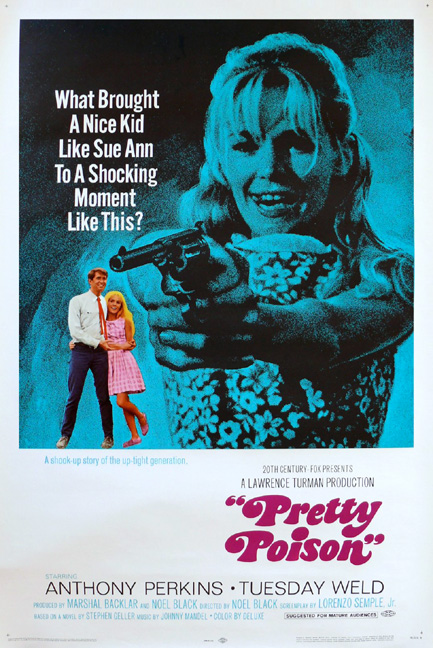
“I don’t care if critics like it; I hated it. I can’t like or be objective about films I had a terrible time doing.”
— Tuesday Weld on Pretty Poison (1968)
It’s actually rather depressing to read that Tuesday Weld hates Pretty Poison because it really is an underrated gem, a nifty little thriller that acts as sly satire on youth, conformity, and small town life. The main reason that the film works is because of the performances delivered by both Weld and her co-star, Anthony Perkins.
But then again, when we the viewers think back on a movie, we remember what we saw as a member of the audience and sometimes, we forget that just because a film is fun to watch, that doesn’t necessarily mean that it was enjoyable to make. When actors and other technicians think back on a film they were involved with, they remember the experience of actually making it. Reportedly, Weld did not get along with the director of Pretty Poison and couldn’t wait to get away from him.
Interestingly enough, in Pretty Poison, Tuesday Weld plays a teenage girl who doesn’t get along with her mother and who can’t wait to get away from her. Perhaps being miserable while making Pretty Poison helped Weld to bring a miserable character to life.
Pretty Poison opens with a nervous-looking man named Dennis Pitt (Anthony Perkins) watching a group of high school cheerleaders practicing on a field. His attention is focused on one cheerleader in particular, the blonde Sue Ann Stepanek (Tuesday Weld). Even before the opening credits have ended, the film has established a familiar dynamic. Sue Ann is the fresh-faced example of small town American innocence. Dennis is the type of creepy older guy that every girl has had to deal with at some point in her life. (When I was in high school, there were always guys like Dennis hanging out around the mall. When I was in college, the Dennis Pitts of the world were the guy who still hung out around the dorms even though they hadn’t been a student in a decade.)
Having established this dynamic early on, Pretty Poison spends the rest of its running time turning that dynamic upside down.
Dennis has recently been released from a mental hospital. Under the watchful eye of his parole officer (John Randolph), Dennis gets a mind-numbingly dull job at a local mill and tries to live a normal life. When Dennis finally does get a chance to talk to Sue Anne, he lies to her and tells her that he’s a secret agent and that he’s in town on a mission. Sue Anne responds to Dennis’s awkward flirting and soon, she’s accompanying him on his “missions.” During one such mission near the mill, they’re spotted by a security guard. Sue Anne responds by enthusiastically murdering him.
Yes, the cheerleader’s a sociopath.
Sue Anne’s tyrannical mother (Beverly Garland) does not approve of her relationship with Dennis. Sue Anne wants her mother out of the way and she expects her secret agent boyfriend to help her out…
Pretty Poison is a sharp mix of dark comedy and heightened drama, one that gets progressively darker as it progresses. From the minute the film first shows Sue Anne intensely practicing on that field while Dennis watches her, it’s pretty obvious that the film was meant to be an allegory for American society in 1968. Sue Anne is the perfect, all-American cheerleader who kills people because she can. Dennis is the neurotic outsider who knows that he’ll never be able to get anyone to believe the truth.
And it all works, largely because both Anthony Perkins and Tuesday Weld are so well-cast. It is, of course, impossible to watch Perkins without first thinking about Psycho but he actually manages to make Dennis into a very different character from Norman Bates. If Norman was a psycho who, at first sight, looked like an innocent, Dennis is an innocent who, at first sight, looks like a psycho. Tuesday Weld, meanwhile, turns Sue Anne into a disturbingly plausible killer, the type who, within minutes, can alternate between moodiness and giddiness, all the while squealing with orgasmic joy while bashing in someone’s head.
Tuesday Weld may hate Pretty Poison but it’s still a pretty good movie.
So, guess what I did this morning? That’s right — I put on a blindfold, a stumbled over to my ever-growing Blu-ray, DVD, and even VHS collection and I randomly selected 12 films!
Why did I do this?
I did it so you, the beloved readers of Through the Shattered Lens, could once again have a chance to tell me what to do. At the end of this post, you’ll find a poll. Hopefully, between now and next Monday (that’s March 24th), a few of you will take the time to vote for which of these 12 films I should watch and review. I will then watch the winner on Tuesday and post my review on Wednesday night. In short, I’m putting the power to dominate in your hands. Just remember: with great power comes great … well, you know how it goes.
Here are the 12 films that I randomly selected this morning:
The Baader Meinhof Complex (2008) — This German film was nominated for Best Foreign Language Film. It tells the true life story of the left-wing German terrorist group, The RAF.
The Cat’s Meow(2001) — From director Peter Bogdonavich, this film speculates about the events that led to the shooting of silent film director Thomas H. Ince. Starring Kirsten Dunst as Marion Davies, Edward Herrmann as William Randolph Hearst, and Eddie Izzard as Charlie Chaplin.
Heavenly Creatures (1994) — The close relationship between two teenage girls (Melanie Lynesky and Kate Winslet) leads to both a vibrant fantasy world and real-life murder. Directed by Peter Jackson.
In A Lonely Place(1950) — In this film noir from director Nicholas Ray, Humphrey Bogart plays a screenwriter who may (or may not) be a murderer.
Liquid Sky(1983) — In this low-budget, independent science fiction film, an alien lands in New York and soon several members of the city’s underground art scene are vaporized. Not surprisingly, it all has to do with heroin.
Made in Britain (1983) — A very young Tim Roth makes his debut in this British film. Roth plays Trevor, a Neo-Nazi who — despite being intelligent and charismatic — also seems to be intent on destroying himself and everything that he sees.
Much Ado About Nothing(2013) — In between The Avengers and Agents of SHIELD, Joss Whedon found the time to direct this adaptation of Shakespeare’s play.
Peyton Place(1957) — In this Oscar-nominated film, the sordid secrets of an outwardly idyllic New England town are exposed.
Pretty Poison (1968) — Having just been released from a mental institution, Dennis (Anthony Perkins) finds himself involved with teenager Sue Anne (Tuesday Weld), who — despite her wholesome appearance — is actually psychotic.
Troll 2(1990) — A family moves to Nilbog, a small town that is populated by vegetarian goblins. This movie is widely considered to be one of the worst ever made.
Walkabout (1971) — In this visually stunning Nicolas Roeg film, a teenage girl and her younger brother find themselves stranded and left for dead in the Australian outback. They try to survive with the help of an Aborigine.
Zabriskie Point(1970) — In this 1970 film, the great Italian director Michelangelo Antonioni takes a look at the 60s counter-culture. Airplanes are stolen, buildings explode, and orgies magically materialize in the middle of the desert.
Yesterday, I took a look at Executive Action, a 1973 docudrama about the assassination of John F. Kennedy. Today, I want to take a look at another film inspired by the Kennedys, the 1979 satire Winter Kills.
As the film opens, it’s been 16 years since a popular and dynamic President named Tim Kegan was assassinated in Philadelphia. Despite constant rumors of conspiracy, the official story is that Kegan was killed by a lone gunman and that gunman was subsequently killed by another lone assassin. The President’s half-brother, Nick (played by Jeff Bridges, who looks so impossibly young and handsome in this film), has disappointed his father (John Huston) by declining to follow his brother into politics. Instead, he spends most of his time sailing on corporate oil tankers and dating fashion editor Yvette (Belinda Bauer). This all changes when a dying man named Fletcher (and played, underneath a lot of bandages, by Joe Spinell) asks for a chance to speak to Nick. Fletcher reveals that he was the 2nd gunman and that he was hired by to kill President Kegan. Before dying, Fletcher tells Nick where he can find the rifle that was used to kill the President.
Following Fletcher’s directions, Nick finds both the rifle and proof that his brother’s death was the result of a conspiracy. Determined to find out who was truly behind the conspiracy, Nick goes to see his father, the flamboyant tycoon Pa Kegan (John Huston) who, we discover, is only alive because he frequently gets blood transfusions from young women. With Pa’s encouragement, Nick is sent on an increasingly bizarre odyssey into the darkest shadows of America, a world that is populated by militaristic businessmen, sinister gangsters, and an unemotional man named John Cerutti (Anthony Perkins) who very well may be the most powerful man in the world.
The martyred President might be named Tim Kegan, his accused assassin might be named Willie Abbott, and the man who shot Abbott might be named Joe Diamond (and might be played by Eli Wallach) but make no mistake about it — Winter Kills is a thinly disguised look at both the Kennedy assassination and the Kennedy family. Based on a novel by Richard Condon (who also wrote the conspiracy classic, The Manchurian Candidate), Winter Kills takes all of the various Kennedy conspiracy theories and intentionally pushes them to their most ludicrous extremes. The end result is a film that tries (and occasionally manages) to be both absurd and sincere, a portrait of a world where paranoia is the only logical reaction.
As I discovered from listening to director William Richert’s commentary on the Anchor Bay DVD, Winter Kills had a long and complicated production history. The film was produced by two marijuana dealers, one of whom was murdered by the Mafia shortly after the film premiered while the other would later be sentenced to 40 years in prison on federal drug charges. The production actually went bankrupt more than a few times, which led to Richert, Bridges, and Bauer making and releasing another film specifically so they could raise the money to finish Winter Kills.
When Winter Kills was finally released, it got a good deal of attention because of its spectacular cast. Along with Bridges, Huston, Perkins, and Wallach, the film also features cameo appearances by Tomas Milian, Elizabeth Taylor, Ralph Meeker, Richard Boone, Sterling Hayden, Dorothy Malone, Toshiro Mifune, and a host of other actors who will be familiar to those of us who enjoy watching old movies on TCM. And yet, according to Richert, the film itself was barely released in to theaters, the implication being that Winter Kills was a film about conspiracies that fell victim to a conspiracy itself.
Given the film’s history and the subject matter, I was really hoping that Winter Kills would turn out to be a great movie. Unfortunately, it really doesn’t work. The film struggles to maintain a balance between suspense and satire and, as a result, the suspense is never convincing and the satire is ultimately so obvious that it ends up being more annoying than thought-provoking. The cast may be impressive but they’re used in such a way that film ultimately feels like it’s just a collection of showy celebrity cameos as opposed to being an actual story.
That said, Winter Kills remains an interesting misfire. Jeff Bridges is a likable and compelling lead (and he gives the film much-needed focus) and, playing a role that has a lot in common with his better known work in Chinatown, John Huston is a always watchable if not necessaily likable. Best of all is Anthony Perkins, who plays a role that, in light of what we now know about the NSA, seems oddly prophetic.
Finally, best of all, Winter Kills remains an interesting time capsule. If nothing else, it reminds us that mistrust and paranoia are not unique to this century.
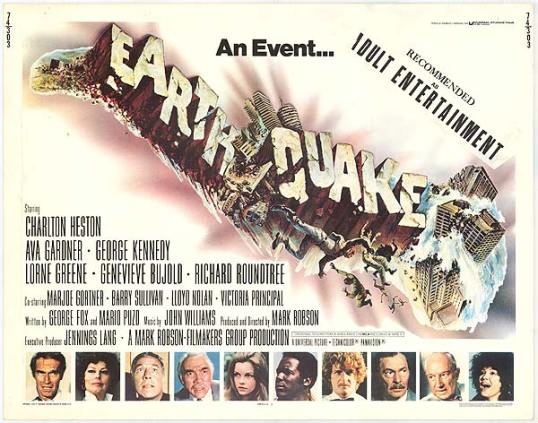
Since it’s impossible for me to talk about anything without somehow relating it to a movie, I guess it makes sense that my reaction to San Francisco winning the World Series was to write a review of the award-winning, 1974 disaster film Earthquake. If the Rangers had won, I would have been obligated to write up a review of No Country For Old Men.
So, Earthquake is one of those movies from the 70s in which a large group of different characters had to deal with some sort of cataclysmic disaster that could, in theory, have happened in reality as well as up on the movie screen. There were apparently about 2,000,000 of these films made between 1970 and 1980 and they all had titles like Hurricane, Tornado, Big Fire, Asbestos, Flash Flood, Lava Flow, Khardashian, Avalanche, and, of course, Earthquake. These movies always featured an “all-star” cast of people that nobody had ever actually heard of and I guess part of the fun was trying to guess who would survive and who would die. Apparently, they were the 1970s version of Dancing With The Stars. Call it Dying With Celebrities.
Earthquake is one of best known of these films. Apparently, it made a lot of money in 1974 and it won Academy Awards for its earthquake effects. Bleh. Whatever. Have you ever really sat down and looked at a list of the movies that have won at least one Academy Award since they first started handing those things out? Earthquake is like a 6 hour movie and Los Angeles doesn’t start shaking until halfway through. The Earthquake itself only lasts for 15 minutes and it’s kind of impressive to watch but it’s 15 minutes out of 360.
Before the earthquake hits, we get to meet the usual cross-section of humanity. Charlton Heston is an architect who is married to Ava Gardner who is the daughter of Heston’s boss, who is played by an actor named Lorne Greene who appears to be younger than either Heston or Gardner. Heston has a mistress who is played by Genevieve Bujold who is really pretty, sweet, and boring. Gardner is none of these things but she is a foul-mouthed alcoholic who fakes suicide attempts so I was pretty much on her side as far as the whole love triangle is concerned. After the Earthquake, Heston and Greene and a bunch of accident-prone extras are stuck in the ruins of sky scraper. Heston grimaces a lot in this film but you know what? Say what you will about Charlton Heston’s politics or his clenched-teeth acting style, the man knew how to wear an ascot.
While Heston is torn between Gardner and Bujold (a plot development that reportedly inspired the famous Sartre play No Exit), Richard Roundtree just wants to jump over stuff on his motorcycle. That’s right — John Shaft is in this movie and we can dig it. He’s a professional daredevil. He’s also a surprisingly dull actor. Who would have guessed that, without a theme song playing, Shaft would turn out to be so boring? Still, there’s a really cool scene where Roundtree tries to ride his motorcycle through Los Angeles in the middle of the earthquake and the film is worth watching for his all-flare stunt daredevil costume if nothing else. Plus, Roundtree’s playing a character named Miles here and I like that name.
There’s another subplot. It involves George Kennedy as a blue-collar cop who does what he has to do to try to maintain the peace before and after the Earthquake. Bleh. I mean, Kennedy actually gives a pretty good performance and he’s probably the most likable character in the film but seriously — Bleh.
And finally, this collection of humanity is rounded out by an aspiring actress (played by actress Victoria Principal who, four years earlier, had made history by being the first woman to successfully seduce actor Anthony Perkins and no, I don’t want to go into how I know that) and the psychopathic grocery store manager who is obsessed with her. The grocery store manager is played by former child evangelist and 70s exploitation icon Marjoe Gortner. Much as in the later film Starcrash, Gortner projects a remarkably unlikable vibe that works well for his character. He also has a really bad perm and a mustache and his performance is so sublimely bad that it’s actually pretty good. As for Principal, her character here is apparently the owner of 1974’s most ginormous afro and, like most women in the 70s, really should have considered wearing a bra. It’s hard to really judge Principal’s performance because any time she’s on-screen, you just start thinking, “Oh my God, she had sex with Norman Bates but somehow, she thinks she’s too good for Marjoe Gortner?”
These are the characters that we follow as Los Angeles is destroyed on-screen. None of them are really much more than cardboard cut outs but there’s something oddly comforting about how shallow and predictable they all are. Add to that, most of them end up dead so if you do dislike them, you’ll find a lot to enjoy. You’ll especially enjoy the film’s final few moments unless, like me, you can’t swim and you’re terrified of drowning. If you’re like me, that scene might give you nightmares.
Flawed as it may be, I still have to recommend this movie as 1) a time capsule and 2) as a quintessential piece of American camp. Every line of dialogue, every performance, every image, and every scene in Earthquake simply screams 1974. I guess the best way to look at Earthquake is to think about it as if the movie’s a time machine. You might not like where the machine takes you but you’re still going to get into the damn thing and, once you find yourself stuck in Iowa in the year 1835, you’ll find someway to force yourself to be entertained because otherwise, you’re just hanging out in Iowa in 1835.



 Through the Shattered Lens