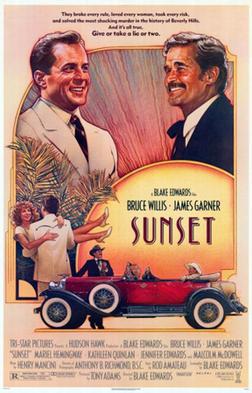
Sunset (1988, directed by Blake Edwards)


In 1920s Hollywood, famed comedian Alfie Alperin (Malcolm McDowell) has made the transition from screen stardom to working behind the scenes as a producer and studio head.  With the coming of the talkies and the death of silent cinema, Alfie plans to make his mark with an epic western starring Tom Mix (Bruce Willis) as Wyatt Earp.  The real Wyatt (James Garner) is hired to act as an on-set consultant.  Wyatt’s former girlfriend, Christina (Patricia Hodge), is now married to Alfie.

What Mix and Earp discover is that, despite his beloved public image, Alfie is actually a monster who is involved with organized crime and sex trafficking and who has the police on his payroll.  While searching for Christina’s missing son (Dermot Mulroney), Mix and Earp get caught up in a murder involving Alife’s sister (Jennifer Edwards) and a gangster named Dutch (Joe Dallesandro).  At the first Academy Awards are handed out in Beverly Hills, Tom Mix and Wyatt Earp prepare for the final showdown with their producer.

The idea behind Sunset was promising.  Wyatt Earp, a real cowboy who survived the end of the West, teams up with Tom Mix, a movie cowboy who is trying to survive the end of the silent era.  (Earp and Mix were friend in real life, as well.)  Bruce Willis comes across as being too contemporary in the role of Tom Mix but James Garner plays Wyatt Earp with a weary dignity and Malcolm McDowell does a convincing Charlie Chaplin impersonation.  Unfortunately, Blake Edwards’s direction allows the story to meander and the mystery itself is so full of red herrings that it’s impossible to follow.  Edwards didn’t seem to know if he wanted this movie to be a buddy comedy, an elegiac tribute to the end of the silent era, or a satire of Hollywood.  He tried to include elements of all three but the movie itself just doesn’t come together.  Only Garner and McDowell emerge from the film relatively unscathed.

Fortunately, for Bruce Willis, Die Hard was released just two months after Sunset.
Film Review: Executive Decision (dir by Stuart Baird)


In 1996’s Executive Decision, terrorists hijack an airplane.  Their leader, Nagi Hassan (David Suchet) demands that the U.S. government not only give him and his men safe passage but that they also release Hassan’s commander, Jaffa (Andreas Katsulas).

In Washington D.C., it is decide to use a stealth plane to transport Col. Austin Travis (Steven Seagal) and his men into the passenger plane.  Accompanying them will be Dr. David Grant (Kurt Russell), a consultant for U.S. Intelligence.  Dr. Grant is the world’s leading expert on Hassan, even though neither he nor anyone else is even sure what Hassan looks like.  Travis distrusts Grant because he’s a civilian and also because he holds Grant responsible for a botched raid on a Russian safehouse in Italy.  Dr. Grant is going to have to prove himself to Col. Travis because Travis doesn’t have any time for people who can’t get the job done.  And Travis is determined to get on that plane and save all those passengers.

In other words, Travis is a typical Steven Seagal character and, for the first fourth of this movie, Seagal gives a typical Steven Seagal performance.  He delivers his line in his trademark intimidating whisper, he glares at everyone else in the film, and essentially comes across as being a total douchebag who can still handle himself in a fight..  However, when it’s time to board the airplane through a docking tunnel, something goes wrong.  Everyone — even nervous engineer Dennis Cahill (Oliver Platt) is able to slip through the stealth plane’s docking tunnel and get into the hijacked airplane cargo hold without being detected.  But the two planes are hit by severe turbulence.  Suddenly, it becomes apparent the one man is going to have to sacrifice his life and close the hatch before the docking tunnel decompresses.

David, already in the cargo hold, looks down at Austin in the tunnel.  “We’re not going to make it!”

“You are!” Austin replies before slamming the hatch shut and getting sucked out of the tunnel.  (There’s your Oscar Cheers Moment of 1996!)  After all that build-up, Steven Seagal exits the film early and now, it’s up to Kurt Russell and what’s left of Austin Travis’s men to somehow stop the terrorists.  Not only do they have to stop Hassan but they also have to do it before the Air Force — which has no way of knowing whether or not any of their men were able to get on the plane before the tunnel fell apart — shoots down the airliner.

(If the airplane looks familiar, that’s because Lost used the same stock footage whenever it flashed back to the plane crash that started the show.)

It’s actually a rather brilliant twist.  When this film came out, Seagal was still a film star.  He played characters who always got the job done and who were basically infallible.  He wasn’t a very good actor but he did manage to perfect an intimidating stare and that stare carried him through a lot of movies.  No one would have expected Seagal to die within the first 30 minutes of one of his movies and when Col. Travis, who the film has gone out of its way to portray as being the consummate warrior, is suddenly killed, there really is a moment where you find yourself wondering, “What are they going to do now?”  In just a matter of minutes, Executive Decision goes from being a predictable Steven Seagal action film to a genuinely exciting and clever Kurt Russell thriller.  For once, Russell is not playing a man of action.  He’s an analyst, a thinker.  And, to the film’s credit, he uses his mind more than his brawn to battle Hassan’s terrorists.  With excellent support from Halle Berry (as a flight attendant who discreetly helps out David and the soldiers), Oliver Platt, B.D. Wong, Whip Hubley,  David Suchet, Joe Morton, and even John Leguizamo (as Travis’s second-in-command), Executive Decision reveals itself to be an exciting and ultimately rewarding thrill ride.

And to think, all it took was sacrificing Steven Seagal.

A Blast From The Past: A Very Delicate Matter (dir by Claude Kerven)


Today’s blast from the past comes to use from 1982.

In A Very Delicate Matter, teenager Kristin Sorenson (Lori-Nan Engler) spends the summer working at a camp.  After her nominal boyfriend, Greg Pscharapolus (Zach Galligan), fails to call her even once, Kirstin ends up dating her superhot co-worker, Larry (future daytime drama star Grant Aleksander, making his television debut).  Once summer ends, Kristin returns home where Greg apologizes for not calling her.  Kristin takes Greg back and decides not to tell him about Larry.  But then Kristin gets a call from Larry.  Larry tells her that she might want to go by the free clinic and get some penicillin because Larry’s got gonorrhea and there’s a good chance to Kristin now has it as well.  And, since Kristin and Greg previously spent a day making up, Greg might have it too!

The plot description probably makes A Very Delicate Matter sound considerably campier than it is.  For the most part, this is a sensitive and nonjudgmental film, one in which no one is portrayed as being a villain.  (As one doctor points out, even Larry showed more courage than most by immediately calling Kristin and letting her know what was going on.)  While the two leads both give good performances (with Galligan just two years away from starring in Gremlins), the film is stolen by Marta Kober and John Didrichsen, who play the best friends of Kristen and Greg and who have a nice flirtatious chemistry with each other.  Just because your friend has a social disease, the film seems to be saying, don’t give up on love.  Marta Kober is probably best known for Friday the 13th Part 2, which featured its own warning about having unprotected sex at a summer camp.

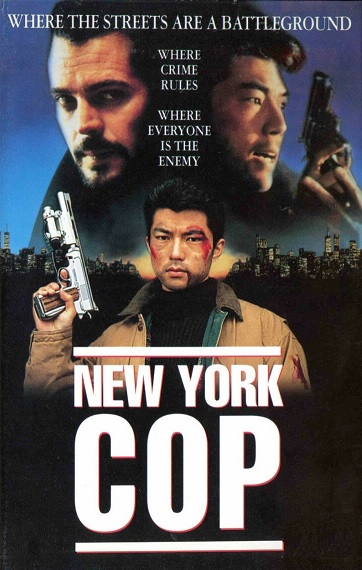
New York Cop (1993, directed by Tôru Murakawa)


Toshi (Tôru Nakamura) is a tough New York cop who is assigned to work undercover in the East Village because, according to his boss, no one will suspect that a Japanese man is actually a cop.  Disguising himself as a homeless gambling addict who has connections with the Tongs, Toshi infiltrates the Brotherhood.  He becomes friends with the gang’s leader, Hawk (Chad McQueen), and he even falls in love with Hawk’s sister, Maria (Mira Sorvino!).  Hawk is buying guns from a mobster named Mr. C (Tony Sirico!!) and Mr. C’s main assassin, Ferrara (Andreas Kastsulas), is driving around New York in a taxi cab and killing undercovers.  Can Toshi take down Mr. C without compromising his relationship with Maria and revealing that he’s actually an undercover cop?  The short answer is no.

New York Cop works best when it focuses on action.  Tôru Nakamura is convincing in the fight scenes but he’s less convincing whenever he has to show emotion or have a conversation with anyone.  The idea that the NYPD would send a Japanese cop undercover to infiltrate a Hispanic gang never makes makes much sense, as Toshi himself points out when the idea is first brought up.  Toshi never makes much of an effort to disguise the fact that he is a cop, which makes Hawk look incredibly stupid for not seeing through him.  The main appeal for most people will probably be the chance to see Tony Sirico and Mira Sorvino in early roles.  Sirico, the former gangster-turned-actor, is convincing as Mr. C and gets all of the film’s best lines.  As for Mira Sorvino, this was only her second or third film role and the script doesn’t give her much to work with.  There are a few scenes where she gets to bring some genuine New York attitude to her character, telling off both her brother and Toshi.  But otherwise, there’s little about her performance that suggests the actress that she would become.  Fortunately, films like Barcelona and Sweet Nothing were right around the corner.

As far as New York cops go, nothing has yet to beat the episode of Barney Miller where Christopher Lloyd vandalizes the station house.

The Death of the Incredible Hulk (1990, directed by Bill Bixby)


David Banner (Bill Bixby), still hoping to find a cure for the condition that causes him to turn into the Hulk (Lou Ferrigno) whenever he gets injured or stressed out, heads up to Portland.  Pretending to be a simple-minded janitor named David Bellamy, Banner gets a job working in the lab of Dr. Ronald Pratt (Philip Sterling).  Banner hopes that Dr. Pratt’s research holds the secret that can release him from being the Hulk.  When Dr. Pratt learns Banner’s secret, he and his wife (Barbara Tarbock) work with Banner to try to cure him and to understand the Hulk.

David Banner is not the only person who has infiltrated the lab.  KGB agent Jasmin (Elizabeth Gracen) has also been sent to the lab with orders to steal Pratt’s research.  Jasmin hates working for the KGB but she’s been told that her sister will be killed unless she complete one final mission.  When Jasmin meets and falls in love with David, she starts to reconsider her loyalties.  When the KGB finally makes their movies, Jasmin is going to have to decide who to help and the Hulk is going to have to come through and save the day one final time.

David Banner’s saga finally comes to a close in The Death of the Incredible Hulk, the third and last of the Incredible Hulk television movies.  It’s also the best of the three, though that might not by saying much when you consider the quality of the first two.  While the other two movies both served as backdoor pilots for other heroes and the Hulk was barely even present in the 2nd movie, The Death of the Incredible Hulk keeps the focus squarely on David Banner and the Hulk.  (Though Jasmin does seem like she could be a version of the Black Widow, I think the similarities between the two characters are a coincidence.  Beautiful and conflicted KGB agents were a popular trope in the 80s and early 90s.)  Both Bixby and Ferrigno get to show off what they can do in their signature roles.  Bixby is especially good at capturing Banner’s tortured and lonely existence and his performance helps to make The Death of the Incredible Hulk something more than just another cheap sci-fi TV movie.

Though the film stays true to its title and ends with a mortally wounded Banner saying that he’s finally free, it was not intended to be the final Hulk film.  There were plans to bring David Banner back to life and presumably, the Hulk would have come back with him.  Unfortunately, Bill Bixby himself died in 1993, before shooting could begin on The Return of the Incredible Hulk.


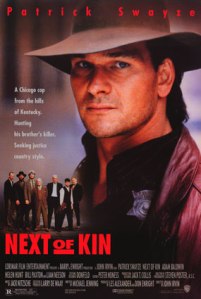
A Movie A Day #25: Next of Kin (1989, directed by John Irvin)


next-of-kinTruman Gates (Patrick Swayze) may have been raised in Appalachia but, now that he lives in Chicago, he’s left the old ways behind.  He has a job working as a cop and his wife (Helen Hunt) is pregnant with their first child.  When Truman’s younger brother, Gerald (Bill Paxton), shows up in town and asks for Truman’s help, Truman gets him a job as a truck driver.  But, on his first night on the job, Gerald’s truck is hijacked by a Sicilian mobster named Joey Rosellini (Adam Baldwin) and Gerald is killed.  Truman’s older brother, Briar (Liam Neeson), soon comes to Chicago and declares a blood feud on the mob.

Of the many action films that Patrick Swayze made between Dirty Dancing and Ghost, Roadhouse may be the best known but Next of Kin is the best.  Next of Kin spends as much examining the family dynamics of Rosellini’s family as it does with Truman’s, suggesting that there is not much of a difference between the two groups.  There’s even a scene where Joey’s uncle (played by Andreas Katsulas) tells Joey that the Sicily was the Appalachia of Italty.  Next of Kin also has a better supporting cast than most of the films that Swayze made during this period.  Along with Paxton and Neeson, the hillbillies are represented by actors like Ted Levine and Michael J. Pollard while Ben Stiller has an early role as Joey’s cousin.  Patrick Swayze gives one of his better performances as Truman but the entire movie is stolen by Liam Neeson, who is a surprisingly believable hillbilly.