Guilty Pleasure No. 103: Private Lessons (dir. by Alan Myerson)


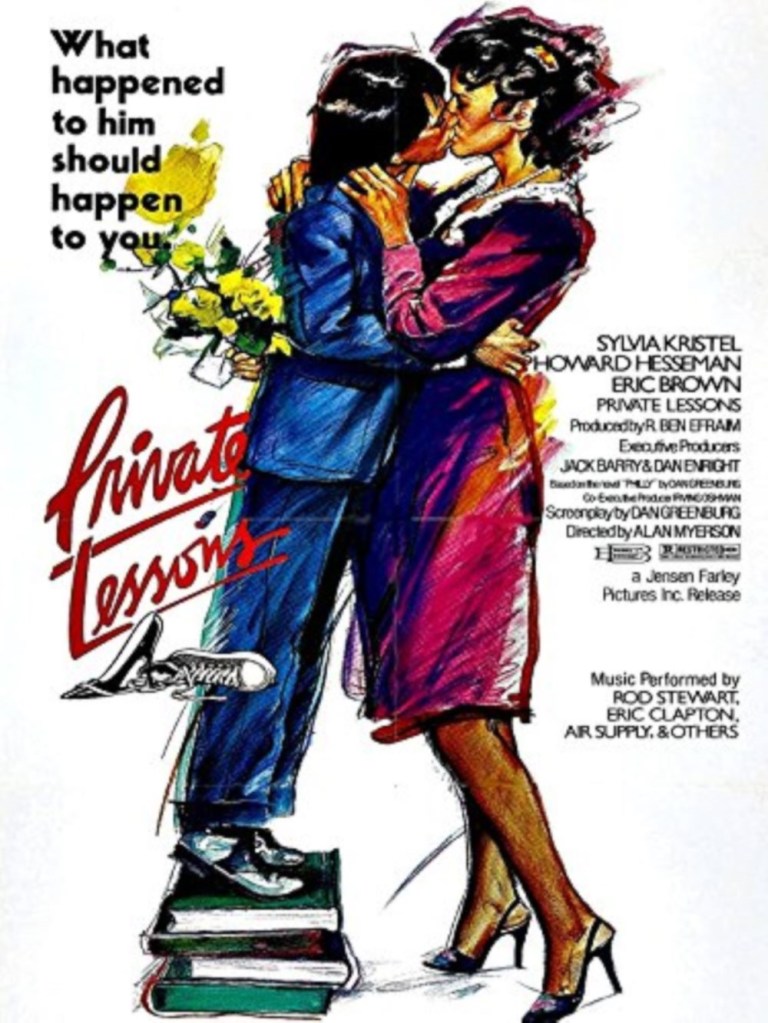
Private Lessons is that kind of early ’80s sex comedy that feels like a time capsule from when movies could get away with stuff that would never fly today. It’s got this awkward charm mixed with some seriously questionable choices, centering on a horny teenager named Philly who gets schooled in the ways of love by his family’s sultry French housekeeper. The film tries to play it all for laughs and titillation, but it lands somewhere between guilty pleasure and uncomfortable relic.

Philly, played by Eric Brown, is your classic 15-year-old rich kid left home alone for the summer in a sprawling Albuquerque mansion while his dad jets off on business. Dad hires Nicole, this alluring European housekeeper portrayed by Sylvia Kristel—yeah, the Emmanuelle star herself—to keep an eye on things, along with the sleazy chauffeur Lester, brought to life by Howard Hesseman in full sleazeball mode. From the jump, Philly’s got a massive crush on Nicole; he’s peeping through keyholes and fumbling over his words whenever she’s around. It’s all very American Pie before American Pie existed, but with a Euro-sex vibe courtesy of Kristel’s effortless sensuality. She catches him spying one night, strips down without a care, and invites him to touch—Philly bolts like his pants are on fire. You can’t help but chuckle at his panic; Brown’s wide-eyed innocence sells it without overplaying the hand.

The setup builds slowly, which is both a strength and a drag. Philly spills the beans to his buddy Sherman, played with manic energy by Patrick Piccininni, who turns every conversation into a roast session about Philly’s virginity. Their banter is some of the film’s highlights—raw, boyish ribbing that feels authentic to awkward teen friendships. Nicole keeps pushing the envelope: a steamy makeout in a dark movie theater, a goodnight kiss that nearly melts the screen, and finally, a fancy French dinner date where they seal the deal back home. Kristel owns these scenes; her Nicole isn’t just a seductress, she’s got this playful confidence that makes the slow seduction believable. The sex scene itself is tame by today’s standards—soft-focus, lots of sighs—but it’s handled with a wink, pretending to be shocking while delivering the era’s softcore goods.

But here’s where Private Lessons swerves into darker territory and kinda loses its footing. Midway through their romp, Nicole fakes a heart attack and “dies” right on top of Philly. Freaked out, he confesses to Lester, who smells opportunity. Turns out, the chauffeur’s been blackmailing Nicole over her immigration status and hatches a scheme to pin her “murder” on Philly, forcing the kid to cough up a chunk of his trust fund to cover it up. They bury a dummy in the desert, and Lester plays the concerned adult while pocketing the cash. It’s a twist that amps up the stakes, but it also shifts the tone from fluffy comedy to something creepier, leaning hard into moral panic territory. Hesseman chews the scenery as Lester, all smarmy grins and side-eye; he’s the perfect villain you love to hate, but the plot machinations feel forced, like the writers ran out of seduction gags and needed conflict.

Nicole, developing real feelings for Philly amid the con, has a change of heart and spills the truth. Together, they rope in Philly’s tennis coach—Ed Begley Jr. in a quick but fun bit—to impersonate a cop and scare Lester straight. The bad guy panics, gets nabbed trying to flee with the money, and everyone agrees to a truce: no one rats anyone out. Nicole’s “child molestation” (the film’s own loaded term for her role in seducing a minor) and immigration issues stay buried, Lester technically keeps his job, and Nicole splits before Dad returns. It’s a tidy wrap-up that dodges real consequences, which fits the film’s escapist fantasy but leaves a sour taste ethically. The romance fizzles without much payoff; you half-expect a heartfelt goodbye, but it’s more pragmatic than emotional.

Tonally, Private Lessons is all over the map. The first half thrives on its lighthearted horniness—Philly’s fumbling advances, Nicole’s teasing allure, and a very of-its-time soundtrack that pumps up the montages. It’s got that innocent raunchiness of films like Porky’s, where sex is the big mystery and everyone’s in on the joke. Brown holds his own as the lead; at 15, he’s convincingly flustered yet game, making Philly relatable rather than cartoonish. Kristel brings actual star power, turning what could be a one-note vixen into someone with hints of depth—her chemistry with Brown sparks genuine warmth amid the sleaze. Hesseman leans into Lester’s slimeball energy, turning every scene with him into a mix of funny and gross.

That said, the film’s not without flaws, and they’re glaring by modern eyes. The premise is straight-up predatory: a grown woman systematically grooming an underage boy, played for comedy without much self-awareness. It’s the male version of Lolita, but without any critique—instead of examining the situation, it just sort of grins and shrugs. The blackmail plot tries to add intrigue but mostly undermines the fun, turning Nicole from free spirit to reluctant crook. Pacing drags in spots; the relatively short runtime still feels stretched when the seduction stalls so the script can set up the con. And the ending? It papers over everything with a shrug, letting all parties walk free like it’s no big deal. The whole thing feels very much like a product of a moment when taboo could be turned into box-office bait without much pushback.

Visually, it’s a product of its time: glossy ’80s cinematography, plenty of skin but no hardcore edge, and that mansion setting screaming wealth fantasy. Director Alan Myerson keeps it breezy, never letting the comedy get too mean-spirited until Lester’s scheme really kicks in. The score and song choices nail the vibe—upbeat for the flirtations, a bit more tense for the con, always keeping things light even when the story goes to shadier places. It very much feels like something that would play late at night on cable and stick in your memory more as a vibe than as a fully coherent film.

Does it hold up? Kind of, if you’re in a nostalgic mood or digging for ’80s cheese. It’s honest about teen lust without being judgmental, and the performances carry the silly plot. But the power imbalance and the underage angle make it tough to fully endorse—watch with that lens, and it’s more cringe than chuckle. Still, for what it is—a raunchy romp with a surprisingly soft center—Private Lessons delivers just enough to warrant a spin on a bored night. Eric Brown and Sylvia Kristel do a lot of heavy lifting; without their chemistry, this would be forgettable smut instead of a strangely endearing, if deeply problematic, relic. If you’re into retro sex comedies like My Tutor or Zapped!, this one sits comfortably in that same dusty corner of the genre, flaws and all, as a snapshot of looser times that’s best taken with a big grain of salt.

Previous Guilty Pleasures

  1. Half-Baked
  2. Save The Last Dance
  3. Every Rose Has Its Thorns
  4. The Jeremy Kyle Show
  5. Invasion USA
  6. The Golden Child
  7. Final Destination 2
  8. Paparazzi
  9. The Principal
  10. The Substitute
  11. Terror In The Family
  12. Pandorum
  13. Lambada
  14. Fear
  15. Cocktail
  16. Keep Off The Grass
  17. Girls, Girls, Girls
  18. Class
  19. Tart
  20. King Kong vs. Godzilla
  21. Hawk the Slayer
  22. Battle Beyond the Stars
  23. Meridian
  24. Walk of Shame
  25. From Justin To Kelly
  26. Project Greenlight
  27. Sex Decoy: Love Stings
  28. Swimfan
  29. On the Line
  30. Wolfen
  31. Hail Caesar!
  32. It’s So Cold In The D
  33. In the Mix
  34. Healed By Grace
  35. Valley of the Dolls
  36. The Legend of Billie Jean
  37. Death Wish
  38. Shipping Wars
  39. Ghost Whisperer
  40. Parking Wars
  41. The Dead Are After Me
  42. Harper’s Island
  43. The Resurrection of Gavin Stone
  44. Paranormal State
  45. Utopia
  46. Bar Rescue
  47. The Powers of Matthew Star
  48. Spiker
  49. Heavenly Bodies
  50. Maid in Manhattan
  51. Rage and Honor
  52. Saved By The Bell 3. 21 “No Hope With Dope”
  53. Happy Gilmore
  54. Solarbabies
  55. The Dawn of Correction
  56. Once You Understand
  57. The Voyeurs 
  58. Robot Jox
  59. Teen Wolf
  60. The Running Man
  61. Double Dragon
  62. Backtrack
  63. Julie and Jack
  64. Karate Warrior
  65. Invaders From Mars
  66. Cloverfield
  67. Aerobicide 
  68. Blood Harvest
  69. Shocking Dark
  70. Face The Truth
  71. Submerged
  72. The Canyons
  73. Days of Thunder
  74. Van Helsing
  75. The Night Comes for Us
  76. Code of Silence
  77. Captain Ron
  78. Armageddon
  79. Kate’s Secret
  80. Point Break
  81. The Replacements
  82. The Shadow
  83. Meteor
  84. Last Action Hero
  85. Attack of the Killer Tomatoes
  86. The Horror at 37,000 Feet
  87. The ‘Burbs
  88. Lifeforce
  89. Highschool of the Dead
  90. Ice Station Zebra
  91. No One Lives
  92. Brewster’s Millions
  93. Porky’s
  94. Revenge of the Nerds
  95. The Delta Force
  96. The Hidden
  97. Roller Boogie
  98. Raw Deal
  99. Death Merchant Series
  100. Ski Patrol
  101. The Executioner Series
  102. The Destroyer Series

Retro Television Review: Welcome Back, Kotter 3.18 “Angie”


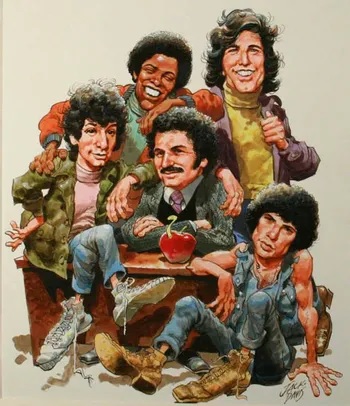
Welcome to Retro Television Reviews, a feature where we review some of our favorite and least favorite shows of the past!  On Saturdays, I will be reviewing Welcome Back Kotter, which ran on ABC  from 1975 to 1979.  The entire show is currently streaming on Tubi!

This week, Gabe gets a new student.

Episode 3.18 “Angie”

(Dir by Alan Myerson, originally aired on January 12th, 1978)

Gabe tells Julie a joke about his Uncle Zoltan.  It’s not really that good of a joke but Julie fake laughs as if it’s the funniest thing that she’s ever heard.  I notice that this has been happening a lot over the course of Welcome Back, Kotter‘s third season.  By most reports, Gabe Kaplan and Marcia Strassman could not stand each other off-camera.  That’s especially obvious whenever Strassman deliberately overreacts to one of Kaplan’s jokes.  It’s easy to imagine that Strassman was secretly thinking of throwing something at Kaplan whenever she laughed.

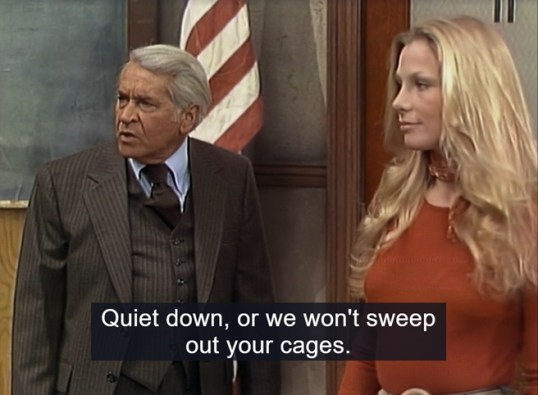
At school, Mr. Woodman interrupts Gabe’s class to introduce everyone to a new student, Angie Grabowski (Melonie Haller).  Epstein, Washington, Horshack, and Barbarino are very excited to see their new classmate, leading to Woodman ordering them to shut up.

Angie announces that she is thrilled to be in Gabe’s class because her dream has always been to become a Sweathog.  Really?  I mean, Barbarino’s cute but would anyone really dream of hanging out with Horshack?  Of course, it doesn’t matter what Angie wants.  Washington and Epstein explain that women are not allowed to become Sweathogs.  That kind of contradicts everything that we’ve previously learned about the Sweathogs but whatever.

Determined to prove that she can be a Sweathog, Angie riggs the spinklers in Woodman’s office.  Woodman ends up soaked but he also announces that he’s going to expel all of the Sweathogs.  Angie demands that he expel her as well.  (Angie seems to be a little self-destructive.)

Well, so much for the Sweathogs.  I guess the show is over.  Thanks for reading these reviews and….

Oh wait!  Angie figures out that the fire alarm is broken because it didn’t go off when the sprinklers started up.  The fire alarm is Woodman’s responsibility!  The Sweathogs — including Angie — dress up as firemen and demonstrate to Woodman that the alarm doesn’t work.  Somehow, this leads to Woodman not expelling the Sweathogs and apparently just forgetting about the prank with the sprinklers.  It also leads to Angie becoming a Sweathog.

Later, Gabe tells Woodman a joke about Ebenezer Kotter, the cheapest of all his uncles.  It takes Woodman a while to figure out the joke but then he laughs in his wonderfully unhinges way.  Gabe Kaplan actually had more chemistry with John Sylvester White than he did with Marica Strassman.

This episode attempted to rejuvenate the show by introducing a new Sweathog.  That makes sense.  A lot of shows have tried to reverse declining ratings by introducing a new character.  The problem is that the show doesn’t need a new Sweathog as much as it just needs for the old Sweathogs to return to being the realistic (if flamboyant) troublemakers that they were during the first season.  In her first appearance, Melonie Haller delivers her lines in a flat and emotionless manner, which adds to the feeling that Angie might not be quite sane.  Seriously, I’m worried about Horshack.  It’s obvious that he has a crush on Angie but Angie seems likely to turn into a stalker.

Run, Horshack, run!

Retro Television Reviews: Jennifer Slept Here 1.10 “Do You Take This Ghost?”


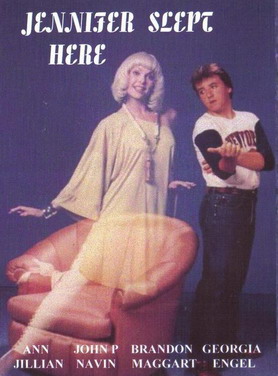
Welcome to Retro Television Reviews, a feature where we review some of our favorite and least favorite shows of the past!  On Thursdays, I will be reviewing Jennifer Slept Here, which aired on NBC in 1983 and 1984.  The entire show is currently streaming on YouTube!

This week, Jennifer wants to get married!

Episode 1.10 “Do You Take This Ghost?”

(Dir by Alan Myerson, originally aired on April 21st, 1984)

George is super-excited because Susan and his anniversary is coming up.  (Awwwww!  George is being sweet and romantic.  That kind of goes against everything that has been previously established about his character but whatever.  Let’s go with it.)  George says that he and Susan are going to celebrate by renewing their vows.  He’s even called the minister who performed their wedding to come do it again.  The ceremony will be held in the house because another set would cost money.

Hearing all of this, Jennifer starts to feel sad that she never had a traditional marriage when she was alive.  Fortunately, her ex-boyfriend, film star Doug Chadwick (Warwick Sims), has just died.  His ghost materializes in the house and soon, he and Jennifer are a couple again.  Jennifer and Doug decide to get married at the same time that George and Susan are going to renew their vows.  Joey can act as the best man for both ceremonies!

Can you see where this is heading?

Joey discovers that, even as a ghost, Doug Chadwick has issues with staying faithful.  While Jennifer plans out her wedding, Doug is sleeping with other ghosts.  He even loses the wedding ring while carousing in a hot tub.  (Ghosts in a hot tub?  I mean, I guess that could happen….)  At the ceremony, Joey tells Jennifer that she can do better than Doug.  Of course, since George and Susan are renewing their vows, they think that Joey is talking about them.  They assure Joey that they love each other.  Joey tells them that he knows they love each other because his father is not the type who would ever cheat on the woman that he loves or lose his wedding ring in a hot tub.  Jennifer takes Joey’s words to heart and calls off her ghost wedding.

This was an okay episode.  If I don’t sound too enthusiastic, it’s because I’m a bit exhausted with how every joke is basically Joey saying something to someone no one else can see and everyone responding by rolling their eyes.  I mean, after ten episodes of thinking that their son has been having loud arguments with himself, you have to wonder why his parents aren’t trying to do more to discover what the problem is.

My main issue with this episode is that, with all the good men who have died through history, why would Jennifer settle for a guy who, by her own admission, didn’t really treat her that well when they were alive?  I mean, Jennifer could marry James Buchanan or maybe Martin Van Buren.  Don’t settle, Jennifer!  Of course, that’s kind of the same thing that Joey told her so I guess I have to give him some credit for that.  As always, Ann Jillian was great as Jennifer and John P. Navin, Jr. did his best with Joey (who is a rather inconsistently written character) but this episode just never worked as well as it could have.  The idea of Jennifer having a ghost wedding had potential but this episode just kind of fell flat.

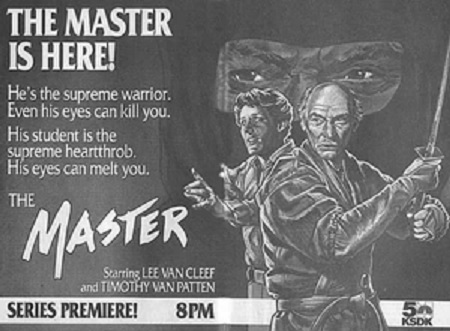
Retro Television Reviews: The Master 1.3 “State of the Union”


Welcome to Retro Television Reviews, a new feature where we review some of our favorite and least favorite shows of the past! On Fridays, I will be reviewing The Master, which ran on NBC from January to August of 1984. The show can be found on Tubi!

This week, The Master stands up for the working man!

Episode 1.3 “State of the Union”

(Dir by Alan Myerson, originally aired on February 3rd, 1984)

“Hi, I’m Max Keller and this is how I start my morning.”

So begins yet another episode of The Master!  This time, McAllister (Lee Van Cleef) is forcing Max (Timothy Van Patten) to start his day by running.  McAllister says that it’s a part of Max’s ninja training but I think it’s more a case of McAllister just seeing how many stupid things he can force Max to do before Max says, “Enough!”

This week finds Max and McAllister in Clearwater, California.  In order to make a little money, Max enters a dirt bike race.  It turns out that Max is very well-known on the dirt bike circuit and he even runs into an old friend named Hog (Mickey Jones) at the race.  Hog only shows up for a few minutes.  He shakes Max’s hand, jokes about the fact that Max is traveling with a hamster and a weird old man, and then he pretty much disappears from the episode.

McAllister watches the race while stroking Max’s pet hamster.

Try to get that image out of your head.

Anyway, Max does not win the race.  Instead, the race is won by Carrie Brown (Crystal Bernard).  At the finish line, Carrie is nearly run over by one her competitors, Chad Webster (Cotter Smith).  Chad is the son of the owner of the local cannery.  It turns out that Carrie also works at the cannery. Max takes an immediate liking to Carrie and decides that he should also get a job at the cannery.

McAllister points out that Carrie is attractive.  Max replies, “Does your ninja training make you immune to such things?”  McAllister shrugs.  It’s kind of an odd scene.

Anyway, at the cannery, Max quickly learns that there’s more to Carrie than just 80s hair and dirt bike racing.  Carrie is also a union organizer!  She’s carrying on her late brother’s dream of unionizing the cannery.  This largely means handing out flyers and encouraging people to go to a meeting. 

How bad are things at the cannery?  They’re so bad that an older worker gets crushed by a palette.  Fortunately, McAllister and Max show up just in time to help out.  Through the use of one of his magic throwing ticks, McAllister is able to send the palette crashing into the ocean.  While Max proceeds to flirt with Carrie, attentive viewers will see the worker — who is now probably crippled for life — being carried away in the background.  Despite having saved the guy’s life, neither Max nor McAllister ever ask about him again.

Anyway, you know where all this is heading.  Carrie wants to unionize the workers.  Chad and his buddies try to intimidate the workers into not joining the union.  At a meeting at the local church, Max gives a speech about how the workers have to get organized.  There are plenty of fights and car chases and yet another bar brawl.  That Max just can’t say out of trouble!

McAllister also joins Max on the dirt bike so that he can throw ninja stars at the bad guys.  This leads to some pretty bad rear projection shots.

In the end, Chad is revealed to have murdered Carrie’s brother.  The cannery votes to unionize and Max and McAllister promptly leave town because even they know better than to work at a union shop.  Though it’s not specifically stated, I imagine that the cannery probably closed two months and Carrie ended up following in the lead footsteps of Jimmy Hoffa.

This episode was a bit silly, largely because neither perky Crystal Bernard nor perpetually mush-mouth Tim Van Patten were believable as firebrand labor activists.  Lee Van Cleef seemed to be largely bored with the whole thing.  Fortunately, next week’s episode features a guest appearance from George Lazenby so maybe that will liven things up on The Master.

We’ll find out soon!

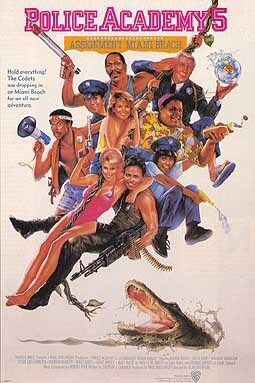
Police Academy 5: Assignment Miami Beach (1988, directed by Alan Myerson)


Police Academy 5 starts as so many Police Academy films have started.  Commandant Lassard (George Gaynes) is getting progressively more loopy and Captain Harris (G.W. Bailey) is plotting to take over the Academy.  This time, Harris thinks that he has come up with the perfect plan when he discovers that Lassard has reached the mandatory retirement age.

With retirement looming, Lassard attends one final law enforcement convention in Miami.  At the convention, Lassard is to be honored as “Police Officer of the Decade” because it was apparently a very slow decade.  Lassard decides to bring along his favorite academy graduates so that they can celebrate with him and meet his nephew, Sgt. Nick Lassard (Matt McCoy, who you may recognize as Seinfeld’s Lloyd Braun or maybe as the spokesman for Hartford Insurance).   The commandant invites Sound Effects Guy (Michael Winslow), Tackleberry (David Graf), Hightower (Bubba Smith), Hooks (Marion Ramsey), Callhan (Leslie Easterbrook), and House (Tab Thacker).  Notice who isn’t there?  This was the first Police Academy film without Steve Guttenberg’s Carey Mahoney and Commandant Lassard celebrating his career without inviting his most loyal graduate doesn’t seem right.

Once what is left of the old gang arrives in Miami, they get caught up in the usual Police Academy shenanigans.  Rene Auberjonois plays a jewel thief who accidentally switches bags with the Commandant and who has 24 hours to retrieve the stolen diamonds.  It’s Florida so there are women in bikinis and an Everglades boat chase.  Harris gets humiliated in every way possible.  The jokes are even more juvenile than usual.  Nick Lassard uses sunscreen to permanently label Harris as being a “dork” so everyone on the beach calls Harris a “dork.”  That’s as sophisticated as things get.

Unfortunately, there’s a Steve Guttenberg-shaped hole at the center of Police Academy 5 and not even as formidable a thespian as Matt McCoy can fill it.  Even though Guttenberg always seemed like he was miscast as both a cop and a former juvenile delinquent, Police Academy 5 shows how important he really was to the franchise.  Mahoney was the closest thing that the Police Academy films had to a fully developed character and, without him around, it’s even more obvious how thinly drawn all of the other characters were.  (Guttenberg was filming Three Man And A Baby while Police Academy 5 was in production though, in an A.V. Club interview a few years ago, Guttenberg said the real reason he wasn’t invited to Miami Beach was because the producers couldn’t afford to pay his salary.  “You’ve got to get paid!” Guttenberg explained.)

I will, however, give Police Academy 5 some credit.  Rene Auberjonois does what he can with his bumbling jewel thief and the scene where Tackleberry pulls a gun on a shark made me laugh.  Otherwise, Police Academy 5 is no Police Academy 3.

Tomorrow, it’s time for … you guessed it! …. Police Academy 6!

Shattered Politics #29: Billy Jack (dir by Tom Laughlin)


Billy_Jack_poster

“Go ahead and hate your neighbor; go ahead and cheat a friend.
Do it in the name of heaven; you can justify it in the end.
There won’t be any trumpets blowin’ come the judgment day
On the bloody morning after, one tin soldier rides away”

— From One Tin Soldier, the theme song of Billy Jack (1971)

Yesterday, we took a look at The Born Losers, the first film to ever feature the character of future U.S. Senator Billy Jack.  The Born Losers ended with former Green Beret-turned-gun-toting-pacifist Billy Jack (played, of course, by Tom Laughlin) saving the girl, killing the bad guy, and getting shot in the back by the police.  As Born Losers ended, we were left to wonder whether Billy would survive his wounds or would he just be another victim of the establishment.

Well, audiences had to wait five years to find out.

When Laughlin returned to the role in 1971’s Billy Jack, it was revealed that not only had Billy Jack lived but he was now residing in a cave with his wise Native American grandfather.  Billy still had little use for civilization but he would occasionally emerge from his cave.  Sometimes, it was to protect wild mustangs from being hunted the evil Old Man Posner (Bert Freed) and his sociopathic son Bernard (David Roya).  Other times, it was to protect the Freedom School and, even more importantly, the Freedom School’s founder, Jean (played by Laughlin’s wife, Delores Taylor).

The local townspeople viewed the Freedom School with suspicion and whenever the students went into town, they would be harassed by Bernard and his friends.  Fortunately, the students could always count on Billy to show up, say a few angry words, and then lose control. Billy may have been a liberal but he was no pacifist.  Jean, however, fully embraced nonviolence and she always made it clear that she wasn’t comfortable with Billy providing her kids with a violent example.

Finally, both Jean and Billy’s convictions were put to the test.  First off, the bigoted townspeople tried to close the school.  Then, Jean was raped by Bernard.  And finally, Billy found himself barricaded in an old mission, surrounded by police and national guardsmen.  Even as Jean pleaded with Billy to lay down his weapons and to peacefully surrender, Billy made it clear that he was willing to die for his beliefs.

And, as the film ended, you would never guess that Billy Jack would eventually become a member of the U.S. Senate.  But, in just a few years, that’s exactly what would happen in Billy Jack Goes To Washington!

Now, of course, Billy Jack is ultimately a product of its time and that’s both a blessing and a curse.  To be honest, if anything could transform me from being the socially liberal, economically conservative girl that you all know and love into a card-carrying right-wing extremist, it would be having to spend any time with the students at the Freedom School.  They are all so smugly convinced of their own moral superiority that the townspeople almost start to look good by default.  Whether they’re attending improv class or disrupting a meeting at town hall, the majority of the students come across like a bunch of rich kids from the suburbs, playing hippy and slumming by hanging out with poor minorities.  As you watch them, it’s difficult not to suspect that most of them are going to get bored with rebelling after a year or two and eventually end up growing up to be just like their parents.

Fortunately, the film is saved by the pure sincerity of Laughlin and Taylor.  For all the attention that the film gets for the scenes of Billy Jack beating people up, the most compelling scenes are the ones where Jean and Billy Jack debate nonviolence.  There’s an honesty and a passion to these scenes, one that proves that Laughlin and Taylor, as opposed to so many other self-styled counterculture filmmakers, were actually serious about their beliefs.  Billy Jack is an essential film, not only as a time capsule of the era in which it was made but also as one of the few films to actually make a legitimate attempt to explore what it truly means to embrace nonviolence.

Billy Jack is also a historically important film.  When American Independent Pictures withdrew from the production, Laughlin took Billy Jack to 20th Century Fox.  When 20th Century Fox looked at the completed film and did not know how to market it, Laughlin distributed the film himself, without the support of a major studio.  And, despite what all of the naysayers may have predicted, Billy Jack was a huge hit.

And every indie filmmaker since owes a huge debt of gratitude to Tom Laughlin.