The Unominated #21: Southern Comfort (dir by Walter Hill)


Though the Academy of Motion Picture Arts and Sciences claim that the Oscars honor the best of the year, we all know that there are always worthy films and performances that end up getting overlooked.  Sometimes, it’s because the competition too fierce.  Sometimes, it’s because the film itself was too controversial.  Often, it’s just a case of a film’s quality not being fully recognized until years after its initial released.  This series of reviews takes a look at the films and performances that should have been nominated but were, for whatever reason, overlooked.  These are the Unnominated.

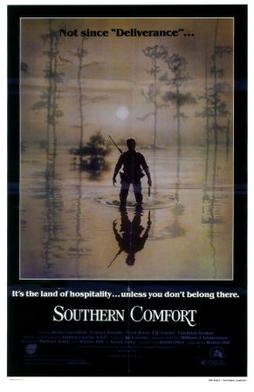
1981’s Southern Comfort takes place in 1973.  While America tries to wind down its presence in Vietnam, a squad of nine National Guardsmen take part in war games in the Louisiana bayous.  The squad is led by the ineffectual Sgt. Crawford Poole (Peter Coyote) while other members include the trigger-happy Lonnie Reece (Fred Ward), the weed-smoking Tyrone Cribbs (T.K. Carter), the cowardly Private Simms (Franklyn Seales), and the tightly-wound Coach Bowden (Alan Autry).  Poole may be in charge but most of the members of the squad seem to look up to the laid-back and friendly Private Spencer (Keith Carradine).  The newest member of the squad is Charles Hardin (Powers Boothe), a sober-minded transfer from Texas who doesn’t seem to get along with anyone but Spencer.

With the exception of Poole and Hardin, no one takes the weekend maneuvers seriously until they find themselves lost in the bayou and it becomes obvious that Poole has no idea what he’s doing.  When they come across some canoes that belong to some Cajun trappers, they decide to “borrow” them.  When the trappers protest, Reece fires his weapon at them.  Reece’s gun is loaded with blanks but the trappers don’t know that.  They fire back, killing Poole.

The national guardsmen now find themselves lost and being stalked by the trappers, a largely unseen force that always seems to attack out of nowhere.  The men have no idea where they are.  The trappers, on the other hand, have lived in the swamps their entire lives.  The guardsmen bicker and argue over the best way to respond.  Some want to fight back and some just want to get back to civilization.  One-by-one, the men are picked off until only two remain.

Though the film is a somewhat heavy-handed metaphor for the Vietnam War, Southern Comfort is still a deeply affecting and suspenseful mix of horror and action.  Director Walter Hill keeps the action moving at a quick pace and the film, which was shot on location and featured scenes shot during an actual Cajun celebration, perfectly captures the languid yet ominous atmosphere of the bayous.  As soon as the men see those canoes unattended, we know that they’re going to steal them and that they are making the biggest mistake of their lives.  Keith Carradine and Powers Boothe both give powerful performances in the lead roles and the members of the supporting cast — especially Alan Autry and Fred Ward — make a strong impression as well.  I especially liked the performance of Brion James, who has a small role as a one-armed Cajun who is more crafty than he looks.

Being a mix of horror and action, it’s probably not a shock that Southern Comfort was ignored by the Academy.  At the very least, I would have found room for Ry Cooder’s original score and Andrew Laszlo’s haunting cinematography.
Previous Entries In The Unnominated:

  1. Auto Focus 
  2. Star 80
  3. Monty Python and The Holy Grail
  4. Johnny Got His Gun
  5. Saint Jack
  6. Office Space
  7. Play Misty For Me
  8. The Long Riders
  9. Mean Streets
  10. The Long Goodbye
  11. The General
  12. Tombstone
  13. Heat
  14. Kansas City Bomber
  15. Touch of Evil
  16. The Mortal Storm
  17. Honky Tonk Man
  18. Two-Lane Blacktop
  19. The Terminator
  20. The Ninth Configuration

The TSL Grindhouse: Nomads (dir by John McTiernan)


1986’s Nomads opens with anthropologist Jean-Charles Pommier being rushed into an emergency room, badly beaten and struggling for his life.  Despite the best efforts of Dr. Eileen Flax (Lesley-Anne Down), Pommier dies in the ER.  Flax is shocked by Pommier’s death and, naturally, she’s upset that she couldn’t save him.  But, at the same time, people die in hospitals.  It happens to the best of doctors.

Except soon, Flax is seeing flashes of the events that led to Pommier’s death.  Pommier has somehow entered her mind and soon, she’s reliving his investigation into the origins of a group of destructive, urban nomads that Pommier witnessed causing havoc throughout Los Angeles.  Pommier often felt like he was the only person who was capable of seeing the nomads and he grew to be tortured by his fear that they were specifically stalking him.  We soon learn that there was reason for that….

Now, based on his name, you’re probably assuming that Pommier is meant to be French.  And he is!  He’s from France, though he considers himself to be a citizen of the world.  He’s traveled everywhere, taking pictures of different cultural rituals across the globe.  However, in Nomads, the very French Jean-Charles Pommier is played by Pierce Brosnan.  Pierce Brosnan is, needless to say, not French.  He’s Irish, even though a lot of people seem to be shocked when they first learn that.  Brosnan normally speaks with an accent that could best be described as a mix of posh London and mid-Atlantic American.  Everything about him screams the UK.  In short, Pierce Brosnan is one of the least convincing French people ever seen on film and he delivers his lines in an accent that sounds like every accent other than the French accent.  Watching this film, I found myself thinking about the Monty Python skit where Terry Jones and Carol Cleveland starred in a French movie.  (“I see you have a cabbage.”  “Oui.”)  Brosnan is not a bad actor and it’s entertaining to watch him overact in Nomads.  But there’s nothing French about him and every time that someone referred to him as being French, it totally took me out of the movie.

Which is a shame because Nomads may be narratively incoherent but it’s got some memorably surreal visuals and it does a good job of generating a properly ominous atmosphere.  Director John McTiernan (who later went on to do Predator, Die Hard, and The Hunt For Red October) makes smart use of slow motion and a handheld camera to keep the audience off-balance.  At its best, Nomads achieves a dream-like intensity that makes up for the fact that the story doesn’t make the least bit of sense.  The nomads themselves are a memorable and creepy.  While Adam Ant plays their leader (and the scene where he smiles as Brosnan attempts to throw him off a building is truly disturbing), the most frightening of the nomads is Mary Woronov as Dancing Mary.  Seriously, after I watched this film, I checked all the locks in the house.  No urban nomads were going to interrupt me in my sleep!

My suggestion to everyone is to do a Nomads/Nomadland double feature.  You’ll never get in another van.

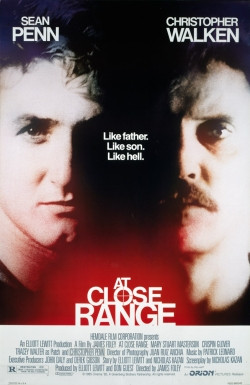
At Close Range (1986, directed by James Foley)


Brad Whitewood, Sr. (Christopher Walken) is known as Big Brad, a rural crime lord who rules the backwoods of Pennsylvania.  When his son, Little Brad (Sean Penn, trying too hard to be James Dean), comes to live with him, Big Brad goes out of his way to try to bring the teenager into his criminal lifestyle.  At first, Little Brad loves being a part of the family business but witnessing a murder and falling in love with Terry (Mary Stuart Masterson) caused Little Brad to start to move away from his father.  With the FBI closing in on the Whitewood family, Brad Sr. starts to eliminate everyone who he considers to be a threat, including the members of his own family.

Based on a true story, this neo-noir features a great cast, including Chris Penn, Millie Perkins, Kiefer Sutherland, Crispin Glover, David Strathairn, Tracey Walter, and Mary Stuart Masterson.  Unfortunately, the movie itself moves at a plodding pace.  There are some good and disturbing scenes, like the montage where Big Brad starts to eliminate the members of his gang.  The film does a good job of showing how seductive Big Brad’s criminal lifestyle can be to a bunch of kids who have basically been written-off by society.  But the story itself is so bleak that most people will end up tuning out long before Little Brad finally turns against his father.

Whatever other flaws it may have, At Close Range does feature one of Christopher Walken’s best performances.  Walken is chillingly evil as Big Brad.  He’s got enough charisma to be believable as someone who could bring a gang together but he’s also frightening as he starts killing anyone who he thinks might talk to the police or the FBI.  Big Brad is a remorseless killer and Walken plays him as being a classic sociopath, someone who cannot understand why the members of his gang and family would get upset when he starts killing some of them.  To Big Brad, that just goes with the territory.  It’s a part of doing business.  With his distinct way of speaking and his trademark tics, Walken is someone who has inspired many impersonators and it can be easy to forget that he’s also a damn good actor.  Films like At Close Range remind us of just how talented Walken actually is.

Insomnia File #27: Remember My Name (dir by Alan Rudolph)


What’s an Insomnia File? You know how some times you just can’t get any sleep and, at about three in the morning, you’ll find yourself watching whatever you can find on cable? This feature is all about those insomnia-inspired discoveries!

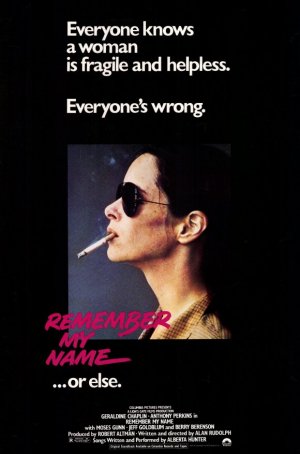
If you were having trouble sleeping last Tuesday, around one in the morning, you could have turned over to TCM and watched Remember My Name, an odd and sometimes frustrating little thriller from 1978.

Remember My Name opens with Emily (Geraldine Chaplin) showing up in a small town in California.  From the minute we first see and hear Emily, something seems to be off about her.  She views the world through suspicious eyes.  Whenever anyone talks to her, you’re never quite sure whether she’s going be friendly or if she’s going to lash out.  When she speaks, there’s something weird about her vocal inflection, as if she’s always struggling to figure out what she’s supposed to say.  She seems to be separated from the world, almost as if she’s walking through a living dream and only talking to figments of her imagination.  There’s nothing about her that feels at all authentic.

She moves into a small apartment and enters into a relationship with her handyman (Moses Gunn), a relationship that seems to be largely defined by her refusal to open up about herself.  She gets a job at a grocery story that’s managed by a Mr. Nudd (Jeff Goldblum).  Mr. Nudd mentions something about Emily knowing his mother.  Apparently, they met in prison.

Soon, Emily is stalking a construction worker named Neil Curry (Anthony Perkins).  When Neil spots her, he calls out her name and Emily runs away.  And yet, Neil doesn’t bother to tell his wife, Barbara (Berry Berenson), about Emily.  Soon, Emily is even breaking into the Curry home, silently shadowing Barbara as she walks through the house.

I described Remember My Name as being a thriller and I guess that, technically it is.  There are a few moments of tension, especially when Emily is stalking Barbara.  However, the film itself is directed in a detached manner by Alan Rudolph.  Rudolph was a protegé of director Robert Altman (who also produced Remember My Name) and Rudolph’s approach is very Altmanesque, often to the detriment of the film.  (Chaplin and Jeff Goldblum had both appeared in several Altman films, most famously in Nashville.)  Though the film is dominated by Chaplin and Perkins, it’s still very much an ensemble film and the action plays out in a deceptively casual, almost random manner.  It tries so hard to be Altmanesque that Remember My Name gets a bit frustrating, to be honest.  Chaplin gives such a good and memorable performance and she works very hard to make Emily a character who is both frightening and, at times, surprisingly sympathetic but, for the most part, Rudolph’s technique makes it difficult to get emotionally involved in any of the action unfolding on-screen.  Rudolph observes the action but refuses to comment on it.  As a result, Remember My Name is occasionally intriguing but, just as often, it’s rather boring.  Just like real life, I suppose.  And, just like real life, it’s not for everyone.

That said, it was interesting to see Anthony Perkins playing a role other than a knife-wielding inn manager.  Without resorting to any of the familiar tics or the neurotic speech patterns that typecast him forever as Norman Bates, Perkins plays Neil as just being a regular, blue collar guy and he actually does a pretty good job.  Watching the film, I got the feeling that this was perhaps Perkins’s attempt to change his image.  (Whenever Neil appears shirtless, both the film and Perkins seem to be saying, Check out this physique!  Would someone only capable of playing a psycho have abs like this?)  Neil’s wife, Barbara, was played Perkins’s wife, Berry Berenson.  Neither one of them is with us any longer.  Perkins died of AIDS in 1990 while Berry Berenson was on one of the planes that flew into the World Trade Center on 9-11.  They both did good work in this film, as did Chaplin and Goldblum and, really, the entire cast.  It’s just a pity that the film itself isn’t as good as the performances. 

Previous Insomnia Files:

  1. Story of Mankind
  2. Stag
  3. Love Is A Gun
  4. Nina Takes A Lover
  5. Black Ice
  6. Frogs For Snakes
  7. Fair Game
  8. From The Hip
  9. Born Killers
  10. Eye For An Eye
  11. Summer Catch
  12. Beyond the Law
  13. Spring Broke
  14. Promise
  15. George Wallace
  16. Kill The Messenger
  17. The Suburbans
  18. Only The Strong
  19. Great Expectations
  20. Casual Sex?
  21. Truth
  22. Insomina
  23. Death Do Us Part
  24. A Star is Born
  25. The Winning Season
  26. Rabbit Run