Late Night Retro Television Review: CHiPs 4.12 “Home Fires Burning”


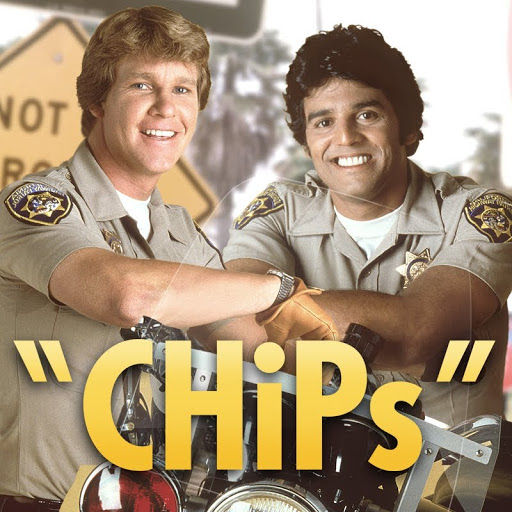
Welcome to Late Night Retro Television Reviews, a feature where we review some of our favorite and least favorite shows of the past!  On Mondays, I will be reviewing CHiPs, which ran on NBC from 1977 to 1983.  The entire show is currently streaming on Prime!

It’s arson and basketball on CHiPs!

Episode 4.12 “Home Fires Burning”

(Dir by Charles Bail, originally aired on February 1st, 1981)

Two arsonists (David Hayward and Michael Cavanugh) are setting RVs on fire as a part of an insurance scam.  One man (Jack Kruschen) who hires the arsonists is horrified when their carelessness leads to a security guard getting seriously injured.  If the guard dies, the man is looking at serious jail time!  (Luckily, the guard doesn’t die and apparently, everyone just forgets about sending his boss to jail.)

Luckily, Baker is there to help track the arsonists down.  Ponch, on the other hand, is busy putting together a Highway Patrol basketball team.  It’s hard not to notice how much time the Highway Patrol spends on stuff like basketball, dirt bike competitions, and drag car racing.  Somehow, Ponch has gone from being the department’s screw-up to now being the guy who is automatically given all of the responsibility.  It’s the Ponch Show and everyone knows it.

This episode was directed by veteran stuntman Charles Bail and it does have some spectacular stunts.  (A car jumping through an exploding RV was my favorite.)  And let’s be honest.  I could sit here and spend hours talking about CHiPs became the Ponch Show during the fourth season and how the rest of the cast was underutilized.  And I would be totally correct.  But the stunts and the car crashes are the main appeal of this show and this episode featured several examples of each.

As such, this was a good episode.

#MondayMuggers – Why DIRTY MARY CRAZY LARRY?


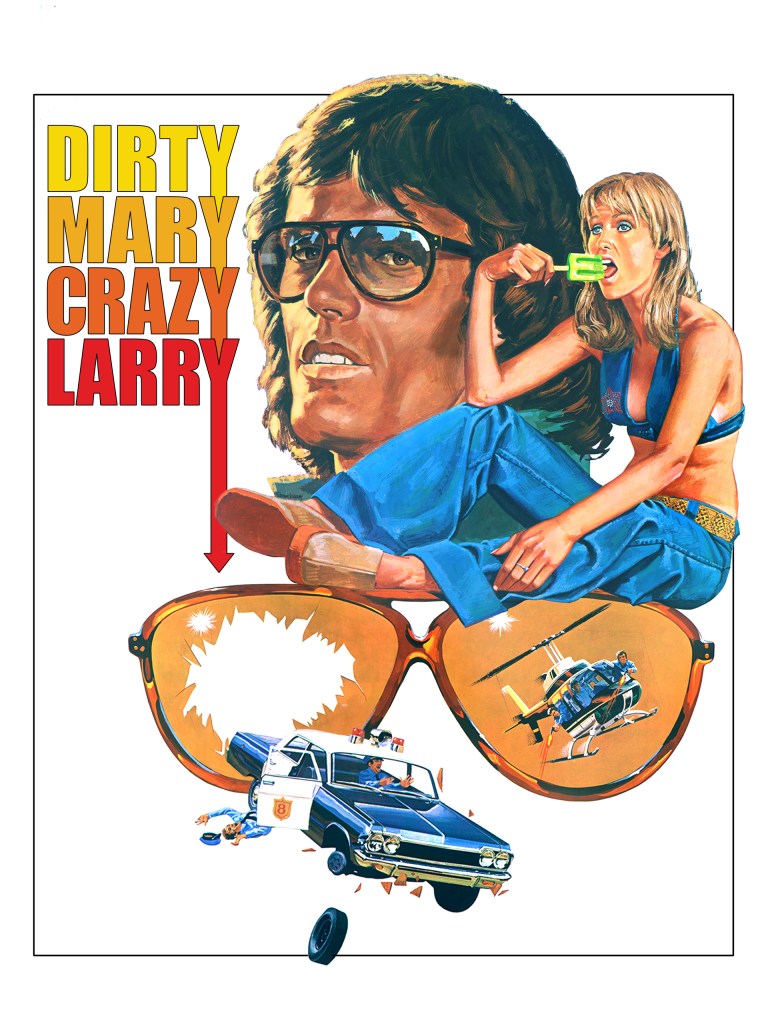
Every Monday night at 9:00 Central Time, my wife Sierra and I host a “Live Movie Tweet” event on X using the hashtag #MondayMuggers. We rotate movie picks each week, and our tastes are quite different. Tonight, Monday December 16th, we’re watching DIRTY MARY CRAZY LARRY starring Peter Fonda, Susan George, Adam Roarke, and Vic Morrow.

So why did I pick DIRTY MARY CRAZY LARRY, you might ask?

  1. I love car chase stunt movies from the 1970’s! We featured WHITE LIGHTNING with Burt Reynolds on here a couple of years ago. This should be another good 70’s car chase movie for the group. I’ve never actually watched the film before today so I’m really looking forward to it.   
  2. I like the cast, especially Susan George. What’s strange is that Susan is in my least favorite Charles Bronson movie of all time, LOLA, but I don’t hold that against her at all. She’s just so beautiful, and with a filmography that includes STRAW DOGS, SONNY AND JED, MANDINGO, and ENTER THE NINJA, what’s not to love?!!
  3. I think it’s cool that Peter Fonda did most of his own driving in the film, often driving over 100 miles per hour. I respect actors who are capable of doing their own stunt work…Jackie Chan, Tom Cruise, and now Peter Fonda!
  4. Quentin Tarantino loves DIRTY MARY CRAZY LARRY! He selected the film for the first “Quentin Tarantino Film Fest” in Austin back in 1996. He also featured a clip from this movie in JACKIE BROWN. It makes it even cooler that the scene in JACKIE BROWN featured Bridget Fonda, Peter’s daughter! If Tarantino loves it, that’s enough for me!

So join us tonight to for #MondayMuggers and watch DIRTY MARY CRAZY LARRY! It’s on Amazon Prime.

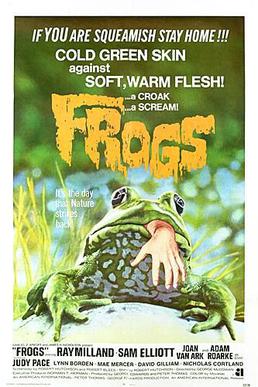
Horror Film Review: Frogs (dir by George McGowan)


1972’s Frogs opens with Pickett Smith (played by a youngish Sam Elliott) canoeing through the bayou, taking pictures of all of the local sights.  Pickett is a nature photographer and someone who is very concerned about what pollution is doing to the local wildlife.  Eventually, Pickett ends up meeting the Crocketts, the wealthy family that owns and lives on an isolated island.  Wheelchair-bound family patriarch Jason Crockett (Ray Milland) is looking forward to celebrating the 4th of July.  It’s a tradition and he goes all out, decorating the mansion with American flags and listening to patriotic music.  The Crockett family always celebrates with Jason, though it quickly becomes apparent that Jason would be just as comfortable celebrating without any of them.

The last thing that Jason Crockett wants is some preachy environmentalist showing up at his mansion and ruining the 4th of July with a bunch of complaints about the pesticides that he’s been using to keep away the island’s wildlife.  The only thing worse than having to deal with an environmentalist would be having to deal with an invasion of alligators, snakes, and frogs.  Unfortunately, Jason is going to have to spend his holiday dealing with all of those things.  Soon, the mansion is surrounded by frogs and servants and family members are showing up dead all over the place.

I’ve seen Frogs a handful of times.  It’s one of those films that many of my friends seem to like much more than I do.  I have to admit that, for whatever reason, I always find myself struggling to focus on the film.  Some of that is because there are more than a few slow spots.  But the main problem is that frogs really aren’t that menacing.  Frogs are cute and kind of goofy-looking, much like Sam Elliott without his mustache.  The alligators are certainly scary.  And there’s an attack by a cottonmouth that makes me go, “Agck!” every time that I see it.  But frogs just look cute when they start hopping around.  Our cat gets excited whenever he sees a frog because he knows that he can put his paw on their back and make them jump. Frogs aren’t threatening but I suspect that’s probably the point of the film.  Frogs is not a film that is meant to be taken too seriously and all of the close-ups of the frogs staring at Ray Milland, Sam Elliott, Joan Van Ark, and Adam Roarke are obviously meant to be more humorous than scary.  By the end of the film, the frogs are hopping over American flags, like a group of rebellious amphibians that have decided to stage their own 1968 Democratic Convention.

The majority of the cast is adequate if not exactly outstanding, with most of them doing what they can to try to look terrified of a bunch of frogs.  That said, the only one who really makes a strong impression is Ray Milland, who appears to relish the opportunity to play someone who dislikes literally everyone that he sees.  As played by Milland, Jason is so honest about being a miserable old man that it’s hard not to like him.  He doesn’t like humanity and he’s not going to pretend otherwise.  One gets the feeling that, when this film was released, he was meant to represent the same establishment that got America into Vietnam.  When viewed today, he comes across like the one person who would be smart enough to never get on social media.

Reportedly, this was one of Andy Warhol’s favorite films.  I’m glad he enjoyed it.

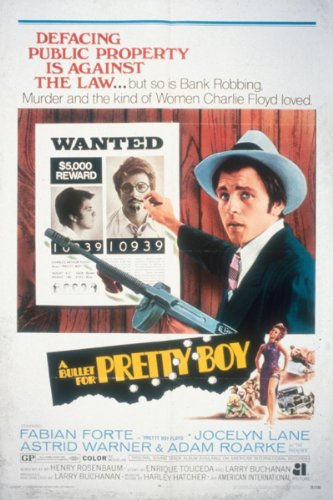
The TSL’s Grindhouse: A Bullet For Pretty Boy (dir by Larry Buchanan)


By most accounts, Charles A. Floyd — better known by the nickname “Pretty Boy” Floyd — was one of the nicer of the Depression-era outlaws.  Though he robbed his share of banks, he was usually described as being rather polite and sensible while he did so.  He didn’t steal from the poor.  While he did kill a few men, they were all law enforcement officers who were also shooting at him.  And while that may not sound like a good thing, with murder being murder and all, it’s still a marked contrast to Bonnie and Clyde, who were known for being as deliberately violent as possible.  Pretty Boy Floyd reportedly had a strong dislike for Bonnie and Clyde and even told his relatives in Oklahoma not to help the Barrow Gang hide from the police.

The most violent thing that Floyd was ever accused of was taking part in the killing of four law enforcement officers in Kansas City.  (This was the so-called Kansas City Massacre.)  Since one of the victims was an FBI Agent, Floyd quickly became public enemy number one and was eventually gunned down in a cornfield in Ohio.  (Some accounts say that Floyd was initially only wounded and was executed by the FBI after he surrendered.)  Most modern historians agree that Floyd was not involved in the Kansas City Massacre.  Even after he had been shot and told that he was dying, Floyd reportedly vehemently denied having had any involvement in what happened in Kansas City.  In the view of most historians, Pretty Boy Floyd was a polite country boy who just happened to rob banks.

That’s certainly the way that he’s portrayed in the 1970 film, A Bullet For Pretty Boy.  Though this low-budget movie from Texas-born filmmaker Larry Buchanan opens with a title card telling us that we’re about to see a true story, it’s highly fictionalized.  Singer Fabian Forte plays Charles A. Floyd, who goes from getting married to going to jail on a manslaughter conviction in record time.  (It was all because someone was making trouble at the wedding reception so really, you can’t blame Floyd for anything that happened.)  Floyd is supposed to serve six years but he decides to break out after only serving three and a half.  Again, you really can’t blame Floyd for doing that.  No one wants to work on a chain gang.  Eventually, Floyd ends up hanging out at a brothel, where he falls in with a gang of bank robbers and a prostitute named Betty (Jocelyn Lane) ends up falling for him.  After several bank robberies and gunfights, Floyd ends up working with an outlaw named Preacher (Adam Roarke).  Everyone does not live happily ever after.

While watching A Bullet For Pretty Boy, it’s pretty easy to see the influence of the 1967 film, Bonnie and Clyde.  There’s a lot of sudden bursts of violence (though never quite as bloody as the violence from Bonnie and Clyde) and the film is clearly on the side of Pretty Boy Floyd as opposed to the cops trying to catch him.  However, whereas Bonnie and Clyde presented its title characters as being rebels against the establishment, A Bullet For Pretty Boy is content to portray Floyd as just being someone who ended up in a bad set of circumstances and who did what he felt he had to do to survive.  As played by Forte, Floyd is good at robbing banks but he doesn’t seem to really enjoy doing it.  That, of course, is a polite way of saying that Fabian Forte is credible but slightly boring in the lead role.  He’s likable enough but he’s not exactly compelling and he often finds himself overshadowed by more energetic performers like Adam Roarke.

That said, I enjoyed A Bullet For Pretty Boy.  Certainly, this film is better than the typical Larry Buchanan film.  There aren’t any slow spots and the film does a good job of capturing the feeling and atmosphere of rural Texas and Oklahoma.  (Undoubtedly it helped that the film was directed by a Texan who actually knew something about the communities that he was portraying.)  The shoot outs and the bank robberies are just well-staged enough to hold your attention and that’s really the main thing that one can ask from a film like this.  A Bullet From Pretty Boy doesn’t exactly make a lasting impression but it’s entertaining enough while you’re watching it.

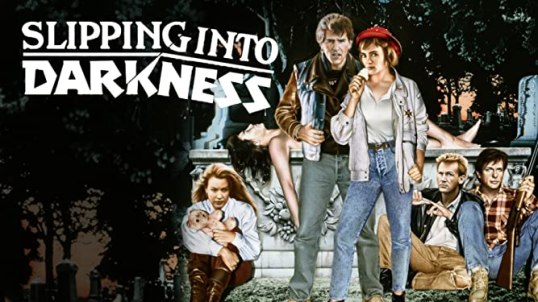
The TSL’s Grindhouse: Slipping Into Darkness (dir by Eleanor Gaver)


Last night, Jeff and I watched the 1988 film, Slipping Into Darkness.  It’s available on Prime and we watched it because it looked like it was good, old-fashioned revenge flick.  The plot description said something about a former biker kidnapping the three women who he held responsible for the death of his brother.  It sounded trashy and fun and you know what?  It definitely is trashy and fun.

It’s also one of the most thoroughly incoherent film that I’ve ever seen.

If you were to ask me what I learned from watching Slipping Into Darkness, I would say that I was amazed to discover that it doesn’t hurt to get your fingers shot off.  Seriously, one character loses his fingers and, just a few minutes later, he’s hitching a ride out of town.  (Needless to say, he has to use his other hand to flag down a ride.)  Even though he’s with his friends, no one seems to be too concerned with the fact that he’s just had several of his fingers blown off.  No one says, “Hey, you want to go to the hospital before you bleed to death?”  I don’t think it even occurs to anyone to pick up his fingers.  They just leave them in a cornfield.

The other thing that I discovered is that some people can still do stuff for several minutes after having a switchblade thrown straight into their brain.  I mean, I guess maybe that’s true.  I’ve heard of weird stuff like that happening but it still seems like having a knife sticking out of your forehead would be a bigger deal than it appears to be in this film.

Just from reading those two paragraphs, you might think that this is like an over-the-top Evil Dead-style comedy, where the action is deliberately cartoonish.  What’s strange is that it’s not.  Instead, it’s a rather pretentious film from Nebraska that actually seems like it wants to say something about …. well, something.  I mean, it’s either trying to say something about morality or the director just randomly decided to include several nuns standing in the background of several shots.  You tell me.

Anyway, the film is about three best friends, Carlyle (Michelle Johnson), Genevieve (Anastasia Fielding), and Alex (Cristen Kaufman).  Caryle is rich and self-centered.  Genevieve is obsessed with sex.  And Alex is just kind of there.  When we first see them, they’re flirting with some bikers, who turn out to be less than ideal company.  Later, after they get away from the bikers, they accidentally hit a dog with their Mercedes.  Fortunately, the dog lives and they take it to the vet.  They also take the dog’s owner, Ebin (Neil Barry), with them as well.  Ebin is developmentally disabled so they take him to get ice cream.  One jump cut later and Ebin is getting run over by a train.  A coroner who announces that, when he died, Ebin was covered in ice cream and liquor.

Ebin’s older brother, Fritz (John D’Aquino), is convinced that Ebin’s death was no accident because Ebin didn’t drink.  Maybe the ice cream’s a clue?  After Fritz sees Carlyle returning the dog from the vet, he decides to kidnap the three friends and demand to know what happened to his brother.  Helping Carlyle out are T-Bone (David Sherrill) and Otis (Vyto Ruginis), two of the bikers who the girls met earlier but who are now apparently unrecognizable because they’ve shaved and gotten haircuts.

Following this so far?

So, Fritz and his friends kidnap Carlye and her friends.  And, at first, Carlyle and her friends don’t want to be kidnapped but then, about five minutes, the girls and their kidnappers are suddenly best friends and everyone just kind of forgets about Ebin.  Genevieve and Otis go off to the cemetery together and, when the sun rises, it turns out that Otis has accidentally killed her during a sessions of rough graveyard sex.

What’s odd is that no one — not even Genevieve’s two best friends — seems to be particularly upset about Otis having killed her.  Instead, they just bury her in a nearby grave and then they start do discuss how to best protect Otis.  So, I guess the whole kidnapping thing has been resolved and no one cares about Ebin anymore.

However, it turns out that Otis is too paranoid to be protected.  Running off to a farmhouse, he discovers an old farmer who has committed suicide.  “This is a shit world,” Otis declares.  Soon, everyone’s getting chased through a wheat field by Otis, who has commandeered a thrasher….

And the movie’s not over yet!  But I’m not going to spoil any more of it.  It’s on Prime and you can watch it for yourself.  Slipping Into Darkness is one of the most incoherent films that I’ve ever seen and yet it’s such an incomprehensible mess that it’s actually a lot of fun to watch.  The dialogue is frequently ludicrous and is filled with lines that sound like they were written by an Intro to Philosophy student trying to be profound.  The film is full of jump cuts, which makes it increasingly difficult to understand how once scene relates another.  It’s impossible to keep track of who is friends with who or who is investigating what because everyone’s motivation and mood randomly changes from scene to scene.  At one point, Fritz is obsessed with his brother’s death and then, a few minutes later, he no longer seems to care.  Otis feels guilty about killing Genevieve and then, in the next scene, he’s a giggling sociopath making crude jokes about necrophilia.  Alex hates T-Bone and then she loves T-Bone and then she hates him and then she loves him and seriously, who can keep track?  The entire movie plays out like a fever dream.

Interestingly, a lot of the film’s most important events take place off-screen.  I don’t know if the director was trying to make a statement about the randomness of life or if she just ran out of money before filming certain scenes.  “We just got arrested!” a character cries towards the end of the film before then adding that they also got bailed out.  Well, that’s good.  It would have been nice to have seen that but oh well.  As long as everything works out….

What to make of Slipping Into Darkness?  I have no idea.  It’s on Prime.  Go watch it, let me know if you can figure out what the Hell’s going on.

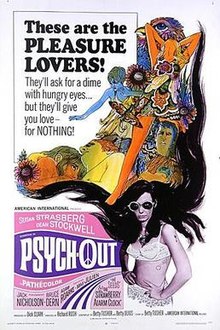
Film Review: Psych-Out (dir by Richard Rush)


There’s a scene in the 1968 film, Psych-Out, in which a group of hippies are talking to be a liberal-minded minister, asking him if a mysterious figure known as “The Seeker” has even come by his church.  The minister tells them that he has not seen the Seeker, though he has heard of him.  As the hippies politely leave the church, one of them accidentally brushes past a middle-aged woman.  Though the hippie politely apologizes, the woman is still obviously disgusted by his presence in the church.  She asks her companion how the minister can possibly allow people who “dress like that” into the church.

As the woman complains, the camera focuses in on the stained glass window directly over her shadow.  There’s Jesus and the disciples.  They’ve all got beards.  They all have long hair.  They’re all wearing simple clothing …. oh my God, they’re hippies!

That’s actually one of the more subtle moments to be found in Psych-Out, an entertainingly heavy-handed film about hippies and wanderers in California.  Psych-Out was made at the height of the counter culture.  It was filmed on location in the San Francisco neighborhood of Haight-Ashbury, where both the love and the clothes are free and no one is about judging anyone else’s thing.  Into this neighborhood comes Jenny Davis (Susan Strasberg), who has run away from home and who is looking for her brother, Steve (Bruce Dern).  Jenny may have been raised in a conservative household but she’s eager to embrace the counter-culture.  Jenny is also deaf but she can read lips.  She also has the police looking for her but fear not!  The residents of Haight-Ashbury look after one another!  They have to, considering that there are still cops and even a few rednecks hanging out around the neighborhood.

No sooner has Jenny arrived in San Francisco than she falls in with a 30-something hippie named Stoney (Jack Nicholson, with a pony tail).  Stoney is a member of a band, along with Elwood (Max Julien) and Ben (Adam Roarke).  Even though Stoney says that he doesn’t care about material goods, he’s still eager to become a rock star.  Stoney also says that he doesn’t want to get tied down by any commitments.  He wants to do his own thing.  He may sleep with Jenny but that doesn’t mean that either one belongs to the other.  Stoney may say that but he certainly gets jealous when he sees Jenny talking to the local guru, Dave (Dean Stockwell).  Dave calls Stoney for being a phony.  “You may be righteous but you’re not hip,” Dave tells him.   Can Stoney become both righteous and hip before the film ends?  Can Jenny find her brother?  Will the band get signed to a recording contract and will the menacing junkyard rednecks ever see the errors of their fascist ways?

Today, of course, Jack Nicholson is probably the main reason why most people would want to see Psych-Out.  Ironically, for a figure who is so identified with the counter-culture, Jack Nicholson did not make for a very convincing hippie.  A lot of that is because Nicholson’s trademark sarcasm (which is on full display in Psych-Out, as this is a far more typical Nicholson performance than the one that would make him a star a year later in Easy Rider) owed more to the beats than to the hippies.  Nicolson’s persona always had more in common with Jack Kerouac than Abbie Hoffman.  In Psych-Out, he comes across as being too much of a natural skeptic to fit in with the free-spirited hippies all around him.  Nicholson is fun to watch because he’s Jack Nicholson but you never buy him as someone who would really want to live in a commune where no one has any possessions and money is frowned upon.

Dean Stockwell, on the other hand, is a totally believable hippie guru though, to his credit, his still brings some welcome wit to his role.  The script may call for him to recite some fairly shallow platitudes but he does so with just enough of a smile to let use know that not even Dave takes himself that seriously.  As for the rest of the cast, Bruce Dern gets to do his spaced-out routine and Henry Jaglom, who would later become an insufferably self-important director, plays an artist with huge sideburns who tries to chop off his hand while having a bad trip.  Jenny is horrified but everyone tells her not to judge.  Susan Strasberg is sympathetic as Jenny and is convincing as a deaf character.  Unfortunately, the film doesn’t give her much to do other than walk around San Francisco with a dazed expression on her face and stare lovingly up at Jack Nicholson.

Psych-Out‘s greatest value is probably as a time capsule.  It was filmed on location and it features actual hippies.  Watching it is like getting a chance to step into a time machine and go back to San Francisco in 1968.  Of course, judging from this film, San Francisco in 1968 wasn’t that appealing of a place but still, Psych-Out remains an entertainingly silly historical document.  Just a year after the release of Psych-Out, Charles Manson and his followers would come out of the canyons and the Altamont Free Concert would end in murder and the 60s would come to an abrupt end.  Watching Psych-Out, it’s hard to believe all of that was right around the corner.

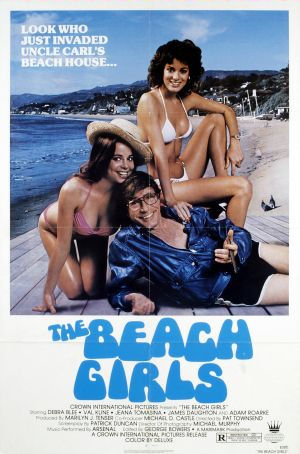
Life is a Beach #3: The Beach Girls (dir by Pat Townsend)


The_Beach_Girls_1982

“You louse!  You hussy!”

“What’s a hussy?”

“Who’s loud?”

— Typical dialogue from The Beach Girls (1982)

 As you may have guessed from the combination of the film’s title, the film’s poster, and the film’s dialogue, the 1982 comedy The Beach Girls is yet another production from Crown International Pictures.

And if you had any doubts, The Beach Girls quickly erases them by not only featuring the exact same songs that were heard in both The Pom Pom Girls and Malibu Beach but by also reusing a good deal of beach footage that originally appeared in Malibu Beach.  Remember that dog in Malibu Beach that kept stealing everyone’s bikini top?  Apparently, the folks at Crown International really liked that dog because all of his scenes are awkwardly inserted into The Beach Girls.

CIP_Logo

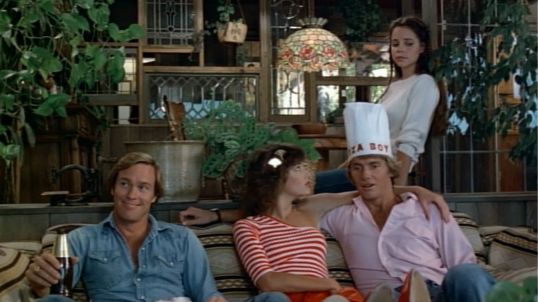
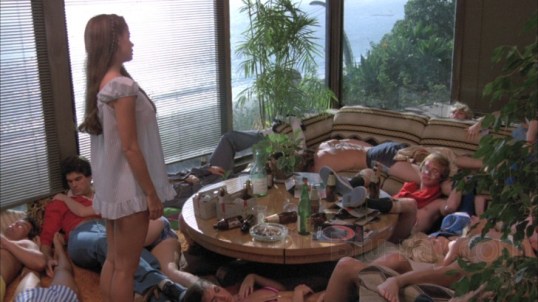
In between all of the Malibu Beach footage, The Beach Girls tells the story of three girls who have a nice beach house for the summer and who proceed to throw a party.  That is literally the plot of the entire film.  Two of the girls — Ginger (Val Kline) and Ducky (Jeana Tomasina) — are up for anything while their best friend, the shy and intellectual Sarah (Debra Blee), desperately needs to relax and have a good time.  Fortunately, there’s a sensitive musician at the party.  His name is Scott and he’s played by James Daughton, who was also in Malibu Beach.  With Scott’s help, Sarah starts to come out of her shell, which largely means that she starts to progressively wear less and less clothes.

Just when it looks like the party might be on the verge of concluding, six garbage bags of weed wash up on the beach.  That comes in handy once all of the uptight authority figures start to show up and demand that the party end.  Fortunately, the super weed inspires everyone to just relax and have fun.  Not even the eventual arrival of the Coast Guard can stop this party…

The Beach Girls

The Beach Girls is pretty much your typical Crown International teen sex comedy.  The main thing that distinguishes it from The Pom Pom Girls and Malibu Beach is that the main characters in The Beach Girls are all female.  And while the three main characters all still required to spend a good deal of the film undressed, this is a rare teen comedy where the guys are just as likely to get naked as the girls and where the girls have as much fun as the guys.  As a result, there’s little of the misogyny that lay underneath the surface of The Pom Pom Girls and, to a lesser extent, Malibu Beach.

Don’t get me wrong.  The Beach Girls, which is currently available Hulu and has also been included in a few Mill Creek box sets, is hardly a great or even a good film.  It’s pretty much a standard sex comedy where both the characters and the jokes are predictably dumb.  But, when taken on its own modest terms, it’s an inoffensive little time capsule.

Plus, the film’s beach house is really nice!  Seriously, that’s one thing that I love about films from the 80s.  Even the low-budget comedies always take place in the nicest houses!

The Beach Girls 2

What could have been: The Godfather


I don’t know about you but I love to play the game of “What if.”  You know how it works.  What if so-and-so had directed such-and-such movie?  Would we still love that movie as much?  Would so-and-so be a star today?  Or would the movie have failed because the director was right to reject so-and-so during preproduction?

I guess that’s why I love the picture below.  Taken from one of Francis Ford Coppola’s notebooks, it’s a page where he jotted down a few possibilities to play the roles of Don Vito, Michael, Sonny, and Tom Hagen in The Godfather.  It’s a fascinating collection of names, some of which are very familiar and some of which most definitely are not.  As I look at this list, it’s hard not wonder what if someone like Scott Marlowe had played Michael Corleone?  Would he had then become known as one of the great actors of his generation and would Al Pacino then be fated to just be an unknown name sitting on a famous list?

(This page, just in case you happen to be in the neighborhood , is displayed at the Coppola Winery in California.)
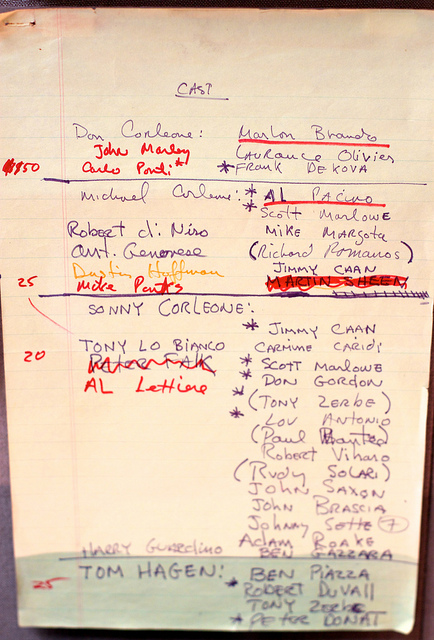
The production of the Godfather — from the casting to the final edit — is something of an obsession of mine.  It’s amazing the amount of names — obscure, famous, and infamous — that were mentioned in connection with this film.  Below is a list of everyone that I’ve seen mentioned as either a potential director or a potential cast member of The Godfather.  Consider this my contribution to the game of What If….?

Director: Aram Avankian, Peter Bogdonavich, Richard Brooks, Costa-Gravas, Sidney J. Furie, Norman Jewison, Elia Kazan, Steve Kestin, Sergio Leone, Arthur Penn, Otto Preminger, Franklin J. Schaffner, Peter Yates, Fred Zinnemann

Don Vito Corleone (played by Marlon Brando): Melvin Belli, Ernest Borgnine, Joseph Callelia, Lee. J. Cobb, Richard Conte, Frank De Kova, Burt Lancaster, John Marley, Laurence Olivier, Carlo Ponti, Anthony Quinn, Edward G. Robinson, George C. Scott, Frank Sinatra, Rod Steiger, Danny Thomas, Raf Vallone,  Orson Welles

Michael Corleone (played by Al Pacino): John Aprea, Warren Beatty, Robert Blake, Charles Bronson*, James Caan, David Carradine, Robert De Niro, Alain Delon, Peter Fonda, Art Genovese, Dustin Hoffman, Christopher Jones, Tommy Lee Jones, Tony Lo Bianco, Michael Margotta, Scott Marlowe, Sal Mineo, Jack Nicholson, Ryan O’Neal, Michael Parks, Robert Redford, Burt Reynolds, Richard Romanus, Gianni Russo, Martin Sheen, Rod Steiger**, Dean Stockwell

Sonny Corleone (played by James Caan): Lou Antonio, Paul Banteo, Robert Blake, John Brascia, Carmine Caridi, Robert De Niro, Peter Falk, Harry Guardino, Ben Gazzara, Don Gordon, Al Letteiri, Tony LoBianco, Scott Marlowe, Tony Musante, Anthony Perkins, Burt Reynolds***, Adam Roarke, Gianni Russo, John Saxon, Johnny Sette, Rudy Solari, Robert Viharo, Anthony Zerbe

Tom Hagen (played by Robert Duvall): James Caan, John Cassavettes, Bruce Dern, Peter Donat, Keir Dullea, Peter Falk, Steve McQueen, Richard Mulligan, Paul Newman, Jack Nicholson, Ben Piazza, Barry Primus, Martin Sheen, Dean Stockwell, Roy Thinnes, Rudy Vallee****, Robert Vaughn, Jerry Van Dyke, Anthony Zerbe

Kay Adams (played by Diane Keaton): Anne Archer, Karen Black, Susan Blakeley, Genevieve Bujold, Jill Clayburgh, Blythe Danner, Mia Farrow, Veronica Hamel, Ali MacGraw, Jennifer O’Neill, Michelle Phillips, Jennifer Salt, Cybill Shepherd, Trish Van Devere

Fredo Corleone (played by John Cazale): Robert Blake, Richard Dreyfuss, Sal Mineo, Austin Pendleton

Connie Corleone (played by Talia Shire): Julie Gregg, Penny Marshall, Maria Tucci, Brenda Vaccaro, Kathleen Widdoes

Johnny Fontane (played by Al Martino): Frankie Avalon, Vic Damone*****, Eddie Fisher, Buddy Greco, Bobby Vinton, Frank Sinatra, Jr.

Carlo Rizzi (played by Gianni Russo): Robert De Niro, Alex Karras, John Ryan******, Sylvester Stallone

Virgil “The Turk” Sollozzo (played by Al Letteiri): Franco Nero

Lucas Brasi (played by Lenny Montana): Timothy Carey, Richard Castellano

Moe Greene (played by Alex Rocco): William Devane

Mama Corleone (played by Morgana King): Anne Bancroft, Alida Valli

Appollonia (played by Simonetta Steffanelli): Olivia Hussey

Paulie Gatto (played by John Martino): Robert De Niro*******, Sylvester Stallone

—-

* Charles Bronson, who was in his mid-40s, was suggested for the role of Michael by the then-chairman of Paramount Pictures, Charlie Bluhdorn.

** By all accounts, Rod Steiger – who was then close to 50 – lobbied very hard to be given the role of Michael Corleone.

*** Some sources claim that Burt Reynolds was cast as Sonny but Brando refused to work with him.  However, for a lot of reasons, I think this is just an cinematic urban legend.

**** Despite being in his 60s at the time, singer Rudy Vallee lobbied for the role of the 35 year-old Tom Hagen.  Supposedly, another singer — Elvis Presley — lobbied for the role as well but that just seems so out there that I couldn’t bring myself to include it with the “official” list.

***** Vic Damone was originally cast as Johnny Fontane but dropped out once shooting began and announced that the project was bad for Italian Americans.  He was replaced by Al Martino.

****** John P. Ryan was originally cast as Carlo Rizzi but was fired and replaced with Gianni Russo.  Ryan went on to play the distraught father in Larry Cohen’s It’s Alive.  Russo went on to co-star in Laserblast.

******* Robert De Niro was originally cast in this role but dropped out to replace Al Pacino in The Gang That Couldn’t Shoot Straight.  Pacino, incidentally, had to drop out of that film because he was given the role of Michael in The Godfather.
6 Trailers From The Valley of the Exploited


No, the Valley of the Dolls is not one of the trailers included in the latest installment of Lisa Marie’s Grindhouse and Exploitation Trailers.  It just happens to be the movie that I’m watching as I edit this post.   Anyway, Valley of the Dolls was an exploitation film mostly because of human error.  The trailers below are for films that came by their exploitation label honestly.

1) An American Hippie In Israel

There’s some debate as to whether or not this movie actually exists.  I originally saw this trailer as an extra on the I Drink Your Blood DVD about three years ago.  At that time, Grindhouse Releasing claimed that it would be releasing this film on DVD “soon.”  Three years later, the DVD has yet to be released.  Perhaps it’s for the best.  I doubt that actual film could live up to lunacy and silliness of the trailer.

2) Best Friends

This is a good example of a movie that, if it was released today, would probably be marketed as an indie art film.  However, since it came out in the 70s, it played in grindhouses and drive-in movie theaters.  It’s actually a surprisingly well-made and well-acted film.

3) Chappaqua

Much like Best Friends, Chappaqua is proof that art and exploitation often go hand-in-hand.  The film was produced and directed by Conrad Rooks and features William S. Burroughs at his cynical best.

4) The Hellcats 

This is another one of those trailers that proves that, in the late 60s, liberated women were actually more menacing than murderous biker gangs.

5) Hell’s Belles

This movie, I suppose, could also have been called The Hellcat.  Adam Roarke, the star of this one, appeared in every biker film released in 1970.

6) Savage Sisters

This is another one of those films that, frustratingly enough, is not yet available on DVD.  That’s a shame.  The world needs more movies about women kicking ass.