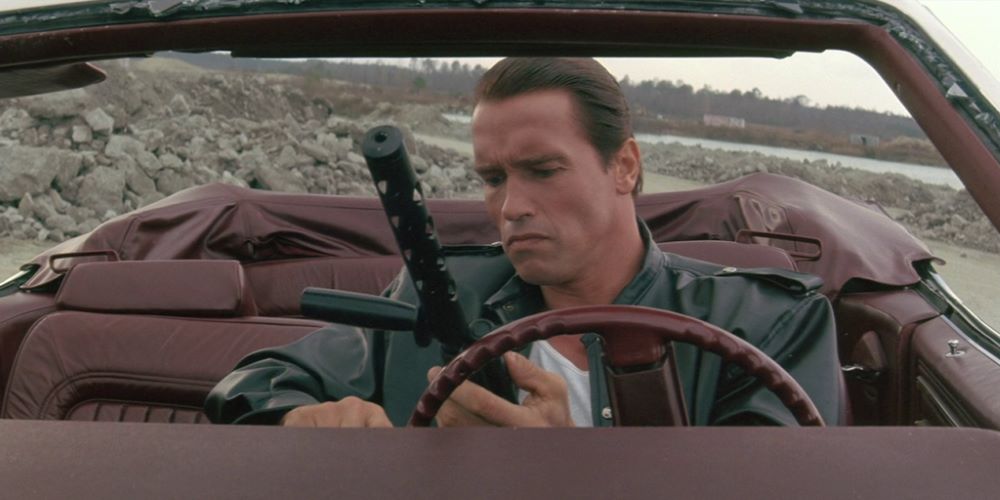
The gravel shootout in Raw Deal is pure, unfiltered 80s excess — the kind of scene that makes you grin even as you shake your head at the absurdity of it all. Arnold Schwarzenegger rolls up in a leather jacket over a white t-shirt, hair slicked back, with that dead-serious look that says he’s about to turn a quarry into a warzone. Then the Rolling Stones’ “(I Can’t Get No) Satisfaction” starts blaring — a choice so wildly on-the-nose that it wraps around to genius. Bullets fly, gravel explodes, and every bad guy who dares show his face gets launched off a cliff or riddled with rounds like it’s just another Tuesday.
It’s one of those moments where action filmmaking and rock-and-roll attitude collide in glorious overkill. Everything about it—the slow-motion carnage, the editing rhythm synced to Mick Jagger’s drawl, even the dust clouds swirling around Arnie—feels like a music video someone made after chugging pure testosterone. It’s ridiculous, it’s brilliant, and it’s exactly the sort of scene that makes Raw Deal such a lovable slice of 80s mayhem and why I just love this scene.
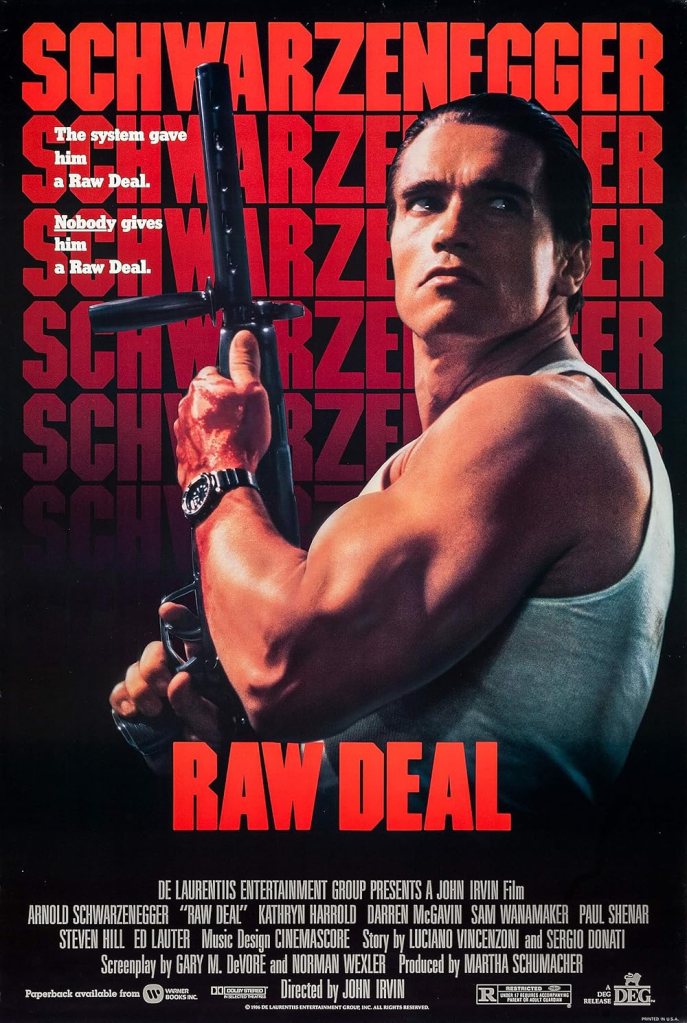
There is a point in every Arnold Schwarzenegger fan’s journey where they eventually circle back to Raw Deal and go, “Wait, how did this one slip through the cracks?” Set between Commando and Predator, this 1986 action vehicle often feels like the red-headed stepchild of Arnold’s golden era: a half-forgotten mob thriller dressed up as a one-man-army shoot-’em-up, with an undercover plot that keeps tripping over itself. Before Arnold was secret agent Harry Tasker in True Lies, he was already workshopping that whole undercover persona as former FBI man Mark Kaminski in Raw Deal. There is something strangely compelling about watching him play at being slick, whether he is posing as “Joseph Brenner” in mob circles or later reinventing himself as a suburban-family-man-turned-super-spy. Yet for all its clumsiness, tonal whiplash, and baffling choices, Raw Deal settles into that sweet, trashy groove where “this is bad” and “this is kind of awesome” blissfully merge. It is, in the purest sense, a guilty pleasure.
The setup is straightforward on paper. Arnold plays Mark Kaminski, a former FBI agent pushed out of the bureau for beating a suspect who assaulted and murdered a child, now stuck as a small-town sheriff in North Carolina with an unhappy, alcoholic wife and a life that feels like exile. His shot at redemption comes when his old FBI buddy Harry Shannon (Darren McGavin) recruits him for an off-the-books vendetta: infiltrate the Chicago mafia responsible for Shannon’s son’s death and tear them apart from the inside, in exchange for a possible path back into the bureau. Kaminski fakes his death, rebrands himself as “Joseph Brenner,” and sets out to worm his way into the organization run by boss Luigi Patrovita (Sam Wanamaker), while juggling mob politics, double-crosses, and a steady escalation of gunfire.
What makes the Kaminski era so weirdly fascinating is how hard the film leans on Arnold as a suave operator when his natural screen charisma is more brute-force than smooth-talking. In Raw Deal, he stalks through nightclubs and mob hangouts as an “undercover” tough guy, and you can almost see the movie trying to stretch him into a more traditional cool-gangster mode even as his sheer physicality keeps breaking the illusion. That tension carries right into True Lies, where the humor finally acknowledges how absurd it is to treat this gigantic Austrian bodybuilder as a low-key spy. The seeds of Harry Tasker’s double life are there in Kaminski: the awkward attempts at suave posturing, the undercover role-play, and the sense that the film is constantly asking the audience to accept him as something more than just the gun-toting tank he so effortlessly embodies. That tonal tug-of-war is kind of a mess, yet it’s also exactly why the movie is weirdly fun to revisit.
As an action piece, Raw Deal is very hit-or-miss, but when it hits, it goes all in on 80s excess. Director John Irvin stages a number of shootouts, but the standout sequence is the gravel pit massacre where Kaminski tears through mob soldiers with Mick Jagger’s “(I Can’t Get No) Satisfaction” blaring on the soundtrack, turning what should be a grim set piece into something closer to a music video about vengeance. The climactic assault on Patrovita’s casino base is another high point, with Kaminski stalking room to room, methodically mowing down henchmen in suits as the film abandons any pretense of undercover subtlety and embraces straight-up carnage. These moments are absurdly over the top, but they’re the reason the film lingers in the memory more than some “better” constructed movies from the same era.
The problem is that the film around those set pieces often feels oddly slack. For a movie with such a simple premise—ex-cop goes undercover in the mob—Raw Deal somehow manages to tangle itself in muddled plotting and underdeveloped subplots. Roger Ebert complained that the story is so basic it should be impossible to screw up, yet the movie still finds ways to make motivations cloudy and relationships confusing, especially when it comes to FBI leaks and why certain hits are happening. There are scenes, like the cemetery assassination setup, that should be loaded with emotional and narrative clarity but instead play as strangely opaque, leaving viewers wondering less “What will happen next?” and more “What exactly is going on?”
Despite the narrative wobbling, the cast gives the film more personality than it probably deserves. Schwarzenegger is still in that phase where his acting is limited but his screen presence is undeniable, and Raw Deal leans into that presence by letting him oscillate between stoic enforcer and deadpan comedian. He is not as effortlessly iconic here as he is in The Terminator or Predator, but he has a grounded gruffness in the early scenes as the weary small-town sheriff, and a playful swagger once he shifts into mob-infiltrator mode. The movie’s tonal confusion sometimes works in his favor: when he drops a ridiculous line in the middle of a supposedly serious undercover situation, it breaks the film’s self-seriousness in a way that oddly makes it more enjoyable.
On the supporting side, Darren McGavin brings a welcome dose of worn-out moral anguish as Harry Shannon, a man consumed by grief and desperate enough to go rogue, while Sam Wanamaker’s Patrovita and Paul Shenar’s lieutenant Max Keller give the mob side just enough theatrical menace to keep things lively. Kathryn Harrold’s Monique—Patrovita’s associate and Kaminski’s sort-of ally—is more underwritten than she should be, but she adds a smoky, world-weary charm to an otherwise thin role, bringing a touch of noir-vibe melancholy to a film that mostly cares about bullets. The dynamic between Kaminski and Monique hints at a more emotionally grounded movie lurking underneath, one that never fully arrives but peeks through in their quieter moments.
Visually and stylistically, Raw Deal fits comfortably into the mid-80s action aesthetic: slightly grimy urban backdrops, neon-lit nightclubs, smoky gambling dens, and anonymous industrial sites where bad guys go to die. John Irvin, better known for dramas and war films, occasionally tries to inject a more grounded tone, but the movie keeps undercutting that with comic-book logic and stylized violence, making it feel as if two different films are wrestling for control. On one level, that is a flaw; on another, that disjointed energy is part of what gives Raw Deal its “so off it becomes its own thing” quality, especially when watched now with decades of ironic distance.
Critically, the film was not well-loved on release, and its reputation has never really recovered in a mainstream sense. It holds a low Rotten Tomatoes score and only middling numbers on Metacritic, with reviewers at the time describing it as muddled, clichéd, and cheap compared to other action fare. Yet audience reactions have always skewed a bit warmer, with CinemaScore polling showing a respectable “B” grade and plenty of fans over the years framing it as an uneven but entertaining entry in Schwarzenegger’s catalog. The distance of time has turned Raw Deal into one of those movies where people admit its flaws freely but still find themselves rewatching it, chuckling at its corniness and vibing with its shootouts.
As a guilty pleasure, Raw Deal works because it is simultaneously too serious and not serious enough. It wants to be a gritty mob infiltration story but keeps indulging in gleefully excessive violence and dumb jokes; it dreams of being a tight cop thriller but never quite musters the narrative discipline. Yet that tension gives it a peculiar charm: it is a film that fails to be the sleek genre picture it might have been, but succeeds as a scrappy time capsule of 80s action sensibilities, carried by Arnold’s charisma and a few standout set pieces.
Viewed today, Raw Deal is hard to defend as “good” in any conventional sense, especially when measured against Commando’s pure cartoon energy or Predator’s lean genre perfection. But as a late-night watch, beer in hand, half-laughing at the dialogue while leaning forward during the gravel pit and casino shootouts, it absolutely delivers the specific pleasure it promises. The system may have given Mark Kaminski a raw deal, but for Arnold fans willing to embrace something messy, loud, and gloriously dated, this film still feels like a trashy little win
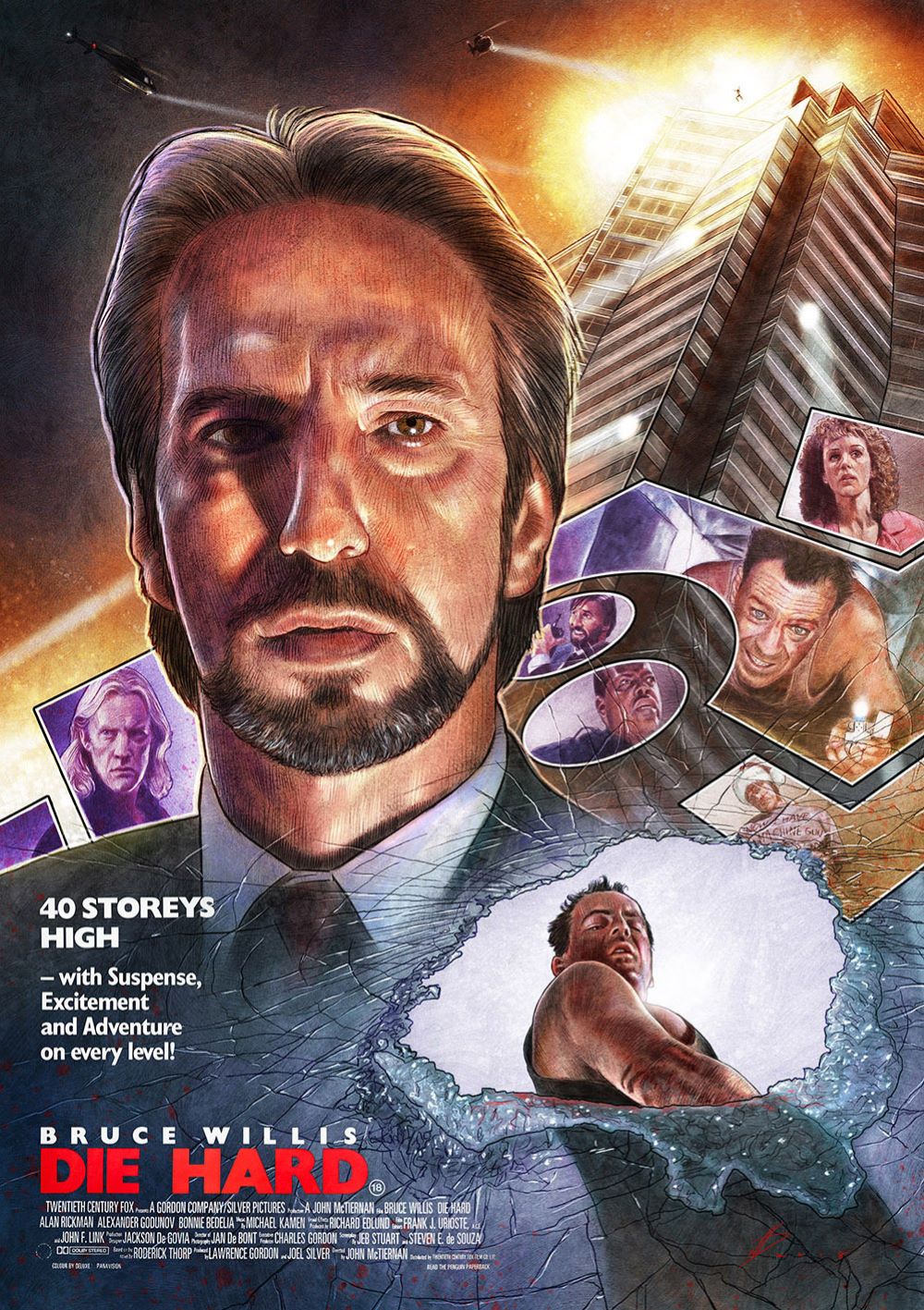
Die Hard is the ultimate Christmas film (though not the greatest) disguised as an action thriller, blending holiday cheer with high-stakes mayhem in a way that has sparked endless debates and turned it into a seasonal staple for millions. It stands as a landmark action movie and a sharp, character-driven thriller that continues to set the standard for the genre. The film mixes bombast with genuine heart, balancing tension, wit, and raw emotion so effectively that its imperfections only add to its enduring appeal.
Released in 1988 under John McTiernan’s direction, Die Hard follows New York cop John McClane (Bruce Willis) arriving in Los Angeles during the holidays to reconcile with his estranged wife Holly at her office Christmas party in Nakatomi Plaza. He’s fresh off a transcontinental flight, nursing a cocktail of jet lag and marital tension, hoping a festive gathering might thaw the ice between them after her career move to the West Coast has strained their family life. No sooner has he kicked off his shoes—famously leaving him barefoot for most of the chaos—than a disciplined crew of armed robbers, masquerading as terrorists under the command of Hans Gruber (Alan Rickman), storms the building, holding the revelers captive and forcing McClane to fight back shoeless and outgunned amid the towering offices. This lean setup—one man, one skyscraper, one chaotic evening—drives the story’s relentless pace, with straightforward spatial awareness keeping viewers locked into the rising peril. The Christmas setting isn’t just window dressing; twinkling lights, carols on the soundtrack, and a rooftop Santa sleigh add layers of irony and warmth to the gunfire, making the film a peculiar but perfect yuletide watch.
The movie refreshingly casts its action lead as an everyday underdog, full of sarcasm and frailty rather than invincible machismo. McClane takes real damage—he’s slashed by glass, battered by falls, and wheezing from asthma attacks—freaks out under pressure, second-guesses himself constantly, and limps through the ordeal covered in cuts and shards while grumbling about his lousy luck. These moments of raw vulnerability humanize him in a genre often dominated by perfect physiques and unflappable cool. Bruce Willis brings a rumpled, relatable edge to the role, drawing from his TV background on Moonlighting to infuse McClane with quick-witted banter and hangdog charm, making his pigheaded risks and desperate quips—like his tense radio chats or infamous air vent shuffle—land as the outbursts of an ordinary Joe desperate for survival and a way out. Willis’s casting was a gamble at the time, pivoting from wisecracking detective to gritty hero, but it paid off by redefining what an action star could be: flawed, funny, and fiercely determined.
Hans Gruber remains a standout antagonist, living up to every ounce of his legendary status—and remarkably, this was Alan Rickman’s very first film role, launching him into stardom with a performance that still defines screen villainy. Fresh from stage work, Rickman infuses him with suave detachment and subtle menace, his silky British accent dripping with condescension as he portrays a criminal mastermind who approaches the heist like a hostile merger, his cultured facade slipping just enough to reveal cold ruthlessness. Lines like his mocking “Mr. Mystery Guest” taunts or his gleeful disdain for American excess have become iconic, delivered with a theatrical precision that elevates Gruber above typical thugs. Clever writing highlights his contempt for yuppie excess and delight in red tape, while McTiernan’s direction turns their encounters into personal showdowns brimming with verbal sparring beyond mere firepower, turning cat-and-mouse into a battle of intellects as much as endurance.
A strong ensemble bolsters the narrative without bogging down the momentum. Bonnie Bedelia’s Holly exudes quiet strength, proving herself a sharp professional unafraid of bosses or bandits, which elevates her rapport with McClane above clichéd rescue tropes—she’s calling shots from the hostage room and holding her own in tense negotiations. Reginald VelJohnson’s Sergeant Al Powell elevates a stock radio contact into the story’s heartfelt core, offering McClane solace and shared regrets during their poignant nighttime talks about lost family and second chances, creating an unlikely but touching bromance across police lines. Figures like Hart Bochner’s smarmy Ellis, with his coke-fueled deal-making, or William Atherton’s pushy journalist Richard Thornburg, chasing scoops with ruthless ambition, add biting commentary on greed and sensationalism, sharpening the film’s take on ’80s excess and how corporate snakes and media vultures complicate the crisis. Even smaller roles, like the hapless deputy chief or the bickering SWAT team, paint a vivid picture of institutional incompetence that McClane must navigate alone.
Die Hard excels in choreographing escalating clashes within tight quarters, turning the skyscraper into a multi-level chessboard. McTiernan masterfully exploits Nakatomi’s design—raw construction levels with exposed beams, service elevators for ambushes, fire stairs slick with tension, upper decks for sniper duels, and cubicle warrens for close-quarters chaos—to distinguish every skirmish from rote shootouts, ensuring each fight feels unique and earned. Precise editing weaves between McClane’s scrambles, captive dread, robber schemes, and external responders, layering suspense without devolving into explosive filler; the cross-cutting builds dread as plans intersect disastrously. Standout sequences thrill because of careful buildup around deadlines and official blunders, like ill-timed interventions that raise the stakes sky-high. The practical effects—real stunts, squibs, and pyrotechnics—give the action a tangible weight that CGI-heavy modern films often lack, grounding the spectacle in sweat and physics.
Blending laughs with savagery proves the film’s toughest feat, yet it mostly triumphs. McClane’s biting comebacks, taped to dead bodies or barked into walkie-talkies, and the dark comedy amid cop-thug banter sustain levity amid dire threats and mounting casualties, preventing the film from tipping into grim slog. Gags like the executive’s C4 “gift” or Powell’s Twinkie diet poke fun at excess without diffusing danger. Certain gags and era-specific jabs feel dated—like mockery of inept brass or overzealous feds—but this institutional skepticism fuels the plot, portraying red tape and hubris as lethal as automatic weapons, a theme that resonates in any age of bloated bureaucracies.
The film’s action overload, ironically its signature strength, occasionally trips it up. Later stretches bombard with relentless blasts and ballets, prompting some to decry the carnage’s intensity or plot holes from initial reviews, where critics noted the escalating body count’s numbing effect. Elements like tactical decisions by authorities or vault breach logistics falter on nitpicks, relying now and then on lucky breaks to align the chaos, such as perfectly timed discoveries or overlooked details in the heist plan. Fans of taut caper tales might see the wilder antics as indulgence over invention, prioritizing popcorn thrills over airtight logic. Yet these are minor quibbles in a runtime that clocks in under two hours, keeping energy high without exhaustion.
Yet a solid emotional arc lends depth beyond mere spectacle. Fundamentally, it’s about a bullheaded officer confronting his marital neglect, enduring brutal comeuppance while seeking redemption amid the tinsel and terror. His raw confessions to Powell inject humanity that heightens the personal stakes, turning isolated survival into a quest for reconnection. The script, adapted from Roderick Thorp’s novel Nothing Lasts Forever, weaves family drama into the frenzy without halting the pace, making quieter moments—like shared vulnerabilities over radio—punch harder than any explosion.
Technically, Die Hard brims with assured flair bordering on swagger. Cinematographer Jan de Bont’s lenses capture glassy surfaces, mirrors for disorienting reflections, and soaring perspectives to render the tower both glamorous and hostile, a glassy trap turned warzone that mirrors the characters’ fractured relationships. Crisp cuts allow pauses for character amid the rush, preserving brisk tempo without shortchanging development; McTiernan’s post-Predator confidence shines in rhythmic pacing that breathes. Michael Kamen’s soundtrack fuses orchestral surges with jingly carols like “Let It Snow,” amplifying the bizarre fusion of festivity and fusillades that forever fuels “Christmas movie” arguments—ho-ho-hos interrupted by hails of bullets.
Die Hard‘s influence reshaped action cinema, birthing the “Die Hard in a [location]” trope for enclosed thrillers, from buses to battleships, spawning endless imitators chasing its formula. Sequels amplified scale at the cost of grounded heroism, proving surface mimics—snark, stunts, scheming foes—miss the original’s vulnerable punch, as later entries piled on global threats and gadgets. Detractors note it paved paths for bloated pyrotechnics in successors, but that’s on copycats, not this taut gem; its box-office success—over $140 million worldwide—proved audiences craved smart spectacle.
All told, Die Hard delivers razor-sharp, hilarious, masterfully built blockbuster entertainment that ages like fine whiskey. Pairing a rugged everyman lead, suave nemesis, and geography-smart sequences, it raises a benchmark few match. Flaws like overkill blasts or shaky rationale aside, its tension, depth, and gritty laughs cement its throne in action lore, a holiday gift that keeps on giving.
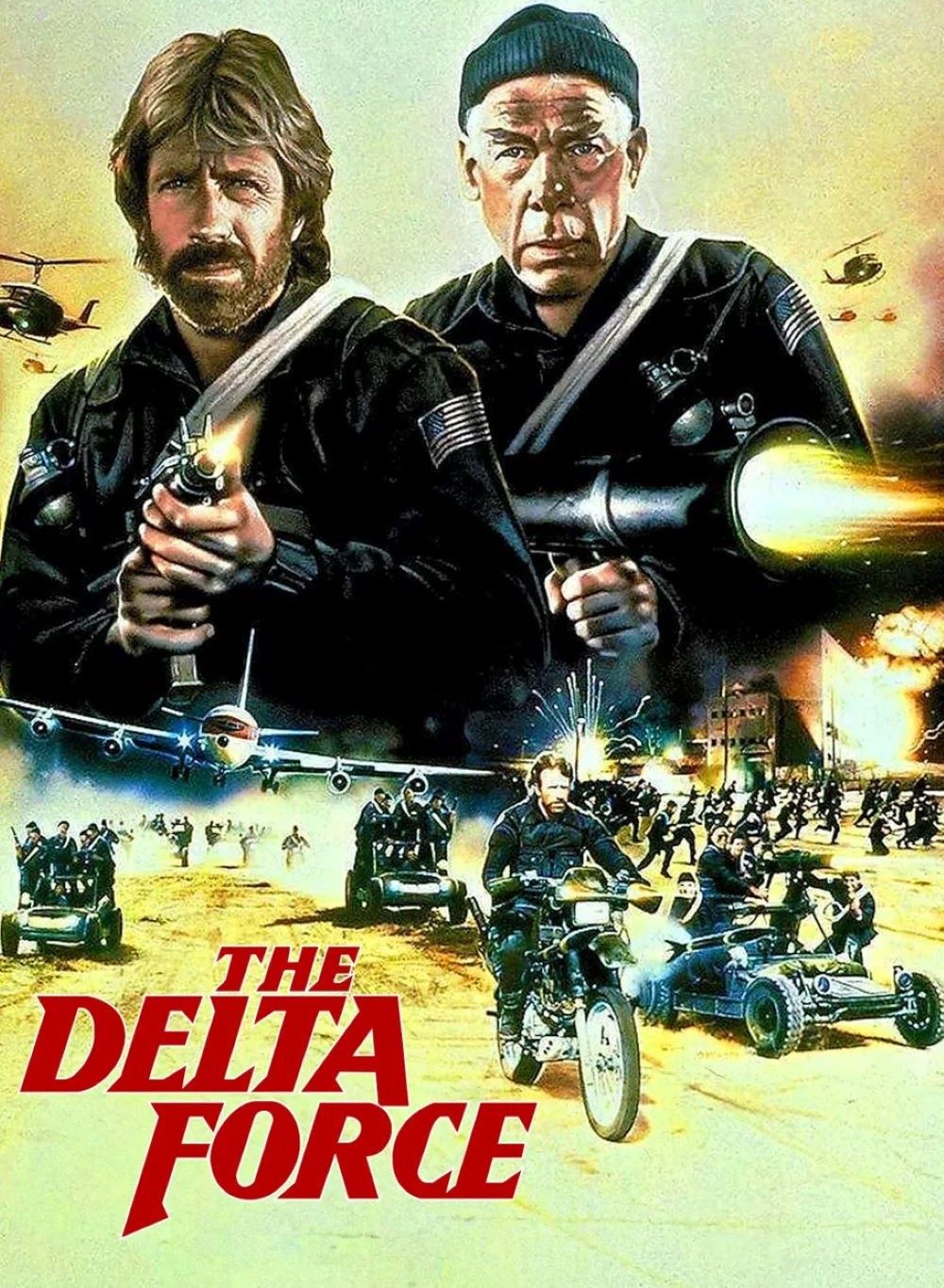
The Delta Force is the ultimate guilty pleasure from the ’80s, that rocket-bike-riding, Chuck Norris-kicking fantasy you pop on when you need two hours of unapologetic, brain-off escapism. It’s a hijacking thriller crossed with Cannon Films overkill, blending real Middle East tensions with pure action movie wish fulfillment, and yeah, it’s politically charged and dated as hell, but damn if it doesn’t deliver the kind of dumb-fun thrills that make you grin despite yourself.
Right from the jump, the film sets up its hook with a failed Delta Force raid in Iran, nodding to the real-life Eagle Claw disaster that still stung in 1986. Fast-forward, and Lee Marvin’s grizzled Colonel Nick Alexander gets yanked out of retirement when Lebanese militants hijack an Athens-to-New York flight, forcing it to Beirut and beyond. Enter Chuck Norris as Major Scott McCoy, the brooding ex-operator haunted by that botched op, who’s all too ready to strap on his gear when innocents are on the line. The setup drags you through passenger terror and terrorist demands, then explodes into rescue mayhem—it’s like the movie knows you’re here for the payback, and it serves it up hot.
As a plot, it’s pure popcorn simplicity: plane gets taken, hostages split by nationality and faith, planes hopscotch across terror hotspots, and Delta swoops in for the save. Drawing from the TWA 847 ordeal, the onboard stuff feels eerily real at first—sweaty close-ups of scared folks like Shelley Winters’ kvetching grandma or Martin Balsam’s anxious exec, turning the cabin into a pressure cooker. George Kennedy’s priest adds heart, and you almost buy the drama until Norris’ dirt bike starts spitting missiles, flipping the script to glorious absurdity. That’s the guilty pleasure pivot: from newsreel grit to arcade-game heroics, and you can’t help but love the whiplash.
Once the action ramps, The Delta Force leans into its B-movie soul with reckless abandon. McCoy’s team hits beaches, raids compounds, and yeah, that motorcycle sequence where Norris zips through baddies like a one-man apocalypse? Iconic cheese that screams “turn off your brain and enjoy.” It’s less about realism and more about catharsis—after watching hostages suffer, the third act’s bullet ballet feels like the justice porn we all secretly crave in these flicks. No deep strategy, just explosions and one-liners, perfectly tuned for that “hell yeah” rush that keeps you glued.
The cast is a riot of guilty-pleasure gold. Marvin, in his last role, growls through command with that unbeatable world-weary vibe, making every order land like gravitas wrapped in grit. Norris? Stone-faced perfection—says little, does everything, his quiet rage bubbling just enough to humanize the roundhouse legend. The passenger ensemble shines in panic mode: Winters chews scenery, Balsam frets convincingly, Kennedy prays with soul. Villain Robert Forster? Over-the-top terrorist glee, accent thick as plot armor, stealing scenes with gleeful menace that’s so cartoonish, it’s addictive.
Sure, the politics are a time-stamped minefield—terrorists as flat-out monsters, Middle East as villain playground, America as lone savior—but that’s part of the era’s guilty thrill. In a post-9/11 world, the stereotypes jar, yet for ’80s nostalgia buffs, it’s that raw, unfiltered patriotism dialed to eleven, the kind you laugh at now but cheered then. The film doesn’t pretend to balance views; it picks a lane—righteous rage—and floors it, making the righteousness feel perversely fun amid the preachiness.
Technically, it’s rough-around-the-edges charm personified. Menahem Golan directs with propulsive energy, keeping the 126 minutes zipping between dread and dazzle. Action’s shot clean—no shaky cam nonsense—with wide lenses capturing chaos in practical, pre-CGI glory that pops on a big screen. The score? Brass-blasting heroism that’s comically epic, sticking like glue and amping every slow-mo strut. Sets fake Beirut convincingly enough, backlots be damned, all fueling that immersive, low-budget magic.
The Delta Force thrives on its split personality: tense hijack bottle episode crashing into commando wet dream. Plane scenes build real unease, echoing headlines, but then rocket bikes and cheering crowds yank it back to fantasy ad. That clash? Pure guilty pleasure fuel—serious enough to hook you, silly enough to forgive its flaws, never letting tension sag.
Bottom line, embrace The Delta Force as peak time-capsule junk: terrorism tamed by ‘stache and firepower, geopolitics as blockbuster bait. Norris and Cannon diehards will fist-pump through every raid; casual viewers get a hoot from the excess. It’s flawed, fervent, and fantastically rewatchable— the kind of flick where you know it’s ridiculous, but two hours later, you’re humming the theme and plotting your next viewing. Guilty pleasure? Abso-freaking-lutely, and wear that shame badge proud.
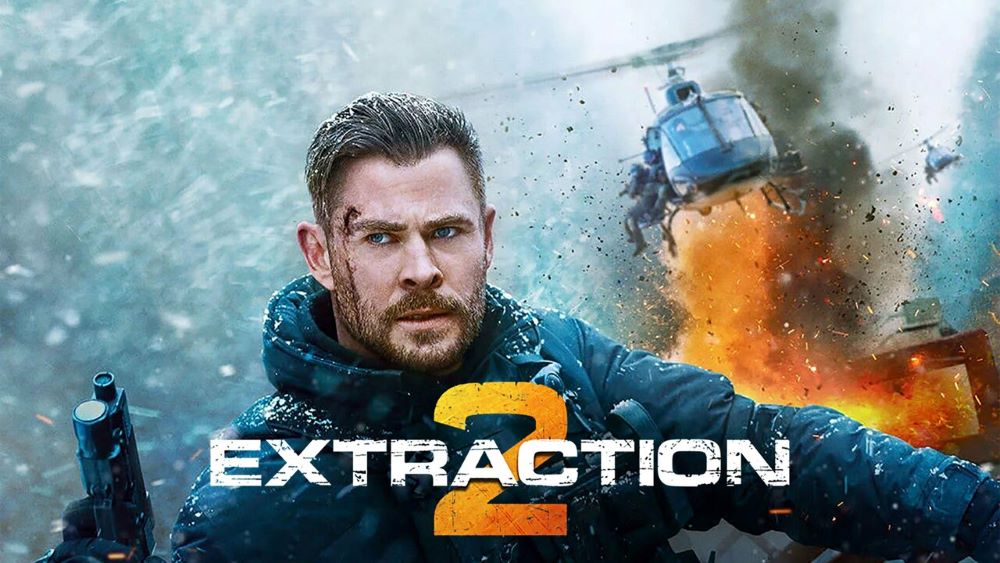
Extraction 2 drops you right into the thick of things, cranking the intensity way past the first film. To quickly recap, the original Extraction introduced Tyler Rake, a gritty mercenary with a troubled past played with undeniable grit by Chris Harmsworth. The story was simple but effective—a high-stakes rescue of a kidnapped boy in Dhaka, Bangladesh, filled with edge-of-your-seat action and those now-iconic, almost balletic long-take fight sequences. It was raw, realistic, and emotionally grounded. Harmsworth’s portrayal anchored the chaos in human vulnerability, helping the film stand out from the typical action fare.
Now, the sequel’s aim is clear—it wants to go bigger, bloodier, and more relentless, and it pulls that off in many ways. The standout here is definitely the action choreography. Sam Hargrave, the director, really flexes his muscle with several jaw-dropping sequences, especially a breathtaking 21-minute continuous take that makes you feel like you’re running alongside Rake, dodging bullets and throwing punches in real time. It’s an impressive technical feat but, more importantly, it’s incredibly immersive. The fights have that gritty realism where each blow counts, and the camera work lets you see every tense moment clearly instead of hiding behind shaky cuts.
Chris Hemsworth, once again, owns the role. This time around, you can see a bit more of the toll the mercenary life has taken on Rake. Hemsworth brings a subtle layer of weariness mixed with fierce determination. His physicality is on full display—he’s convincing in those brutal hand-to-hand combats without ever feeling like a stuntman stand-in. He does it all, and it’s clear he’s not just punching air; this is a man fighting for something beyond just survival. The emotional beats land a bit more naturally this time around, helped by Hemsworth’s grounded performance, which balances the nonstop action with moments of quiet reflection.
Visually, the film is a significant step up. The settings shift from humid, congested streets to icy, oppressive Georgia, and the cinematography makes the most of this change. The chilly, bleak palette fits perfectly with the film’s mood—harsh, unforgiving, and tense. The camera work is bold yet measured; it takes its time to show us the fights fully, letting the choreography breathe without rushing or confusing the viewer. This clarity turns the action scenes into mini-masterpieces, where every movement, every shot, and every punch feels deliberate and impactful.
That said, not everything clicks perfectly. The plot plays it safe with familiar revenge and rescue-mission beats, and the supporting characters don’t get much development beyond their utility to the story. Golshifteh Farahani steals a few scenes as Nik, adding fresh energy and complexity as a tough and capable ally, but others around her mainly exist to get the body count up. There’s a formulaic feel to the storyline—with plenty of high-stakes tension but little in the way of surprise. If you go in looking for deep storytelling or rich character arcs, you might be left wanting.
The film truly embraces the “bigger is better” mantra, and in many ways, it pays off spectacularly with larger, more intricate action sequences and expanded scale. This escalation brings a fuller, more thrilling spectacle that keeps you hooked from start to finish. However, this increase in scope leads to a trade-off: the narrative feels more convoluted and sometimes weighed down by its own ambition. The plot introduces multiple new characters and intersecting agendas, which lengthens the storyline unnecessarily and complicates what could have been a more straightforward mission. This convolution makes the story not only more formulaic but also harder to follow, detracting from the lean storytelling charm that made the first movie so effective.
Tone-wise, the movie trades some of the first film’s grounded grit for a flashier, more stylized look and feel. Some sequences stretch believability—Rake’s near-indestructibility and certain stunt setups can pull you out of the moment. Still, if you’re willing to accept that and enjoy the ride, the movie delivers on adrenaline and spectacle in full force.
One of the most refreshing things about Extraction 2 is how well it balances raw, physical combat with moments of emotional depth. Between the intense fight scenes, there are small windows into who Tyler Rake is and what drives him. These touches give the film a heartbeat beneath all the explosions and punches. Rake is no cookie-cutter action hero; he’s a broken man clawing his way toward redemption, and that gives the film a surprising amount of emotional weight for a movie mainly about violence and chaos.
Ultimately, Extraction 2 isn’t reinventing the wheel, but it doesn’t need to. It knows its audience and delivers exactly what it promises: high-octane, impeccably executed action sequences tied together by a thread of humanity. Hemsworth’s portrayal elevates it beyond just a flashy romp, lending it a gritty soul. The villains feel suitably menacing, and the stakes are convincingly high, which keeps the tension ticking throughout.
If you loved the first Extraction for its mix of brutal realism and emotional punch, the sequel will feel familiar but amplified—more intense, more expansive, and a bit louder. If you’re new to the series, Extraction 2 still stands solid on its own as a showcase of what well-choreographed action cinema looks like today—raw, precise, and emotionally resonant with just enough story to keep you invested without dragging you down.
In short, Extraction 2 is a wild, thrilling ride with a surprisingly human heart beating beneath all the chaos. It’s a film that knows how to entertain, showcasing Chris Harmsworth at his physical and emotional best and proving that action movies can still push creative boundaries while keeping viewers hooked. The movie brings bigger and bolder set pieces that truly live up to the “bigger is better” slogan, but this comes at the cost of making the plot more convoluted and overly complicated than it needed to be. While the intricate story layers may strain some viewers, the explosive action and solid performances make it a must-watch for any fan of visceral, edge-of-your-seat thrillers. If you want a no-nonsense blockbuster with a pulse, Extraction 2 delivers in spades.
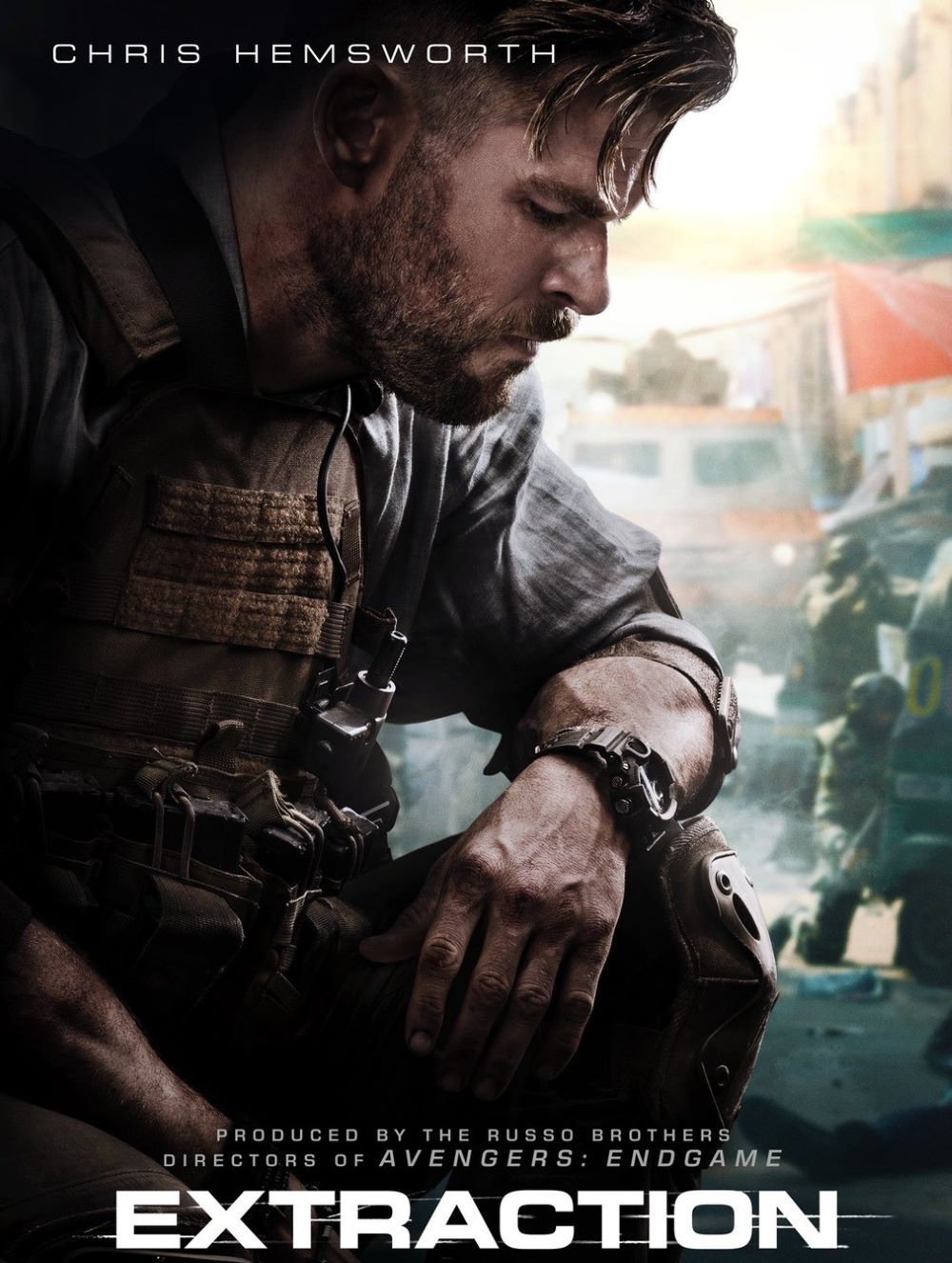
Extraction (2020) is an action film directed by Sam Hargrave and written by Joe Russo, centering on a high-stakes rescue mission led by Chris Hemsworth’s character, Tyler Rake. The story comes from the graphic novel Ciudad, following Rake, a hardened mercenary tasked with rescuing Ovi Mahajan—the kidnapped teenage son of a Mumbai drug lord—from a rival gang in Dhaka, Bangladesh.
The biggest highlight of the film is undoubtedly the action. Sam Hargrave’s background as a stuntman and stunt coordinator heavily shapes the film’s visceral, grounded fight scenes and chase sequences. Before directing Extraction, Hargrave worked extensively in Hollywood, doubling for Chris Evans as Captain America in several Marvel movies like Winter Soldier and Endgame, and choreographing stunts for The Avengers, Pirates of the Caribbean, and The Hunger Games. This experience shows in the film’s impressive physicality and well-structured action set pieces.
One of the film’s standout moments is a roughly 15-minute continuous shot that follows Rake through escalating fights, car chases, and shoots without cuts, putting the audience right in the middle of the chaos. Cinematographer Newton Thomas Sigel maintains great clarity during this complex sequence, making it easy to follow the action without losing tension or momentum.
Chris Hemsworth’s Tyler Rake is a mix of toughness and quiet emotion. While Rake is the typical stoic, skilled mercenary with a haunting past, Hemsworth brings enough charisma and subtlety to keep him interesting. Rudhraksh Jaiswal’s Ovi balances vulnerability and resilience, and their relationship adds some emotional depth to an otherwise action-heavy film.
The setting of Dhaka plays a significant role in creating tension. The crowded streets and claustrophobic urban spaces add a feeling of danger and urgency. The production design and score contribute to this gritty atmosphere, making the world feel lived-in and tense.
Violence in Extraction is brutal and unflinching, not shying away from the grim realities of its story. The R rating is earned through graphic fights, gun battles, and some harsh moments involving bystanders, including children. This unrelenting approach to violence adds a raw edge to the film but can also feel overwhelming at times.
However, the movie’s major drawback comes from its story and character development, which are fairly thin and formulaic. The plot is straightforward: a mercenary protecting a kidnapped kid while fighting off enemies. Most of the supporting characters are underdeveloped, with the villain Amir portrayed as a one-dimensional bad guy without much backstory or nuance. Although Randeep Hooda’s character Saju adds some tension and complexity, other roles feel functional rather than memorable.
The film attempts to add emotional weight through Rake and Ovi’s bond, but the effort sometimes falls flat. Key moments meant to build character feels like typical exposition, and some plot points are rushed or underexplored. A subplot involving David Harbour’s character feels tacked on and doesn’t quite fit into the narrative flow.
Pacing also hinders the film, especially in the middle act, where the story slows down and struggles to balance action with character moments. This section can feel tedious compared to the rest of the film’s adrenaline-fueled sequences.
The ending, while action-packed and satisfying in terms of spectacle, also features a somewhat questionable twist and a final shot that feels like a cheat, leaving some ambiguity that may frustrate viewers seeking clear resolution.
In summary, Extraction delivers on what fans of intense, well-executed action expect. It’s a showcase for Hargrave’s stunt expertise and Hemsworth’s physical performance but falls short when it comes to storytelling and character depth. The film is a gripping, high-energy ride with brutal, creative fight and chase scenes—but if you’re looking for a nuanced plot or fully fleshed-out characters, it’s lacking. Fans of pure action films like John Wick or The Raid will find much to enjoy here, but others may find the story too simplistic and the constant violence numbing over time.
Yesterday, I highlighted one of my more recent guilty pleasures, Timu Tjahjanto’s unhinged action thriller The Night Comes for Us, and today I highlight an action scene from an earlier film that helped propel Indonesia’s action film scene to most Westerners with a little sequence from Gareth Edwards’ The Raid 2. A sequel to his own earlier film, The Raid.
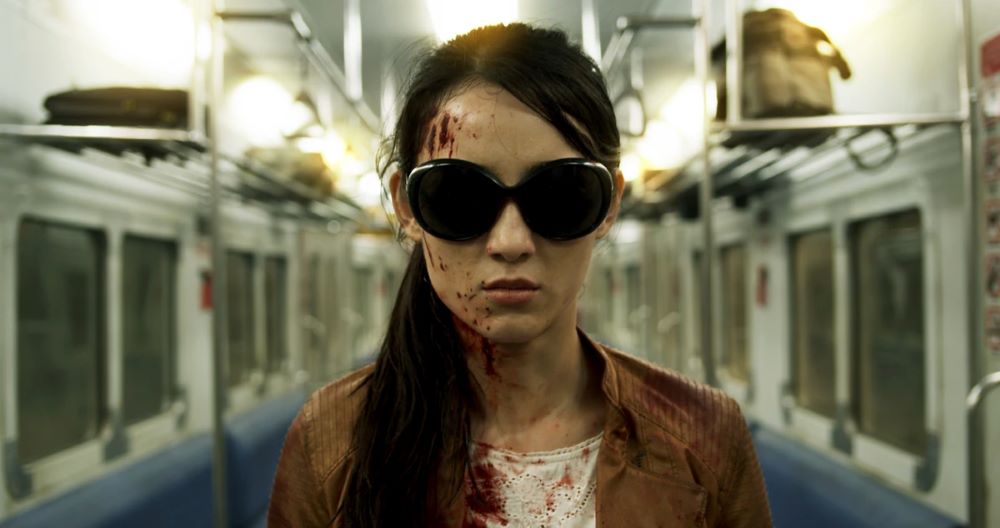
This sequence stars the character only known as Hammer Girl and played Julie Estelle who is also in The Night Comes for Us. I would’ve picked her scene from that film to highlight but it spoils a major part of the film so I decided on this scene in The Raid 2 that got her noticed with action film aficionados worldwide.
It’s a simple set-up. Girl with two claw hammers in a crowded train silently squares up against a train car full of yakuza members. What comes next is a masterclass in action choreography that induces many a visceral response form the viewer yet hard to look away from.
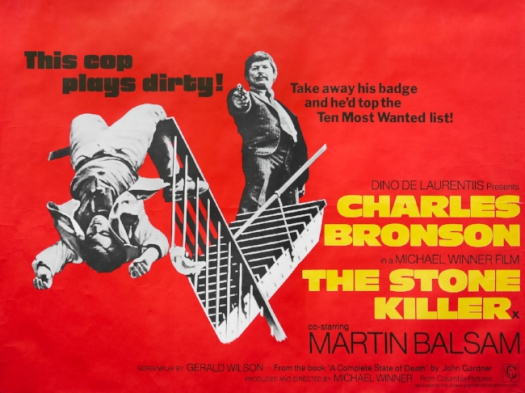
Charles Buchinsky was born November 3, 1921 in the coal-country town of Ehrenfield, PA to a Lithuanian immigrant father and second-generation mother. He didn’t learn to speak English until he was a teen, and joined the Air Force at age 23, serving honorably in WWII. Returning home, young Charles was bitten by the acting bug and made his way to Hollywood, changing his last name to ‘Bronson’ in the early fifties. Charles Bronson spent decades toiling in supporting parts before becoming a name-above-the-title star in Europe.
By the 1970’s, Bronson had begun his long run as an action star. THE STONE KILLER capitalizes on the popularity of Cop and Mafia movies of the era, with Our Man Bronson as Lou Torrey, a Dirty Harry-type who shoots first and asks questions later. After he kills a 17-year-old gunman in the pre-credits opening, Torrey is raked over the coals by the New…
(First off, feast your eyes on the incredibly cool Frank Frazetta poster! Then read on… )
Clint Eastwood’s directorial credits include some impressive films: THE OUTLAW JOSEY WALES, PALE RIDER, UNFORGIVEN, MYSTIC RIVER, MILLION DOLLAR BABY. While 1977’s THE GAUNTLET may not belong on that list, I feel it’s a very underrated movie deserving a second look. Clint and his lady love at the time Sondra Locke star in this character study of two damaged people disguised as an action comedy, essentially a chase film loaded with dark humor.
Clint plays Ben Shockley, an alcoholic Phoenix cop sent to Las Vegas to extradite Gus Mally, “a nothing witness in a nothing trial”. Gus turns out to be a woman, a hooker in fact, set to testify against a Phoenix mobster. Ben’s suspicions are roused when he learns Vegas oddsmakers are giving 50-1 they don’t make it to Phoenix alive, confirmed…
In 2015, a little film from Lionsgate came out during that time between the summer blockbuster and the awards seasons. It’s sort of the time of the cinematic year when a film is not good enough to be a blockbuster and not enough pedigree to be seen as awards-worthy.
This film was John Wick and it starred Keanu Reeves. It was also directed by two filmmakers more well-known for choreographing fights and action scenes than a full feature film.
John Wick had the last laugh as it surpassed everyone’s expectations to become one of the best action films of recent memory. It helped resurrect Keanu Reeves as a bonafide action star once again.
At this year’s New York Comic-Con the first teaser trailer for the second chapter of the John Wick story dropped to the howling delights of all attending.
We still have to wait until 2017 for John Wick: Chapter 2, but until then let’s stare in awe at John Wick doing what he does best.



 Through the Shattered Lens