Brad’s Thoughts on Season 1 of LANDMAN, Starring Billy Bob Thornton!


Taylor Sheridan has become a fairly big part of my life over the last decade. It started when I saw HELL OR HIGH WATER in the movie theater back in 2016. It was one of my favorite movies of the year, and it was written by a guy named Taylor Sheridan. Well, the next year brought us WIND RIVER, which was both written and directed by Taylor Sheridan, and it was one of my favorite movies of 2017. Then came the series YELLOWSTONE, which was created by Taylor Sheridan and began airing in 2018. I didn’t watch the first couple of seasons, but I thought it looked good and even bought the first season on DVD when I saw it for sale at Wal Mart. When my wife Sierra came home from performing her nursely duties at the hospital and told me that everyone was saying that we needed to watch YELLOWSTONE, I informed her that I just so happened to own Season 1 on DVD. So, we popped it in the DVD player, and we were soon obsessed with the world of the Duttons. My wife took special joy in the characters of Beth (Kelly Reilly) and Rip (Cole Hauser), while John Dutton (Kevin Costner) and Rip kept my attention. I’ll admit that it scared me a little bit that Sierra enjoyed Beth so much, and I’m glad to report that, up to this point, she has not started trying to emulate her actions in real life!

When YELLOWSTONE ended its run at the end of 2024, the Paramount network was putting a major marketing push into their latest “Taylor Sheridan” series, that being LANDMAN, which had started its first season around the same time YELLOWSTONE was wrapping up its final season. I’m a huge fan of actor Billy Bob Thornton, so the fact that he was headlining a series set in Texas oil country automatically piqued my curiosity. Not ready to commit to 10 hours’ worth of LANDMAN episodes quite yet, we put the show on the backburner for a bit, knowing that we could jump in and watch it whenever we wanted to. Well, this past weekend, we got snowed in here in Central Arkansas, so I asked Sierra if she’d like to watch a few episodes of LANDMAN. Needless to say, over the course of the day we watched every episode of Season 1. I really enjoyed the first season and decided to share some of my thoughts with you.

First off, if I’m going to commit to watching 10 hours’ worth of anything, I need to really like at least some of the characters. I don’t just like Billy Bob Thornton’s portrayal of the “Landman” of the title, his Tommy Norris is now one of my favorite characters that he’s ever played. He’s the ultimate realist, because no matter what situation he finds himself in, whether he’s dealing with the head of a drug cartel, the head of his oil company, or his ex-wife, he tackles every situation by uniquely framing the specific issues in a matter of moments and then providing solutions that appeal to his audience’s most base instincts. Alternatively hilarious, serious, heartbreaking and genius, Thornton gives a masterful performance that I don’t think anyone else could have pulled off any more effectively. His ex-wife Angela (Ali Larter) is probably the toughest of all for him to deal with as his own sense of self-preservation seems to go out the window whenever she’s around. Ali Larter’s performance as Angela is loud, brash, attention-seeking, hypersexual, and every so often, just vulnerable enough that you can kind of like her. I think she’s great, and quite sexy, in the role. Michelle Randolph and Jacob Lofland get a lot of screen time in the first season as their children, Ainsley Norris and Cooper Norris. Michelle is cute and spunky, definitely her mother’s daughter, but she also loves her dad so much. I like her. Lofland, who, like Thornton, is from my state of Arkansas, has a meatier role, having to deal with tragedy from the very beginning and then serious family drama as the season plays out. It’s not a showy role, but he does a solid job. The other performance that I really enjoy throughout season 1 comes from Jon Hamm as the head of the oil company, Monty Miller. I kept referring to him as J.R. Ewing as I watched because he’s the big boss. He’s the person that Tommy Norris calls when he can’t solve their problems. Unlike J.R. Ewing, although Miller is a tough businessman, he’s also a committed family man who tries to be there for his wife Cami (Demi Moore) and their daughters when they need him. He is as hard-nosed as it gets in his business dealings, though, and it’s easy to see why he had emerged as the main guy over Tommy. I did want to shout out the actors Colm Feore, James Jordan and Mustafa Speaks as various employees of the oil company who provide different elements of humor and toughness to the proceedings over the course of the season. Finally, as far as the primary cast, while prominently credited throughout the first season, Demi Moore has relatively little to do until the very end of season 1. If you’re a big fan of hers, just know that going in. Her character seems primed to be a big part of season 2, though, so it will be interesting to see where that goes.

Second, like with any popular dramatic TV series, LANDMAN Season 1 contains some storylines that I really enjoy, while there are some that I don’t really care for. Where LANDMAN really works for me is when it features Billy Bob Thornton’s Tommy Norris as a fixer of some sort. It was in these storylines that we get to see his ability to use his intelligence, communication skills, and understanding of human nature to come up with solutions that are best for everyone. It might not always be easy, and he might have to take a beating every now and then, but Tommy knows how to get things done, and the show is at its best when it’s focused on him. We see this throughout season 1 as Norris deals with a variety of cartel henchmen, hotshot attorneys, and unhappy leaseholders in order to advance his company, M-Tex’s interests. There are also a few badass moments when it becomes clear that talking won’t get the job done, and even more direct methods will have to be used to get his point across. This usually happens when Tommy’s feeling the need to protect his children. If there is a weakness to the show, for me, it’s the fact that when Tommy Norris isn’t part of the proceedings, I don’t like it nearly as much. For example, while scenes involving Jacob Lofland’s character, Cooper, and the recently widowed young mother Ariana (Paulina Chavez), whose husband was an employee of the company, ramp up the melodrama, they also take up a lot of time, and I don’t find them very appealing. The same can be said when Ali Larter’s character, Angela, and her daughter Ainsley, decide they’re going to volunteer at a nursing home, and then proceed to hook the residents up with alcohol and even take them to a strip club. While I smiled at some of the proceedings, they weren’t realistic and didn’t really add anything to the story. I even found myself worrying about some of the residents, I mean, I’m sure some of their medication was NOT compatible with tequila! I’m guessing that these quibbles really just come down to a matter of personal preference, as I’m sure there are some who enjoy these moments more than I do. I will admit that these scenes are well-acted and performed even if they’re not advancing my favorite parts of the story.  

Overall, I really enjoyed season 1 of LANDMAN, and I’m looking forward to jumping into season 2 soon, which is now streaming. The last couple of episodes of season 1 introduced or elevated some very interesting characters who will have more prominent roles moving forward (played by Andy Garcia and Demi Moore), and peaking ahead, season 2 also appears to have some interesting additions to the cast (I’m looking at you Sam Elliott). I’m looking forward to the next 10 hours of fun!
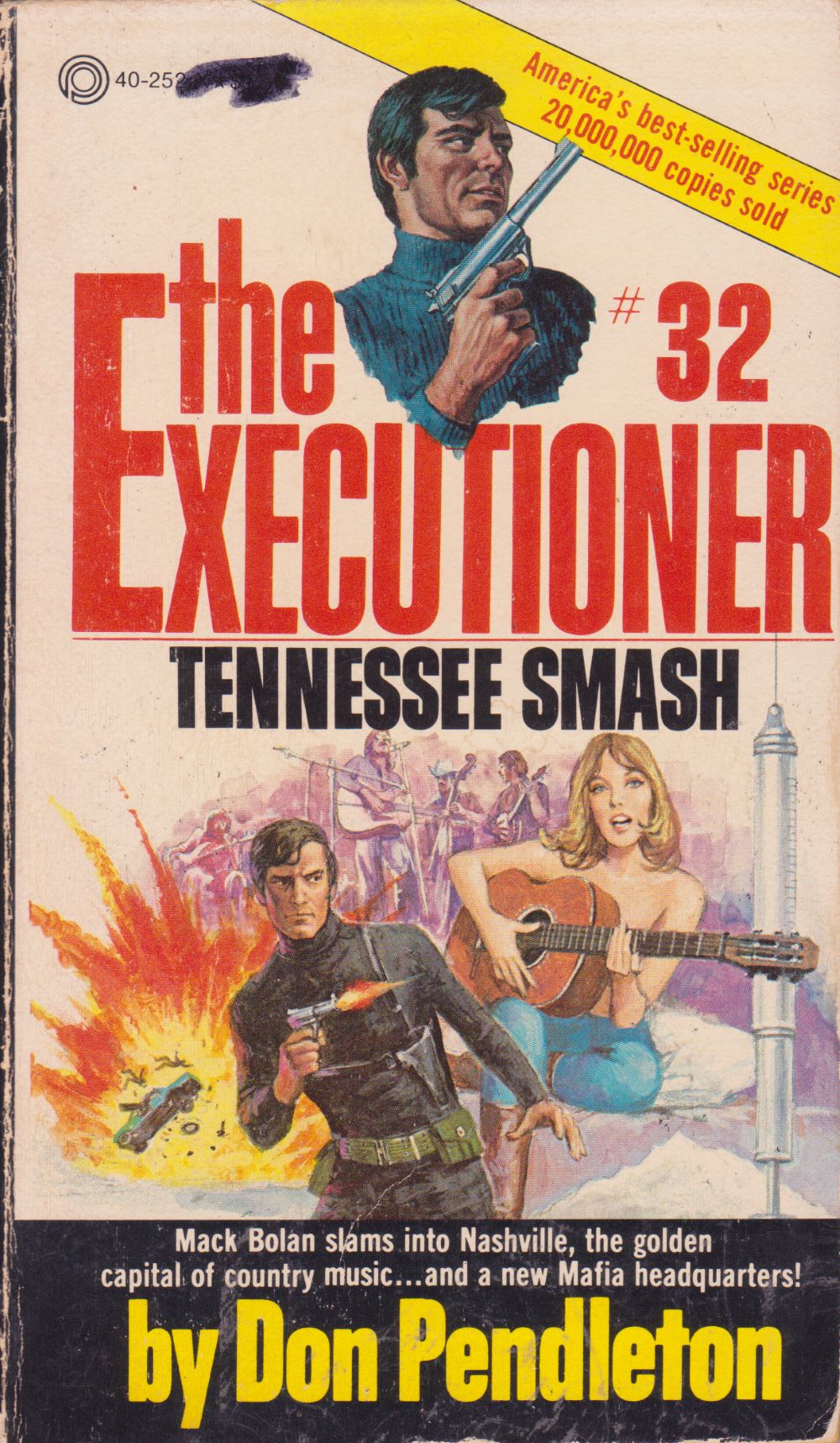
Guilty Pleasure No. 101: The Executioner Series (by Don Pendleton)


The Executioner series by Don Pendleton is one of those long-running action sagas that practically defines the phrase “guilty pleasure.” Kicking off in 1969 with War Against the Mafia, it introduces Mack Bolan, a Vietnam veteran whose homecoming turns into a nightmare and pushes him into a one-man war against organized crime. With an astonishing total of over 600 books across the main series and its spin-offs, it stands as one of the most prolific runs in pulp fiction history, delivering a steady diet of ambushes, car bombs, and last-stand shootouts, all orbiting a hero who lives somewhere between soldier, avenger, and urban legend. It’s even seeing a resurgence lately, with many original titles now available as e-books through Open Road Media, drawing in a new wave of digital readers hungry for retro action thrills.

The hook is simple and primal. Bolan comes back from Vietnam to discover his family destroyed by Mafia loan sharks, their lives shattered by debt, intimidation, and violence. The man who survived jungle warfare as a sniper becomes a domestic insurgent, redirecting the tactics of war onto American soil. In War Against the Mafia and the early novels, there’s a grim, almost workmanlike edge as he stalks mobsters through streets and back alleys, treating cities like new combat zones. Chapters move quickly, with Pendleton leaning into clear, muscular prose: weapons described with fetishistic precision, tactics laid out like field reports, and action beats that rarely pause for introspection longer than a sentence or two.

Those first runs of books form a surprisingly cohesive arc. Bolan’s war starts local and then scales outward: first the hometown syndicate, then larger crime families, then international networks and political entanglements. Titles like Death SquadBattle Mask, and Miami Massacre escalate the conflict, dropping Bolan into fresh arenas—new cities, new bosses, new layers of corruption—without ever really changing the fundamental formula. Each volume is basically a new operation: recon, infiltration, explosion. There’s comfort in that clockwork repetition, especially if you’re coming to the series for the thrill of seeing how Bolan will dismantle this week’s nest of villains, a pattern that sustains all 600-plus entries.

As pulp entertainment, the series doesn’t pretend to be anything but what it is: ruthlessly efficient action storytelling. Bolan isn’t written as a richly conflicted psychological study; he’s a vector. He thinks tactically, talks sparingly, and acts decisively. When he pauses to reflect, it’s usually to reaffirm his personal code—his obligation to protect innocents, his hatred for predators, his sense that the “jungle” followed him home from the war. That stripped-down approach makes the books read almost like mission logs. You don’t linger with him; you move with him, from weapon cache to kill zone to escape route.

The “guilty pleasure” part comes from how unapologetically the series indulges in its own extremes. Villains are drawn in thick strokes: sadistic enforcers, greedy bosses, corrupt officials, each more deserving of a bullet than the last. Bolan is judge, jury, and firing squad, and the narrative rarely questions whether that’s a good thing. The violence is frequent and often spectacular—blown-up cars, shredded safehouses, street battles that leave staggering body counts. It channels the same energy as grindhouse action cinema and ’70s vigilante films, but in prose form that you can tear through in a single sitting.

Taken purely as escapism, this is the series’ appeal: it offers a fantasy of absolute efficacy. Problems are solved through planning, courage, and overwhelming firepower, not through compromise or negotiation. If you’ve ever been frustrated with red tape and institutional inertia, Mack Bolan is the fantasy of ripping all that away and going straight to the source with a rifle. That’s also where the discomfort starts to creep in if you read the books with a more critical eye.

From a contemporary perspective, the vigilante ethos can feel both dated and unsettling. The books largely treat legal systems as ineffectual and police as either helpless, compromised, or quietly cheering Bolan from the sidelines. There’s little space for nuance when it comes to morality. That black-and-white worldview gives the action its propulsive drive, but it also flattens complexity: systemic issues collapse into a handful of “bad guys” to be eliminated. The series reflects the anxieties of its time—post-Vietnam disillusionment, fear of organized crime, distrust of institutions—but it rarely interrogates them.

Characterization is another weak spot, though it’s almost a feature of the genre. Outside of Bolan, most people function as types rather than fully realized individuals: the honorable cop, the tragic informant, the doomed love interest, the sneering mob lieutenant. Women, in particular, often feel like afterthoughts—romantic interludes, victims in need of saving, or temporary allies who don’t really alter the trajectory of Bolan’s mission. If you’re looking for layered relationships, you won’t find many here; the stories are built on momentum, not emotional intricacy.

As the series goes on and other writers take over, the tone and focus inevitably shift. The core template—lone warrior versus entrenched evil—remains, but the enemies expand from the Mafia to terrorists, cartels, rogue states, and shadowy conspiracies. Depending on your taste, that either keeps the concept fresh or dilutes Pendleton’s original blue-collar vendetta into something more generic and interchangeable with other men’s adventure titles. The early books carry a rough, personal edge; later entries sometimes feel more like franchise installments than deeply felt passion projects, stretched across hundreds of volumes.

All of that said, it’s hard to deny the series’ impact. Mack Bolan is a clear ancestor to a long line of fictional warriors and vigilantes, from paperback commandos to gun-toting comic book anti-heroes. You can see echoes of his DNA in countless characters who blend military skill with personal trauma and a private war against evil. In that sense, The Executioner isn’t just a pulpy distraction; it’s a foundational text for a whole corner of modern action storytelling.

Reading it today, the best way to approach The Executioner is with eyes open and expectations calibrated. It is not subtle, not especially nuanced, and not interested in long philosophical digressions about the nature of justice. It is fast, blunt, and engineered to scratch a very specific itch—now even more accessible thanks to Open Road Media’s e-book editions breathing fresh life into the saga. If you’re comfortable with that—if you want a hard-edged, morally stark, action-first series that feels like flipping through a stack of R-rated VHS tapes—then Mack Bolan’s war is easy to fall into and surprisingly hard to quit, even after 600 books.

If you’re curious, the ideal entry point is still the beginning: War Against the Mafia and the couple of books that follow. Those early volumes give you the raw version of the character and the template everyone else later imitates. If they don’t work for you, the rest of the series almost certainly won’t. But if you find yourself staying up late to squeeze in “just one more chapter,” that’s when you know the guilty pleasure has done its job.

Previous Guilty Pleasures

  1. Half-Baked
  2. Save The Last Dance
  3. Every Rose Has Its Thorns
  4. The Jeremy Kyle Show
  5. Invasion USA
  6. The Golden Child
  7. Final Destination 2
  8. Paparazzi
  9. The Principal
  10. The Substitute
  11. Terror In The Family
  12. Pandorum
  13. Lambada
  14. Fear
  15. Cocktail
  16. Keep Off The Grass
  17. Girls, Girls, Girls
  18. Class
  19. Tart
  20. King Kong vs. Godzilla
  21. Hawk the Slayer
  22. Battle Beyond the Stars
  23. Meridian
  24. Walk of Shame
  25. From Justin To Kelly
  26. Project Greenlight
  27. Sex Decoy: Love Stings
  28. Swimfan
  29. On the Line
  30. Wolfen
  31. Hail Caesar!
  32. It’s So Cold In The D
  33. In the Mix
  34. Healed By Grace
  35. Valley of the Dolls
  36. The Legend of Billie Jean
  37. Death Wish
  38. Shipping Wars
  39. Ghost Whisperer
  40. Parking Wars
  41. The Dead Are After Me
  42. Harper’s Island
  43. The Resurrection of Gavin Stone
  44. Paranormal State
  45. Utopia
  46. Bar Rescue
  47. The Powers of Matthew Star
  48. Spiker
  49. Heavenly Bodies
  50. Maid in Manhattan
  51. Rage and Honor
  52. Saved By The Bell 3. 21 “No Hope With Dope”
  53. Happy Gilmore
  54. Solarbabies
  55. The Dawn of Correction
  56. Once You Understand
  57. The Voyeurs 
  58. Robot Jox
  59. Teen Wolf
  60. The Running Man
  61. Double Dragon
  62. Backtrack
  63. Julie and Jack
  64. Karate Warrior
  65. Invaders From Mars
  66. Cloverfield
  67. Aerobicide 
  68. Blood Harvest
  69. Shocking Dark
  70. Face The Truth
  71. Submerged
  72. The Canyons
  73. Days of Thunder
  74. Van Helsing
  75. The Night Comes for Us
  76. Code of Silence
  77. Captain Ron
  78. Armageddon
  79. Kate’s Secret
  80. Point Break
  81. The Replacements
  82. The Shadow
  83. Meteor
  84. Last Action Hero
  85. Attack of the Killer Tomatoes
  86. The Horror at 37,000 Feet
  87. The ‘Burbs
  88. Lifeforce
  89. Highschool of the Dead
  90. Ice Station Zebra
  91. No One Lives
  92. Brewster’s Millions
  93. Porky’s
  94. Revenge of the Nerds
  95. The Delta Force
  96. The Hidden
  97. Roller Boogie
  98. Raw Deal
  99. Death Merchant Series
  100. Ski Patrol

Film Review: Fort Apache, The Bronx (dir by Daniel Petrie)


Welcome to Fort Apache, The Bronx.

Shot on location, the 1981 film of the same name takes place in one of the toughest police precincts in New York City.  The film opens with a prostitute (Pam Grier) walking up to a police car in the middle of the night and promptly gunning down the two cops inside.  (The scene emphasis on the blood splattering in the squad car makes it all the more disturbing and frightening.)  As soon as the cops are dead, people come out of the shadows and immediately start going through their pockets, collecting everything that they can.

Why were the cops killed?  There is no real motive, beyond Grier’s prostitute being high on drugs and enjoying the kill.  Indeed, we know from the start that Grier is the killer but the cops investigating the case continually ignore her, despite the fact that she’s always wandering around in the background.  (Grier is perfectly frightening in the nearly silent role.)  The new captain of the precinct, a by-the-book type named Dennis Connolly (Ed Asner), assumes that the killing must have been an organized assassination and he is soon ordering his cops to arrest and interrogate almost anyone that they see.  If someone jaywalks, Connolly wants them in the back of a squad car so that they can be interrogated.  He offers to give the men two weeks of extra vacation time for every lead that they find.  When veteran detective John Joseph Vincent Murphy III (Paul Newman) says that the reward is going to do more damage than good, Connolly dismisses his concerns.  Connolly is convinced that he knows how to run the precinct.  He views the people who live in the Bronx as being enemies who have to be tamed and controlled.  Murphy, who comes from a long line of cops, believes in working with the community as opposed to going strictly by the book.

It’s an episodic film, following Murphy and his partner, Corelli (Ken Wahl), as they try to keep the peace in a neighborhood full of empty lots, abandoned buildings, and horrific poverty.  (The film is all the more effective for having actually been shot on location.  Looking at the scenery in which everyone is living and working, it’s easy to understand why tempers get so easily frayed.)  Corelli is ambitious.  Murphy is cynical.  When Murphy meets a nurse (Rachel Ticotin), it seems like love at first sight.  They’re both survivors of the toughest city in America.  But the nurse has a secret of her own.  There’s a lot of stories that are told in Fort Apache, The Bronx but few of them have a happy ending.

It’s an effective film, though the structure is occasionally a bit too loose and the generic “cop music” on the soundtrack sometimes makes it seem as if the viewer is watching a cop show on one of the nostalgia channels.  The film works because it allows the Bronx itself to be as important a character as the cops played by Newman, Asner, and Wahl.  There’s a grittiness to the film that overcomes even the occasional melodramatic moment.  In the end, the film suggests that, while cops come and go, the precinct will always remain the same.  Killing two drug dealers just allows two more to move in.  Reporting on a bad cop, like the one played in the film by Danny Aiello, will only lead to the ostracization of a good cop.  To the film’s credit, neither Newman nor Asner are portrayed as being totally correct or totally wrong in their different approaches to police work.  Newman is correct about Asner’s heavy-handed tactics creating mistrust and resentment in the community.  Asner, however, has a point when he says that a cop killer cannot be allowed to go unpunished.

Paul Newman gives a great performance as Murphy, a role that a lesser actor would have turned into a cliche.  Murphy is the latest in a long line of cops and he’s on the verge of abandoning the family business.  Newman does a good job of portraying not only Murphy’s burnout but also how his affair with the nurse briefly inspires him to believe that he still might actually be able to make a difference in the world.  The film ends on an ambiguous note, one that leaves you with the impression that Murphy couldn’t stop being a cop if he tried.  The job may be burning him out but it’s still the only thing he knows.

Fort Apache, The Bronx is not an easy movie to find.  Though it did well at the box office (and reportedly inspired shows like Hill Street Blues and NYPD Blue), the film was also controversial because of the way the Bronx was portrayed.  While it’s not currently streaming or even available to rent on any of the major sites, I did find a good, age-restricted upload on YouTube.  Look for it before someone takes it down.

Film Review: Winning (dir by James Goldstone)


In 1969’s Winning, Paul Newman plays a race car driver.

That’s certainly not a surprise.  Newman was very much a fan of racing and owned a few race cars himself.  In Winning, he looks totally comfortable and believable behind the wheel.  There’s not a moment that you look at Paul Newman and think to yourself that he couldn’t be exactly who he’s playing, a very successful and very ambitious race car driver.  At its best, the film is a visual love letter to the sport of racing and the thrill of driving fast.  When Newman is on that track, Winning is an exciting film.

Unfortunately, Winning doesn’t spend nearly enough time on the track.  Instead, we spend way too much time examining the bad marriage of Frank (Paul Newman) and Elora Capua (Joanne Woodward).  Frank meets Eulora at a car rental place, where she’s working behind the counter.  After a whirlwind romance, they get married and Frank becomes a stepfather to Elora’s annoyingly sensitive son, Charley (Richard Thomas).  (The film doesn’t necessarily mean for Charley to be annoying but he most definitely is.)  Still, Frank remains obsessed with winning.  He remains so obsessed with winning that Elora has an affair with Lou Erding (Robert Wagner), another race car driver.  With his marriage in shambles, Frank throws himself into preparing for the Indianapolis 500.

Winning is very much a film of the late 60s.  There’s really not much of a story so the film tries to get by on frequent jump cuts, intentionally skewed camera angles, and frequent montages.  It’s one of those American films that desperately wants to be mistaken for the type of movies that were coming out of Europe at the time.  I tried to count all of the jump cuts during the first few minutes of the film and I quickly gave up.  While there’s nothing wrong with a good jump cut, the frequent cuts in Winning feel more like an affectation than anything else.  Basically, someone in production said, “The kids like jump cuts so toss them in whether they’re necessary or not.”  The film’s attempt to be arty only further serve to remind us that there’s very little actually going on.

Paul Newman had charisma to burn and, in Winning, he looks like he’s enjoying himself whenever he’s behind the wheel.  The marriage of Newman and Woodward was one of Hollywood’s great love stories but that doesn’t come across in the marriage for Frank and Elora.  A lot of that is because there’s really not much that can be said about who Elora.  She’s a blank.  Paul Newman had the screen presence and the cool confidence to get away with playing an underwritten character.  Woodward, however, can’t overcome the shallow script.  (Though Robert Wagner was nowhere near as good an actor as either Newman or Woodward, he has the right look for the role and his stiff line delivery actually works well for the character.  For whatever reason, Wagner often seemed to do his best work in Paul Newman films.)

Really, I shouldn’t be surprised that Winning turned out to be stylish but empty.  The film was directed by James Goldstone, who also directed the painfully portentous Sidney Poitier-as-Jesus film, Brother John.  Eventually, Goldstone straightened up and gave us enjoyably bad films like Rollercoaster and When Time Ran Out.  Newman is in When Time Ran Out as well.  Just as with Winning, he’s the best thing in the movie.  That’s one of the benefits of being one of the great actors.  Even when they’re appearing in a less-than-impressive film, you just can’t stop watching them.


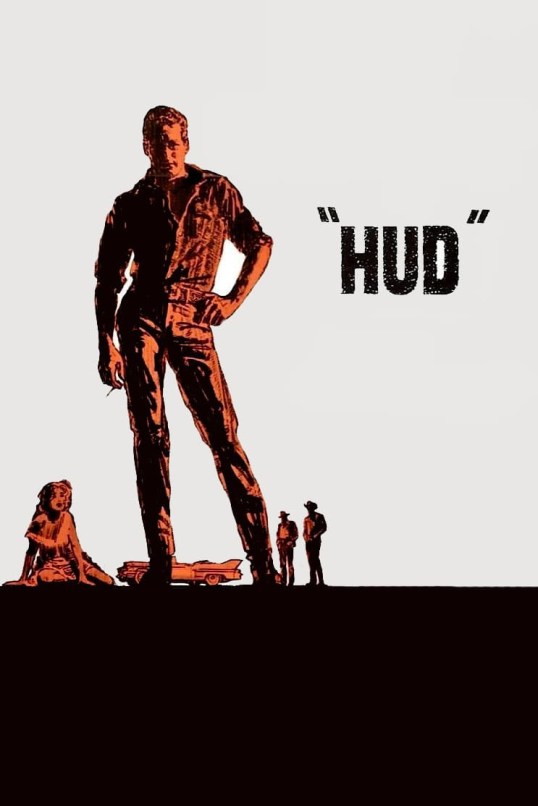
Film Review: Hud (dir by Martin Ritt)


In 1963’s Hud, Paul Newman plays a monster named Hud.

Hud Bannon is the son of rancher Homer Bannon (Melvyn Douglas).  Hud lives in a small Texas town, where he’s known for his pink Cadillac, his heavy-drinking, and his womanizing.  When we first meet him, he’s leaving the home of a married woman and narrowly escaping the rage of her husband.  Throughout the film, he mentions that he’s heading into town to meet “Mrs.” So-and-So.  Hud’s father fears that Hud might be incapable of caring about anyone but himself.  Hud’s nephew, Lonnie (Brandon deWilde), at first looks up to Hud but, over the course of the film, he comes to see his uncle for who he truly is.  Though Hud is quick to defend Homer from others, he himself views Homer with contempt and even plots to have the old man declared incompetent so that he can take over the ranch.  His flirtation with the family housekeeper, Alma (Patricia Neal), soon crosses the line into something much more dangerous.  Hud is charming and handsome in the way that only a 30-something Paul Newman could be.  But he’s also a complete monster.

In Hud, Newman gave one of his best performances and director Martin Ritt and cinematographer James Wong Howe captured some haunting images of the most barren parts of the Texas panhandle.  Howe’s black-and-white imagery not only captures the harsh landscape but also the harsh outlook of the people who live there.  Hud’s ruthless personality as is much a product of the demands of the land as his own narcissism.  The characters in Hud live in a land that doesn’t allow sentimentality.  It’s a land that’s allowed Hud to become the monster that he is.

At least, that’s the way that Paul Newman saw Hud.  That was also the way that the film’s director, Martin Ritt, viewed Hud.  They viewed him as being about as villainous and unlikable as a character could be but, to Newman’s surprise, audiences actually walked out of the film embracing the character and making excuses for him.  Newman was shocked to learn that teenagers were putting posters of him as Hud on their walls.

Why did viewers embrace Hud?

Some of it is due to the fact that Brandon deWilde gives a remarkably bland performance as Lonny.  We first see Hud through Lonny’s eyes and we are meant to share Lonny’s growing disillusionment with his uncle.  But Lonny comes across as being such an empty-headed character that it’s hard to really get emotionally invested in his coming-of-age.  When Hud eventually dismisses Lonny and his concerns, Lonny really can’t defend himself because there’s not much going on inside of Lonny.  On the other hand, Paul Newman gives such a charismatic performance as Hud that we find ourselves continually making excuses for his bad behavior.  When he talks about how he was raised and his difficult relationship with his father, we have sympathy for him even though we know we shouldn’t.  The viewer makes excuses for Hud because that’s what we tend to do when it comes to charismatic bad boys who don’t follow the rules.

Indeed, Hud is proof of the power of charisma and screen presence.  As a character, Hud does some truly terrible things and yet, because he’s Paul Newman, we want to forgive him.  We want to try to figure out why someone who is so handsome and so charismatic would also be so angry.  Lonny may be the “good” character but Hud is the one who we want to get to know.  When Lonny flips through a paperback to read the sex scenes, he comes across as being creepy.  When a drunk Hud flirts with a woman who he has just met, we ask ourselves what we would do if Hud ever tried that with us.  The truth is that we all know what we would do.  That’s what makes Hud both a dangerous and an intriguing character.

In the end, Hud is an excellent film that features Paul Newman at his best and which uses the downfall of Homer’s ranch as a metaphor for a changing American society.  Though Hud was  not nominated for Best Picture, it was nominated for almost everything else.  Melvyn Douglas and Patricia Neal won acting Oscars.  James Wong Howe’s cinematography was also honored.  Paul Newman was nominated and perhaps would have won if not for the fact that Sidney Poitier was nominated for playing the exact opposite of Hud in Lilies of the FieldHud was meant to be a picture about Lonny discovering his uncle was a monster.  Instead, the film became about Hud’s refusal to compromise.  It turns out that people like good-looking rebels who do what they want.

Even if viewers missed the point, Hud was one of the best films of the early 60s and Paul Newman’s powerful performance continues to intrigue.


Film Review: Paris Blues (dir by Martin Ritt)


1961’s Paris Blues tells the story of four Americans in Paris.

Ram (Paul Newman) and Eddie (Sidney Poitier) are expatriate jazz musicians.  Ram has come to Paris to try to find success as a musician.  He’s a little cocky.  He’s a little arrogant.  However, he’s talented and he believes enough in his talent that he takes it a little bit personally when he’s told that he should just focus on being a composer instead.  Eddie is Ram’s best friend and someone who has no interest in ever returning to America.  In America, he’s judged by the color of his skin.  In Paris, no one cares that he’s black.  In Paris, they just care about his talent.

Lillian (Joanne Woodward) and Connie (Diahann Carroll) are best friends who are spending two weeks in Paris.  They love jazz and eventually, Lillian comes to love Ram while Connie comes to love Eddie.  Connie tries to convince Eddie to marry her and come back to America with her but Eddie tells her that “the struggle” in America is not “my struggle.”  Ram also finds himself torn over whether he should stay in Paris or return to America with Lillian.  In the end, one man leaves and one man stays.  It’s not really much of a surprise who does what.

Paris Blues was directed by Martin Ritt, a director who had been blacklisted during the 50s and whose career was revived by several films that he made with Paul Newman.  (Newman and Joanne Woodward first met on the set of Ritt’s The Long Hot Summer.)  Ritt was one of those reliably liberal directors who made message films that dealt with political issues but were never quite radical.  Paris Blues features a lot of talk about the civil rights movement and it makes an attempt to be honest about why two Americans would chose to live in a different country.  And yet, as was so often the case with Martin Ritt’s films, the film presents itself as being far more daring than it actually is.  Yes, Ram initially hits on Connie but he loses interest once he sees Lillian.  Though the film is based on a novel that featured an interracial relationship, there’s never really any doubt that, in the film, Ram is going to end up with Lillian and Eddie is going to end up with Connie.  And while the film makes it clear that Ram and Lillian sleep together within hours of first meeting each other, the relationship between Connie and Eddie is romantic but chaste.  Paris Blues may be a mature film for 1961 but it’s still definitely a film of 1961.

That said, the music’s great (Louis Armstrong shows up to jam with Ram and Eddie) and Newman and Woodward’s chemistry is off the charts.  Ram is like a lot of the characters that Paul Newman played in the 50s and 60s.  He can be self-centered and he can be petulant and he can be self-destructive.  But he’s never less than honest and the fact that he refuses to compromise or give into self-doubt makes him very appealing.  While Poitier struggles with a script that refuses to allow him too much personality (he’s affably pleasant, even when he’s explaining why he doesn’t want to live in America), Newman dominates the film in the role of an artist determined to share his vision.

Paris Blues is never the masterpiece that it tries to be but Paul Newman makes it more than worth watching.

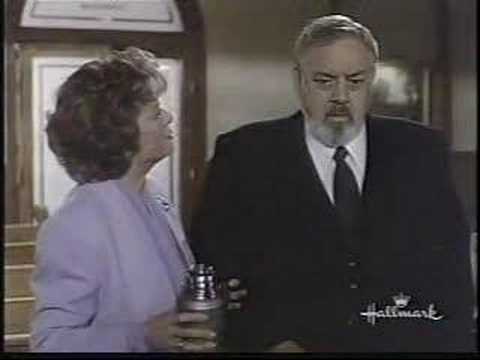
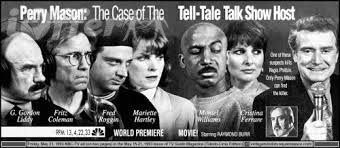
I Watched Perry Mason: The Case Of The Telltale Talk Show Host (1993, Dir. by Christian I. Nyby II)


At the end of this movie… PERRY KISSED DELLA!

On the lips!

I knew they were in love!  Obviously, Della (Barbara Hale) was also in love with Paul Drake, Sr. but with Paul gone and Paul Drake, Jr. doing his own thing, she and Perry (Raymond Burr) can finally be together.  It was about time, too.  Even though Perry comes across like he would be too work-obsessed to really be a good husband or even boyfriend, it has also been obvious that Perry and Della were in love ever since Perry Mason Returns.

As for the mystery itself, it’s a really simple one and I was able to guess who the killer was from the start.  I know that Raymond Burr was terminally ill when he shot this film (and it was the last time Perry Mason movie to ai during his life time) and maybe that’s why the plot isn’t as complicated as usual.  The guest cast is really good, though.  Regis Philbin plays the owner of a talk radio station who is murdered by one of his hosts.  Every host is a suspect and they’re all strange enough to be fun to watch.  Both Montel Williams and G. Gordon Liddy are in this thing!

Knowing this was the last of the films to air during Burr’s lifetime made watching The Case of the Telltale Talk Show Host feel a little sad.  As sick as he was, Raymond Burr still dominated the courtroom.  That was one reason why the kiss made me so happy.  Perry (and Burr) didn’t have much time left but he made sure we all knew how he felt about Della.


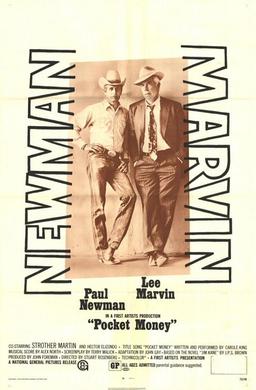
Pocket Money (1972, directed by Stuart Rosenberg)


In this slow but amiable film, Paul Newman plays Jim Kane.  Kane is a down-on-his luck cowboy who finds himself in Arizona with nearly a dollar to his name.  Because Kane’s a likable sort, he has people who are willing to help him out but eventually, he finds himself with no choice but to accept a job offer from Stretch Russell (Wayne Rogers) and shady rancher Bill Garrett (Strother Martin).  Kane agrees to Mexico to round up a heard of cattle.  Helping Kane out on the job is an old friend by the name of Leonard (Lee Marvin).

Pocket Money was the last script to be written by Terrence Malick before Malick began his own directing career and the script’s dialogue shows off Malick’s skill at capturing the unique dialect and sound of the Southwest.  It’s an episodic film, where the emphasis is more on the journey than the destination and it could be argued that the movie never really reaches its destination.  The plot is far less important than the way Kane and Leonard talk to each other and view the world around them.  Pocket Money is not for everyone.  It’s the type of movie that will inspire some to complain that nothing really happens.  For fans of Newman and Marvin, though, there’s a lot of enjoyment to be found.  Newman and Marvin reportedly did not get along during shooting but that didn’t do a thing to harm their chemistry in their scenes together.  This film reunites Paul Newman with Cool Hand Luke director Stuart Rosenberg and and also with two co-stars from that film, Strother Martin and Wayne Rogers.  Newman gives a relaxed and likable performance.  Lee Marvin gets to show his skill with comedy.  If you’ve ever wanted to see Lee Marvin ride a horse while wearing a suit, this is the film for you.

Pocket Money was the first film to be produced by First Artists, a production company that was started by Paul Newman, Sidney Poitier, Barbra Streisand, Steve McQueen, and Dustin Hoffman.  The company closed its doors in 1980 but not before giving the world not just this movie but also The Getaway, Straight Time, The Gauntlet, An Enemy of the People (starring Steve McQueen), The Life and Times of Judge Roy Bean, and The Gumball Rally, amongst others.