by R.R. Epperly
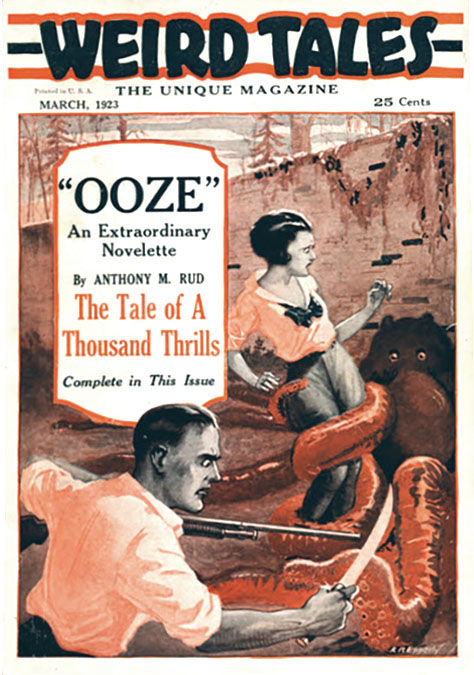
This cover is from 1923. It’s over a hundred years old but tentacles are still scary.
by R.R. Epperly
This cover is from 1923. It’s over a hundred years old but tentacles are still scary.
Obsession was originally written and recorded as a duet by Michael Des Barres and Holly Knight. The original version was included in the soundtrack for a forgotten 80s film called A Night In Heaven, which featured Lesley Ann Warren as a professor who has an affair with one of her students, a male stripper played by Christopher Atkins. The film was a flop but the song caught the attention of the band, Animotion. Their cover version is not only the best-known version of the song but it was also Animotion’s biggest hit.
Directed by underground filmmaker Amos Poe, the video featured the band performing in front of a pool and in a luxury house while dressed up in different costumes. Why Mark Anthony and Cleopatra? Why Amelia Earhart and Rudolph Valentino? Why not? It was the 80s and cocaine was very popular. The important thing is that both the video and the song came to epitomize an era.
I know this is running the risk of becoming a cliché but this is another song that I originally came to appreciate while playing Grand Theft Auto: Vice City. It was the perfect song for going for a midnight joyride in a stolen car. I crashed any number of vehicles into the ocean while listening to Animotion.
Welcome to Late Night Retro Television Reviews, a feature where we review some of our favorite and least favorite shows of the past! On Mondays, I will be reviewing CHiPs, which ran on NBC from 1977 to 1983. The entire show is currently streaming on Prime!
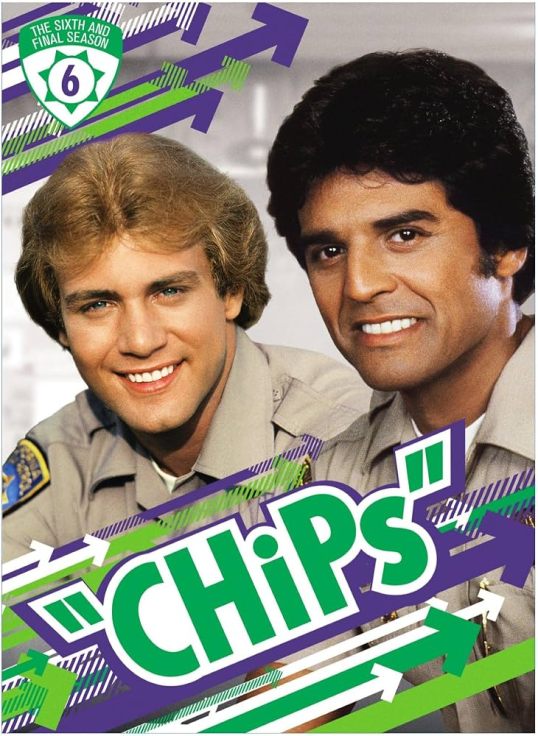
This week, Bobby learns a lesson and the Getraer family has a crisis!
Episode 6.10 “Fallout”
(Dir by Nicholas Sgarro, originally aired on December 19th, 1982)
Ellen Getraer (Lynn-Holly Johnson), the never-before-mentioned daughter of Sgt. Getraer, has fallen in with a bunch of Episcopalians and is planning to protest a nuclear plant with them. The only problem is that the church bus has bad brakes, and it keeps causing accidents on the highway. Personally, I would have thrown that smarmy Rev. Porter (John Elerick) in prison, but instead the Highway Patrol just gives him a ticket at the first accident and, at the second, they help him and the protesters escape from their burning bus. (Ellen helps too.) At the end of the episode, both Porter and Ellen do get arrested while sitting in front of the nuclear plant, but they’re released soon afterwards. Sgt. Getraer is proud of his daughter for sticking up for what she believes in. And I’m sure he’ll probably remove the arrest from her record when no one’s watching.
This episode was actually more about Bobby Nelson learning how to control his temper while performing crowd control. At a training exercise, for instance, he throws a fit when Bruce brings up the name of his ex-girlfriend. All of this probably would have been more effective if we had previously seen any evidence of Bobby having any sort of temper. Ever since he was first introduced, Bobby has come across as something of a mellow airhead. Anyway, Bobby learns how to control that supposedly fearsome temper, and he does a good job at the nuclear protest. He makes his arrests politely and courteously. As a result, the plant workers (one of whom is played by a young Dennis “Mr. Belding” Haskins) can go to work.
The other big storyline was Ponch and Nelson arriving at the scene after young Louis Hindall (Adam Rich) is hit by a car. You would think this would be especially difficult for Ponch, seeing as how his fiancée was hit and killed by a drunk driver just two weeks ago. But Ponch never mentions her. Instead, he gets upset when he sees the bruises on Louis’s back and realizes that the boy is being abused by his mom’s new boyfriend, Hal (Paul Tulley).
Later, at the hospital, Hal overhears Ponch and Bobby talking about how Hal is an abuser, and he promptly takes off in his car. This leads to a high-speed chase and a fairly impressive stunt where Hal’s car somehow goes airborne and rolls across the top of a trailer. It’s kind of amazing that, while being chased by the cops, Hal’s first instinct was to turn into a lot full of cars that he could crash into.
Finally, upon learning that the LAPD has changed their height requirements, mechanic Harlan Arliss (played by 5’2″ Lou Wagner) puts in for a transfer. Unfortunately, he fails the physical because his eyesight isn’t 20/20. Ponch tells him that with the LAPD, he would have just been another cop. But with the Highway Patrol, he’s the world’s greatest mechanic. Awwww!
At one point, Ponch opens his locker and the inside of it is covered with pictures of women. But there’s no picture of his dead fiancée. Have you no heart, Ponch!?
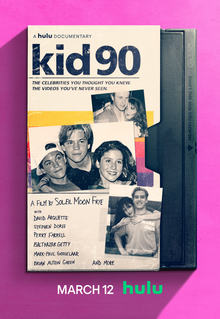
First released in 2021, Kid 90 is a documentary about what it’s like to be rich, famous, and young. Apparently, it sucks. The time that it sucks the most is when you’re no longer a teenager and you’re looking back on on your past and trying to somehow shape it all into a coherent narrative.
The documentary was produced, directed, and written by Soleil Moon Frye, a former child actress who originally found fame in the early 80s as the star of a sitcom called Punky Brewster. That show was a bit before my time but I do remember seeing her on that episode of Saved By The Bell where she pretended to like Screech for his spaghetti sauce money. She’s also appeared in a few horror films, many of whom have found a second life in the streaming era. The daughter of actor Virgil Frye (he was the creepy in security guard in Herb Freed’s Graduation Day), Soleil apparently started carrying a video camera around at a young age and was constantly filming her friends, who included people like Leonardo DiCaprio, Mark-Paul Gosselaar, Mark Wahlberg, David Arquette, Stephen Dorff, the skaters who appeared in Larry Clark’s Kids, and a host of others. She also saved all of her diaries and her voicemails. Kid 90 was assembled from those artifacts. Soleil tells her story while discussing the pressures of being a young woman in Hollywood and being objectified when she was barely old enough to be considered a teenager. She talks about drugs, sex, her friends who died young, and the unique trauma of growing up while the entire world watches and judges. She talks about a relationship with an older man, who she doesn’t name even while pictures of her with Charlie Sheen appear on the screen. What she doesn’t do is go into too much detail.
Indeed, while watching Kid 90, the main thing that struck me was how guarded everyone seemed to be, even in the candid footage that was shot when they were all teens. Young Soleil asks her friends about their philosophy of life and none of them can come up with anything particularly interesting. Instead, they all sound like their reading from a script that was handed to them by a publicist. The voicemails that we hear are largely generic and uninteresting and, if not for the title card that accompanies each one, we would have no idea who was talking. (There’s only so much meaning that one can wring out of, “Hey, just calling to see if you were around.”) Yes, Leonard DiCaprio appears in a clip or two but DiCaprio also served as a producer on the film so you can be sure that those clips were very carefully selected. In the present, a handful of actors talk about the process of going from being teen actors to adults. Brian Austin Green talks about the first time that he realized that there were people who did not like him. (His shock about the failure of his rap career is actually kind of poignant.) David Arquette is goofy but honest when discussing his history of drug abuse. Stephen Dorff is thoughtful. Mark-Paul Gosselaar is likable but obviously careful about saying anything that could come back to haunt him. (I’ve never seen Gosselaar give a bad interview, largely because he’s a master of revealing just enough without revealing too much.) And then you’ve got poor Soleil, who struggles to assign some sort of bigger meaning to her youthful memories. She obviously doesn’t want to be known as just another spoiled child actress but, when she shares footage of herself hanging out with a bunch of New York skaters, it’s hard not to see her as being anything other than a rich kid slumming.
(Not that’s anything wrong with that! I did plenty of slumming when I was in college.)
In the end, Kid 90 is really about the innate human desire to take all of the random events of our life and shape them into some sort of grand narrative. Unfortunately, life is never really that easy to explain or categorize. No one in the film, Soleil included, really lets their guard down. I can’t say that I blame them.
What’s an Insomnia File? You know how some times you just can’t get any sleep and, at about three in the morning, you’ll find yourself watching whatever you can find on cable or streaming? This feature is all about those insomnia-inspired discoveries!
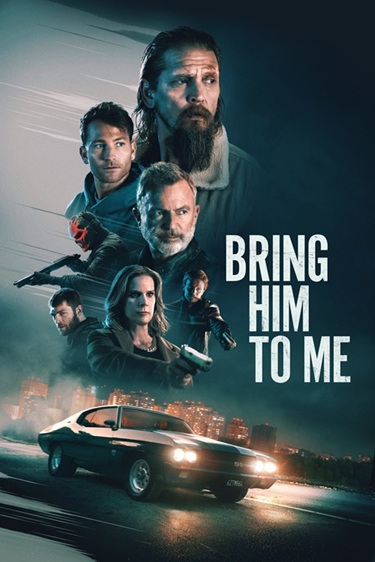
Are you having trouble getting to sleep tonight? Is your excitement about the upcoming Horrorthon keeping you awake? Well, if that’s case, you can always go over to YouTube and watch the 2023 film, Bring Him To Me.
In Bring Him To Me, Barry Pepper plays the driver. He’s a quiet man, a career criminal who is good at his job but who also doesn’t seem to particularly like it. We don’t really learn much about the Driver, at least not until the very end of the film. But one look at Pepper’s rough-hewn face and his world-weary eyes tells us more about him than any monologue could. He’s someone who has seen things that he would rather forget.
In this film, his job is to transport a talkative and asthmatic man credited as being the Passenger (Jamie Costa). We do eventually learn the Passenger’s name and quite a bit about his family situation. That’s because the Passenger will not stop talking. While the Driver is trying to do his job and transport the Passenger without getting emotionally involved in any of it, the Passenger simply will not stop revealing details about himself.
The film takes place entirely at night. The Driver finds himself being pursued by a number of different people, including a shady pawn shop owner (Sam Neill) who wants vengeance for both a theft and a beating. The film doesn’t always follow a linear timeline so it takes a while before it becomes clear just exactly what’s going on. Fortunately, there’s enough action and moral ambiguity to hold the viewer’s attention. This is the type of film that demands a lead who can keep everything from spinning out of control and Barry Pepper fulfills the role admirably.
I have to admit that, when Bring Him To Me started, I didn’t have much hope for it. The non-linear timeline, the occasional forced quirkiness of the dialogue, and the constant cursing made the film seem like it was just another heist film made by someone who was trying to be the next Tarantino. That said, the film won me over. Barry Pepper won me over. The gorgeous night cinematography won me over. And eventually, even the twisty story won me over. In the end, director Luke Sparke managed to bring all the disparate elements together into an intriguing noir-flavored film.
Bring Him To Me surprised me by actually being a decent movie. That’s one of the fun things about watching a random movie in the middle of the night. You never know what you might discover.
Previous Insomnia Files:
“What is rock and roll?” — Fire Up The Shoeshaw by Lionrick
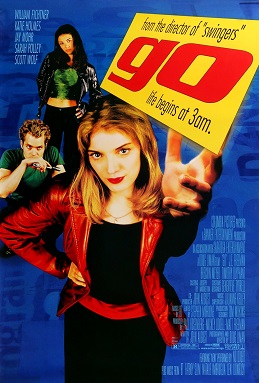
In 1999’s Go, Sarah Polley plays Ronna, a supermarket cashier who is on the verge of getting kicked out of her apartment because she can’t pay the rent. (As Julianne Moore put it in Boogie Nights, “My landlord is a real jerk.”) When Adam (Scott Wolf) and Zack (Jay Mohr) approach her and ask if she can hook them up with twenty ecstasy pills, Ronna agrees. Her co-worker, Simon (Desmond Askew), is a low-level dealer and he’s gone to Las Vegas for the weekend. Ronna decides to get the pills from Simon’s connection, Todd Gaines (Timothy Olyphant). Because Ronna doesn’t have enough money to pay Todd, she agrees to leave her friend Claire (Katie Holmes) behind as collateral.
Meanwhile, Simon goes to Vegas with Marcus (Taye Diggs), Singh (James Duval), and Tiny (Breckin Meyer). While Singh and Tiny deal with the consequences of eating too much shrimp and Marcus deals with people assuming that he must work at the casino, Simon nearly burns down the hotel and then manages to piss off both a bouncer (Jimmy Shubert) and his father (J.E. Freeman).
Finally, in the film’s third storyline, Adam and Zack are revealed to be two soap opera actors who are secretly dating and who were busted by a bizarre cop named Burke Halverson (William Fichtner). Halverson wants Adam and Zack to help him set up Todd Gaines. However, beyond that, Halverson really wants Adam and Zack to have Christmas dinner with him and his wife (Jane Krakowski). Adam and Zack suspect that Halverson has ulterior motives and he does. However, it turns out that neither one of them could have guessed what Halverson really wants them to do.
Go is one of those films that seems like the greatest thing ever made when you’re a teenager and you’re watching it at your friend’s house with the volume turned down super low so that their parents don’t come in the room and ask why William Fichtner is wandering around naked while talking to Jay Mohr about cologne. Under those circumstances, it makes sense that the employees of a grocery store would all look like models and that they would spend their break playing the dead celebrity game. When you’re the right age, it doesn’t matter that Todd Gaines is a homicidal drug addict. All that matters is that Timothy Olyphant has probably never been sexier than he was in this film.
Once you grow up, it becomes a bit more obvious that Ronna, Simon, and even Adam and Zack are basically complete and total idiots and that they really have no one to blame but themselves for the trouble that they get into. When you’re a teenager and you watch Go, you ask yourself, “How could anyone evict someone during the holidays!?” When you’re an adult and you watch Go, you ask yourself, “Why didn’t you just pay your rent, Ronna?”
That said, I still love Go. Yes, it’s basically a rip-off of Pulp Fiction, but it’s still an energetic, well-acted, and surprisingly funny movie and I love the soundtrack. I love the fact that the film actually earns the right to be called Go by giving us a narrative that never stops to catch its breath. It’s a film about being young and being stupid and it perfectly captures why so many of us have nostalgia for the mistakes we made years ago. Go was Doug Liman’s follow-up to Swingers and feels like the type of film that would have been produced by Trent and Sue. It’s derivative, irresponsible, and oddly charming. It’s a mix of Los Angeles and Vegas that encourages us all to never stop moving.
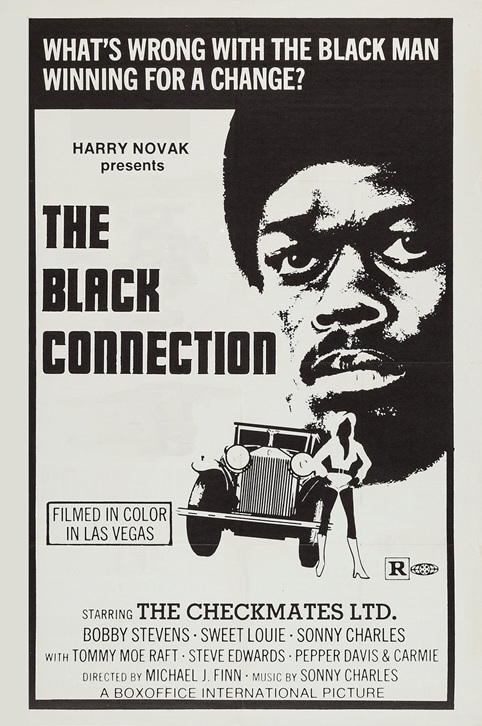
Miles Carter (Bobby Stevens) is a smooth-talking Vegas drug dealer who owes the Mafia a good deal of money due to some missing cocaine. Knowing that he’s in trouble but still confident that he can outsmart a bunch of goombahs in ill-fitting suits, Miles heads to Albuquerque so he can make another drug deal that will net him enough money to pay off the mob. But Miles isn’t actually planning on paying back the mob. Instead, he’s planning on taking whatever money he makes and then fleeing to Mexico. However, the Mafia has an assortment of overweight hit men with bad haircuts and they’ve all been sent to take down Miles.
That’s the plot of 1974’s The Black Connection. Or, at least, I think that’s the plot. It’s not a particularly easy film to follow. The film starts out with nearly thirty minutes of minor characters talking to each other and making phone calls. Once Miles does finally show up, it’s difficult to really know what he’s trying to pull because 1) the dialogue is so muddled that it’s nearly impossible to make out and 2) Bobby Stevens was not a particularly good or compelling actor. Instead, he was the lead singer for a band called The Checkmates, ltd. His bandmates appear in minor roles and also perform the film’s rather generic score. Bobby Stevens supposedly came up with the story for The Black Connection but it’s interesting to note that, in the opening credits, there’s no “written by” credit. Instead, someone is credited with being a script supervisor. That would perhaps explain why the film doesn’t really seem to be complete story as much as it’s just a bunch of random scenes that have been strung together.
The Black Connection is not a long film but I would still say that it’s probably about 60% filler. This is one of those films where no one does anything without announcing that they’re going to do it and then debating whether or not they should actually do it before doing it. It’s revealed that phones make Miles paranoid and yet the entire film is full of people talking and talking and talking on the phone. I lost track of how many shots there were of people dialing a landline and then waiting for someone to answer. There were also multiple shots of people in phone booths. At times, the film felt as if it should have been put in a time capsule so that, decades later, people could experience what it was like to live in the days before the invention of the iPhone.
There are a few scenes that work or, at the very least, are watchable. A scene in which a fat mobster shows off his karate skills is interesting because …. well, he’s a fat mobster. A scene in which two other mobsters grin while firing their guns into a car is notably gruesome and made all the more disturbing by the joy that the mobsters take in their work. Finally, the film ends on a downbeat note that would probably be more effective if not for the buckets of fake blood that were apparently splattered around right before the director shouted, “Action!”
This film was produced by the infamous Harry H. Novak. It’s nowhere near as sleazy as some of Novak’s other films. That’s actually kind of a shame. Sometimes, sleaze is the only thing that can save a film this inept.
“Vegas, baby, Vegas!”
1996‘s Swingers is a very quotable movie. “You’re so money and you don’t even know it,” is one of the more famous lines. Whenever I watch the movie, I always laugh when Mike (Jon Favreau) reacts to Sue (Patrick Von Horn) pulling a gun during an argument in a parking lot by saying, “Haven’t you seen Boyz N Da Hood? Now, one of us is going to get shot!” But for me, my favorite line will always be Trent yelling “Vegas, baby, Vegas!” as he drives Mike to Nevada’s best-known city.
There’s a sincerity to the way Trent yells it, one that you might miss on your first viewing. Trent is the aspiring actor who is confident and who always seems to know the right thing to say and who manages to keep his cool no matter how potentially embarrassing the situation. He’s a bit immature and a little bit loud but he’s the type of friend that every group needs. Mike is a comedian who moved from New York to Los Angeles. He hosts a night at a comedy club. He also asks for an application when he goes to Starbucks. He’s just been dumped by his girlfriend and he’s struggling to get over her. He’s still in that stage where all he can talk about is his former relationship. He’s the sweet guy who makes you go “Awww!” and little else.
Trent is convinced that a trip to Vegas is what Mike needs. Mike is trying convince himself that Trent is right. It’s a long and a hot drive. When Trent suddenly yells, “Vegas, baby, Vegas!,” it’s not just his way of keeping Mike awake. It’s his way of promising Mike that things are going to get better. To Trent, Vegas is the solution to all of Mike’s L.A. woes. Once they arrive in Vegas, Trent neve stops believing. It doesn’t matter that he and Mike get exiled from the high rollers table at a casino and end up gambling with a bunch of elderly tourists. It doesn’t matter that the waitress (Deena Martin) that Trent picks up lives in a rundown mobile home. And, in the end, it even doesn’t matter that Mike ends up spending the entire night telling the waitress’s roommate about his ex-girlfriend. What matters is that Trent believes that he has the solutions to everyone’s problems. For Mike, that solution is Vegas. For Sue, it’s playing hockey. Everyone has their own personal Vegas.
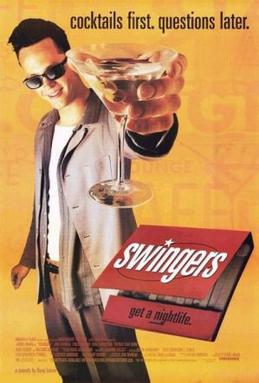
Swingers is a classic example of American independent film. Jon Favreau wrote the script and based it on his own experiences as a struggling actor. The cast was largely made up by Favreau’s friends. Vince Vaughn has said that Trent was largely based on himself, which is why he asked that there be at least one scene that revealed that Trent really did care about his friends. The story is deliberately loose. Mike tries to get over his ex-girlfriend while receiving largely useless advice from his friends. Rob (Ron Livington) moves to Los Angeles and provides somewhat gentler advice than Trent. Sue pulls a gun on some wannabe white gangstas and talks about how he grew up on the tough streets of Los Angeles. (He actually grew up in Anaheim.) The effortlessly cool Charles (Alex Desert) declares every party that the group goes to to be “dead.” As a group they spend a lot of time talking about movies. They complain about Tarantino stealing from other directors before an extended sequence of them walking in slow motion down a Los Angeles street while the Average White Band plays on the soundtrack.
The heart of Swingers together is the very real friendship between the characters. with Trent holding it all together. Mike and Sue tolerate each other because they both want to hang out with Trent. Even the momentary crisis caused by Sue pulling his gun on the guys in the parking lot is solved by the fact that the guys all want to hang out with Trent as well. Problems in Swingers are not solved by guns or high-speed chases. They’re solved by video games, beer, dancing, and maybe a trip to Vegas. They’re solved by doing your own thing and not worrying about “the rules.” They’re solved by just being in the right place at the right time. They’re solved by Mike dancing with Heather Graham and then hanging up on his ex right when she’s saying, “I love–”
Today, of course, Swingers is very much a period piece. It’s a film from a time when you actually had to get in a car and drive to Vegas if you wanted to gamble. It’s a film from a period where Mike has to ask permission to use someone else’s phone to call his ex and when there was a grace period between leaving a bad message on a machine and having to worry about anyone having heard it. For me, it’s always interesting to see Vince Vaughn, Jon Favreau, and Ron Livingston back when they were all still so young and, in the case of Vaughn and Favreau, thin. It’s a film that celebrate friendship, love, and being young enough to still feel like anything can happen.
It’s a film that celebrates everyone’s personal Las Vegas.
Oh, Sudden Death, how I love you!
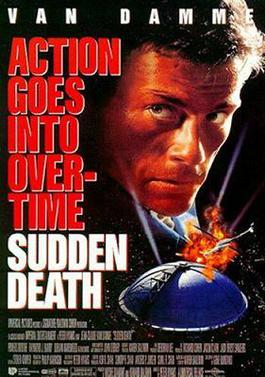
At first glance, 1995’s Sudden Death appears to just be another “Die Hard in a—” type of film. The final game of the Stanley Cup Final is being played in Pittsburgh. The Vice President (Raymond J. Barry) will be attending. Security’s tight, but not tight enough to stop rogue Secret Service agent Joshua Foss (Powers Boothe) and his band of quirky mercenaries. The hockey players continue to fight on the ice. The fans in the stadium continue to cheer every punch thrown and tooth knocked out. None of them know they are currently being held hostage as part of Foss’s plot to extort the government out of several billion dollars.
Fireman Darren McCord (Jean-Claude Van Damme) is at the game with his son and his daughter. He just wants a good bonding experience with his children. Instead, in true John McClane fashion, he finds himself sneaking around the arena, trying to defuse the bombs Foss has set and also trying to rescue the Vice President. It’s not easy, even for someone like Jean-Claude Van Damme.
As I said, this film was obviously inspired by Die Hard. But not even Bruce Willis ever found himself fighting for his life against a terrorist wearing a big penguin costume. Van Damme not only defuses bombs but also finds time to put on a goalie’s costume and hit the ice. He manages to block the puck, then looks up at the stands and gives his son a meaningful look. Even with the mask covering his face, his son recognizes him. Meanwhile, up in the VIP box, Powers Boothe appears to be having a wonderful time chewing the scenery. Even though he’s playing the bad guy in a Die Hard rip-off, Boothe doesn’t make the mistake of trying to imitate the great Alan Rickman. Instead, Boothe brings his own rugged style to the role of Joshua Foss. It’s hard not to appreciate a villain who can casually threaten to blow up a stadium without breaking a sweat. When someone sensibly points out that Foss would probably die in the explosion as well, he merely shrugs as if to say, “Let’s do it and be legends.”
And I haven’t even gotten to the bit with the helicopter yet….
Sudden Death is a big, ludicrous, and wonderful movie. It’s the type of action film that could only have starred Van Damme. Sylvester Stallone and Bruce Willis may have been better actors, but Stallone would have taken the project too seriously and Willis’s wiseass persona would have sabotaged the film’s more earnest moments. Arnold Schwarzenegger may have been bigger, but there’s no suspense to watching Schwarzenegger beat up someone in a penguin costume. Steven Seagal would have made you root for the penguin. Only Van Damme could have played Darren McCord and made you cheer for him whether he was fighting terrorists or trying to impress his children. Director Peter Hyams directs with an anything-goes sort of energy. The same genius that somehow made me cry when Elliott Gould and James Brolin ran through the cemetery in Capricorn One is present in Sudden Death’s best scenes.
Sudden Death is a true pleasure. No need to feel too guilty about this one!
Previous Guilty Pleasures
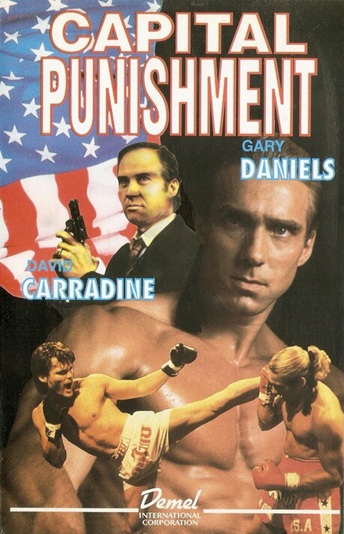 A new synthetic drug nicknamed “Kick” is creating havoc in Asia. “9 out of 10 children have been born with birth defects” due to their parents using Kick. A syndicate led by Nakata (Tadashi Yamashita) is planning on brining Kick into the United States. The government does the only thing that makes sense. They turn to a kickboxer named James Thayer (Gary Daniels) to stop the Kick from entering the U.S. The only problem is that Nakata was once James’s sensei and the head of the DEA (David Carradine) is secretly working with Nakata!
The plot doesn’t make any sense. Does it have to? If you’re watching this movie because Gary Daniels is in it, you know what you’re getting into. Scene after scene, Daniels beats someone up. He beats them up outside. He beats them up in hallways. He beats them up on rooftops. Sometimes, I wasn’t sure who he was beating up or why but that’s to be expected with a Gary Daniels films. Eventually, the bad guys kidnap Gary’s equally lethal wife (Ava Fabian) and Gary finally gets some motivation. Even when motivated, Gary Daniels can’t act but he still does his best with the weak one-liners that the script gives him. He’s the human equivalent of Homer Simpson shouting, “Die, bad robots, die!” (With a cool dry wit like that, I could be an action hero.)
Don’t get too excited about David Carradine being second-billed. He spends most of this movie either on the phone or driving a truck. Do get excited over the way he calls Gary Daniels a “son of a bitch” at the end of the movie. It’s as if he finally woke up. As Nakata, Tadashi Yamashita is more committed to his role than either Daniels or Carradine. He gets to deliver the inevitable “I am a capitalist” speech.
This may sound weird but I feel like I could watch this film a hundred times more. It has no coherent plot. It has absolutely no budget. But it did have nonstop fights and Gary Daniels stiffly trying to joke after killing someone. It’s dumb but hypnotic, the type of film where a bad guy gets shoved out of a helicopter for asking if he’ll be getting a fair share of the loot and no one really seems to notice.
I don’t know why it’s called Capital Punishment. Does it matter?

