Anime You Should Be Watching: Space Battleship Yamato (Uchū Senkan Yamato)


 “Duty calls us to give more than our lives; it calls us to give our very souls.” — Capt. Juuzo Okita

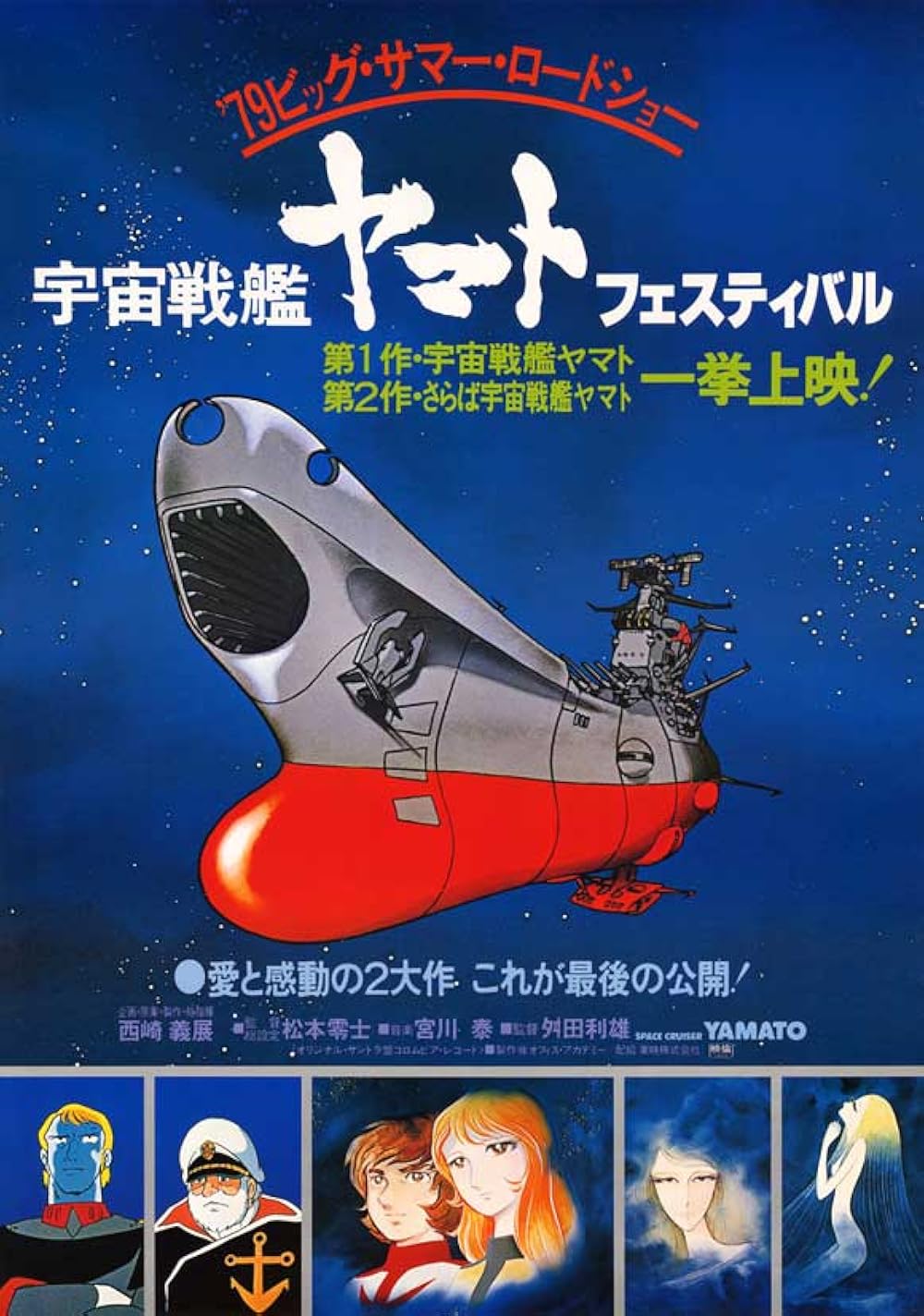
Space Battleship Yamato, which aired from 1974 to 1975, is a monumental anime series that shaped the medium’s evolution and continues to resonate deeply with audiences today. Directed by Leiji Matsumoto and produced by Yoshinobu Nishizaki, this 26-episode space opera follows the crew of the Yamato—a resurrected World War II battleship transformed into a spacefaring vessel—on a desperate mission to save an irradiated Earth.

Set in the late 22nd century, Earth has been devastated by radiation from relentless attacks by the alien Gamilas. The surface is inhospitable, and humanity is forced underground. Salvation arrives in the form of a message from the distant planet Iscandar, promising a technology that can cleanse Earth’s radiation. The Yamato, captained by Juuzo Okita and crewed by a band of determined officers including the impetuous but brave Susumu Kodai, must make a perilous journey through hostile space to retrieve this salvation device. Along the way, they face not just merciless enemies but internal struggles, moral dilemmas, and the constant pressure of a ticking clock: the Earth will perish within a year if they fail.

In many ways, Yamato broke the mold for 1970s anime. At a time when most shows were episodic and targeted mainly at children, this series presented serialized storytelling with a complex, continuous narrative arc. This format created genuine dramatic tension and emotional stakes that kept viewers invested episode after episode. While some parts drag with melodrama or technical exposition, the story steadily builds toward a moving climax filled with sacrifice, hope, and bittersweet heroism.

Animation-wise, the series shows its age, with occasionally stiff character movements and production shortcuts like reused backgrounds—typical of 1970s TV budgets. Yet, Leiji Matsumoto’s designs and the Yamato ship itself remain iconic, blending Japan’s wartime history with futuristic sci-fi technology in a compelling aesthetic. The space battles are sweeping and cinematic for the era, supported by Hiroshi Miyagawa’s rousing and emotional musical score, which perfectly balances military pride and somber reflection.

The characters inhabit archetypal but evolving roles. Captain Okita embodies the bushido spirit—noble, self-sacrificing, and burdened by duty—while Kodai matures from impulsive youth to responsible leader molded by loss. Supporting characters bring warmth and conflict, though the presence of women like Yuki Mori reflects dated 1970s gender norms, often limiting them to stereotypical and occasionally objectified roles, which jars against the show’s mature themes.

Beneath its sci-fi veneer, Yamato is a profound meditation on postwar Japanese identity. The revival of the WW2 Yamato as a vessel of salvation symbolizes a desire to transform defeat and shame into hope and renewal. The series navigates the duality of glorifying martial courage while confronting war’s tragic costs. The alien Gamilas are also complex antagonists, featuring honorable figures as well as villains, introducing a nuanced moral landscape rare for its time.

The influence of Space Battleship Yamato on anime is immense and multifaceted. It essentially invented what became the “serious,” serialized sci-fi anime format, making way for legends like Mobile Suit Gundam, which took the treatment of war, politics, and character drama to new levels, and Macross, which played with themes of enemies-turned-allies. Notably, Hideaki Anno, creator of the psychologically rich Neon Genesis Evangelion, cites Yamato as a formative influence, incorporating its emotional and philosophical themes. The series also impacted video games, with elements of its design and story inspiring creators well beyond animation.

The Yamato universe has expanded through numerous sequels, side stories, spin-offs, and remakes. The modern reboot Space Battleship Yamato 2199 is a fan favorite, refreshing the original plot with updated animation and added depth, proving the story’s continued resonance. Other adaptations include OVAs, manga expansions, and a live-action movie, each exploring various facets of the original mythos while bringing Yamato to new audiences.

On the international stage, the series’ English-dubbed adaptation, Star Blazers, was among the first serialized anime to reach Western audiences, planting early seeds for global fandom. Its mature storytelling, serialized arcs, and emotional depth influenced how anime was perceived outside Japan, paving the way for wider acceptance of anime as serious storytelling.

Though the animation style and representations may feel dated now, Yamato’s strengths remain powerful: its epic storytelling, rich themes of sacrifice and renewal, unforgettable characters, and visionary world-building. The show exemplifies how anime can weave thrilling adventure with meaningful thematic exploration, laying groundwork that countless series have followed.

Space Battleship Yamato (1974-1975) stands as a cornerstone of anime history. It transcended its era to become a storytelling template and cultural touchstone whose legacy endures through its influence, spin-offs, and remakes. For fans of sci-fi, anime enthusiasts, and cultural historians alike, it remains an essential watch—a stirring saga of resilience, hope, and the human spirit against cosmic odds.

Monday Live Tweet Alert: Join Us for Excessive Force 2: Force on Force!


As some of our regular readers undoubtedly know, I am involved in hosting a few weekly live tweets on twitter and occasion ally Mastodon.  I host #FridayNightFlix every Friday, I co-host #ScarySocial on Saturday, and I am one of the five hosts of Mastodon’s #MondayActionMovie!  Every week, we get together.  We watch a movie.  We snark our way through it.

Tonight, for #MondayActionMovie, the film will be Excessive Force 2: Force on Force!

It should make for a night of fun viewing and I invite all of you to join in.  If you want to join the live tweets, just hop onto Mastodon, pull up Excessive Force 2: Force on Force on YouTube, start the movie at 8 pm et, and use the #MondayActionMovie hashtag!

Enjoy!


Brad’s “Scene of the Day” – Charles Bronson & Alan Ladd in DRUM BEAT (1954)! Happy Birthday, Charlie!!


Until 1954’s DRUM BEAT, Charles Bronson had been billed on screen as Charles Buchinsky. He then proceeded to steal the film right out from under star Alan Ladd. Bronson’s powerful performance as renegade Modoc indian Captain Jack is an early sign of Bronson’s immense talent and charisma.

Enjoy this action-packed clip from Delmer Davis’ excellent western, and happy 104th birthday, Charles Bronson!

6 Bronsonrific Trailers


Today is Charles Bronson’s birthday!  I sent the trailer kitties out to gather the trailers for this week’s edition of Lisa Marie’s Favorite Grindhouse and Exploitation Film Trailers with one mission in mind.  Make it Bronsonriffic!  Let’s see how they did!

1) Once Upon A Time In The West (1968)

2) Someone Behind The Door (1970)

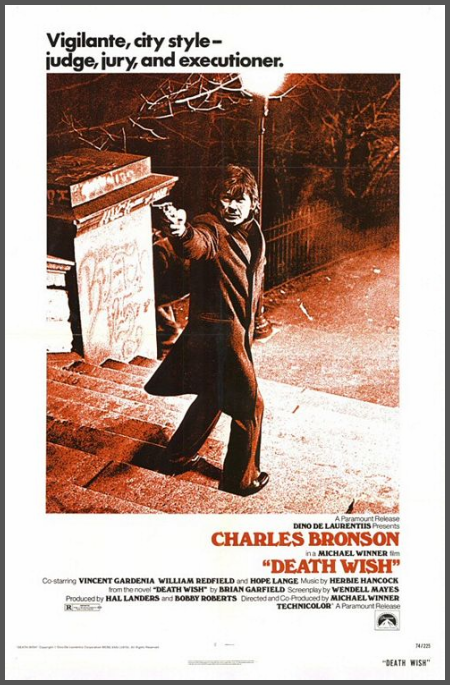
3) Death Wish (1974)

4) From Noon Till Three (1976)

5) Telfon (1977)

6) 10 to Midnight (1983)

What do you think, Trailer Kitty?

Music Video of the Day: Once Upon A Time In The West, performed by The Danish National Symphony Orchestra & Tuva Semmingsen (2018, dir by ????)


It’s Charles Bronson’s birthday so it only makes sense that today’s music video should be for a performance of the Ennio Morricone-composed theme of one of his best films.

Enjoy!

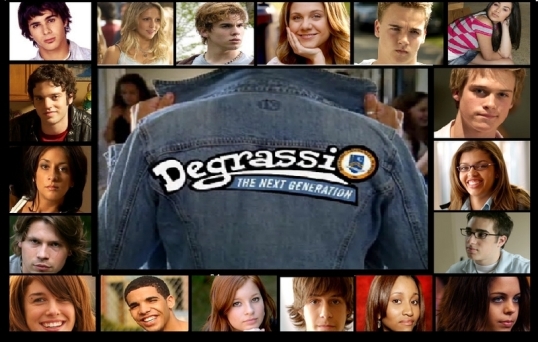
Late Night Retro Television Review: Degrassi: The Next Genreation 1.12 “Wannabe”


Welcome to Late Night Retro Television Reviews, a feature where we review some of our favorite and least favorite shows of the past!  On Sunday, I will be reviewing the Canadian series, Degrassi: The Next Generation, which aired from 2001 to 2015!  The series can be streamed on YouTube and Tubi.

This week, we get a peek into Degrassi’s future.

Episode 1.12 “Wannabe”

(Dir by Laurie Lynd, originally aired on June 10th, 2002)

This week’s episode is a good example of Emma Nelson being the worst person possible.

Paige and Hazel (Andrea Lewis) are planning on relaunching the Degrassi Spirit Squad, with help of Oskar (Fielding Horan), a character who I’m pretty sure was never seen again after this season.  Manny, a trained gymnast, wants to join the Spirit Squad and does a cartwheel in the school hallway for her audition.  It looks like Manny is finally going find a life outside of being Emma’s supportive friend and….

Uh-oh, Emma looks mad.

Yes, Emma is angry again.  She writes an editorial for the school newspaper, calling the Spirit Squad a sexist relic and saying that the only people interested in it are bimbos.  For some reason, the newspaper runs the editorial, which leads me to suspect that they have no faculty sponsor.

Paige, Manny, and Hazel responds by grabbing every issue of the paper and ripping out Emma’s editorial.  That is some of the funniest and most realistic high school behavior ever.  However, the show expects for us to be as upset as Emma.  No, I’m sorry.  Emma’s editorial was out-of-line and was clearly written by someone who had a personal issue with Paige.  (Never mind that Paige was the one who came to Emma’s rescue when Emma got her first period while wearing a white skirt….)  A responsible editor wouldn’t have published it.  If I said to Arleigh, “Hey, you know that former film blogger in Canada with whom I had that extremely petty argument 15 years ago?  I’m going to write a surprise, 1,000-word post calling him a loser just because I’m in a bad mood,” Arleigh would rightfully suggest that I reconsider.  Add to that, every editorial that Emma has written has sounded like scoldy crap but, during the first season at least, Emma was such a creator’s pet that we weren’t supposed to notice.

Mr. Simpson confronts Paige and Manny about vandalizing the Degrassi Grapevine.  Paige says that she saw Hazel doing it.  Manny realizes that Paige cannot be trusted!  Paige tells Manny that she’ll be lucky to make the Spirit Squad unless she adjusts her attitude.

Of course, those of us who have seen Degrassi knew the future.  Despite Emma’s whining, The Spirit Squad is going to become one of the show’s mainstays.  Manny is going to make the squad and become friends with Paige.  Meanwhile, Hazel is eventually going to be retconned into a Somalian refugee who ends up dating Jimmy until he gets shot in the back.  Meanwhile, Emma will marry Spinner and….

Oh yeah, Spinner!  Poor Spinner!  In this episode, Spinner gets stuck in one of the lamest Degrassi storylines ever.  Toby, JT, and Liberty think that they have a Pringles can that will win them a million dollars in some weird Canadian Pringles sweepstakes.  Spinner decides that he wants some of the money as well and J.T. and Toby say sure because they’re like 4’11 and Spinner is like 5’10.  But it turns out that JT had the wrong can so no one wins anything.  Yes, it’s just that dumb.

Again, it’s good to know the future when watching the Pringles subplot.  J.T. will never become rich because he’s going to be brutally murdered during his senior year.  Before he dies, J.T. will manage to impregnant Liberty and Liberty will give the child up for adoption.  Meanwhile, Toby will end up hosting a Canadian robotics competition.  (Yeah, I don’t quite understand it myself….)  And Spinner will end up flunking three times before graduating at the age of 21.  And even then, he still hung out around the school until he was like 30.  Never underestimate how far this show would go to keep a popular character around.

This episode was pretty lame but historically, it was very important.  Not only was it the first episode to feature Spirit Squad drama but it was also one of the first episodes to suggest (albeit unintentionally) that Emma was essentially a sociopath who couldn’t stand to see her friends happy.  This episode was a harbinger of Degrassi’s future.

Happy Birthday to Katharine Isabelle who starred with Charles Bronson on YES VIRGINIA, THERE IS A SANTA CLAUS!


Charles Bronson came back to the world of movies after his wife Jill Ireland passed away with the sweet 1991 TV movie YES VIRGINIA, THERE IS A SANTA CLAUS. I’m wishing a happy birthday to Kartharine Isabelle who was so good as Virginia!

Great Moments In Comic Book History #44: The Amazing Spider-Man #33


On what would have been Steve Ditko’s 98th birthday, let’s remember his greatest moment as the artist who first truly brought Spider-Man to life.

From The Amazing Spider-Man #33:

Previous Great Moments In Comic Book History:

  1. Winchester Before Winchester: Swamp Thing Vol. 2 #45 “Ghost Dance” 
  2. The Avengers Appear on David Letterman
  3. Crisis on Campus
  4. “Even in Death”
  5. The Debut of Man-Wolf in Amazing Spider-Man
  6. Spider-Man Meets The Monster Maker
  7. Conan The Barbarian Visits Times Square
  8. Dracula Joins The Marvel Universe
  9. The Death of Dr. Druid
  10. To All A Good Night
  11. Zombie!
  12. The First Appearance of Ghost Rider
  13. The First Appearance of Werewolf By Night
  14. Captain America Punches Hitler
  15. Spider-Man No More!
  16. Alex Ross Captures Galactus
  17. Spider-Man And The Dallas Cowboys Battle The Circus of Crime
  18. Goliath Towers Over New York
  19. NFL SuperPro is Here!
  20. Kickers Inc. Comes To The World Outside Your Window
  21. Captain America For President
  22. Alex Ross Captures Spider-Man
  23. J. Jonah Jameson Is Elected Mayor of New York City
  24. Captain America Quits
  25. Spider-Man Meets The Fantastic Four
  26. Spider-Man Teams Up With Batman For The Last Time
  27. The Skrulls Are Here
  28. Iron Man Meets Thanos and Drax The Destroyer
  29. A Vampire Stalks The Night
  30. Swamp Thing Makes His First Cover Appearance
  31. Tomb of Dracula #43
  32. The Hulk Makes His Debut
  33. Iron Man #182
  34. Tawky Tawny Makes His First Appearance
  35. Tomb of Dracula #49
  36. Marvel Publishes Star Wars #1
  37. MAD Magazine Plays Both Sides
  38. The Cover of Green Lantern/Green Arrow #85
  39. LBJ Stands Up For The Hulk
  40. Chamber of Chills #2
  41. Tomb of Dracula #41
  42. Tomb of Dracula #27
  43. X-Men Meet Frankenstein’s Monster

Retro Television Review: Homicide: Life On The Street 4.13 “I’ve Got A Secret”


Welcome to Retro Television Reviews, a feature where we review some of our favorite and least favorite shows of the past!  On Sundays, I will be reviewing Homicide: Life On The Street, which aired from 1993 to 1999, on NBC!  It  can be viewed on Peacock.

Ring ring.  “Homicide.”

Episode 4.13 “I’ve Got A Secret”

(Dir by Gwen Arner, originally aired on February 2nd, 1996)

This week, almost everyone has a secret.

For example, when Pembleton and Bayliss are called in about a man found dead in his car, they discover that, earlier in the day, he went to a local ER after being shot.  The gunshot wound, which was accidental, didn’t kill him.  Instead, it was the internal bleeding that the doctor either missed or intentionally ignored.  Dr. Kate Wystan (Mimi Kennedy) may come across as being a selfless doctor who has dedicated her life to helping the residents of Baltimore’s most crime-ridden neighborhood but Pembleton and eventually Bayliss come to suspect that her secret is that, because the victim was black and a known criminal, she didn’t give him the same standard of care that she gives to her other patients.  Pembleton considers this to be murder, though it sounds more like a case of malpractice than anything else.

Munch spots Kay kissing a man outside of police headquarters and he becomes obsessed with trying to figure out who the man is.  He’s always believed that Kay is happy being single and alone.  (Uhm, hello?  Munch?  Remember when she dated Ed Danvers?)  Kay’s secret is that apparently she has a life outside of Homicide.

Finally, Lewis and Kellerman spend the entre episode chasing a burly man who is wanted for killing both of his parents.  At first, this entire storyline feels almost like a parody of NBC’s request that the series start featuring more action.  Lewis and Kellerman spend the entire first half of the episode chasing this guy through allies and pool halls and every time, they fail to catch him.  There’s none of the badass heroics that we’ve come to expect from cop shows.  Eventually, Lewis reveals that his brother is in a mental institution.  When Lewis tries to visit his brother, he’s just turned away.  Lewis’s secret is that he actually cares about his brother.

This was an okay episode.  By this point in the series, Homicide had reached the point where it could do an episode where the true enjoyment came less from the storyline and more from just listening to the characters talk to each other.  I really didn’t care much about the crimes that they were investigating.  Instead, I just enjoyed listening to Pembleton and Bayliss talk and bounce ideas off of each other.  They’ve come along way since the day that Bayliss objected to Pembleton’s interrogation technique and Pembleton shouted that he would never have a partner.  By the same token, Kellerman and Lewis have their own unique chemistry that is fun to experience.  They’re like the sensitive frat cops.  As for Munch and Kay, they should just hook up already.  It’s obvious to everyone that they’re in love!

Maybe that’s their secret?