Guilty Pleasure No. 106: The Troubles of Janice (by Erich von Götha)


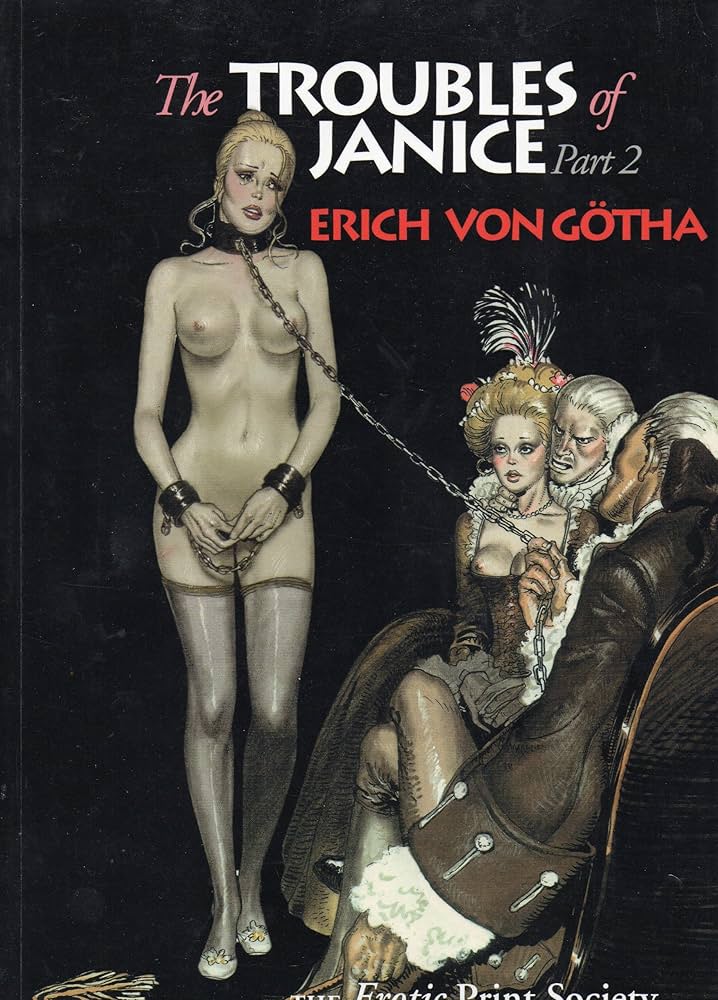
The Troubles of Janice by Erich von Götha remains one of the most infamous works in erotic comics, a multi-volume series spanning 1987 to 1996 that draws readers into a vivid world of sadomasochistic intrigue amid the lavish decay of 18th-century England. Janice McCormick, a curvaceous young woman released from Newgate Prison, soon finds herself ensnared by the sadistic Duke Viscount Vauxhall of Nether Wallop, whose experiments in female discipline propel her through a cascade of blackmail, assassinations, and sensual escapades—from the clandestine Hellfire Club to the shimmering waterways of Venice. Serialized initially in French magazines and later compiled into albums such as Parts 1 through 4, the narrative echoes the spirit of the Marquis de Sade’s Philosophy in the Bedroom, pitting innocence against unbridled authority in panels brimming with exaggerated forms and explicit encounters that straddle the edge of terror and desire.

This series thrives squarely in guilty pleasure territory, offering a procession of BDSM scenarios tailored for indulgent, after-hours reading—Janice bound and enduring floggings, group violations, and ceremonial degradations at the hands of depraved aristocrats, clergy, and a imposing black servant named Horace, whose prominence marks the early chapters. The artwork begins with a raw, straightforward style, its stark lines accentuating phallic prominence and voluptuous contours, but evolves across the run into more refined techniques, incorporating nuanced shading, occasional full-color pages, and fluid compositions that convey genuine motion. Under the pseudonym of British artist Robin Ray, von Götha refined his craft from earlier projects like the sporadic Torrid comic of the 1980s, achieving here a theatrical intensity that elevates rote erotica into something akin to a decadent opera. Janice’s subjugation under Vauxhall builds to extravagant bacchanals, her figure a stage for boundless transgression, sustained by slender plotlines: a doomed union with Lord Mitchcombe, clerical extortion of her fortune, and a desperate flight to Venice. It delivers unvarnished pornographic fantasy, where non-consent heightens the illicit allure, interwoven with dated racism, sexism, and brutality that clash with contemporary standards.

Nevertheless, amid its sensationalism, The Troubles of Janice carries a sly undercurrent that resonates as guilty pleasure, while dedicated admirers in specialized erotica and Sadean circles regard it as elevated art for its bold dissection of dominance and moral corruption. Enthusiasts praise von Götha’s fidelity to historical particulars—powdered periwigs, flickering chambers, and rigid social strata—which grounds the excess in authenticity, recasting Janice’s sufferings as a pictorial meditation on control and yielding. The work’s longevity, evidenced by deluxe reprints into 2008 via publishers like Dynamite and Priaprism/Last Gasp, underscores this devoted following, as initial stark visuals mature into polished depictions of perspiration, anguish, and rapture rendered with technical finesse. Partnership with writer Bernard Joubert lends philosophical weight reminiscent of Sade’s justifications for indulgence, complemented by von Götha’s advertising and design heritage, which infuses each frame with compelling, voyeuristic magnetism.

The episodic structure fosters escalating drama without pause: Janice’s journey from captive to bereaved inheritor to elusive temptress parallels gothic archetypes, her physique weathering not only corporal trials but subtle emotional fissures that suggest deeper psyche amid the torment. Venetian interludes in subsequent volumes add worldly elegance, with Janice alluring period luminaries amid carnivalesque revels and canal rendezvous, a momentary reprieve prior to recapture. Visually, the shift from monochrome austerity to vivid palettes enlivens flesh tones and intensifies ominous depths. Fair assessment reveals shortcomings, however: proportions veer toward the grotesque, recurring motifs dull the initial impact, and pervasive misogyny, though fitting the fantastical milieu, borders on excess even for 1980s sensibilities. Stereotypes such as Horace’s portrayal jar in modern light, affirming its roots in London’s pre-PC erotic underbelly.

Within insular communities, such elements paradoxically enhance its stature—collectors and forums acclaim von Götha as a virtuoso of restraint, his standalone prints and mythic illustrations perpetuating the legacy, bolstered by exhibitions in Bologna and Paris that confer artistic validity. To the broader audience, it embodies quintessential guilty pleasure—discreetly concealed material that fulfills taboo yearnings sans apology. The Troubles of Janice persists by unflinchingly engaging the subconscious, compelling confrontation with shadowed impulses through line and shade. Whether approached for its carnality or its Sadean resonances, The Troubles of Janice endures as a divisive masterpiece, ideally encountered with caution.

Previous Guilty Pleasures

  1. Half-Baked
  2. Save The Last Dance
  3. Every Rose Has Its Thorns
  4. The Jeremy Kyle Show
  5. Invasion USA
  6. The Golden Child
  7. Final Destination 2
  8. Paparazzi
  9. The Principal
  10. The Substitute
  11. Terror In The Family
  12. Pandorum
  13. Lambada
  14. Fear
  15. Cocktail
  16. Keep Off The Grass
  17. Girls, Girls, Girls
  18. Class
  19. Tart
  20. King Kong vs. Godzilla
  21. Hawk the Slayer
  22. Battle Beyond the Stars
  23. Meridian
  24. Walk of Shame
  25. From Justin To Kelly
  26. Project Greenlight
  27. Sex Decoy: Love Stings
  28. Swimfan
  29. On the Line
  30. Wolfen
  31. Hail Caesar!
  32. It’s So Cold In The D
  33. In the Mix
  34. Healed By Grace
  35. Valley of the Dolls
  36. The Legend of Billie Jean
  37. Death Wish
  38. Shipping Wars
  39. Ghost Whisperer
  40. Parking Wars
  41. The Dead Are After Me
  42. Harper’s Island
  43. The Resurrection of Gavin Stone
  44. Paranormal State
  45. Utopia
  46. Bar Rescue
  47. The Powers of Matthew Star
  48. Spiker
  49. Heavenly Bodies
  50. Maid in Manhattan
  51. Rage and Honor
  52. Saved By The Bell 3. 21 “No Hope With Dope”
  53. Happy Gilmore
  54. Solarbabies
  55. The Dawn of Correction
  56. Once You Understand
  57. The Voyeurs 
  58. Robot Jox
  59. Teen Wolf
  60. The Running Man
  61. Double Dragon
  62. Backtrack
  63. Julie and Jack
  64. Karate Warrior
  65. Invaders From Mars
  66. Cloverfield
  67. Aerobicide 
  68. Blood Harvest
  69. Shocking Dark
  70. Face The Truth
  71. Submerged
  72. The Canyons
  73. Days of Thunder
  74. Van Helsing
  75. The Night Comes for Us
  76. Code of Silence
  77. Captain Ron
  78. Armageddon
  79. Kate’s Secret
  80. Point Break
  81. The Replacements
  82. The Shadow
  83. Meteor
  84. Last Action Hero
  85. Attack of the Killer Tomatoes
  86. The Horror at 37,000 Feet
  87. The ‘Burbs
  88. Lifeforce
  89. Highschool of the Dead
  90. Ice Station Zebra
  91. No One Lives
  92. Brewster’s Millions
  93. Porky’s
  94. Revenge of the Nerds
  95. The Delta Force
  96. The Hidden
  97. Roller Boogie
  98. Raw Deal
  99. Death Merchant Series
  100. Ski Patrol
  101. The Executioner Series
  102. The Destroyer Series
  103. Private Teacher
  104. The Parker Series
  105. Ramba

Guilty Pleasure No. 104: The Parker Series (by Richard Stark)


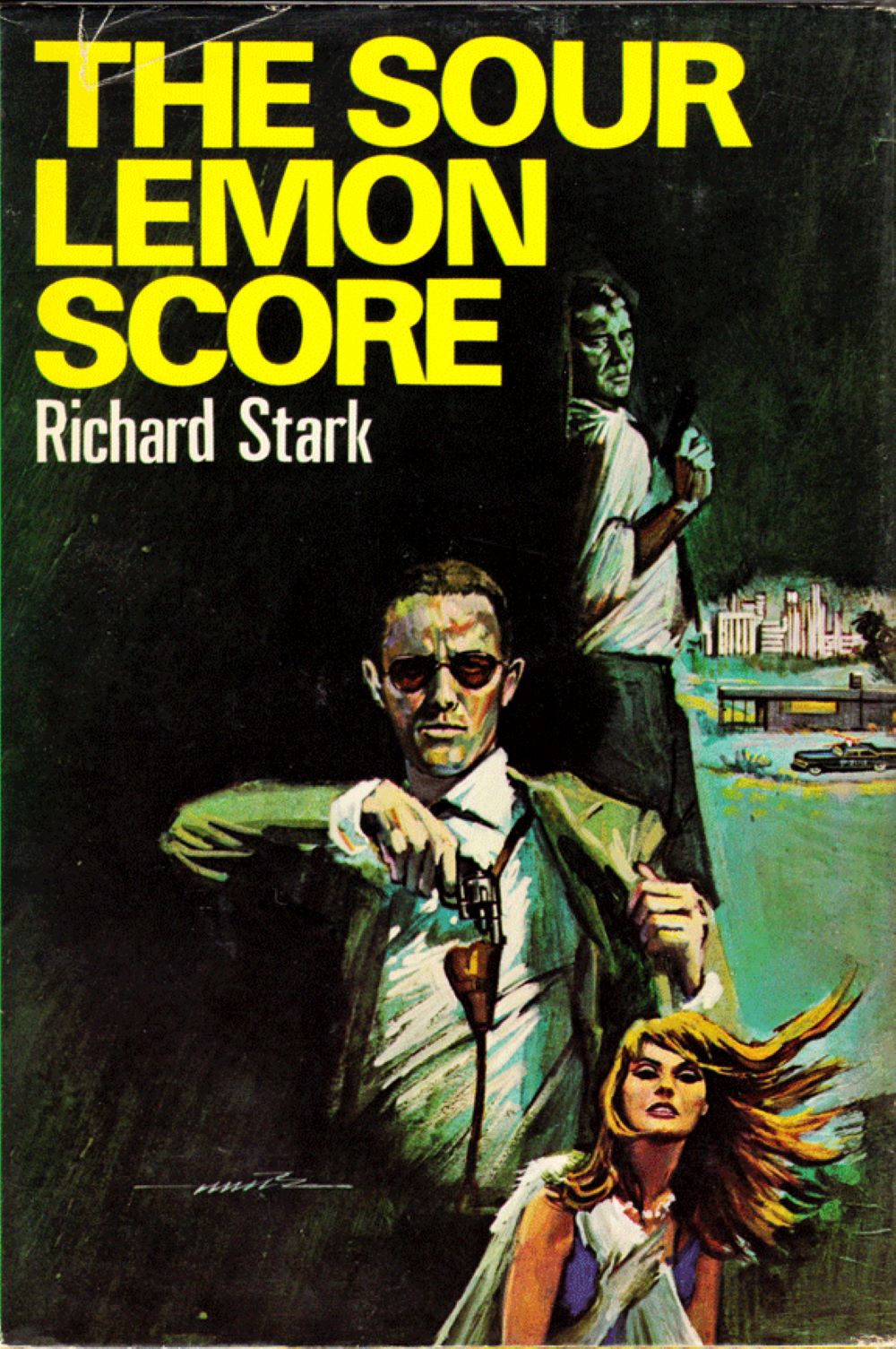
Richard Stark’s Parker novels are the kind of crime fiction that feel like they’re bad for you in all the right ways: lean, mean, amoral heist stories that work as both clinical studies of professional thieves and utterly shameless page‑turners. Taken across the 24-book run, from The Hunter in 1962 through Dirty Money in 2008, the series is remarkably consistent, yet also strange and jagged enough that you never quite relax into it. Reading Parker is like chain‑smoking noir paperbacks—self‑aware guilty pleasure with just enough bite and bleakness that you can pretend it’s good for you.

The basic premise barely changes, and that’s part of the appeal. Parker is a professional robber who prefers big, high‑yield scores: armored cars, payrolls, entire towns temporarily cut off from the world. He’s not an antihero in the modern prestige‑TV sense so much as a working stiff whose job happens to be violent crime, a man who approaches robbery with the same cold professionalism most people reserve for accounting. In The Hunter, the novel that kicks everything off, he’s double‑crossed by his wife and partner, shot, and left for dead, and the story is essentially one long act of payback as he claws his way back to New York and into the orbit of the Outfit, the crime syndicate that ultimately ends up with his money. That mix of stripped‑down revenge and procedural detail sets the tone for almost everything that follows, even when the later books drift away from personal vendetta into cleaner, job‑of‑the‑week capers.

What makes the series work—what makes it weirdly addictive—is how mercilessly Donald Westlake (under the Stark pseudonym) commits to Parker as an almost inhuman constant in a chaotic world. He’s often described by fans as a kind of force of nature, and that tracks with how he moves through these books: stoic, unadorned, perpetually assessing angles, crew members, and exit routes. Traditional redeeming qualities—sentimentality, guilt, even much curiosity about other people—just aren’t there; what you get instead is a kind of brutal efficiency that, perversely, becomes its own charisma. The guilty‑pleasure element kicks in because the novels quietly invite you to enjoy watching a ruthless pro outthink and outmuscle everyone in his path, even though the moral framework is closer to nihilism than romantic outlaw fantasy. There’s pleasure in the competence and in the clean lines of the plotting, even as you’re aware you’re rooting for someone who treats human beings like moving parts in a job.

Formally, the books have a recognizable skeleton that Stark keeps returning to and subtly bending. Most of the novels are divided into four sections: first, Parker’s point of view as he’s planning or executing a job; second, a continuation that usually ends with a betrayal or reversal; third, a shift into the perspective of whoever is double‑crossing or hunting him; and finally, a return to Parker as he fixes what’s gone wrong and settles accounts. This architecture does a couple things. It gives the series a strong procedural rhythm that fans can relax into—you know there will be a job, a screw‑up, and a payback—but it also keeps the tension high by delaying gratification until that fourth‑quarter rampage. You get both the chess match and the inevitable explosion. It’s formulaic in the same way a great blues progression is formulaic: you come for the structure, you stay for the particular variations each time.

The prose is another major part of the series’ guilty‑pleasure charge. Westlake pares the language down to something close to bare steel; the description is sparse, the sentences short, the dialogue practical and unfussy. Reviewers frequently point to how there’s “not a wasted word,” and that seems right: you feel like every line is there to move money, people, or bullets into position. In an age where a lot of thriller writing leans on verbosity and constant internal monologue, Parker’s tight focus can feel almost cleansing. At the same time, that same spareness means the violence can land with an extra jolt—there’s no cushioning around it, no moral throat‑clearing, just the fact of what Parker decides to do when someone gets in his way.

Across the series, the quality is not perfectly even, and that’s where a fair, balanced take has to admit some dips. The early stretch—The HunterThe Man with the Getaway FaceThe OutfitThe Score, and The Jugger—has a raw momentum and a sense of discovery as Westlake works out how far he can push a protagonist this cold. Later titles, especially in the first run up to Butcher’s Moon, often expand the canvas, giving more time to side characters and to elaborate, multi‑phase heists. Some readers and critics consider The Score, with its audacious robbery of an entire mining town, a high‑water mark; others see it as simply a particularly well‑executed entry in a series where the baseline is already high. Then, after the long break between the 1970s and the 1990s revival with Comeback and Backflash, you can feel Westlake adjusting the formula to a slightly different era, with Parker still fundamentally the same but the world around him updated. Those later books are often solid and occasionally excellent, but the sheer shock of the early ones is hard to recapture.

From a modern perspective, one of the more interesting tensions in reading Parker is the question of identification. The books are not satire, and they aren’t quite celebrations; they’re closer to case files written with a strong sense of style. The theme that emerges most strongly is the amoral logic of criminal enterprise: loyalty is provisional, greed is constant, and institutions—whether the Outfit or banks or small‑town cops—are just different power systems to be exploited. There’s no sentimental criminal code here, only practical rules about not talking, not freelancing, and not getting sloppy. That worldview can be bracing and, frankly, kind of fun to inhabit for a few hundred pages at a time, particularly because Westlake doesn’t ask you to endorse it; he just drops you in and lets you watch how it operates.

At the same time, that detachment and hardboiled minimalism can turn some readers off. If you need emotional growth, redemptive arcs, or a sense that the universe punishes the wicked, Parker is going to feel either empty or actively hostile to your expectations. The closest the series comes to sentiment is in Parker’s occasional, grudging respect for other professionals who do their job well—safecrackers, drivers, heist planners—and even that is strictly bounded by the demands of survival and profit. Women, in particular, can feel underwritten or instrumental in some entries, especially the earlier books, reflecting both the genre conventions of the time and the series’ focus on Parker’s narrow, self‑interested worldview. It’s possible to argue that this is part of the point—these are Parker’s stories, and he does not care about anybody’s inner life—but it does mean the books can feel airless if you’re reading a bunch in a row.

Still, that’s the strange magic of Parker: for all the limitations and repetitions, you finish one and almost immediately think about the next job, the next crew, the next betrayal. The series taps into a very specific pleasure center: watching a ruthlessly competent person navigate systems stacked with corruption and stupidity, using only planning, discipline, and a willingness to hit back harder than anyone expects. It’s not aspirational, and it’s not comforting, but it is undeniably gripping. If you can accept an unapologetically amoral center and you have a taste for stripped‑down crime fiction with a strong procedural spine, Parker is easy to devour and just as easy to feel a little guilty about enjoying as much as you do.

Previous Guilty Pleasures

  1. Half-Baked
  2. Save The Last Dance
  3. Every Rose Has Its Thorns
  4. The Jeremy Kyle Show
  5. Invasion USA
  6. The Golden Child
  7. Final Destination 2
  8. Paparazzi
  9. The Principal
  10. The Substitute
  11. Terror In The Family
  12. Pandorum
  13. Lambada
  14. Fear
  15. Cocktail
  16. Keep Off The Grass
  17. Girls, Girls, Girls
  18. Class
  19. Tart
  20. King Kong vs. Godzilla
  21. Hawk the Slayer
  22. Battle Beyond the Stars
  23. Meridian
  24. Walk of Shame
  25. From Justin To Kelly
  26. Project Greenlight
  27. Sex Decoy: Love Stings
  28. Swimfan
  29. On the Line
  30. Wolfen
  31. Hail Caesar!
  32. It’s So Cold In The D
  33. In the Mix
  34. Healed By Grace
  35. Valley of the Dolls
  36. The Legend of Billie Jean
  37. Death Wish
  38. Shipping Wars
  39. Ghost Whisperer
  40. Parking Wars
  41. The Dead Are After Me
  42. Harper’s Island
  43. The Resurrection of Gavin Stone
  44. Paranormal State
  45. Utopia
  46. Bar Rescue
  47. The Powers of Matthew Star
  48. Spiker
  49. Heavenly Bodies
  50. Maid in Manhattan
  51. Rage and Honor
  52. Saved By The Bell 3. 21 “No Hope With Dope”
  53. Happy Gilmore
  54. Solarbabies
  55. The Dawn of Correction
  56. Once You Understand
  57. The Voyeurs 
  58. Robot Jox
  59. Teen Wolf
  60. The Running Man
  61. Double Dragon
  62. Backtrack
  63. Julie and Jack
  64. Karate Warrior
  65. Invaders From Mars
  66. Cloverfield
  67. Aerobicide 
  68. Blood Harvest
  69. Shocking Dark
  70. Face The Truth
  71. Submerged
  72. The Canyons
  73. Days of Thunder
  74. Van Helsing
  75. The Night Comes for Us
  76. Code of Silence
  77. Captain Ron
  78. Armageddon
  79. Kate’s Secret
  80. Point Break
  81. The Replacements
  82. The Shadow
  83. Meteor
  84. Last Action Hero
  85. Attack of the Killer Tomatoes
  86. The Horror at 37,000 Feet
  87. The ‘Burbs
  88. Lifeforce
  89. Highschool of the Dead
  90. Ice Station Zebra
  91. No One Lives
  92. Brewster’s Millions
  93. Porky’s
  94. Revenge of the Nerds
  95. The Delta Force
  96. The Hidden
  97. Roller Boogie
  98. Raw Deal
  99. Death Merchant Series
  100. Ski Patrol
  101. The Executioner Series
  102. The Destroyer Series
  103. Private Teacher

Song of the Day: Hooray for Santa Claus by Milton DeLugg and the Little Eskimos


Did everyone have a good Christmas?  Did everyone get everything that they wanted?

If the answer’s yes, you have one man to thank for that!

Hooray for Santy Claus!

(You might recognize this song from one of our favorite holiday classics, Santa Claus Conquers The Martians!)

Music Video Of The Day: Wonderful Christmastime by Paul McCartney (1979, directed by ????)


As a group, The Beatles never released an “official” Christmas song, though the members of their fan club received a recording of Christmas Time Is Here Again in 1967.  After the band broke up, all four of the members recorded Christmas songs on their own.  Paul McCartney’s Wonderful Christmastime is probably the most remembered.  I don’t know if I would say it was the most popular but anyone who has ever had to rush out to do some last minute Christmas shopping has heard it playing in countless stores on December 24th.  Whenever I’ve been in a store while Wonderful Christmastime was playing, I’ve always felt as if the song was taunting me but it is definitely a part of the season.

McCartney recorded this song at his farm.  He was just getting into what was then known as “electropop,” which is why he used a Sequential Circuits Prophet-5 synthesizer in the song.  More than anything, that weird bouncing noise probably explains why this song is so well-known.  Whenever I hear this song, I imagine that this is what Christmas sounds like on Mars.

The video was shot at at the Fountain Inn in Ashurst, West Sussex.  Though the members of Wings had nothing to do with recording the song, they all appeared in the video because they were all hanging out with McCartney on the night that it was filmed.

Reportedly, Paul McCartney receives $400,000 a year in royalties from Wonderful Christmastime.

Enjoy!

Song of the Day: Why? by Herve Villechaize


Since I just reviewed the final Tattoo episode of Fantasy Island, let’s say goodbye with today’s song of the day.

In 1981, at the height of Fantasy Island’s popularity, Villechaize released a song called “Why?”  It’s all about trying to understand why people have to fight and why people cannot just accept the wisdom of peace-loving children.  The video at the top of this post was recorded for a TV show on which Villechaize appeared.  Unfortunately, I don’t know which show it was for and the video upload itself is not the best quality.  Apparently, the split-screen visual effect that gives us two Herves singing at once was a part of the show.

That said, why do we always have to fight?

Song of the Day: Hooray for Santa Claus by Milton DeLugg and the Little Eskimos


Did everyone have a good Christmas?  Did everyone get everything that they wanted?

If the answer’s yes, you have one man to thank for that!

Hooray for Santy Claus!

(You might recognize this song from one of our favorite holiday classics, Santa Claus Conquers The Martians!)

Music Video of the Day: Why by Herve Villechaize (1981, dir by ????)


For the past few months, I’ve been watching and reviewing episodes of the original Fantasy Island.  One of the keys to that show’s success was the enigmatic partnership between Mr. Roarke and Tattoo.  Even though it’s usually pretty easy to see that Ricardo Montalban and Herve Villechaize did not like each other, their exchanges are usually the highlight of any episode.  Of course, after years of high ratings and television fame, Villechaize was fired from Fantasy Island when he demanded more money.  Without Tattoo, the series was canceled after one season so …. well, they probably should have just given him the money.

Anyway, one thing that I recently discovered about Herve Villechaize is that he had a musical career!  In 1981, at the height of the show’s popularity, he released a song called “Why?”  It’s all about trying to understand why people have to fight and why people cannot just accept the wisdom of peace-loving children.  The video at the top of this post was recorded for a TV show on which Villechaize appeared.  Unfortunately, I don’t know which show it was for and the video upload itself is not the best quality.  Apparently, the split-screen visual effect that gives us two Herves singing at once was a part of the show.

That said, this is as close as we have to an actual music video for Herve Villechaize’s Why? so I’m sharing with it.  What better way to start a new year than with a plea for peace?

Why do we always have to fight?

Enjoy!

Guilty Pleasure No. 56: Once You Understand By Think


Things get a little easier

Once you understand

That is the message of TSL’s latest guilty pleasure, a little song from 1971 called Once You Understand.  In case you missed that message the first time, don’t worry.  It will be repeated.  In fact, it’s the only lyric in the entire song.  The song starts with one voice singing, “Things get a little easier/once you understand” but soon, several other voice join in until there’s a heavenly choir of sorts.  It’s really enthusiastic choir, too.  In fact, it’s so enthusiastic that it’s a little bit creepy.  No one’s that happy about understanding.

While the voices are singing to us that things get a little easier once you understand, we also get to listen to a few scenes from the late 60s/early 70s generation gap.  The scenes are acted out by a bunch of uncredited actors who give it the old community theater try.  We listen to teenagers argue with their parents and parents talk down to their children and what we immediately notice is that no one is trying to understand and therefore, things will never get a little easier.

One mother accuses her daughter of doing more than babysitting and demands that she stay out of a certain neighborhood.  A father demands that his son get a haircut and reminds him that he had to work hard when he was young.  Another kid is super excited to have gotten a guitar and he’s planning on starting a band.  His father replies that there’s more to life than music.

Things get a little easier

Once you understand

Things get a little easier

Once you understand

Things get a little

Suddenly, the music stops.  We listen as one of the fathers gets a tragic phone call about his son, the one that he didn’t understand.  The father sobs uncontrollably as the song ends and I guess it could, in theory, have been a powerful moment if not for the fact that father is so obviously reading a script.  The other problem is that 99% of the song consists of parents acting like jerks but then, in the final few moments, it turns out that at least one of the parents was right about his son throwing his life away.  So maybe, it was the son who needed to understand.  Who knows?

Anyway, Once You Understand is one of those songs that’s often included in lists of the worst songs of all time.  However, much like The Dawn of Correction, I like Once You Understand because it is so totally a product of its time.  It’s a cultural artifact and listening to it is a bit like stepping into a time machine.  That said, I kind of doubt this song inspired anyone to understand.  If anything, everyone comes across as being kind of whiny.

Previous Guilty Pleasures

  1. Half-Baked
  2. Save The Last Dance
  3. Every Rose Has Its Thorns
  4. The Jeremy Kyle Show
  5. Invasion USA
  6. The Golden Child
  7. Final Destination 2
  8. Paparazzi
  9. The Principal
  10. The Substitute
  11. Terror In The Family
  12. Pandorum
  13. Lambada
  14. Fear
  15. Cocktail
  16. Keep Off The Grass
  17. Girls, Girls, Girls
  18. Class
  19. Tart
  20. King Kong vs. Godzilla
  21. Hawk the Slayer
  22. Battle Beyond the Stars
  23. Meridian
  24. Walk of Shame
  25. From Justin To Kelly
  26. Project Greenlight
  27. Sex Decoy: Love Stings
  28. Swimfan
  29. On the Line
  30. Wolfen
  31. Hail Caesar!
  32. It’s So Cold In The D
  33. In the Mix
  34. Healed By Grace
  35. Valley of the Dolls
  36. The Legend of Billie Jean
  37. Death Wish
  38. Shipping Wars
  39. Ghost Whisperer
  40. Parking Wars
  41. The Dead Are After Me
  42. Harper’s Island
  43. The Resurrection of Gavin Stone
  44. Paranormal State
  45. Utopia
  46. Bar Rescue
  47. The Powers of Matthew Star
  48. Spiker
  49. Heavenly Bodies
  50. Maid in Manhattan
  51. Rage and Honor
  52. Saved By The Bell 3. 21 “No Hope With Dope”
  53. Happy Gilmore
  54. Solarbabies
  55. The Dawn of Correction