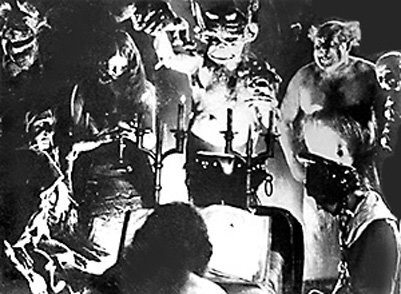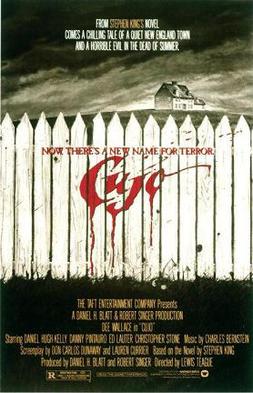
Director Robert Siodmak is remembered today for his dark excursions into the world of film noir: THE SUSPECT, THE KILLERS , CRY OF THE CITY, CRISS CROSS . His first entry in the genre is generally recognized as 1944’s PHANTOM LADY , but a case could be made for SON OF DRACULA, Siodmak’s only Universal Horror that combines elements of both genres into what could best be described as supernatural noir.
A train pulls into the station in a sleepy Louisiana town. Frank Stanley (Robert Paige) and Dr. Brewster (Frank Craven ) are there to meet Count Alucard, invited for a visit by Kay Caldwell (Louise Albritton), Frank’s fiancé, who has long been interested in the occult. Alucard isn’t aboard, but his trunks are, and Brewster notices Alucard spelled backwards reads as Dracula. The trunks are delivered to Kay’s family plantation, Dark Oaks. The scene shifts, and…
Back in September, I was browsing at the local Barnes & Noble (as I frequently do, given the lack of independent bookstores around here) looking for something to review this Halloween season. I’d just finished with Stephen King’s REVIVAL (Pocket Books paperback, 2017), and while it’s good, everybody does King this time of year, and I wanted something different. I wandered through the fantasy section, and waaaay up on the top shelf I spotted a title that caught my interest. DARK DETECTIVES: An Anthology of Supernatural Mysteries, combining two of my favorite genres, horror and detective fiction! Curiosity piqued, I grabbed the book and bought it (along with the great James Lee Burke’s latest novel, ROBICHEAUX).
DARK DETECTIVES, first published as a limited edition in 1999, features ten short stories, some old, some written especially for the anthology, by authors I’m familiar with (and I assume you are too, if…
The 1974 film Silent Night, Bloody Night is an oddity.
On the one hand, it’s pretty much a standard slasher film, complete with a menacing mansion, a horrible secret, a twist ending, and John Carradine playing a mute newspaper editor.
On the other hand, director Ted Gershuny directs like he’s making an underground art film and several of the supporting roles are played by actors who were best known for their association with Andy Warhol.
Personally, I like Silent Night, Bloody Night. It has a terrible reputation and the film’s star, Mary Woronov, has gone on record calling it a “terrible movie” but I like the surreal touches the Gershuny brought to the material and the sepia-toned flashbacks have a nightmarish intensity to them. The film makes no logical sense, which actually makes it all the more appealing to me. As the saying goes, your mileage may vary.
For today’s music video of the day, we have yet another song called Dracula. However, as you can tell by looking at the lyrics, this song actually has some connection to everyone’s favorite vampire (or, at the very least, the legend of everyone’s favorite vampire):
Her She was a dancer Feel As the girl she twirls off the edge of her paper-thin world
The “I” Give to the Master Mirror, mirror Can you tell one from the other? Strange I offer my veins Feel As the girl she twirls off the edge of her paper-thin world
Oh in the night When Dracula comes to fill your soul To atone, confess My one true weakness My Dracula, Count Dracula
Her She was a dancer (First I must appease my thirst) Feels Good you know as the girl she twirls off the edge of her world
Oh in the night When Dracula comes to fill your soul To atone, confess My one true weakness My Dracula, Count Dracula
According to singer Moana Mayatrix, “I’d say it’s not directly about vampires but more so an exploration of vampire mythology and the allure of the dark side, much like being seduced by a Bram Stoker character.”
Kolchak investigates a series of accidents at a hospital and discovers that they’re all connected to a recently reawakened monster known as the Matchemonedo! This episode features the great character actor William Smith as Jim Elkhorn, who teams up with Kolchak to battle the Matchemonedo.
This episode originally aired on December 13th, 1974.
Seriously, those little wooden things totally freak me out. You know how some of you feel about the painted smile on the clowns ‘face? Well, that’s how I feel whenever I see the big eyes of a ventriloquist dummy or that mouth with the fake teeth. And don’t even get me started on those tiny little legs that some of them have! AGCK!
I mention this because there is a ventriloquist’s dummy in the 1980 film, Humanoids From The Deep. There’s really no reason for it to be in the film but suddenly, out of nowhere, there it is. It belongs to a teenager named Billy who, when we first see him, is relaxing in a tent on the beach, trying to get his girlfriend to undress for him and the dummy. Of course, they’re promptly interrupted by a seaweed-covered monster, who rips open the tent, kills Billy, and chases after his girlfriend. The whole time, the dummy watches with a somewhat quizzical expression on his face. It’s a strange scene.
Now, I’ve done some research and I’ve discovered that Billy was played by David Strassman, who was (and still is) a professional ventriloquist and his dummy was named …. I do not kid …. Chuck Wood. So, the whole tent scene was kind of a celebrity cameo. Roger Corman, who produced the film, said, “You know what? This movie has blood, nudity, killer fish-men, and rampant misogyny but it’s still missing something! How about that ventriloquist that I saw on the Tonight Show last night!?”
Anyway, Humanoids From The Deep is basically about what happens when you try to mutate salmon. You end up with a bunch of pervy fish monsters swarming the beach and trying to make like human/fish babies. You end up with a lot of dead teens and unplanned pregnancies. You also end up with the local redneck fisherman (led by Vic Morrow) blaming the local Native Americans, accusing them of killing all of the dogs in town. Jim Hill (Doug McClure) and his wife, Carol (Cindy Weintraub), try to keep the peace but their efforts are continually tripped up by the fact that almost everyone in town is an idiot.
For instance, despite the fact that there’s been a countless number of murders and rapes and that they’ve all been committed a group of monsters that nobody knows how to fight, the town still decides to hold their annual festival on the pier. Of course, as soon as the obnoxious DJ starts broadcasting, the humanoids from the deep show up and basically, the entire festival goes to Hell. And here’s the thing. The film itself is ugly and mean-spirited and misogynistic but the attack on the festival is totally and completely brilliant. I mean, it’s one of the greatest monster sieges of all time, largely because the monsters are apparently unstoppable and that humans are so obnoxious that you don’t mind seeing them all die. I mean, if nothing else, the monster deserve some credit for taking out that DJ.
It all leads to a “surprise” ending, which isn’t particularly surprising but which is so batshit insane that it somehow seems appropriate.
Humanoids From The Deep is an incredibly icky movie, one that has some effective scare scenes but which is way too misogynistic to really be much fun. (Roger Corman hired Barbara Peeters to direct the film but reportedly brought in a male director to film the movie’s more explicit scenes.) Oh well. At least the ventriloquist died.
This scene, of course, is from 1980’s The Shining.
Technically, this is before Jack Torrance met the ghosts and started to lose his mind but, in this scene, you can tell that Jack’s already getting a little bit tired of his family. Jack Nicholson’s delivery of, “See? It’s okay. He heard it on the television,” gets me every time.
Maggie Healey (Linda Blair) is an American nurse in Australia. Freshly separated from her drug addict boyfriend, Maggie gets a job working at a mental hospital. Dr. Jonathan Heckett (Tony Bonner) is experimenting with “dead sleep therapy,” where the patients are kept drugged at night. Maggie notices that the patients keep dying and that Dr. Heckett doesn’t care so she teams up with an annoying activist to investigate what dead sleep therapy is actually about.
This was on TCM at 3 a.m. last night, airing right after Dreamscape. Dead Sleep might be disguised as a horror film but there’s nothing scary about it. When the patients are in dead sleep, they don’t even have nightmares, which is a huge missed opportunity. The movie is so sloppily put together that it doesn’t even reveal why Dr. Heckett is putting his patients in dead sleep, other than he’s just evil. Linda Blair delivers her lines as if she is reading them off a cue card and the entire movie look like it was filmed at a community college. The only amusing thing about the movie was that all of the male patients got to wear hospital gowns when they went under deep sleep while all the female patients slept topless. Normally I wouldn’t complain but it was so blatant what the filmmakers were doing that it was hard not to laugh when the movie tried to pivot to being a serious drama. A film starring Linda Blair has no right to be this boring.
If you were to ask me to recommend one book to someone who is looking for an introduction to the world of Italian horror, Eaten Alive is the book that I would recommend.
That’s largely because this book was my introduction. Way back in 2006, I came across a copy at Recycled Books in Denton, Texas and I bought it. I bought it because, at the time, I was already into horror movies. However, after reading the reviews and the essays in this book, I discovered that I wanted to learn much more about Italian horror. Outside of Suspiria and a few giallos like Blade in The Dark, the first Italian horror movies that I specifically tracked down and watched were the movies that I read about in this book. If not for Eaten Alive, I would never have seen the wonderfully macabre and disturbing Beyond the Darkness. This was book was also my first real exposure to Lucio Fulci. If not for this book, I never would have seen Zombi 2. I never would have discovered the Beyond trilogy.
In fact, considering that Arleigh and I first bonded over Italian horror, it’s doubtful that I would be writing for this site if I had not made that decision to buy Eaten Alive.
As for the book itself, it’s a comprehensive overview of Italian cannibal and zombie cinema. Along with containing information about every Italian cannibal and zombie film released in the 20th Century, it also features interviews with stars like Ian McCullough, Catriona MacColl, and GIovanni Lombardo Radice. (Radice even reviews one of the films himself.) The majority of the films are reviewed by Jay Slater but there are also contributions from writers like Ramsey Campbell and Lloyd Kaufman. (In fact, Kaufman writes a rather stirring defense of one of the more controversial films to be found in Eaten Alive, Cannibal Holocaust. Campbell, meanwhile, thoroughly destroys Nights of Terror.)
Seriously, if you’re interested in learning more about Italian horror or if you’re already a fan, this book is a must!
Universal’s 1943 remake of the 1925 Lon Chaney Sr. classic THE PHANTOM OF THE OPERA is definitely an ‘A’ movie in every way. A lavish Technicolor production with an ‘A’ list cast (Claude Rains, Nelson Eddy, Susanna Foster) and opulent sets (including the Opera House interiors built for the ’25 silent), it’s the only Universal Horror to win an Oscar – actually two, for Art Direction and Cinematography. Yet I didn’t really like it the first time I saw it. It’s only through repeated viewings I’ve softened my stance and learned to appreciate the film.
Claude Rains’s performance in particular has made me a convert. As Erique Claudin, he’s a sympathetic figure, and one can’t help but feel sorry for him. When he’s let go from the orchestra by the maestro, after twenty long years as a violinist, his arthritis causing his playing to become subpar, I felt pity for…