4 Or More Shots From 4 Or More Films is just what it says it is, 4 shots from 4 of our favorite films. As opposed to the reviews and recaps that we usually post, 4 Shots From 4 Films lets the visuals do the talking!
This October, I’m going to be doing something a little bit different with my contribution to 4 (or more) Shots From 4 (or more) Films. I’m going to be taking a little chronological tour of the history of horror cinema, moving from decade to decade.
Today, we take a look at the early 50s!
4 Shots From 4 Horror Films: The Early 50s
The Thing From Another World (1951, dir by Christian Nyby, DP: Russell Harlan)
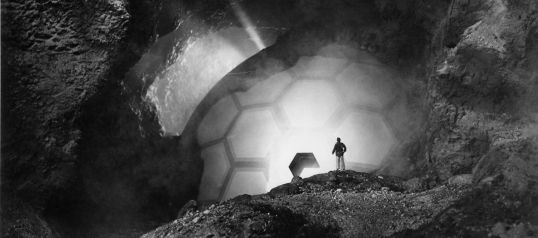
It Came From Outer Space (1953, dir by Jack Arnold, DP: Clifford Stine)
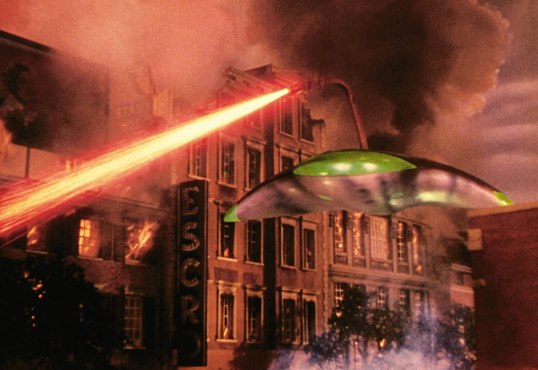
The War of the Worlds (1953, dir by Byron Haskin, DP: George Barnes)
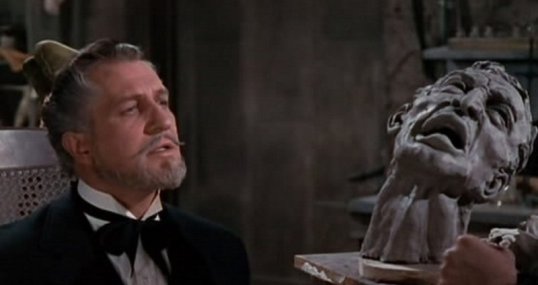
House of Wax (1953, dir by Andre de Toth, DP: Bert Glennon, J. Peverell Marley, and Lothrop B. Worth)
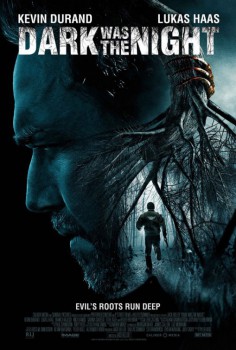
The 2014 horror film, Dark Was The Night, takes place in the town of Madison Woods.
Madison Woods is a small, isolated town that is located somewhere up north. It’s one of those dreary blue collar towns where everyone knows everyone else. Most of the citizens work in the logging industry, attend the same church, and drink at the same bar. It’s not a town where much happens. The police force consists of two guys, Sheriff Paul Shields (Kevin Durand) and his new deputy, Donny Saunders (Lukas Haas). Donny worked in New York City before moving to Madison Woods. Shields is currently estranged from his wife. That’s the type of thing that passes for big news in Madison Woods.
When one of the local farmers complains that one of his horses has disappeared, Shields and Saunders assume that the horse has just run off. When other animals start to disappear, Shields continues to insist that it’s all just a coincidence. When the local hunters start to talk about an ancient legend of a monster that lives in the woods, Shields replies that there are no monsters and, for good measure, there’s no God as well. (In many ways, Shields is a perfect example of the old joke about how the best way to spot an atheist is to wait a few minutes and he’ll tell you.) Even when weird cloven footsteps start to show up around town and Shields himself spots something in his backyard, the Sheriff continues to insist that there is a rational explanation for all of this. Meanwhile, Saunders hangs out at the bar and drinks and really, who can blame him? As far as I can tell, it’s not like Madison Woods has a movie theater or anything like that. It’s a really boring town. You can either develop the beginnings of a drinking problem or you can start random fights or you can get ripped apart by the thing in the woods. Make your choice.
Eventually, Shields and Saunders do discover that there is something lurking out in the woods. And, despite their attempts to come up with a rational explanation, the creature proves itself to be more than just some animal. Instead, it’s a true supernatural monster, tracking its prey through the community. As a group of loggers discover at the start of the movie, the creature is just as quick to attack humans as it is to go after deer and other wild animals. With the entire town locked away in the church basement (because, as Night of the Living Dead proved, the basement is always the safest place), Saunders and Shields try to figure out how to stop a monster that neither one of them has ever seen before.
Dark Was The Night was loosely inspired by a true story. In 1885, the citizens of Topsham in the UK were stunned to wake up one cold morning and discover a series of cloven footprints in the snow. The footprints led through the entire city and it appeared that whatever was responsible for them had stopped in front of every house and place of business. Some claimed that the footprints belonged to the devil while others said that it was just some sort of animal. The Devil’s Footprints, as the story became known, serves as a bit of Rorschach test. Those inclined to believe in the supernatural have little trouble believing that the Devil visited the town of Topsham while the more rational among us assume that the footprints were left by a wild animal and then people saw whatever they wanted. Dark Was The Night moves the story to the modern day and to America but the question remains the same. Is there really a monster in the woods or, as Shields initially believes, are people just seeing what they want to see? Unfortunately, the film reveals the monster’s existence within its opening minutes. The film would have perhaps been more effective if there had at least been some mystery about whether or not Shields’s initial instincts were correct.
Dark Was The Night is a deliberately paced film, which again would be more effective if there was any mystery at all as to whether or not the monster actually existed. On the plus side, the film is full of atmosphere and Kevin Durand and Lukas Haas are both effective as the two lawmen who find themselves in over their heads. Fans of Lost will remember Durand as the evil Martin Keamy, who was one of the most heartless characters to ever appear on that show or any other show. Durand gets to play the hero in Dark Was The Night and gives a good performance as a man who discovers that not everything has a rational explanation. That said, while the film has some interesting ideas and performances, it ultimately becomes just another monster-laying-siege film and the ending is one that most viewers will see coming from miles away. It’s not a bad film but it’s still never quite as good as one might hope.
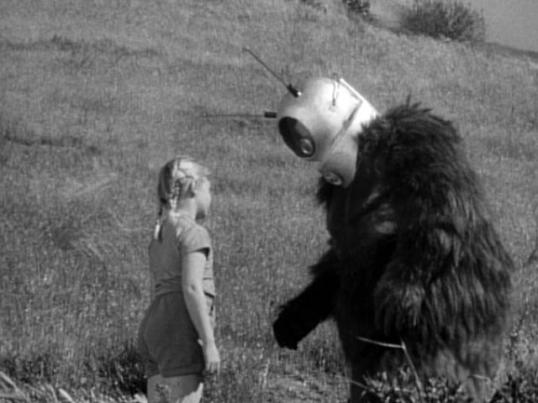
Today’s horror film is a true classic of its kind, the 1953 science fiction epic Robot Monster.
Now, I should admit that this is not the first time that I’ve shared Robot Monster in October. I share it every year and, every year, YouTube seems to pull the video down in November. That sucks because Robot Monster is one of those weird films that everyone should see. So, I’m going to share it again. And, hopefully, YouTube will let the video stay up for a while.
As for what Robot Monster is about…
What happens with the Earth is attacked by aliens? Well, first off, dinosaurs come back to life. All of humanity is killed, except for one annoying family. Finally, the fearsome Ro-Man is sent down to the planet to make sure that it’s ready for colonization. (Or something like that. To be honest, Ro-Man’s exact goal remains a bit vague.)
Why is Ro-Man so fearsome? Well, he lives in a cave for one thing. He also owns a bubble machine. And finally, perhaps most horrifically, he’s a gorilla wearing a diver’s helmet. However, Ro-Man is not just a one-dimensional bad guy. No, he actually gets to have a monologue about halfway through the film in which he considers the existential issues inherent in being a gorilla wearing a diver’s helmet.
Can humanity defeat Ro-Man? Will Ro-Man ever get his intergalactic supervisor to appreciate him? And finally, why are the dinosaurs there?
Despite the film’s reputation for being borderline incoherent, most of those above questions actually are answered if you pay attention to the first few scenes of Robot Monster. In fact, one could even argue that Robot Monster is maybe a little bit more clever than it’s often given credit for. Of course, it’s still a zero-budget mess of a film but it’s also undeniably fun and, in some sections, unexpectedly dark. If you’ve never seen it before, you owe it to yourself to set aside an hour and two minutes in order to watch it. You’ve never see anything like it before.
Finally, I should note that Robot Monster’s hero was played by George Nader, who actually did go on to appear in several mainstream films. Despite his good looks and talent (which may not be obvious in this film but which he did have), George Nader struggled to get starring roles in Hollywood, where he was often dismissed as just being a member of Rock Hudson’s entourage. (It’s been theorized that Nader struggled because the studios feared that giving him too big of a role would lead to the gossip magazines writing about Nader’s relationship with Hudson, though the two were just friends. Nader was in a relationship with Hudson’s private secretary, Mark Miller, from 1947 until Nader’s death in 2001.) Nader finally left Hollywood and went on to have a pretty successful career in Europe. He was perhaps best known for playing secret agent Jerry Cotton in a series of films in the 60s.
Though he had retired from the band to pursue a solo career, Dee Dee Ramone wrote Poison Heart and gave it to Ramones. The story has always been that Dee Dee gave them the song as a way to thank the band for bailing him out of jail. I don’t know if that story is true or not but it does have a ring of truth to it. Print the legend, to quote The Man Who Shot Liberty Valance.
The song appeared on the soundtrack for Pet Semetary 2 and the video is clearly inspired by that song, with the child being forcefully dragged through the cemetery while the band performs in what appears to be an underground tunnel.
This video was directed by Samuel Bayer, who has done videos for just about everyone.
In the 2nd episode of Ghost Story, an important lesson is learned. If you’re going to bury a sea captain, do not bury him in concrete because his spirit belongs to the ocean. Upset his spirit and he’ll basically ruin whatever hopes you have of bringing tourists to the seashore!
This episode stars Gena Rowlands and Stuart Whitman and it was directed by none other than Richard Donner. Donner, of course, would go on to direct such films as The Omen, Superman, and Lethal Weapon.
Enjoy!
(Despite the weird thumbnail, this video should work if you click play.)
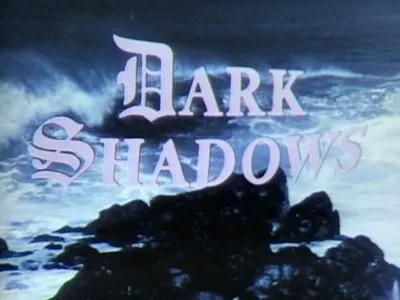
The year was 1967 and, in Collinsport, Maine, a petty criminal named Willie Loomis was about to make television history. Convinced that a fortune in jewelry was hidden in the Collins family’s mausoleum, Willie broke in and opened a coffin that, strangely, was covered in chains. Willie expected to find a fortune. Instead, he found Barnabas Collins, a 200 year-old vampire who transformed Willie into his servant and proceeded to spend the next five years masquerading as a cousin from Britain while searching for both a cure to his condition and for the reincarnation of the love of his life, Josette.
Played by stage actor Jonathan Frid, Barnabas Collins made his first appearance on the April 18th, 1967 episode of Dark Shadows. Though Barnabas was originally only meant to be a temporary addition to the show’s roster of characters, Frid proved to be popular with viewers, like my mother who not only watched the show when it first aired but also when reruns were broadcast in syndication many years later. The show soon came to center on the ruthless vampire.
In fact, Frid and Barnabas became some identified with the show that many are still shocked to learn that Dark Shadows had run for a full year before Barnabas was introduced as a character. When the show airs in syndication, it usually starts with Willie (played by John Karlen) opening Barnabas’s coffin and not with the earlier episodes in which the show’s nominal lead character, Victoria Winters, first arrived at Collinwood and met the members of the family.
Many future horror directors and writers have stated that their interest in the genre began with watching Jonathan Frid on Dark Shadows. And it all began with that one great moment when Willie Loomis opened the coffin and set Barnabas free.
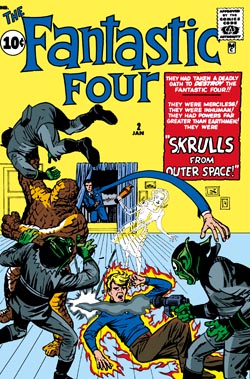
Just a few months after introducing themselves to the world, the Fantastic Four appear to be on a crime rampage! The Thing swims out to an oil rig and knocks it over with one punch. The Human Torch melts a memorial. The Invisible Girl steals jewelry. And when New York suffers a huge blackout, witnesses report seeing an arm stretching it’s way into a powerplant and flipping the off switch!
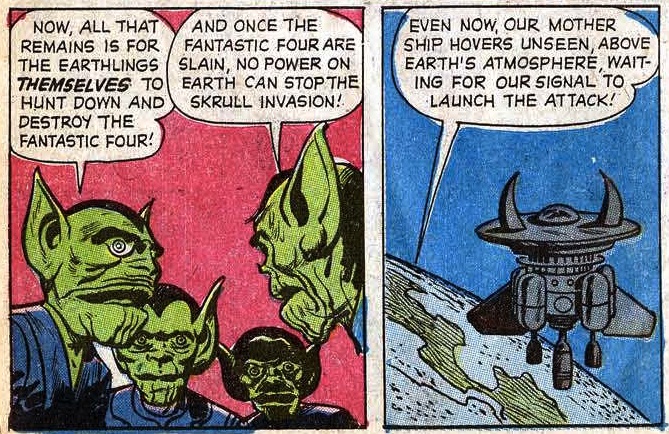
The Fantastic Four claim that they’re innocent and it turns out that they are. Four shape-shifting aliens, known as the Skrulls, have traveled to Earth and are pretending to be the Fantastic Four so that the government will turn on them and it will be easier for the Skrulls to take over the planet. Fortunately, Mr. Fantastic figures out what’s going on. Not only does he fool the Skrull commanders by showing them back issues of Journey Into Mystery and Strange Tales and saying that they’re actual newspapers about the monsters that exist on earth but he also hypnotizes three of the Skrulls on Earth and convinces them that they are cows.
I’ve always liked the Skrulls and it’s always bothered me that they seemed to lose almost every war that they got involved in. How could the Kree defeat the Skrulls? And was it necessary to add insult to injury by having Galactus eat their homeworld? The Skrulls just could not catch a break and I think that’s one reason why they’ve always been popular. With their ability to change their shape and adopt the powers of the heroes that they’re imitating, the Skrulls should have been unstoppable. They should have conquered this planet a long time ago. But the Skrulls, for all of their powers, could just never seem to get it together. To paraphrase Uncle Ben, with great power comes truly rotten luck.
Fantastic Four #2 was not only the first appearance of the Skrulls but it was also the first instance of a Marvel super hero team thwarting an invasion of Earth. (Eventually, Earth being invaded would become a monthly occurrence in the Marvel Universe.) The issue also introduced a major Marvel theme. The Fantastic Four may have saved the world from Mole Man just a few weeks before the Skrulls arrived but it didn’t take long for the general public to turn on them. It was a lesson that would later also be learned by Spider-Man and the X-Men. The general public is extremely fickle when it comes to its super heroes.
And it all started with four shape-shifters coming to Earth. The Skrulls may never win but Marvel still owes much to them.
Fantastic Four Vol. 1 No. 2
(September, 1962)
“The Fantastic Four Meets The Skrulls From Outer Space”
Script: Stan Lee Pencils: Jack Kirby Inks: George Klein Letters: John Duffy
I do love a good short film. I love a good comedy horror and loathe the ones that are terrible like this garbage trash “Origin” that I reviewed last year: https://unobtainium13.com/2021/10/06/origin-film-review-by-case-wright/ I’m not saying that the person who unleashed “Origin” or any terrible Short Film should be imprisoned forever, but I’m not saying that they shouldn’t either- Listen, I’ll back your play.
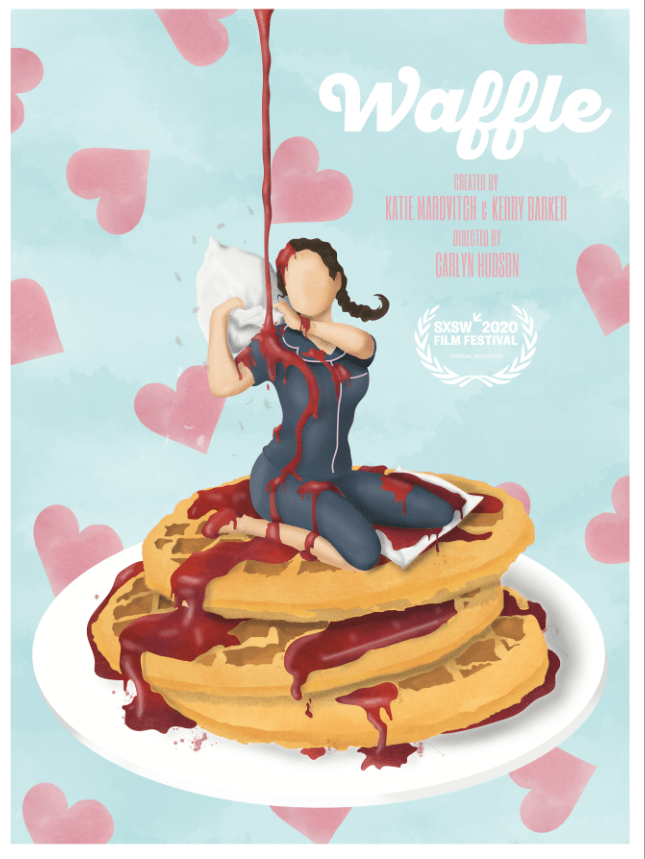
Waffle was ….. not bad. There were some stunners last year. I mean true artworks and please if you have the ability to hire these actors, writers, and directors – please call them. I’ll spot your month’s IMDB Pro dues if you do. *winks with sexy Italian eyebrows, makes click sound – Sup?*
Kate Marovitch and Kerry Barker created Waffle and they hit a number of good points. It’s a self-contained story. They were on a budget, but made the film look awfully slick. There’s a clear plot and narrative thread. I put this short-film in the good category, which I don’t give out lightly. Shorts are a unique storytelling artform- Every word matters and every second matters. I wouldn’t mind seeing another one of their shorts; however, I’d like to see what they could create for a series.
The short takes our phone induced isolation to another level. In this world, you rent friendship and love with a finger swipe, but Katie uses the evil Tinder to find her victims. Yes, this plot is straight-forward, but it had some funny lines and a heart. They are tapping into the interpersonal relationship version of there are “ten-thousand channels and nothing’s on.”
I don’t want to spoil the ending and would recommend this ten-minutes for you. Yes, you!
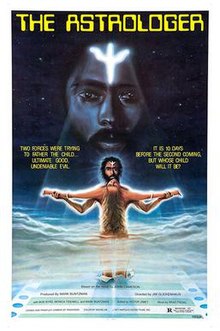
Quite possibly one of the most boring film ever made, 1975’s The Astrologer tells the story of …. well, I’m not really sure what the point of it all is.
Basically, an astrologer named Alexi Abarnel (Bob Byrd) has figured how to combine the zodiac with 70s technology and, as a result, everyone’s potential for good and evil can be determined simply by typing their birthdate into a computer. The U.S. government funds his agency, which is known as Interzod. And let’s be honest, that does sound like the type of dumbass thing that the government would fund, especially when the Democrats are in power.
According to the stars, the second coming of Christ is only a few days away. Alexi is convinced that he has married the woman who is destined to give birth to the Savior. Because of this, he refuses to consummate his marriage because it’s very important that she remain a virgin. However, he hasn’t bothered to inform her of any of this so poor Kate (Monica Tidwell) spends all of her time wondering why her husband hasn’t touched her in five years of marriage and why it’s also so important to him that she never tell anyone the actual date of her birth.
Meanwhile, a group of gypsies are traveling the country and, under the leadership of Kajerste (Mark Buntzman), they are both murdering people and also compelling people to commit suicide. Interzod is concerned about Kajerste because of his “zodiacal” potential but Alexei is also concerned that he doesn’t have Kajerste’s exact birthdate. But the fact that Kajerste is commanding his followers to kill people should be enough to clue Interzod into the fact that Kajerste is bad guy, regardless of whether he’s a Capricorn or an Aquarius. Fortunately, Interzod has come up with a plan on how to kill Kajerste, one that involves implanting thoughts in his head via electrodes and tranquilizer dots. A young congressman (Al Narcisse) wants to help because he’s so interested in Interzod’s work. However, it turns out that the ludicrously complicated plan to take out Kajerste is …. well, ludicrously complicated. If my tax money is going to fund Interzod, I would hope they would make better use of it.
The film’s plot definitely has the potential to be interesting but, unfortunately, The Astrologer is a very, very talky film. It only has a 78-minute running time and the majority of the film is made up people having very long and very dry conversations about how Interzod works and why its work is important. The problem is that there’s not really any need to convince the viewers that Interzod is important or to show us how it works. No watching this film is going to be interested in an in-depth examination of a fictional government agency. Everyone knows that this isn’t 60 Minutes and it’s not like the NSA has hand-picked the correspondent who is going to be reporting on them. This is a film about spies, astrology, and a killer cult. It should be a lot of fun but instead it’s incredibly boring.
That’s not to say that it’s a total waste. This was James Glickenhaus’s first film as a director. Glickenhaus went to direct some well-regarded action films in the 80s and there are a handful of isolated moments in The Astrologer where it is obvious that the film was made by someone who had a good visual eye. A cult ceremony scene that is almost totally made up of freeze frames is nicely done. And, as always, it’s hard not to admire the ambition of someone trying to make a metaphysical thriller and tackle the big questions of existence on a budget.
In the end, though, the most interesting thing about The Astrologer is its insistence on having its characters frequently use the term “zodiacal.” Take a drink every time that you hear someone say, “zodiacal” but don’t drive afterwards.


 Through the Shattered Lens