The Films of 2020: The Night Clerk (dir by Michael Cristofer)


“Tye Sheridan Is …. THE NIGHT CLERK!”

That’s not how The Night Clerk was advertised, though perhaps it should have been.  This is one of those overheated melodramas that’s so sure that it’s making a bigger statement than it actually is that it becomes somewhat fascinating to watch.  Usually, when we say that a film is fascinating to watch, we mean that it’s either fascinatingly good or fascinatingly bad.  The Night Clerk is fascinatingly middle-of-the-road.  It has opportunities to be good, largely due to the performances of Tye Sheridan and Ana de Armas.  And it has opportunities to be bad, largely due to the direction and script of Michael Cristofer.  Try as it might, the film never becomes truly good and yet it’s never truly bad, either.  It’s just kind of there.

The title character is Bart Bromley (Tye Sheridan), a young man who has Asperger’s syndrome and who works as a night desk clerk at a hotel.  He’s hidden cameras all over the hotel, so that he can observe the guests in their rooms.  He even watches the guests when he returns to the home that he shares with his mother, Ethel (Helen Hunt).  That’s undeniably creepy but we’re not supposed to hold that against Bart because he’s only watching the guests so that he can learn how to talk and communicate with other people.

(To be honest, the film is very lucky that Tye Sheridan was available to play Bart.  As written, Bart is not a particularly sympathetic character.  But Sheridan is such a likable actor and has such an appealing screen presence that you’re willing to overlook a lot of narrative inconsistencies where his character is concerned.)

Anyway, Bart ends up taking an interest in a guest named Karen (Jacque Gray) but, when Karen’s murdered, Bart becomes the number one suspect.  Even though Bart knows that Karen was killed by a mysterious man who had a distinctive tattoo, he can’t reveal how he knows that information.  When Bart is assigned to another hotel, he meets Andrea Riviera (Ana de Armas).  Andrea seems to take an interest in Bart but is she sincere or is she somehow involved with the murderer herself?

Do I really need to answer that question for you?

And again, the film is lucky that Ana de Arams was available to play Andrea because Andrea is another character who wouldn’t be particularly sympathetic if she had been played by a less appealing performer.  The film can never seem to make up its mind whether she’s a calculating femme fatale or a naive victim and it’s somewhat amazing that de Amas is able to give a good performance considering how badly Andrea is written.

The Night Clerk is one of those films that holds your interest while you watch it but it tends to fade from the memory as soon as it ends.  Sheridan and de Armas are appealing actors but the film’s central mystery isn’t a particularly interesting one.  When the mystery is finally solved, I was so underwhelmed that I kept waiting for another twist to suddenly pop up.  Surely, I kept saying, it can’t be that simple.  But yes, it is.  Though the hotels are impressively trashy, the film itself has a rather flat, uninteresting look and director Michael Cristofer never really brings the story together.  It’s a mess of a film but it does work as a testament to the talents of Tye Sheridan and Ana de Armas.

The Films of 2020: John Was Trying To Contact Aliens (dir by Matthew Killip)


If you were sending music into outer space in the hope of contacting aliens, what songs would you send?

That was the question that I found myself wondering as I watched the short documentary, John Was Trying To Contact Aliens.

John Was Trying To Contact Aliens is about John Shepherd, a Michigan man who became a bit of a local celebrity in the 70s with his attempts to contact extraterrestrials by beaming music into space.  John tried to send spacey music and, as far as we know, the aliens never responded.  It could be that they didn’t hear the music or maybe aliens, like all good people, just hate prog rock.  It could also be that the aliens did try to respond but they just couldn’t locate Michigan.  It happens.

Myself, if I was sending music to aliens, I’d probably send The Chemical Brothers.  Maybe The Crystal Method.  I would definitely send a lot of Britney Spears because I think that the aliens would definitely want to meet Britney.  Taylor Swift’s great but I probably wouldn’t send her music to any aliens because I think the aliens would be like, “Those humans are just going to sing about what jerks we are after we leave.”  I think the aliens would like Saint Motel so I’d probably be sure to broadcast My Type at least three times a day.  I love Big Data but I think Dangerous would scare the aliens off.  I can’t say that I’d have any more luck than John Shepherd did but, to be honest, I don’t know if I would want aliens landing in my backyard.  I’m not really a fan of unexpected guests.

Of course, John Way Trying To Contact Aliens is not really a film about aliens.  Instead, it’s a character study of a man who most people would probably consider to be an eccentric.  John starts the film telling us about why he wanted to contact aliens and what type of music he thought the aliens would like.  He seems like he’s quirky in a likable sort of way.  It’s only as the film goes on that we find out about John’s childhood and his search for extraterrestrial life goes from being quirky to being poignant.

Abandoned by his mother and raised by his grandparents, John knew he was gay from an early age.  Growing up and living in rural Michigan, he was an outsider.  As he explains it, he felt that everyone around him knew that there was something different about him and, as a result, he didn’t feel comfortable with any of them.  He felt like an alien on Earth so it only made sense that he would try to contact real aliens.  His search for aliens had less to do with making his science fiction dreams come true and more about just trying to make some sort of connection with someone who was as “different” as he felt himself to be.

Fortunately, this 16-minute documentary has a happy ending.  Though John may not have found aliens, he did find love.  It’s a sweet documentary and a moving story and it can currently be viewed on Netflix.

The Films of 2020: A Fall From Grace (dir by Tyler Perry)


Let us take a few minutes to praise Tyler Perry.

Seriously, so much time and energy has been devoted to writing about the numerous flaws that can be found in the majority of Perry’s film that I do think we can spare a few minutes to acknowledge all of the goods things about Tyler Perry.

First off, though he undeniably has an ego, Tyler Perry appears to be a decent human being and he frequently puts his money to good use.  At a time when we’ve gotten used to hearing terrible things about some of the richest and most famous men around, Tyler Perry is unique in that we don’t ever seem to hear anything particularly negative about him as a person.

Secondly, Tyler Perry has proven himself to be a far better actor than I think anyone originally gave him credit for being.  Just check out his performance in Gone Girl, for instance.  He took a stock role, the flamboyant attorney, and played it with such wit and intelligence that he become one of the most interesting characters in the film.

Third, Tyler Perry’s films — regardless of what the critics may think of them — have provided roles for a lot of talented black actors and actresses who often don’t get the type of roles that they deserve from Hollywood.

Fourth, Tyler Perry proved that there was a market out there for all sorts of films made for and by black people.  Though many are still loathe to admit, Tyler Perry has played a huge role in changing the way the film industry views black audiences.

With all that in mind, it’s kind of tragic that, for all the good things that you can say about him, he’s still an absolutely terrible director.  There’s nothing wrong with having an ego (and, as my fellow site contributors can tell you, I’ve certainly got a healthy one myself) but I sometimes think that the same ego that has allowed Perry to become a success and do so much good has also prevented him from growing as a director.  How else do you explain that, after having directed over 20 films, Tyler Perry still often seems like a very enthusiastic film student who is just now making his first feature?  How else do you explain that he’s keeps making the same rookie mistakes — i.e., boom mics slipping into the shot, continuity errors, and melodramatic tone changes that often seem to come out of nowhere — even though he’s been doing this for 16 years?

This brings us to A Fall From Grace.

A Fall From Grace was Tyler Perrry’s 21st film as a director.  It was also the first film that he made for Netflix and he also apparently shot it in 5 days.  There aren’t many directors, outside of Roger Corman, who can claim to have shot an entire film in 5 days.  Most directors, of course, would know that you need more than 5 days to shoot a film, especially one that wants to explore a serious issue.  Corman may have spent two days on Little Shop of Horrors but that’s a movie about a talking plant.  A Fall From Grace takes on the criminal justice system.

Jasmine (Bresha Webb) is a public defender who doesn’t get emotionally involved with her clients and who almost always makes a plea deal.  Her husband (Matthew Law) is a cop who is haunted by a recent suicide.  Jasmine’s latest client is Grace Walters (Crystal Fox), who has been arrested for murdering her husband (Mehcad Brooks).  Grace wants to plead guilty but Jasmine suspects that there might be more to the case than anyone realizes.  Why Jasmine suddenly takes an interest in taking Grace’s case to trial is never really that clear but it does lead to a lot of melodrama and a lot of rather clumsy flashbacks.  Eventually, Jasmine just kind of stumbles onto the truth and has to fight to reveal what really happened.

The story is nearly impossible to follow and the film’s action often seems to drag.  Probably the best thing about the film is that Perry himself plays Jasmine’s sarcastic boss.  Perry has a truly impressive beard and he seems to be having fun with the character.  Crystal Fox gives an effective performance as Grace and Phylicia Rashad has some good moments as Crystal’s friend.  Even Mehcad Brooks is convincing, even if he does get stuck with the film’s worst lines.  But Bresha Webb and Matthew Law are boring as the main couple and the story gets bogged down with flashbacks.  It’s just not a very good film.

Still, the film was reportedly one of the most viewed movies on Netflix during the weekend of its release.  The critics may not have embraced the film but Perry has shown repeatedly that you don’t need the critics on your side to be a success.


Julius Caesar (1970, directed by Stuart Burge)


In ancient Rome, under the direction of Cassius (Richard Johnson), several members of the Senate conspire to kill Julius Caesar (John Gielgud), believing that his death is the only way to preserve the Republic.  Even Caesar’s longtime friend, Brutus (Jason Robards), is brought into the conspiracy.  Unfortunately for the conspirators, after Caesar’s murder, Mark Antony (Charlton Heston) gives his famous speech asking the Romans to lend him their ears and the Roman citizens turn against Caesar’s murderers and instead look to Antony and Octavius (Richard Chamberlain) to lead them.

This was the first adaptation of William Shakespeare’s play to be filmed in color and the assassination of Caesar was portrayed much more graphically than in previous productions.  By the end of the attack, Caesar has been stabbed so many times and there’s so much blood on screen that it doesn’t seem like he should even have the strength to say, “Et tu, Brute?”  Despite the then-modern innovations, this version still feels creaky and stiff.  When Caesar makes his appearance on the Ides of March, all of the conspirators actually stand in a neat line while Caesar enters the Senate.  When Mark Anthony and Brutus make their speeches, the extras playing the Roman citizens looked bored and disinterested.

For most viewers, the appeal of this version of Julius Caesar will be for the cast, which was considered to be all-star in 1970.  Along with Gielgud, Robards, Heston, Johnson, and Chamberlain, the cast also features Robert Vaughn as Casca, Christopher Lee as Artemidorous, Jill Bennett as Calpurnia, and Diana Rigg as Portia.  Surprisingly, it’s Jason Robards, the Broadway veteran, who struggles with Shakespeare’s dialogue, delivering his lines flatly and without much emotion.  Meanwhile, Charlton Heston steals the entire film as Mark Antony, nailing Antony’s funeral oration and proving himself to be much more clever than the conspirators had originally assumed.  (Of course, Mark Antony was the Charlton Heston of his day so I guess it shouldn’t be too much of a surprise that Heston is perfect in the role.)  I also liked Diana Rigg’s performance in the small role of Portia and Robert Vaughn’s devious interpretation of Casca.

Though he plays Caesar here, John Gielgud previously played Cassius in the 1953 version of Julius Caesar, the one with James Mason and Marlon Brando.  That is still the version to watch if you want to see the definitive adaptation of Julius Caesar.

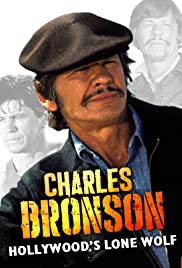
Charles Bronson, Hollywood’s Lone Wolf (2020, directed by Jean Lauritano)


How did a former Pennsylvania coal miner who was born Charles Buchinsky eventually transform himself into Charles Bronson, one of the world’s biggest movie stars?

That’s the question that’s examined in this short documentary.  Filled with scenes from Bronson’s films and clips of the tight-lipped interviews that he gave throughout his career, Charles Bronson, Hollywood’s Lone Wolf takes a look at Bronson’s life and film persona.  It attempts to explain the appeal of a notoriously inexpressive actor who, unlike many of his contemporaries, never went out of his way to win any popularity contests.  Unfortunately, the documentary struggles to tell us much that we didn’t already know about Bronson.  Even when, after years of trying, he finally became a Hollywood superstar, Bronson was still known for keeping to himself.  Much like the characters that he played, Bronson was someone who kept his feeling under wrap.  Lacking any contemporary interviews with the people who knew Bronson and who worked with him, the documentary often has to rely on what Bronson said and, unfortunately, Bronson never said much.

Another problem with the documentary is that it doesn’t seem to have been made by people who actually liked Charles Bronson’s films.  While Once Upon A Time In The West, The Mechanic, and Rider on the Rain are all rightfully praised, Death Wish is dismissed as reactionary and many of the films that he made in the 70s — including some of his best, like From Noon Till Three, Raid on Entebbe, and Telefon — are ignored all together.  While it’s true that Bronson’s films were rarely critically acclaimed, doesn’t it seem like a documentary about Charles Bronson should be made by people who actually dig his movies?

The documentary is at its best when it examines how much of Bronson’s career was fueled by his own bitterness towards his poverty-stricken childhood and the many years in which Hollywood refused to give him decent roles.  Bronson comes across as being surly, a little bit mean, and not someone to mess around with.  At the same time, when he’s with his second wife, Jill Ireland, Bronson seems like a totally different man.  He actually smiles!  Ireland brought out Bronson’s nice side.  With Ireland, Bronson relaxes in a way that most of the characters that he played would never have allowed himself to.  After Ireland’s death in 1990, Bronson is described as having been devastated but he subsequently used that pain to give one of his best performances, in Sean Penn’s The Indian Runner.

The documentary ends by noting that Quentin Tarantino dedicated Kill Bill Volume 1 to his memory.  No one, we’re told, knows how Bronson would have felt about it.  That sounds about right.  I think that really was what made Charles Bronson a superstar.  No one knew what he was thinking but everyone wanted to find out.

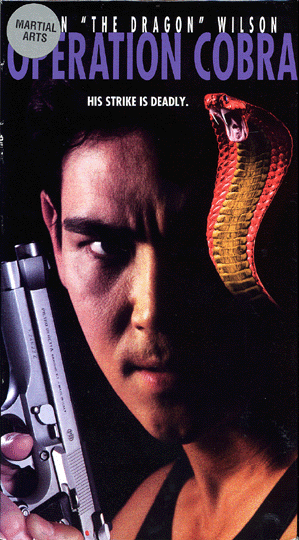
Cinemax Friday: Operation Cobra (1997, directed by Fred Olen Ray)


Interpol agent Kyle Connors (kickboxing legend Don “The Dragon” Wilson) is sent into a tailspin when his partner, Trevor (Rick Hill), is apparently killed during a failed operation.  Connors’s boss (played by the film’s director, Fred Olen Ray) orders Connors to go on leave so Connors promptly heads over to India.  Connors is planning on capturing Daveed (Evan Lurie), the drug dealer who Kyle blames for murdering Trevor.

While searching for Daveed with the help of an honest (and obviously doomed) cop named Ravi (R. Madhavan), Connors has several battles with a group of Indian ninjas who are intent on capturing a mysterious woman named Shallimar (Deepti Bhatnagar).  Connors also meets yet another mysterious woman, Callista (Tane McClure), who claims to be an intelligence agent and who tells him that Daveed’s boss is actually the enigmatic Victor Grayson (Michael Cavanaugh).  While Connors is tracking down Grayson, he finds out about yet another shadowy crime boss known as The Hydra and a computer disk that can apparently be used to hack into computer in the known world.

Can you guess who The Hydra actually is?

As any aficionado of late night Cinemax can tell you, Don “The Dragon” Wilson and Fred Olen Ray are a match made in heaven.  If you were growing up in the 90s, you knew Don “The Dragon” Wilson was cool because everyone who talked about him used both his given name and his nickname.  He was never just “Don Wilson” or “The Dragon.”  Instead, he was Don “The Dragon” Wilson.  Though Wilson never had much screen presence, he was a good on-screen fighter and the fact that he wasn’t a typically muscle-bound action hero made him more interesting than an ‘actor” like Steven Seagal.  Fred Olen Ray, meanwhile, was smart enough to get out of the way and let Wilson kickbox his way through the movie.  Though the story is nearly impossible to follow, a few good fight scenes more than make up for it.  Ray understands that is what most of his audience (maybe all of his audience) is going to be watching for.

Though the plot of Operation Cobra never makes any sense, most people will know what they’re going to get when they see who directed it and who is starring in it.  Even though the film wasn’t shot in the most photogenic areas of India (because that would have cost too much money), it still makes good use of its location footage and it’s hard not to be entertained by a film features Don “The Dragon” Wilson, Tane McClure, Rick Hill, and Evan Laurie.  That’s B-action movie nirvana.  I also liked that it was never entirely clear what the computer disk actually did but that it was extremely important than it not fall in the wrong hands.  It was the ultimate MacGuffin and because the film was made in 1997, it wasn’t necessary to go into details.  All that had to be said was that it had something to do with computers and that automatically made it a big deal.  That’s just the way things were in the 90s.

4 Shots From 4 Films: Special Brian De Palma Edition


4 Shots From 4 Films is just what it says it is, 4 shots from 4 of our favorite films. As opposed to the reviews and recaps that we usually post, 4 Shots From 4 Films lets the visuals do the talking!

Today, we wish a happy 80th birthday to director Brian De Palma with….

4 Shots From 4 Films

Carrie (1976, dir by Brian De Palma)

Scarface (1983, dir by Brian De Palma)

Body Double (1984, dir by Brian De Palma)

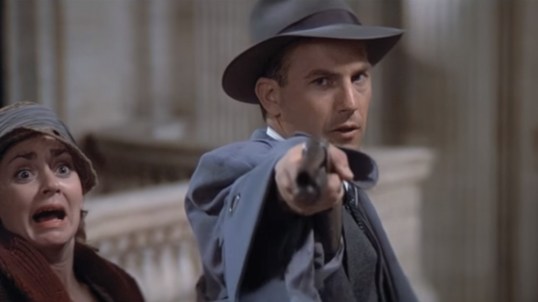
The Untouchables (1987, dir by Brian De Palma)

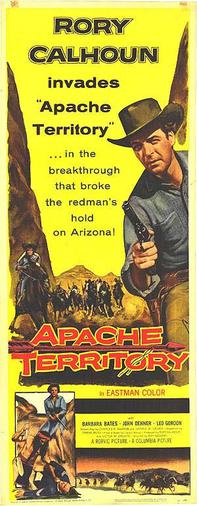
Apache Territory (1958, directed by Ray Nazarro)


In this B-western, Rory Calhoun plays Logan Cates, an old west drifter, while traveling through the desert, comes across a young woman named Junie Hatchett (Carolyn Craig).  Junie’s parents were settlers who were captured and killed by a group of Apaches.  Knowing that the Apaches will still be looking Junie, Logan takes her to a nearby canyon where there’s water and shelter.  Soon, other victims of the Apaches start to show up at the canyon.  With their supplies dwindling and the Apaches surrounding them, Logan has to keep everyone alive and lead them to safety.

Complicating matters is that one of the people who shows up at the canyon is Logan’s ex-girlfriend, Jennifer (Barbara Bates).  Jennifer is traveling with her new husband, the wealthy (and therefore cowardly) Grant Kimbrough (John Dehner).  Also seeking shelter at the canyon are a group of Calvary officers, a Pima Indian named Lugo (Frank DeKova), and a naive teenage cowboy named Lonnie (Tom Pittman).

Based on a novel by Louis L’Amour, Apache Territory is a pretty standard western.  Some of the battle scenes are surprisingly brutal — particularly when one of the Calvary officers gets hit by a flaming arrow — but otherwise, this is a typical B-western, the type of movie that would have been the second part of a double bill at a Saturday matinee.  Logan Cates is able to survive because, unlike Grant Kimbrough, he knows and respects the land and, unlike the Calvary officers, he respects his enemy.  He’s a typical western hero, though well-played by Rory Calhoun.

The main problem with the film is that, for a film about a group of people trapped in one location, it never achieves any sense of claustrophobia.  The size of the canyon seems to change from shot to shot.  The film’s finale involves a well-realized dust storm but it still never reaches the type of action-packed conclusion that most western fans will be hoping for.  It ends with a whimper instead of a bang.  It feels more like an extended episode of Gunsmoke or The Virginian than a feature film.

This one will be best appreciated by undemanding fans of the genre.

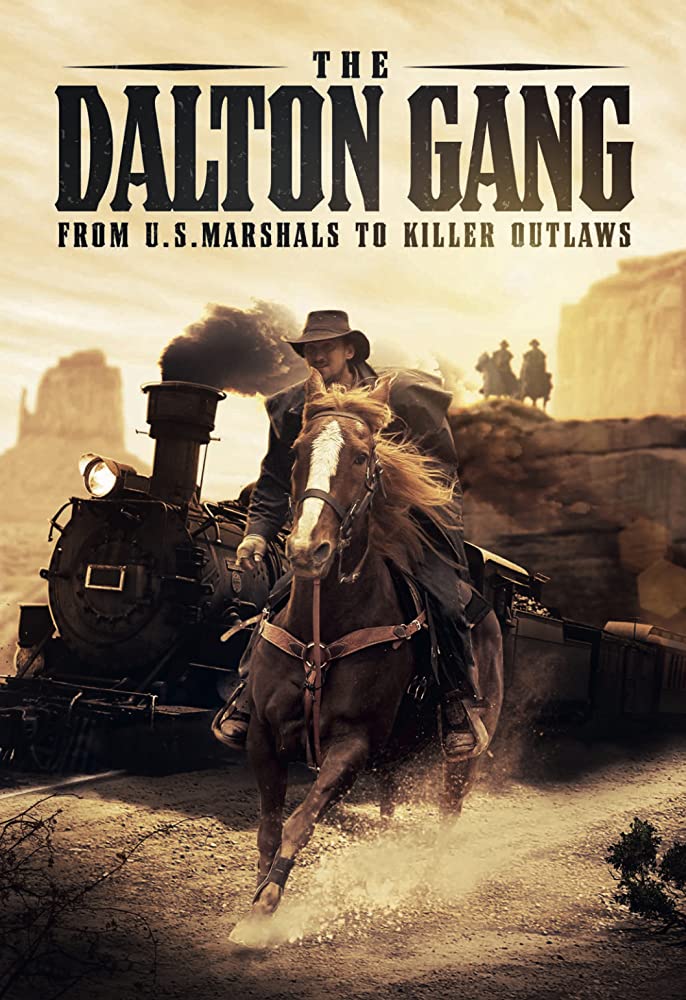
The Dalton Gang (2020, directed by Christopher Forbes)


In this western, Arkansas Sheriff Frank Dalton is gunned down by an outlaw.  Seeking justice, Frank’s three brothers — Bob, Gant, and Emmett — become members of law enforcement themselves.  They kill a wanted outlaw but when they try to collect the reward, they’re told that the reward money has already gone to fund other projects.  (It’s hinted that the new sheriff stole it for himself.)  They’re also told that, since they’ve been smuggling whiskey to the Indians, they probably won’t get paid their salary.  The Dalton Brothers quit law enforcement and decide to become outlaws themselves.

The Dalton Gang is a low-budget western that tells the true story of the Dalton Brother and their career as outlaws.  Some of the film’s wildest developments — like the Gang attempting to rob two banks in one day — are based on fact.  Unfortunately, though the film gets the facts right, it’s done in by its own low budget.  From the muddy soundtrack to the tiny cast to the overuse of slow motion, everything about The Dalton Gang reminds you that you’re watching a movie and not particularly well-produced one.  Some members of the cast have the right look for a dusty western but the performances are so inconsistent that it’s sometimes difficult to watch the film with a straight face.  Jerry Chessman plays Bob Dalton and yells his lines so loudly that it’s hard not to jump whenever he starts speaking.  Undoubtedly due to the low budget, much of the action takes place off-screen.  The Dalton brothers spend a lot of time riding up to trains and then later talking about how much money they stole from the train but it’s rare we ever get to see them actually robbing anything.

Personally, I would like to see more westerns being released.  In the modern era, it’s a genre that seems to go through brief moments of resurgence followed by long periods of being pushed to the side.  Hopefully, though, future westerns will be better than The Dalton Gang.

Here’s The Teaser For Nomadland!


Back in 2018, director Chloe Zhao was quite rightfully acclaimed for her quietly beautiful film, The Rider.

Full of haunting images of the western landscape, The Rider was a character study of a rodeo rider struggling to recover after a serious accident.  It was a poignant and affecting film, one that made you cry while steering clear of all of the usual cliches.  Though the film was ignored at the Oscars, it still picked up several awards from the critics groups.

When 2020 began, Chloe Zhao had two movie scheduled to be released.  One was Marvel’s Eternals, a big-budget MCU film that sounds like it’s basically the antithesis of The Rider.  The other is Nomadland, which stars Frances McDormand as a woman who, having lost her job and her home, travels the country in search of employment.  Based on a nonfiction book, Nomadland sounds like it will continue to explore the themes that Zhao first examined in The Rider.

As a result of COVID-19, both films were briefly in limbo.  Eternals was eventually rescheduled for February of next year.  Nomadland is set to premiere at both the Venice and Toronto Film Festivals this Friday.  It’s scheduled to get a theatrical release on December 4th and Searchlight Film is expected to push the film for Oscar consideration.

Here’s the teaser, which features Frances McDormand doing a lot of walking: