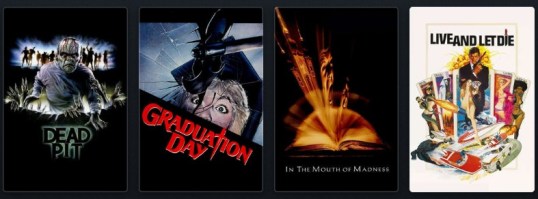
It’s October! Here’s four films that you can watch this weekend to help you get in the Halloween mood!
For last night’s #FridayNightFlix, we watched Roger Moore’s first outing as James Bond, Live and Let Die (1973). Now, I know that a lot of people are going to read that and think to themselves, “Live and Let Die isn’t a horror movie!” While it’s true that Live and Let Die is primarily a spy movie, it does borrow quite a bit from the horror genre. I mean, this is a film that opens with a man being killed in voodoo ceremony! Baron Samedi (played by Geoffrey Holder), the man who cannot die, is one of Bond’s best villains and also one of the few that apparently does manage to avoid dying. If Hammer or Amicus had produced the Bond films, they would probably look a lot like Live and Let Die. So, if you’re looking for a horror-adjacent film to help get you in the Halloween mood, Live and Let Die is a great choice. It’s the closest thing we have to a true James Bond grindhouse film. The boat chase is a classic, though how much of a classic depends on you feel about having a redneck Louisiana sheriff dropped right in the middle of a Bond film. The film is currently on Prime, along with all the other Bond films.
Two weeks ago, for #MondayActionMovie, we watched Graduation Day (1981). Featuring a great soundtrack, several over the top kills, a hammy Christopher George, a young Vanna White, and an epic 12-minute performance of the song GangsterRock by Felony, Graduation Day is one of the best of the early slashers. Like a lot of those pre-Nightmare On Elm Street slasher films, it owes a huge debt to the giallo genre. The killer even wears black gloves! Can you figure out who the murderer is? And will you ever get the film’s insanely catchy theme song, The Winner, out of your head? Everybody wants to be the winner…. Graduation Day is streaming on Prime.
The Dead Pit (1989) is a personal favorite of mine. A woman end up in a mental hospital and spends the majority of the movie running around in her underwear while trying to get people to understand that the dead are coming back to life. I’ve had that dream more times than I care to count. This is an enjoyably over-the-top B-movie. Director Brett Leonard captures some truly creepy images and lead actress Cheryl Lawson gives a good and sympathetic performance as the amnesiac who keeps seeing terrible things. With all of the elevated horror nonsense that’s going on right now, it’s nice to see a film from an age when the horror films were made by people who didn’t feel the need to apologize for the genre. The Dead Pit is streaming on Tubi.
Finally, with In The Mouth of Madness (1995), John Carpenter proved himself to be one of the few directors capable of actually capturing the bleak atmosphere of H.P. Lovecraft’s best stories. The much-missed Sam Neill gives one of his best performances as a reporter who discovers a horrifying truth. The film’s final scene is brilliant.
First released in 2007, P2 tells the story of Angela Bridges (Rachel Nichols), a young businesswoman who just wants to get off work and spend Christmas Eve with her family. Instead, she finds herself trapped in an underground parking garage and stalked by an unhinged security guard named Thomas (Wes Bentley).
P2 feels as if it was designed in a lab to exploit every fear I have.
First off, I’m terrified of confined places. This is a film that moves from one confined spot to another. It’s not just that Angela is trapped in a parking garage and the only person who has the key is determined to keep her there. Over the course of the night, she also finds herself trapped in Thomas’s office, an elevator, and the trunk of her car. P2 captures the suffocating feel of claustrophobia, the sense that an already confined space is slowly closing in on you. The more Angela struggles, the less space she seems to have.
I’ve always been scared of loud, barking dogs, especially the kind that jump out of nowhere and start growling at you as if you’re the bait in some game you didn’t even realize you were playing. Thomas has a dog named Rocky. Both Thomas and Rocky are relentless in their pursuit of Angela. Thomas wants to take her back to his office so he can force her to comply with his desires. Rocky, on the other hand, just wants to tear her apart.
I’ve always been scared of drowning, and, believe it or not, this film actually contains a scene in which Angela is forced to face that same fear. How does one drown in a parking garage? Let’s just say that Thomas knows every button to push and every lever to turn. Angela may work in the building and park in the garage, but for the most part she’s only a visitor. The garage is Thomas’s whole world.
I’ve always been scared that if I found myself in a really bad situation, I wouldn’t be able to depend on anyone to help. In P2, Thomas hides his homicidal nature behind his uniform and his title. When two policemen show up to check out the garage, they don’t even notice Angela’s broken phone lying on the ground. Even when Angela does manage to call 911, she’s answered not by an operator but by an automated system that puts her on hold. If Angela is going to survive, she’s going to have to do it on her own.
The film also captures a much more universal fear: the fear of not having control. Angela has never noticed Thomas before, but Thomas has spent two years obsessing over her and waiting for the day he would be able to drag her back to his office. To Thomas, it makes sense that Angela should spend Christmas with him because she has been on his mind nonstop for years. Angela, meanwhile, wakes up in the office wearing handcuffs and a revealing white dress that Thomas apparently put on her while she was unconscious. This is a film that always makes me wonder how many Thomases are out there. Who knows what’s happening behind the smiling faces of the people we see every day but don’t really know?
P2 works because it captures those universal fears. Yes, the story might be a bit predictable, but most of our fears are predictable too. That doesn’t make them any less scary. Rachel Nichols is sympathetic as Angela, while Wes Bentley is appropriately unhinged as Thomas. Bentley has said that he was struggling with a heroin addiction when he made P2, and he plays Thomas with the self-destructive intensity of an addict who can’t think beyond his next fix. It doesn’t matter to him—or perhaps even occur to him—that there’s no way he can get away with abducting Angela. All that matters is having her at that exact moment. He’s impulsive and unpredictable, and all the more frightening because of it.
P2 was the directorial debut of Franck Khalfoun, who went on to make the surprisingly effective remake Maniac. Unfortunately, his later films haven’t really lived up to the promise of his earlier work, but P2 remains an effective slice of holiday horror.
Today, the Shattered Lens has got a grindhouse classic. From 1976, it’s Drive-In Massacre!
Terrible things are happening at the local drive-in! There’s a killer at large. Can the police solve the mystery before yet another drive-in theater is forced to close? This is a surprisingly entertaining little film. I can only imagine how fun it probably was to see a film called Drive-In Massacre at an actual drive-in! Be sure to stick around for the public service announcement at the end!
For the record, I’ve always liked Douglas Gudbye’s performance as Germy. I haven’t been able to find out much about the actor but he definitely brings something to the role. Be sure to keep an eye out for George “Buck” Flower, who not only appears in this film but also co-wrote it!
As some of our regular readers undoubtedly know, I am involved in a few weekly live tweets on Twitter and Mastodon. I host #FridayNightFlix every Friday, I co-host #ScarySocial on Saturday, and I am one of the five hosts of #MondayActionMovie! Every week, we get together. We watch a movie. We tweet our way through it.
Tonight, at 10 pm et, #ScarySocial presents The Harbinger!
If you want to join us this Saturday, just hop onto twitter, start the movie at 10 pm et, and use the #ScarySocial hashtag! It’s a friendly group and welcoming of newcomers so don’t be shy.
The Harbinger is available on Prime! See you there!
Today, the Shattered Lens wishes a happy birthday to actress Catriona MacColl.
This scene that I love comes from Lucio Fulci’s 1981 masterpiece, The Beyond. In this scene, Liza (MacColl) first meets the mysterious Emily (Cinzia Monreale). To those not familiar with Fulci’s aesthetic, it may seem strange that Liza would not be more surprised to find a blind girl waiting for her on one of Louisiana’s infamous bridges to nowhere. Those of us who are familiar with Fulci, though, recognize this as being one of his most gloriously dream-like moments.
This scene is also memorable for bringing together two of the best actresses to have worked with Fulci. MacColl appeared in all three of the Beyond films, though she played a different character each time. Monreale also appeared in several Fulci films, including the family western Silver Saddle and the underrated Sweet House of Horrors.
4 Or More Shots From 4 Or More Films is just what it says it is, 4 shots from 4 of our favorite films. As opposed to the reviews and recaps that we usually post, 4 Shots From 4 Films lets the visuals do the talking!
Today, the Shattered Lens wishes a happy birthday to Canadian director, Denis Villeneuve! It’s time for….
4 Shots From 4 Denis Villeneuve Films
Prisoners (2013, dir by Denis Villeneuve, DP: Roger Deakins)
Arrival (2016, dir by Denis Villeneuve, DP: Bradford Young)
Blade Runner 2049 (2017, dir by Denis Villeneuve, DP: Roger Deakins)
Dune Part Two (2024, dir by Denis Villeneuve, DP: Greg Fraser)
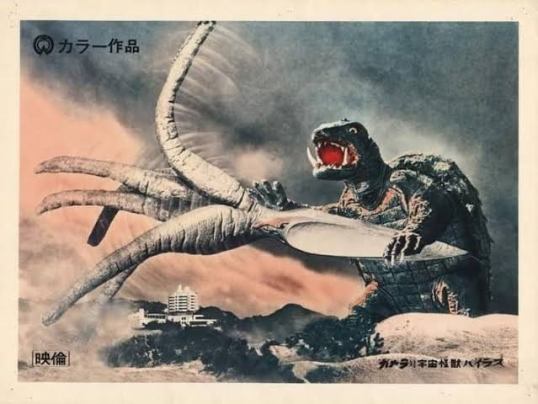
1967’s Gamera vs. Viras opens with what appears to be a yellow and black-striped Tupperware container spinning through space. Looks can be deceiving, though. It’s not actually a freshness-sealed container that’s heading towards Earth. Instead, it’s a spaceship from the planet Viras. It seems that the inhabitants of Viras are dependent upon Nitrogen to live. Foolishly, they’ve wasted all of their own Nitrogen and now they’re planning on coming to Earth to steal ours!
GAMERA, WE NEED YOU!
Gamera vs Viras is yet another Gamera film in which everyone’s favorite flying turtle also serves as the defender of Earth. Even though the adults on Earth frequently mistake Gamera for being a threat, Gamera has a sentimental attachment to the planet’s children. In this film, when he’s not fighting aliens and orbiting the planet, he’s hanging out with a bunch of boy scouts. Unfortunately, for Gamera, the aliens realize that his protectiveness of children is also his greatest weakness. The aliens abduct two of the boy scouts, American Jim (Carl Craig) and Japanese Masao (Tōru Takatsuka) and lure Gamera into space. The aliens manage to take control of Gamera’s mind and soon, they’re forcing him to attack humanity!
In America, Gamera vs Viras is one of the best-known Gamera films. That’s because, in 1969, American International Television released it directly to American television in a re-edited and dubbed version that was entitled Destroy All Planets. (I assume that the title, which doesn’t really anything to do with the plot, was meant to bring to mind Destroy All Monsters.) Destroy All Planets is the version of this film that went on to be included in hundreds of DVD box sets. Destroy All Planets is a great title. I mean, if you’re a monster movie fan of a certain age, there’s no way you’re going to able resist watching something called Destroy All Planets.
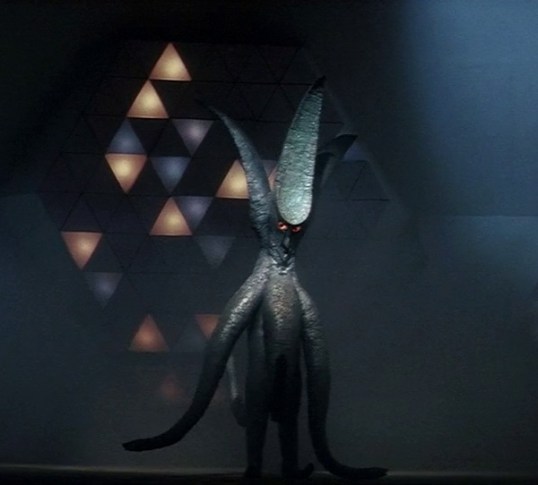
Whether you call it Gamera vs Viras or Destroy All Planets, this is one of my favorite Gamera films. Yes, the kids are a little bit annoying but Gamera is absolutely adorable and this movie finds him going up against a giant squid. To be honest, this film is totally worth it just to see the Squid.
Watching this film, I thought about how sad it was that the Squid didn’t just politely ask for some Nitrogen, as opposed to trying to conquer the planet and steal all of it. I’m sure that humanity would have been willing to share. I mean, a planet that has embraced a giant fire-breathing turtle has to have a good heart, right? I also felt sorry for Gamera because those kids wouldn’t stop yelling at him. I get that Gamera has a soft spot for kids but I imagine even the most loyal of giant turtles needs a break every once and a while.
Speaking of turtles (both giant and otherwise), turtles are really cool creatures that don’t cause any trouble for anyone. We live near a creek and it’s not unusual to look outside and see a turtle slowly making its way down the sidewalk. One thing that I love about this neighborhood is that everyone gives the turtles their space. The turtles may not be fast but they know where they’re going.
In 2004, Godzilla: Final Wars was released by Toho and promoted as Godzilla’s final film.
And indeed, for ten years, there was no sign of Godzilla. There were rumors that he would return but, for the most part, he was a fondly remembered relic of a different era. That changed in 2014, when Legendary Pictures produced and Warner Bros. distributed a new Americanized version of Godzilla. Though the new version was not particularly well received by critics, it did well enough at the box office to convince Toho that it was time to make a new Godzilla film of their own.
2016’s Shin Godzilla is not a sequel to any of the previous Godzilla films. Instead, Shin Godzilla imagines a continually evolving Godzilla attacking Japan, for the first time, in 2016. When Godzilla first appears, he definitely doesn’t look like himself. He doesn’t have his famous scaly skin. Instead of proudly striding through the cities and stepping onto buildings, he slithers through the streets. To be honest, he actually looks a little… well, goofy. At first, I wasn’t really sure that I would be able to accept this Godzilla. However, the film apparently predicted my reaction. Throughout the film, Godzilla slowly transforms (or “evolves,” as the film puts it) into the majestic monster that we all know and love. And when that Godzilla finally made his appearance, I wanted to cheer. I also wanted to hide behind the couch, because this is one of those films where Godzilla has no interest in being a nice guy. He lives to destroy, and Shin Godzilla, made in the aftermath of the earthquake, tsunami, and nuclear crisis that rocked Japan in March 2011, doesn’t shy away from showing the amount of damage and death that would result from an actual monster attack.
The film uses Godzilla sparingly. Instead, most of the running time is taken up with meetings. The Japanese government meets and tries to figure out what to do about the monster that’s attacking their country. The military is unprepared. The citizens have no memory of being put under a national emergency. The prime ministers (yes, the film goes through more than one) all look like they’re about to have a panic attack when they’re expected to make a decision. The Americans send over an envoy (Satomi Ishihara) who views dealing with Godzilla as a way to further her own political ambitions. Running throughout the film is the idea that the Japanese government has been left powerless to deal with real emergencies. The film’s ineffective bureaucrats become stand-ins for the same bureaucrats who failed in 2011. This is the most openly political Godzilla film since the first one.
Indeed, Shin Godzilla is far more concerned with how the government reacts to Godzilla than with Godzilla himself. I imagine that was, and probably still is, an issue for some viewers of the film. Myself, I appreciated the film’s portrait of a useless and largely impotent bureaucracy full of entrenched people who were more concerned with their own advancement than with protecting the citizens they were supposed to be serving. There’s a satirical edge to Shin Godzilla that I absolutely loved. Be glad Godzilla isn’t real, the film seems to be saying, because these idiots certainly aren’t going to protect you. Instead, all they can do is issue meaningless statements and pointless regulations designed to maintain the illusion of their own power. In its way, Shin Godzilla predicted the entire COVID era. It’s a Godzilla film with a lesson for us all.
“It doesn’t feel wrong. They’re bad people. They deserve to suffer.” — Jay
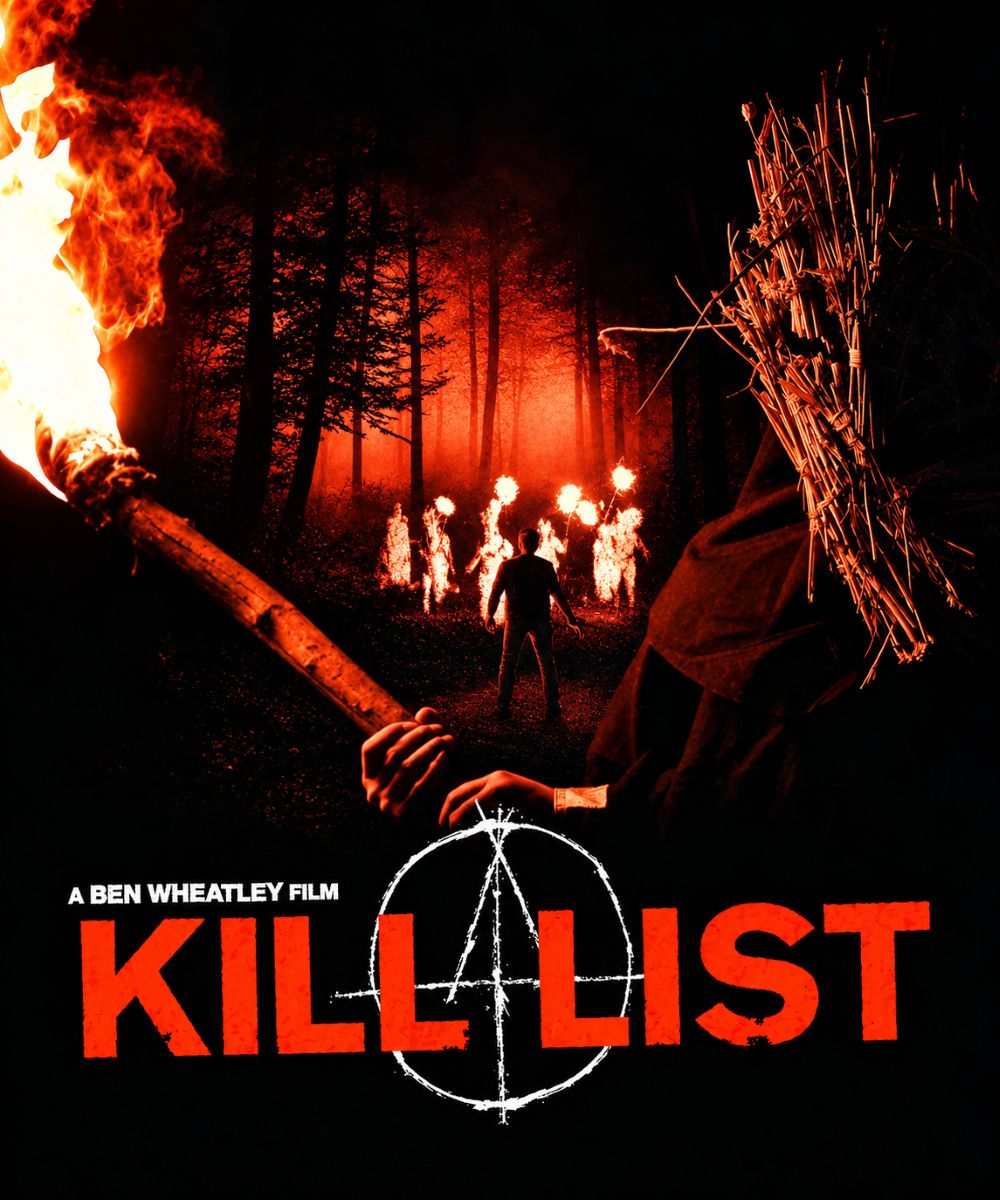
There is something especially unsettling about a horror film that refuses to let you know it is a horror film until you are already trapped inside it. Ben Wheatley’s Kill List begins in the familiar, grimy territory of a British crime thriller, but its slow, deliberate transformation into full-blown cosmic and folk horror makes it one of the most unnerving films of the 2010s.
Jay, a former soldier turned contract killer, has been out of work for months after a botched assignment in Kyiv. His wife Shel is fed up with his anger, his drinking, and his lack of direction. Their marriage is strained, their finances are collapsing, and their home feels less like a place of comfort than a pressure cooker waiting to explode. Rather than starting with a monster, a murder, or a flashy supernatural hook, Kill List starts with domestic tension. It places the audience in a home where every conversation feels like it could become a screaming match, and every small complaint seems connected to a much larger emotional wound.
That grounded, unpleasant realism is a huge part of why Kill List works so well. Wheatley does not rush to tell the audience what kind of movie they are watching. For a while, it plays almost like a rough, deeply uncomfortable British domestic drama, with the sort of bickering and passive-aggressive resentment that feels overheard rather than scripted. Jay and Shel’s arguments are messy, mean, and often funny in a dark way, while Jay’s friendship with his old colleague Gal has a lived-in quality. These are not glamorous movie hitmen trading cool one-liners. They are middle-aged men with bills to pay, bad tempers, old wounds, and a job they would probably rather not be doing if they had any other viable option.
Jay’s decision to accept a new killing contract with Gal initially pushes Kill List further into thriller territory. The assignment comes from a wealthy, unsettling client who hires them to eliminate three targets: a priest, a librarian, and a member of Parliament. That setup sounds straightforward enough, and Wheatley lets the film function for a time like a grimy, morally rotten crime thriller. Jay and Gal investigate their targets, plan their attacks, and move through a world of rural estates, anonymous offices, abandoned buildings, and shadowy back rooms. There is tension, but it is the tension of men entering dangerous situations without knowing whether they are being watched or manipulated.
What makes the film increasingly unnerving is that every target seems to know more than Jay and Gal do. The victims do not merely fear death. In some cases, they appear grateful for it. They refer to Jay as though he has been expected, almost as if he has been chosen for a role he does not understand. The priest calls him “the harbinger,” while the librarian thanks him after being killed. These details are not explained in a neat, comforting way. Wheatley plants them casually, allowing confusion to gather in the background while Jay becomes more violent, unstable, and paranoid.
That gradual descent is what makes Kill List so effective. It starts off more like a thriller, or even a bleak crime drama, but slowly makes its way into full-blown horror by the time the end credits begin rolling. The film does not suddenly flip a switch and announce that it has become a supernatural nightmare. Instead, it lets the atmosphere become stranger one scene at a time. A symbol appears carved into a mirror. A strange man silently watches from the woods. A dinner party turns from awkward to deeply hostile. A pair of masked figures emerge at the edge of a field. By the time the movie reaches its final stretch, the feeling is no longer one of criminal danger but of being trapped inside a ritual that began long before Jay understood he was involved.
Wheatley’s direction is crucial here. Kill List has a raw, handheld, low-budget immediacy that makes the violence feel especially ugly. There is very little stylization separating the audience from what is happening. The film is not interested in making murder look slick, cathartic, or exciting. When Jay attacks someone, it feels brutal, chaotic, and emotionally damaging. The violence is often sudden, but it is never casual. It leaves a stain on the scene, on the characters, and on the viewer. Jay’s behavior becomes increasingly alarming because his anger is not framed as toughness. It is framed as a dangerous loss of control.
Neil Maskell gives an excellent performance as Jay, a man whose emotional state is always sitting somewhere between numbness and eruption. He is not an easy protagonist to like, and that is part of the point. Jay can be cruel, childish, frightening, and self-destructive. Yet Maskell also makes him feel recognizably human, especially in the quieter moments with his son, Sam. Those scenes matter because they give the final act its real emotional weight. Jay is not just a professional killer being targeted by an unknown force; he is a husband and father whose damaged life is about to be pulled into something far worse than a failed job.
Michael Smiley is equally strong as Gal, who initially comes across as the more stable, reasonable half of the duo. He is calmer than Jay, more socially functional, and less openly volatile. But the movie gradually reveals that Gal has his own weaknesses and blind spots. Their friendship feels genuine, even when it is poisoned by secrecy, resentment, and the increasingly bizarre circumstances surrounding the contract. MyAnna Buring also deserves credit as Shel. She could have easily been reduced to the stereotypical nagging wife in a lesser film, but Buring makes her sharp, vulnerable, manipulative at times, and visibly exhausted by the life she shares with Jay.
The horror in Kill List becomes especially potent because it draws from both cosmic and folk-horror traditions without fully settling into either one. The cult imagery, hidden rituals, strange symbols, rural landscapes, and anonymous masked figures all give the film a folk-horror texture. There is a distinctly British unease to the countryside in the final act: fields that should feel open instead feel isolating, and a rural community becomes a place where ancient, secretive violence can exist just out of sight. At the same time, the movie’s cosmic-horror side comes from the sense that Jay has stumbled into a system too vast and unknowable for him to comprehend. He thinks he is taking a contract. In reality, he may be participating in a process that has been designed around him from the beginning.
That sense of predestination is one of the film’s most disturbing qualities. Kill List never overexplains the cult, its beliefs, or exactly how much control it has over the characters’ lives. Some viewers may find that frustrating, especially because the ending refuses to provide a clean mythology or a tidy resolution. But that ambiguity is also why the film lingers. The cult is scary not because the audience receives a detailed rulebook, but because its reach appears to be everywhere. It can infiltrate a job, a social gathering, a family home, and even the choices Jay believes he is making freely.
The ending is famously shocking, but it is not shocking only because of its cruelty. It works because the movie has carefully built Jay into a man who responds to fear with rage and violence. The final revelation turns that trait against him in the most devastating possible way. It is bleak, tragic, and almost mythic in its nastiness. The final image does not feel like a twist for the sake of a twist. It feels like the horrifying completion of a ritual that the audience has been watching take shape without fully recognizing it.
Kill List is not a comfortable watch, and it is not a horror movie that tries to please the audience with easy scares or a reassuring explanation. Its slow burn can feel deliberately abrasive, especially in the early domestic scenes, but that patience pays off. Wheatley takes a grim thriller about two hitmen and gradually transforms it into a nightmare of conspiracy, fate, cult ritual, cosmic dread, and folk-horror menace. By the end, the film has moved so far from its seemingly familiar premise that it feels like the ground has disappeared beneath it. That is what makes Kill List so memorable: it does not simply become horrifying. It reveals that horror was there all along, hiding inside every uneasy conversation, every unexplained symbol, and every choice Jay thought was his own.
The title character of 2014’s Gramps Goes To College may be known as Gramps but his actual named Ty Bounds. Played by Donald James Parker, Ty is a sixty-something resident of South Dakota who has recently retired from his job as a computer programmer. Despite being retired, Ty is not ready to fade away. In fact, he’s decided that it’s time to start a new chapter in his life so he enrolls in a college that is located in Tennessee. He hopes to eventually get his Master’s Degree in Biology.
Good luck with that, Gramps!
Gramps, you see, is a Christian and a believer in creationism. No sooner does he step into his Into to Biology class than he finds himself arguing with Professor Tucker (Carol Anderson). Tucker takes pride in turning religious students into atheists. She sees Ty as a challenge. She invites him to lunch. She invites him to dinner. She tries to seduce him. Nothing that she does can convince Ty to believe in evolution. Darwin wasn’t evil, Ty explains at one point. He was just misguided by the Devil.
Ty becomes a hero on campus and he even starts his own team of Christian athletes so that they can compete in the school’s Intramural competition. He becomes a mentor to his roommate, Brad (Rusty Martin). Ty worries that Brad is bein led astray by Stephanie (Courtney Lee Simpson). When Brad comes back to the dorm after a party, Ty demands to know why Brad reeks of alcohol. Can you imagine going away to college and discovering that your new roommate is not only old enough to be your grandfather but that he’s also going to scold you whenever you stay out late? Yikes!
(As I watched this movie, I was reminded of how, when I was in college, there was a student who was in her forties and who lived in the dorms. I always felt a little bit sorry for her. She was given a private room and people treated her respectfully — certainly more respectfully than they treat Gramps in this film — but I always wondered what it was like to be an adult, trying to finally get a degree, and finding yourself living in a dorm occupied by brats like …. well, like me. I’ve always told myself that if I ever run into her again, I’ll apologize for all those nights I played my music too loud. I’m older now so I understand why that would be annoying.)
Eventually, Stephanie dies of alcohol poisoning but she’s revived. She talks about how, while she was dead, all she saw were the flames of Hell. Well, that’s one way to get someone convert.
Gramps Goes To College is a fairly amateurish film. That’s not really a surprise. If anything did surprise me, it was how wrathful Gramps came across as being. To be honest, I was expecting a corny “old person” comedy. Instead, Gramps spent a lot of time suggesting that different people and ideas had been sent by the Devil. In the film, Gramps becomes a beloved celebrity on campus. He even gets Professor Tucker to doubt her atheism, despite the fact that none of his arguments seem to be anything that Tucker would not have heard before. To be honest, Gramps kind of comes across as being kind of a crank. His intentions may have been benevolent but he was so preachy and so frequently angry that he was often more intimidating than inspiring.
Myself, I’m just glad that I went to a party school and I didn’t actually have to pay attention in any of my classes. That’s the best way to do the college!