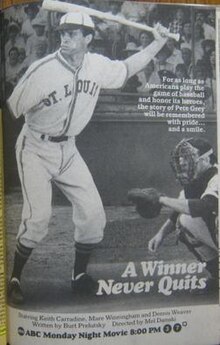
I Watched A Winner Never Quits (1986, dir. by Mel Damski)


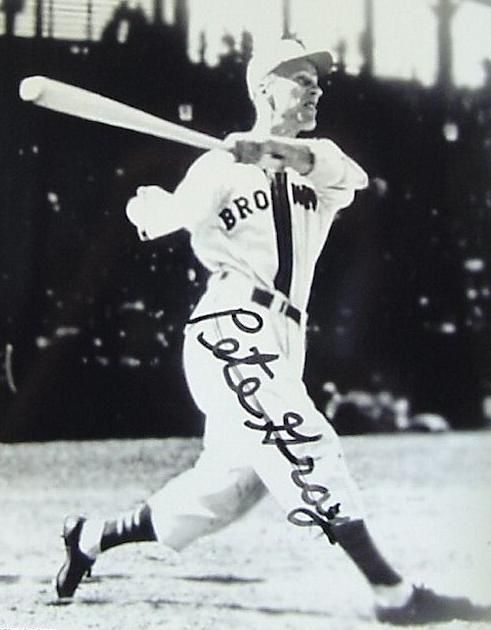
In 1945, Peter Gray made history when he became the first one-armed major league baseball player.  Gray grew up in poverty in Pennsylvania.  His father was a miner and Peter was one of five children.  He was only seven years old when he lost his right arm in a wagon accident but he loved baseball and he wasn’t going to let his disability keep him from playing.  He learned how to bat and catch and throw with his left hand.  He quit school when he was thirteen and worked for a while as waterboy while playing baseball in the local leagues.  Eventually, he made his way up to the minor leagues and, in 1945, he was called up to the majors.  He played one season for the St. Louis Browns.

The media loved the story of the one-armed baseball player but Peter always said that he resented feeling like he was being put on display whenever he took the field.  He was a competitive outfielder who could catch a ball, remove his glove, and then throw the ball to the infield just as quickly as anyone with two hands.  As a hitter, he struggled because pitchers figured out early on that he couldn’t hit the breaking ball.  After the 1945 season, Peter was sent to back to the minors, where he spent the rest of his career.  Though Peter was known for being an angry player who resented anyone pointing out his disability, he still made time to visit amputees in military hospitals to show them that they could still find success and to encourage them to chase after their dreams.

Peter’s story was the basis of A Winner Never Quits, which I watched on YouTube this weekend.  It was a good baseball movie, starring Keith Carradine as Peter.  What I liked is that the movie didn’t make him into a saint.  Carradine played Peter as being angry and with a definite chip on his shoulder.  Peter had every right to be angry and I’m glad the movie acknowledged that.  In both the movie and in real life, Peter was worried that he was just being treated as a sideshow.  In the movie, his attitude improves when he meets a young boy who recently lost his arm and who looks up to Peter.  Peter remained a friend to the boy and his family for the rest of his life.  A Winner Never Quits is about pursuing what you love and never giving up.  That’s what baseball is all about.  A Winner Never Quits is a good and inspiring baseball movie that’s not just for the fans.
Alexandre Dumbass and THE SHAWSHANK REDEMPTION – a scene that I love!


In honor of Director Frank Darabont’s 66th birthday, I’m sharing a scene from his masterpiece, THE SHAWSHANK REDEMPTION. One of the best things about this movie is how much humor is found behind those prison walls, often coming from seemingly unexpected places. In this scene, the humor is found when the characters take on the mundane task of cataloging the prison library. Enjoy!

I recently reviewed THE SHAWSHANK REDEMPTION on my son’s birthday. 

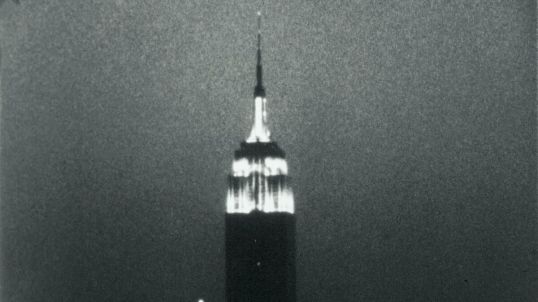
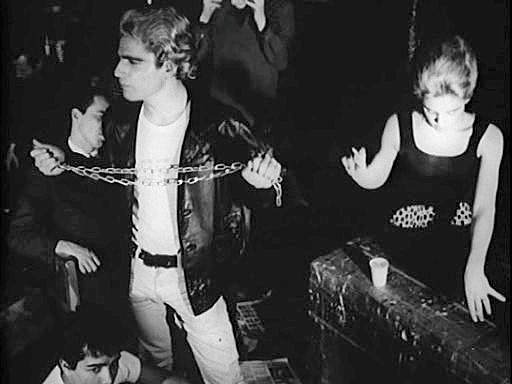
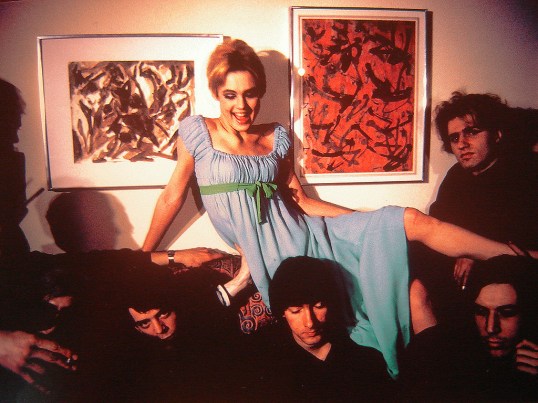
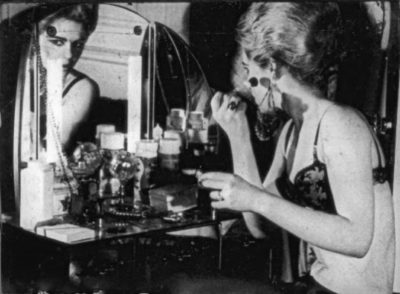
4 Shots From 4 Films: Special Pop Art Edition


4 Shots From 4 Films is just what it says it is, 4 shots from 4 of our favorite films. As opposed to the reviews and recaps that we usually post, 4 Shots From 4 Films lets the visuals do the talking!

Happy Pop Art Day!  It’s time for….

4 Shots From 4 Pop Art Films

Empire (1965, dir by Andy Warhol)

Vinyl (1965, dir by Andy Warhol)

Lupe (1966, dir by Andy Warhol)

Chelsea Girls (1966, dir by Andy Warhol and Paul Morrissey)

Film Review: Poor Little Rich Girl (dir by Andy Warhol)


Poor Little Rich Girl (1965, dir by Andy Warhol)

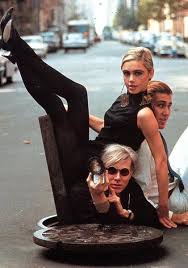
In March of 1965, Andy Warhol, Gerard Malanga, and Chuck Wein went to the New York City apartment of Edie Sedgwick and made a movie.  Edie Sedgwick, at that time, was a 22 year-old model who had been christened a “youthquaker” by Vogue.  She was also, for a year or so, the best-known member of Andy Warhol’s ensemble.  Of all the so-called superstars that spent time with Warhol and appeared in his films, Edie was the one who actually was a star.

The film opens with Edie waking up, walking around her bedroom, smoking a cigarette, popping pills, exercising, and lounging in bed.  (That’s pretty much my morning routine too, except for the cigarettes.)  She doesn’t speak.  The only sound that we hear is a record being played in the background and the whirring of Warhol’s camera.  Because of a faulty lens, the first 30 minutes of Poor Little Rich Girl are out-of-focus.  We can see Sedgwick’s form as she moves and we can, for the most part, tell what she’s doing but we can’t see any exact details.  Her face is a blur and sometimes, her body seems to disappear into the walls of the room itself.  It’s a genuinely disconcerting effect, even if it was an accident on Warhol’s part.  Edie is there but she’s not there.  The blurry image seems to reflect an unfocused life.  Edie is the poor little rich girl of the title and indeed, she was known as a socialite before she even became a part of Warhol’s circle.  The blurriness indicates that she has everything but it can’t be seen.

After 30 minutes, the film comes into focus.  Clad in black underwear, Edie answers questions from Chuck Wein, who remains off-camera.  Sometimes, we can hear Chuck’s questions and sometimes, we can’t.  Our focus is on Edie’s often amused reaction to the questions, even more so than her actual answers.  Edie smokes a pipe and looks at herself in her mirror and she talks about how she blew her entire inheritance in just a manner of days.  She raids her closet and tries on clothes while Wein offers up his opinions.  Edie is living the ultimate fantasy of trying on different outfits while your gay best friend makes you laugh with his snarky comments.  Edie comes across as someone who is living in the present and not worrying about what’s going to happen in the future.  It’s only when she nervously smiles that we get hints of the inner turmoil that came to define her final years.  The camera loves Edie and, even appearing in what is basically a home movie, Edie has the screen presence of a star.  There was nothing false about Edie Sedgwick.

Edie Sedgwick, Chuck Wein, and Andy Warhol

Watching the film today, of course, it’s hard not to feel a bit sad at the sight of a happy Edie Sedgwick.  While Edie would become an underground star as a result of her association with Andy Warhol and his films, their friendship ended when Edie tried to establish a career outside of Warhol’s films.  Edie’s own struggle with drugs and her mental health sabotaged her career and she died at the age of 28.  I first read George Plimpton’s biography of Edie Sedgwick when I was sixteen and I immediately felt a strong connection to her and her tragic story, so much so that I was actually relieved when I made it to my 29th birthday.  Though most people ultimately see Edie Sedgwick as being a tragic figure, I prefer to remember Edie as she appeared in the second half of Poor Little Rich Girl, happy and in focus.

Ghosts of Sundance Past: Waiting For The Moon (dir by Jill Godmilow)


The Sundance Film Festival is currently underway in Utah.  For the next few days, I’ll be taking a look at some of the films that have previously won awards at Sundance.

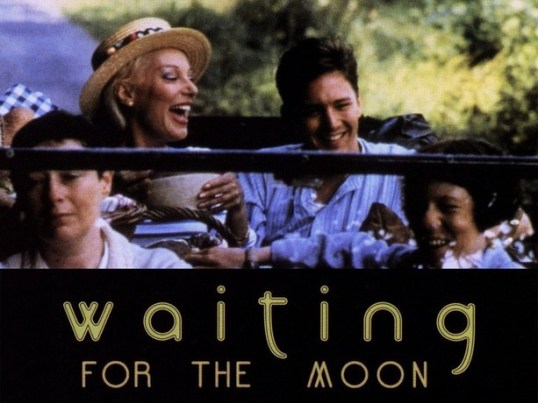
First released in 1987, Waiting For The Moon is a lowkey and fictionalized account of the relationship between Gertrude Stein (Linda Bassett) and Alice B. Toklas (Linda Hunt).

The film takes place in 1936, almost entirely at the home that Stein and Toklas shared in France.  Back in the years immediately following World War I, their home was a stopping spot for almost every writer who no longer felt at home in the conventional world.  It was the place where the members of the so-called Lost Generation met to socialize and discuss their art.  (Ernest Hemingway memorably wrote about visiting Stein and Toklas in A Moveable Feast.)  However, Waiting For The Moon takes place long after those exciting years.  Gertrude and Alice are now living a rather comfortable and settled life.  Occasionally, someone will stop by.  Hemingway (played by Bruce McGill) shows up.  Picasso stops by for a visit, though we only hear him.  But, for the most part, the film focuses on Gertrude and Alice.  The film follows them as they bicker like the old married couple that they essentially are, even if society in 1936 wasn’t willing to acknowledge it.  Alice proofreads Gertrude’s latest writing.  Gertrude waits for word from her doctor.  They talk about old times and old friends.  At one point, an aspiring writer named Henry Hopper (Andrew McCarthy) pays the two women a visit and, for a day at least, it’s like old time.  Henry is earnest and idealistic and full of plans for the future.  Unfortunately, he’s also planning on fighting in the Spanish Civil War and it doesn’t take a genius to guess that probably won’t go well.  Indeed, we learn that several of Gertrude and Alice’s old acquaintances are now fighting and dying in the Spanish Civil War.  For the so-called Lost Generation, the battle against Franco is a chance to find themselves but students of history already know how the war is going to end.  For that matter, students of history will also realize that World War II is right around the corner.  (Needless to say, the film itself offers up not a hint of the controversy that would surround Stein’s activities during the Vichy regime,)

Waiting For The Moon is a deliberately paced film, which is a polite way of saying that it’s a bit on the slow side.  That said, the scenery is beautiful and both Linda Hunt and Linda Bassett give good performances as the film’s versions of Alice and Gertrude.  Bruce McGill steals the film as the blustery Hemingway.  I’m sure Ernest would have approved.  (Could Ernest Hemingway ever be played as being anything other than blustery?)  The film captures the daydream that I think captures the fancy of many aspiring writers, the idea of being in a place where your thoughts are the center of life and all of your friends understand what it’s like to be a creative soul.

Waiting For The Moon won the Dramatic Grand Jury Prize at the 1987 Sundance Film Festival.  It’s not an easy film to find.  On Amazon, a copy on DVD runs about $52.00.  I was fortunate enough to find a copy at Half-Price Books.


Lisa Marie Reviews An Oscar Nominee: Born On The Fourth of July (dir by Oliver Stone)


In 1989, having already won an Oscar for recreating his Vietnam experiences in Platoon, director Oliver Stone returned to the war with Born On The Fourth Of July.

Based on the memoir of anti-war activist Ron Kovic, Born on the Fourth of July stars Tom Cruise as Kovic.  When we first meet Kovic, he’s growing up on Long Island in the 50s and 60s.  He’s a clean-cut kid from a nice family.  He’s on the school wrestling team and he’s got a lot of friends.  When he was just 15, he heard John F. Kennedy telling people to ask what they can do for their country and he was inspired.  He decided he wanted to join the Marines, despite the fact that his father (Raymond J. Barry) was still haunted by the combat that he saw in World War II.  (In one of the film’s better scenes, a young Kovic notices that the elderly veterans marching in the Independence Day parade still flinch whenever they hear a firecracker.)  He enlists in the Marines after listening to a patriotic speech from a recruiter (played by Tom Berenger).  Ron runs through the rain to attend his prom and has one dance with Donna (Kyra Sedgwick), on whom he’s always had a crush.  There’s nothing subtle about the way that Stone portrays Kovic’s childhood.  In fact, one might argue that it’s a bit too idealized.  But Stone knows what he’s doing.  The wholesomenss of Kovic’s childhood leaves neither him nor the viewer prepared for what’s going to happen in Vietnam.

Vietnam turns out not to be the grand and patriotic adventure that Kovic thought it would be.  After Sgt. Kovic accidentally shoots one of his own men in a firefight, he is ordered to keep quiet about the incident.  After he is wounded and paralyzed in another firefight, Kovic ends up in a Hellish VA hospital, surrounded by men who will never fully recover from their mental and physical wounds.  Kovic is eventually returns home in wheelchair.  The film then follows Kovic as he goes from defending the war in Vietnam to eventually turning against both the war and the government.  At one point, he ends up with a group of disabled vets in Mexico and there’s a memorable scene where he and another paraplegic (Willem Dafoe) attempt to fight despite having fallen out of their chairs.  Eventually, Kovic returns to America and turns his anger into activism.

There’s nothing subtle about Born On The Fourth Of July.  It’s a loud and angry film and Oliver Stone directs with a heavy-hand.  Like a lot of Stone’s films, it overwhelms the viewer on a first viewing and it’s only during subsequent viewings that one becomes aware of just how manipulative the film is.  Tom Cruise gives a good performance as Ron Kovic but his transformation into a long-haired, profane drunk still feels as if it happens a bit too abruptly.  A good deal of the film centers on Kovic’s guilt about accidentally killing one of his men but the scene where he goes to the soldier’s family and asks them for forgiveness didn’t quite work for me.  If anything, Kovic came across as being rather self-centered as he robs the man’s mother and father of the belief that their son had at least died heroically in combat as opposed to having been shot by his own sergeant.  Did Kovic’s need to absolve himself really give him the right to cause this family more pain?  Born on the Fourth Of July is an effective work of agitprop.  On the first viewing, you’ll want to join Kovic in denouncing the military and demanding peace.  On the second viewing, you’ll still sympathize with Kovic while also realizing that he really owes both his mother and father an apology for taking out his anger on them.  By the third viewing, you’ll be kind of like, “Wow, I feel bad for this guy but he’s still kind of a jerk.”  That said, when it comes to making an effective political film, Adam McKay could definitely take some lessons from Oliver Stone.  Born On The Fourth of July is at its best when it simply captures the feeling of living in turmoil and discovering that the world is not as simple a place as you once believed.  As idealized as the film’s presentation of Kovic’s childhood may be, anyone who has ever felt nostalgia for an earlier and simpler world will be able to relate.

Oliver Stone won his second Best Director Oscar for Born On The Fourth Of July.  The film itself lost Best Picture to far more genteel version of the past, Driving Miss Daisy.


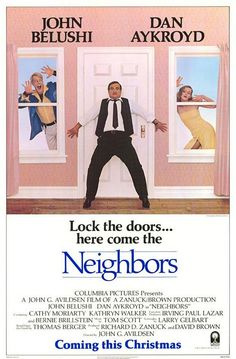
Neighbors (1981, directed by John G. Avildsen)


Uptight suburbanite Earl Keese (John Belushi) is paranoid about his new neighbors, Vic (Dan Aykroyd) and Ramona (Cathy Moriarty).  Ramona continually tries to seduce Earl (and everyone else) while Vic is loud and obnoxious, always telling off-color jokes and insinuating that Earl is less of a man than he is.  Earl thinks that there’s something mentally wrong with Vic but Earl’s wife and daughter (played respectively by Kathryn Walker and Lauren-Marie Taylor) love both Vic and Ramona.  Over the course of one very long night and morning, Earl grows more and more suspicious even as he starts to feel truly alive for the first time in several years.

Based on a novel by Thomas Berger, Neighbors is an unfortunate attempt at dark comedy that also turned out to be the final film appearance of John Belushi.  It’s appropriate that Belushi’s final film featured him with his comedic partner and best friend, Dan Aykroyd, though I think most of their fans would rather remember them for The Blues Brothers than Neighbors.  Originally, Aykroyd was cast as Earl while Belushi was meant to play Vic but the two actors decided to switch roles at the last minute.  It takes a while to get used to seeing Belushi as an uptight character who worries about the neighbor’s dog digging up his flower garden but Belushi actually does give a good performance as Earl, revealing that he had more range as an actor that most suspected.  Aykroyd and Moriarty also give good performances, though Aykroyd’s performance is not as much a departure as Belushi’s.  Earl is an amiable eccentric with several out-there beliefs, which also sounds like a good description of Dan Aykroyd.

Why, despite the talented cast, does Neighbors fail?  Director John G. Avildsen was the wrong choice to direct the film.  From the first shot of Earl and Vic’s two houses sitting on a hill and looking like left-over sets from The Addams Family, Avildsen directs in a cartoonish manner that is not appropriate for a comedy-of-manners.  The book’s humor comes from Earl becoming progressively more and more unstable but, in the movie, Earl seems to be unhinged from the start.  Bill Conti’s musical score drives him every point with a thudding obviousness.  Conti’s style was perfect for the soaring anthems of Rocky but not for a comedy like Neighbors.

Unfortunately, this would be Belushi’s final film.  Neighbors was released in December of 1981.  John Belushi died four months later.

#MondayMuggers – Why FEAR CITY (1984)?


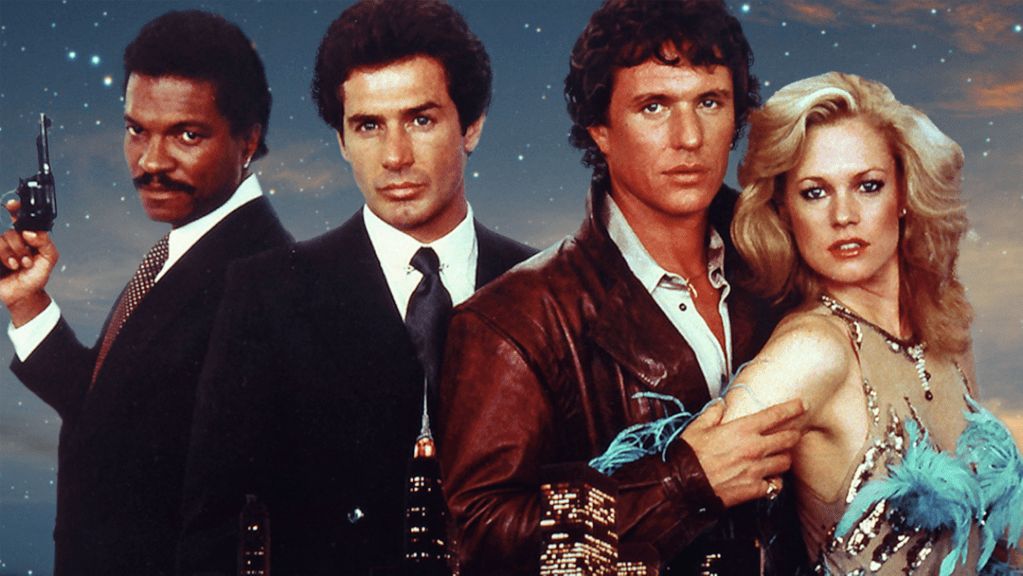
Every Monday night at 9:00 Central Time, my wife Sierra and I host a “Live Movie Tweet” event on X using the hashtag #MondayMuggers. We rotate movie picks each week, and our tastes are quite different. Tonight, Monday January 27th, we’re watching FEAR CITY starring Tom Berenger, Billy Dee Williams, Jack Scalia and Melanie Griffith.

So why did I pick FEAR CITY, you might ask?

  1. I’m a huge fan of Tom Berenger. SOMEONE TO WATCH OVER ME (1987 with Mimi Rogers), SHOOT TO KILL (1988 with Sidney Poitier), MAJOR LEAGUE (1989 with Charlie Sheen), and LAST OF THE DOGMEN (1995 with Barbara Hershey) are some of my very favorite films. He’s an outstanding actor and screen presence. Tom Berenger is one of those actors who I always enjoy seeing on screen.
  2. FEAR CITY is directed by Abel Ferrara. Abel Ferrara is one of those directors who makes movies about the very worst in society. His films MS. 45 (1981), KING OF NEW YORK (1990), and BAD LIEUTENANT (1992) are all movies that intrigued me greatly as I was trying to discover who I was growing up in the 80’s and early 90’s. 
  3. The sleaze is off the charts in FEAR CITY, with so many big-time stars, and set in New York City of the 1980’s. From everything I’ve read, this a time capsule of a place that no longer exists. If I ever make it to New York City, I’ll be greeted with a place that’s designed more like Disney World. I think it’s interesting to see the city as presented here!
  4. I also think it will be interesting to see what it’s like to experience a movie like FEAR CITY as part of a group. I discovered this film as a teenager in the 80’s. I remember being a little embarrassed as I watched the film, especially with its large serving of nudity (from big stars) and graphic violence. I’ve watched films in groups with the most extreme graphic violence imaginable and no one batted an eye. I’m looking forward to seeing how this plays out.

So join us tonight to for #MondayMuggers and watch FEAR CITY! It’s on Amazon Prime.

Monday Live Tweet Alert: Join Us for Extreme Justice!


As some of our regular readers undoubtedly know, I am involved in hosting a few weekly live tweets on twitter and occasion ally Mastodon.  I host #FridayNightFlix every Friday, I co-host #ScarySocial on Saturday, and I am one of the five hosts of Mastodon’s #MondayActionMovie!  Every week, we get together.  We watch a movie.  We snark our way through it.

Tonight, for #MondayActionMovie, the film will be 1993’s Extreme Justice!

It should make for a night of fun viewing and I invite all of you to join in.  If you want to join the live tweets, just hop onto Mastodon, pull up Extreme Justice on YouTube, start the movie at 8 pm et, and use the #MondayActionMovie hashtag!

Enjoy!

Scenes That I Love: Mozart Meets The Emperor in Amadeus


Today is Mozart’s birthday so, of course, today’s scene from the day comes from 1984’s Amadeus.  In this scene, the Emperor (Jeffrey Jones) delivers his critique to Mozart (Tom Hulce) and anyone who has ever had to deal with an idiotic critic will be able to relate.

“There’s too many notes!”

What really makes this scene work, along with Hulce’s reaction, is Jones’s blandly cheerful manner.  The Emperor really thinks he’s being helpful!