Well, actually, normally I don’t post at all, since I never finish video games anymore. I’m working on that. But today was special! I got a free pass to see an advance screening of this film (and by advance, I mean people on the East Coast are about to see it, I’m sure…but moving on…). I initially wasn’t going to go, having failed utterly in my attempts to enjoy the previous Harold and Kumar offering. I’m sure the target audience for these films are people who don’t know who Cheech Marin or Tommy Chong are, but until marijuana is legalized everywhere, this kind of stoner humour is going to have its own demographic to target. I’m okay with that! The key for any film-maker, regardless of genre or intent, is please – please god – tell a good story. Make a good film! That’s all I ask. Write a script that doesn’t suck, get some actors who can play the characters you’re drawing, and find a director who has a vision of what the movie will look like, and you’re generally going to create something watchable. Some of those movies are still going to be terrible misfires, but I always enjoy the effort being put forth.
So is this latest iteration of Harold and Kumar a good movie? I’m surprised to find myself saying… yes, I thought so. Now, I will admit, this movie is almost certainly going to play better to a sold out theater (my particular screening was on the I-Max in 3-D) on a huge screen. When the entire audience is laughing and having a good time, it’s easy to get swept up in the momentum of the film. I’m usually not a huge ‘out loud’ laughter guy at the movies, but I did find myself cracking frequent smiles, and some parts incited me to laugh out loud.
The film traces yet another night-long misadventure that teams up perennial screw-up Kumar, still living in the same junked apartment and getting high every day (and once again without a job), with straight-laced family-man Harold, who has married his heart-throb Maria and landed a cushy job on Wal-Street. The pals begin the film estranged, and part of the journey that we take with Harold and Kumar is them coming to realize how important their friendship is. Some of the messages in the film are surprisingly heartwarming, despite the comic ridiculousness of every situation that the unlucky pair find themselves in. All of the familiar characters are there, albeit in cameo appearances (even Neil Patrick Harris, though his sequence was particularly fun), and we add some new faces who frame a story that is basically what you’d expect. All of the locations and situations are new, but we are definitely treading familiar ground. Still, I thought this movie felt a good deal fresher than Harold and Kumar Escape Guantanamo Bay. It has a spirit of fun and a great energy throughout the entire ride, and neither the highs nor the lulls felt overdone to me. The script is fairly tight, all things considered, and breezes in at an 89 minute running time which feels just right.
Oh, and one last thing. For once, yes, I actually thought that the 3-D added something to the film. A lot of the film’s elements are coming at you off of the screen, and the film has an incredibly refreshing sense of humour about how ridiculous it is that a Harold and Kumar movie is in 3-D at all. It was intended to be released in 3-D, as opposed to the cute studio trick of using a computer to add 3-D effects in post to jack up ticket prices, and the effort pays off. By the end I still found myself a little annoyed with the uncomfortable 3-D glasses, and I’m still hardly a champion of paying a premium for 3-D effects, but this film does make good use of them. I’m sure it would still be enjoyable even in 2-D, but in this case I’d recommend seeing the 3-D version.
My sister Erin and I went and saw The Rum Diary on Tuesday and wow, was it ever a disappointment. The commercials make it look like a wild comedy featuring Johnny Depp looking all sexy and decadent but, in reality, the film is kind of a mess that is almost schizophrenic in its attempts to be more than the sum of its parts.
Johnny Depp plays Paul Kemp, an alcoholic writer who goes to Puerto Rico in the early 60s and takes a job writing horoscopes for the local newspaper. The job leads to him drinking a lot and hanging out with characters who are sweaty and so generally grimy that it’s borderline revolting to even see them on-screen. (Giovanni Ribisi, giving a distressingly bad performance, is the main offender.) Paul also ends up kinda befriending (but not really) a businessman named Sanderson (Aaron Eckhart), who you know is a bad guy because he’s the only character who dresses in pastels. Anyway, Sanderson has a girlfriend named Chenault (Amber Heard) and Chenault really has no purpose for existing other than for Paul to fall in love with her and save her from a terrible future of being married to a rich, handsome man. The film starts out as a comedy and then, after about an hour, it suddenly turns all serious and preachy. It’s as if the film can’t decide whether it wants to be an unfunny comedy or a laughable drama.
Luckily, Johnny Depp is on screen for nearly the entire film and, as we watched, Erin and I quickly learned that the best way to enjoy The Rum Diary is just to allow yourself to be carried away by the Deppness of it all. Don’t think about how the film’s kind of a mess and how Aaron Eckhart is more of a designated villain than a real villain and ignore the fact that Chenault is a sexist fantasy and tune out the preachy dialogue and try not to think about how everyone appears to have had more fun making the film than you’re having watching it, and just concentrate on Johnny Depp being all kinds of sexy.
If you do that, The Rum Diary is a tolerable 2 hours.
For my final public domain horror film of this wonderful month, allow me to present to you 1932’s White Zombie. Starring (and completely dominated) by Bela Lugosi, White Zombie is considered by many to be the first true zombie film. Watching this film today is an interesting experience if just because these aren’t the zombies that we’re used to. These are Pre-Romero, old school zombies. These are Serpent and the Rainbow zombies. Some of the acting in White Zombie (to be charitable) pretty bad but no matter. The film’s visuals have a hypnotic, dream-like quality to them and it’s a truly important piece of horror film history.
In the best grindhouse tradition, the first part of this trailer is made up of scenes from Last House On The Left. On another note, one of the benefits of living in north Texas is that we don’t have to deal with basements and all the icky little things that tend to live in basements.
Lisa Marie has been posting some very good pubic domain horror films for the past couple weeks and I think it’s about high time I posted one of the best public domain films. This one happens to be a horror film and also happens to be one of the best horror films ever made. I would be of the mind to call this one of the most important films ever made in the last hundred years.
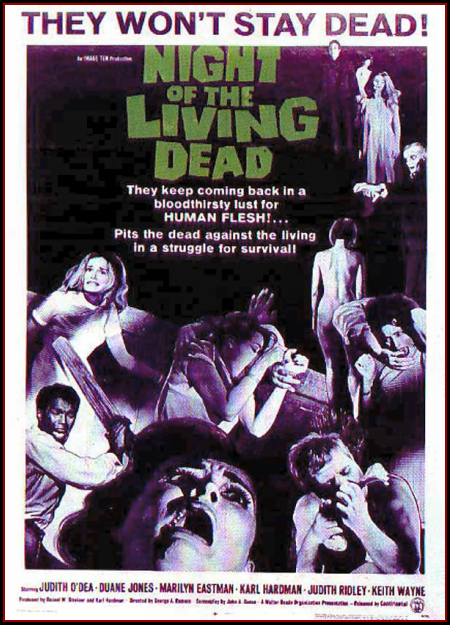
The film I speak of is George A. Romero’s classic and iconic horror film from 1968 simply called Night of the Living Dead. I’ve reviewed and posted this film from over a year ago, but it’s only been recently that Youtube has had a quality HD version of the full film uploaded to its site. Now, people don’t need to go find and buy the countless DVD versions of this film floating around in almost every store imaginable. I think even 7-11 and corner mom-and-pop stores carry a dvd of this film. This is why public domain films can be such a boon to films of the past (though also a curse since some transfers of pubic domain films are beyond awful) that tend rarely get a video release.
Fortunately, Night of the Living Dead is not one of those films. It’s the opposite in that it’s a film that many consider the birth of modern horror cinema and one of the perfect example of guerrilla filmmaking. It’s a film that didn’t just change how we look at horror now (gone are the gothic trappings that most horror had prior), but it also was one of the few horror films to successfully marry not just scares but thought-provoking themes and ideas. Even now most horror films fail to do one of the other let alone both at the same time.
The modern zombie genre of entertainment (films, stories, video games and even protest movements) owe it’s existence to this little low-budget horror film from the late 60’s by a Pittsburgh native and his friends who decided to pool their money together and make a horror flick. It’s a film that still stands the test of time. When all the hoopla over the Paranormal Activity nonsense, remakes of horror (both good and bad) and teen-sanitized horror goes by the wayside this film will continue to impress, remain relevant and still scare (pardon my French) the shit out of young people discovering it for the first time.
Today, being Halloween Eve, seems like the perfect time to offer up one of my favorite public domain horror films — Roger Corman’s 1959 horror/comedy Bucket of Blood. Featuring an iconic performance from Dick Miller (playing a character with the perfect name of Walter Paisley), Bucket of Blood is the story of an untalented artist who discovers that the best models are the dead ones. Speaking as both a lover of the old school Beat Generation and the proud owner of a largely useless degree in Art History, I love Bucket of Blood for all of its camp and satire. Dick Miller deserved an Oscar.
The Hammer Mummy films never get as much respect as the old Hammer Dracula and Frankenstein films. This is mostly because the Mummy films tend to drag and the Mummy never quite had the charisma of a Christopher Lee or a Peter Cushing. Still, mummies are pretty freaky. I’d probably be more scared of them if I lived in an area with a larger concentration of archeological digs.
Earlier today, I saw Roland Emmerich’s new film Anonymous and wow. I don’t even know where to begin with just how thoroughly bad a film Anonymous is. Yes, I know that this film has gotten good reviews from mainstream sellouts critics like Roger Ebert. And yes, I heard the old people sitting behind me and Jeff in the theater going, “So, do you think Shakespeare really wrote those plays?” after the movie ended. I’m aware of all of that and yet, I can only say one thing in response: Anonymous is the worst film of 2011 so far.
In its clumsy and rather smug way, Anonymous attempts to convince us that the plays of William Shakespeare were actually written by a boring nobleman named Edward De Vere (Rhys Ifans, giving a very boring performance). De Vere, you see, is obsessed with writing but as a member of a noble family, he cannot publicly do anything as lowbrow as publish his plays himself. So, he pays playwright Ben Johnson (Sebastian Armesto) to take credit for the plays. However, Johnson has moral qualms about taking credit for another man’s work. However, Johnson’s sleazy (and, the film suggest, sociopathic) friend Will Shakespeare (Rafe Spall, who at least appears to be enjoying himself in the role) has no such qualms and, after murdering Christopher Marlowe, Will is soon the most celebrated “writer” in England. Meanwhile, Queen Elizabeth I (Vanessa Redgrave, giving a performance so terrible that you know she’ll probably get an Oscar for it) is growing senile and De Vere starts to realize that he can use his literary talents to attempt to determine who will sit on the English throne after Elizabeth dies.
However, before we can even start in on that plot, we have to sit through the film’s opening sequence. Taking place in the modern day, we watch as actor Derek Jacobi (and not Malcolm McDowell, I’m sad to say) delivers a lecture on why he thinks that Shakespeare didn’t write a word. His argument basically comes down to the fact that Shakespeare was “the son of a glovemaker” and therefore, how could he have become the world’s greatest writer? How could he have written about royalty when he himself was a commoner who didn’t go to a prestigious university? How could he have been a genius when we know so little about his life? And blah blah blah. I understand that Jacobi actually frequently gives lectures like the one we hear in this film and I, for one, will make sure never to attend one because, quite frankly, Jacobi comes across like something of a pompous ass here. It doesn’t help that Emmerich films Jacobi’s lecture in much the same way he filmed the world falling apart in 2012. Seriously, a boring old man ranting on a stage is still a boring old man regardless of how many times the camera zooms into his boring, old face.
This introductory lecture pretty much sets the tone for the entire film to follow and, by screwing this up, Emmerich pretty much screw up everything that follows. However, Jacobi is not entirely blameless for the film’s failure. Number one, he delivers the lecture with all the righteous fury of someone talking about something … well, something more relevent than whether Edward De Vere wrote Shakespeare’s plays. Secondly, Jacobi comes across as if he’s sincerely convinced that he’s telling me something that I haven’t already heard from a high school English teacher, a college creative writing instructor, and a drama professor. Seriously, guys — the whole idea that some people claim Shakespeare was a fraud is not that mind-blowing. Thirdly, and most importantly, Jacobi’s main argument seems to primarily be an elitist one. Shakespeare is not “one of us” so therefore, Shakespeare must be a fraud. In short, Derek Jacobi comes across as a snob, a bore, and an upper-class twit. He’s the type of blowhard that you secretly dread will end up moving in next door to you. I can imagine him now coming over and saying, “Hi, my name’s Derek Jacobi. Might I borrow some salt and while you get it, I’ll explain why I hate glovemakers so.”
Both the film and Sir Derek George Jacobi reveal next to no regard for the wonders of imagination when they argue that Shakespeare couldn’t have written about royalty because he himself was not of royal blood. But, I wonder — how hard is it to write about royalty, really? Is Hamlet really a play about a prince or is it a play about a man who is struggling to maintain his idealism in an increasingly harsh world? Is Henry V really about royalty or is it about a formerly irresponsible boy who is being forced to grow up? To take Jacobi’s argument to its logical conclusion, why could Shakespeare not write about royalty but apparently De Vere could write about gravediggers and loan sharks?
The answer to that question is not to be found in Ifans’ glum, humorless performance. As played by Rhys Ifans, Edward De Vere is a blank slate who seems to be incapable of the joy and the love of life that is apparent in some of the plays that Jacobi credits him with. The film’s version of Edward De Vere doesn’t seem to be capable of telling a good joke, let alone writing one. Yet, we are to believe that he is the author of Much Ado About Nothing? It’s enough to make you wonder if anyone involved in this film has ever bothered to read Shakespeare or do they just use his work (and a wikipedia-level understanding of British history) as a roadmap for their own conspiracy theories?
Once you get past the whole Shakespeare-as-fraud thing, it’s a bit difficult to really talk about the plot of Anonymous because there really isn’t much of a plot. There’s a lot of people plotting things and there’s a lot of scenes of distinguished looking men standing in ornate waiting rooms and either whispering or yelling about who deserves to succeed Elizabeth as ruler. I’m an unapologetic history nerd and I usually love all the soap opera theatrics of British royalty (both past and present) so I should have taken to these scenes like a cat pouncing on a bird but I didn’t. All of the palace intrigue left me cold and bored, largely because it all just felt as if they were being randomly dropped in from other, better films about the Elizabethan era. The plot of Anonymous doesn’t so much unfold as it just shows up uninvited and then refuses to go home.
Storywise, Anonymous tells us the following (and yes, these are spoilers):
1) Queen Elizabeth, the so-called “virgin” queen, was apparently something of a slut and had a countless amount of illegitimate children who apparently all ended up living next door to each other as if they were all in the cast of some sort of renaissance sitcom. “This week on Tyler Perry’s Meet the Tudors…”
2) Her first bastard son was none other than Edward De Vere who several years later — unaware of his true parentage — would become Elizabeth’s lover and would end up impregnating Elizabeth with the Earl of Southampton. The Earl of Southampton would eventually grow up to become De Vere’s ward though he would never realize that he was also De Vere’s son and half-brother. (And all together now: Ewwwwww!)
3) The Earl of Southampton would then go onto to become an ally of the Earl of Essex, yet another one of Elizabeth’s unacknowledged sons and when Essex would attempt to claim his right to succeed to the English throne, De Vere would attempt to aid in his efforts by writing Richard III.
4) Oh, and finally, William Shakespeare personally murdered playwright Christopher Marlowe. In real-life, Marlowe was murdered in 1593. The film takes place in 1598 so I’m guessing that either the filmmakers are just stupid or else they “embellished” the story in order to give us another reason to hate Shakespeare. However, seeing as how Emmerich and Rhys Ifan and Derek Jacobi have been out there bragging about how authentic and scrupulous this film is, it’s hard to really forgive the “whole embellishment” argument when they’re essentially accusing Shakespeare of committing a very real crime against a very real contemporary. It’s especially odd that the film pretty much drops the whole Shakespeare-as-murderer subplot right after bringing it up. It’s hard not to feel that the filmmakers assumed that nobody would either bother or be smart enough to catch them on this.
Needless to say, this material is all so melodramatic and over-the-top that it should have been great fun, a so-bad-its-good masterpiece of bad dialogue and tacky costumes. Well, the film is full of bad dialogue and the costumes are tacky but yet, the film itself is never any fun. The film’s sin isn’t that it’s ludicrous. No, this film commits the sin of taking itself far too seriously. This is a film that has fallen in love with its own delusions of adequacy. In short, this is a film directed by Roland Emmerich.
Indeed, there’s many reasons why Anonymous fails as a film. John Orloff’s screenplay is ludicrous, the film’s premise is never as interesting as it should be, the film’s version of 16th Century London is so obviously CGI that it resembles nothing less than a commercial for Grand Theft Auto: The Elizabethan Age, and the film is full of overdone performances. (Vanessa Redgrave might get an Oscar nomination for her performance here but seriously, she’s beyond terrible.) Ultimately, however, all of the blame must be given to Roland Emmerich. As a director, he is just so damn literal-minded that he doesn’t seem to be capable of understanding just how stupid this movie truly is. At first this film might seem like a change of pace for Emmerich but after watching just a few minutes, it quickly becomes apparent that we’re dealing with the same idiot who had arctic wolves running around New York City in The Day After Tomorrow.
I’ve seen a few interviews with Emmerich in which he has said that the question of Shakespeare’s authorship is something that “many people don’t want to discuss.” If I remember correctly, he said the same thing about the Mayan prophecy that the world would end in 2012 and I wouldn’t be surprised if he trotted out that line in regards to climate change back when he did Day After Tomorrow. Sadly, what Roland Emmerich doesn’t seem to get is that people are willing to discuss all of those topics. They just don’t want to discuss them with him.
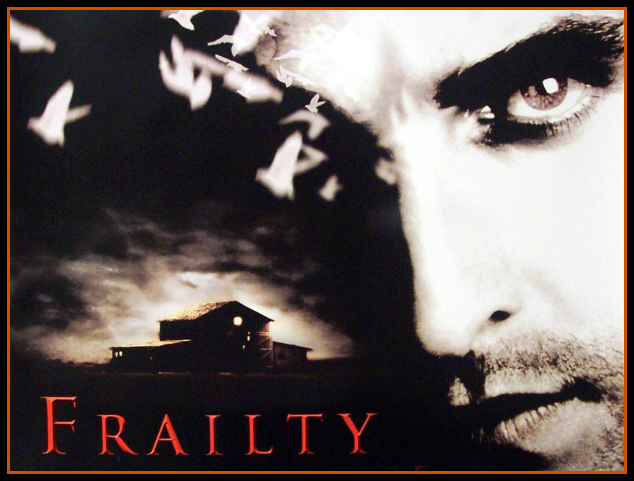
Every year there are always films of every genre and stripe which fly under the radar of most film-goers. Every film fan knows of several such films and always like to believe they were one of the few who actually saw it in the theaters when it came and went. In 2002, one such film was the psychological thriller/horror film Frailty by veteran actor Bill Paxton. This was to be his directorial debut on a feature-length film and for a first time it was a home run right from the start.
Frailty was done mostly through flashbacks as told to an FBI special agent by a man (Matthew McConaughey) and how this man knows the true identity of a particular serial killer around the Texas region who has dubbed himself the “God’s Hand”. It’s through this man’s retelling of the origins of the “God’s Hand” that we see the lives of a father raising two young boys as best he can until a sudden “vision” of divine nature changes their lives forever. The father begins to believe that he has been given a divine purpose to find and destroy demons who have taken on human form. To do this deed he has an axe he’s dubbed “Otis” to assist him. The reaction of the two young boys differ as their father goes about his new work. The older brother in Fenton Meiks believes what his father is doing to be illegal and makes him a murderer. On the other hand, the younger brother in Adam Meiks has taken on seeing their father as the hero that he sees him and supporting him in his new endeavor.
The film doesn’t inundate the viewer with much gore and violence. This is not say that the film lacked for killings. The father finds and “destroys” the demons given to him on what he calls “God’s list”, but the film doesn’t linger on these scenes of violence. It instead focuses on the reactions of the father’s two sons and the growing rift which gradually begins to grow between the three. It would be this rift which plants the seed of who would ultimately become the “God’s Hand” killer.
The film also manages to turn the theme of a father’s love for his sons and vice versa become a taut and disturbing study on the concept of faith. The film also does a great way of twisting the story in a way that we never know who the “God’s Hand” killer was until very close to the end despite everything being told by the man to the FBI pointing to specific individual. This was one of the few films which used the twist to the narrative properly and not as a crutch to make the film better than the source.
It’s this source, the screenplay in other words, which makes Frailty such an under-appreciated and great film. There’s rarely any instances where the story takes on leaps of logic that would break the audience from the world they’ve become invested in. In fact, I would say that the film was quite traditional in how it handled the story and characters. There’s wasn’t any special character and narrative quirks to make them stand out from the rest of the other roles. It’s from the performances by all involved, especially the very convincing ones from the two young actors playing the young Fenton (Matt O’Leary) and young Adam (Jeremy Sumpter), that sells the film. Matthew McConaughey as the man telling the story of the Meiks does a great job in a role that others might have gone overboard with. His restrained performance in concert with the young actors in the film would be another reason why Frailty became such a great film.
Performances, as great as they were in this film, required for a filmmaker to have a deft handle on his cast and the screenplay. This film was lucky enough to have a first-time filmmaker in Bill Paxton who played to the strength of the screenplay and trust in his actors. He didn’t try to be too cute or direct like someone with something to prove. I know that saying one directed a film with efficiency would be seen as a negative. In this instance I’d say that Paxton’s efficient direction helped the film stay focused on the story and the characters instead of trying to be flashy.
Frailty was, and still is, a film that seems to fly under most people’s radars, but it’s also a film that has gained quite a loyal following since it’s initial 2002 release. It’s a rare film that has continued to live up to it’s growing cult status not because of what people might have heard of it, but because it’s a rare film that stand on it’s quality. A film which, from top to bottom, made for a smart thriller with some horror aspects through in that didn’t try to fool it’s audience (even the twist in the story was a true genuine surprise instead of a story cop-out). If there ever was a film that needed to be seen by more people it’s definitely Frailty.
I resisted seeing An American Werewolf in Londonfor quite some time because 1) I kept mixing the film up with its “sequel,” An American Werewolf in Paris (which is seriously one of the worst films ever made) and 2) werewolves scare me in a way that vampires and zombies don’t. Seriously, what is a werewolf other than a really big pit bull and to say that I’m not a dog person is an understatement. However, this Halloween season, several people on twitter suggested that I give the film a chance so, reluctantly, I watched it and I’m glad that I did. Good call, twitter.
Originally released way back in 1981, An American Werewolf in London starts with two nice guys from New York (played by David Naughton and Griffin Dunne) backpacking across England. They stop in one of those proverbial, fog-drenched English villages where they are told, by the secretive town folk, to stay off the moors. Naughton and Dunne promptly wander into the moors. “Whoops,” they literally say as the full moon shines behind them. Suddenly, they are attacked by some sort of wild animal. Dunne is killed and a severely wounded Naughton wakes up days later in a London hospital.
While recovering in the hospital, Naughton meets and starts up a tentative romance with his nurse (Jenny Agutter) even as he finds himself haunted by disturbing graphic nightmares in which he sees his family being massacred by humanoid wolves dressed up like storm troopers. (Seriously, these genuinely disturbing nightmares were so seamlessly worked into film that they took me totally by surprise.) Even worse, Dunne’s progressively decaying corpse keeps popping up in his hospital room and telling him that 1) they were attacked by a werewolf, 2) Dunne’s spirit is trapped on Earth until the werewolf’s bloodline is extinguished, and 3) that bloodline is currently being carried on by Naughton. Fearing for his sanity, Naughton moves into Agutter’s flat after he’s released from the hospital and, for a brief moment, it actually seems like he might actually be okay.
And then, inevitably, a full moon rises and soon, there’s an American werewolf in London…
An American Werewolf in London is an oddly succesful hybrid of genres that don’t always mix well: it’s scarier than Paranormal Activity, funnier than Scream, and ultimately more romantic than any of the Twilight films. David Naughton and Jenny Agutter are both so appealing in this film that you actually get invested in their relationship and, as a result, the inevitably of the film’s conclusion becomes all the more tragic. As this film was pre-CGI, Naughton actually had to act out the process of transforming into a werewolf and, as a result, An American Werewolf in London feels real in a way that most werewolf films do not.
Director John Landis manages to maintain a perfect balance between the horror and the comedy and, as a result, I found myself both laughing out loud and hiding my eyes throughout this entire film. For me, the scariest scene in the film comes when an unfortunate commuter finds himself being tracked through a nearly deserted tube station by our werewolf. Landis wisely draws the sequence out, with the camera taking on the point-of-view of the prowling werewolf. Seriously, this growls heard during this whole sequence reminded me of why I’m so scared of big dogs. The other stand-out sequence comes towards the end of the film, in which Naughton takes refuge in a filthy porno theater and talks to Dunne (who, by this point, is just a skeleton). Dunne, it turns out, has brought with him the spirits of all the people who Naughton killed during the last full moon. So, while Dunne and his new friends encourage Naughton to commit suicide and Naughton starts to painfully transform into a werewolf, the worst porno film ever made is playing in front of them. The scene — with its perfect mix of tragedy, comedy, and horror — epitomizes everything that makes An American Werewolf in London work as a film.
One final note: one of the problems that I have with a whole lot of horror films is that they rarely make good use of their setting. Whether it’s that old deserted building or that piece of wilderness that’s not on anyone’s map, horror locations often feel as a generic as horror plots. However, Landis makes good use of both London and the English countryside here and this is a film that really should serve as a lesson for aspiring horror filmmakers todays. Of course, it helps that the location in question happens to be London with all of its gothic traditions and old school horror heritage. Let’s face it — An American Werewolf in St. Louis* just doesn’t carry the same punch.